Introduction
Tuberculosis (TB) is an infectious bacterial disease caused primarily (in humans) by Mycobacterium tuberculosis. It typically affects the respiratory system (throat and lungs) and is transmitted via the air when a person with active TB coughs, sneezes or speaks. This ‘ancient scourge’ has plagued humans and their ancestors throughout known history. Despite the existence of a cure for TB since 1949 and vaccination (administered predominantly to high-risk infants shortly after birth) since 1921, TB is still a great public health concern, with approximately 1.7 billion people currently (latently) infected worldwide (Daniel, Reference Daniel2006; WHO, 2018). Around 5–10% of these 1.7 billion people will develop active TB during their lifetime, which means that the disease will become symptomatic and transmissible. Instances of active TB are referred to as ‘TB cases’.
The majority of worldwide TB cases arise in developing countries such as Indonesia (Bock & Cox, Reference Bock and Cox2017). In the Indonesian context, money for procuring (and access to) health care is often lacking. Additionally, Indonesia’s impoverished living conditions are said to contribute to TB’s high burden. According to the World Health Organization, there were approximately 319 new cases of TB per 100,000 people during 2017 in Indonesia alone. To put this into perspective, the incidence rates per 100,000 people in some other high-burden countries are 423 (Central African Republic), 361 (Zambia) and 554 (the Philippines). In 2017 two-thirds of global TB cases occurred in eight countries, including Indonesia (and the Philippines) (WHO, 2018). It causes a great economic burden to the Indonesian economy: approximately US$6.9 billion was lost in 2015, with 86.6% of this accounted for by premature death resulting in lost productivity (Collins et al., Reference Collins, Hafidz and Mustikawati2017). Although this disease is curable, multi-drug resistance caused by improper treatment regimens or incompliance with regimens has made TB difficult to treat effectively. Also, TB was thought to be receding in the past decade, but there is evidence that it has been re-emerging in recent years (Shajahan et al., Reference Shajahan, Navaratnam, Kasinathan, Kadirvelu and Pillai2016).
The known risk factors regularly associated with TB are: being young, male, living in a developing country, being a health care worker, poor ventilation, exposure to contaminated air and having a compromised immune system (e.g. due to smoking). HIV infection and (consequently) AIDS are the most prominent risk factors for contracting TB (Dye et al., Reference Dye, Scheele, Dolin, Pathania and Raviglione1999; Fogel, Reference Fogel2015). In recent years, the importance of extensive interdisciplinary research into TB has been appreciated as TB’s various socio-politico-economic risk/exacerbating factors have come to light, and this has prompted the need to delve beyond the purely biomedical model (Mason et al., Reference Mason, Roy, Spillane and Singh2016, Reference Mason, Roy and Singh2017). However, risk factors related to stress or education have not (yet) been examined as extensively within the existing literature; they are rarely included in the analysis, but a lack of education may hinder an individual’s ability to take measures to protect themselves from disease (Baker et al., Reference Baker, Leon, Smith-Greenaway, Collins and Movit2011). There are various stigmatic associations pertaining to TB, such as belonging to a low social class, poverty or indecorous behaviour. Contempt towards TB sufferers can manifest as social exclusion, which heightens allostatic load, resulting in worsened ability to perform daily tasks (Simandan, Reference Simandan2017a), thereby delaying recovery. Anticipation of such contempt can even discourage disclosure of TB sufferers’ diagnoses to friends and family, thereby generating avertable risks to loved ones and public health (Simandan, Reference Simandan2017b). Additionally, the implementation of politico-economic ideologies such as neoliberalism has led to layoffs and uncertainty about employment conditions, inducing fear and anxiety coinciding with (and explaining) the increased incidence of TB in affected countries (Simandan, Reference Simandan2017a). The complicated interplay that stress has with anxiety, substance abuse and depression can lead to incompliance with treatment regimens and aggravate health outcomes (Zvonareva et al., Reference Zvonareva, van Bergen, Kabanets, Alliluyev and Filinyuk2019). Worse still, stress also adversely affects immunity (Morey et al., Reference Morey, Boggero, Scott and Segerstrom2015). Evidently, the detrimental effects that stress, anxiety and allostatic load have on the acquisition, persistence and recrudescence (de Oliveira & Moreira Filho, Reference de Oliveira and Moreira Filho2000) of TB warrant further study. Indeed, reciprocity amongst TB researchers from various disciplines is required to understand and ameliorate the burden of this multi-faceted disease (Mason et al., Reference Mason, Roy, Spillane and Singh2016). These causal/exacerbating factors may have various sources or triggers, but this study focuses only on the association between occupational stress (stress at work) and the diagnosis of TB infection.
The widespread burden of TB in Indonesia and its re-emergence prompt an urgent need to cover the aforementioned research gaps, and therefore form the motivation for this study. The study aimed to explore a wide variety of risk factors at the individual, household and community level for comparison and completeness, incorporating both existing understanding of the risk factors for TB as well as expanding the understanding of hitherto neglected factors. Bivariate measures of association and logistic regression were used to quantify the extent to which these factors act as predictors for contracting and subsequently being diagnosed with TB. The key contribution of the study is its emphasis on behavioural and psychological risk factors (especially stress) as opposed to the more commonly understood ones such as HIV. The research findings may help reduce the burden of TB in Indonesia, as well as improve the socioeconomic status of Indonesian citizens.
Methods
Data
Publicly available demographic household survey data from the fifth wave of the Indonesian Family Life Survey (IFLS-5) were used. The primary motivation for using IFLS datasets was that they contain TB markers whereas other common datasets (e.g. DHS) do not. While this was a longitudinal survey, only the most recent wave was used to explore the cross-sectional association between the incidence of TB and relevant risk factors. The survey samples from a frame of approximately 83% of the Indonesian population, and each wave of the survey encapsulates responses from over 30,000 respondents living in thirteen out of the 27 Indonesian provinces. The surveyed provinces are: North Sumatra, Yogyakarta, West Sumatra, East Java, South Sumatra, Bali, Lampung, West Nusa Tenggara, Jakarta, South Kalimantan, West Java, South Sulawesi and Central Java. These data were collected by RAND (Research and Development) Corporation staff using anonymous face-to-face household questionnaires (RAND, 2018). The resultant datasets are very rich, with information on various aspects of socioeconomic status and health. The data and documentation are publicly available on request at https://www.rand.org/labor/FLS/IFLS/.
In the IFLS-5, many variables have a very small number of respondent answers (e.g. distance to, and knowledge of, medical facility). Therefore, the variables used in the logistic regression were limited by the number of cases available for analysis. The number of variables that were non-significant and/or less prolific in the literature compared with the other variables was also limited in order to retain the power of the logistic regression, especially when there was evidence of collinearity in the model. Since the asthma and other lung condition variables have similar symptoms to TB and are both representative of access to health care, they were omitted from the logistic regression due to their redundancy.
Stress and education level are often overshadowed by other, well-known risk factors (e.g. HIV), and less attention has been given to these risk factors in the past. Due to stress and education level being under-explored in the existing literature, these variables were examined with particular attention. In this study, stress was represented by the responses to the survey question ‘My job involves a lot of stress’, with four different answers pertaining to level of agreement with this statement. In order to compare high and low levels of stress, a category ‘High’ was formed for the two highest stress levels. Similarly, a category ‘Low’ was formed for the two lowest stress levels.
Variables
The dependent (outcome) variable was TB diagnosis status, corresponding to the survey question ‘Has a doctor/paramedic/nurse/midwife ever told you that you had TB?’ Due to TB’s non-specific symptoms, misdiagnoses may have occurred, especially in cases where TB infection was not bacteriologically confirmed. Furthermore, TB infection may have remained undiagnosed, perhaps due to latent infection (which is asymptomatic), or a lack of access to diagnostic health care. There was a total of 328 people who reported having TB cases from the 34,249 respondents.
The selection of explanatory variables was based on the existing literature, which highlights age, smoking, malnutrition, HIV/AIDS, body mass index and poverty/impoverished living conditions as the predominant risk factors (Duarte et al., Reference Duarte, Lönnroth, Carvalho, Lima, Carvalho, Muñoz-Torrico and Centis2018; Keflie et al., Reference Keflie, Samuel, Woldegiorgis, Mihret, Abebe and Biesalski2018). Variables corresponding to age and smoking (cigars/cigarettes per day) were readily available, but HIV data were missing. In the absence of clinical nutrition data, a variable pertaining to how satisfied the respondents were with the adequacy of the level of their food consumption was used; this acted as a proxy for both nutrition and body mass index. About two-thirds of responses for annual salary data were missing, so a variable relating to the type of toilet household members used was also used; this acted as a proxy for impoverished living conditions/hygiene. Education level was considered because, although it is typically overlooked, there is some evidence that it may have a considerable effect on health (Baker et al., Reference Baker, Leon, Smith-Greenaway, Collins and Movit2011). Stress at work was also used to investigate the apparent association between stress and TB (Morey et al., Reference Morey, Boggero, Scott and Segerstrom2015; Simandan, Reference Simandan2017a). Communicable diseases in general are associated with crowded conditions and urban areas, where people are often in close contact for extended periods of time. Therefore, variables corresponding to the number of people living in each household, and whether the household was in an urban or a rural area, were used. With regards to occupational risk factors, TB is typically associated with working in travel or health care industries, so the respondents’ sectors of work were considered. Since asthma and other lung conditions are pulmonary diseases, their relationships to TB (which is typically a pulmonary infection) were investigated. The following remaining variables were chosen to be investigated because they relate to health or disease transmission/diagnosis in general: gender (Nhamoyebonde & Leslie, Reference Nhamoyebonde and Leslie2014), knowledge of/distance from medical/health facilities and health benefit/insurance (O’Donnell, Reference O’Donnell2007).
Analysis
Prior to analysis, variables were transformed/modified as appropriate, to ensure that the analyses would be meaningful. Bivariate measures of association were used to assess the relationship between having received a TB diagnosis and each selected variable, based on a chi-squared test for categorical variables and ANOVAs for continuous variables. Logistic regression was then used to quantify the relationship between TB diagnosis status and selected variables simultaneously. Associations were said to be significant at a 5% level in all cases. Data were analysed using SPSS 20 for Windows and R 3.4.4 for Windows.
Results
Relationship between explanatory variables and TB diagnosis status
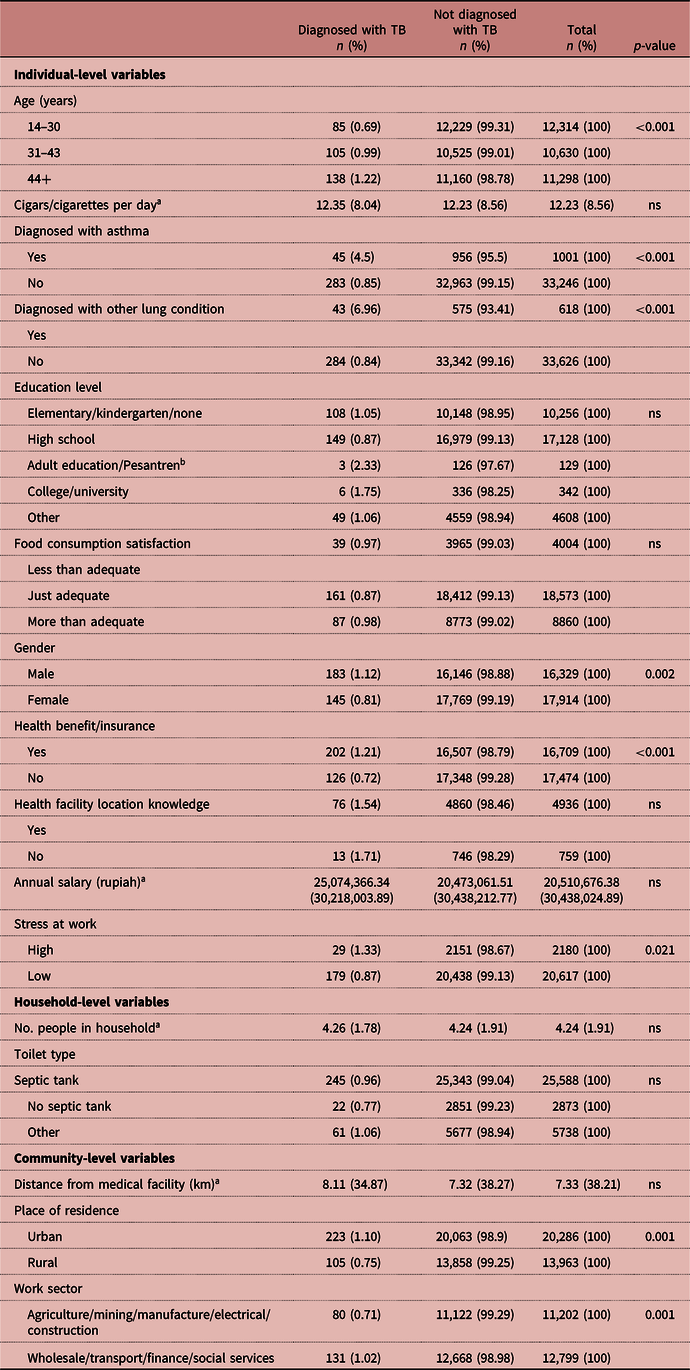
Table 1 shows the relationship between the explanatory variables and TB diagnosis status for the study sample, assessed with chi-squared tests for categorical variables and ANOVAs for numerical variables. The categorical variables age, stress level at work, gender, work sector, asthma, other lung conditions, health benefit or insurance and rural/urban area were found to be significantly associated with TB diagnosis status (p < 0.05 in chi-squared tests). The variables found to be non-significant were: daily cigarette consumption, education level, food consumption satisfaction, health facility location knowledge, annual salary, number of people in the household, type of toilet used by household occupiers and distance from medical facility (p > 0.05 in chi-squared tests or ANOVAs).
Cross-tabulation of explanatory variables against TB diagnosis status, Indonesia, 2015

a Mean (SD), with p-values for the ANOVAs or chi-squared tests.
b Islamic boarding school.
ns: not significant.
Results of logistic regression analysis
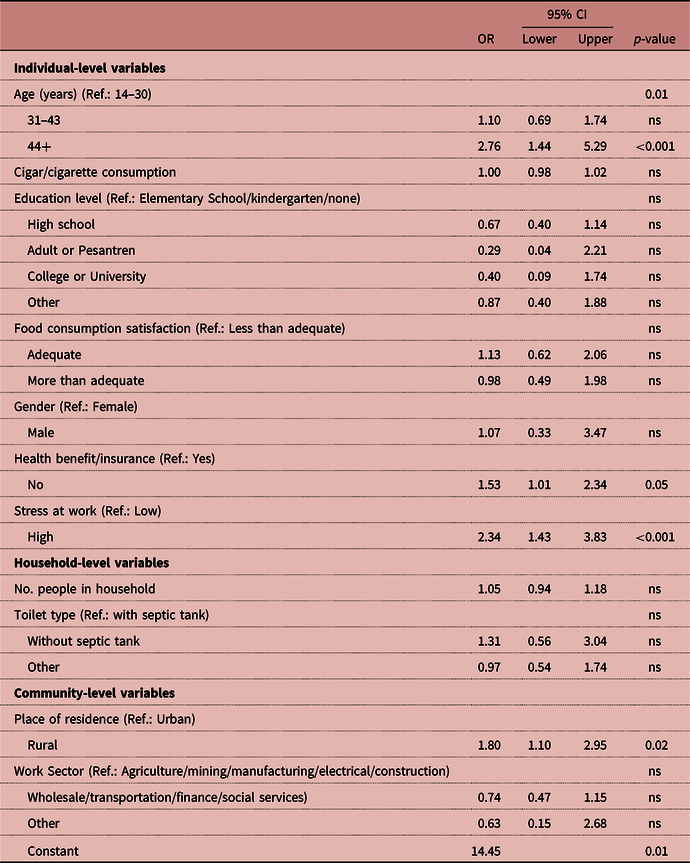
The results of the logistic regression of the risk of TB diagnosis by eleven explanatory variables for 9725 cases (including 95 reported TB cases) are shown in Table 2. These should be interpreted with the limitations or assumptions of logistic regression in mind; for example, a uniform relationship between the explanatory variables and the dependent variable is assumed (Ranganathan et al., Reference Ranganathan, Pramesh and Aggarwal2017). The Hosmer-Lemeshow p-value of 0.679 (p>>0.05) suggests that the model fits the data rather well. However, this metric should be interpreted with caution due to its limitations; for example, it tends to have low power (Hosmer et al., Reference Hosmer, Lemeshow and Sturdivant2013).
Logistic regression analysis of the risk of TB diagnosis by explanatory variables, N = 9725

ns: not significant.
From the logistic regression, the significant predictors of being diagnosed with TB were stress at work, living in a rural area, age and having health benefit or insurance (p < 0.05).
Individual-level risk factors for TB diagnosis
The odds ratio (OR) of 2.76 for the 44+ age group suggests that middle-aged or elderly citizens in the study sample were 276% more likely to have been diagnosed with TB than very young people (14–30 years). Cigarette consumption had an OR of 1.00 and was not significant, suggesting that it was a poor predictor for being diagnosed with TB in the current sample. Education level was difficult to interpret here due to the various categories and large standard errors, which led to large confidence intervals. At first glance it looks like those with higher levels of education than the reference category had lower chances of contracting and being diagnosed with TB (each OR <1: 0.67, 0.29, 0.40, 0.87). However, when considering the OR confidence intervals, it is clear that the association is not significant. With regards to food consumption (satisfaction), consuming an ‘adequate’ or ‘more than adequate’ amount (rather than a ‘less than adequate’ amount) of food appears to have marginally altered the odds of being diagnosed with TB by factors of 1.13 and 0.98, respectively, implying that those with less than adequate or more than adequate food consumption were at a slightly lower risk of contracting TB. However, it was expected that increased food consumption would lower the risk of TB, since low body mass index is a risk factor for TB. The association was also not significant in this case. The OR for gender was just slightly greater than 1 (1.07) and was not significant. Having health benefit or insurance increased the odds of successfully being diagnosed with TB by a factor of 1.53 (1.01, 2.34); this variable probably indicated improved surveillance rather than being a risk factor for contracting TB itself. There was a clear association between TB diagnosis status and (occupational) stress in the present sample; people with higher levels of stress at work appeared to be 2.34 (1.43, 3.83) times as likely to be diagnosed with TB.
Household-level risk factors for TB diagnosis
The number of household occupiers variable had an OR of 1.05 and was not found to be associated with TB diagnosis status. The type of toilet used appeared to have some effect on the chance of being diagnosed with TB; those using toilets without a septic tank were 1.30 times as likely to be diagnosed as those using toilets with septic tanks. Using a toilet with a septic tank appeared to have little impact on TB diagnosis status compared with the use of ‘other’ facilities (OR = 0.97).
Community-level risk factors for TB diagnosis
Living in a rural area raised the odds of being diagnosed with TB by a factor of 1.80, and this effect was significant. Sector of work appeared to have some effect on the chances of being diagnosed with TB, although this effect was not significant. The odds ratios of 0.74 and 0.63 suggest that agriculture, mining, manufacturing, electrical and construction industries were relatively higher risk occupations compared with the other areas of work considered.
Discussion
The purpose of this study was to investigate several potential risk factors for tuberculosis in Indonesia, especially behavioural or psychological risk factors. The publicly available survey data were investigated using statistical methods (chi-squared tests, ANOVAs and logistic regression) to investigate the relationships between several explanatory variables and the dependent variable (TB diagnosis status). Some of the results agreed with contemporary literature, whereas other results were unexpected.
A significant association was found between age and TB diagnosis status. The average age of those who had not been diagnosed with TB was roughly 5 years younger than those who had been diagnosed. This was as expected. Pawelec (Reference Pawelec2018) stated that older people had a higher risk of contracting diseases due to gradual weakening of the immune system with increasing age. The chances of having been diagnosed with TB appeared to be roughly the same for those aged 14–30 and 31–43 years (OR = 1.10), which was as expected; immune function tends to only begin decreasing substantially at about 50–60 years of age. The 44+ age group, predictably, had much higher odds (OR = 2.76) of being diagnosed with TB compared with other age groups.
The relationship between cigarette consumption (smoking) and TB diagnosis status contradicted the literature (Duarte et al., Reference Duarte, Lönnroth, Carvalho, Lima, Carvalho, Muñoz-Torrico and Centis2018), as there did not appear to be any significant relationships between the variables, and the values for daily cigarette consumption for the two TB diagnosis status categories were very similar (12.35 and 12.23 for those who had or had not been diagnosed with TB, respectively). This result disagrees with the global consensus that smoking significantly increases the chances of contracting TB (WHO, 2007). However, there is some evidence that in the Indonesian context, the effect of smoking on TB is not significant (Sahiratmadja & Nagelkerke, Reference Sahiratmadja and Nagelkerke2016). It has been shown that smoking causes damage to the throat, lungs and cilia (which help to remove pathogens from the immune system) (Bates et al., Reference Bates, Khalakdina, Pai, Chang, Lessa and Smith2007); it would therefore be expected that smoking would significantly impact TB diagnosis status. Even when comparing smokers with non-smokers (past and present), there was no significant association; this suggests that smoking may not be so influential as a risk factor, at least in Indonesia. However, it is likely that some people had reduced their cigarette consumption upon experiencing symptoms of TB or being diagnosed with TB as smoking exacerbates TB symptoms. Furthermore, since, in Indonesia, smoking is legal in both private and government offices, restaurants and pubs, many people would be affected by passive smoking, which was not accounted for in the survey. Therefore, it is not possible to fully understand the relationship between smoking and TB without further analysis.
Since education can have a prominent impact on health (Baker et al., Reference Baker, Leon, Smith-Greenaway, Collins and Movit2011), the highest education level achieved was investigated as a predictor for TB diagnosis status. However, no significant association was found. This may have been due to the lack of specificity in the data regarding subjects studied and academic attainment. For example, people who studied health or biological sciences at high school were in the same category, regardless of attainment. Additionally, people studying subjects unrelated to health and disease transmission at the same level (e.g. at university) were in the same category as those studying the aforementioned subjects. Therefore, a lot of relevant information, which may have included predictors for TB, was not accounted for.
Malnutrition and body mass index are said to be prominent risk factors for tuberculosis and diseases in general (Keflie et al., Reference Keflie, Samuel, Woldegiorgis, Mihret, Abebe and Biesalski2018), especially considering the importance of vitamins, minerals, carbohydrates and proteins for maintaining a strong immune system. As a proxy for malnutrition and body mass index, a survey question on the respondent’s satisfaction with their food consumption was used. However, no clear association between this variable and TB diagnosis status was found. Data directly relating to nutrition (for example, blood test results for vitamin A and zinc) and body mass index (e.g. body weight and height measurements) would probably have led to a better investigation into the relationships that nutrition and body mass index have with TB.
Gender is also an interesting factor, and it could be argued that it is a behavioural risk factor: in patriarchal societies like Indonesia, men constitute a considerably larger proportion of the workforce than women (Organisation for Economic Co-operation and Development, 2018), who are likely to stay at home to look after children. Therefore, men generally have considerably more exposure to TB. Despite that, no significant association between gender and TB diagnosis status was found in the present study. These results disagree with numerous studies, even if the 95% confidence interval contains the odds ratio between men and women, 1.61, estimated in the study by Marçôaa (Reference Marçôaa2018).
Health benefit or insurance is an excellent indicator for access to health care. The OR of 1.53 suggests that those with health benefit or insurance are significantly more likely to be successfully diagnosed with TB than those without. It may be noted that the Indonesian government introduced universal health coverage (UHC) in 2014 to improve access to health care.
Stress at work was a variable of great interest in this study, but it has often been overlooked previously. There is minimal consensus and various schools of thought regarding the classification of events as stressful. One perspective of particular note, arising from the occupational stress literature, is that a stressful event is one where demands exceed resources. However, many researchers define stressful events differently (e.g. as events consensually seen as harmful or threatening) (Cohen et al., Reference Cohen, Murphy and Prather2019). In the present study, the data were from respondents who individually, subjectively appraised their perceived stress levels (psychological stress) at work. This variable should be considered in the context of allostatic load theory, which aims to delineate the physiological mechanisms that lead from stressors experienced to ill health (Simandan, Reference Simandan2010), all the while offering precise terminology free of the inherent ambiguity of the word ‘stress’. The substantial evidence that there is an association, and possibly a causal link, between stress (especially allostatic load) and TB, both due to weakened immunity (Morey et al., Reference Morey, Boggero, Scott and Segerstrom2015) and reduced ability to carry out daily duties (Simandan, Reference Simandan2017a), prompted the need for exploration of pertinent data. According to the results of this study, there is indeed a significant association between (occupational) stress and TB diagnosis status, and stress at work is a prominent predictor for contracting TB. The high odds ratio (2.34) suggests that appropriate control measures should, quite urgently, be implemented in the Indonesian population. In the context of occupational stress, there is probably an inverse relationship between chronicity and intensity, which may be important to consider for future research directions, especially when considering the relationship between chronicity of stress and immune function (Dhabar & McEwen, Reference Dhabhar and McEwen1999).
Despite TB’s sobriquet of a ‘poor man’s disease’, the results do not reveal a significant relationship between annual salary amongst groups with distinct diagnosis statuses. In fact, unlike the study undertaken by Bhunu et al. (Reference Bhunu, Mushayabasa and Smith2012), the present study found that people diagnosed with TB seemed to be wealthier (they had a higher average annual salary) than those who hadn’t been diagnosed. This could potentially be explained by difficult circumstances (e.g. due to having to repay debts, or financially assisting family members) resulting in living conditions remaining or becoming impoverished. Additionally, this variable doesn’t provide data on total income (just income from the respondent’s main job), and the respondent may have been diagnosed with TB prior to getting a higher-paying job.
The study found that ‘other’ lung conditions and asthma were found to be significantly associated with TB diagnosis status. However, this may have been due to people with asthma or other (known) lung conditions being closely monitored by health care professions, so this association may pertain to surveillance.
To investigate the effect of overcrowding or population density on TB diagnosis status, the number of people living within each household was considered. However, no statistically significant differences in TB diagnosis status were found for this variable. Nor was it a significant predictor in the logistic regression, but logistic regression’s assumption of relational uniformity is important to note here, as there may have been, for example, more cases of TB at lower values (due to, for instance, struggling single-parent families) and at higher values (due to overcrowding), or particular ranges of values with many cases of TB. A lack of ventilation and airflow is also said to contribute to TB transmission in households (Duarte et al., Reference Duarte, Lönnroth, Carvalho, Lima, Carvalho, Muñoz-Torrico and Centis2018), although there were no data available to investigate this. There may have been more interesting results if data were available on community-level population density.
Due to the importance of investigating sanitation and poverty levels, a variable relating to the type of toilet household members used was considered. Unlike annual salary, there were considerably fewer missing data for this variable. However, no significant association between these variables and TB diagnosis status were found; this, alongside the investigation of annual salary, suggests that poverty may not be as prominent of a risk factor in Indonesia as the existing literature (Fuady et al., Reference Fuady, Houweling, Mansyur and Richardus2018) suggests.
There is no clear consensus in the literature regarding whether living in an urban or rural area has a significant impact on the likelihood of becoming infected with TB. Living in an urban area has often been associated with overcrowding and pollution (Keller, Reference Keller2018), whereas living in a rural area is associated with having to pay medical expenses out-of-pocket and having to travel long distances to medical facilities. Furthermore, rural areas are considerably more likely to have farms, where bovine TB could spread to humans (Davis, Reference Davis, Reichman and Earl2000; Amo-Adjei, Reference Amo-Adjei2016). In principle, either living in an urban area or a rural area could potentially increase an individual’s susceptibility to TB, but from this study, those living in rural areas of Indonesia were significantly more likely to be diagnosed with TB, and this may be due to the UHC introduced in 2014 in Indonesia.
Sectors of work were investigated as risk factors for TB. The literature states that people working in travel or health care sectors are at a high risk of acquiring TB due to extensive exposure. The present study found a significant association between work sector and TB diagnosis status, which aligns with studies conducted by Rim and Lim (Reference Rim and Lim2014). However, inferences on specific sectors of work could not be made as the sample sizes would have been too small to make these analyses meaningful.
In summary, this study found that age, stress at work, living in a rural area and having health benefit or insurance were the most significant predictors of TB diagnosis status in this Indonesian sample in 2017, supporting results reported in the literature – although stress has rarely been explicitly discussed previously. An interesting finding is that most of the significant variables related to immune system deficiencies or vulnerabilities (and surveillance), rather than exposure to the disease itself, and this aligns with TB’s reputation of being an ‘opportunistic’ disease (Barnes et al., Reference Barnes, Le and Davidson1993). People with healthy immune systems will often be able to fight off the infection, even if their exposure to TB is high (Fogel, Reference Fogel2015). Some results were unexpected, with cigarette consumption and annual salary not being found to be significantly different amongst TB diagnosis status categories. Although several variables were analysed, it would have been beneficial to have had even more variables to investigate, such as those relating to HIV status and body mass index. Survey questions directly related to knowledge of TB would also have been highly desirable. Nonetheless, according to the Hosmer-Lemeshow test, the logistic model fitted the data rather well, so the model (as well as some other findings) may potentially be useful in real-world scenarios, especially for investigations on the thirteen Indonesian provinces in which the IFLS-5 survey was carried out.
The role of stress here is a pertinent one. The results may potentially be of interest in the field of behavioural epidemiology and could prompt further research into stress as a risk factor for TB (or other diseases). This research may also be of great interest to employers and companies; one can see from the findings that stress at work is associated with TB, and from the literature review it is clear that TB is detrimental to productivity and, consequently, the Indonesian economy (Collins et al., Reference Collins, Hafidz and Mustikawati2017). It could therefore be highly beneficial for companies to introduce schemes for alleviating the stress levels of their employees. This work may also be of value to medical practitioners, academics, researchers or centres for disease control for determining comparative TB risk in the absence of HIV data and other data. As expected, age was found to be a prominent risk factor for TB, and these findings may act as a catalyst for the implementation of interventions that prioritize care for elderly citizens. This would also be applicable to those with asthma and other lung conditions. The fact that TB was found to be concentrated in people living in rural areas of Indonesia suggests that there is a great need for additional affordable and accessible health care institutions to be established in these areas. Indeed, the high basic reproduction number of TB (estimated to be 4.5 by Blower et al. (Reference Blower, Mclean, Porco, Small, Hopewell, Sanchez and Moss1995)) suggests that powerful control measure(s) would need to be implemented to eradicate this persistent disease. Further studies should also be conducted to understand the nature of TB risk factors; these could include undertaking multivariate analyses using the IFLS-5 data, or analyses of other variables using alternative datasets, and comparisons of the analyses of similar datasets between different countries or regions. Developing a logistic model tree (or other suitable and sufficiently complex models) would also be an excellent way of expanding upon this work, but this was not within the scope of this study.
The study has its limitations. The questionnaires and resultant secondary data obtained from RAND’s IFLS-5 were not tailored specifically to the study, and lacked pertinent information directly relating to HIV, blood pressure, body mass index, malnutrition and knowledge of TB. The study was liable to some frame bias; the reliance on household-level enumeration excluded traveller or slum dwelling populations, which may not have been enumerated and, worse still, were more likely to be at an elevated risk of developing active TB. Furthermore, only 0.01% of the Indonesian population was surveyed, from thirteen out of the 27 Indonesian provinces. People with extreme cases of TB (especially in the case of TB–HIV co-infection) may have been too unwell (and possibly hospitalized) to answer the survey questions. Furthermore, the survey question relating to TB diagnosis status was not restricted to a specific time period, so the interaction between TB and its predictors could not be fully ascertained.
Acknowledgments
The authors would like to thank RAND Corporation for the open-access survey data, and for assistance with handling the data files.
Funding
This research received no specific grant from any funding agency, commercial entity or not-for-profit organization.
Conflicts of Interest
The authors have no conflicts of interest to declare.
Ethical Approval
The authors assert that all procedures contributing to this work comply with the ethical standards of the relevant national and institutional committees on human experimentation and with the Helsinki Declaration of 1975, as revised in 2008.