Introduction
Similar to other developed countries, Singapore is witnessing a rise in its elderly population. Statistics produced by the United Nations project that the proportion of elderly in the country will rise to about a third of the population by 2040 (Population Division of the Department of Economic and Social Affairs of the United Nations Secretariat, 2008) making Singapore one of the world's more rapidly aging nations (Kinsella and He, Reference Kinsella and He2009). An expected effect of the demographic shift is increased prevalence of physical and mental disorders associated with aging. Cognitive impairment (CI) is one such disorder. Regional prevalence studies have also projected the rising prevalence of dementia in Singapore (Ministry of Health Singapore, 2007; Alzheimer's Disease International, 2008).
The consequences of the increased number of individuals with CI and/or dementia (henceforth we use the term “CI/dementia” to include individuals with both or one of the two disorders) for the social and health care system of a country are far reaching. Compared with individuals without cognitive deficits, people with CI/dementia are likely to require higher levels of care, support, and supervision from families, other formal and informal caregivers, the health system, and government programs (Brodaty et al., Reference Brodaty, Draper and Low2003). A higher prevalence of the disorder poses challenges for policy-makers, clinicians, health care administrators, and researchers to detect individuals with CI/dementia, ensure their accurate treatment and management, provide appropriate care inputs and services to individuals with dementia and their families, enable provision of all treatment and services at a reasonable cost, and increase community awareness about the condition, its prevention, and implications (Dunkin and Anderson-Hanley, Reference Dunkin and Anderson-Hanley1998; Doody et al., Reference Doody2001; Brodaty et al., Reference Brodaty, Draper and Low2003, Reference Brodaty, Thomson, Thomson and Fine2005; Cuijpers, Reference Cuijpers2005; Vernooij-Dassen et al., Reference Vernooij-Dassen2005; Etters et al., Reference Etters, Goodall and Harrison2008; Alzheimer's Association, 2010; Alzheimer's Disease International, 2010; Wimo et al., Reference Wimo, Winblad and Jonsson2010).
Considering the multitude and complexity of challenges associated with the increasing prevalence of CI/dementia, countries with aging populations have worked towards developing policies, practices, and health/social support systems related to the needs of this population. In this context, the care system in Singapore is sustained by individuals, families, community, and the government. The financing policies related to elder care in Singapore place the primary responsibility on individuals, their families, and the community (Inter-Ministerial Committee on Healthcare of the Elderly, 1997). However, the government provides a safety net for individuals and families who are unable to access family care and gives both financial and non-financial support to voluntary welfare organizations (VWOs) for provision of community-based care. Although a majority of care is provided informally by families at home (Teo et al., Reference Teo, Chan and Straughan2003), a range of services are offered, mostly through VWOs, that include community-based non-residential day rehabilitation and dementia day care centers, home-based medical and nursing care, and institutional residential care in nursing homes (Ministry of Health Singapore, 2001). Despite the range of care arrangements available, a majority of families in Singapore prefer to care for dementia patients in home settings (Tew et al., Reference Tew, Tan, Luo, Ng and Yap2010). However, due to the lack of availability of informal caregivers to satisfy the need for home care, foreign domestic workers (FDWs) play a significant role in defining the health care system for elderly in general and dementia patients in particular (Yeoh and Huang, Reference Yeoh and Huang2010). Additionally, the housing schemes developed by government encourage children to live close to their parents. In contrast to the peripheral role played by the government in the above-mentioned domains of CI/dementia care, the public sector takes a leading role in providing education and training, promoting awareness, and ensuring quality of care and service provision for the elderly (Inter-Ministerial Committee on Healthcare of the Elderly, 1997).
To address the challenges associated with CI/dementia, it is important to develop practical and effective public and clinical policies based on a solid scientific foundation. This study is the first context-setting phase of a multiphase five-year project funded by the Singapore National Medical Research Council (NMRC) to apply system dynamics (SD) modeling to study CI/dementia among the Singaporean elderly. System dynamics is a conceptual framework for integrating observation and theory from multiple perspectives to improve our understanding of how feedback structure determines system results. Following identification of the problem and establishment of a causal hypothesis (accounting for time as well as interrelationships between potential causal elements), a computer model is constructed to examine these hypotheses and to build confidence that the essence of the problem is understood; subsequently, solutions can be tested in simulation, prior to implementation (for a more complete description of methodology, see Forrester, Reference Forrester and Forrester1975; Ränders, Reference Ränders1980). The objective of this study is to provide a foundation for applying system dynamics to the problem of aging-related CI/dementia, by exploring the concerns of individuals with direct knowledge about the care and treatment of persons with this disorder.
Methods
This study reports on indepth interviews of caregivers (both formal and informal), clinicians, community workers, policy-makers, and academics. Using semi-structured, open-ended questions, a total of 30 stakeholders from multiple backgrounds were interviewed to identify current concerns and potential policy changes that have implications for CI/dementia care in Singapore.
Sample
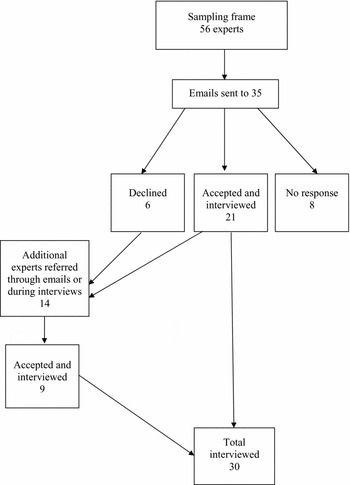
As the objective of the study was to understand the perspectives of a broad range of individuals involved directly or indirectly with decision-making or care of individuals with CI/dementia, a purposive sampling methodology was employed. An initial list of 56 individuals, who work in the area of CI/dementia in Singapore, was compiled from publications and from personal contacts of the researchers (Figure 1). To obtain representation of a wide range of stakeholders, the interviewee list included individuals from varied backgrounds, including practicing clinicians, researcher clinicians, academics, policy-makers, community workers, and administrators. Emails were sent to 35 selected experts, of whom 21 agreed to participate and the remaining 14 either sent no response or declined. Some of the individuals who declined to be interviewed suggested other people to be included in the study. The list cascaded by asking those who agreed to participate for names of other stakeholders to interview. Caregivers were also invited to be interviewed. This snowball sampling led to the inclusion of nine additional individuals, increasing the final sample size to 30.
Sampling methodology for interview participants

Data collection
The interviews were based on a series of open-ended questions addressing policy, practice, and research domains related to CI/dementia in Singapore, including screening and diagnosis, treatment and management, costs and resource utilization, quality of life for patients and informal caregivers, structure and patterns of care, and ongoing research and community projects/databases (see Appendix for the interview instrument).While the interview instrument focused on study objectives, the semi-structured format allowed researchers some latitude to pose follow-up questions (Minichiello et al., Reference Minichiello, Aroni, Timewell and Alexander1990; Crabtree and Miller, Reference Crabtree and Miller1999; Fossey et al., Reference Fossey, Harvey, McDermott and Davidson2002; Johnson, Reference Johnson, Gubrium and Holstein2002). The open-ended design of the interview also allowed for discussion of topics not included in the instrument and generated observations not foreseen by the researchers.
The interviews, lasting about an hour, were conducted by the Principal Investigator and the Research Coordinator. Informed written consent was obtained from the participants before initiating the interview. Most participants agreed to audio recording; however, 4 out of 30 interviewees declined but agreed to notes being taken during the interviews.
Data analysis
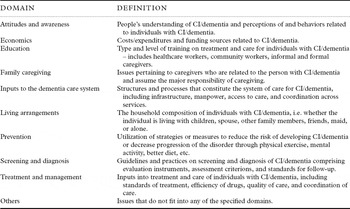
The recorded interviews were transcribed into text documents for the purpose of analysis. Qualitative data analysis (QDA) was utilized to analyze the textual data to identify major issues and challenges associated with dementia care. Framework analysis was used to evaluate interviews. In framework analysis statements are organized into one or more key themes as well as emergent categories (Ritchie and Spencer, Reference Ritchie, Spencer, Bryman and Burgess1994; Ritchie et al., Reference Ritchie, Spencer, O'Connor, Ritchie and Lewis2003; Spencer et al., Reference Spencer, Ritchie, O'Connor, Ritchie and Lewis2003). In this case, text was indexed into one or multiple domains and themes. A domain represents a practice or policy lever that can impact the framework for dementia care in the country. Nine domains were defined by the authors based on prior knowledge and experience and supplemented by discussions with researchers of the core team (Table 1). Within each domain, themes represent issues and challenges associated with the practice/policy lever represented by the domain. The themes that did not fit into any of the predetermined domains were designated as “other.”
Policy and practice domains used in the qualitative data analysis framework to identify issues and challenges associated with dementia care

Two researchers independently analyzed all the interviews. Each researcher read and coded a portion of interview transcripts independently to identify an initial list of themes. Multiple rounds of text coding and subsequent discussions led to the creation of the list of themes reported here. The initial objective of the analysis was to identify themes within domains and this was extended to include sub-themes where necessary.
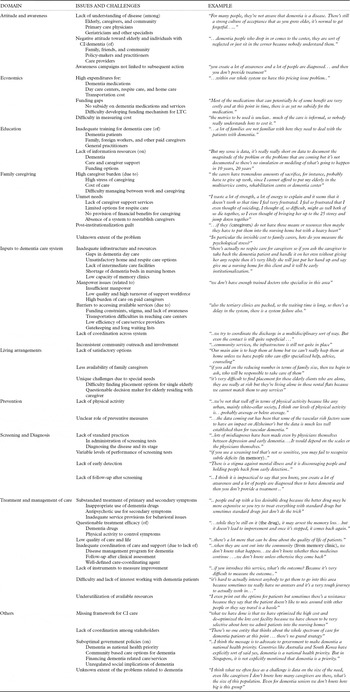
All analyses were conducted using the NVivo 9.0 program (QSR International, Cambridge, MA). All domains were added as nodes in the software and corresponding themes as sub-nodes. The text from interviews was assigned to the corresponding nodes and sub-nodes. The nodes and sub-nodes, along with description of sub-nodes, are presented as findings using a thematic chart. A relevant quote for each sub-node is also presented to illustrate an interviewee's perspective related to the issue.
To test the validity of the findings, inter-rater reliability scores were calculated. This score measures the degree of concordance among reviewers and is calculated as number of units of agreement divided by total units of measures within the data item (Mays and Pope, Reference Mays and Pope1995; Reference Mays, Pope, Pope and Mays2000; Donovan and Sanders, Reference Donovan, Sanders, Bowling and Ebrahim2005). A 100% concordance was found for the coding of domains and 80% concordance on coding of themes by the two reviewers. The scores were found to be within established norms, with no threat to consistency of results.
Results
Analysis of the interviews revealed that stakeholders raised numerous concerns related to CI/dementia that could be categorized as issues and challenges relating to one or more domains (Table 2). Specific sub-themes associated with some of the issues and challenges also emerged from the analysis.
Issues and challenges associated with dementia care identified by prominent stakeholders in Singapore

Attitude and awareness
A majority of stakeholders expressed concerns related to attitudes toward and awareness of dementia. Two prominent issues raised related to the domain were the lack of understanding of the disease and negative attitudes toward older and demented people. Interview subjects reported that family, friends, community, clinicians and policy-makers with whom they are familiar had low levels of knowledge and negative opinions about CI/dementia patients.
Economics
The related issues of high expenditures for care and funding gaps were the two economic challenges raised by subjects. The high cost of dementia medications due to the absence of subsidy policies was an observation made by the majority of stakeholders. One stakeholder associated the issue of funding gaps with the difficulty of developing a long-term care funding mechanism. In addition to cost and funding issues, stakeholders also raised the issue of difficulty with measuring economic cost of care due to reliance on informal care.
Education
Community workers and health care practitioners stressed the need to train caregivers (formal and informal) and health care workers to achieve better care outcomes. A desire to educate general practitioners to act as the first stop for cognitively impaired people was voiced by the majority of stakeholders. The inadequacy of information resources on dementia, caregiving, and funding was another commonly cited concern.
Family caregiving
More than half of the stakeholders expressed concern about the high burden of caregiving while looking after individuals with dementia, especially as the disease progressed. A majority of stakeholders raising this concern were the informal caregivers, who talked about the difficulty of balancing work with caregiving, as well as the emotional burden they bore as a result of being a primary caregiver. In addition to the emotional burden of caregiving, the cost associated with caregiving (in the form of direct expenditures and loss of productivity/job) was an issue raised by stakeholders.
Few support services for family caregivers, lack of options for respite care, inadequate financial support, and limited opportunities for caregivers to re-enter the workforce were some of the challenges identified by stakeholders (unmet needs) for families and caregivers. Post-institutionalization guilt among informal caregivers and family members upon nursing home admission of the elderly with CI/dementia was an issue raised by a few social workers/caregivers. Some stakeholders also raised concerns about the unknown extent of the problem that family caregivers face due to the difficulty in measuring psychological stress that the caregivers go through.
Inputs to dementia care system
This category included a range of issues relating to different types of resources that constitute a complete care system. Every stakeholder identified gaps in one or more of the areas related to infrastructure, resources, workforce, service delivery, coordination, and community outreach. At the infrastructure level, both long and short term care facilities were mentioned as deficient in quality and quantity. With respect to service availability, dissatisfaction was expressed with home and community-based settings and institutional care. Workforce capacity constraints were prevalent for categories including physicians, nurses, and allied health workers. In addition to issues related to recruitment, retention, and quality of health care workers, stakeholders raised concerns about the heavy burden of care on paid caregivers, usually foreign-born domestic workers. Interviewees mentioned barriers to accessing available services including insufficient funds, transportation difficulties, long waiting lists, inefficiency of care providers, stigmatization, and lack of awareness. In the view of a majority of interviewees, barriers to access were exacerbated by a lack of coordination across the health and social services systems. Respondents suggested that efforts to involve volunteer or part-time workers were patchy, and, while some geographic regions had well-established community services, other neighborhoods had no community services available. A need to enhance community involvement in the care of dementia was also mentioned.
Living arrangements
Community workers and service providers expressed concern about a perceived lack of options for viable living arrangements for people with dementia. The burden of care of dementia patients is exacerbated due to a number of factors related to living arrangements, including the shrinking size of families and the growing number of dual income families (less availability of family caregivers). Interviewees noted that this challenging situation was compounded by a limited supply of nursing beds and overuse of hospital beds by dementia patients due to the lack of options at discharge. Living arrangements of some patients with dementia also raise unique challenges due to special needs, such as the difficulty of finding an optimal place of living for single elderly patients.
Prevention
One of the stakeholders viewed the physical activity levels of the Singapore population as below-average with respect to other countries (lack of physical activity). However, the role of prevention was not frequently discussed, and there was no consensus among interviewees on potential medical, economic, or social benefits from prevention initiatives (unclear role of preventive measures).
Screening and diagnosis
Responses to questions about tools available for screening/diagnosis and the ability to make accurate diagnoses were associated with the background of the responder. Some clinicians said that the use of diagnostic tools is not a concern and expressed confidence in their ability to diagnose dementia accurately. Other clinicians expressed the view that there is much variance in the system, and that clinicians who use several different tests in conjunction with patient observation are more likely to make an accurate diagnosis (lack of standard practices). Community workers expressed less confidence in the likelihood of an accurate diagnosis and questioned the diagnostic tools in use and the abilities of the physicians (variable levels of performance of screening tests). Interviewees expressed concern that a diagnosis of mild cognitive impairment (MCI, a medical condition differentiated from CI/dementia) might be misleading in that there is not a clear trajectory for the progression of the disorder. However, community workers expressed a desire to identify people with dementia at an early stage because, without a diagnosis of dementia, community workers are constrained in the advice and help they are permitted to offer the patient and the informal caregivers (lack of early diagnosis). Also, a few stakeholders raised concerns about lack of follow-up after screening.
Treatment and management of care
The treatment and management of care for patients with dementia are complex issues. Interviewees mentioned that the most prominent issues are substandard treatment of primary and secondary symptoms, questionable treatment efficacy, and low quality of care and life. The two issues related to treatment included problems with both dementia drugs and treatment of secondary symptoms. Interviewees reported that the use of drugs to treat dementia has its own set of challenges including high costs and unpredictable efficacy. The data suggest a difference of opinion between clinicians and health system policy-makers, with clinicians stressing the importance of making drugs available and policy-makers focusing on the high costs and unclear impact on patient outcome. Quality of care and life was seen to be constrained by a variety of factors including economic, educational, attitudinal, and infrastructure limitations.
Inadequate coordination of services among different types of care providers was identified as a systemic problem that needs to be addressed at a national level. At the clinic level this issue was manifested as the inability to identify an entity to manage the care of dementia patients. Some clinics are set up with follow-up care services; other clinics are not equipped to deal with patients once they are outside their locus of care. The management of patients who are elderly, single and residing on their own was a particular problem highlighted by stakeholders.
Related to management of care, stakeholders also talked about problems with measuring improvement after treatment and difficulty in finding workers to provide care due to lack of interest in caring for individuals with CI/dementia. Some respondents also pointed the low utilization of available services due to high costs.
Other
Among other issues that stakeholders raised, a leading concern was the lack of a framework that can serve as a master plan to think about CI care. Related to the framework for CI/dementia care, concerns were expressed about the absence of coordination between various stakeholders leading to disparate perspectives and a need to bring people together. Stakeholders also talked about some existing suboptimal government policies. One of the policy-related issues was the absence of a national dementia plan which, according to one stakeholder, if implemented, could set the problem as a national priority. The lack of a legal framework to judge the decision-making capabilities of people diagnosed with dementia, especially financial decisions related to assets and savings, was another policy relevant problem mentioned by a few stakeholders. Finally, a number of stakeholders talked about the unknown extent of the problem due to lack of data on the number of individuals with CI, family caregiver needs, and costs of care.
Discussion
The goal of this research was to identify issues and challenges associated with CI/dementia in the context of Singapore through indepth interviews with stakeholders. The results support the notion that this is a condition with causes and effects well beyond the biological, with crucial social, financial, and organizational elements. This study strongly suggests that to understand the issues of CI/dementia and/or dementia one must take into account all these perspectives.
The issues raised by the stakeholders provide insights for future policy analysis, further research, and service innovation and evaluation. The findings of the study emphasize the possible value of policies related to awareness campaigns; moderation of cost of medications and services; alternative funding mechanisms; integration of care; expanding specialty services; increased screening and diagnostic facilities; improved training for health care professionals and families; support of family caregivers; and strengthening of the current infrastructure to improve community-based services. More broadly, many comments highlighted the importance of coordination among stakeholder groups, such as practitioners, researchers, and policy-makers, as a strategy for promoting system improvement.
In addition to allowing the construction of a list of issues, the analysis of the interviews led to development of a taxonomy of issue domains. This is useful in the current context as a way of organizing further work in which attention is focused on salient problems, and their potential dynamic causes and solutions. The taxonomy is sufficiently generic to be a useful analytic framework for similar future research assessing complex health care issues.
The study has some limitations. First, the sample used in the study was limited to 30 participating stakeholders. However, since the objective of the study was not to obtain a statistically representative sample of views but rather to gain a cross-section of perspectives among stakeholders, the focus on a small number of respondents allowed deeper exploration of the problem and the snowball sampling method maximized the opportunity to capture the range of opinions. Second, though the study participants comprised a range of stakeholders including clinicians, researchers, hospital administrators, policy-makers, community workers, and caregivers, the study fails to include the perspective of people who are recipients of dementia care services.
This study portrays a broad picture of CI/dementia care in Singapore. The findings are consistent with the need, particularly in this complex context, for an integrative analytic approach such as system dynamics. In ongoing work, this methodology will be applied with the objective of achieving practical and sustainable solutions to the complex and dynamic challenge of CI/dementia care in Singapore.
Conflict of interest
None.
Description of authors’ roles
All authors contributed to the conceptualization of the paper, interpretation of results, and manuscript preparation. M. Setia and A. M. Islam conducted the qualitative data analysis. In addition, D. Matchar and A. M. Islam designed the interview instrument and conducted the interviews.
Acknowledgments
This study is part of an ongoing five-year project funded by the National Medical Research Council (NMRC), Singapore on using system dynamic modeling to study CI among the Singaporean elderly. The authors thank all stakeholders who participated in the interviews, shared their experiences and views, and gave their time to the study. We are also grateful to the other members of the project who gave their invaluable inputs toward development of the paper.
Appendix: Interview outline
Project title: Establishing a practical and theoretical foundation for comprehensive and integrated community, policy and academic efforts to improve dementia care in Singapore
Principal Investigator:
David B. Matchar, Program Director and Professor, Health Services and Systems Research Program, Duke-NUS Graduate Medical School
8 College Road, Singapore 169857
Phone: 6516-2584, Fax:6534-8632
Co-Investigator:
Amina Mahmood Islam, Project Manager,
Health Services and Systems Research Program, Duke-NUS Graduate Medical School
8 College Road, Singapore 169857
Phone: 6516-5462, Fax:6534-8632
Background questions
Name:
Occupation:
Position:
Organization:
Years in current position:
Years working in the field of cognitive impairment/dementia:
Main discussion issues and questions
Can you give a background of your involvement in the field of cognitive impairment and dementia? This could cover the areas of:
i) Epidemiology (incidence, prevalence, rates and determinants/predictors of progression)
ii) Patterns/effectiveness/cost of medical services (use of tests and treatments of CI/D and associated symptoms (e.g. behavioral features))
iii) Patterns/effectiveness/cost of non-medical services (e.g. formal home care, use of housekeepers, family and friends as caregivers)
iv) Patterns/effectiveness/cost of living arrangements (e.g. home, nursing home, alternative living sites)
v) Other specific issues (e.g. resource utilization, quality of life for patients and caregivers, intangible costs, policy decision making, legal/ethical issues).
From your experience and perspective:
What are the key problems related to the care of individuals with cognitive impairment and dementia in Singapore? Examples:
• Use of screening
• Diagnosis by physicians
• Use of disease-specific treatments
• Use of treatments for associated symptoms (e.g. behavioral features)
• Patient quality of life
• Caregiver quality of life
• Costs of services to patients, families, medical system, or society
Can you comment on the similarities and differences of diagnoses and care of individuals with cognitive impairment and dementia in Singapore compared to other countries?
What changes have you seen in the way people with cognitive impairment and dementia are diagnosed, treated, and cared for over the last ten years?
Are there any issues or concerns with regard to access and availability of care for people with cognitive impairment or dementia?
What are the relevant public policies related to dementia? Can you point us to specific documents describing these policies?
Do you have any thoughts about the Ministry of Health's Clinical Practice Guidelines (CPGs) on Dementia? (e.g. are they applied in day-to-day treatment and management? Are they up to date? Are they useful? What might be done to improve the CPGs to make them more useful?)
Who are the main experts working in the field of cognitive impairment and dementia in Singapore? It could be in the area of diagnosis or treatment, care of individuals, clinical research, community research or policy making.
What are the best sources for information about the field?
Can you point to specific research projects currently being undertaken on any aspect of cognitive impairment and dementia in Singapore?
Can you point to specific community projects currently being undertaken on any aspect of cognitive impairment and dementia in Singapore?
In cases where the informant is involved with a project:
What are the aims and objectives of the project?
What is the conceptual design of the project?
What are the key challenges you face in implementing the project?
What kind of support have you received for the project?
What do you think is most successful about the care of individuals with cognitive impairment and dementia patients in Singapore? Least successful?
What would you say are the key interventions that can improve the quality of care for people with cognitive impairment and dementia in a way that is humane, sustainable and cost-effective?
Are there specific policy and/or clinical “levers” that can be effectively employed to achieve this objective?
What opportunities would motivate you to participate in a Singapore-wide effort to improve the detection and care of individuals with cognitive impairment and dementia?
Assuming that there are no financial constraints, can you describe your ‘dream’ project to improve the care of individuals with cognitive impairment and dementia in Singapore.