

Introduction
In the period from the 1990s emerging market financial crises until the North Atlantic financial crisis of 2008, the development of domestic bond markets in developing economies was a prominent agenda item in international financial reform circles. The crises of the 1990s drew attention to the vulnerabilities generated by frequently occurring double mismatches of currency denominations and maturities in the borrowing of emerging economies.Footnote 1 Against this backdrop, domestic bond market development was seen as a key means to strengthen the resilience of financial systems in the developing world, resulting in a series of reform efforts targeted at both increasing liquidity and the range of borrowers that can access these markets.Footnote 2 In the aggregate, these efforts were successful: for emerging market economies as a whole, domestic debt now exceeds international debt.Footnote 3 Moreover, domestic corporate bond markets have emerged in many countries, often for the first time.
At first glance, therefore, the explanation of domestic bond market development might appear relatively straightforward: the “original sin” problem—an inability to borrow long-term in domestic currency—facing developing economies was widely recognized by international financial institutions (IFIs) and developing country governments themselves, prompting IFI-supported government initiatives, which underpinned widespread and consistent market development to address the problem. Yet while the direction of change has clearly been in favor of development, there exist significant variations in the nature of market development across even the “emerging market” economies—those countries, which, among developing economies, enjoy the highest levels of international investor interest. This empirical puzzle in itself warrants further scrutiny.
It is also of broader interest to those studying the interactions of business and politics more generally as it is precisely these interactions—constituted by a complex set of heterogeneous interests and influences—that shape specific market outcomes. Explaining variation, we argue, requires careful attention to the structure of domestic financial markets, and to the impact of those structures on incentives of governments and domestic financial market actors in supporting development. These dynamics, which we characterize for the period until the 2008 crisis, continue to shape market outcomes in the longer term. They are important to understanding when and how local bond markets are amenable to policy intervention, and call for a more nuanced understanding of the impact of financial market structure.
In this paper, we examine the interplay of government and business actors in market development. Drawing on 155 interviews with policy and market actors as well as secondary data, we show that the main area of variation in market development lies in the pre-existing structure of financial markets. Structure determines the interests and influence of the dominant domestic financial actors regarding development. There exists variations in what they can offer government and thus the degree of influence they can exert.
Government priority is in funding the current account deficit, if it exists, and borrowing on the most attractive terms. International preferences favoring development were consistent from IFIs and international investors over this period (from the mid-1990s until the 2008 crisis). This was the period when the ideas underpinning international attitudes toward market development were most consistently positive, before the financial crisis raised doubts (e.g., Kirshner (Reference Kirshner2014)), culminating in IMF approval of various forms of capital controls (Gallagher (Reference Gallagher2011); Korinek (Reference Korinek2011)). This allows us to show how domestic interests and institutions shape outcomes even when international ideas and interests are consistent, but without challenging the potential importance of changes in international ideas. The influence of IFIs and international investors on outcomes varied depending on what assistance they could provide in funding the government and the current account deficit, which was, in turn, mainly a function of domestic financial market structure. We illustrate these claims by looking at four “emerging market” economies: Brazil, Lebanon, Malaysia, and Turkey. Even in cases such as these where we might expect international pressures to have significant influence, domestic financial market structure shapes variation in outcomes.
Financial structure: constellations of interests and influence
The political economy of domestic bond market development remains under analyzed, but belongs within the rich literature on the integration (or not) of domestic economies with the international financial system. Historically, this literature has emphasized investigating the relationship between national governments and international investors and the extent to which various interest coalitions favor economic openness or more protectionist measures.Footnote 4 Attention has also been paid to the question of how—and under what conditions—international investors want and effectuate domestic policy change.Footnote 5 A somewhat different approach was taken by work on the structural power of capital, with international capital, be it official or private, seen as occupying an advantageous position over national governments through its ability to exit investments or go on an investment strike.Footnote 6 Along these lines, another strand of literature has focused specifically on the roles of IFIs in domestic policy change, for example, through conditionality attached to crisis lending.Footnote 7
In a recent contribution to this journal, Young critiques the neglect of a deeper engagement with notions of the structural power of business.Footnote 8 Importantly, he suggests that work on the structural power of business tends to “conflate hypothesized cause and effect.” To remedy this source of confusion, Young proposes to distinguish between structural prominence as a positional property and structural power as a relational outcome. The latter, then, can be measured in terms of “preference attainment,” for example, by looking at how the preferences of differently situated (financial) firms are met at the level of policy reform. We see a similar conflation at work where it comes to interest/influence constellations; influence, in our conceptualization, is conditioned by structure. In so doing, it is demonstrated by the ability of actors to facilitate or impede development at a given moment of time, for example, by investing in specific products such as long-term bonds or withholding support for such investments. We focus on market outcomes rather than preference attainment in specific stated policies.
As is evident from numerous policy documents and statements, for the period of analysis, the interests of IFIs were consistently in further development. In the decade from the 1990s emerging market crises to the outbreak of the 2008 financial crisis, IFIs were keen to develop domestic bond markets as a “spare tire” for times of market stress.Footnote 9 IFI influence can clearly vary depending on a country's need for their financing, but in the cases studied here, direct IFI influence was small, and desired outcomes were dependent on other actors. For the existing literature, the obvious other actors are international investors, whose interest is also consistently in market development, and whose influence lies in the impact their involvement in domestic bond markets can have on the particular government's ability to finance any current account deficit and on government borrowing. As we will show, this impact can vary from negative to positive. The level and nature of international investor potential involvement in a country's domestic bond markets can vary, but the variation in international investor influence is predominantly explained by a particular country's domestic financial market structure.
International investors can indeed have significant influence on the financing of government debt or the balance of payments,Footnote 10 but this influence cannot be measured solely be the size of debt or current account deficit on the one hand; or the size of their (potential) investment on the other. In respect of the balance of payments, we must consider the source of funding for any deficit, not just its size. Where that funding depends heavily on debt portfolio capital (Turkey) pressure from the balance of payments for bond market development is high; where it is relatively dependent on foreign direct investment (Brazil), it is low. In Lebanon, the largest deficit of our cases is financed primarily by diaspora deposits in the domestic banks. For reasons explored below, this influences governments against bond market development. This variation in the nature of balance of payments financing is an issue of market structure, as we will show.
Greater variation in the potential attractions for government borrowing capacity of acquiescing to international financial market policy preferences also needs to be considered. We cannot simply assume that governments with large borrowing requirements will support market development as a way of diversifying their investors. The Lebanese example in particular shows how high levels of government debt influences governments against development, and both Brazil and Turkey also show similarly narrow influences. International investors’ potential contribution to resolving the “original sin” problemFootnote 11 is particularly important for encouraging a positive attitude toward development. The highly varied amounts and nature of international investors’ interest clearly plays an important role, affected, among other things, by the absolute size of the market or economy, credit ratings, and a country's relative weighting in bond market indices.Footnote 12 However, domestic market structure has a greater influence, because it determines the nature of the potential impact of international investors.
The government in the case study countries plays an important role on its own as an actor in policy setting and influencing outcomes, not a mere reflection of sectoral interests. We do not take a simple open economy policy model of policy formation, but consider government's view of the impact of bond market development on the financing of the current account and of the government deficit as the key issues for government.Footnote 13 In the case of government deficit, it is necessary to consider Maxfield's “revenue imperative argument” of the desire to finance the fiscal deficit at the lowest possible cost and the “original sin” issue of the desire to create the most sustainable government financing. For both government and current account financing, we must also consider what Brooks terms the “transitional costs approach,” the risk of short-term disruption as a result of market development.Footnote 14 It is only once concerns about the current account and government borrowing are allayed that other policy options can be considered. An example of such policies is Malaysia seeking to establish itself as a global hub for Islamic finance.Footnote 15
Government is an actor in policy setting, but the varied interests and influence of relevant domestic financial market actors must be given equal weight in any explanation of market development. Governments can make policy regarding market development and influence markets markedly through their own borrowing activities, but government policy is not always even a necessary, and very rarely a sufficient, condition for market development. We consider different areas of finance in our case study countries, with a focus mainly on banks and pension funds, the key actors in these four countries. In the analysis of these domestic market actors, we are primarily interested in: (1) the interaction between financial market structure and the policy preferences of profit-maximizing financial market actors in bond market development; and (2) the interaction between financial market structure and the influence of financial market actors on government policy formation.
The influence of domestic financial market actors can be seen in two areas. First, they lobby for their policy preferences.Footnote 16 Second, independent of their lobbying (and more easily observable), the investment and trading practices of domestic financial market actors have a significant impact on market development. Despite the (varying) importance of international investors, no domestic market will be liquid and actively traded without the participation of a range of domestic financial institutions. This participation can be encouraged by government actions, including but not confined to liberalization, but not forced by those actions. The influence of domestic financial market actors primarily originates, as it does for their international counterparts, in their impact on government borrowing costs and sustainability and where appropriate on the current account.
The structure of the market is important also to the strategic interaction between policymakers and financial market actors. First, concentration does not necessarily increase the likelihood of policy capture. Some large investors in all our countries face constraints on their abilities to exit, which can limit their influence. Second, market structure can result in policy options for governments, which are against the immediate preferences of market actors. For example, Brazilian pension funds favor short-term government bond investments, as a result of the country's hyperinflationary experiences. However, this is a significant pool of financial capital, which, in stable times, should match its long-term liabilities with longer maturity government bonds. As discussed below, this encourages government in favor of market development that will encourage longer-term pension fund investments and reduce “original sin.”
Domestic financial market actors’ interests lack the homogeneity of their international counterparts, and can vary from hostility to development, through indifference to active support. As with international investors they vary also in the impact they have on financing the current account and government borrowing, including the “original sin” position their activities leave the government. An important further variable must also be included when considering domestic financial market actors: their ability to influence—to hinder or assist—market development. As we will show, large domestic financial market actors not only have the ability to lobby their governments in defence of their interests, but also have the ability to defend those interests by market actions (or indeed inaction).
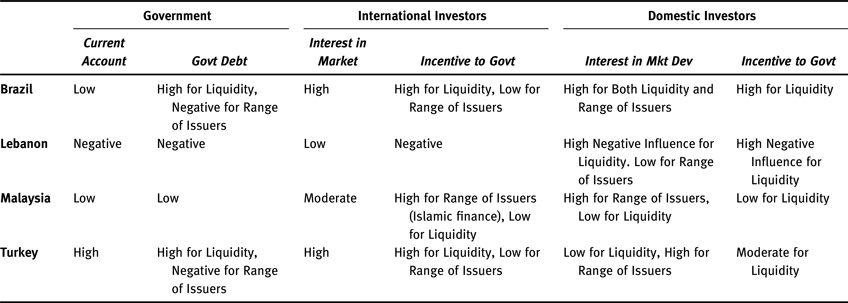
Financial structure thus constitutes a complex set of heterogeneous interests and influences, which we summarize in table 1:
Table 1:

Methodology and research design
We analyze domestic bond market development dynamics in four emerging economies located in the main regions of emerging market investment: Brazil, Lebanon, Malaysia, and Turkey. These four markets occupy different positions when it comes to market development. The existing literature is divided between those whose dependent variable is government policy decisions and those who seek to explain various outcomes. Pepinsky, for example, considers policy changes with regard to the capital account and foreign bank ownership, contrasting his approach with the focus of Rajan and Zingales on the economic outcomes of international financial integration and domestic financial development.Footnote 17 Our focus on an outcome—domestic bond market development—has an important implication for the nature of analysis. While government policy decisions remain central to any analysis of change, we must also include change initiated by financial market actors. Governments intervene to control markets, in particular in crisis conditions, but this does not justify an exclusive focus on government policy actions.
Measuring any capital market development is not straightforward, and is typically achieved by considering size, using indicators such as amount of securities outstanding as share of GDP. For bonds, this implies unreasonably that more indebted countries are more developed. Trading volume is certainly generally higher in larger markets when size is considered in terms of absolute size, but the correlation between trading volume and size relative to GDP is not high. For example, Lebanon has a sizeable domestic bond market relative to GDP, but is the least developed market; bonds are typically held to maturity, little trading occurs and the range of instruments is limited.Footnote 18 There exists no correlation between market size relative to GDP and market turnover in domestic bond markets in World Bank data.Footnote 19 All other things being equal, “[s]ize breeds liquidity,”Footnote 20 but, as we show, other things are not equal. On its own, market size to GDP—measured as volume of bonds outstanding or trading volume—tells us little about the development of bond markets.
Size across a range of market instruments (especially a range of borrowers) is indicative of market development, but increased borrowing, particularly government borrowing, does not in itself increase market development (although the government's approach to borrowing can of course influence development). Financial crisis-induced borrowing by western governments, for example, has not increased government bond market development. A more useful way to understand bond market development is to move away from individual measures of market size and toward seeing it as a process that has, as its endpoint, a “complete” market in which all risks can be traded. While this is a theoretical construct, as markets cannot be completed, such an approach recognizes that market development involves both the range of financial instruments available to trade (asset structure) and the ability to transact (market liquidity).
There are a number of ways to measure the range of instruments available to trade. We could consider, for example, the broad range of increasingly complex types of bonds that have emerged as a result of financial innovation, many of which readers have seen discussed in post-mortems on the 2008–2009 financial crisis. There are good reasons to avoid such an approach, however. One reason is the empirical problem of identifying genuinely different types of bonds amongst the supposed innovations. A second reason is that much financial innovation can be cyclical rather than secular: the disappearance of various complex securitization products after 2008 did not represent a reduction in U.S. bond market development.
We therefore use a simpler approach, looking at whether there is a sufficient range of different types of borrowers—governments, financial institutions, and non-financial companies—in particular markets with outstanding issuance in excess of 5 percent of GDP. While this is a crude measure of the ability of traders and investors to buy and sell bonds (or trade risk) for a range of borrowers, it also has the added value of making a more direct link with development through a greater capacity for a broader range of entities to borrow.
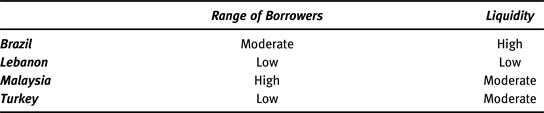
At the 2008 cut-off date, there clearly exist significant differences across the countries analyzed (see table 2). The Brazilian market is highly liquid (mainly thanks to the futures and options market), but there is not the full range of government, financial, and non-financial corporation bonds in meaningful size (domestic corporate bonds are only 1 percent of GDP). Malaysia, in contrast, has the full range of issuers, but a significantly lower level of trading activity. Turkey's trading is similar to Malaysia's, but it is concentrated in government bonds. Lebanon only has a government bond market (and it is large relative to GDP), but trading volume is very low.
This remains a narrowly focused measure. In Brazil and Malaysia, for example, the availability of certain instruments, including floating rate notes and index-linked certificates, further helps investors to trade risk. We do not focus on the important issue of repo markets, although such assistance to market trading is arguably covered in our measure of liquidity.Footnote 21
Bond market development configurationsFootnote 22

Our interviews with government and domestic and international financial market actors allow us to explore the attitudes and motivations of a wide range of the most important actors in the four markets, and their number allows us to allay concerns regarding the subjectivity of individual interviewees. Interviews represent a particularly effective way of accessing the details of the activities of financial market actors, and are used in conjunction with the empirical data available on each market. The focus of our study is a particular period, the decade leading up to the 2008–2009 global financial crisis, a time of heightened concern with the development of domestic bond market in international financial policy circles. This focus subsequently lapsed somewhat with a shift of attention to systemic risk factors in the quest for financial stability, making the financial crisis the most likely high-point for consistent levels of market development effort across our case study countries. Therefore 2008 can be seen as a high point in international pressure for bond market development.
In this paper, we trace how the structure of domestic financial markets impacts development outcomes. This, as always, raises the issue of the endogeneity of preferences, which risks becoming a question of how far back in time we look to explain policy decisions and outcomes.Footnote 23 In our case, we seek to explain specific developments following the resurgence of emerging market investment in the 1990s. Earlier government policy decisions, such as regarding pension provision in Brazil (dating from the 1920s) and Malaysia (1950s), or outcomes such as the failure to control inflation in Brazil from the 1980s, are therefore contributors to financial market structure, but not the subject of explanation.Footnote 24
Financial market structure and the development of domestic bond markets
In seeking to elucidate the constellations of interests and influence that shape market development in our four countries, we ask a series of questions:
1. What are the incentives for governments in market development?
The current account
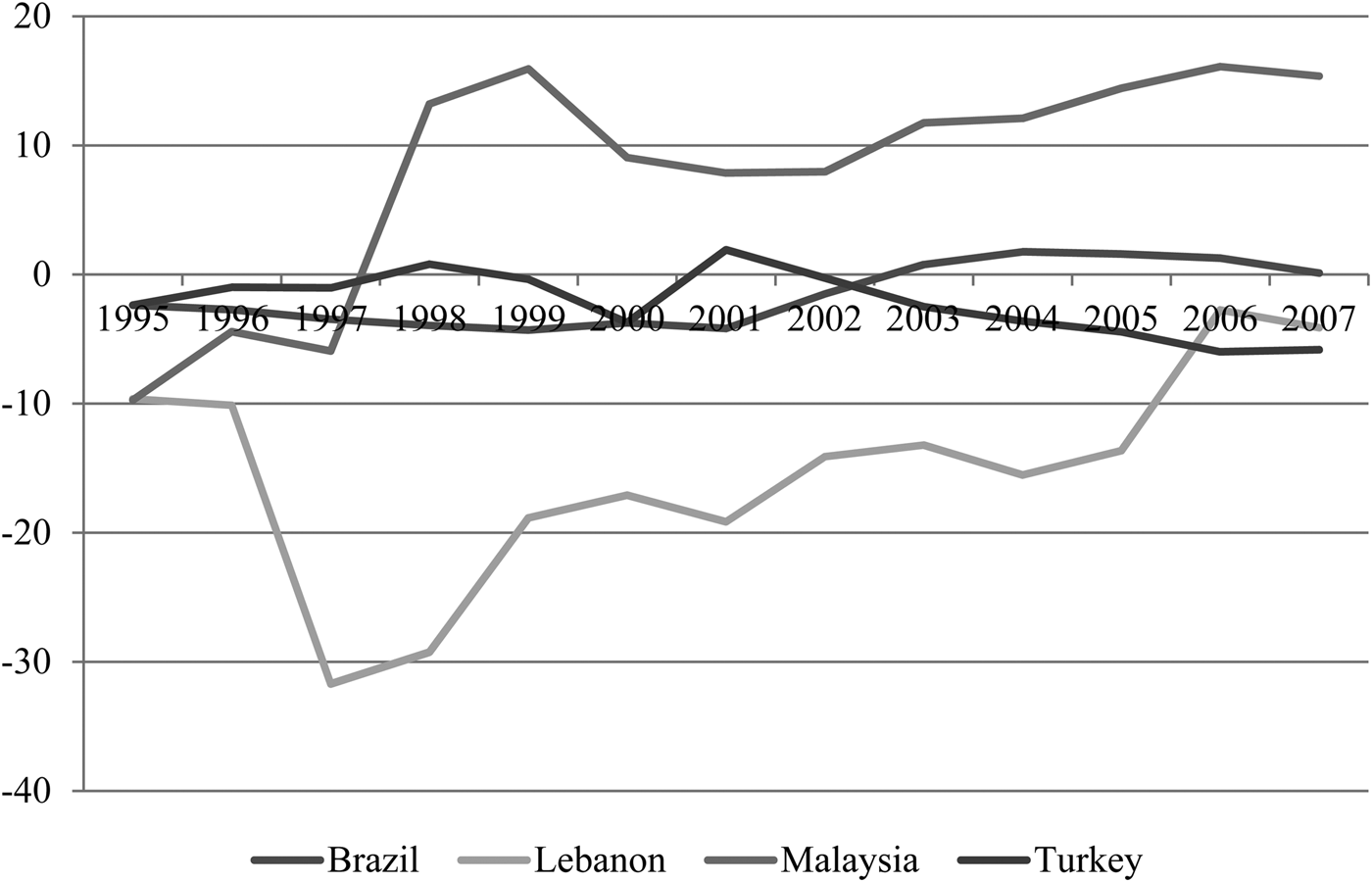
A country's current account position is an important determinant of its policy options.Footnote 25 As figure 1 shows, the current account positions of our four countries exhibited a strong variation during the period under investigation. Lebanon had a very significant current account deficit, Malaysia a surplus, and Brazil and Turkey lay between. If a current account deficit was in itself an important influence in favor of market development, we would expect Lebanon to have developed the most, Malaysia the least. In the case of current account deficits, however, we must also focus on the nature and context of financing. Brazil financed its deficit—before moving into surplus—in large part through Foreign Direct Investment, resulting in low pressure from the financing of the current account for market development. In contrast, Turkey had both a larger current account deficit in this period, and historically low levels of FDI (although the beginning of EU accession negotiations increased FDI markedly). Turkey therefore had to attract portfolio capital, representing a strong incentive to develop domestic markets to appeal to international investors, primarily by maximising liquidity in government bonds.
Current account as % of GDP, 1995–2007
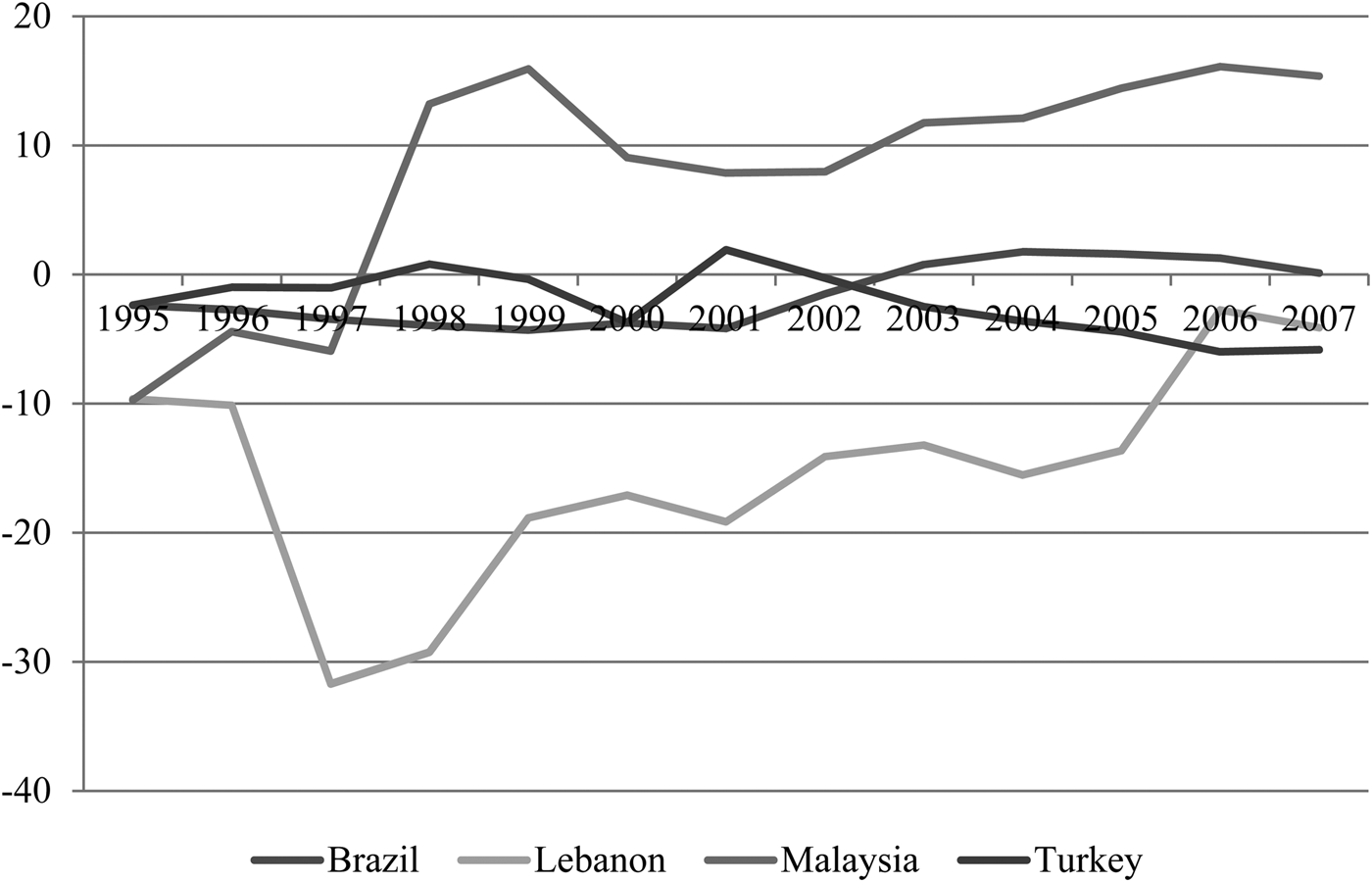
Lebanon similarly required inflows of financial capital to finance a far larger current account deficit. These are largely covered by remittances from its very sizeable diaspora population, which made annual remittances of up to 26 percent of GDP 2003–2007, largely through deposits in domestic banks.Footnote 26 Post-civil war economic stabilization rested on effectively fixing the domestic currency against the U.S. $ since 1993, a policy universally supported across the disparate political spectrum. It is combined with a constitutional commitment to the free movement of capital, a legacy of Beirut's pre-civil war status as an important regional banking centre. The acceptance of foreign currency deposits by the banking system is a similar legacy. It resulted in incentives for government not to develop domestic markets, because central to attracting diaspora money is the high yields on deposits and the stability of the banks. This required substantial investment in government bonds and market control to ensure bank profitability even during political crises.Footnote 27 Malaysia's current account surplus is also important, but in a different way. In removing the need for policies focused on financing the current account, it removed a constraint on Malaysia pursuing other market development policies, most importantly on the development of its Islamic finance sector.
Government debt and “original sin”
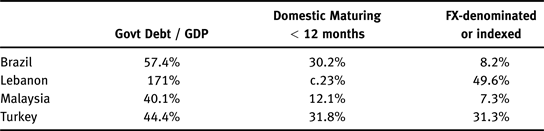
A government's primary interest lies in the ability to borrow sufficient amounts to finance their budget deficits, on a long-term basis in local currency: Governments seek to avoid original sin; an issue of which, interviews suggest, emerging market authorities are well aware.Footnote 28 When combined with significant levels of debt, and therefore frequent refinancing, this has a significant impact on government attitudes to market development, from positive to ambivalent to negative depending on circumstances. The degree to which government debt is a significant problem, and to which market development can be the solution, both vary. Our four countries vary with regards to the problem, again largely because of their respective financial market structures. Table 3 summarizes the differences.
Government debt / original sin, end 2007

Sources: Bank Negara Malaysia Monthly Statistical Bulletin; Lebanon Ministry of Finance Debt and Debt Markets Quarterly Bulletin; Brasil Tesouro Nacional Federal Public Debt Monthly Report; Turkey Undersecretariat of Treasury Public Debt Management Report
Malaysia has the lowest government debt, only a small proportion of which is short term or in foreign currencies: there is no original sin problem. Domestic financial structure explains the government's capacity to borrow domestically and long-term. Investment in the government bond market is dominated by the Employees Provident Fund (EPF), Malaysia's mandatory pension savings scheme. It mainly holds bonds to maturity and in 2000 held three quarters of outstanding government bonds.Footnote 29 EPF is also important through its ability to play a mitigating role during periods of market stress in government borrowing, such as the Asian crisis.Footnote 30 By purchasing bonds issued by Malaysia's asset management company set up to deal with non-performing corporate loans, EPF acted as a quasi-lender of last resort.Footnote 31 In addition, EPF means foreign borrowing has traditionally been low. Overall, the pressure for or against market development from either the level or composition of government debt in Malaysia is very low, with the same consequences for the ability to pursue other policies discussed above.
In Brazil and Turkey, government debt is slightly higher, and in Turkey foreign currency debt is significantly higher than in Malaysia. Domestic government bond borrowing in both countries is also of very short maturity, creating a significant issue with “original sin.” As of end-2007, only 35.1 percent of Brazilian domestic debt had a fixed interest rate, and 72.7 percent of Turkish debt reset its interest rate within twelve months. In the case of Turkey, the fact that much foreign currency borrowing could be sold to the domestic banking system as a result of highly dollarized domestically-sourced bank deposits mitigates the problem somewhat. The Turkish banks can also assist government borrowing at times of market stress. However, minimum levels of investment by pension funds in government debt were set with an eye not only on prudence, but also on the government's borrowing needs.Footnote 32 Limits on yields and tax incentives have also been used to favour government over corporate debt. In Brazil, despite the authorities’ view of themselves as liberalizing, the need to refinance remained an important influence: “[t]he federal government's gargantuan funding needs induces it to pass regulation favouring its own debt in detriment of the corporate financing market.”Footnote 33 The need to refinance outstanding government debt, the result both of the size and maturity structure of that debt, supported development of the government debt market, but resulted in the government hindering the development of other domestic bond markets.
This is also the case in Lebanon, except that many of the deposits originate with the diaspora, and in Lebanon banks also buy slightly longer maturity bonds. However, in Lebanon, the most significant issue is not the maturity or currency composition of government debt, but rather the size. This represents the main concern of the authorities in this area, but the important issue is the size of government debt relative to the ability of the Lebanese banks to finance that debt. This ability remains high, including at periods of potential market weakness, arguing against market development, as such development is both not needed to fill any gap between government need and domestic capacity to buy government bonds, and would undermine the control of government and banks on which government borrowing ultimately depends: Lebanon faced a very significant transitional costs problem.
2. What do international investors offer?
International investors favor market development, particularly liquidity in government bond markets. Other than the government, only a small group of large financial institutions or non-financial corporations are likely to be seen as potential investments, so their influence on the range of borrowers is generally lower. However, despite this consistent policy preference, international investors are also seen by policymakers as more likely to prove fickle in the case of market difficulties. International investors increase price volatility in government bond markets, which must be balanced by a positive impact on achieving government aims in undertaking market development.Footnote 34 We cannot assume such an equally positive impact across countries, or indeed policymakers’ expectations of any positive impact at all. The key variable in this regard is again the potential contribution to the current account and government borrowing, which is a function of existing market structure.
Turkey enjoyed the highest level of foreign ownership across our countries. The beginning of membership talks between Turkey and the EU in 2005 increased interest in Turkish debt, but more fundamentally, as a large issuer among emerging markets, Turkey represents a high proportion of indices measuring the performance of emerging market local currency debt. This increases international investor demand and reduces the likelihood of the sudden reversal of these flows.Footnote 35 Turkey also has the highest requirement for foreign portfolio capital. International investors also offer an opportunity to deal with the “original sin” problem that is a legacy from high inflation and political instability. A Turkish Treasury official estimated that 80–5 percent of the first auction of five-year government bonds was sold to international investors. The successful issuance and subsequent price performance of these longer maturity securities then encourages domestic interest.Footnote 36
This willingness to buy longer-dated government bonds makes international investors attractive to the Turkish government beyond the volume of their investment. The incentive for the Turkish government to meet international investors’ desire for market development was high; however, the relatively small size of domestic pension and insurance funds meant that the extension of maturity by domestic investors relies on banks, and is therefore limited by banks’ ability to take maturity mismatches. In contrast in Brazil, the potential of international investors encouraging domestic maturity extension is greater because it is complemented by the large domestic pension funds.
The history of high inflation in Brazil created an “original sin” problem very similar to the Turkish case in terms of maturity profiles. All types of domestic investor preferred short term investments linked to market rates. This resulted in a high sensitivity of the government's debt levels to market movements, as illustrated most graphically before Lula's 2002 presidential election victory.Footnote 37 However, Brazil's different financial structure increases the attraction of foreign investors because of the extensive pension system.Footnote 38 In Brazil, the domestic pension funds not only could, but for liability-matching reasons arguably should buy long term government bonds to match their long-term liabilities, and they already had sizeable funds invested in government bonds. The immediate pay-off for the Brazilian authorities of international investor involvement is high, despite relatively low pressure from the current account and low levels of international investment, because international investors will buy longer maturity bonds, and because of the potential for longer maturity pension fund investment to help address the original sin problem. This results in a high incentive for the Brazilian government to develop their domestic bond market in line with international investor preferences.
In contrast, during our period of observation, international investors offered only moderate incentives related to the current account or government borrowing for the Malaysian government to move towards further market development, because neither the current account or government borrowing were a major concern. Given Malaysia's imposition of capital outflow controls in 1998, these investors showed only limited interest in the Malaysian market for most of the period under analysis anyway.Footnote 39 Malaysia was free to pursue other development objectives such as the development of its Islamic finance sector. Interest in the Malaysian market did resume in the early 2000s, but was mainly driven by Malaysia's expanding Islamic finance sector. International investors interested in Islamic finance give an incentive to increase the range of issuers. The appetite for new Islamic structures was high, indicated by the oversubscription of new government and corporate issues.Footnote 40 Nevertheless, these changes with regard to the Malaysian bond market were not specifically aimed at increased turnover, and Islamic restrictions on the sale of debt provide further impediments. The development of market liquidity was slow to keep pace with the increased range of financial instruments, resulting in a different form of market development from Brazil and Turkey.
In Lebanon, international investors provide a disincentive to market development. As a small country, international interest is anyway likely to be limited and sporadic, but the structure of the financial system in Lebanon is such as to make the interest a potential negative. The captive bank buyers of Lebanese debt meant Lebanese yields have historically been far lower than the country's weak credit rating would imply, despite its exceptional debt to GDP ratio. “We will not buy this credit because it should yield more” summarizes the attitude of international investors.Footnote 41 If these investors had taken a view on Lebanon, many of them would likely have done so through short positions, pressuring yields higher. The frequency of political uncertainty in the country means there is a strong possibility of periods of negative news. International investors therefore represented a threat, not an opportunity, and are a negative influence on the government's incentive to develop the bond markets.
3. Who are the dominant domestic financial market actors, and what is their role in market development?
Brazil stands out amongst our cases in having in this period the full range of domestic financial institutions, including banks, pension, mutual and hedge funds. The key actors are, however, the banks (who also own the largest mutual funds) and the pension funds. The government bond market, particularly thanks to the futures and options market established in 1986, is highly liquid, though short-term. The BM&F's early growth was both assisted by the hedging of inflation risk and opposed by the Brazilian government.Footnote 42 This key part of the market structure had an influence on how market participants seek profits and therefore see their interests, with involvement of the local banks in the market being broad. They own government bonds far in excess of their (unusually high) regulatory requirements, and are the leading traders. Data on the accounting choices of Brazilian banks, in addition to interview evidence, suggest that both private and state-owned Brazilian banks are more trading-oriented than their Turkish counterparts.Footnote 43 The greater trading sophistication of the Brazilian banks also means they have less to fear from the competition from international bank entrants than their counterparts in countries such as Turkey.Footnote 44
Brazilian banks also dominate the mutual fund industry. Brazilian bond fund assets are the world's fourth largest,Footnote 45 and are an important source of revenue that banks have sought to defend in small ways that undermine market development. Attempts to sell government bonds directly to individuals have faced a lack of cooperation from the banks, and the implementation of mark-to-market rules were resisted to the point that one large bank boycotted a government bond auction.Footnote 46 On balance, Brazilian banks are nevertheless supportive of market development. Bank treasuries and government bond market dealers are focused in their discussions with the authorities on achieving maximum liquidity in the market.Footnote 47 They share these views with the important Brazilian hedge fund community. Banks have also been supportive of greater foreign investor involvement in the market to a greater extent than in other case study countries, for example through BEST Brazil, “an initiative aiming at promoting the Brazilian capital and financial markets to the international community.” This is supported by the government, and its sponsors include ANDIMA, which represents a range of institutions in the Brazilian financial markets, and FEBRABAN, the federation of banks in Brazil.Footnote 48
The banks are the dominant financial market actors in Brazil, but, as noted above, much of the incentive for market development for the government results from changing the short-term investment practices of the pension funds. Even when looking long-term, pension funds have not seen all market development as in their interests. As “buy and hold” investors, they have less to gain from increased market liquidity.Footnote 49 They have been more focused on bond issuance that meets their specific cashflow and benchmarking needs and lobbied for corresponding coupon and amortization payments, and inflation calculations, and therefore against the homogeneity of instruments that would facilitate trading.Footnote 50
In Turkey, banks differ from their Brazilian counterparts in seeing international investors as almost exclusively accessing the market through the foreign investment banks, without domestic banks benefitting. Turkish banks have in the past been major beneficiaries of a narrow banking model that depended heavily on the taking of deposits and investment in government bonds. At the time of interviewing, various factors were changing this business model, even as the creditworthiness of the Turkish government was improving. First, and most important, is increased investment in “real banking,” which dates in the main from 2003.Footnote 51 It includes increased competition for deposits, but more importantly, lending to businesses and individuals. A significant influence on this activity has come from foreign commercial banks looking to buy or invest in their Turkish counterparts, and preferring those banks that do not depend on investment in government securities.Footnote 52 It also reflects, however, reduced profitability from investment in government bonds as yields have fallen with greater macroeconomic stability.Footnote 53 Second, some (private actor driven) market innovations were increasing the ability of Turkish banks to hedge their risk, including credit default swaps.Footnote 54 This ability had not developed to the extent of Brazil, however.
For the Turkish banks, the further development of the government bond markets is something of a double-edged sword. They are unlikely to be the intermediaries for foreign investment into the market, and international investors are “an unknown.”Footnote 55 As in Lebanon, banks carry very large bond positions, and are therefore vulnerable to price falls they fear the exit of foreign investors would make more likely.Footnote 56 The larger banks are making strong returns from “flow business”—the buying and selling of securities—in government markets, and if activity increases, so should these returns. However, the large banks are “trading more like real money managers,” with a constant long position in government bonds.Footnote 57 This means low volatility is attractive and control important.Footnote 58 It also acts as a brake on any increase in trading activity. During the period under observation, other potentially important domestic financial market actors were not significant investors in government bonds, although the government introduced pension reforms. Importantly, however, the government's borrowing needs are a significant factor in determining pension funds’ minimum requirements for investment in government bonds and maximum overseas investment.Footnote 59 The extent of the pension funds lobbying for market development has been for longer maturity issuance to match their liability needs,Footnote 60 which very much matches the government's own concerns, rather than the liquidity-hindering specifically-tailored issues sought by the Brazilian pension funds.
A similar, though less acute, interdependence exists between the government and banks in Turkey as in Lebanon. The banks, unable to exit thanks to the large volumes of government bonds they hold, would be very unlikely to allow a bond auction to fail.Footnote 61 There is less concern on the part of the authorities with directly protecting the banks’ profitability in normal times, but measures to support the banks are taken; for example, domestic U.S.$-denominated bonds were issued in 2001 to assist the banks in closing the currency mismatch on their balance sheets.Footnote 62 The banks also have less direct influence on government borrowing policy. Unlike in Lebanon, international investors are needed to finance both the government and the current account, and, as in Lebanon, Turkish banks have few choices other than domestic government bonds: “the prime minister can ask the chairman of banking association that if you are not purchasing T bill what are you going to do?”Footnote 63 Turkish bank influence is therefore lower than their Lebanese counterparts. Overall, we see domestic financial actors’ interests in market development as moderate but increasing over the period studied. Their influence with regards to market development is similar to Brazil's banks, but clearly less than the main market actors in Lebanon and Malaysia.
Malaysia stands out among our cases in having a market dominated by a single financial actor, EPF, which is the single largest investor in domestic government debt securities. In 2007, EPF's investments equalled more than 60 percent of Malaysia's GDP.Footnote 64 About a third of its assets were invested in government bonds, with another third being invested in corporate “loans and bonds.” In combination with government-mandated asset allocation that favors a conservative investment portfolio (debt over equity, domestic over international), this gives EPF a very strong interest in market development as a means to broaden the range of investible assets.Footnote 65 However, at the same time EPF has little ability, given its size and the buy and hold nature of pension fund investment, to take advantage of, or contribute to, increased trading. For market liquidity, the dominance of the EPF presents a hindrance.
Second among the main domestic financial market actors investing in bonds are the banks. Regulated government bond yields prior to 1990, in combination with “captive demand” due to regulatory requirements and a limited supply of government bonds during the fiscal surplus years of the early 1990s, created little incentive for Malaysian banks to adjust their portfolios and actively trade government bonds.Footnote 66 Government efforts to develop the corporate bond market created incentives for domestic banks to become more involved in market development, but primarily with regard to expanding the range of borrowers and products. During the Asian crisis, the central bank successively lowered statutory reserve requirements and introduced a new liquidity framework, with the long-term side effect of making more bonds available for trading,Footnote 67 but this has not overcome the limitations on liquidity as a result of the EPF's dominance. Banks’ interest in profiting from the expanding Islamic financial sector, in combination with tax incentives, has also provided greater incentives for market development, in particular product innovation, but this is again market development that contributes to the range of financial instruments, not significantly to market trading.
Overall, during the period of analysis the interest of the dominant domestic financial market actors in development in Malaysia was high for range of borrowers, but low for liquidity. The interest of both EPF and the banks in expanding the range of instruments, especially the range of borrowers, was, for different reasons, high, but the interest in increasing market liquidity is low for EPF, and only moderate for banks and other investors such as mutual funds, which at that time were only beginning to make inroads in bond investment. In terms of the outcome of increased market development, the crucial issue of market structure is the systemically dominant position of the EPF, which limits trading activity while also reducing pressure for the government to enhance liquidity.
Over the longer term, government policy can, of course, result in change. Reforms of pension funds in Turkey are discussed above. At the time of interviewing, Malaysian policymakers had begun the process of considerably liberalizing EPF's mandated asset allocation and adopting a more aggressive investment strategy. Moreover, EPF and domestic banks are no longer the only domestic investors with a strong focus on the bond market. By 2007, insurance companies were the third largest group of domestic investors in the Malaysian bond market, holding over 10 percent of government bonds outstanding and 16 percent of corporate bonds.Footnote 68 Given the nature of their liabilities, however, like EPF they are mainly interested in broadening the range of investible assets and less focused on market liquidity. Despite changes, the implications of EPF's dominance remain in place, and therefore the outcome of government policy initiatives in terms of market development are conditioned by market structure.
In Lebanon, the banks are the only significant financial market actors, and their attitude to market development is negative. Domestic investors own effectively all the domestic currency debt issued by the government, and around 80 percent of the notionally international debt. The relationship between the domestic banks and the government's borrowing is, however, one of interdependence. The reputation of Lebanese banks amongst the diaspora is very high, helped by the fact that the last time a depositor lost money was before the 1975–90 civil war. A significant inducement to make U.S.$ deposits with Lebanese banks rather than more highly-rated international banks is nevertheless the higher interest rates paid by banks in Beirut relative to banks elsewhere. In order to attract these deposits, Lebanese banks must be able to lend them profitably. Lebanese companies typically borrow in U.S.$, because the interest rates are lower than in Lebanese pounds, but, they are generally overleveraged, so limiting further lending opportunities.Footnote 69 The obvious outlet for the U.S.$ deposits received is therefore investment in U.S.$ Lebanese government bonds.
Maintaining the level of central bank reserves necessary for the support of the exchange rate requires an interest rate on domestic currency deposits that will prevent wholesale conversion to U.S.$, resulting in a balancing between appropriate domestic currency and U.S.$ interest rates. The banks must also have profitable domestic currency lending opportunities, but here the options are even more limited. With limited corporate or retail lending opportunities and no offshore domestic currency alternatives, the choice is domestic Treasury bills or deposits with the central bank. The banks as a result owned over 75 percent of Treasury bills held outside the central bank at the end of 2007. Overall, over half the Lebanese banks’ assets are government bonds or deposits with the central bank. As with EPF in Malaysia, the banks hold securities difficult to sell, because of a market illiquidity that is the result of their own dominance of the market.Footnote 70 Lebanese banks also need continued issuance of government bonds to maintain their profitability and growth.
The result is interdependence between government and the banks, and a potentially long-term ability to block international price signals. This is a key additional source of influence for Lebanese banks compared to their Turkish counterparts. Although Turkish banks are important to their government's financing, Turkey borrows far more in line with its international comparators. Lebanese banks’ influence on the government's borrowing capacity is therefore higher. In periods of market stress, government and banks in both countries can cooperate to maintain stability and prevent stress becoming crisis, to their benefit as well as the government's.Footnote 71 For the Lebanese banks, the incentives in further market development are there, in the opportunities for further trading activities and at least partial hedging of risk. However, they are outweighed by the potential loss of market control, both for themselves, and for the central bank, whose activities allow them to generate profits. Banks therefore want the continuation of a system where the central bank will not allow them to lose money on Treasury bills.Footnote 72 It is attractive to them to continue the situation where “at the end of the day we are more in control of this market than any other international counterpart.”Footnote 73
The losses to the banks if Lebanon traded more in line with the yields of comparably rated countries would be very substantial, and unwelcome market, and thus profit, volatility would increase: “We worry about our bonds being held outside because whenever they worry about the situation, they will . . . drop the market heavily.”Footnote 74 Banks therefore do not have an interest in market development. This results not only in little if any pressure on the government to develop the market, but also preventive actions by the banks. They will not lend bonds they own to other market participants (thus limiting short selling and the development of repo or Credit Default Swap markets), and will proactively seek to prevent international market actors from short-selling.Footnote 75 These actions limit market development, regardless of the fact that they are in line with government policy preferences. Furthermore, the dominance of the Lebanese banks in the market, as with EPF in Malaysia, is itself a hindrance to market development. We summarise the dynamics in the various markets in table 4.
Summary

Conclusion
While in the aftermath of the 1990s emerging market crises, bond market development was a cornerstone of the international financial reform agenda, it is less amenable to direct policy intervention than is often thought. As we have shown in this paper, its success depends on specific constellations of interests and influence. The importance of financial structure in explaining progress with and obstacles to bond market development has a number of important implications.
Bond market development does not follow a one size fits all schema. Its success or failure depends on the interest and influence of a wider range of actors than is captured by an analytical focus on the relationship between national governments and international investors. Importantly, this includes a range of domestic financial actors such as pension funds and banks, whose interests in and ability to influence market development can diverge, largely because of country-specific, historical factors.
Similarly, on its own government policy is unlikely to be sufficient to overcome domestic vested financial interests, and is often shaped by these interests, through their importance to current account and government debt financing. Financial structure shapes the interests of market actors, the incentives for government and therefore the varied levels of bond market development outcomes. Understanding the reasons for the varied nature of development across emerging economies therefore requires paying closer attention to domestic financial market structure.