Introduction
The British group Gentle Giant began to perform and record under that name in 1970 and is typically associated with that wave of British rock regularly, but inexactly, labelled ‘progressive’. Attempted definitions of distinct stylistics and aesthetics of this musical movement have since their first emergence focused extensively on the facts that (i) some of the musicians involved had received a high degree of formal musical training (either privately, at public schools, or at universities and conservatoires); (ii) the music often utilised elements of form and genre relating to established practices in Western classical music, (iii) the music shunned to some degree the received commonplace melodic and harmonic features of earlier Afro-American music (notably those found in blues, soul and rock ’n’ roll), connecting instead self-consciously to what was perceived as novel patterns of song-writing in the music of a number of British groups by the end of the 1960s (notably The Beatles and The Who); and (iv) this music placed an emphasis on order and structure that contrasted with the improvised structures of the psychedelic movement of the late 1960s and its bona fide Dionysian subculture.Footnote 1 Mark Mazullo's attempted typology of different connotations of the term ‘progressive rock’ and what he calls ‘the progressive aesthetic’ focuses, rather typically not only for lay discourses but also for much musicological scholarship, on the surface levels of sound and instrumental proficiency:
The first use [of the term progressive rock] is the more normative of the two: ‘progressive rock’ is synonymous with ‘art rock’ and thus refers to the primarily, though by no means exclusively, British phenomenon of the early to mid-1970s – represented by such bands as Genesis, Yes, and Gentle Giant – in which technically proficient, educated musicians attempted to expand the boundaries of rock by appropriating such elements of ‘classical’ music as extended keyboard solos, symphonic instrumentation, and radically extended composition lengths. (Mazullo Reference Mazullo2000, p. 723)
While such definitions may serve well as categories in the study of the reception of this music, they fail to elucidate if, how and in which ways this music drew on traditions from Western classical music in its structure, as opposed to outward and immediately recognisable factors such as proficient instrumental figuration, timbre, texture, duration and rhythmical accentuation. Chris Atton remarks in his study of value-judgements in later progressive rock discourses that ‘[i]n general, the fans seem disinterested in the specifics – even the generalities – of how their music resembles classical models’ (Atton Reference Atton2001, p. 35). To this one may add that the same in fact holds true also for a majority of the musicologists who have written on the topic, most likely because of the stress laid on reception (with its sociological implications) and to musical form at the macro-level, as far as the musical artefacts are concerned.Footnote 2 Edward Macan (Reference Macan1997, p. 31) has stated that the progressive rock movement was ‘indebted to the classical tradition in the realms of instrumentation, structure and virtuosity’. This article shall deal exclusively with the second of these three.
Motivic structure as a sublevel in phrase-bound structures
A distinctive trait in the mainstream of popular music in Western Europe during the 1960s and 1970s is the predominance of phrase-bound structures, where either no smaller melodic unit than the phrase can be discerned, or where smaller units (such as in the case of riffs or ostinato figures) have functions that are subordinate, or complementary, to the melodic phrase as a unit of form (this definition of phrase-bound structure will be used throughout this study). Such phrase-bound structures, when limited to recurring melodic figures, may be largely constructed out of sequences, without therefore being considered by the present author as motivic structures below the level of phrase. Consider, for example, the case of David Bowie's Life on Mars (cited as an example of sequential structure in Moore Reference Moore2001, pp. 37–8), where the phrases arguably could be broken down into recurring statements of one briefer figure. The distinction between an aggregate of sequences and a complex of motives must be inferred from at least one of the following: (i) a function of sectional, or otherwise form-related, cohesion, and/or (ii) significant transformation by the melodic element itself. To illustrate this distinction one could say that if anything resembling the 1-2-3-4-3-2-1-(3) figure in the verses of Life on Mars were to appear, for example, (i) in another section of the song than that of the verse, thus providing a link between two points in the song not otherwise melodically, rhythmically or harmonically connected, and/or (ii) in the form of fragments (which may in turn be merely separated, or re-combined to form new melodical elements), or permutations such as inversion, retrograde, augmentation, diminution, considerable alteration in contour and internal rhythmic properties (or other), it could be identified as belonging to the same category as the motives discussed in the present study. According to this analytical viewpoint, a motive is only a motive once it does something specific outside itself. This is accordingly a much narrower definition than that of a mere building block of a phrase (such as the 1-2-3-4-3-2-1-(3) above), and one, needless to say, that is relevant only to the discussion of motivic cohesion, not to segmental analysis in general. In the following, we attempt to identify with this methodology how segments cohere in order to establish what exactly is cohering, while we must always start by hypostatising elements on a more general level (such as in the case of Life on Mars). Some such elements may be identified. The music of Gentle Giant appears, on closer first-hand examination, to depart from the common practice of phrase-bound structure, differing in this respect not only from the mainstream of popular music, but also from the music by other groups within the progressive rock movement. On the first seven of their 10 studio albums (those released before 1975) we come across what seem to be tightly knit musical structures based to a greater extent on concatenations of shorter motives than on phrase-bound structures. Phrase-bound structures do indeed appear frequently, but appear underpinned, as shall be demonstrated below, by re-appearing and developing motivic units, leaving the music theorist with the impression that they have been constructed ab initio from motivic cells.
Previous discussion of Gentle Giant's music has stressed, as we shall see, its perceived ‘composedness’, ‘order’, ‘compactness’ and ‘structure’, but merely on the aesthesic level of phenomenon, i.e. how the music is outwardly perceived thus at face value. The present author finds reason to believe that the above-mentioned motivic cohesion and parsimony, seemingly never clearly pointed out and thoroughly addressed, account for these reactions. Analytical attempts have so far tended merely to scratch the surface of the structural details that make up what analysts seem to perceive as consistency and cohesion in the music.Footnote 3 But how is it possible that the same authors who criticise the band for taking eclecticism and complexity to the point of distraction also commend their ability for creating unified structures? It must be regarded as a justified assumption worth investigating that there is some deep-level organisation that is detectable to these commentators. What seems to figure here is a conception of order and structure which defies, or at least comes into potential conflict with the cited descriptions of eclecticism and complexity. In referring to ‘logic’ and ‘order’ without substantiating these qualities with examples from particular musical instances, the cited studies often lie open to criticism such as that levelled in another context by Hans Keller: ‘[t]here certainly is such a thing as musical logic but since no critic using the concept of logic has ever disclosed what it is it must remain meaningless to the most knowledgeable addressee, all the more so since the concept of contradiction, which is often employed in the same devastating breath, is not applicable as unfavourable criticism, to musical logic at all’ (Keller Reference Keller and Hogg1987, pp. 114–15). It should be understood from the context of Keller's writings that he describes here a syntactic logic (resembling, if anything, the German concept of ‘Folge’), internal to each work and therefore closer to the concept of rationally intelligible order than to logic proper, considered as a systematic, non-contextual discipline.Footnote 4 Allan Moore has suggested that on the Gentle Giant album Octopus (1972), as far as sectional form is concerned, rather simple binary and ternary forms are used, and that most tracks on this album are held together by what he terms ‘through contours’ and ‘peak contours’ – an observation which certainly links up on a general level to what is proposed in the present article.Footnote 5
Some recent authors, who have mainly targeted perceived ideological implications in the study of Austro-German 18th- and 19th-century repertoire, have on different grounds questioned the concept of unity as a valid assumption in music analysis. Robert Morgan has examined in detail five such studies, postulating that those questioning the concept of unity are in fact often tacitly assuming its significance to a greater extent than those claiming its methodical validity in music analysis. This leads him to defy categories such as ‘disunity’: ‘[u]nity is certainly not the only thing worth analysing, but, in this music at least, the alternative is not disunity but a different analytical perspective altogether’ (Morgan Reference Morgan2003, p. 43).Footnote 6 The underpinning assumption of the present article is that an analyst is justified in subsuming individual events under categories (here, motives) that are more general than if each event were to be considered unique (the latter is, by definition, never warranted in hierarchical systems such as tonal and modal music). This principle does not come into conflict with an awareness of, and sensibility to, the possibility that similar intellectual currents such as that criticised in the modern study of Austro-German classicism and early romanticism (organicity, unity, cohesion) are applied to the repertoire of progressive rock, by its fans, as well as by musicologists and music theorists, on grounds other than those of music analysis. As we have seen, the latter seems in fact to be the case, for which reason the questions raised becomes: is motivic unity or cohesion in structure and design truly to be found (as defined above: searching for what exactly is cohesive by looking at how a number of hypostatised elements adhere) in this music and, if so, in which ways and on which levels? The motives pointed out below can thus be regarded as important nodes in the musical complex of totality, rather than organic cells, cogs in a mechanical device, or any other metaphor that has historically been summoned to represent unity in music theory.Footnote 7
Three of the authors responsible for the most in-depth studies of Gentle Giant's music so far, John Covach, Gerhard Zimmermann and Geir Hasnes (the latter a knowledgeable Gentle Giant collector and Liebhaber rather than a trained scholar or music theorist), have pointed to the implied compositional procedure of the instances modelled most closely on fixed forms in Western tradition, but have not attempted to identify which concrete structures lie behind what is referred to as the ‘tremendous compositional control’ and ‘concentration’ in all of Gentle Giant's early music (again that recorded before 1975).Footnote 8 They all agree that Gentle Giant are set apart from progressive rock conventions due to their consistent exploitation of contrapuntal writing.Footnote 9 Paul Stump suspects something similar to the topic under discussion here: ‘[D]ensity of texture and sleight of hand suggest aural puzzles’ (Stump Reference Stump2010, p. 149) and Macan has tried to explain its roots by stating that Gentle Giant and some other bands ‘experimented with more modern types of polyphonic textures drawn from composers such as Stravinsky and Holst, in which several short, repetitive melodic fragments are superimposed against each other to create intricately interlocking ostinato networks’ (Macan Reference Macan1997, p. 50).
With the displacement of phrase-bound structures in favour of motivic design follows a less clear-cut and immediately perceptible order in between the sections of a musical work. Progressive rock may predominantly attract the interest of what has been called ‘the trained listener’ anyway, but as we have seen, even these profess ignorance of precisely what in the immanent structure causes what seems to be one widely shared reaction to this music (or a number of very similar reactions). By the ‘immanent level’ we shall here understand ‘what is there in the audible artefact’. Not all music theorists and musicologists agree that one may talk of such an immanent level.Footnote 10 The present author does not disagree with the contention that perception is an intentional act, and the rationale for the present article is that: (i) one may note a strong correspondence of reaction to the music of Gentle Giant between most of the above-quoted commentators; (ii) it is possible to observe (with perception that is by nature intentional) a number of factors at the audible level of the music (transcribed to notation in order to facilitate reference and discussion) which seem to at least partly explain the correspondence of reactions. The interpretation presented here is hopefully demonstrably linked to musical features perceptible to any listener, as well as being transparent and rational, and thereby potentially refutable.
Experimental psychology has strongly suggested that a musical theme is for a majority of listeners more clearly conveyed through melodical curvature or contour than through its intervallic relationships (see Dowling Reference Dowling1978; Edworthy Reference Edworthy1985). Highly pertinent to the present investigation, the outcome of one such study was that ‘…[a]lthough immediately precise, contour information is easily lost whereas interval information, once obtained, is more resistant to forgetting’ (Edworthy Reference Edworthy1985, p. 375). Repetition of intervallic patterns is a potent agent of musical form not only in the so-called common practice period of Western tonal tradition, but also in the post-tonal music so often regarded as important for the British progressive rock groups (e.g. motivic structures in Bartok as well as Stravinsky's and Scriabin's octatonicism). It is less present in popular music of the late 20th century and one may suspect that such analytical approaches would be looking for something not generally to be expected in this music, potentially even an undue bias from completely different types of repertoire. In Gentle Giant's music, as exemplified by the three songs to be considered below, however, I would argue that we have a point in case where intervallic patterns are manifestly employed in a way not normally found in 1960s and 1970s rock.
Relationship between poeitic and analytical processes in the case of Gentle Giant's music
The analysis of popular music must generally be carried out with a clear distinction between the assumed or hypostatised poiesis of the artefact in question and the analytical methods and conclusions applied to that poiesis. This is on account of the fact that analytical conclusions, regardless of how well justified they are in relation to the immanent level of the musical artefact, more often than not lack any firmly established relation to corresponding intentions in the mind of the composer. In our present case, this is rather different, since both the background and the musical conception of the composer and the music analyst are bound to be much more closely connected than in most other case studies of popular music. Gentle Giant worked at least partly from notation, which enables control over the interplay between the instruments, and naturally shapes the compositional process. Instead of the musicians appearing as soloists in different sections, the band could by this thoroughly worked-out procedure act as one organism (perhaps it is only here that the concept of ‘work’, related as it is to that of organicity, referentiality and autonomy, becomes relevant and applicable in the study of popular music). The newsletter publication Proclamation, devoted entirely to the music of Gentle Giant, has frequently issued transcriptions – intended both for analysis and performance – of passages of Gentle Giant's music, where in some cases the writers have had access to the scores of the band members – a rare type of source in popular music studies.Footnote 11
Gentle Giant's second album, Acquiring the Taste (1971), containing the three songs that will act as case studies for the motivic analysis below, features the following motto on the sleeve:
It is our goal to expand the frontiers of contemporary popular music at the risk of being very unpopular. We have recorded each composition with the one thought – that it should be unique, adventurous and fascinating. It has taken every shred of our combined musical and technical knowledge to achieve this. From the outset we have abandoned all preconceived thoughts of blatant commercialism. Instead we hope to give you something far more substantial and fulfilling. All you need to do is sit back, and acquire the taste.
Ambitions such as these, often strongly ridiculed in contemporary and slightly later musical criticism, were rather typical for many of the main exponents of the so-called progressive rock movement. Unlike a number of other conservatoire- or university-trained progressive rock musicians, Kerry Minnear of Gentle Giant did not drop out of his studies upon the early success of his group, having already graduated with a degree in composition at the Royal Academy of Music in 1970, when the first Gentle Giant album was released. Since several of the other members of the group, all of whom to some degree contributed to the compositional process of the songs (bass, trumpet and violin player Raymond Shulman especially so), had considerable experience in playing orchestral and chamber repertoire in Western classical and popular traditions, we are well justified in inquiring how elements of structure in original compositions of Gentle Giant may draw from internalised contrapuntal, thematic, motivic and developmental practices.Footnote 12 Stump has also suggested that ‘Ray Shulman was so inspired by Minnear's abilities that, despite of his lack of formal training, he strove to emulate his junior bandmate in his own compositional writing’ (Stump Reference Stump2005, p. 41).Footnote 13
John Sheinbaum has discussed the so-called cultural capital of the progressive rock movement and has, in his dichotomic table of high and low values, pitted ‘genius’ (high value) against ‘craftsperson’ (low value), (Sheinbaum Reference Sheinbaum and Holm-Hudson2002, p. 24). This polarisation may be relevant in some reception studies of progressive rock, as contrasted to the music of the late 1960s, but it probably makes little sense considering the modus operandi and aesthetic outlook of a conservatoire-educated composer, such as Kerry Minnear. Minnear would at the Royal Academy of Music in fact certainly have met with, and quite likely been affected by, preserved remnants of the earlier ideals of neue Sachlichkeit (‘new objectivity’) which strongly stresses craftsmanship and honed practice in composition and instrumentation.Footnote 14
Analysing the immanent level of Gentle Giant's early music we find melodically parsimonious structures to all appearances founded on the use of small motives. Trying to elucidate the poietic process in the light of these structures leaves us with three basic possibilities: (i) the motivic structures are coincidental; (ii) the motivic structures are undeliberate reflections of the composer's conception of inherent structure (such as described by Schoenberg)Footnote 15; or (iii) the motivic structures result from deliberate compositional choices. Without assessing these possibilities beforehand we turn to the immanent level of the three songs, attempting to identify the most probable explanation in each particular instance. Before so doing, it is relevant to invoke Dora Hanninen's distinction between ‘structural motif’ and ‘pure motif’, without therefore admitting wholesale to the far-reaching consequences of her general theory of segmentation (Hanninen Reference Hanninen2001, pp. 386–7). The former is assumed to carry interpretation supported by an orienting theory, whereas the latter involves only the contextual domain of the musical work. In analysing the immanent level, it is productive to operate with a distinction between deep structure and surface design, allowing analytically a certain degree of autonomy to the surface level on which the motives are first observed (see Rothgeb Reference Rothgeb1971).
‘Pantagruel's Nativity’
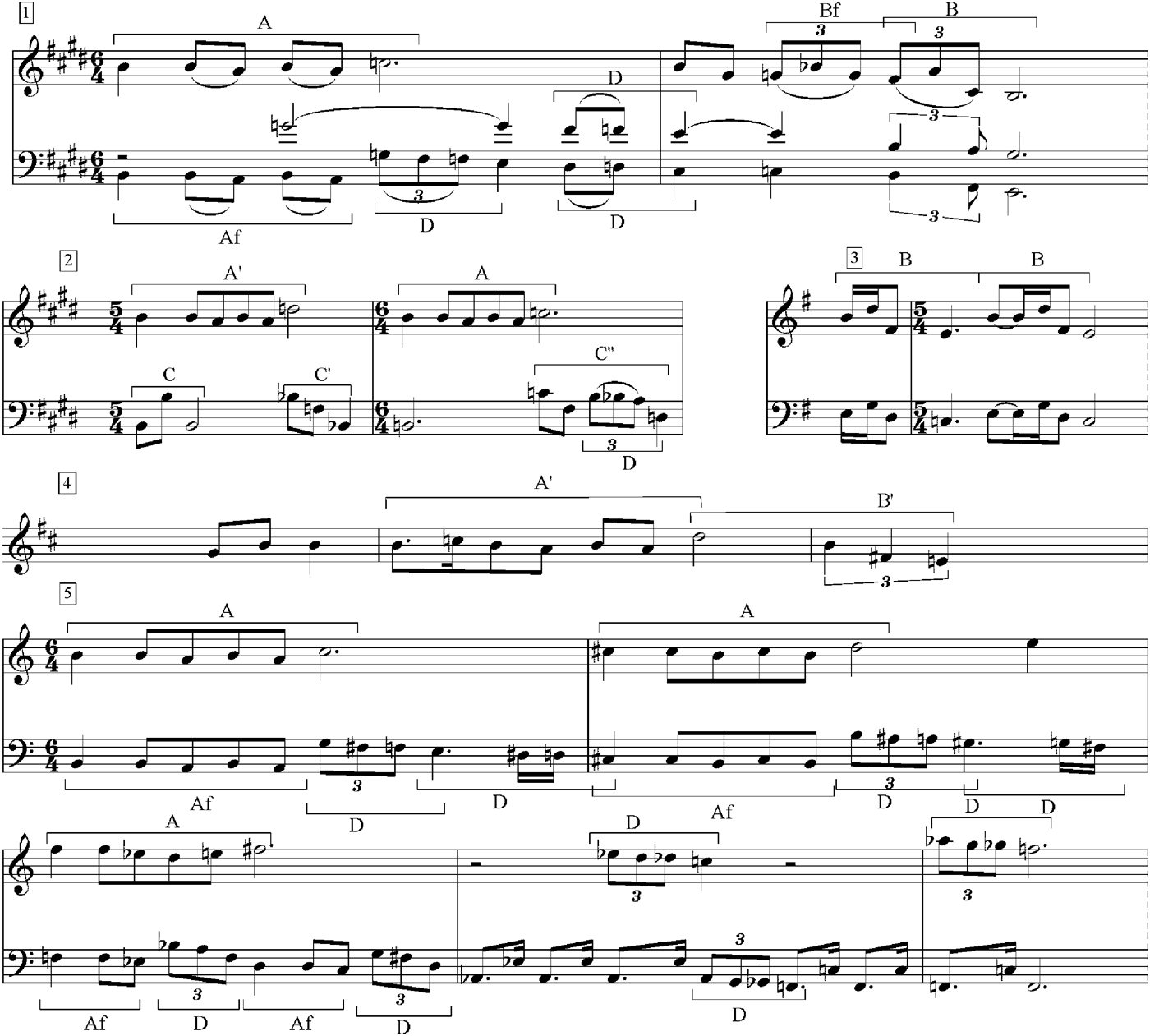
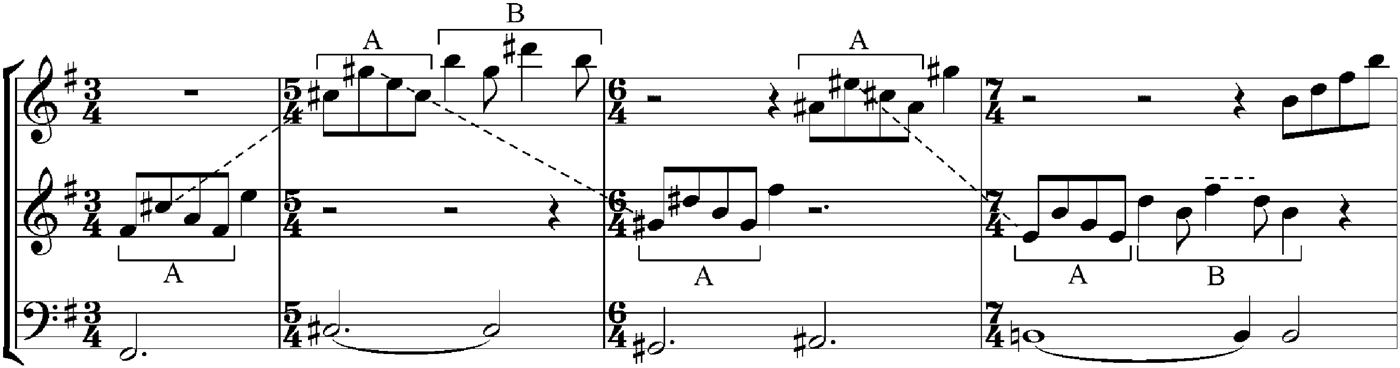
‘Pantagruel's Nativity’ is one of several Gentle Giant songs with allusions to François Rabelais’ La vie très horrifique du grand Gargantua père de Pantagruel (Lyon, 1534). Gerhard Zimmermann (Reference Zimmermann1994) has provided a short analysis of this song, where he outlines the main motives used (which do not correspond exactly to those presented here) and goes some way towards suggesting some of the ways in which they are deployed – a creditable study, even if too short to disclose the connections between the motives and the entire song. The melodic material in the song is almost exclusively based on four motives, here named A–D, not according to their order of appearance, but to the perceived structural importance (see Example 1). A lower case ‘f’ is hereinafter used to illustrate an appearance of a motive in fragmented form. One may note the rhythmic similarity of B and D in these particular forms, but this is in fact of less importance since the same motivic types appear in many rhythmically dissimilar variants throughout the song.
Use of motives in “Pantagruel's nativity” (1: 00:00-00:10; 2: 03:10-03:17; 3: 00:56-01:00; 4: 01:17-01:21; 5: 05:35-05:56).

We can identify from the outset the motive D, a chromatically descending triplet figure at the end of the cited phrase in Example 1.2 (previously having appeared in Example 1.1). In Example 1.2 we find a motive appearing for the first time in a bass part, C (it is doubled by guitar, but hereinafter referred to as a bass riff, due to its function as a bass part). One could alternatively regard the first row of six notes as one motive stated twice, but what has been called C relates rhythmically to C’ (where the octave is divided at the fifth), something that is also projected by the performance phrasing of this row. This phrase appears as a riff below a vocal texture, which in turn consists of motive A in two different variants, both having appeared previously in the song. One of them ends with a rising minor second, the other with a rising minor third. Here the two variants are intermingled in alternation, appearing every other statement of the motive. They have, however, first been presented separately – A in the instrumental opening, A’ in the vocal verses; only later are they being juxtaposed as in Example 1.2. Example 1.4 shows a trumpet line interjected in the verses, an assemblage of A’ and B.
If we turn to Example 1.3, most analysts would immediately spot where in the song this has appeared before: it is an exact replication of motive B from the instrumental introduction (taken from its first appearance, where it appears as a closing figure: see Example 1.1). This kind of parsimonious use of melodic material, transfigured to a completely different rhythmical, accentual and harmonic character, is typical for Gentle Giant's music, but appears extremely rarely in popular music otherwise, the music of other progressive rock groups included.Footnote 16 What is interesting is that other major progressive rock groups such as Emerson, Lake and Palmer, Yes and Genesis typically open up a Schubertian plethora of ever-new melodies in their multi-sectional songs – something for which they are commended and admired by many commentators and critics. Gentle Giant alone seems to have cultivated the principle of melodic parsimony, a practice that requires sophisticated motivic permutation such as that of the B motive here, in order to be effective.Footnote 17 Even then, it is not easily spotted, but acts, I will argue, predominantly on a structural background level that affects even the motivically non-cogitant listener.
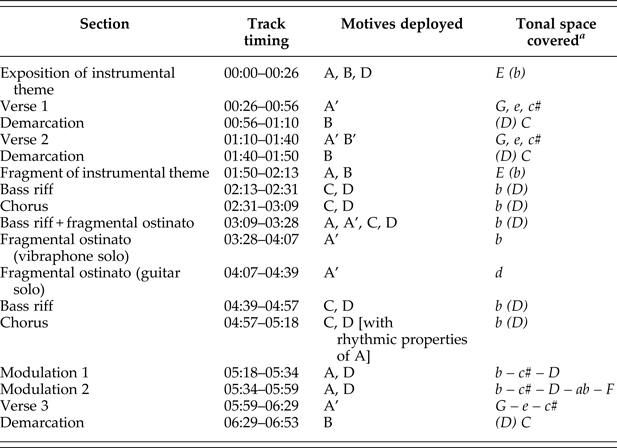
Table 1 suggests that harmonic analysis – the road generally taken in attempts to elucidate structures in progressive rock – is in itself insufficient for understanding the form of this song. If we turn first to tonal space, the far right column, it would suggest a tripartite form where two unstable tonal centres on G frame a central repeated oscillation of b – D (such an impression would be rooted in the return to G in the verses and the comparatively short duration of the intercalated passages, not as obvious in the table which does not reflect the duration of each tonal area). This may also be how most listeners experience the song on a surface, first impression level – what Cone calls ‘first hearing’, a mode of perception that is ‘temporal’ and ‘experiential’, ‘completely innocent of analysis’ (Cone Reference Cone and Morgan1989b, p. 85). (The notion is not to be understood as strictly idealistic, since Cone acknowledges, in context, different preconceptions for different listeners.) But this does nothing to explain why the passage beginning at 02:31 is experienced as a brand new section, rather than just a continuation of the tonal space b, being already in place in the immediately preceding section. It would be trivial merely to point out (as the motive column indeed does) that new melodic material is being introduced here, and this cannot in itself account for the effective sectionalisation (in which one must also acknowledge instrumentation and dynamics). According to the column of tonal space, the demarcation sections ought to be strong signals of sectionalisation, whereas the passage beginning at 02:31 should not. I doubt that any listener would experience it that way, however, and purport that the reason that these sections have a demarcating rather than a contrasting character is because they present a motive (B, rhythmically developed) which has already been smuggled into the exposition of the instrumental theme, and there exactly with a closing (rather than opening) character within a cadence that is effected by the lower parts, and in which the motive is therefore only involved at design level (see Example 1.1). Having been ‘loaded’ with the characteristics of closure before appearing in a different context and then as a demarcating device, motive B is not heard as a new opening – this seems to balance the fact that it introduces a completely new and unrelated tonal space (Example 1.3). Conversely, when the bass riff appears (Example 1.2), presenting a motive which has carefully been avoided up to that point (the first two and a half minutes are void of any quaver octave leaps, otherwise so highly characteristic for Raymond Shulman's style of bass playing), it is experienced in a familiar tonal space – the starting point of all instrumental passages up to then, even if these are concluded by cadences in E major – which makes it appear as a continuation of the instrumental theme. The motivic family A includes also melodic variations beyond those of A and A’. In the verses, the tonal spaces g / G is in actual fact motivically underpinned by the common form of A’ in the g / G section, the e / E section having instead a melodically inverted variant and the c# / C# section stating the motive A’ with the rising interval enlarged to a perfect fourth. This procedure prolongs the fundamental pitch of G throughout the verses.
Sectional form of ‘Pantagruel's Nativity’.
Notes: aThis harmonic parameter is certainly a matter of interpretation. Tonal or modal sections are frequently ambiguous, for which reason the present author has been guided primarily by what can be perceived as the fundamental bass in each section, i.e. that in relation to which all movement could be interpreted as voice leading (e.g. in each space of the harmonic row G – e – c# in the verses, both thirds are present, while there is an unambiguous fundamental bass and a clearer tendency towards minor in the last two segments). Letters in parentheses signify important cadential points or secondary tonal areas. For brevity of space, minor sonorities are given, according to German nomenclature, in lower case letters, major in upper case letters.
It thus seems that Gentle Giant kept the two levels of harmony and motivic development deliberately separated in order to increase the combinatorial possibilities. Satyendra, in a Keller-influenced analysis of Chick Corea's Starlight, has identified a similar situation of several operating layers of form, which he calls a ‘masking strategy’, ‘that is a strategy wherein a dominant feature camouflages a latent feature’ (Satyendra Reference Satyendra and Stein2005, p. 60). In the case of ‘Pantagruel's Nativity’ this also made it possible to conclude the entire song with the demarcation figure, stressing a tonality experienced only twice, and very briefly, in the song up to then (C major), only because it was used as a closing figure in the opening instrumental theme. It is unresolved on the motivic level (its 8–4–3 movement being rendered 8–4), but resolved on the harmonic level, ending for the first time on D major. The degree to which the B motive is deployed as a consequent to all other (antecedent) motives suggests an intentional deployment where the surface design is deliberately led to counteract the deep structure of harmony and voice-leading.
If we consider all instrumental sections of ‘Pantagruel's Nativity’ it appears that there is in fact a unity also between motivic and large-scale harmonic features. The overall harmonic scheme based on E as the fundamental pitch stressed in the first half of the song (instrumental theme and re-occurring fragments), with subsequent sections on B (bass riff and chorus) and C (demarcation) approaches what Schenker called ‘Übertragung der Ursatzformen’, that is, a transference of the forms of the fundamental structure to levels more close to the surface (Schenker Reference Schenker and Oster1979, pp. 242–6). This links the macrostructure of the harmonic sections with the microstructure caused by motive A (oscillation of fifth and minor sixth in relation to the fundamental pitch), something that can be seen harmonically in Example 1.1, where the cadence C major – B major – E major is the only feature that breaks up the chromatically descending part-writing. Interpolated within this sub-structure of the instrumental sections, the vocal verses move with a regular harmonic scheme – three transposed segments with mediant relationships, each a minor second lower than the former – the same oscillation as the b – D in the central section. If we turn to motives A in relation to the entire series of C motives as these appear in Example 1.2 (C – C’ – C’’), it is perfectly clear that they share a common outline: the bass riff in its entirety corresponds to motive A in the 6/4 bar of the example (a rising semi-tone step with lower second as auxiliary note) whereas the motive A in the 5/4 bar corresponds to the bass riff in the 6/4 bar (a rising minor second leap). The combinatory possibilities of this material suggest that the building blocks were in place first and that these in turn affected the large-scale sectional form.
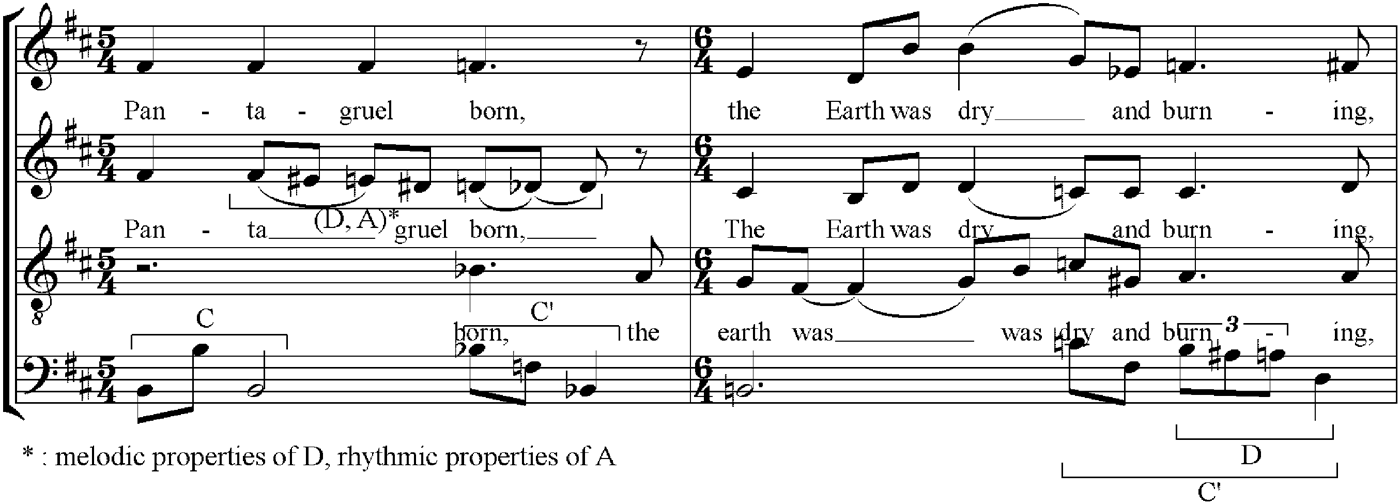
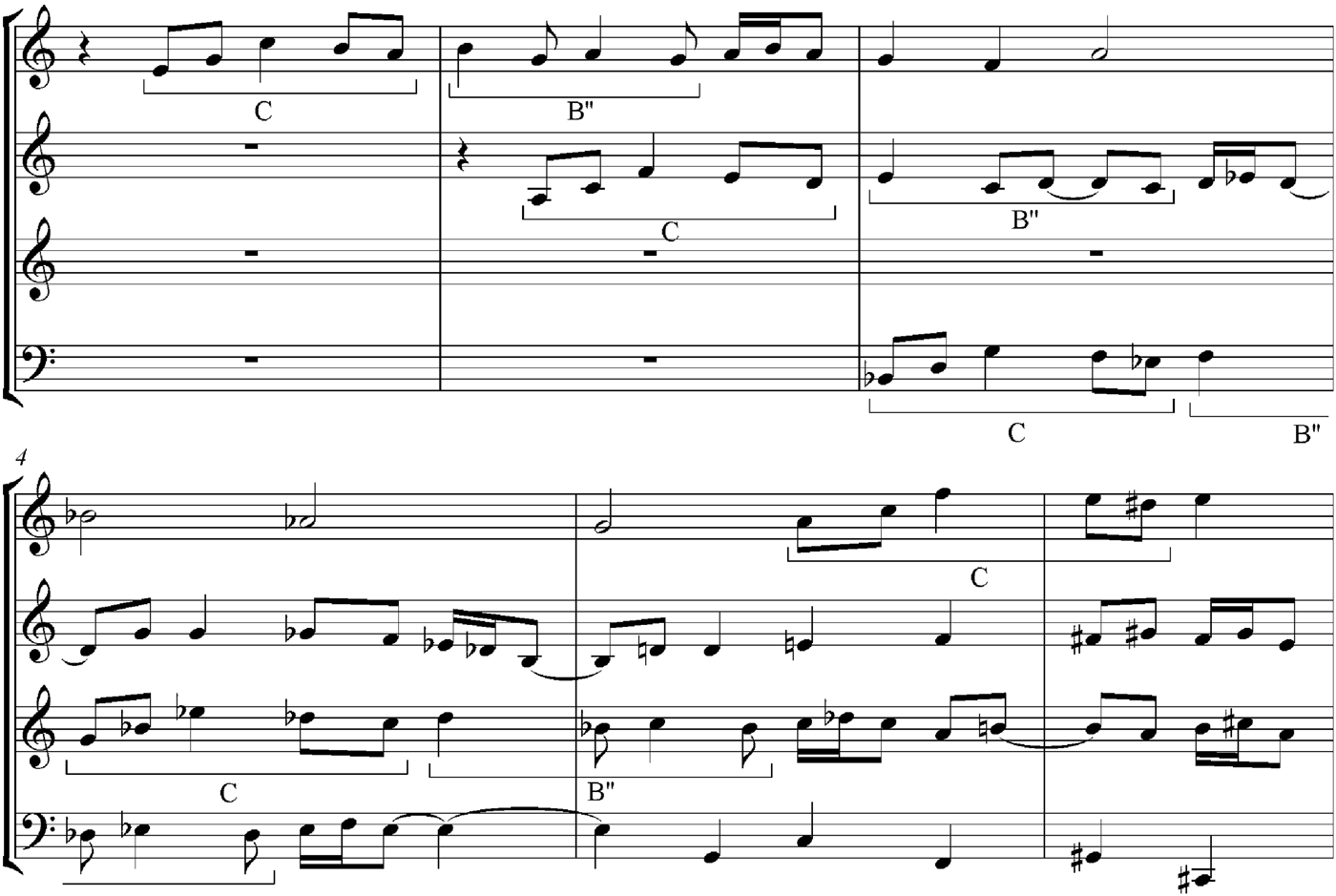
The polyphonic vocal chorus cited in Example 2 is superimposed over the previously introduced phrase constructed out of motive C, C’ and C’’, which in turn is kept separate from motivic statements in the upper parts. The chromatically descending material in the upper parts is a logical continuation of the motive D. An interpretation of the outline of rising thirds at ‘earth was dry and burning’ as related to motive B is less plausible – one could probably only argue for such a motivic connection with appeal to Schoenberg's mode of subconscious intentionality (see above). Motive A is present through its rhythmic properties in the second highest part in the first bar of the example (and indirectly also in the highest part).
Chorus over bass riff, “Pantagruel's nativity” (02:31–02:40).
By the end of ‘Pantagruel's Nativity’ there is a modulation that is interrupted, recommenced and which eventually leads only the second time to its aimed junction: the final vocal verse section (05:00 onwards). Example 1.5 illustrates that the modulation is extremely parsimoniously written, using exclusively the motives A and D in a straightforward row of rising sequences (the only non-motivic material is the dotted fifth leaps in the bass, seemingly inserted for the sole purpose of complementary figuration). Intensification is achieved on the surface level of dynamics by crescendo (a commonplace in progressive rock), but on the structural level by ever-closer entries of the D motive. Gerhard Zimmermann's comment on this in Proclamation is worth noting, since it seems to relate to this very procedure: ‘This “great” development sequence is certainly the weakest part of the song. With its pomposity it turns out rather academic and turgid’ (Zimmermann Reference Zimmermann1994, p. 69). The editor of Proclamation, Geir Hasnes, felt obliged to include a comment that he disagreed with Zimmermann's judgement. The objection to ‘academic’ procedure is a well-established trope in the reception of progressive rock, also by some of its most ardent fans (see Atton Reference Atton2001). This is generally a broadly aimed criticism, but with Zimmermann's statement on the motivic concentration in the cited passage we may identify a concrete example of what was regarded as unfitting in the styles and genres of popular music. It is distinctly ironic, however, that he calls it ‘turgid’ (from turgidus, connotating something ‘swollen’ or ‘puffy’) when it is exactly the opposite – an extremely parsimonious and tight-fisted way of composing. Again, we see that it is perfectly possible to identify the structural features that appear to cause the reactions of the cited listener-commentators.
‘The Moon is Down’
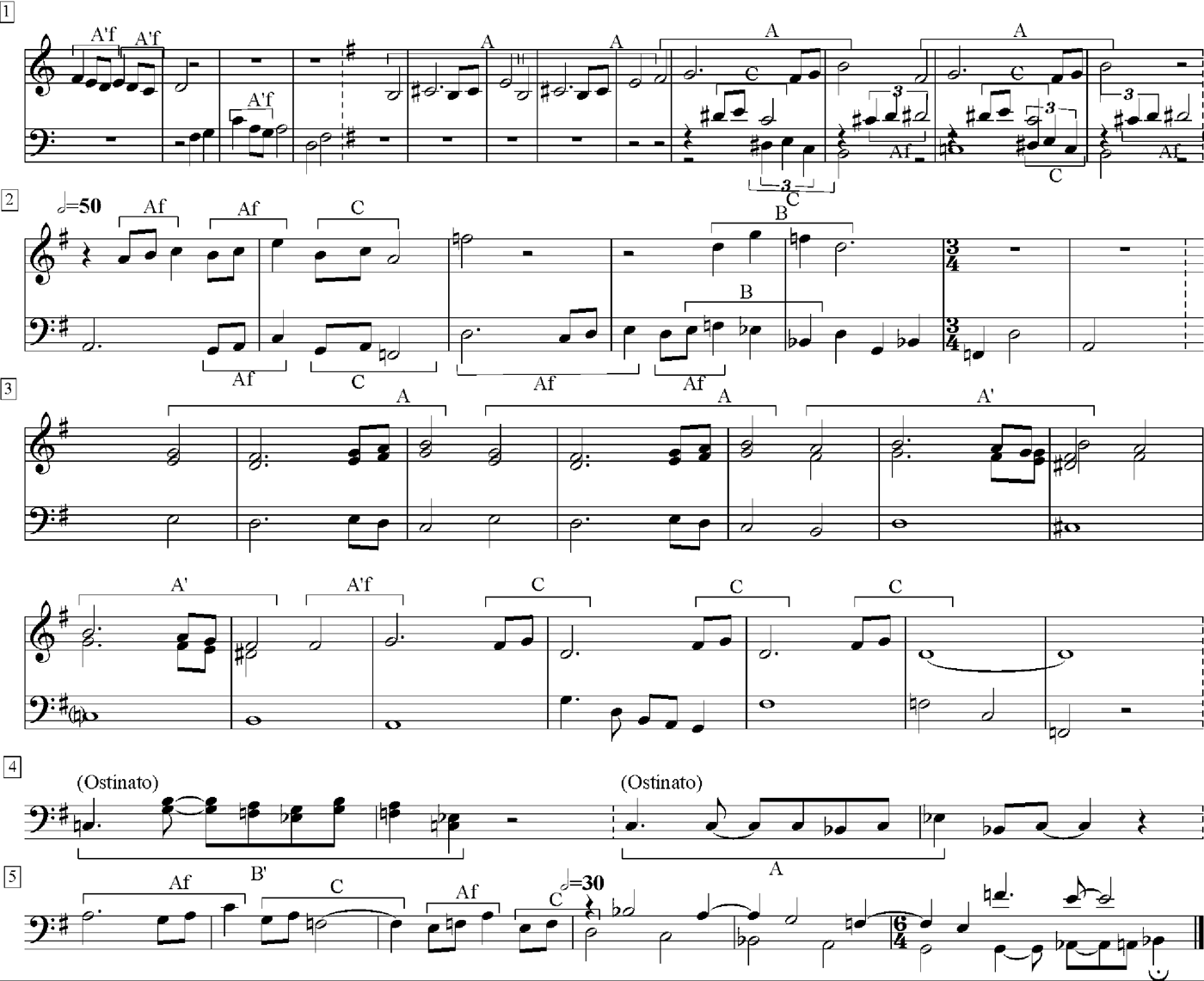
‘The Moon is Down’, the title and text of which are possible allusions both to Shakespeare's Macbeth and/or John Steinbeck's (1942) novel with the same title, is largely constructed on three motives, of which two are structurally predominant.Footnote 18 This song is, it seems, even more melodically concentrated and more clearly based on minuscule figures than ‘Pantagruel's Nativity’, employing also melodic inversion. The three motives are outlined by Examples 3.1–3.5:
Use of motives in “The moon is down” (1: 00:00-00:28; 2:00:38-00:00-50; 3: 01:00-01:22; 4: 02:16-02:46; 5: 04:07-04:26).
Here the motivic density is higher on the rhythmic than on the diastematic level. The interpretation of A’ as an intentional inversion of A is suggested by the way in which this motive is used in the third section of the song (Example 3.3), where two equivalent passages give the motive in inversion at the fourth, further on with the same melodic material but with opposed rhythmical relationships (two quavers to one crotchet becomes one crotchet to two quavers). Interestingly, it is in the latter form that the motive is first presented. If we consider the introduction, (Example 3.1) the motive appears first in the A’ form (fragments and full statements), then in the form which is tantamount to the vocal passage (here given without lyrics) in Example 3.3. At the end of Example 3.3 the motive C is used in a modulating codetta. This procedure is typical for the earliest and most ambitious motivic development of Gentle Giant. The motives are first presented in permutated forms, only then to be stated in the form that is most easily melodically spotted (this contradicts Hasnes’ statement of thematic exposition followed by development, see above).
Thematically pithy passages are often consistently deployed as ‘verse and refrain’ – the motives are here assembled to melodical phrases. That the reverse case (the motives and the motivic passage-work having been deduced from an initially conceived melodical phrase) is unlikely becomes clear if one considers the alignment and the reappearances of the motives within the phrases, but also (incidentally) from the sheer fact that they are not, at a Conian ‘first hearing’ level, catchy melodies of any kind.Footnote 19 In ‘The Moon is Down’ the mentioned procedure happens in Example 3.2, which includes all three motives. It lies close at hand to suggest that this procedure provides a key to the poietic genesis of the songs – one could compose such passages first and then interfoliate sections where this material is fragmented. That such is again not likely the case with these songs is almost always evident from the fact that these passages let themselves be so readily combined with entire phrases consisting of motives in permutation. We saw this in ‘Pantagruel's Nativity’ (Examples 1.1–1.5), and there are several other similar cases throughout the album Acquiring the Taste. As with all contrapuntal music, one must already in the conception of the melodic material take into consideration its combinatorial possibilities. The very term ‘motivic saturation’ implies exactly that the poietic process is: (i) motive – (ii) construction of phrase-bound structure out of motive – (iii) re-working of the phrase-bound structure with motivic passagework (saturation). This appears to have been the case in ‘The Moon is Down’. If one should insist in speculating over which motivic layers must have been in place first, one may tentatively assume that ostinato passages such as those in Example 3.4 would (or at least could) have been contrived at a late stage (in the second ostinato we find a phrase exactly like the one in the bass in Example 3.2). Then what has been marked as motive B’ due to its intervallic outline C – (G) – F – Eb – (G – F) – C may in fact well have been derived from A. Uncertainty of interpretation must be reserved for cases like this: an analysis without such ambiguities would without doubt leave one highly apprehensive (Dahlhaus [1975, p. 17] firmly held that ‘flawlessness of an analysis, although it may be taken as a triumph of a method, is a reason for scholarly mistrust’).
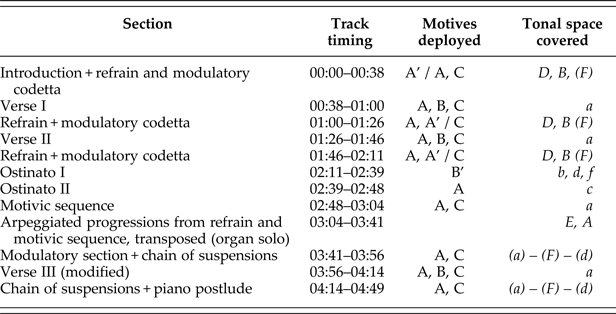
An analyst preferring a looser diastematic typology could possibly argue with some justification for a conflation of the motives here termed A and C, the latter then interpreted as a variation of the last three notes of the former. This would, however, blur the way in which the two are kept apart in Examples 1.1, 1.3 and 1.5. Motive B stands out just as the motive C in ‘Pantagruel's Nativity’, not least through the way it is used. It is consistently kept apart from the other motives both by musical structure and by the lyrics, appearing vocally only with the exact text ‘the moon is down’, and moreover sung on all occasions but the last one by a separate voice (that of Kerry Minnear, the rest of the text being sung by Derek Shulman). As can be seen in Example 2, Minnear's statement of the four notes in motive B appears slightly out of tonal space (outlining d minor when the music is moving flatwards, its g has to be re-interpreted harmonically). The relief in which this motive appears is reinforced further by the fact that the sentence ‘the moon is down’ is at best only indirectly connected with the text of the three verses. The text ‘the moon is down’ having appeared thus in motivic, textual and timbral isolation (suggesting, with the use of Minnear's voice, a persona separate from that of the lead singer) it is ‘resolved’ in the last and firmly slowed down verse by being sung by Derek Shulman to the motive C (‘now the old moon is down’ at 04:13), a climax which ends the motivic work by plunging directly to the chain of suspensions previously played after the last modulatory section, signalling that the song is over. Before all is silent, however, the bass ascends with the same form of A motive fragment that was used at the end of Example 3.1 (see the end of Example 3.5). The concluding piano arpeggiations are ‘atmospheric’, using the same reverberation as for the introductory saxophone trio. They are not motivic, but may in texture be intended as reminiscent of the section at 03:41.
What is called motivic sequence in Table 2 is a longer melody played by saxophones, identical to the bass part of the verses (invertible counterpoint) and that of the modulatory section. In the verse (Example 3.2), the A + C compound theme is stated once, in the modulatory section (Example 3.5) it is stated twice, whereas in the section at 03:04 it is stated three times (with new rhythmic phrasing). Motive C is used in the modulatory codettas (these always follow the refrain, marked A / C in the table, to stress that motive C does not appear until the refrain is over, after which point the A motive is absent). This highlights the flexibility of the building block design, as ‘pure motif’ and their relation to the whole, interpreted here as structural form (see Hanninen Reference Hanninen2001, pp. 386–7).
Sectional form of ‘The Moon is Down’.
‘Black Cat’
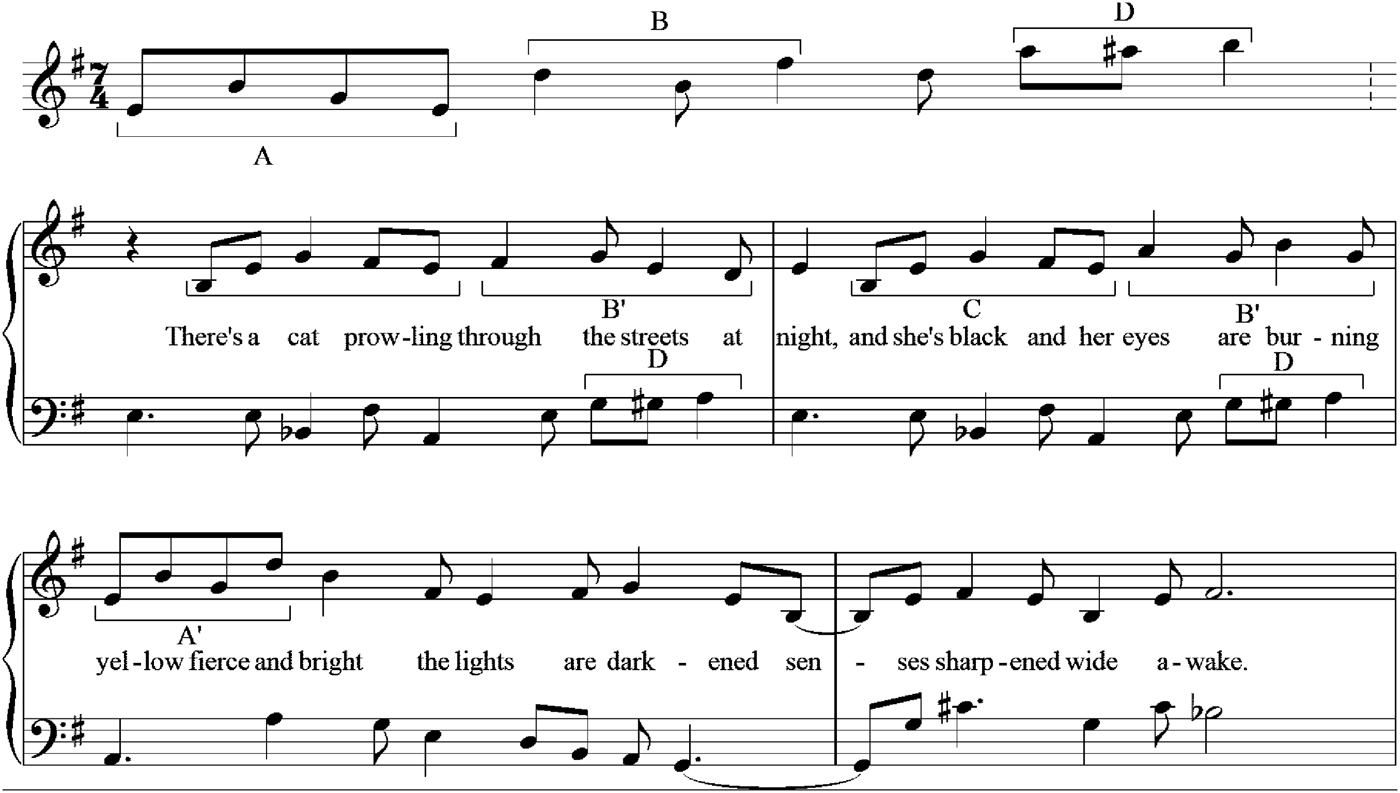
If the two ostinati in Example 3.4 opened up for discussion of partial monothematicism (A and B being more closely related than the other motives in ‘The Moon is Down’), all melodic material found in the song ‘Black Cat’ can be formed by combining four short motives, all consisting of minor triads in different order, three of which appear in the opening figure (A and B; again motives are not ordered according to their order of appearance, but according to their perceived relations). See Example 4.
Opening motive (0:00-00:04) and first verse (00:29-00:44) of “Black cat”.
All three motives A–C are in their basic forms internally related as far as pitch content is concerned. The reason why we have chosen to consider B as one motive with two cells, rather than as two statements of the same motive in transposition, is the suggestion of a closer relationship with motive A, both being minor triads in ‘closed’ sequential order (beginning and ending on the same note).Footnote 20 B’ is rhythmically identical to B, with steps in the opposite direction to the leaps in B. The amalgamated motive CB has the rhythmic properties of B and the melodic outline of C in the inverted form appearing in the transition section in Example 5.
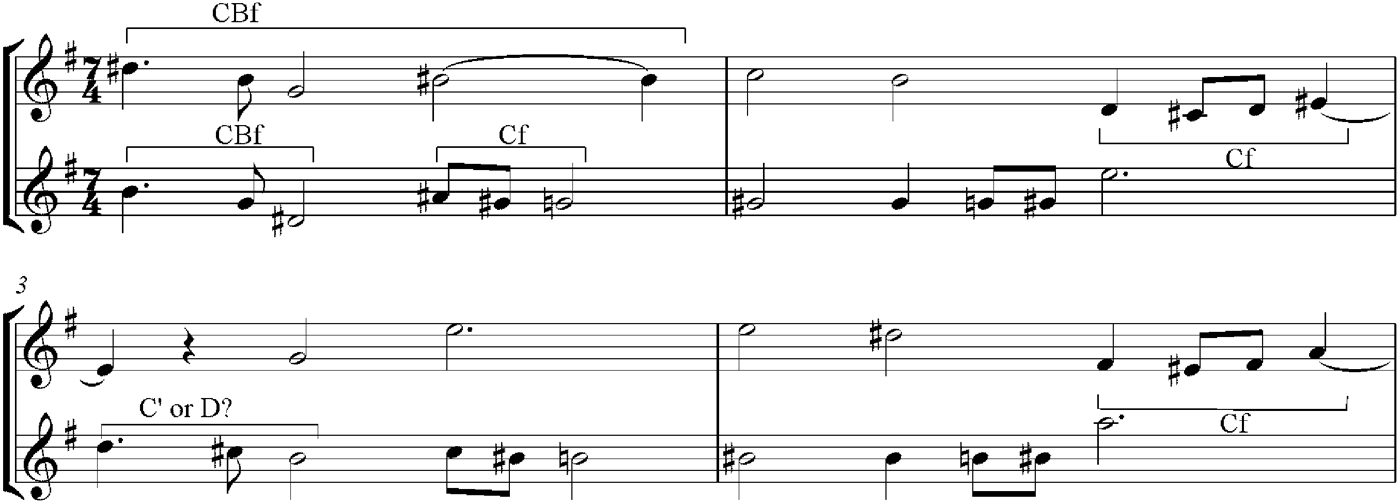
Middle parts of transition passage (02:00-02:17), “Black cat”.
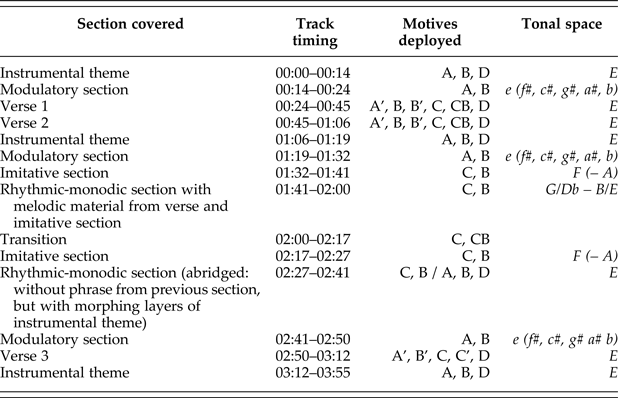
Harmonically, we have here, similarly to ‘Pantagruel's Nativity’, a rather straightforward tripartite large-scale form (Table 3). Motive D has a framing function – appearing only in the opening and closing verse sections, and then always in e minor without diastematic variegation, it is clearly the least structurally important for the song. Thus the design of the motivic surface reinforces the structure, rather than simply coinciding with it. Just as in ‘The Moon is Down’, we see that the verses contain a summa of all motives.
Sectional form of ‘Black Cat’.
CB is, to all intents and purposes, a melodic inversion of C, but what reasons are there to suspect that this is not only de facto, but also deliberately so? Firstly, it would otherwise be the only non-motivic substance of the verses (see Example 4). Furthermore, it appears separately and emphatically in the non-tonal transition at 02:17–00:27. Although not easily spotted by ear due to the harmonic context, that section opens with that motive in dissonant consecutive movement in all parts. Example 5 shows its appearance in the two middle parts, and it appears also in other parts of this brief section (note the canonic structure of these parts). After the initial statement of C’, we see that this motive merges with D, resulting in the same ambiguity as with B’ and A in ‘The Moon is Down’ (Example 3.4). The identical rhythmical properties of motive D and the first three notes of C leave several motivic interpretations rationally available. The three-note chromatic figures in this passage cannot, in spite of their being audibly similar, be interpreted as D tout court, since half of them have completely different melodic outlines, with neighbouring notes rather than one-way linear motion, thus also with completely different consequences for deeper structure.
The first rhythmic-monodic section (at 02:41–) bitonally presents the same combination of motives that form the entries in imitative sections; the resulting phrase is stated in D flat against a dissonant non-motivic accompaniment with G as fundamental pitch. In the second rhythmic-monodic section the instrumental theme consisting of A, B and D in sequential order (as in Example 4) is morphed by layer, i.e. treated as two separate structures, the first shifting and fading into the other (something completely different from the amalgamation of motives mentioned above): in effect the modulatory sections follow attacca, but the two layers are phased over each other, something that was probably achieved in the studio after the recording session.
The compositional gambit of acceleration through harmonic pulse and motivic intensity encountered in Example 6 belongs to a commonplace in progressive rock.Footnote 21 The way in which the passage given here differs from all similar instances known to the present author in the music of bands other than Gentle Giant is that the intensification is not evenly progressing one way. Instead it proceeds unevenly, twice interrupted by intercalations of motive B. As opposed to the modulatory passage in ‘Pantagruel's Nativity’ discussed above, the harmony here follows the motivic development closely, each A motive introducing a new minor chord. The acceleration is achieved solely by the motivic densification of the third bar of the example: apart from that point, the passage would be bound to a simple phrase structure: ||: A + AB :||. Moreover, apart from the ‘gap’ in the third bar, modulation is driven by the fifths of the A motive, each new entry falling on the fifth of the preceding entry (since there are no major harmonies, the deeper voice-leading effect is rather weak). Any comparison of this procedure to the Genesis and Van der Graaf Generator examples referred to, would have to acknowledge the higher degree of motivic control of the present example, but also that it sounds much more balanced, prolonging the acceleration so that the passage does not ‘crash’ into the following section immediately, but dwells on the moment of climax before proceeding to the dominant root function of the last bar of the example. Note how motives A and B are used to supply the  ${6 \over 4} = {5 \over 3}$ suspension melodically:
 $\hbox{A}\colon {6 \over 4}\semicolon \; \hbox{B}\colon {5 \over 3}$. The motives are worked into the fabric of structure of harmony and voice-leading rather than superimposed on the surface level of design.
Modulatory section in “Black cat” (00:13–00:23).
A brief contrapuntal section for strings (Example 7) occurring twice is strictly imitative, but in no way fugue-like harmonically, the entries following instead a flat-wards scheme (C – F – Bb – Eb), moving by enharmonic re-interpretation (the enharmonic spelling is of course that of the author's transcription) in its first instance back to a loosely tonal section based on G, on its second reprise to a corresponding passage transposed to E.
Imitative section in “Black cat” (01:31–01:40).
Motivic development variation and saturation: the function of motives within musical entirety
As has been said, the term ‘motivic saturation’ suggests a poietic hypothesis, implying as it does that motives have either (i) been conceived first or (ii) been identified within phrase-bound structures and later reintroduced devoid of their original context. To speak of ‘motivic development’ one must ascertain a scheme that makes the process distinct from mere ‘motivic variation’ (one could argue, for example, that the melodic treatment of the three verses of ‘Pantagruel's Nativity’ offer variation without development). By any definition, the middle section of ‘Pantagruel's Nativity’ amounts to development, since it reintroduces previously encountered motives with new rhythms and musical functions, but it also introduces a motive until then unheard (C). The difference between the motive within the phrase-bound structure of the synthesiser passages (found both in the intro and interpolated between the guitar rendition of motive A) on the one hand, and the specific variant of the demarcating motive (see Example 1.3) is not merely one of contrast, but of re-composition, the new variant apparently being filled with new intentions and implied instructions for how it should be heard. Since the purpose common to the synthesiser interfoliation and the closing motive in Example 1.3 is one of demarcation, one may aptly speak of motivic development, but with a specific function as regards the sectionalisation of the large-scale form.Footnote 22 The situation is similar with the combination of motives B and C in ‘Black Cat’.
Regardless of the particulars in the compositional process, it must be regarded as without doubt that Kerry Minnear, Raymond Shulman and Gentle Giant adhered to some principle of melodic parsimony, thereby achieving an overall impression of cohesion also among listeners who are unaware (either due to listening habits or to insufficient musical perception and understanding) of the details in musical design and structure. Edward Cone's conception of musical unity and logic on the level of the individual work is equally perceptible and experiential on that semiotically ‘lower’ level of listening: ‘What is often referred to as musical logic comprises just these relationships of each event to its predecessors and to its successors, as well as to the whole’ (Cone Reference Cone and Morgan1989a, p. 41). Edworthy's conclusion that intervallic information is less readily grasped and memorised than contour and curvature, but also less easily lost by memory once internalised, may well account for the efficiency of form that appears to defy a rather inaccessible melodic style by means of sheer mass repetition (some main motives appear more than a hundred times in the three songs analysed here, as compared to a phrase-bound structure song of the same duration, where the main melodic units would occur on, say, 12 or 16 occasions). Without making precipitous conclusions as to the complex matter of musical cognition, it seems clear that the songs under discussion are experienced by the listener-commentators quoted above in a way depending to a great extent both on perception and memory. A loosely phrased observation of Schoenberg is certainly relevant in the light of Cone's and Edworthy's contributions (in themselves otherwise not necessarily related at all): ‘[T]he role of memory in music evaluation is more important than most people realise. It is perhaps true that one starts to understand a piece only when one can remember it at least partially. But memory must be nursed and given opportunity to function’ (Schoenberg Reference Schoenberg and Newlin1950b, pp. 183–4). I purport that this sheds light on the aesthesic level – the experiential reception – of the motivic parsimony described and analysed in this article primarily on the immanent level of the recorded songs. I would be more careful to suggest that this was always pre-meditated in the poietic process of the composers, and would also like to stress that since it is noted that Gentle Giant stands apart from a majority of other contemporary British progressive rock groups relating to sectional form, the situation is most likely very different in the music of these bands, where very different structural approaches and methods most likely are of prime importance.
Conclusions and outlines for further research
We can see that Gentle Giant make distinctive use of melodic parsimony and motivic passagework in a way that is not normally associated with popular music. Interestingly, many commentators with great interest in this music appear to be unaware of this fact, in spite of their comments concerning unity on a general level. What then, about the link proposed in this article between immanent structure and the experience of the non-cogitant listener? This is fully in line with Dahlhaus’ general remark on Mersmann's Substanzgemeinschaft theory: ‘That the component parts of which a form consists are shown, under the scrutiny of the analyst, to be different expressions of the same substance should be an explanation for the impression of a conciseness which proceeds from the work, without the unsophisticated listener's being conscious of the reasons’ (Dahlhaus Reference Dahlhaus1975, p. 12). This article makes the statement that (sophisticated) listeners and analysts have, as of yet, not attempted to link perceived aspects of compositional control and unity to specific features in the music discussed, nor hypostatised any theory as to how and why these are in fact exponents of compositional control and unity. It has been suggested here that Gentle Giant employ motivic writing on surface levels (what Rothgeb calls ‘design’) sometimes to support large-scale harmonic and voice-leading structures, sometimes to deliberately depart from them in order to bring about demarcation or connection across the borders of structural segmentation.
An interesting matter for further analysis is the eventuality of possible standard patterns for motivic work in Gentle Giant's music. One such recurring procedure appears to be interrupted modulation based on small motives in the final sections of a song, immediately followed by a reprise of a passage from motivic ‘core sections’ in their original tonal space.Footnote 23 We have seen this in ‘Pantagruel's Nativity’, ‘Black Cat’ and it happens also in the songs ‘Wreck’ (from Acquiring the Taste) and ‘Why Not?’ (from the album Gentle Giant, 1970). In ‘The Moon is Down’ the corresponding passage is slightly different in procedure. Motive A is present in this harmonically motile passage (Example 3.5), but it is thwarted into a series of suspensions. (As we saw, however, the piece is finished with a fragment of motif A.)
Motivic connections between seemingly distinct passages or sections occasionally resemble historical contrapuntal idioms (e.g. by Vorimitation and imitative fragments against larger thematic units) and on the album Acquiring the Taste there are also melodic and textual allusions in between the different songs: ‘The Moon is Down’ borrows melodically from two other songs and is connected by the text to one other (it contains the words ‘At the edge of twilight’; a separate song titled ‘The Edge of Twilight’, in turn, commences with the words ‘The Moon is Down’). It is the frequency and diversity of motivic details in these structures that makes one wonder if Gentle Giant foremost used this way of writing to achieve a desired effect of large-scale form, or if the band primarily wished through these details to communicate to their listeners on a meta-level (‘listen to what we've done here, can you hear where this comes from?’) that does not necessarily, although possibly incidentally, affect the overall first impression of the songs for most listeners. After having examined closely the eight tracks on Acquiring the Taste, the present author rather tends to believe that the latter intention sometimes may have dominated. Yet, I would contend that the connections, demarcations and integration of form achieved by the motivic parsimony operate on levels in the overall background impression of the songs, regardless of whether or not they are perceived and comprehended by the listener and that this could in some instances explain how and why many listeners are strangely impressed by form and facture in this music, also without having seen its strict organisation.Footnote 24
The examples chosen for study in this article are taken from Gentle Giant's second album, one that seems to be viewed by fans and music critics as in some respects musically premature. Discussions on online fora and review sites seem to point to the third through to the fifth albums (Octopus, 1972; In a Glass House, 1973; The Power and the Glory, 1974) as the peak both artistically and judged by complexity, while the remaining five albums (1975–1980) miss the mark in both respects. Further studies could elucidate if the motivic parsimony has a role in this historiography and reception.
The three works that have been analysed here are, on account of their relatively simple sectional form, perceived intuitively as songs – certainly more so than the large-scale song structures of Yes, Jethro Tull and Genesis, who are perhaps more aptly described as multi-movement suites, or linked groups of separate songs.Footnote 25 Yet all three songs adhere to the general characteristics of British progressive rock, as outlined in the outset of this study, featuring much greater variety and contrast as regards metrical structure, timbre, texture dynamics and harmony than that found in mainstream contemporary popular music. Since these contrasts are sharper, they demand stronger motivic unity than do songs in the said mainstream, which often derive their unity exactly from timbre, dynamics and harmony.