Social relationships take on particular significance for well-being in older adulthood when many individuals increasingly rely on their network members for support in the context of declining physical and cognitive resources (e.g. Pinquart and Sorensen, Reference Pinquart and Sorensen2000). The interactions that define an individual's social world are often complex, characterized by relationships of varying emotional closeness, geographical proximity, and functional roles (Antonucci et al., Reference Antonucci, Fiori, Birditt, Jackey, Lamb and Freund2010). Scholars have recognized the multifaceted nature of social relations by defining key elements of social relationships in terms of network structure (e.g. network size, proximity, and contact frequency), relationship function (e.g. the perceived availability of social support) and relationship quality (e.g. subjective satisfaction with networks; Cohen and Wills, Reference Cohen and Wills1985; Fiori et al., Reference Fiori, Smith and Antonucci2007; Antonucci et al., Reference Antonucci, Fiori, Birditt, Jackey, Lamb and Freund2010). Each of these social network components has the potential to shape the context of development in different ways by directly influencing well-being, and/or by providing compensatory resources that are accessed during times of need (Cohen and Wills, Reference Cohen and Wills1985), including the experience of aging-related resource deficits such as poor health.
In the present study, we consider associations of network structure and subjective perceptions of relationship quality with mental health in a sample of older adults. Despite numerous previous studies, debate still exists with regard to how specific network attributes contribute directly and indirectly to well-being in later life (Litwin, Reference Litwin2011). Our aims were to examine direct associations of network structure and relationship quality (positive and negative social exchanges) with mental health, and also to examine whether these network attributes play different roles in moderating the association between SRH and mental health.
Social network attributes and mental health in older adulthood
In recent years, a number of researchers have approached the complex nature of social networks in later life by adopting profile-based methods. These methods are aimed at identifying subgroups defined by different constellations of social network characteristics. The identification of network types, as opposed to focusing on individual social variables, provides an effective method for considering which different combinations of network attributes tend to characterize social relationships, and how these different network types are related to well-being outcomes (Litwin, Reference Litwin2001; Fiori et al., Reference Fiori, Antonucci and Cortina2006).
Profile-based studies have typically identified network types using cluster-analytic techniques, with types defined according to different combinations of structural network attributes (for a review see, Antonucci et al., Reference Antonucci, Fiori, Birditt, Jackey, Lamb and Freund2010). Studies of this type have tended to reveal a relatively consistent pattern of network types that include: (1) smaller networks characterized by family connections, (2) larger networks characterized by diverse relations, (3) larger friendship-centered networks, and (4) restricted networks characterized by few ties (e.g. Litwin, Reference Litwin2001; Fiori et al., Reference Fiori, Antonucci and Cortina2006; Doubova et al., Reference Doubova, Perez-Cuevas, Espinosa-Alarcon and Flores-Hernandez2010; Litwin, Reference Litwin2011). Importantly, studies of network profiles have also shown relatively consistent patterns of association between network types and mental health. For example, individuals classified into restricted network types (indicating fewer social support resources), tend to fare worse on measures of mental health and well-being relative to those with more diverse, and friend-focused networks (e.g. Litwin, Reference Litwin2001; Fiori et al., Reference Fiori, Antonucci and Cortina2006; Litwin and Shiovitz-Ezra, Reference Litwin and Shiovitz-Ezra2011).
Theoretical perspectives on social relations and health also point to the importance of considering functional, as well as structural, network attributes as resources for well-being. According to Cohen and Wills (Reference Cohen and Wills1985), structural and functional network resources are likely to affect well-being via different pathways. Network structure is thought to contribute directly and positively to physical and mental health by affecting the availability of resources and opportunities that determine possible behavioral and emotional responses (Berkman et al., Reference Berkman, Glass, Brissette and Seeman2000). For example, being socially integrated provides opportunities to fulfill role expectations, thereby creating positive affect, increasing self-esteem and sense of purpose, and suppressing stress-related neuroendocrine responses (Cohen and Wills, Reference Cohen and Wills1985; Berkman et al., Reference Berkman, Glass, Brissette and Seeman2000; Thoits, Reference Thoits2011). Similarly, having access to larger networks increases the availability of informational support, potentially facilitating goal attainment (Thoits, Reference Thoits2011). In contrast, perceived availability of social support (a functional resource) is regarded as primarily supporting well-being through its role as a coping resource. Considerable evidence suggests that social support buffers the effect of stressful events on psychological distress (see Cohen and Wills, Reference Cohen and Wills1985; Kawachi and Berkman, Reference Kawachi and Berkman2001 for review). This can occur as social support reduces negative appraisals of potentially stressful events, lessens negative affective stress responses through enhanced emotion regulation, and activates resources (e.g. financial help) in response to needs (Cohen and Wills, Reference Cohen and Wills1985; Thoits, Reference Thoits2011). In addition, social support can dampen physiological stress responses, and has positive effects on endocrine, cardiovascular, and immune systems (see Uchino et al., Reference Uchino, Cacioppo and Kiecolt-Glaser1996 for review). An early review of the social support literature generally supported the main effect (structure) and stress-buffering (function) models (Cohen and Wills, Reference Cohen and Wills1985); however, a number of more recent studies have also reported main effects of functional network characteristics (i.e. supportive relationships) on health and well-being (Thoits, Reference Thoits2011).
Finally, it is important to recognize that interpersonal relationships not only benefit health and well-being, but can also represent significant sources of strain and tension (e.g. Newsom et al., Reference Newsom, Nishishiba, Morgan and Rook2003; Rook et al., Reference Rook, Luong, Sorkin, Newsom and Krause2012). For example, research has shown that those experiencing problematic or ambivalent relationships (characterized by both tensions and positive exchanges) report poorer physical and psychological health than those with more exclusively supportive relationships (Rook et al., Reference Rook, Luong, Sorkin, Newsom and Krause2012). Some research also suggests that negative interpersonal exchanges are more strongly (negatively) associated with subjective well-being than positive exchanges (Newsom et al., Reference Newsom, Nishishiba, Morgan and Rook2003).
We are aware of one previous study that has complemented a profile-based approach focused on structural network attributes, by also considering measures of positive and negative relationship quality as independent predictors of depressive symptoms in a sample of older adults. Litwin (Reference Litwin2011) examined whether network types (restricted, diverse, friend, family, and a “congregant” network characterized by frequent religious participation) accounted for variance in depressive symptoms independently of subjective ratings of positive and negative relationship quality with family, friends, and spouses. Results revealed no direct associations of relationship quality ratings with depressive symptoms; however network structure was a reliable predictor, with those in the friend, congregant, and diverse networks less likely to report high levels of depressive symptoms than those in the restricted network.
Subjective ratings of relationship quality of the type used by Litwin (Reference Litwin2011), as well as those used in the current study, ask participants to evaluate the extent to which their network members typically provide care and emotional support, and as such reflect functional (i.e. perceived support) as well as quality-focused network attributes. Consequently, in light of the main effects, and stress-buffer models outlined above (Cohen and Wills, Reference Cohen and Wills1985), it is perhaps not surprising that Litwin's (Reference Litwin2011) analysis revealed direct associations of network structure, but not function, with depressive symptoms, as benefits of network function might only become evident in the context of stress, or resource deficits.
The present study
Consistent with Litwin (Reference Litwin2011), in the present study we extend previous profile-based approaches to social networks in later life by considering the relative contribution of both network structure (captured by membership of network types) and relationship quality to prediction of mental health. Importantly, our analysis includes assessment of associations of negative, as well as positive social exchanges with mental health. We also aimed to extend previous findings by shedding light on the potential roles of these multiple network attributes in moderating the association of poor physical health – a key aging-related resource deficit (e.g. Mulsant et al., Reference Mulsant, Ganguli and Seaberg1997) – with mental health. Evidence regarding the relative importance of different social network resources in protecting against the negative consequences of poor physical health for mental health provides information about the processes underlying links between resource deficits, social networks, and well-being. A better understanding of such processes could help to inform development of social interventions designed to promote resilience among older adults experiencing declining health (e.g. Thoits, Reference Thoits2011).
Health status was operationalized using SRH, consistent with previous studies of resource deficits and social networks (Antonucci et al., Reference Antonucci2001), and the numerous studies that have shown SRH to be a reliable predictor of objective indicators of health, such as cardiovascular disease (Kaplan et al., Reference Kaplan1996) and mortality (Jylhä, Reference Jylhä2009). Based on Litwin's (Reference Litwin2011) findings, we expected that network structure would be directly associated with mental health, with those reporting fewer structural resources reporting poorer mental health relative to those with more diverse structural resources. We also expected that relationship quality would emerge as a moderator of the SRH – mental health association, with those reporting poorer SRH being less likely to also report poorer mental health if they possessed high quality relationships (indexed by more frequent positive, and less frequent negative exchanges).
Our analysis was based on a large sample of midlife and older Australians with diverse network characteristics. Participants were, however, recruited from a member-based seniors’ organization (see method), and consequently are not representative of the general Australian population. Consequently, our focus was on examining interrelationships among variables, rather than aiming to identify modal patterns of social network characteristics evident in the population. We followed previous studies (Litwin, Reference Litwin2001; Fiori et al., Reference Fiori, Antonucci and Cortina2006; Litwin and Shiovitz-Ezra, Reference Litwin and Shiovitz-Ezra2011) in applying a profile-based approach that categorized participants into network types based on combinations of structural network attributes. This enabled us to examine associations of different combinations of network attributes with mental health, and to contextualize the findings within the existing literature on network profiles and well-being in older adulthood.
Methods
Participants and procedure
The data were obtained from the nationwide Social Networks and Ageing Project (SNAP) survey of older Australian adults (Booth and the SNAP Team, Reference Booth2013). Participants were drawn from the membership of National Seniors Australia (NSA), a broad-based non-profit association providing informational and other services for seniors. Invitations to participate were sent to 10,000 members by email and to 2,500 members by post (depending on their usual method of communication with NSA), selected after stratification by sex and age (for details on sampling method, see Booth and the SNAP Team, Reference Booth2013). In the total sample, 54% of participants responded online and 46% by postal questionnaire. An effect-size metric was used to compare the online and offline samples on the study variables (Lindenberger et al., Reference Lindenberger, Singer and Baltes2002). Small effect sizes (< 0.22 SD units) suggested no substantial differences between participants according to mode of completion.
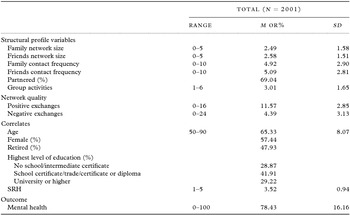
The SNAP sample consisted of 2,122 participants (response rate of 17%) aged 50 to 90 years (M = 65, SD = 8.10). The age distribution of the SNAP sample (and the NSA membership) under-represents relatively younger (ages 50–54 years) and older (ages 80 years and above) adults, and over-represents those aged 65 to 69 years relative to the Australian population. Of the initial 2,122 participants, 56 were excluded because they resided in long-term residential care or had missing data on this item. Exclusion of additional participants with missing values on more than 50% of the profile-defining social network variables resulted in the classification of 2001 participants into network types. Table 1 provides descriptive statistics for the 2001 participants included in the analysis. The proportion with missing data on each of the socio-demographic, SRH, and mental health variables was less than 5%. Participants with missing data were excluded analysis-by-analysis. The research was approved by the Australian National University Human Research Ethics Committee (Protocol 2009/360).
Sample descriptive statistics

Note. SRH = Self-rated health.
Measures
Social network structure
Social network profiles were defined using measures of network structure. A binary variable (partnered) distinguished between participants who reported living with a partner (n = 1,347) versus those not living with a partner (n = 604). Two measures of contact with non-co-resident family were included. Family network size was assessed with the question “How many individual family members, who do not live with you, did you spend time with in the past 4 weeks?” Responses were provided on a five-point scale: 1 (1), 2 (2 or 3), 3 (4 to 6), 4 (7 to 10), or 5 (11 or more). Frequency of contact with family (family contact frequency) consisted of the sum of two items (α = 0.81). Participants were asked, “On how many different occasions did you spend time with these family members in the last 4 weeks?” (Responses: 1 (once in the last 4 weeks), 2 (2 or 3 occasions), 3 (4 to 6 occasions), 4 (7 to 10 occasions), or 5 (11 or more occasions)), and, “How long did you spend with these family members in total in the last 4 weeks?” (Responses: 1 (less than 1 hour), 2 (1 hour to less than 5 hours), 3 (5 hours to less than 10 hours), 4 (10 hours to less than 20 hours), or 5 (20 hours or more)). The same items (i.e. number, frequency of occasions, and duration of contact) were asked in relation to contact with friends, and occasions and duration were combined to produce a friend contact frequency measure (α = 0.88). Participants who reported that they did not spend time with any non-co-resident family or friend were assigned a score of 0 on these measures. Participation in organized group activities was measured with the question, “In the last 4 weeks, how long did you spend in group activities?” Examples of group activities were cited as including participation in gym classes, committee meeting, church services or similar with individuals who are not generally considered as friends, and excluded time spent at work (Responses: 1 (did not attend), 2 (less than 1 hour), 3 (1 to 5 hours), 4 (5 to 10 hours), 5 (10 to 20 hours), or 6 (21 or more hours)).
Social network quality
Social network quality was assessed using measures of frequency of positive (expressions of care and interest) and negative (demands, criticisms, and arguments/tensions) exchanges in each domain of family and friend relationships using items adapted from Schuster et al. (Reference Schuster, Kessler and Aseltine1990). Two items assessed positive exchanges (e.g. “How often do adult family members who do not live with you/your friends make you feel cared for?”), and three items assessed negative exchanges (e.g. “How often do adult family members who do not live with you/your friends criticize you?”). Responses were provided on a five-point scale from 1 (always) to 5 (never). Items were reversed (and scaled from 0 to 4) so that higher scores represented greater frequency of positive or negative exchanges. Exploratory factor analysis (results not shown) of the 10 items (2 items positive exchanges family, 2 items positive exchanges friends, 3 items negative exchanges family, 3 items negative exchanges friends) indicated that the data were best characterized by two factors representing aspects of positive (positive exchanges) and negative (negative exchanges) interpersonal experience. Internal consistencies were good for the two measures (positive exchanges α = 0.82, negative exchanges α = 0.79).
Mental health
Mental health was assessed using the five-item Mental Health Index (MHI-5) of the 36-item Short Form Health Survey (SF-36; Ware and Sherbourne, Reference Ware and Sherbourne1992; current sample α = 0.87). Participants were asked “How much of the time in the previous 4 weeks have you. . .?” and rated each item with a six-point frequency scale (1 (All of the time), 2 (Most of the time), 3 (A good bit of the time), 4 (Some of the time), 5 (A little of the time), and 6 (None of the time)). “Been a nervous person” and “Felt calm and peaceful” (reverse scored) are examples of the items rated. The raw items are re-scaled to produce a total score with a possible range of 0 to 100, with higher scores representing better mental health.
Self-rated health
Participants rated their general health on a scale ranging from 1 (excellent) to 5 (poor). SRH scores were reversed so that higher scores indicated better health. SRH is considered a comprehensive measure of human health status, and a number of longitudinal studies have shown that SRH predicts mortality (Jylhä, Reference Jylhä2009).
Covariates
We adjusted for education, assessed using highest level of education with three categories: no school/intermediate certificate (approximately 3 years of high school), school certificate (approximately 5 years of high school)/trade/certificate or diploma, and university or higher), as previous profile-based studies have reported that those who are younger and better educated tend to report more diverse networks (Litwin, Reference Litwin2001; Fiori et al., Reference Fiori, Antonucci and Cortina2006). We also adjusted for sex, in light of previous studies indicating that females tend to have larger, more integrated networks relative to males (Antonucci and Akiyama, Reference Antonucci and Akiyama1987), and for retirement status, as employment provides a structural context for establishing and maintaining friendships (Stevens and Van Tilburg, Reference Stevens and Van Tilburg2011).
Results
Derivation of social network types
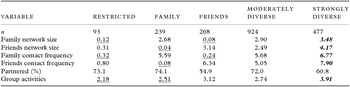
Following profile-based approaches to the study of structural network characteristics (see above), we identified network types based on results of LCA conducted using Mplus (Muthén and Muthén, Reference Muthén and Muthén2006). This approach uses mixture models to identify different latent classes (or clusters) of individuals characterized by high levels of within-class similarity on class-defining variables (Table 2; see Vermunt and Magidson, Reference Vermunt, Magidson, Hagenaars and McCutcheon2002). The models were estimated using maximum likelihood, which accounts for missing data under standard missing at random assumptions (Little and Rubin, Reference Little and Rubin1987), enabling classification of all 2001 individuals into network types.
Profile-defining variable means by social network types

Note. Underlined values represent subsets with the lowest values and bold italic values represent subsets with the highest values according to Tukey's HSD post hoc group comparison tests (applied to continuous variables only).
We estimated a series of models ranging from two to seven classes, and evaluated different solutions based on guidelines for mixture modeling outlined by Ramm and Grimm (Reference Ram and Grimm2009). Briefly, this involved a series of steps beginning with assessing the interpretability of different class solutions, before examining multiple statistical indices of model fit (e.g. BIC, VLMR-LRT; see Nylund et al., Reference Nylund, Asparouhov and Muthén2007). Results (available upon request) pointed to the appropriateness of a 5-class solution.
As seen in Table 2, the five network types identified through the LCA were broadly consistent with those found in previous research, including restricted, family, friends, and diverse networks. Those in the restricted network type were mostly partnered, reported very low contact with family and friends, and low levels of participation in group activities. Those in the family network type were also mostly partnered, reported high frequency of contact with a number of family members, as well as almost no contact with friends and low participation in group activities. Those in the friends network reported higher contact with friends than those in the moderately diverse network, but very low contact with family. Members of this network type were the least likely to be partnered, and showed relatively high participation in group activities. Two diverse networks were identified. Participants classified as moderately diverse reported high contact with family and friends as well as average levels of participation in group activities. Those in the strongly diverse network had the highest levels of contact with family and friends, and the highest participation in group activities; however a lower proportion were partnered relative to those classified as moderately diverse.
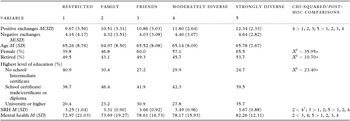
Descriptive statistics: correlates of network types
First, we considered unadjusted associations of network types based on structural attributes (see method) with socio-demographic characteristics, SRH, and ratings of relationship quality in the form of positive and negative exchanges. This provided a means of externally validating the network types, as well as providing descriptive information regarding the extent to which differences in structural network characteristics corresponded with differences in perceived network quality. Results are shown in Table 3. Members of the restricted network were more likely to be men and had the lowest levels of education. This network type also showed poorer SRH relative to the friends and strongly diverse types, and reported less frequent positive exchanges relative to both of the diverse network types. The family type was characterized by a lower proportion of retirees and poorer SRH relative to the friends and strongly diverse types. The family type also reported less frequent positive exchanges compared with the two diverse types. The friends network was characterized by high SRH. Members of the moderately diverse network type were more likely to be female relative to the restricted and family types and showed relatively high frequency of positive exchanges. Those classified in the friends and moderately diverse networks also reported better mental health relative to those in the family network in the unadjusted analysis. The strongly diverse network had the highest proportion of females and retirees, and the highest level of education. Members of the strongly diverse network also reported the highest SRH and most frequent positive exchanges, and had better mental health than any of the other network types. Network types did not differ in age or perceived negative exchanges.
Socio-demographic characteristics, self-rated health (SRH), network quality and mental health by social network types

Note. Post-hoc comparisons for continuous variables (Games-Howell) are significant at p < 0.05.
*p < 0.05, † p = 0.051.
Associations of network type and relationship quality with mental health
We used regression analysis to examine associations of network type and relationship quality with mental health, with adjustment for covariates. The models were specified with network type (using restricted as the reference category) and network quality (positive and negative exchanges) as the key predictors of interest, controlling for sex, retirement status, and level of education. We also examined possible moderating effects of the social network variables by testing interactions of SRH with network type (representing structure) and positive and negative exchanges (representing function/quality) using cross-product terms, after mean centering the continuous predictor variables.
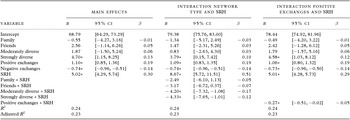
Inclusion of the main effects for network type and network quality accounted for a significant additional 8.4% of the variance in mental health over and above the variance accounted for by the covariates (F change (6, 1,714) = 31.29, p < 0.001). Members of the restricted network type reported poorer mental health relative to those in the strongly diverse network. Both frequency of positive exchanges and negative exchanges showed significant associations with mental health, indicating that higher frequency of positive exchanges is associated with better mental health and higher frequency of negative exchanges is associated with poorer mental health (Table 4). Network structure accounted for a unique 1.7% of the variance in mental health, whereas frequency of positive exchanges and frequency of negative exchanges accounted for a unique 6.2% and 3.2% of variance, respectively.
Network type and network quality as predictors of mental health with restricted as reference group

Note. Adjusted for age, sex, retirement status, and education.
*p < 0.05.
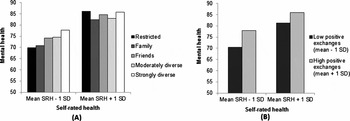
To examine the extent to which the association of SRH with mental health varied as a function of network type, cross-product network type x SRH terms were included in the analysis at a second step. A borderline significant additional 0.4% of variance in mental health was accounted for by the interaction term (F change (4, 1,710) = 2.30, p = 0.057). The nature of the interaction is displayed in Figure 1, which shows predicted values for mental health for hypothetical individuals with low (−1 SD) and high (+1 SD) SRH across each network type. Those with better health tended to report higher levels of mental health irrespective of network type. Among those with poorer health, participants in the restricted type reported substantially lower mental health than those in the strongly diverse (0.49 SDs) and moderately diverse (0.30 SDs) types. Thus, the interaction suggests a buffering effect of being in either diverse network type, relative to the restricted network type, on the association between SRH and mental health.
Predicted values of mental health over low (−1SD) and high (+1SD) SRH for (A) each network type and (B) low and high positive exchanges. Among those with poorer health, participants in the strongly diverse and moderately diverse types reported higher mental health than those in the restricted type. The negative association between SRH and mental health was attenuated among those who had high frequency of positive exchanges.

Finally, to examine the extent to which the association of SRH with mental health varied as a function of network quality, cross-product interaction terms representing positive exchanges x SRH and negative exchanges x SRH were included in the analysis. Addition of the positive exchanges x SRH interaction accounted for an additional 0.2% of the variance in mental health (F change (1, 1,713) = 4.52, p < 0.05). The significant interaction term indicated that the negative association between SRH and mental health was attenuated among those who had high frequency of positive exchanges (Figure 1). Addition of the negative exchanges x SRH interaction term did not account for significant additional variance in mental health (F change (1, 1,713) = 0.19, n.s.).
We also tested a regression model including both interaction terms: network type x SRH and positive exchanges x SRH. In this model, network structure was still a significant moderator of the SRH-mental health association, indicating that among those in poorer health, participants in the restricted type reported substantially lower mental health than those in the strongly diverse and moderately diverse networks. However, the cross-product positive exchanges x SRH was no longer significant (B = −0.19, C.I. [–0.45, 0.06], n.s.).
Discussion
In the present study, we examined how different social network attributes are associated with mental health, focusing on the extent to which structural network characteristics and perceptions of relationship quality (positive and negative exchanges) each play a role in moderating the associations of SRH (representing health resource deficits that become more common in older adulthood) with mental health. Using a profile-based approach, we identified five distinct network types reflecting different combinations of structural network characteristics. The network types were broadly consistent with those identified in previous studies (Litwin, Reference Litwin2001; Fiori, et al., Reference Fiori, Antonucci and Cortina2006; Litwin and Shiovitz-Ezra, Reference Litwin and Shiovitz-Ezra2011). In addition to restricted, friend, and family-focused network types, we distinguished two diverse networks that differed in terms of relative levels of network size and contact frequency. Litwin (Reference Litwin2011) reported a similar profile, where a diverse type was distinguished from a second network type with relatively high (but not as high as the diverse type) levels of structural resources (labeled “congregant” due to high religious participation).
Consistent with our hypotheses and the results of previous profile-based studies (Fiori et al., Reference Fiori, Antonucci and Cortina2006; Litwin, Reference Litwin2011), participants with more diverse networks reported better mental health relative to those in restricted networks. This finding could relate to the role of broader structural network attributes in creating opportunities for role fulfillment, goal attainment, and sense of purpose, which translate into better mental health (Cohen and Wills, Reference Cohen and Wills1985). Our findings also revealed direct associations of positive exchanges with better mental health, and negative exchanges with worse mental health. Numerous previous studies have reported similar associations of social exchange quality with mental health and well-being (e.g. Newsom et al., Reference Newsom, Nishishiba, Morgan and Rook2003; Rook et al., Reference Rook, Luong, Sorkin, Newsom and Krause2012). However, our results were not consistent with those of Litwin's (Reference Litwin2011) analysis, which indicated that relationship quality was not associated with depression independently of structural network attributes. There are several possible explanations for the divergent findings. First, Litwin's analysis included dichotomized social exchange (predictor), and depression (outcome) variables. Dichotomizing continuous variables can dramatically reduce statistical power (Cohen, Reference Cohen1983), which may have contributed to the lack of reliable associations between social exchange domains and depression.
Second, Litwin's (Reference Litwin2011) sample was, on average older relative to ours (age range of 65 to 85 years as opposed to 50 to 90 years in the present study), and as a result of aging-related improvements in socio-emotional experience (Charles and Carstensen, Reference Charles and Carstensen2009), may have included a smaller proportion of individuals reporting negative exchanges and/or depressive symptoms, reducing the size of observed associations. A noteworthy finding of the present study was that, despite our relatively broader age range, the identified network profiles were similar to those of previous studies of older samples (e.g. Fiori et al., Reference Fiori, Antonucci and Cortina2006; Litwin, Reference Litwin2011), and moreover there was no relationship of age with profile membership. One might speculate based on these findings that individual (e.g. personality) and social-contextual (marital status, number of children, and relatives) factors that are established earlier in life have a greater bearing on structural network composition in older adulthood than aging-related losses and transitions. Profile-based analysis of network characteristics using longitudinal data sources that span long time periods is needed to better establish the stability of network profiles with aging.
Analyses of moderation revealed that the negative association of SRH with mental health was marginally stronger among those who reported less frequent positive exchanges (though the interaction fell short of significance in a model that also included SRH x network structure). This finding was consistent with our hypothesis, and provides qualified support for a buffering role of social network quality. More specifically, older adults in poor health who have access to supportive relationships may be better able to cope with illness or disability than those less healthy older adults who do not. In contrast, the association of SRH with mental health did not vary as a function of negative exchanges. The literature regarding joint effects of stress and negative exchanges on well-being is somewhat mixed, with several studies reporting independent main effects of stress and negative exchanges, and others reporting interactive effects showing that negative exchanges exacerbate effects of stress on emotional health (for a review see August et al., Reference August, Rook and Newsom2007). Examination of these issues is complicated by the fact that joint effects may be evident for some, but not all stressors, and that the negative effects of interpersonal tensions on well-being may increase, or diminish, above certain thresholds of stress (August et al., Reference August, Rook and Newsom2007). Developing a better understanding of the processes through which negative social exchanges and different sources of stress could jointly impact on well-being in older adulthood represents a potentially fruitful area for future study.
Results of moderation analyses also pointed to a buffering effect of network structure on the association between SRH and mental health; although it is acknowledged that the effect size was small, and addition of the interaction term to the model fell just short of significance. The nature of the interaction suggested that participants reporting poorer health were more likely to also report poor mental health if they were classified as belonging to restricted, rather than moderately or strongly diverse networks. The possible buffering role of network structure suggested by these results is consistent with recent theoretical perspectives on the processes linking social resources to physical and mental health. Thoits (Reference Thoits2011) argues that in addition to the support provided by close network members (e.g. spouses) during times of stress, other relatively more peripheral network members can also provide important resources for coping by providing empathic understanding, informational support, and coping encouragement. The efficacy of these types of support is believed to be enhanced when the supportive network member is socially similar, and has experienced comparable stressors. Thus, we can speculate that having more diverse networks increases the probability of access to similar others who can offer different forms of support for those experiencing stressors such as declining health.
The findings were also informative with regard to associations of network types based on structural attributes with functional network characteristics, health and socio-demographic characteristics. For example, SRH differed by network type, with members of the strongly diverse network reporting better SRH than those in the restricted, family and moderately diverse networks. A number of studies have reported that friend-focused and diverse networks show better functional health (Fiori et al., Reference Fiori, Antonucci and Cortina2006; Litwin, Reference Litwin2011) and lower disability (Litwin, Reference Litwin2001) than more restricted networks. Although previous research has shown that those in restricted networks tend to be older (e.g. Litwin, Reference Litwin2001; Fiori et al., Reference Fiori, Antonucci and Cortina2006), this was not observed in our results. The fact that the youngest and oldest age groups were underrepresented in our sample might partly explain the lack of age differences across networks types. In addition, our sample was younger than those in previous studies (mean age 65 years compared to over 70 years) and some of the network differences might emerge later in life, for example, when ill health limits social interaction, when network members are lost due to death, or when the increasing salience of limited future time results in the winnowing of peripheral network members (Carstensen and Lockenhoff, Reference Carstensen and Lockenhoff2003).
Our findings also shed some light on how structural aspects of networks relate to experiences of relationship quality in older adulthood. Participants classified into the diverse network types reported more frequent positive exchanges relative to those in the restricted, family, and friend types. It is not surprising that more frequent contact with a wider array of network members increases opportunities for positive exchanges, and the results are consistent with the view that broader social engagement increases opportunities for positive affect (Cohen and Pressman, Reference Cohen and Pressman2006). It might also be anticipated that larger networks and more frequent social contact with diverse network members increases the potential for interpersonal tensions; however, this was not evident in our findings, since network types did not differ in perceived negative exchanges. The ability of older adults to remain broadly engaged while at the same time avoiding the greater relative experience of interpersonal tension is consistent with perspectives on socio-emotional aging that recognize the accrual of social skills with age (Charles and Carstensen, Reference Charles and Carstensen2009). Specifically, older adults with diverse networks may have developed high level skills in avoiding interpersonal tensions, organizing their networks, and prioritizing their relationships in ways that maximize the quality of social and emotional experience. The relatively low levels of negative exchanges reported across network types could also reflect the extent to which adults of all ages are more likely to avoid conflict with older, relative to younger, social partners (Fingerman and Charles, Reference Fingerman and Charles2010).
It is important to acknowledge several limitations of the current study. First, our sample was not representative of the population, and as a result the network types identified in our profile-based analysis, and the proportions of participants classified into those types, cannot be assumed to directly reflect the social network characteristics of older Australians. However, given the large and heterogeneous sample, there was sufficient variance in the measures to examine their interrelationships. Whereas low response rates can affect univariate distributions (e.g. population prevalence statistics) bias may be of less concern when examining the relationships between variables in multivariate models (see Rindfussl et al., Reference Rindfussl, Choe, Tsuya, Bumpass and Tamaki2015). In addition, the fact that the identified network types and their associations with external variables were similar to those reported in previous studies (e.g. Litwin, Reference Litwin2001; Fiori et al., Reference Fiori, Antonucci and Cortina2006) lends credence to the patterns of relationships among variables reported here. Second, the data were cross-sectional, so we must be wary when drawing conclusions about cause and effect. While we assume that network types influence well-being, it is likely that this relationship is complex and bi-directional, with aspects of well-being (e.g. trait positive and negative affectivity) likely to also influence network composition and quality. Third, comprehensive measures of resources that may influence social engagement and behavior (e.g. mobility, objective health, cognition) and therefore, may be important in distinguishing between different network types were not available. Fourth, our measures of positive and negative exchanges with family did not distinguish between different family relationships. At older ages, quality of social exchanges with different sources of family relationships (spouses, children, other family) may have different implications for well-being (e.g. Okun and Keith, Reference Okun and Keith1998). Finally, we were unable to determine the extent to which the actual levels of contact reported by participants were in line with their “ideal” levels of contact. In particular, it would be interesting to distinguish between individuals in the restricted network type who desire more social contact and those who do not. Since we know that “lone wolves” may be particularly at risk for mental health problems (Takahashi et al., Reference Takahashi, Tamura and Tokoro1997), future research should focus on this unique population of individuals.
Taken together, our results indicated that having more diverse, better quality networks was directly related to better mental health, and might also help to protect against poor mental health outcomes resulting from declining physical health in later life. Thus, the results are consistent with recommendations that social interventions aim to address multiple aspects of the social environment including building options for support through developing individual interpersonal skills, enhancing integration within existing community networks, and reducing exposure to negative social exchanges (Cohen, Reference Cohen2004). Our methodological approach enabled identification of older adults with both poorer health, and more limited social resources as being at particular risk for poor mental health outcomes, a finding consistent with previous studies (e.g. August et al., Reference August, Rook and Newsom2007). Health promotion interventions that focus on strengthening the broader social network resources of individuals before they experience normative aging-related losses (such as declining health) likely to inhibit independence and the capacity to “re-engage” could also represent a promising means for individuals and communities to establish a reserve of compensatory social resources.
Conflict of interest
None.
Description of authors’ roles
Tim Windsor planned the study, contributed to data analysis and wrote the manuscript. Pilar Rioseco contributed to data analysis and writing the manuscript. Katherine Fiori and Rachel Curtis contributed to writing the manuscript. Heather Booth contributed to the study design, interpretation of data and drafting the manuscript.
Acknowledgments
This research was funded by an Australian Research Council Linkage Grant in collaboration with National Seniors Australia [LP09909674]. The findings and views reported in this paper are those of the author(s) and not necessarily those of the supporting agencies who did not contribute to study design, analysis, interpretation of data, or writing the manuscript. Tim Windsor is the recipient of an Australian Research Council Future Fellowship [FT100100228].