Disability in people with schizophrenia is evident in multiple areas of functioning, such as the quality of social contact and the fulfillment of roles at school or work (Green, Llerena, & Kern, Reference Green, Llerena and Kern2015; Harvey et al., Reference Harvey, Sabbag, Prestia, Durand, Twamley and Patterson2012). Although the importance of impaired social and role functioning as fundamental components of schizophrenia have been increasingly acknowledged (Burns & Patrick, Reference Burns and Patrick2007), little is known about their exact developmental course.
Studies of intellectual ability in schizophrenia indicate a slower increase in functioning in individuals who later develop the illness relative to the more rapid growth of healthy individuals (Reichenberg et al., Reference Reichenberg, Caspi, Harrington, Houts, Keefe, Murray and Moffitt2010), indicating that cognitive abilities of future schizophrenia patients do increase over time, but with a pace slower than that of those who will never develop the illness. This finding is in congruence with the neurodevelopmental model, in which it is assumed that premorbid deficits in schizophrenia result from early neurodevelopmental disturbances, making it difficult to keep up with the “normal” functional growth that occurs later in life (Murray, O'Callaghan, Castle, & Lewis, Reference Murray, O'Callaghan, Castle and Lewis1992; Schmidt-Kastner, van Os, Esquivel, Steinbusch, & Rutten, Reference Schmidt-Kastner, van Os, Esquivel, Steinbusch and Rutten2012; Weinberger, Reference Weinberger1987). The decade between early adolescence and young adulthood is specifically critical in this regard, as it has been suggested to represent a period during which growing societal/environmental challenges may negatively impact the final stages of brain maturation (Selemon & Zecevic, Reference Selemon and Zecevic2015; Weinberger, Reference Weinberger1987).
In individuals who later develop schizophrenia, increasing deviations relative to the healthy population, prior to illness onset, have also been observed at the level of social and academic/vocational functioning (referred to as role functioning; Cole, Apud, Weinberger, & Dickinson, Reference Cole, Apud, Weinberger and Dickinson2012; Horton, Tarbox, Olino, & Haas, Reference Horton, Tarbox, Olino and Haas2015; Shapiro et al., Reference Shapiro, Marenco, Spoor, Egan, Weinberger and Gold2009). Extensive work in this field stems from the 1950s, when Dr. Philips created the empirically derived Premorbid Adjustment Scale to retrospectively assess premorbid social and role functioning levels in patients diagnosed with schizophrenia (Phillips, Reference Phillips1953). Studies using the scale have since pointed to considerable heterogeneity, but overall it tends to show growing levels of premorbid social impairment in the phases closer to the illness (e.g., Allen, Frantom, Strauss, & van Kammen, Reference Allen, Frantom, Strauss and van Kammen2005; Hafner, Nowotny, Loffler, an der Heiden, & Maurer, Reference Hafner, Nowotny, Loffler, an der Heiden and Maurer1995; Monte, Goulding, & Compton, Reference Monte, Goulding and Compton2008; Strauss et al., Reference Strauss, Allen, Miski, Buchanan, Kirkpatrick and Carpenter2012). Poorer premorbid functioning scores were shown to be associated with worse symptom course and overall severity of illness (Garmezy & Rodnick, Reference Garmezy and Rodnick1959).
However, these previous studies generally used retrospective designs, introducing methodological limitations, such as recall biases. Although one recent population-based study showed a very similar pattern to the famous retrospective ABC studies (Hafner, Loffler, Maurer, Hambrecht, & an der Heiden, Reference Hafner, Loffler, Maurer, Hambrecht and an der Heiden1999), with increasing impairment compared to the general population in individuals tested closer to first hospitalization, this study included only one data point per individual (Velthorst et al., Reference Velthorst, Reichenberg, Kapara, Goldberg, Fromer, Fruchter and Weiser2015). Collectively, these studies seem to point toward growing functional impairment over time, but longitudinal prospective studies are needed to confirm cross-sectional observations.
In addition, relatively little is known about the functional trajectories in the years following identification of risk of psychosis. Studying social and role functioning in this clinical high risk (CHR) phase is important, as it may provide important clues about the early developmental precursors of schizophrenia (Lin, Wood, & Yung, Reference Lin, Wood and Yung2013). In most CHR studies carried out thus far, functional impairment is typically viewed as a single construct (e.g., as assessed with a single global assessment of functioning summary score; see Cotter et al., Reference Cotter, Drake, Bucci, Firth, Edge and Yung2014), but distinct developmental trajectories may characterize different functional domains (Harvey et al., Reference Harvey, Sabbag, Prestia, Durand, Twamley and Patterson2012). Previous studies from our group showed that, while impairments in both role and social functioning are persistent in individuals at CHR for psychosis (Addington, Cornblatt, et al., Reference Addington, Cornblatt, Cadenhead, Cannon, McGlashan, Perkins and Heinssen2011), only deficits in the latter domain differentiate between those who eventually do and do not convert to psychosis (Cannon et al., Reference Cannon, Cadenhead, Cornblatt, Woods, Addington, Walker and Heinssen2008; Cornblatt et al., Reference Cornblatt, Carrion, Addington, Seidman, Walker, Cannon and Lencz2012), potentially suggestive of a differential developmental trajectory. Clarification of this matter is particularly important from the perspective of treatment of these different components of functional impairment.
In the present study, we explored if there are important periods during which impairments in the two key components of community functioning (social functioning and role functioning) start to become more pronounced in those who convert to psychosis. We compared the developmental trajectories of the two domains among CHR individuals who later converted to psychosis (CHR-C), CHR individuals who did not convert over a 2.5-year follow-up period (CHR-NC), and a healthy comparison group. More specifically, we examined whether the increased impairments over time in social and role functioning previously observed in CHR-C could be attributed to (age-related periods of) stagnation, delayed growth, or decline in functioning.
Methods
Subjects
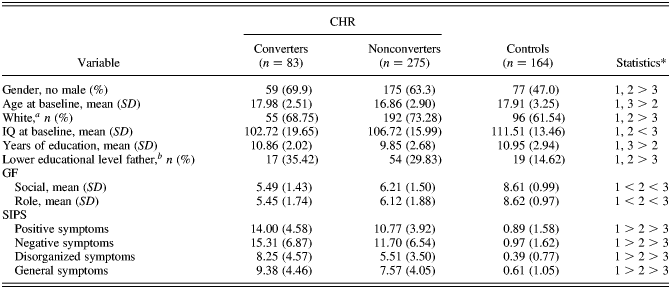
We used data from 358 CHR and 164 healthy individuals (311 males, 211 females; baseline age: M = 17.37, SD = 3.0) who were participants in the North American Prodrome Longitudinal Study Phase 1 (NAPLS-1; Cannon et al., Reference Cannon, Cadenhead, Cornblatt, Woods, Addington, Walker and Heinssen2008) and/or the ongoing Center for Assessment and Prevention of Prodromal States (CAPPS) study at the University of California Los Angeles (UCLA) Semel Institute, and who had their baseline assessment in the decade between early adolescence and early adulthood (ages 12–23). Table 1 provides a detailed description of the baseline demographic and clinical characteristics broken down by group status. Forty-two percent of our sample (n = 217) was recruited as part of the CAPPS study. Of those, 41 (36 CHR, 5 controls) also participated in NAPLS-1. The other 176 CAPPS participants were recruited after the establishment of the NAPLS-1 cohort. CAPPS and NAPLS-1 used identical inclusion criteria and study designs; all participants (CHR and controls) were seen at 6-month intervals and prospectively followed for up to 2.5 years. At the UCLA Semel Institute, the same interviewers performed all clinical interviews and symptom ratings for both CAPPS and NAPLS-1.
Baseline demographic and clinical characteristics of the sample
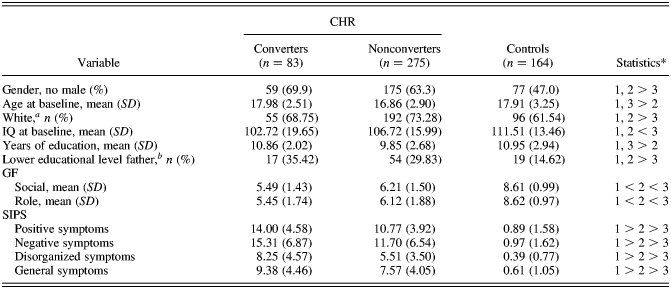
Note: CHR, Clinical high risk; GF, global functioning; SIPS, Structured Interview for Prodromal Syndromes. Scores represent SIPS and GF at baseline.
a Data for n = 24 missing.
b Number of individuals without education higher than high school. Data for n = 163 missing.
*p = .05.
CHR participants were help-seeking individuals who met criteria for one of three CHR categories, as assessed with the Structured Interview for Prodromal Syndromes (SIPS; McGlashan, Walsh, & Woods, Reference McGlashan, Walsh and Woods2010) by experienced MA/PhD level clinicians: attenuated psychotic symptoms; transient, recent-onset psychotic symptoms; or a substantial drop in functioning in conjunction with schizotypal personality disorder or a first-degree relative with psychosis. Participants were excluded for current or past diagnosis of an Axis I psychotic disorder, including affective psychoses, as determined by the Structured Clinical Interview for the DSM-IV (SCID; First, Spitzer, Gibbon, & Williams, Reference First, Spitzer, Gibbon and Williams1997). Approximately 96% of the CHR participants met initial eligibility based on attenuated positive symptoms, and 4% met initial eligibility based on brief intermittent psychotic symptoms. While only 2 (<1%) patients were ascertained as prodromal exclusively in the genetic risk and deterioration category, 12% had a comorbid attenuated positive symptoms–genetic risk and deterioration prodromal diagnosis.
The typically developing control sample, matched on age to the CHR sample, did not meet CHR criteria or DSM-IV criteria for any major psychiatric disorder. Additional exclusion criteria for all participants were as follows: neurological disorder, drug/alcohol abuse or dependence within the past 6 months, insufficient English fluency, and/or IQ below 70 (see (Addington et al., Reference Addington, Cadenhead, Cannon, Cornblatt, McGlashan and Perkins2007, for more details regarding inclusion/exclusion criteria and diagnostic reliability procedures). The institutional review boards of the participating sites approved study protocols and informed consent documents.
Measures
Symptomatology
The SIPS and the Scale for Assessment of Prodromal Syndromes (McGlashan et al., Reference McGlashan, Walsh and Woods2010) were used to assess CHR criteria, severity of attenuated positive symptoms and negative symptoms, and to define conversion to psychosis (Cannon et al., Reference Cannon, Cadenhead, Cornblatt, Woods, Addington, Walker and Heinssen2008). Symptom domain scores were determined by the sum of symptom severity scores within each domain (positive, negative, disorganized, and general symptoms). Full details regarding SIPS criteria, reliability, and consensus procedures are described elsewhere (Addington et al., Reference Addington, Cadenhead, Cannon, Cornblatt, McGlashan and Perkins2007; Meyer et al., Reference Meyer, Bearden, Lux, Gordon, Johnson, O'Brien and Cannon2005). The SCID (First et al., Reference First, Spitzer, Gibbon and Williams1997) was used to establish current and past DSM IV Axis 1 diagnoses. Estimated full-scale IQ scores were derived from the Vocabulary and Block Design Tests of the Wechsler Intelligence Scale for Children—Third Edition (Wechsler, Reference Wechsler1991) for individuals younger than 16 years and from the Wechsler Adult Intelligence Scale—Revised (Wechsler, Reference Wechsler1981) for individuals 16 years or older (Carrion et al., Reference Carrion, McLaughlin, Goldberg, Auther, Olsen, Olvet and Cornblatt2013).
Social and role functioning
Social and role functioning were assessed using the GF: Social Scale and the GF: Role Scale (Cornblatt et al., Reference Cornblatt, Carrion, Addington, Seidman, Walker, Cannon and Lencz2012), two scales specifically designed to detect change in functioning in at-risk adolescents and young adults who are not as severely impaired as more chronic patients. The scales were initially validated as part of collaboration between the Zucker Hillside and UCLA sites, but later used as the common social/role measures across NAPLS-1 sites (Cornblatt et al., Reference Cornblatt, Carrion, Addington, Seidman, Walker, Cannon and Lencz2012). The GF: Social Scale assesses peer relationships, peer conflict, age appropriate intimate relationships, and involvement with family members. The GF: Role Scale assesses performance and amount of support needed in one's specific roles (i.e., school/work). Scores of both scales range from 1 to 10 (with higher scores indicating better functioning). In the present study, we made use of the “current” functioning scores, that is, functioning levels in the month preceding assessment. Ratings for each scale were based on best estimates derived from all available information, an approach that has been shown to yield high interrater reliability scores (Cannon et al., Reference Cannon, Cadenhead, Cornblatt, Woods, Addington, Walker and Heinssen2008; Cornblatt et al., Reference Cornblatt, Auther, Niendam, Smith, Zinberg, Bearden and Cannon2007).
Follow-up procedure
All 6-month interval follow-up interviews included SIPS ratings and the two global functioning scales. Conversion to psychosis was defined as the presence of a psychotic-level positive symptom (a score of 6 with a minimum duration of 1 week). For the majority of the cases, a follow-up SCID interview was conducted at the time of conversion to additionally determine DSM-IV diagnosis of psychotic disorder.
Statistical analyses
Because we were specifically interested in the period between early adolescence and early adulthood, and the number of data points per age group (specifically for converters) was substantially lower after this period, we restricted our analyses to participants aged 12–23 years. We included only those participants who had data on social and role functioning, and IQ scores available. We limited our analyses to data collected on functioning prior to first onset of psychosis only; thus, data from CHR-C youth gathered after first psychosis onset was excluded. Interdependence between the two functional domains (i.e., shared variance between deficits in role and social functioning) was examined with partial correlations, controlling for age, gender, and IQ. We used regression analyses to examine the association between functional impairment, age at baseline, and time-to-conversion. Differences in baseline demographic characteristics, baseline symptoms (positive, negative, disorganized, or general), IQ, and social and role functioning between the control group, CHR-NC, and CHR-C individuals were examined with regression analyses for continuous variables, and chi-square tests for dichotomous variables.
Functioning data from the 358 CHR and 164 healthy individuals included in our study (159 with 1 assessment, 363 with >1 assessment, range = 1–5) yielded 1,275 observations (including first assessment) to construct developmental trajectories. There were a significantly higher number of dropouts after first assessment among healthy individuals (43.3%; n = 71) versus in the CHR cohort (24.6%; n = 88). Some follow-up assessments were not included in the analyses as the participant aged-out of our age window: 9 participants had turned 24 by the time of the second assessment, another 4 by the time of the third, 2 by the time of the fourth, and 3 more by the time of the fifth assessment. CHR individuals with only one assessment were comparable to those with >1 on all clinical and functional measures and most demographic characteristics, but were marginally older (17.6 vs. 17.0; t = 1.98, p = .049). Healthy individuals with only one assessment did not differ from those with >1 on functional measures and demographic characteristics, but had significantly less positive (p < .001), general (p = .023), and disorganization symptoms (p = .013).
Developmental trajectories of social and role functioning were analyzed separately with multilevel linear modeling analyses (Statacorp 14; StataCorp, 2014), taking multiple observations per individual into account. We explored the different functioning developmental trajectories per status group by entering age of assessment as an independent variable, and functioning score as the dependent variable in the model (controlling for IQ and gender). Both the main effect of group (CHR-NC, CHR-C, and controls) and the Group × Age interaction were effects of interest: a group main effect only would be suggestive of a static group difference, whereas a Group × Age interaction would be suggestive of stagnation, faster growth, or decline in functioning in one group compared to other groups.
We subsequently explored whether there were specific periods in the functional development of future converters that distinguished them from nonconverters by subdividing all social and role functioning assessments into age bands that capture different developmental epochs: early adolescence (ages 12–15 years), middle to late adolescence (15–18 years), young adulthood (18–21 years), and adulthood (21–23 years). We performed multilevel linear modeling analyses for each age band to identify time periods when levels of functioning in the CHR-C group started to diverge from the CHR-NC. We controlled for gender and IQ in these analyses as well.
To explore whether the baseline severity of symptoms attenuated our findings, all analyses were repeated controlling for positive, negative, general, and disorganization symptoms.
Results
Of the 358 CHR participants, 83 converted (23.2%) to a psychotic disorder within the follow-up period. Diagnostic outcome was available for 70 converters (84.3%). Of those, 36 (51.4%) received a diagnosis in the schizophrenia spectrum (schizophrenia, n = 18; schizophreniform, n = 11; schizoaffective, n = 7), 9 (12.9%) were diagnosed with a mood disorder with psychotic features, 19 (27.1%) with a psychosis not otherwise specified, 4 (5.7%) with a brief psychotic episode, and 2 (2.9%) with a delusional disorder.
Among those who converted, the mean time from baseline assessment to conversion to psychosis was 0.88 years (~10 months; SD = 0.81). Average time of follow-up assessment for the remainder of the sample was 1.19 years (SD = 0.97). Time to conversion was not significantly associated with social and role functioning at any time point (p values ranged between p = .20 and p = .96 for social functioning, and between p = .08 and p = .79 for role functioning) or with age at baseline (B = –0.05, SE = 0.04, p = .18). Table 1 presents baseline demographic and clinical data for the 358 CHR participants and the 164 healthy comparison subjects. CHR individuals overall had lower IQ, and were significantly more often White and male relative to the comparison group. CHR-NC individuals had fewer years of education and were younger than CHR-C and the control group.
GF: Social functioning trajectories
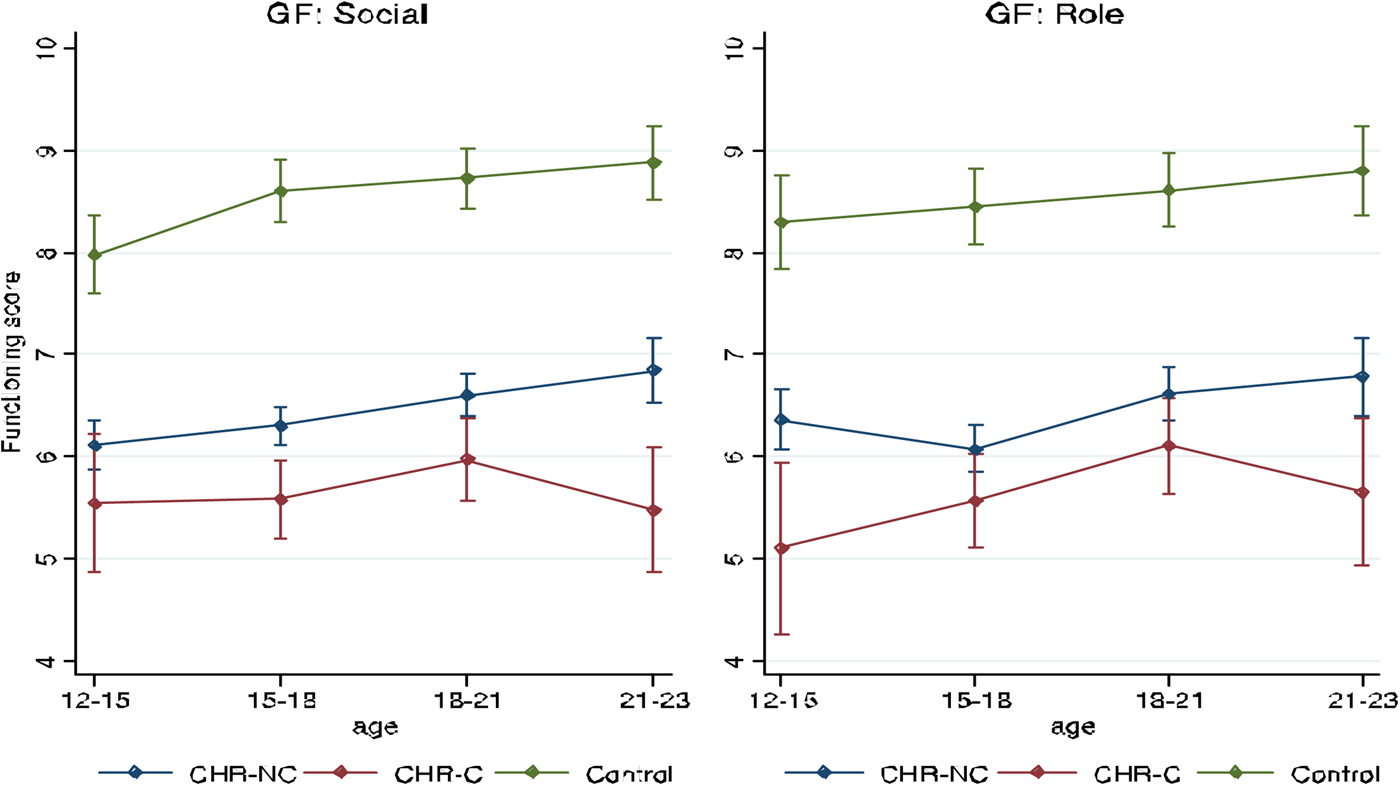
The square of correlations between role and social functioning was .34, indicating a moderate amount of common variance. We examined the natural course of social functioning by examining the social functioning data over time in controls. Social functioning in this group was dynamic, gradually improving with age (B = 0.08, SE = 0.02, p ≤ .001). Both the CHR-C and CHR-NC groups had lower levels of social functioning over time relative to the control group (main effect: B = –2.84, SE = 0.17, p < .001; B = –2.04; SE = 0.12, p < .001). There was a trend toward a Group × Age interaction when comparing functional trajectories across all groups (B = –0.10, SE = 0.06, p = .073), suggesting that functional trajectories may differ between groups. Examining this further, we observed that in contrast to CHR-NC individuals who (in congruence with the healthy control sample) significantly improved in their social functioning skills with age (B = 0.10, SE = 0.02; p < .001), the CHR-C group did not show such an increase (B = –0.0002, SE = 0.06, p = .997; see Figure 1). These findings held when the baseline severity of positive, negative, and disorganized symptoms were accounted for.
(Color online) Developmental trajectories of social and role functioning. The Y-axis in the figure represents the GF: Social Scale and the GF: Role Scale scores, which range from 1 to 10, with higher scores meaning better functioning. The X-axis represents mean scores at the assessments conducted with individuals at ages 12–15, 15–18, 18–21, and 21–23.
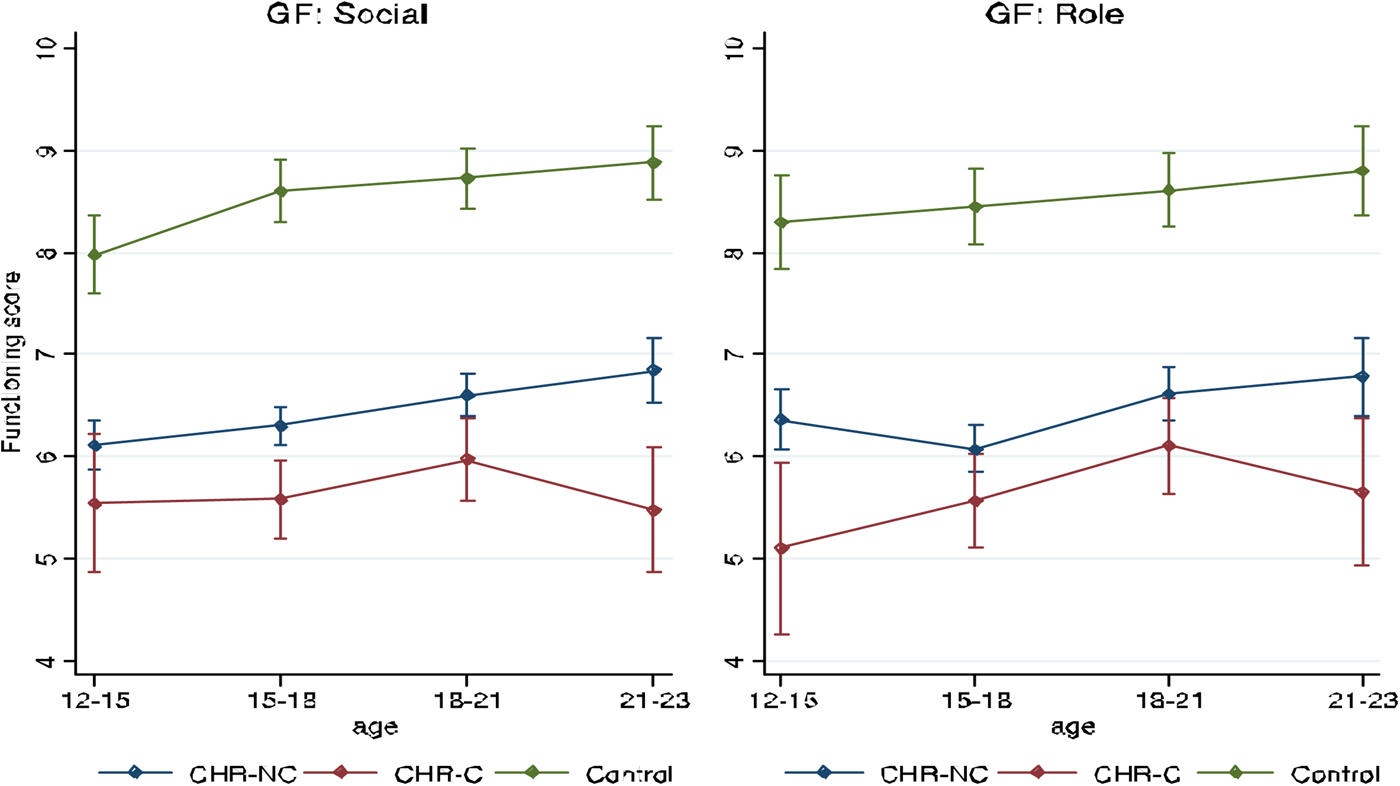
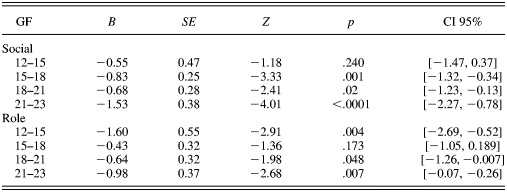
Analyses within the CHR group suggest that there may be two potential periods during which converters started to lag behind in social functioning compared to nonconverters (see Table 2). Between ages 15 and 18, the growth seen in premorbid social functioning of nonconverters was not seen in the converting group (B = –0.84, SE = 0.25, p = .001; Cohen d = 0.56). Subsequently, a similar period occurred between ages 21 and 23, reflected by a relatively increasing deficit between converters and from nonconverters (B = –1.53, SE = 0.38; p < .001; Cohen d = 1.07). Controlling for prodromal symptoms did not attenuate the results.
Difference in social and role functioning between CHR converters and nonconverters per age band
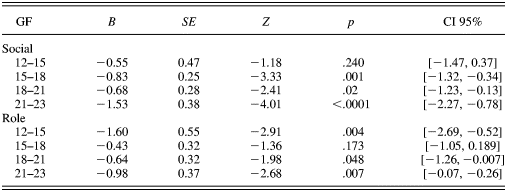
Note: CHR, Clinical high risk; GF, global functioning. All analyses are controlled for IQ and gender. Number of data points: 12–15 years: CHR converters (CHR-C), n = 25; CHR nonconverters (CHR-NC), n = 228; 15–18 years: CHR-C, n = 76; CHR-NC, n = 377; 18–21 years: CHR-C, n = 86; CHR-NC, n = 251; 21–23 years: CHR-C, n = 27; CHR-NC, n = 125.
GF: Role functioning trajectories
Similarly, in the domain of role functioning, controls marginally improved with age (B = 0.04, SE = 0.02, p = .04). Although an overall group difference was apparent (with the CHR-C and CHR-NC groups having lower role functioning scores compared to the control group; main effect: B = –2.75, SE = 0.20, p < .001; B = –2.05; SE = 0.14, p < .001), here there was no indication of a Group × Age interaction. Adjusting the analyses for prodromal symptom severity at baseline did not alter the results.
However, examining the developmental trajectories per group separately, we found the CHR-C group to show greater impairment in role functioning compared to CHR-NC between ages 12 and 15 (B = –1.60; SE = 0.55; p = .004; Cohen d = 0.81). In addition, we detected a similar difference for role functioning between CHR-C and CHR-NC as observed for the social trajectories (see Figure 1) between the ages of 21 and 23 (B = –0.94, SE = 0.37, p = .01; Cohen d = 0.83). This latter effect decreased to trend level when negative symptoms or disorganization symptoms were accounted for (B = 0.74; SE = 0.45, p = .08, and B = –0.78, SE = 0.45, p = .059, respectively).
Converters and nonconverters between ages 21 and 23 were otherwise largely comparable to those with data at earlier ages. Apart from a higher IQ score in nonconverters age 21–23 compared to the nonconverters in the younger group (IQ = 106.0 vs. IQ = 113.4; p = .02), the CHR-C and CHR-NC groups with data between ages 21 and 23 did not significantly differ from the those with data at earlier ages in terms of positive, negative, general, or disorganization symptoms, nor in terms of ethnicity or gender.
Discussion
In a large sample of youth at high clinical risk for psychosis, we evaluated whether there are periods of change in the development of two key components of community functioning: social and role functioning. Taken together, our results indicate that both social and role functioning are more impaired in CHR individuals compared to controls from as early as age 12, and that differences between converters and nonconverters become increasingly apparent by age.
In congruence with the literature (Shapiro et al., Reference Shapiro, Marenco, Spoor, Egan, Weinberger and Gold2009), functional levels of controls gradually increased with age. For social functioning, there were periods of early and late dynamic changes that distinguished CHR-C from CHR-NC, and results remained consistent when time to conversion was accounted for. During the first period, between ages 15 and 18, social functioning of converters stagnated and diverged from that of nonconverters, who, like controls, continued to improve. Next, the growth seen in nonconverters between ages 21 and 23 was not apparent for converters, further distinguishing them from nonconverters. Similar changes were observed for role functioning, with functioning levels that were lower in the CHR cohort, but initially increasing in a similar pace for both converters and nonconverters relative to the functional improvement observed in controls. However, a late change in role functioning became apparent for the converter group, as their role functioning scores seemed to stagnate between ages 21 and 23.
Similar patterns have been observed in a cross-sectional cohort (Velthorst et al., Reference Velthorst, Reichenberg, Kapara, Goldberg, Fromer, Fruchter and Weiser2015) and in various retrospective studies to patients diagnosed with schizophrenia using the Premorbid Adjustment Scale (Allen et al., Reference Allen, Frantom, Strauss and van Kammen2005; Monte et al., Reference Monte, Goulding and Compton2008; Shapiro et al., Reference Shapiro, Marenco, Spoor, Egan, Weinberger and Gold2009; Strauss et al., Reference Strauss, Allen, Miski, Buchanan, Kirkpatrick and Carpenter2012). The initial more pronounced difference in trajectories for social functioning between converters and nonconverters may be at least partly explained by findings of previous work from our research group, showing that social and role functional outcome may be driven by different cognitive functions (Carrion et al., Reference Carrion, McLaughlin, Goldberg, Auther, Olsen, Olvet and Cornblatt2013; Meyer et al., Reference Meyer, Carrion, Cornblatt, Addington, Cadenhead and Cannon2014). In this study, processing speed performance appeared to be particularly important for social outcome, while verbal memory was found more strongly related to successful academic and work achievement. Population-based studies point to an accelerated deficit in processing speed from the age of 13 in children who will develop adult schizophrenia, which could explain the stagnation in social functioning around that time (Meier et al., Reference Meier, Caspi, Reichenberg, Keefe, Fisher, Harrington and Moffitt2014; Reichenberg et al., Reference Reichenberg, Caspi, Harrington, Houts, Keefe, Murray and Moffitt2010). In contrast, impairment in verbal memory has been found to be more stable (Stone et al., Reference Stone, Mesholam-Gately, Giuliano, Woodberry, Addington, Bearden and Seidman2016), possibly accounting for the initially more subtle deficits in role functioning.
As argued previously, although accounting for baseline prodromal symptom severity did not alter our results, the subsequent period of stagnation in both social and role functioning in early adulthood may be caused by the interaction between prodromal symptoms and the increasingly complexity of social and work tasks that have to be taken on (Hafner et al., Reference Hafner, Loffler, Maurer, Hambrecht and an der Heiden1999; Velthorst et al., Reference Velthorst, Nieman, Becker, van de Fliert, Dingemans, Klaassen and Linszen2009). While in early adolescence support systems may still compensate and hide subtle functional deficits, early adulthood represents a phase during which people are no longer expected to heavily rely on others, potentially contributing to the increasing deficits during this time. It will be interesting for future studies to disentangle how stagnation in functional impairment may in turn directly contribute to increased risk of psychosis onset in the CHR samples; for example, it may be that functional impairment creates social distress, or reduces access to social support.
This study has several limitations. First, the minimum age of study participants was 12. We are therefore constrained to conclusions about functional trajectories, and symptom development only from this age onward. It would be interesting for future prospective population-based cohort studies to examine at which age first symptoms and functional impairments appear. Second, “a significant drop in functioning” was one of the necessary criteria for individuals included based on schizotypal personality disorder diagnosis. However, in our study only 0.8% of the CHR individuals were included solely based on the criterion “first-degree relative with psychosis or patient with schizotypal personality disorder and a 30% drop in global assessment of functioning score compared with that 1 year ago, sustained over the past month,” and omitting those subjects from the analyses did not significantly impact the results. Third, many, but not all, individuals who go on to develop psychosis experience subthreshold symptoms, and our conclusions are limited to those who do. In addition, some CHR subjects may convert to psychosis after the 2.5-year follow-up period (Nelson et al., Reference Nelson, Yuen, Wood, Lin, Spiliotacopoulos, Bruxner and Yung2013), and some converters may only have experienced brief full-blown psychotic complaints. Fourth, the potential misclassification of some subjects may have reduced differences observed between converters and nonconverters (Seidman et al., Reference Seidman, Giuliano, Meyer, Addington, Cadenhead and Cannon2010). Because controls with DSM-IV psychiatric diagnosis were excluded, the control group may represent a higher functioning subgroup of the general population. However, the divergence in functioning we observed between CHR-C and CHR-NC would suggest that our findings are not simply a result of general distress, but are related to subsequent development of psychosis. Fifth, the sample size of converters in the 12–15 and 21–23 age bands was relatively small, and findings with regard to these age epochs should be interpreted with caution. Sixth, the lack of an association between time to conversion and functioning scores may have been partly accounted for by limited variability in the time to conversion, with the majority converting within the first year. Seventh, data on ongoing (pharmacological) interventions was not taken into account.
Despite these limitations, our study is largely consistent with results of previous studies, which suggest that early stagnation in social functioning may be a unique risk marker for psychosis (e.g., Cannon et al., Reference Cannon, Cadenhead, Cornblatt, Woods, Addington, Walker and Heinssen2008; Strauss et al., Reference Strauss, Allen, Miski, Buchanan, Kirkpatrick and Carpenter2012; Velthorst et al., Reference Velthorst, Nieman, Linszen, Becker, de Haan, Dingemans and Ruhrmann2010). Our findings also provide new evidence supporting the neurodevelopmental model of psychosis, pointing to a developmental lag in social functioning between the ages of 15 and 18, followed by another period of stagnation in early adulthood. Results we found related to age rather than to greater levels of functional impairment in those closer to overt illness. Role functioning trajectories of converters and nonconverters were initially more comparable, although also for role functioning, a period of relatively increasing impairment in early adulthood became apparent for the converting group.
Moreover, our findings further highlight the importance of examining social and role functioning separately, and moving away from “global” measures to more age-specific measures (Cornblatt et al., Reference Cornblatt, Auther, Niendam, Smith, Zinberg, Bearden and Cannon2007). Treatment attempts to improve social functioning in psychotic disorders have been only marginally successful (Almerie et al., Reference Almerie, Okba Al Marhi, Jawoosh, Alsabbagh, Matar, Maayan and Bergman2015), which may be partly due to the global measures used, as well as our limited knowledge of when deviations develop. Our results indicate that impaired social and role functioning in CHR individuals are apparent already in early adolescence, but that functioning levels of converters further diverge from nonconverters in early adulthood. We found middle adolescence to be a first period of change in the development of social functioning, as during this time trajectories of those with and without a psychotic disorder start to diverge. Worldwide, noninvasive cognitive (behavioral) interventions for young individuals at risk for psychosis are emerging (Addington, Epstein, et al., Reference Addington, Epstein, Liu, French, Boydell and Zipursky2011; Landa et al., Reference Landa, Mueser, Wyka, Shreck, Jespersen, Jacobs and Walkup2016; Okuzawa et al., Reference Okuzawa, Kline, Fuertes, Negi, Reeves, Himelhoch and Schiffman2014; van der Gaag et al., Reference van der Gaag, Nieman, Rietdijk, Dragt, Ising, Klaassen and Linszen2012, Reference van der Gaag, Smit, Bechdolf, French, Linszen, Yung and Cuijpers2013) with few also focusing on the improvement of social functioning, or the preservation of social engagement (for a review, see Thompson et al., Reference Thompson, Millman, Okuzawa, Mittal, DeVylder, Skadberg and Schiffman2015). Certain cognitive interventions (e.g., see French & Morrison, Reference French and Morrison2004) may be promising in impeding the deteriorating functional course of adolescents at risk for psychosis.
It will be important for future studies to disentangle what neural and genetic processes contribute to this diversion and how these processes vary across different functions. The significance of these future studies has been highlighted by Hodgekins et al. (Reference Hodgekins, Birchwood, Christopher, Marshall, Coker, Everard and Fowler2015) who found that a large proportion of individuals with significant social disability do not improve over the first 12 months of service provision (66%).
Conclusion
In conclusion, our findings provide new insight into the developmental course of functioning in youth at CHR for psychosis, and inform the field about potentially important intervention windows. We hope that a better understanding of the origins and developmental course of functional impairment will ultimately help us decrease its debilitating consequences and increase our knowledge of the pathways to psychotic disorders.