

In this paper, I aim to present a new understanding concerning the development of the trigonometric functions during the Arabic-Islamic civilization. This understanding is briefly explained in the following paragraph.
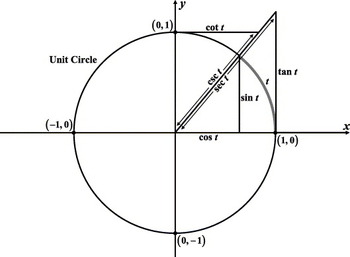
In the Greek/Indian period, it is very noticeable to me that different radii were used in connection with the chord, i.e. different chord tables were available in the context. This manner also continued in the Indian period with the sine (half the chord), i.e. there were also different sine tables depending on the radius of the circle used. But throughout the Arabic-Islamic period, it is noticeable that there was stability in the radius, i.e. there was only one sine table, namely only the value 60 for the radius was used (i.e. always Sinx = 60 sin x), and thus the function appeared to be for abstract usage only. At the beginning of the Arabic-Islamic period, particularly at the time of al-Battānī, new terms were introduced; I mean tangent and cotangent, not as functions of angles (or arcs) but as lengths, and again with no stability in their radii (different radii and thus different tables for the same term). Here these new born terms were not bounded to a circle, and this was why they were not responsible for finding the angles (arcs), i.e. no abstract usage, only the sine did, and the term miqyas r (the measure), which was variable, was used to express “the radius” related to these new born terms (Tanx = r tan x and Cotx = rcot x). It appeared clearly to me that the trigonometric functions at that time naturally treated as if they were two different groups. These two groups were clearly expressed in the works of that period as for example in the zīj of al-Battānī (Fig. 1). The first group, which contained the sine and the cosine, was abstract (by having the same table always), and the second group, which contained the tangent and the cotangent, was still for practical usage (different radii were used for the value r as 1, 6, 6.5, 12, and 60 depending on need, availability, and the branch of science). While at Abū al-Wafā’’s time, there was a noticeable advancement, and this advancement was based on introducing the new terms (tangent, cotangent, secant, and cosecant) as functions of angles (arcs), and this appeared in the definitions and also in the spherical tangent rule, and hereunder the new functions were immediately bounded to the circle, and thus as a consequence, and instead of having two circles in the same figure, a kind of unity appeared (Fig. 2) by making the radius of the new functions r the same as that for the sine (which was fixed to 60), and again there was stability in the value of r, and therefore only one table for each function, and so the new functions could be responsible for finding the angle (arc) in the same power as the sine, i.e. the new functions started to appear more abstract than practical, and this unity (Fig. 2) remained fixed in the modern times (Fig. 3).
I will divide the long history of the trigonometric functions into three main stages: the Greek\Indian stage, the Arabic-Islamic stage, and the stage of modern times.Footnote 1 I will also present three geometrical figures, one to represent the form of the trigonometric functions at the beginning of the Arabic-Islamic stage, and one to represent their form at the end of this stage, and the third to represent their form in the stage of modern times. Accordingly, and away from the more advanced and different definitionsFootnote 2 of the six trigonometric functions, throughout this paper the reader is kindly asked to keep in mind this one simple modern definition (which represents the stage of modern times): the trigonometric functions can be defined as the lengths of various line segments on a unit circle.Footnote 3 And in order to take a snapshot of a long particular period, I will make some selections and will jump from period to period.Footnote 4
In ancient Greek, and regardless the system of numeration used, starting from Hipparchus (d. 120 BC), or before him, to Ptolemy (d. c. 165), I noticed that the chord (which was the only function used in that period) was tablated with different values of the radius (or the diameter) of the reference circle, as 3436 and 60. This instability in the value of the radius will continue in the Indian period, starting from around the sixth century,Footnote 5 with the new born function (half the chord), which will be known as the sine,Footnote 6 and also with its immediate consequence the complement (i.e. the cosine). During this Indian period, several values were given to the radius of the reference circle, as 120, 3436, 150, etcFootnote 7. Taking this into consideration, in the stage of Greek and Indian, there was instability in the value of the radius. On the other hand, in the Arabic-Islamic stage the radius related to sine and cosine was fixed in the scientific culture to the value sixty, and as far as I know, no attempt appeared to change it.Footnote 8 On the contrary, during this Arabic-Islamic stage, the new born functions, tangent, cotangent, secant, cosecant, followed the same way the sine and the cosine did, i.e. they started with an unstable situation (regarding their own radiusFootnote 9) and then moved to a stable one, as it will be shown.
Instead of going back to the earliest scientists in the Arabic-Islamic stage, such as al-Khwārizmī (d. about 840) and Ḥabash al-Ḥāsib (d. between 864 and 874) and their zījes, I will stop at al-BattānīFootnote 10 (d. 929) as a good representative for that particular period (i.e. the beginning of the stage), and quote the following from his zīj as a common example. In this quotation, he was looking for a method to find the length of the horizontal shadowFootnote 11 from a given altitude of the sun:
إذا أردت أن تعرف الظل من قِبل الارتفاع، فاعرف وتر الارتفاع ووتر ما يبقى لتمام الارتفاع إلى تسعين، ثم افرض أجزا’ المقياس كم شئت، واضرب وتر تمام الارتفاع في أجزا’ المقياس فما بلغ فاقسمه على وتر الارتفاع، فما خرج فهو مقدار انبساط الظل وامتداده على بسيط الأرض بالمقدار الذي تكون به أجزا’ المقياس تلك الأجزا’.
To find the shadow from the altitude [of the sun], first find the chord of the altitude and the complement of this chord to ninety [degrees], where the gnomon (miqyās)Footnote 12 is divided into any desired number of equal parts, and then multiply the complement of the chord of the altitude by the number of the parts of the miqyās, and then divide the product by the chord of the altitude, and the quotient is the length of the shadow where the miqyās is equal to that chosen number of parts.
Before I deeply discuss the method (supplied with a figure), I will throw light on some points. Even though there was nothing new, or wrong, with the terminology used in this quotation, the combination of “the complement to ninety” together with “the chord” might make confusion. But this confusion will go away as soon as one knows that the term used here “the chord” means “half the chord” i.e. the sine,Footnote 13 which is of Indian origin. In addition to this, the methodology used is somewhat similar to that of Ptolemy in his Almagest.Footnote 14 So the difficulty or you might call it the beauty dealing with the text above comes from the fact that it is a mixture of Greek, Indian, and Arabic-Islamic thinking. Moreover, one can easily detect that the shadow in al-Battānī’s mind is the shadow with its literal meaning, and this is true because when he was explaining, he was repeatedly mentioning how the length of the shadow changes during the daylight from morning to evening i.e. a sun in the sky traveling and a miqyās is set to be vertical or horizontal and casting a shadow on a horizontal or vertical plate (respectively). That means “the shadow” used here is not the same as “the tangent” or “the cotangent”, which are the terms that will appear later after a half century in the Arabic-Islamic stage. This also means, up to the time of al-Battānī, and this point is important, the vertical and the horizontal cases were just two practical cases and made for practical purposes, but the scientists of that period, such as al-Battānī, were aware that these two cases are theoretically complement of each other (the complement to ninety), as it will be shown, but this relation will appear clearer later with the new terms tangent and cotangent as functions of arcs. And choosing the miqyās to be of any length, this is also of high importance, and I will use it in my coming argumentation. To summarize, a snapshot of the scientific culture of that particular period (i.e. the beginning) regarding the trigonometric functions would be that the radius of the reference circle which is related to sine and cosine is stable, i.e. fixed to sixty, and the miqyās is variable and is not bound to a circle, and al-Battānī, for some reason, chose his miqyās to be of value twelve.Footnote 15
To clarify the calculation described above, I will make use of Fig. 1 below, this figure, which I made, is not found in the zīj of al-Battānī, but it coincides completely with his method and his way of thinking.
The form at the beginning of the Arabic-Islamic stage

The horizontal line (OG) represents the surface of the earth, and AB is the miqyās Footnote 16 and its length is given to be twelve, and OA is the shadow which is unknown and to be determined, and point O is the end point of the shadow and also the center of the circle (which is abstract and its radius equals sixty), and the oblique dot line is the ray of the sun. Accordingly, DC Footnote 17 is the chord of the altitude of the sun (angle DOG or arc DG), and CO Footnote 18 is the complement of the chord DC to ninety degrees. This means, DC is the new born sine and CO is the new born cosine. Even though the purpose was simplification, but it seems the birth was hard, at least from our position. After this has been clarified, al-Battānī’s method for determining the length of the shadow AO can be interpreted with modern notations as follows:
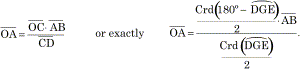
And this can easily be simplified successively to (in the same order as they appeared with time):Footnote 19

If al-Battānī did tablate the ratios
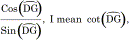
and even without knowing what they are (just as constants), to make calculations easy for finding the shadow when the miqyās changes, he would have tablated the values of our cotangent, but as it appeared he tablated the values

This bad luck, from a historical point of view, had also accompanied Ḥabash who before al-Battānī tablated the same ratios with miqyās equal to six and also equal to twelve.Footnote 20 I am saying this because the technique in reducing the number of variables in a formula of several variables (i.e. by making most of them constants for the purpose of simplification) was common at that time, especially in astronomy. As examples on this, I will in the following present three different problemsFootnote 21 taken from the Almagest of Abū al-Wafā’:Footnote 22
Problem 1: When he wanted to calculate the ortive amplitude, his formula was

where φ is the ortive amplitude of the given longitude λ, and ε is the obliquity of the ecliptic, and ϕ is the latitude of the location. In this case, Abū al-Wafā’ reduced the formula to Sin φ = k ⋅ Sin λ i.e. first by calculating the value

at a given locationFootnote 23 so that he could easily find φ for any λ.
Problem 2: His formula for determining the “sine of day” was
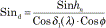
i.e. the case f(x, y, z), where hn is the altitude at noon and δ1(λ) is the first inclination of the longitude λ. He first reduced the formula to

by calculating k = Cos δ1(λ) ⋅ Cos ϕ for a given λ at a given location of latitude ϕ in order to make calculations easy for any hn i.e. the case is reduced to f(x).
Problem 3: This could be crucial. When he wanted to determine the oblique ascensions αϕ(λ) (i.e. the ascensions at spheara obliqua) from the right ascensions α(λ) (i.e. the ascensions at spheara recta) and the equation of daylight ω(λ), his method was: αϕ(λ) = α(λ) − ω(λ). And in order to make things easy, first he tablated the values ω(λ) for all λ < 90° at given latitude ϕ.
In addition to the three problems, Abū al-Wafā’ tablated both the values of sine and cosine of the first inclination i.e. the values Sinδ1(λ) and Cosδ1(λ) for all λ < 90°, to be used in many of his astronomical calculations, as for example in problem 2. On the other hand, in his table of sines, Abū al-Wafā’ did not tablate the values of cosine but the values of versed sine i.e. 60 − Cosx. In this manner, as I have understood al-Battānī’s method, the “cotangent” which he tablated, was somehow similar to these constants k mentioned in the problems above. But the difference is that the constants k of Abū al-Wafā’ were abstract (except in problem 3), and those of al-Battānī were related to something concrete (applications in real life) as in problem 3. And al-Battānī is evidence of this. When he wanted to do the opposite (i.e. determining the altitude of the sun from the shadow), he had in mind only the table of sines, and the method was as follows: in figure 1 the triangles OAB and OCD are similar (where OA is known, and AB is equal to twelve, and OD is equal to sixty, and CD is the unknown) and this gives

which is equal to  . And by using his table of sines, he would be able to find arc DG. The radical
 , which is OB, clearly reminds us about cosecant, and the whole formula reminds us about the relation

Analogously, if I, from the beginning, quoted the method of al-Battānī for determining the shadow from the altitude (where the miqyās in this case is horizontal, MN in Fig. 1), and its opposite (i.e. determining the altitude from the shadow), I would have reached something that would remind us about tangent, secant, and the relation

where the miqyās was again equal to twelve.
As it appeared in his zīj, al-Battānī tablated the values of 12 cot x for the corresponding altitudes x of the sun, and not the values12 tan x, where the number 12 here means 12 fingers, and he was aware that they are complement of each other (complement to ninety degrees), and maybe this was why he tablated only one of them. And this table was constructed to find the altitude from the shadow or the opposite i.e. only for practical use (similar to that table of equation of daylight mentioned before in problem 3 and that of Cosδ1(λ), and not for finding the arc, as soon as the arc was the wanted, he would think of the sine or cosine. And in case the cosine was given, he would use table of sines to find the corresponding arc and then subtract it from ninety degrees. And this technique went over to his successors, even after the tangent and cotangent were introduced as functions of arcs, and even they kept mentioning the expressions as “inverse of tangent” or “inverse of cotangent”. Similarly, in order to find the arc of a given tangent, cotangent, secant, or cosecant, first they determined the sine by using the relations among the trigonometric functions,Footnote 24 and then they took the inverse of the sine; and this was what Abū al-Wafā’ and al-Bīrūnī (d. 1048) did in their works.Footnote 25
Based on the above, the functions that we now call trigonometric were born as two groups, as follows (the classification here is by radius):
Group one: Sin x = R·sin x and Cos x = R·cos x.
Group two: Tan x = r·tan x, Cot x = r·cot x, Sec x = r·sec x, and Csc x = r·csc x.
In this grouping, only the sine was responsible for determining the arc (or the angle), and R, which represents the radius of the circle, was fixed to sixty as mentioned before, and this sixty is abstract and has no measure unit, and this is very clear for example in the works of Abū al-Wafā’. He worked with two unequal circles (in the same geometrical figure) and both radii were divided into sixty equal parts, and his sine and cosine maintained the same values in both cases (third chapter of Book IV of his Almagest). Accordingly, if the discussion was restricted to the Arabic-Islamic period,Footnote 26 I would find it necessary to always tell that Sin x = 60 sin x and Cos x = 60 cos x accompanied with the mentioned understanding (i.e. the stability).
As for r, which represents the miqyās, it is variable and depends on need and availability, also on the branch, such as astronomy and astrology, and it is, together with the related functions, responsible (in the first place) for determining the lengths in reality expressed in the given measure unit, and it was not bound to the circle. And I did find its value changes from one book to another, and the most used values were: 1, 6, 6.5, 9, 12, and 60. In The Quadrilateral, al-Ṭūsī (d. 1274) listed some of the famous values.
Leaving the period of al-Battānī and stopping at the period of Abū al-Wafā’,Footnote 27 the picture will change, and there will be a noticeable advancement, and at that time, it is worth mentioning that there were many great scientists, such as Ibn ‘Irāq (d. 1036), al-Sijzī (d. c. 1020), al-Bīrūnī and Kushyār ibn Labbān (d. 1029), and others. As soon as the Almagest of Abū al-Wafā’ is considered, the sun and the shadow disappear, and the talk will be about the tangent and cotangentFootnote 28 as functions of arcs, and these have the ability to work also during the night. That means, the “old shadows” is now moved from the surface of the earth to the papers to be more and more abstract, as exactly as in case of the sine (with some restrictions), i.e. they are now terms that are bound to the circle, and this is noticeable especially with the spherical tangent rule of Abū al-Wafā’, here both the sun and the miqyās disappear completely.Footnote 29 And as done before, figure 2, which was introduced for the first time in the Almagest Footnote 30 of Abū al-Wafā’, will clarify the picture. And it is worth mentioning that the young al-Bīrūnī immediately adapted the figure, and explained it in his works (explained the difference between the shadow of the miqyās and the tangent as a function of arc).Footnote 31 The same happened with al-Ṭūsī who reprinted it (as it is) in his The Quadrilateral, and this behavior continued.
The form at the end of the Arabic-Islamic stage
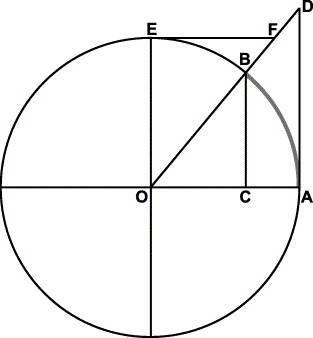
In figure 2, OA is the radius, which is in principle divided into sixty equal parts, and this sixty is related only to sine and cosine, and at the same time, it is also the miqyās, which is in principle a variable related to the other functions. This could produce confusion or difficulties,Footnote 32 and for this reason Abū al-Wafā’ tablated the tangent and cotangent with miqyās equal to sixtyFootnote 33 (the same as that for sine and cosine), and this was why he also preferred to deal with miqyās of length one,Footnote 34 but this time along with an advancement. And in this discussion, there is no need to list Abū al-Wafā’’s achievements in plane and spherical trigonometry,Footnote 35 these might be a subject of another occasion, and they do deserve to be treated separately. But for the moment, the relations that could enrich the current discussion are those modern relations that he deduced when he took the miqyās to be one in figure 2, i.e. he was dealing with a unit circle,Footnote 36 as:

And thus, his values for tangent, cotangent, secant, and cosecant were exactly the same as the values in modern time, as for example these “celebrated” results:

which were appearing for the first time. All these were mentioned to be compared later with figure 3. Obviously, a kind of unity has started to appear in the thinking i.e. the stability,Footnote 37 and instead of dealing with two radii, there would be only one radius for all functions. Accordingly, the other functions would also be responsible for finding the arc or the angle in the same degree as the sine, and the confusion caused by different tables of tangents (and cotangents) available in the market will be removed, and this was why the expressions “inverse of tangent” or “inverse of cotangent” started to appear in the works of that period. So this relative stability of the trigonometric functions (i.e. their tables) together with figure 2 with miqyās equal to one,Footnote 38 all these will represent the form in the end of the Arabic-Islamic stage. Standing at this form, only one step remained and the trigonometric functions would get released from the radius, i.e. to settle down forever as lengths on a unit circle (or as ratios). As it is noticed, the features of the form in figure 2 remained fixed into figure 3 which represents the modern times.
The form in modern times

ACKNOWLEDGMENT
The writer would like to take this opportunity to thank Prof. Kirsti Andersen (Aarhus University-Denmark) and Prof. Roshdi Rashed (Paris 7) so much for their valuable advice and comments as well as for their patience over the past years, who have always helped me through the course of my career. The writer would also like to express his sincere thanks to King Fahd University of Petroleum and Minerals (KFUPM) for its continuous support, including the proof-reading by EFL instructor Rodney Munn.