INTRODUCTION
One could argue that Norway is a special case when it comes to alternative religion and the public sphere. In recent years, Norway has become known internationally for having a Royal Princess who is deeply involved in alternative religiosity. In the summer of 2007, Princess Märtha Louise admitted publicly to being clairvoyant, and told the media that she had psychic powers and could teach people to communicate with angels Aftenposten (2007). Together with her business partner, Elisabeth Samnøy, she has started her own alternative medical school, Astarte Education, named after one of the oldest goddesses in the Middle East. The training program is billed as a means of “getting in touch with your own truths through readings, healing, crystals and hands-on treatment.” The princess, who still officially represents the Royal Family at various events, is educated as a physiotherapist, later trained as a Rosen therapist and has also studied at an academy for holistic medicine. In the summer of 2008, Märtha Louse was back in the headlines Dagsavisen (Reference Dagsavisen2008), as she has been criticized for admitting children as young as 12 to her courses (albeit for a lower fee than adults).
A lesser known fact is that alternative therapy has also been promoted by government representatives. Shortly before he took office in 1996, former Norwegian Prime-Minister Thorbjørn Jagland, from the Norwegian Labour Party, told the public about his own use of homeopathic medicine (Jagland Reference Jagland1995a). In his opening speech at the Norwegian Labour Party's 55th ordinary national congress in 1995, Jagland argued that the government's health budget could be reduced by transferring public money from school medicine to alternative medicine and alternative therapy (Jagland Reference Jagland1995b). Even though there are active spokesmen for alternative religiosity among elite groups and, as we have just seen, even in the government, alternative religiosity seems to have had little impact on the political agenda. Is this situation about to change? The research question here is: will alternative religion develop into a political cleavage and replace the traditional moral-religious cleavage?
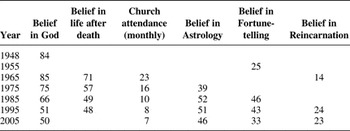
In many parts of Europe, traditional religion has been declining while alternative spirituality has been on the rise. According to Davie (Reference Davie2002), these two developments are interrelated. Her analysis of religion in Europe shows that the decline of the church leads to an upswing in individual religiosity, especially in extra-church religiosity such as occultism, astrology, New Age, and so on. The argument seems to be that when churches lose power and influence, people feel free to pick up ideas and practices from other religious traditions — and to combine them in different ways. Empirical data taken from various polls and surveys conducted in Norway shows that such a development has taken place over the last 50 years. According to Table 1, church religiosity has steadily declined while alternative religiosity has gained in support. But the picture is not as simple as that. Since the beginning of the second millennium, some of the parameters measuring alternative religiosity have also shown a degree of decline. This indicates that alternative religiosity is also undergoing a transition. The situation could therefore be more complicated than Grace Davie suggests in her thesis.
Measures of traditional and alternative beliefs in the Norwegian population (%)

Source: Norwegian Gallup Institute and Norwegian Monitor Study (MMI/Synovate).
DATA AND METHOD
The main data for this study were taken from a large survey of 1,453 Norwegians in 2000 as part of the International Social Survey Programme (ISSP).Footnote 1 The questionnaire module consisted of questions on the environment and political ecology but there were also some supplementary questions used only in a Norwegian context. One set of questions was related to different forms of spirituality. This article is primarily based on these supplementary questions. The Norwegian part of the ISSP was managed by the Norwegian Social Science Data Services (NSD) together with the Norwegian Gallup Institute.
ISSP 2000 randomly sampled 2500 people between 18 and 79 years of age living in Norway, sending them a questionnaire in the mail. The response rate was 58.1 per cent. The sample was checked against the total population and found representative on such variables as gender, age, and place of residence. The variables that were used to construct indexes are documented in the Appendix.
FROM RELIGION TO SPIRITUALITY
In 1996, a British professor in religion and modernity, Paul Heelas (Lancaster University), published a book entitled The New Age Movement — the Celebration of the Self and Sacralization of Modernity, and published another book in 2004 entitled The Spiritual Revolution (2004), co-authored with Linda Woodhead (also Lancaster University). In this new book, “New Age” is almost not mentioned at all. Instead the authors speak of “inner spirituality” and “spirituality of life.” Heelas indicates in his books that the New Age movement has undergone a gradual development from the days of the religious counter-culture of the 1970s to the inner-spirituality that flourishes today. He mentioned in 1996 that two different paths were open to the New Age movement. Either people would continue to use New Age to satisfy individualistic or consumerist needs, or this orientation would be replaced by a kind of spirituality where people would work to change themselves and society (Heelas Reference Heelas1996, 221). In his latest book, Spiritualities of Life, it is obvious that Heelas (Reference Heelas2008) thinks that the latter of these two scenarios has come true. Do we need both concepts to capture the whole picture or does the term “spirituality” incorporate the core elements of the New Age movement of the 1980s and 1990s? An alternative view would be to look at spirituality as something different from both New Age and Christianity, and that all three phenomena exist side by side in the population.
There are many definitions of New Age in the academic literature. However, when it comes to empirical research, people tend to use the same “operational” definition. On both sides of the Atlantic, New Age is usually measured by questions relating to interest or belief in such phenomena as astrology, reincarnation, fortune-telling, contact with the dead and so on (Donahue Reference Donahue1993; Canetti-Nisims and Beit-Hallahmi Reference Canetti-Nisim and Beit-Hallahmi2007; Holm and Bjorkquist Reference Holm and Björkqvist1996; Hollinger and Smith Reference Hollinger and Smith2002). Solum (Reference Solum2001), one of the leaders of the alternative religious community in Norway, confirms that even within the community itself there is a tendency to divide people into two groups: those who are interested in one or more of the religious phenomena without integrating them into a coherent world view, and those interested in the ideas that hold the elements together — the holistic ideology. The concern with ideology seems to go hand in hand with a search for spiritual experiences.
According to Heelas and Woodhead (Reference Heelas and Woodhead.2004), the growth of “spirituality of life” in the West is related to a massive subjective turn in modern culture, a turn away from life lived in terms of external roles, duties and obligations, and a turn toward life lived according to reference to one's own subjective experiences (relational as much as individualistic). This broad cultural shift is also a shift from religion to spirituality. The former subordinates subjective life to the “higher” authority of transcendent meaning, goodness and truth, while the latter invokes the sacred in the cultivation of a unique subjective life (Heelas & Woodhead Reference Heelas and Woodhead.2004). Spirituality sacralises subjective life and the inner experiences of the individual. The kind of spirituality that can be found in Christian circles may also involve intense experiences of joy and awe but in contrast to the new spirituality, it focuses on something external and higher than the self.
Heelas and Woodhead (Reference Heelas and Woodhead.2004) have posited the hypothesis that a silent revolution is taking place where (traditional) religion is giving way to “spirituality.” If this is the case, alternative religion or spirituality is also likely to assume the role that traditional Christian religion has played in the political system. My thesis is that although alternative beliefs over the years have gained support in the population at the expense of traditional religion, this does not mean that alternative religion will develop into a full political cleavage that will significantly impact the political system. One of the main obstacles to this happening seems to be that the alternative movement is split into two factions when it comes to world view and ideological matters. My argument is based on empirical analyses of data from surveys conducted in Norway. According to these surveys, those who are attracted to New Age beliefs, such as astrology, fortune-telling, and reincarnation are generally not the same people who are interested in seeking spiritual experiences and deepening their inner spirituality.
HOW SOCIAL DIVIDES BECOME CLEAVAGES
For more than a century, religion has played an important role in Norwegian politics. In the early days of party democracy in the 1880s, the pietistic laymen's movement was an important part of the Norwegian Liberal Party (Venstre literally “Left”) (Nerbøvik Reference Nerbøvik1999). Later, in 1933, an explicit Christian party (Kristelig Folkeparti) was founded as a reaction to growing secularism. Cultural and spiritual values were proposed as an alternative to the focus political parties had on material values. In 1945, in the first elections after the Nazi occupation of Norway, the party was organized on a nationwide basis, and won eight seats in Parliament. In its social policy, the party has conservative opinions, but not in its economic policy. On life issues, the party opposes euthanasia and abortion, although it could support abortion in cases of rape or when the mother's life is at risk. The party supports accessibility to contraception as a way of lowering abortion rates, wants to ban research on human fetuses, and has expressed skepticism to proposals that would liberalize biotechnology. In the 1990s, it positioned itself as a family-friendly party. The Norwegian Christian Democratic Party has been a member of several non-socialist coalition governments since the 1960s and in 1973 the party had its first prime minister. According to political scientists, since the start of party democracy, religion (the traditional Lutheran form) has been an important political cleavage (Rokkan Reference Rokkan, Lipset and Rokkan1967).
For more than 50 years, political science research has dealt with the question of how a political issue or a social conflict develops into a political cleavage. The discussion often starts with the model presented by Lipset and Rokkan (Reference Lipset and Rokkan1967). These two scholars produced the most powerful comparative statement of parties as political expressions of social cleavages. They isolated four major cleavages that gave rise to European parties with different social bases: center-periphery, state-church, land-industry, and owner-worker. However, Lipset and Rokkan (Reference Lipset and Rokkan1967) did not give a precise definition of what they felt political cleavage meant. Subsequent researchers have therefore attempted to be more precise, most prominently Bartolini and Mair (Reference Bartolini and Mair1990), who specify that cleavages are related to three distinct elements:
… an empirical element, which identifies the empirical referent of the concept, and which we can define in social-structural terms; a normative element, that is the set of values and beliefs which provides a sense of identity and role to the empirical element, and which reflects the self-consciousness of the social group(s) involved; and an organizational/behavioural element, that is the set of individual interactions, institutions, and organizations, such as political parties, which develop as part of the cleavage (Reference Bartolini and Mair1990, 215).
For Bartolini and Mair (Reference Bartolini and Mair1990), cleavage involves all the three elements at the same time. For practical reasons we can call them “structure,” “identity,” and “institution.” They emphasize that “cleavages cannot be reduced simply to the outgrowths of social stratification; rather, social distinctions become cleavages when they are organized as such” (Bartolini and Mair Reference Bartolini and Mair1990, 216). Most research on cleavage accepts these three elements as outlined by Bartolini and Mair (Reference Bartolini and Mair1990). Researchers in the field therefore search for self-conscious demographic groups sharing a common mindset and distinct (political) organization (Deegan-Krause Reference Deegan-Krause, Dalton and Klingemann2007). Historically, cleavages are formed when a social group comes together and develops a common understanding of its interests and ideas. When a common ideological base is formed, it starts to build networks and institutions that can communicate the members' interests and ideas to the rest of society and the political system.
The scholarly quest to identify cleavages with all three elements outlined by Bartolini and Mair (Reference Bartolini and Mair1990) has yielded fruitful results in Western democracies. Much of today's scholarship on “cleavage” focuses on differences related to institutions and attitudes. Such divides appear to have increased in importance, accompanying or perhaps supplanting structurally-based divides. Needless to say, structure still plays an important role. Lipset and Rokkans's (Reference Rokkan, Lipset and Rokkan1967) definition of key structural elements has survived the test of time not only because its labels elegantly capture key structural differences but also because they have proven highly adaptable. The “urban-rural” cleavage now represents geographic difference, the “owner-worker” cleavage represents socio-economic status, the “center-periphery” cleavage represents cultural difference, particularly ethnicity, and finally the “church-state” cleavage represents differences in cultural values and religiosity (Deegan-Krause Reference Deegan-Krause, Dalton and Klingemann2007).
Thus adapted, Lipset and Rokkan's (Reference Rokkan, Lipset and Rokkan1967) list leaves little room for additional categories. The few serious rival claimants include generational differences and educational level (Inglehart Reference Inglehart1977), economic sector (Kriesi Reference Kriesi1998), and gender (Brooks, Nieuwbeerta and Manza Reference Brooks, Nieuwbeerta and Manza2006). Some will object, saying that more than one cleavage is needed to capture the cultural diversity in advanced post-industrial societies.
Scholars of cleavage document considerable areas of stability. Both social class and religiosity have continued to exhibit a significant relationship to partisanship and in some Western countries so have regional, ethnic, or linguistic differences. Yet much has changed. New institutional differences have emerged with the rise of Green and extreme right parties. Established democracies have also experienced the rise of issue divides based on such questions as political participation, environmental protection, sex- and reproduction-related issues, and immigration.
The six social dimensions — economic status, religion, ethnicity (language, race), region, urbanization, and education, have been used productively to analyze party support and political preferences across a broad range of nations. There are also many examples of non-structural issues developing into political cleavages, such as foreign policy, globalism, immigration, and so on. The primary example is protection of the environment advocated by the “green movement.”
THE TWO FACES OF ALTERNATIVE RELIGION
In the following, I will analyze Norwegian survey material to detect different religious and spiritual dimensions in the population, and compare them in such areas as ideological content, social profiles, and political attitudes.
My hypothesis is that the alternative movement does not constitute one consistent entity, but that we have to deal with several different world views. There is as yet no broad agreement in the research community as to what indicators we should use to measure the phenomenon “spirituality” in the population. Heelas and Woodhead (Reference Heelas and Woodhead.2004) have used a set of indicators in small-scare surveys in Kendal, England, but no one has yet constructed batteries of questions to use in a national survey. Thus, the use of factor analyses may be of help in the process of measuring the different forms of religiosity that exist in a general population. Analyses in this article are based on the Norwegian part of the survey project ISSP 2000.
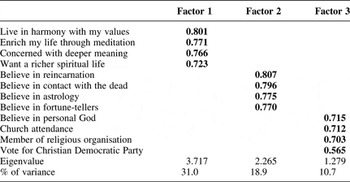
Table 2 shows the percentage of the Norwegian public that has a positive score on the listed items and indicates that we find three distinct forms of religiosity. Most of the measures used in the factor analyses are related to religious beliefs and values and thus connected to ideology. The first four questions are open and neither typical Christian nor typical New Age elements. I tend to interpret this first factor as the spirituality dimension that Heelas and Woodhead (Reference Heelas and Woodhead.2004) focus on (the Appendix provides the exact questions in English). The next four questions are related to typical New Age elements, such as astrology, fortune-telling, reincarnation, and so on. The last five questions are traditional Christian or church-oriented items. Reliability measures (Cronbach's Alpha) are acceptable for all three factors (Spirituality = 0.807, New Age = 0.804, and Traditional Christianity = 0.669). I have also found the same pattern using other Norwegian surveys with somewhat different questions and variables (Botvar Reference Botvar, Furseth and Leer-Salvesen2007). This tends to strengthen the argument about the existence of several distinct religious dimensions or factors.
Factor analyses of spiritual variables.a Only scores higher than 0.40 are presented

a Extraction method: Principal Component Analyses. Rotation method: Varimax with Kaiser Normalization.
The empirical analyses show that those who speak of alternative religion as one single phenomenon are missing the point. According to the Norwegian data, we find one traditional Christian dimension and two separate alternative ones. The first factor in the table resembles the kind of spirituality that Heelas and Woodhead (Reference Heelas and Woodhead.2004) outline in their book, The Spiritual Revolution. However, I also find a type of religious orientation that is more in line with what Paul Heelas and others have described in earlier research on the New Age movement (Heelas Reference Heelas1996; Kyle Reference Kyle1995; Lewis and Melton Reference Lewis and Melton1992). This means, as already stated, that those who are attracted to New Age beliefs, such as astrology, fortune-telling, and reincarnation, are generally not the same people who are interested in seeking spiritual experiences. Research conducted in Scandinavia concludes that there are different variants of alternative religion. Ahlin (Reference Ahlin2001; Reference Ahlin2005) has analyzed alternative religion in both Sweden and Denmark. One of his findings is that modern alternative religion can be divided into two parts. The first is described as sharing many characteristics with earlier types of popular religion, both because it seems to be a religion for the lower classes and because it points toward a fatalistic world view (Ahlin Reference Ahlin2005). The second type of alternative religion is described by Ahlin (Reference Ahlin2005) as highly individualistic. On this point Ahlin tends to differ from Heelas and Woodhead (Reference Heelas and Woodhead.2004), who see the new spiritual orientation as both social and egalitarian, in that they value every individual's religious experiences as equally important (Botvar Reference Botvar2004).
The labels I use for each religious orientation are of course open to discussion. Some argue that the New Age concept is out-dated and would instead use the category “modern folk religion” (Ahlin Reference Ahlin2005; Hammer Reference Hammer1997). Today's New Age religiosity has many of the same functions as the Scandinavian folk religion of the 18th and 19th centuries, even if the content has changed. While there are not many who believe in trolls, elves or the nix any more, the newer concepts (in the West), such as astrology, karma, and reincarnation, might serve some of the same social purposes. These beliefs can help explain accidents and other problems occurring in everyday life, and thus create order out of chaos (cf. Hodne Reference Hodne1999, 240; Botvar Reference Botvar1999, 25).
We have seen that the indicators of New Age religiosity constitute a different dimension from the new measures related to “spirituality.” These findings are highly problematic when seen in connection with the discussion on the necessary conditions for political cleavage to prevail. According to Bartolini and Mair (Reference Bartolini and Mair1990), having a common identity is one of the preconditions for a social divide to become a political cleavage. Without a common ideological base, the struggle for societal recognition and political influence is likely to fail. If the alternative religious movement really is divided into two separate factions, this will probably also be reflected in the social distribution of the two groups, and in their attitudes toward questions in other areas than religion.
To further test the hypothesis about distinct forms of alternative religiosity, I will take a closer look at the social profile of the three religious dimensions. Bearing the factor analyses in mind, I have constructed three cumulative indexes with values ranging from 1 to 12 based on four variables. These indexes will be used in statistical analyses of social structure and political values.
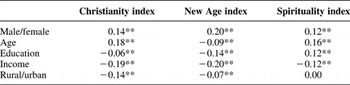
Table 3 shows us that the three religious orientations tend to attract different people or different social strata. Women are more attracted to all the religious or spiritual orientations than are men. The gender difference is smallest when it comes to spirituality.
The social profile of the three indexes. Pearson's r

**sign. on 0.01 level.
*sign. on 0.05 level.
Source: ISSP 2000, Norway. N = 1450.
Age is a variable that has different effects on the three religious factors. While both Christianity and spirituality tend to attract adults and old people, New Age is supported by more young people. The relation between education and religiosity is an interesting one. While both Church-oriented Christians and New Agers tend to have a lower level of education than the average citizen, spirituality is most successful among the well-educated. All three religious groups tend to have income lower than the average level. Finally, spirituality tends to be a more urban phenomenon than the other religious dimensions.
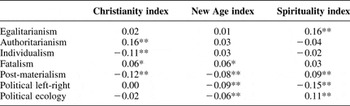
Table 4 shows that the three religious orientations tend to have different social outcomes. In some instances, the differences go between Christianity and the alternative world views. This is the case with authoritarianism and individualism. But in many respects, New Age and spirituality tend to play contrasting roles when it comes to political attitudes related to post-materialism, fatalism, and ecology, for example.
The relations between religious indexes and other social-value indexes. Pearson's r

**sign. on .01 level.
*sign. on .05 level.
Source: ISSP 2000 Norway. N = 1450.
According to other studies, “the spirituals” have a higher score on social-capital indicators than have “New Agers.” This is the case when one looks at variables such as “membership in organizations,” the ability to do voluntary work, and trusting other people. Those adhering to New Age score high on negative indicators, such as political apathy and fatalism (Botvar Reference Botvar, Furseth and Leer-Salvesen2007, 97). The positive correlation between the spirituality dimension and various indicators of societal involvement gives this dimension a better chance of becoming a political cleavage than the New Age dimension. These findings also point in another direction than prescribed by those who think that the alternative movement only is concerned with narrow self-interest and individual goals (e.g., Bruce Reference Bruce1996, 225).
Those attracted by spirituality are more likely to vote for the Norwegian Christian Democratic Party and the Socialist Left Party than the rest of the population. This group is less likely to vote for the right-wing Progress Party and the Conservatives. The New Agers are, however, more inclined to vote for the right-wing Progress Party (Fremskrittspartiet) and less likely to vote for the Liberals (Venstre) than the rest of the population. As we have seen, there are also other differences in political values between the two alternative groups and the split is further demonstrated by the differences in social profiles (Table 3).
According to the Norwegian data, we are dealing with three distinct religious or spiritual orientations. Empirical evidence shows that there are interesting differences between the two phenomena in terms of ideological content, social profiles, and political attitudes. I would argue that one fruitful approach is to distinguish between New Age and spirituality and to treat them as separate phenomena. The empirical findings show that it is impossible to say that New Age is no longer relevant as a religious category even if the movement does not appear to have as many societal consequences as the other religious dimensions.
INSTITUTIONS WITHOUT IDEOLOGY?
The empirical analyses have shown that there is a problematic relationship between alternative religion and the two first elements in the model presented by Bartoloni and Mair (Reference Bartolini and Mair1990). When included in empirical analyses, measures derived from the literature on New Age and spirituality do not form a single dimension. Alternative religion seems to be divided into two separate ideological groups, one relating to those New Age ideas that flourished in the media during the 1980s, and the other relating to deepening one's spiritual life by seeking spiritual experiences through meditation techniques. These two alternative orientations or world views also have different consequences for social stratification. The New Age orientation mostly attracts people with a low level of education living in the countryside, while spirituality attracts adults with higher education living in both rural and urban parts of the country.
What about the third element that is emphasized in Bartolini and Mair's (Reference Bartolini and Mair1990) model? According to them, “institution” constitutes a crucial part of political cleavages. Institution means the ability to form networks and make organizational structures that can articulate the interest and ideas of the social group. In recent decades, alternative religion has developed comprehensive networks; at least this is the case in Norway. Since the beginning of the 1990s, several institutional organs have been established in the field of alternative religion. One of these is the monthly magazine first entitled Alternative Network and now with the name Visjon, which has approximately 16000 subscribers. This magazine has played a significant role in maintaining the movement. It contains articles on alternative practices and ideas, and presents events, courses, and therapists working in the field. The editorial page addresses ideological and political matters. When Election Day approaches, the magazine presents those parties that are most “friendly” to the alternative way of thinking.
Organizational events include the annual Body, Mind, Spirit symposiums that are held in the larger cities each year. The first symposium was held in Oslo in 1997 and each year attracts around 20000 participants. In 2004, a holistic-life-view organization that calls itself the Holistisk Forbund (Holistic Association) was formed. As of August 2008, it has 1200 registered members and covers all regions in Norway. The organization receives state funding in the same way as churches and mosques and represents its members in various political and inter-religious councils.
The ideological split within the alternative movement represents a great challenge for the movement. In an article in Visjon, the editor of the alternative magazine — Solum (Reference Solum2008) — accepts that the movement has overlooked the need to be outspoken about its goals and purposes. The vision of a silent spiritual revolution in society has not yet become reality. The holism rhetoric has not functioned as the ideological glue to keep the movement together. In an attempt to bring new enthusiasm into the project, Solum (Reference Solum2008) gave his article the title “We are the ones we are waiting for.” The alternative movement seems to be in need of a more explicit ideology that can foster a common identity. The leadership has been too eager to please all groups within the movement, and now faces the dilemma of having to choose between two bad alternatives, either continuing to be vague and diffuse or to formulate a distinct program that can be used to promote social change. Due to the idea that everybody should find their own spiritual way, the movement has refused to be precise as to their position on ideological matters. It has avoided setting down a set of core values to strive for in fear of ending up as a clone of the very churches they have criticized so heavily in the past for being too dogmatic.
CONCLUSION
According to Bartolini and Mair (Reference Bartolini and Mair1990), three preconditions have to be fulfilled before a social divide will develop into a full political cleavage. The three elements are related to social structure, ideology, and institutions. There are several reasons why alternative religion has not developed into a political cleavage. According to my research on alternative religion in Norway, the main problem where political influence is concerned is not a lack of institutional arrangements. The main obstacle to alternative religion becoming a real political force is the issue of “identity” and the problems related to building a common ideological basis that can lead to a collective identity among the adherents. The modern alternative religion cannot be described as one coherent movement; in spite of the holism rhetoric, the movement is very much divided into two orientations or factions. These two orientations differ on such elements as social structure and basic religious and political values.
My own research on Norwegian survey material shows that the movement is split into two distinctive groups. These differences are related both to social structure and religious and political values. Using factor analyses, I have constructed indexes that measures the two dimensions within the alternative religious movement. These analyze show that both dimensions are alive and well, and exist within the alternative movement. In my view, the ideological split within the movement is one of the reasons why the alternative movement still has a long way to go before it eventually becomes full political cleavage.
To succeed in the political arena, the movement has to formulate a program that specifies its goals and values. In the present situation, the movement is split into two orientations that point in different ideological directions. The lack of a common ideology could well be the reason why the established political parties have not yet looked at the alternative movement as an interesting pool in which to fish for voters.
APPENDIX
Questions from ISSP 2000 Norway (translated into English)
Spirituality Orientation:
– I want to live a richer spiritual life
– I try to enrich my spiritual life by reading, meditating or praying
– I want to live a life more in harmony with the values I really support
– I often think about the deeper meaning of life
New Age Orientation:
– Some people have the ability to foresee the future
– By reading the stars you can say something significant about a person's personality and fate
– People have lived previous lives and are born into new ones
– Under certain conditions it is possible to come into contact with dead people
Traditional Christian Religiosity:
– Which statement comes closest to expressing what you believe about God?
– Apart from such special occasions as weddings, funerals and baptism, how often do you attend religious services?
– What party would you vote for if Election Day were next Monday?
– What, if any, church or religious group do you belong to?
Egalitarianism:
– Governments should redistribute income from the better-off to those who are less well-off
– Private enterprise needs to be controlled to protect everyone's needs
Authoritarianism:
– One of the problems with people today is that they challenge authority too often
– All societies have inequalities which it is better not to interfere with
Individualism:
– People with money should be left to enjoy it
– There are times when people should follow their consciences even if it means breaking the law
Fatalism:
– There is little that people can do to change the course of their lives
Postmaterialism:
– Standard four-item Inglehart battery
Political Ecology:
– We worry too much about the future of the environment and not enough about prices and jobs today
– People worry too much about human progress harming the environment
– In order to protect the environment Norway needs economic growth.