INTRODUCTION
The fin whale (Balaenoptera physalus L.) is a cosmopolitan species occurring in all major oceans usually in temperate and polar latitudes. In the North Atlantic fin whales occur from Baffin Bay west of Greenland south to Florida and the Gulf of Mexico in the west and from Iceland and Norway, south to the Iberian Peninsula in the east (Reid et al., Reference Reid, Evans and Northridge2003). In Ireland, fin whales have previously mainly been recorded on the shelf edge beyond the 500 m contour (Reid et al., Reference Reid, Evans and Northridge2003; O'Cadhla et al., Reference O'Cadhla, Mackey, Aguilar de Soto, Rogan and Connolly2004; Notarbartolo di Sciara et al., Reference Notarbartolo di Sciara, Evans, Harris and Yalden2008). A total of 693 fin whales were caught on the shelf by whalers off the north-west coast of Ireland between 1908 and 1920, indicating that fin whales frequently passed along the edge of the continental shelf during the summer (Fairley, Reference Fairley1981); a similar pattern was revealed from whale catches along the shelf west of the Outer Hebrides in Scotland (Evans, Reference Evans1990). In the UK, the Faroe–Shetland Channel and Rockall Trough are both thought to be important feeding grounds or are on the migration paths of this species (Weir et al., Reference Weir, Pollock, Cronin and Taylor2001; Macleod et al., Reference Macleod, Simmonds and Murray2003; Reid et al., Reference Reid, Evans and Northridge2003). The most recent abundance estimate for fin whales in Irish and the adjacent waters of the British Isles–Spain–Portugal management area was from the CODA survey carried out in July 2007, which produced an estimate of 9019 (CODA, 2008).
Based on genetic evidence, the International Whaling Commission has recognized that current data make it impossible to discern between one or several breeding stocks of fin whales in the North Atlantic, and in fact the genetic data from different studies are contradictory (Bérubé et al., Reference Bérubé, Aquilar, Dendanto, Larsen, Di Sciara, Sears, Sigurjonsson, Urban and Palsboll1998; IWC, 2007). A genetically distinct population occurs in the Mediterranean Sea (Bérubé et al., Reference Bérubé, Aquilar, Dendanto, Larsen, Di Sciara, Sears, Sigurjonsson, Urban and Palsboll1998). The migration patterns of fin whales in the North Atlantic are poorly known but they are thought to migrate northwards in the spring to spend the summer in cold temperate and polar seas. Acoustic monitoring in deep water has supported the previous information from whale catches that the western seaboard of Ireland and Scotland is a migratory corridor for fin whales and Clark & Charif (Reference Clark and Charif1998, Reference Clark and Charif2000) have recorded vocalizing animals west of the continental shelf in all months with no obvious seasonal trends. Less vocalizing was recorded from May through to July which was thought to be outside the main mating period in late autumn to winter.
The fin whale has been the subject of a number of studies involving the use of photo-identification. Robbins et al. (Reference Robbins, Dendanto, Giard, Panigada, Sears and Zanardelli2008) recently reviewed fin whale photo-identification catalogues about the North Atlantic. They identified two catalogues relating to the north-west Atlantic, four relating to the Mediterranean Sea and three smaller catalogues relating to the north-east Atlantic from the Azores, Spain and Ireland. The longest running and largest catalogue is the ‘North Atlantic Fin Whale Catalogue’ for the north-west Atlantic. Images have been collected since 1974 from which the ‘North Atlantic Finback Whale Catalogue’ was created in 1981 (Agler et al., Reference Agler, Beard, Bowman, Corbett, Frohock, Hawvermale, Katona, Sadove, Seipt, Hammond and Donovan1990). It now includes 23,665 images of 841 individual whales sighted in the Gulf of Maine, off New York, and off Nova Scotia and the Gulf of St Lawrence (Robbins et al., Reference Robbins, Dendanto, Giard, Panigada, Sears and Zanardelli2008). The ‘Mingan Island Cetacean Study’ holds images of 430 individual fin whales mainly from the Gulf of St Lawrence and the Groupe de Recherche et d'Éducation sur les Mammifères Marins maintains a catalogue of around 200 individual fin whales also from the Gulf of St Lawrence. In the north-east Atlantic, photo-identification catalogues of fin whales are few and mainly occur in the Mediterranean Sea. The Tethys Research Institute (TRI) contains images of a total of 425 individual fin whales collected over a 17-year period (Zanardelli et al., Reference Zanardelli, Notarbartolo di Sciara and Jahoda1992; Bendinoni et al., Reference Bendinoni, Azzellino, Panigada and Zanardelli2003; Robbins et al., Reference Robbins, Dendanto, Giard, Panigada, Sears and Zanardelli2008). Three other research groups have a total of 177 individual fin whales which have recently been integrated with the catalogue held by TRI (Robbins et al., Reference Robbins, Dendanto, Giard, Panigada, Sears and Zanardelli2008). Outside the Mediterranean Sea, small catalogues exist in the Azores (72 individuals as of 2006), the Bay of Biscay (three individuals as of 2005), Wales (six as of 2008; P.G.H. Evans, personal communication) and Iceland (two as of 2008; C. Schmidt, personal communication). Here we report the first results of a photo-identification study of fin whales off the south coast of Ireland including information on intra- and inter-annual site fidelity.
MATERIALS AND METHODS
Fin whale sightings off the south coast of Ireland
Records of cetacean sightings are submitted to the Irish Whale and Dolphin Group (IWDG) from all around Ireland. They are validated for quality control, and species identification is downgraded if the information received does not fully support the species identification (see Berrow et al., Reference Berrow, Whooley and Ferriss2002). All records from 2003 to 2008 were included in this review. Only sightings which could be identified to species level were included and species downgrades were omitted from further analysis. During the period of interest, there were 38 records of the downgraded category (fin/sei/blue whale) and 132 records of the downgrade category ‘large whale species’, many of which were likely to be of fin whales.
Photo-identification of fin whales
Photo-identification of fin whales was carried out between August and November 2003, June and December 2004, August 2005 and February 2006, July 2006 and January 2007, August and November 2007, and between April and December 2008. Of the 79 days of fieldwork, 96% were carried out from an 11 m catamaran ‘Holly Jo’ skippered by Colin Barnes. The majority of trips (73%) were opportunistic accompanying commercial whale watching trips but on 22 occasions (27%) the vessel was chartered in order to carry out other research activities such as biopsy sampling, acoustic research or for filming purposes. In either case the vessel carried out the same search pattern looking for all cetaceans, mainly between Toe Head and Galley Head, with occasional trips as far east as the Old Head of Kinsale (Figure 3) and up to 20 km offshore. On four occasions surveys travelled east towards Youghal in East Cork and Ram Head, County Waterford.
Location of all fin whales sightings reported to the Irish Whale and Dolphin Group between 2003 and 2008.

Images of fin whales were taken on all opportunities. An attempt was made to photograph the entire flank from the animal's blow-hole, along its tail stock and from both the left and right side. Extra effort was taken to obtain images of the whales' dorsal fin and adjacent back. All images were taken with a Canon 20D digital camera and f2, 70–200 mm IS telephoto lens with × 1.4 or × 2 converter. Images were downloaded and cropped to exclude areas that were not of interest. All images were stored and the best left and right sided images uploaded onto the on-line catalogue available on www.iwdg.ie.
Images were examined by eye and whales classified following the categories presented by Agler et al. (Reference Agler, Beard, Bowman, Corbett, Frohock, Hawvermale, Katona, Sadove, Seipt, Hammond and Donovan1990). Fin shapes were categorized into five types (types A–E), scars into six types and three other mark types (blotch, chevron and cyst) were also used.
RESULTS
Fin whale sightings from Ireland
The IWDG cetacean sighting scheme has received 8093 sightings (all cetacean species) between 2003 and 2008, of which 486 (6%) were fin whales. Most of these (451; 93%) were from the south coast (Counties Cork, Waterford and Wexford) and 350 (78%) of these were from County Cork, the majority of these sightings being from between Roaringwater Bay and the Old Head of Kinsale. Only 144 fin whale sightings (32%) were from outside this area, including 21 offshore records and five from the Irish Sea and Approaches (Figure 1).
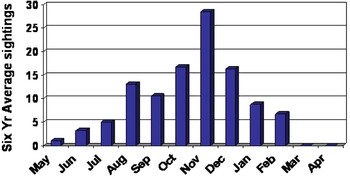
Fin whales have been reported in eleven months of the year with records only absent from April and only one record in March (Figure 2). Numbers of sightings increases through the summer and autumn to a peak in November. The fin whale season may extend from May through to February, with a peak between October and December, and with a gap between seasons in March and April.
Monthly distribution of fin whale sightings along the south coast of Ireland, 2003–2008.

Fin whale photo-identification
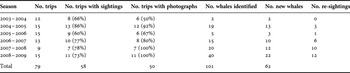
A total of 79 survey trips were carried out between August 2003 and December 2008. Around 12–15 trips were carried out most years with the fewest in 2007–2008 when only nine trips were undertaken (Table 1). Fin whales were sighted during between 60 and 86% of trips each year and images obtained during 50–100% of trips with sightings each year. This rate has increased throughout the study suggesting that the researcher's ability to obtain images is improving. The locations where fin whales were photographed were consistent with the distribution of fin whale sightings within the study area showing coverage during photo-identification surveys was good (Figure 3). The total number of whales, and the number of new whales identified each year, have both increased (Table 1) but a discovery curve of photographed individuals, still rising steadily suggests there still are more individuals visiting the area to photograph (Figure 4).
Location of (A) all fin whale sightings in west Cork (2003–2008); (B) locations of photographed whales (2003–2008).

Discovery curve of new whales identified each season.

Number of trips with fin whale sightings photographed and identified during 2003–2009.

Of the 62 individual whales identified, images of the left side were obtained from 33 whales, right hand side from 42 whales, and from both sides on 13 whales (Table 2). All fin shapes could be categorized into types A–E from Agler et al. (Reference Agler, Beard, Bowman, Corbett, Frohock, Hawvermale, Katona, Sadove, Seipt, Hammond and Donovan1990) and none in categories F or O. The second most prevalent fin shape off Ireland was type D (23%), followed by types B and C (both 16%). Over one-third (37%) of fin whales individually identified off the south coast of Ireland had notches in the trailing edge of their dorsal fin which made them very suitable for photo-identification. Only one whale had a notch in its leading edge (Table 2). Scars were very prevalent with six of the eight described by Agler et al. (Reference Agler, Beard, Bowman, Corbett, Frohock, Hawvermale, Katona, Sadove, Seipt, Hammond and Donovan1990) recorded to date. Most (65%) were scrapes, with circular scars (39%) and dents (8%) also frequently recorded (Table 2). Five whales were recorded with attachments which were all identified as Penella sp., a parasitic copepod. One scar (termed braid) was most likely to have been caused by a boat propeller.
Summary of lesions used to identify fin whales off south-west Ireland from Agler et al. (Reference Agler, Beard, Bowman, Corbett, Frohock, Hawvermale, Katona, Sadove, Seipt, Hammond and Donovan1990).

Dorsal fin shape type: (A) large and broad (44%); (B) long, thin and pointed (16%); (C) small and triangular (16%); (D) leading edge bent posteriorally, fin very hooked (23%); (E) short, low version of type A (2%). Dorsal fin notch location: leading edge of dorsal fin (2%); trailing edge of dorsal fin (37%). Scar type: L, linear (lines less than 2 inches wide (6%)); S, scrape (linear marking >2 inches wide (65%)); C, circular (round or circular shapes of any size (39%)); D, dent (any depression (15%)); T, tracks (linear scar intersected by perpendicular lines (0%)); (A) attachment (usually a parasitic copepod, penella, lamprey, etc (8%)).
Re-sighting rates
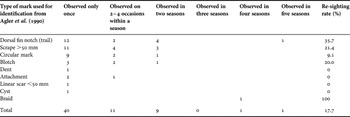
Of the 62 individual fin whales identified, 40 (65%) were recorded only once (Table 3). Eleven whales (18%) were recorded within a season on at least two, and up to four occasions. A total of eleven whales (18%) have been re-sighted between seasons (Table 3). One whale each has been recorded in four and five of the last seven years, showing a strong site-fidelity to West Cork. Sixteen of these individuals have been recorded within a season and four at intervals of 2–4 seasons. The ability to identify an individual whale depends on how distinctive and obvious the mark used is to photograph and observe. The best markings are notches on the dorsal fin as they are permanent and relatively easy to photograph. Using these marks alone we recorded a re-sighting rate of 35.7 (Table 3). Scrapes over 50 mm in length were recorded on 18 whales and 21.4% of these whales were re-sighted between years. Blotches were used to identify six individual whales and 20% were re-sighted between years. Other marks such as dents, cysts and attachments were only rarely recorded and only re-sighted within a season and thus are not useful for mark–recapture studies. One whale with a very noticeable scar across its back in front of the dorsal fin was recorded in four of the last seven seasons. If we consider all whales then we report a re-sighting rate of 17.7% but if a sub-set of well-marked individuals is used then this rate increases to 22.2%. The mean interval between the first and last reported sighting was 33.2 days, with a minimum of one day and a maximum interval of 165 days.
Number of re-sightings of fin whales off the south coast of Ireland between 2003 and 2008.

DISCUSSION
Fin whales are widespread and numbers in many areas are thought to be recovering after commercial exploitation had severely depleted populations. Little is known about the movements and behaviour of fin whales in the North Atlantic, and the locations of their breeding grounds have still not been identified. Photo-identification has been shown to be a powerful tool in the studies of migration and life-history for many large whales, especially humpback whales Megaptera novaengliae L., but despite being shown to be applicable, photo-identification has not been widely used on fin whales. This may be for a number of reasons including their general offshore distribution and difficulties in approaching these fast moving whales. The number of sightings of fin whales from the south coast of Ireland in recent years is remarkable. Fin whales have been recorded inshore along the entire south coast, especially in West Cork during 10 months of the year. Clearly the south coast of Ireland is an excellent site for studying fin whales as they generally occur within 12 nautical miles (20 km) of the coast and are thus quite accessible also by small research boats. There is a strong peak in sightings in November, and fin whales were observed actively feeding on many occasions. They seemed to strongly associate with small sprat Sprattus sprattus and herring Clupea harengus shoals and the south coast of Ireland is an important spawning area for both these species. The herring stock spawns later off the south coast compared to the south-west coast and progressively later further east (Molloy, Reference Molloy2006). Thus the peak in fin whale sightings in November seems to coincide with an inshore occurrence of spawning herring.
Photo-identification studies of fin whales in the North Atlantic are mainly limited to the north-west Atlantic and the Mediterranean Sea. The biggest catalogue is curated by Allied Whale at the College of the Atlantic in the US which contains images of around 800 individuals collected since 1968 mainly off the north-east US (Robbins et al., Reference Robbins, Dendanto, Giard, Panigada, Sears and Zanardelli2008). A catalogue of around 300 fin whales has been collected since 1990 from mainly the Ligurian Sea in the northern Mediterranean Sea (Zanardelli et al., Reference Zanardelli, Notarbartolo di Sciara and Jahoda1992; Bendinoni et al., Reference Bendinoni, Azzellino, Panigada and Zanardelli2003). The ‘Irish Fin Whale Catalogue’ is the largest single holding relating to the north-east Atlantic outside of the Mediterranean Sea.
Re-sighting rates and seasonal residency
Eleven of the 62 fin whales were recorded between seasons. The overall re-sighting rate of 17.7% reported from the south coast of Ireland is probably an under-estimate as this includes not-well marked individuals. Using only well-marked individuals then a rate of 22.2% is reported which was similar to the 19.5% reported from the Ligurian Sea. This is less than the 13–77% recurring whales (those observed in three of the eight years of study) reported from the Gulf of Maine, by Schulte & Kennedy (Reference Schulte and Kennedy2004). In the Gulf of Maine 57% of fin whales in the catalogue have been re-sighted within the same field season, and 43% have been re-sighted in multiple years. Similarly, in the Gulf of St Lawrence, 45–70% of individuals are considered regular visitors (re-sighted in more than five seasons). If we use only those whales with notches in their dorsal fins in the present study, the re-sighting rate increases to 35.7% which is closer to that reported from the north-west Atlantic, however survey effort is probably much higher in the Gulf of Maine and Gulf of St Lawrence than off Ireland. The actual rate of recurring whales in Ireland is likely to be much higher than presented in this study but whales occurring in inshore waters could have easily been un-recorded as survey trips each year were limited and some whales included in the Irish catalogue are identified from subtle lesions or marks which would require very good images for re-sighting. The re-sighting rate reported here should be considered a minimum but it does demonstrate that fin whales are returning year after year to the south coast of Ireland and may spend many months in inshore waters.
Seasonal residency ranged from one to 165 days with a mean of 33.2 days. This was longer than that reported for fin whales in the Mediterranean Sea which have been recorded with seasonal residency from 1–90 days. Fin whales with calves were reported from the Gulf of Maine, from June to September (Agler et al., Reference Agler, Schooley, Frohock, Katona and Seipt1993). There was only one record of an adult with a calf in the present study although there were two recent records of fin whale calves live stranded in Ireland, both in December 2007 at sites along the west coast (O'Connell & Berrow, Reference O'Connell and Berrow2008). Their small length (~6 m) suggests they had only recently been born. Fin whales occurring off the south coast of Ireland may mainly comprise immature or non-breeding animals, even if they are of adult size.
The present study provides some evidence of large latitudinal movements. Parasites may be used as biological tags to help in differentiating stocks or determine migrations (Castro-Pampillón et al., Reference Castro-Pampillón, Soto-Búa, Rodríguez-Domínguez, Mejuto-García, Arias-Fernández and García-Estévez2002). The copepod Penella spp. was observed attached to five of the 62 individuals recorded. Penella is usually associated with warm temperate or tropical waters, which suggests these individuals have migrated north to Ireland from lower latitudes. In addition, round or circular shapes were recorded on 40% of whales. Some of these may have been caused by cookie-cutter sharks (Isistius brasiliensis) which have been used to suggest latitudinal movements by fin whales, as this shark is normally found south of 20–33°N (Moore et al., Reference Moore, Steiner and Jann2003). There have been reports of fin whales struck by ships in Ireland (Smiddy, Reference Smiddy1990). There was only one whale with a lesion that was associated with ship strike which suggests that although occurring, ship strikes of fin whales are rare off the south coast of Ireland.
The regular occurrence of fin whales close inshore for long periods of the year provides a strong potential for studying this species. It also provides a great opportunity for marine tourism and whale watching has indeed become established along the south coast (Hoyt, Reference Hoyt2000). Although commercial whale watching remains at a small scale it has the potential to expand and clearly mitigation measures should be put in place to ensure this industry does not cause excessive disturbance on these feeding grounds. It is hoped that by continuing this photo-identification study we will be able to increase the number of individually recorded whales occurring off the south coast of Ireland and record more intra and inter-annual re-sightings as well as deriving abundance estimates using mark–recapture models. This continued study can also provide a baseline for additional projects including tracking and telemetry studies to greatly increase our knowledge of the biology of fin whales in the North Atlantic.
ACKNOWLEDGEMENTS
We wish to thank Dan Brown, John Daly, Ray D'Arcy, Rob Howe, Janet Howley, Dr Simon Ingram, Daniel Lettice, Robbie Murphy, Sean Reidy, Conor Ryan and Ian Slevin for submitting images of fin whales to the Irish Whale and Dolphin Group. This work was funded by the Vodafone/Conservation Volunteers Ireland Nature Fund (2005–2007), Heritage Council of Ireland (2003, 2004 and 2008). We would like to thank Ian O'Connor of the Galway–Mayo Institute of Technology for preparing the maps. This paper was prepared under the Sea Change strategy with the support of the Marine Institute and the Marine Research Sub-Programme of the National Development Plan 2007–2013 (Grant Aid Agreement No. PBA/ME/07/005 (02)).