Introduction
Dicamba is a selective herbicide that is most effective on broadleaf weed species with little to no response on grasses (Chang and Vanden Born Reference Chang and Vanden Born1971). It belongs to the synthetic auxin (WSSA Group 4) family of herbicides (Shaner et al. Reference Shaner, Jachetta, Senseman, Burke, Hanson, Jugulam, Tan, Reynolds, Strek, McAllister, Green, Glenn, Turner and Pawlak2014) and has weed control utility across production systems. Auxin herbicides have been registered for broadleaf weed management in wheat (Triticum aestivum L.), rice (Oryza sativa L.), and maize (Zea mays L.) since their inception in the 1940s, and are also used in turf, pasture, and residential areas. In 2017, Monsanto Company (now Bayer Crop Sciences) released genetically engineered crop systems for cotton (Gossypium hirsutum L.) and soybean [Glycine max (L.) Merr.] that are resistant to dicamba under the trade name Xtend™ but restricts the use to dicamba formulations that are designed to reduce off-target movement (Anonymous 2020). Whereas glyphosate-resistant crops included gene insertion to change the pathway of 5-enolpyruvylshikimate-3-phosphate synthase (EPSPS), creating a glyphosate-resistant form of the EPSPS enzyme (Dill Reference Dill2005), auxinic-resistant crops rely on the plant’s ability to metabolize the applied herbicide (Green Reference Green2012). The need for new crop technologies was prompted by the development of resistance in numerous weed species such as Palmer amaranth (Amaranthus palmeri S. Watson) to multiple herbicides (Heap Reference Heap and Zimdahl2018). These modes of action (MoAs) included acetolactate synthase (ALS) inhibitors (WSSA Group 2) (Tranel and Wright Reference Tranel and Wright2002), triazines (WSSA Group 5) (Darmency and Gasquez Reference Darmency and Gasquez1990), glyphosate (WSSA Group 9) (Culpepper et al. Reference Culpepper, Grey, Vencill, Kichler, Webster, Brown, York, Davis and Hanna2006), and several others (Heap Reference Heap and Zimdahl2018).
Synthetic auxin herbicides are structurally similar to endogenous indole-3-acetic acid (IAA) and are therefore capable of following the IAA pathway in plants (Grossman Reference Grossmann2000, Reference Grossmann2010). Dicamba and other auxin analog herbicides are highly symplastically mobile in plant tissue, accumulating in actively growing tissue (Chang and Vanden Born Reference Chang and Vanden Born1971). Most translocation occurs within 12 h of application (Johnston et al. Reference Johnston, Eure, Grey, Culpepper and Vencill2018). The initial symptomology appears as stem elongation (epinasty) and leaf cupping, followed by chlorosis and necrosis, with plant death occurring between 10 and 18 d after treatment (DAT) (Sciumbato et al. Reference Sciumbato, Chandler, Senseman, Bovey and Smith2004). Dicamba and other synthetic auxin herbicides bind to the TIR1 receptor, causing degradation of the Aux/IAA repressor, leading to the constant transcription of auxin response factors (Grossman Reference Grossmann2010). Overproduction of ethylene is one of the results of deregulation in these response factors and generally leads to rapid epinasty in dicots (Grossmann Reference Grossmann2000). This overproduction of ethylene leads to accumulation of high amounts of abscisic acid that remain in the shoot tissue; this is thought to be the main mechanism of plant death in dicots (Scheltrup and Grossman Reference Scheltrup and Grossmann1995).
The widespread adoption of glyphosate-resistant crops (Young Reference Young2006) led to glyphosate being the most widely used pesticide in the United States (USDA 2020). This widespread use in agronomic crop production has led to the selection of herbicide-resistant biotypes of several weed species. Glyphosate is a WSSA Group 9 herbicide that has broad-spectrum activity on both monocots and dicots (Shaner et al. Reference Shaner, Jachetta, Senseman, Burke, Hanson, Jugulam, Tan, Reynolds, Strek, McAllister, Green, Glenn, Turner and Pawlak2014). Growers often prefer to apply glyphosate as a tank mixture with other herbicides, and the addition of glyphosate may help growers control other weed species against which dicamba alone would be weak (Underwood et al. Reference Underwood, Soltani, Hooker, Robinson, Vink, Swanton and Sikkema2017). The MoA of glyphosate works by inhibiting the biosynthesis of aromatic amino acids through the EPSPS pathway (Amrhein et al. Reference Amrhein, Deus, Gehrke and Steinrücken1980). This inhibits the production of many necessary amino acids and plant proteins, causing relatively slow (7 to 21 d) plant death (Sprankle et al. Reference Sprankle, Meggitt and Penner1975). Fifty-three weed species have been confirmed resistant to glyphosate (Heap Reference Heap2021). Despite the herbicide resistance issues that have developed, glyphosate remains a highly valuable herbicide in crop production because of its continued activity on many weed species (Beckie et al. Reference Beckie, Flower and Ashworth2020).
Herbicides affect normal plant processes, and their activity can be influenced by time of day (TOD) because of factors such as light intensity, temperature, and other environmental factors and stressors (Stopps et al. Reference Stopps, Nurse and Sikkema2013; Walker and Oliver Reference Walker and Oliver2008). Previous studies have reported variability in weed control based on the TOD of herbicide application (Norsworthy et al. Reference Norsworthy, Oliver and Purcell1999; Stopps et al. Reference Stopps, Nurse and Sikkema2013). Herbicides that lead to plant death by inhibiting the light reactions of photosynthesis would be affected by the TOD of application and thus light/dark conditions, as their MoA specifically targets reactions involved in photosynthesis (Bowes et al. Reference Bowes, Crofts and Arntzen1980; Matringe et al. Reference Matringe, Camadro, Block, Joyard, Scalla, Labbe and Douce1992; Shaner et al. Reference Shaner, Jachetta, Senseman, Burke, Hanson, Jugulam, Tan, Reynolds, Strek, McAllister, Green, Glenn, Turner and Pawlak2014). Other MoAs that do not directly affect photosynthetic activity have also been observed to be influenced by the TOD application (Duke and Kenyon Reference Duke and Kenyon1986; Mohr et al. Reference Mohr, Sellers and Smeda2007; Norsworthy et al. Reference Norsworthy, Oliver and Purcell1999). The reason for these observed differences can be explained by the differential translocation that plants exhibit based on diurnal cycles (Johnston et al. Reference Johnston, Eure, Grey, Culpepper and Vencill2018). Light can influence the translocation of photosynthates based on the storage and mobilization of sugars produced during photosynthesis, which would suggest that these herbicides would move in a similar fashion dependent on their physiochemistry (Lanoue et al. Reference Lanoue, Leonardos and Grodzinski2018). Translocation is key to systemic herbicide efficacy, because significant movement within the plant is imperative to reach the site of action (Walker and Oliver Reference Walker and Oliver2008).
In addition to differential translocation based on photosynthetic activity, plant morphology can also change with diurnal patterns (Hammerton Reference Hammerton1967). Diurnal leaf movement has been shown to affect spray droplet interception in some species such as sicklepod, and consequently would reduce herbicide absorption and efficacy (Norsworthy et al. Reference Norsworthy, Oliver and Purcell1999). Furthermore, the TOD effect has been seen across several cropping systems, multiple MoAs indicating that most applications occurring during high-light midday applications tended to result in greater herbicide efficacy (Budd et al. Reference Budd, Soltani, Robinson, Hooker, Miller and Sikkema2017; Carter and Prostko Reference Carter and Prostko2019; Mohr et al. Reference Mohr, Sellers and Smeda2007; Montgomery et al. Reference Montgomery, Treadway, Reeves and Steckel2017; Stewart et al. Reference Stewart, Nurse and Sikkema2009; Stopps et al. Reference Stopps, Nurse and Sikkema2013). Previous studies have indicated that additions of glyphosate to dicamba applications can improve control of glyphosate-resistant waterhemp (Amaranthus rudis J.D. Sauer); this efficacy could be translatable to Palmer amaranth. However, the TOD effect of glyphosate, dicamba, and the combination with glyphosate has not been investigated in cotton or other dicamba-tolerant crops. Therefore, the objectives of this study are to determine the overall weed control efficacy of dicamba and glyphosate in cotton varieties that are tolerant to these herbicides. The focus of the study was on the time of application, within a 24-h period, using dicamba, glyphosate, and a mixture of both herbicides, and to determine the effect of weed height and TOD on herbicide efficacy. Although this study focuses on dicamba, glyphosate was included because it is affected by photoperiod differences (McAllister and Haderlie Reference McAllister and Haderlie1985), as well as being a common mixture with dicamba in the Georgia cotton-growing region (Underwood et al. Reference Underwood, Soltani, Hooker, Robinson, Vink, Swanton and Sikkema2017). Experiments evaluated the influence on weed control of diurnal time of herbicide application of dicamba, glyphosate, and a combination of the two.
Materials and Methods
Field studies were conducted in 2018 and 2019 at Tift (31.39° N, 83.55° W) and Sumter (32.03° N, 84.37° W) counties in Georgia. Four species of weeds were evaluated: sicklepod, prickly sida, pitted morningglory, and ivyleaf morningglory (Ipomoea hederacea L.). These species were chosen because they are problematic in cotton production (Van Wychen Reference Van Wychen2016). Immediately before cotton planting, weed seed (Azlin Seed Service, Leland, MS) was hand-sown over the entire area with a hand-operated broadcast spreader (EarthWay Commercial Spreaders Inc., Bristol, IN) and incorporated through the bedding and planting process. The weed seed was mixed uniformly by volume before sowing and applied to the trial area at approximately 7 L ha–1, resulting in a stand of 15 to 20 plants m–2 of each species at the time of application. The cotton cultivar, ‘Deltapine 1646 B2XF’ (Bayer Crop Sciences, St. Louis, MO), was planted with a row spacing of 0.9 m and a population of 5 to 7 plants m2–. Cotton planting dates ranged between early and late May dependent on the availability of equipment and environmental conditions. Herbicide was applied 4 to 7 wk after planting relative to weed maturity and cotton development.
In Tift County, the soil type for both test areas was a Tifton sandy loam (96% sand, 2% silt, 2% clay, 1.2% organic matter, and pH 6.0 to 6.5, fine-loamy, kaolinitic, thermic Plinthic Kandiudults), whereas Sumter County soil was Greenville sandy loam (71% sand, 13% silt, 16% clay, 1% organic matter, and pH 6.0 to 6.5, fine-loamy, kaolinitic, thermic Rhodic Kandiudults). All agronomic factors relating to irrigation, fertility, and pest control for insects and fungi, were based on The University of Georgia Extension recommendations for Georgia cotton production (Whitaker Reference Whitaker2019).
Plots were arranged in a randomized complete block utilizing a 3 by 8 by 2 factorial, with four replications. Plot size was two rows of cotton 9.1 m long by 0.9 m wide (typical row spacing for southern Georgia). The randomized factors were time (8), herbicide treatment (3), and weed size (6 to 10 and 11 to 18 cm) (2). Visual ratings were taken at 7, 14, 21, and 28 DAT on a scale of 0 (no control) to 100% (total death). Following the last visual rating, plots at each location were maintained weed-free until harvest, using mechanical and chemical means following Georgia pesticide recommendations and herbicide labels (Whitaker Reference Whitaker2019). Within the study, herbicides included glyphosate (1.3 kg ae ha–1), dicamba (0.56 kg ae ha–1), or a mixture of glyphosate plus dicamba at the same use rates [Xtendimax and Roundup Powermax II, respectively (Monsanto Company, St. Louis MO)]. These three herbicide treatments were applied at eight different times within a 24-h period (Table 1). Two different treatment scenarios were utilized with a 10- to 14-d separation to achieve different weed sizes (6 to 10 cm and 11 to 18 cm tall). The eight different applications were chosen to represent times of the day that a grower may be applying herbicide and different amounts of solar radiation when the herbicide is applied based on the TOD (Table 1). Solar radiation measurements were also taken at the time of each herbicide application (Table 1) to ensure that applications were made in uniform conditions concerning light intensity. Data on solar radiation were averaged across year and location (ANOVA P = 0.2379).

a Averaged across locations because of lack of variance (ANOVA PROC GLM).
b PPF, photosynthetically active light (µmol m–2 s–1) readings were obtained from the University of Georgia Weather Network for Sumter and Tift counties Georgia weather stations (http://georgiaweather.net/). Solar radiation measurements were recorded to ensure that treatments were applied at uniform conditions and means separated using Tukey-Kramer HSD α = 0.05. Levels not connected by the same letter are significantly different.
Applications were made using a 91.4-cm CO2-pressurized handheld boom with three nozzles spaced at 47.5 cm calibrated to deliver 140 L ha–1. TeeJet TTI 11002 nozzles (TeeJet® Technologies, Springfield, IL) were used to maintain consistency with label requirements for applying XtendiMax® herbicide. Treatments including XtendiMax also contained Reign drift-reducing agent (Loveland Products, Greenville, MS) at 0.5% vol/vol to follow label recommendations.
Data taken on visual ratings of overall weed control by species were subjected to an ANOVA using JMP v14.3.1 with a significance value of α = 0.05. Tukey-Kramer HSD means separation was utilized to reduce the risk of type I errors (Abdi and Williams Reference Abdi, Williams and Salkind2010). Data were combined over location because of lack of variance (ANOVA P < 0.001) for each species observed at both location.
Orthogonal contrasts were used to compare data for weed control (SAS version 9.4; SAS Institute, Cary, NC) across pre-dawn and midnight applications to determine the possible influence of circadian rhythm on the efficacy of these herbicides. Comparisons were also made to determine control between daylight and night applications. Pre-dawn (5:30 AM) was compared against midnight applications, and light (7:30 AM to 7:30 PM) applications were compared against all dark (9:30 PM to 5:30 AM) ratings 21 DAT. Data reported are the visual ratings made at 21 DAT because of the presence of the full herbicide effect as well as reduced risk of the presence of newly emerged weeds.
Once cotton reached 90% to 95% open bolls, it was defoliated following The University of Georgia Extension recommendations for Georgia cotton production (Whitaker Reference Whitaker2019). Cotton was harvested and weighed by plot for all locations. Tift County cotton was not collected in 2018 because of inclement weather (Hurricane Michael). All seed cotton weights were measured at the time of harvest. Yield data were subjected to ANOVA in JMP v14.3 to analyze variance between TOD and herbicide treatment. Data were combined across year in Sumter County and location because of lack of variance (P = 0.4394 and 0.0953, respectively). Means were separated using Tukey-Kramer HSD (α = 0.05). Orthogonal contrasts (SAS 9.4) were used to compare herbicide treatments to the nontreated control.
Results and Discussion
Results of the ANOVA at 21 DAT (P values > 0.05 for location and experiment year) led to weed control data being combined over year and location. The ratings at 21 DAT were chosen to represent when herbicides had a full effect on control, and new weed growth was not yet observed, as no preemergent herbicides were used at planting. Interactions observed from the ANOVA included time of application (P < 0.0001), weed species (P = 0.0069), and size (P < 0.0001), as well as the herbicide (P < 0.0001) that was applied. Results are reported by species (P < 0.0001), as they all responded differently.
Sicklepod
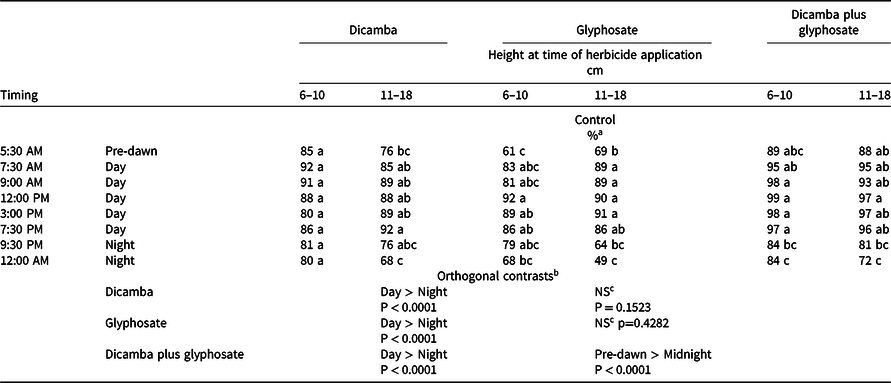
Sicklepod responded to glyphosate applications most significantly between day and night timings using Tukey-Kramer HSD (α = 0.05) for means comparison (Table 2). Diurnal nyctinastic leaf movement during hours of darkness probably resulted in less interception of the applied herbicide (Kraatz and Anderson Reference Kraatz and Andersen1980), as has been noted by others (Dalazen and Merotto Reference Dalazen and Merotto2016; Norsworthy et al. Reference Norsworthy, Oliver and Purcell1999). Dicamba application showed a smaller effect based on TOD. However, the mixture of dicamba and glyphosate did show differences from TOD for both weed heights. The lowest overall efficacy observed for sicklepod occurred during midnight applications, where glyphosate was able to achieve only 49% control. Noon applications resulted in up to 99% control using the mixture (Table 2).
Time-of-day control response of sicklepod in Tift and Sumter counties, Georgia, 21 d after treatment. Means were combined between 2018 and 2019 and location because of ANOVA results (P < 0.005).

a Means separated using Tukey-Kramer HSD (α = 0.05). Levels not connected by the same letter are significantly different with respect to column.
b Day is considered any treatments made 1 h after sunrise (7:30 AM) to 1 h pre-sunset (7:30 PM)––night being all other treatments. Pre-dawn is considered as 1 h prior to sunrise (5:30 AM).
c No significant difference was observed at α = 0.05.
Morningglory Species
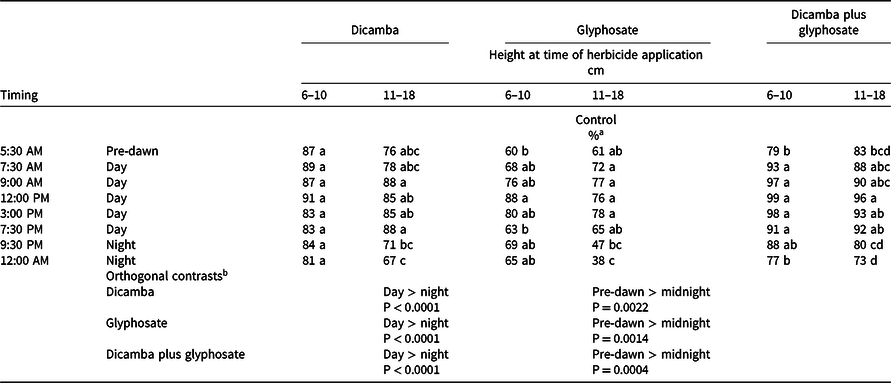
Visual ratings of control for morningglory spp. represented both Ipomoea hederacea and I. lacunosa. Levels of control using dicamba only showed differences relative to the TOD at the larger (11 to 18 cm) weed size (Table 3). Overall control of the larger weeds increased at midday, suggesting that although both herbicides are phloem-mobile, dicamba translocates differently than glyphosate does. TOD effect on glyphosate activity was similar to dicamba, but greater differences were observed at the smaller (6 to 10 cm) weed size. Interestingly, although total weed control was increased with the mixture (P < 0.0001, data not shown), effects were greater concerning TOD––possibly a result of the two herbicides’ interaction with each other in both the spray tank and the plant tissue (Underwood et al. Reference Underwood, Soltani, Hooker, Robinson, Vink, Swanton and Sikkema2017). Morningglory control increased by nearly 50% total control in most cases when treatments were applied at midday and early afternoon and were lower when applied during dark conditions. Similar to sicklepod control, morningglory spp. showed the least herbicide response during midnight glyphosate applications at 38%, whereas the mixture applied at noon resulted in up to 99% control (Table 3). As dicamba is required in lower use rates, to affect weeds the area of a leaf that must be covered by herbicide solution is less; thus, in the case of a large-leaf weed like morningglory, dicamba can maximize its efficacy (Bauerle et al. Reference Bauerle, Griffin, Alford, Curry and Kenty2015).
Time-of-day control response of morningglory (Ipomoea spp.) in Tift and Sumter counties, GA, 21 d after treatment. Means were combined between 2018 and 2019 and location because of ANOVA results (P < 0.05).

a Means separated using Tukey-Kramer HSD α=0.05. Levels not connected by the same letter are significantly different with respect to column.
b Day is considered any treatments made 1 h after sunrise (7:30 AM) to 1 h before sunset (7:30 PM)––night being all other treatments. Pre-dawn is considered to be 1 h prior to sunrise (5:30 AM).
Prickly Sida
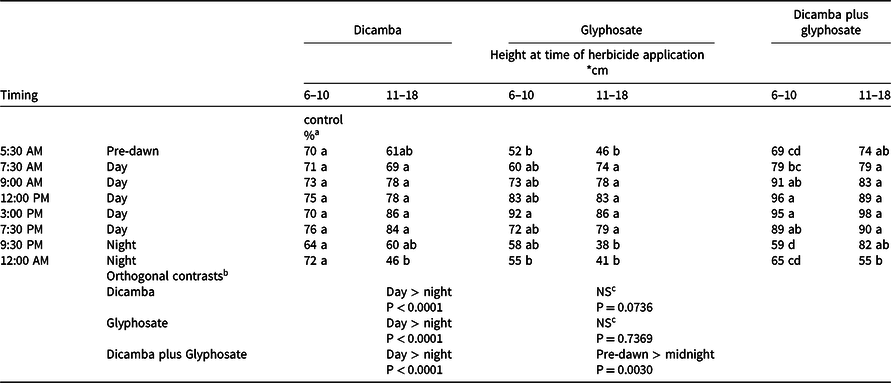
The TOD effect was observed for prickly sida at both heights (6 to 10 cm and 11 to 18 cm) but was more pronounced at midnight with the larger (11 to 18 cm) weeds (Table 4). Previous studies using different herbicides noted that prickly sida may be less susceptible to the TOD effect (Stewart et al. Reference Stewart, Nurse and Sikkema2009). The response of prickly sida to glyphosate did, however, follow a pattern similar to the other weed species, with the midday application generally being the most efficacious. A similar trend was seen with the mixture of both herbicides. Overall control of prickly sida was lowest (P < 0.0001, data not shown) when compared to other weeds in the study, but the mixture did show an overall increase in efficacy. Mixing glyphosate and dicamba increased overall efficacy but followed similar trends; glyphosate at midnight resulted in only 41% control, and the mixture at 3:00 PM resulted in 98% control.
Time-of-day control response of prickly sida in Tift and Sumter counties, GA, 21 d after treatment. Means were combined between 2018 and 2019 and location because of ANOVA results (P < 0.005).

a Means separated using Tukey-Kramer HSD α=0.05. Levels not connected by the same letter are significantly different with respect to column.
b Day is considered any treatments made 1 h after sunrise (7:30 AM) to 1 h before sunset (7:30 PM)––night being all other treatments. Pre-dawn is considered to be 1 h prior to sunrise (5:30 AM).
c No significant difference was observed at α = 0.05.
The use of orthogonal contrasts supports a circadian-rhythm effect concerning the efficacy of some herbicides on some weed species. The pre-dawn applications showed greater efficacy than the midnight applications for the mixture of dicamba and glyphosate in all species (Tables 2, 3, 4). For morningglory, the circadian-rhythm effect was observed across all three herbicidal treatments (Table 3).
An explanation for this observed effect across all three weed species and the herbicides applied would be the difference in the way plants mobilize photosynthate between starch and simple sugars (Geiger et al. Reference Geiger, Servaites and Fuchs2000). Both herbicides translocate within plant tissue (Wyrill and Burnside Reference Wyrill and Burnside1976; Chang and Vanden Born Reference Chang and Vanden Born1971) and would likely follow the route of the mobilization of photosynthate (Geiger et al. Reference Geiger, Kapitan and Tucci1986). The activity of photosynthesis based on light intensity has also been shown to drive herbicide efficacy (Kudsk and Kristensen Reference Kudsk and Kristensen1992) as well as photosynthate production (Peeters and Eilers Reference Peeters and Eilers1978). As data on solar radiation (Table 1) show, light intensity being significantly higher in the hour after sunrise than the hour before sunset could explain the differential in the overall efficacy of these herbicide treatments, most likely resulting from several physiological processes (Tables 2, 3, 4).
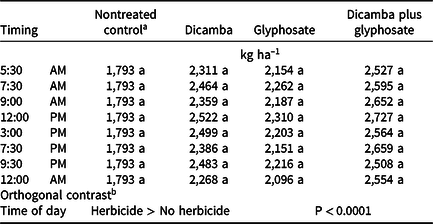
Yield data showed no differences between application TODs (Table 5)––a trend observed in peanut (Arachis hypogaea L.), soybean, and corn (Carter and Prostko Reference Carter and Prostko2019; Mohr et al. Reference Mohr, Sellers and Smeda2007; Stewart et al. Reference Stewart, Nurse and Sikkema2009; Stopps et al. Reference Stopps, Nurse and Sikkema2013). The explanation for this finding is likely that although weed control was reduced during night applications, this reduction was insufficient to affect yield. Although plots were maintained weed-free following the final rating date, any of the infestation following treatment would fall in the critical period of weed control for cotton (Webster et al. Reference Webster, Grey, Flanders and Culpepper2009). Although lower weed control is never desired, it still can aid in cotton’s ability to compete with weed pressure and increase yield at the end of the year compared to no weed control at all (Buchanan and Burns Reference Buchanan and Burns1970).
Seed cotton yield for Tift County (2019) and Sumter County, GA, for 2018 and 2019. Means combined over year and location.

a Nontreated control was used as a comparison for yield loss.
b Means separated using Tukey-Kramer HSD α=0.05. Levels not connected by the same letter are significantly different with respect to column.
The diurnal effects of herbicide efficacy in this study suggest that midday applications of these herbicides will result in the greatest efficacy. Other studies have noted a similar trend, where applications occurring during midday result in greater weed control (Budd et al. Reference Budd, Soltani, Robinson, Hooker, Miller and Sikkema2017; Carter and Prostko Reference Carter and Prostko2019; Mohr et al. Reference Mohr, Sellers and Smeda2007; Montgomery et al. Reference Montgomery, Treadway, Reeves and Steckel2017; Stopps et al. Reference Stopps, Nurse and Sikkema2013). These studies included several herbicides across MoAs but tended to have increased efficacy when applied under the high-light conditions at midday. It is important to note that the light-adapted treatments show greater efficacy when comparing through orthogonal contrast. However, timely weed control is a major factor, especially when applying dicamba. Control was reduced with increasing weed height when using only dicamba, but overall control improved when glyphosate was added to control glyphosate-resistant waterhemp (Spaunhorst and Bradley Reference Spaunhorst and Bradley2013).
Moving forward using this new technology, we must understand how best to maximize efficacy while minimizing off-target impacts. Several of these application timings are outside of label restrictions for dicamba because of off-target movement concerns, but these times of application did result in the lowest average weed control across all species. When balancing efficacy, critical weed size, and unintended off-target impacts, flexibility in the time of application can be a useful tool for growers. As fewer producers are growing on more hectarage, timing of applications becomes more difficult. Understanding the implications of TOD of application and weed size of these herbicides is critical for maximizing efficacy and minimizing the development of herbicide resistance, and may help growers prioritize field operations. With the adoption of dicamba technology, understanding factors including TOD is critical to stewarding this herbicide. As part of this new technology, it is critical to consider all weed control options as part of an integrated weed management strategy. Nonchemical, biological, and mechanical weed control measures must be implemented as part of an overall weed management plan to ensure maximum weed control. Future work could evaluate the impact of these integrated weed management techniques such as cover crops, and the impact of herbicide tank mixes to mitigate TOD effects.
Acknowledgments
The authors would like to thank the University of Georgia, Bayer Crop Science, and the Georgia Commodity Commission for Cotton for supporting this research. No conflicts of interest have been declared.