Methicillin-resistant Staphylococcus aureus (MRSA) is a major cause of healthcare-associated infections, with particularly high incidence in the United States, Asia, and parts of Europe.Reference Hidron, Edwards and Patel1, Reference Sader, Streit, Fritsche and Jones2 MRSA infections amongst hospitalized patients can result in devastating morbidity and significant mortality. Preventing spread of MRSA amongst hospitalized patients is a priority for hospitals, public health officials, and policy makers.
Amongst hospital-based strategies to prevent MRSA infections, MRSA screening followed by subsequent contact precautions is a common strategy used by US hospitals.Reference Coia, Duckworth and Edwards3–Reference Muto, Jernigan and Ostrowsky5 MRSA screening and contact precautions in populations with high MRSA prevalence has demonstrated effectiveness in reducing transmission and the number of newly acquired infections.Reference Huang, Yokoe and Hinrichsen6–Reference Lawes, Edwards, Lopez-Lozano and Gould12 Guidelines from SHEA recommend active surveillance for MRSA,Reference Muto, Jernigan and Ostrowsky5 but this recommendation has been challenged and is not universally adopted as a gold standard across the United States.Reference Diekema and Edmond13 Public concern about MRSA infections has led to a number of US state legislatures passing laws mandating that hospitals perform active surveillance for MRSA in selected populations, particularly for intensive care units, regardless of underlying MRSA prevalence.14 Others have advocated for even broader, hospital-wide programs of universal surveillance and isolation.Reference Peterson and Diekema15, Reference Lee, Bailey and Smith16 Support for broader screening has come from investigators suggesting that hospital-wide, universal surveillance may be a cost-effective strategy when considered from a societal perspective.Reference Lee, Bailey and Smith16, Reference Hubben, Bootsma and Luteijn17
Although universal surveillance may be cost-effective from a societal perspective, hospitals considering implementation of universal surveillance must consider the additional costs incurred from surveillance, isolation, and contact precautions that are not reimbursed. The economic impact to an individual hospital may represent an important barrier to implementation. To examine the potential economic barriers to implementation of universal MRSA surveillance, we developed a decision tree model to quantify the costs and benefits of implementing universal MRSA surveillance in a hospital. We believe that results of our model may help hospitals, state, and national policy makers understand the economic impact of universal surveillance on a hospital.
METHODS
We developed a decision tree model to estimate the economic impact of adopting a hospital-wide, universal active surveillance program for MRSA with subsequent contact precautions for all MRSA carriers. Specifically, we compared the costs of the surveillance and contact precaution program against the projected economic benefits of preventing secondary MRSA infections. The cost-benefit analysis was conducted from the individual hospital perspective and compared against no screening. We report results for 10,000 inpatient admissions, which can readily be converted to any number of admissions (e.g., a 500-admission hospital would divide 10,000 by 20). Based on a recently completed systematic literature review,Reference McKinnell, Huang, Eells, Cui and Miller18 our baseline conditions assume an MRSA nares colonization prevalence of 7.3% in US hospitals. Based on the same review,Reference McKinnell, Huang, Eells, Cui and Miller18 our baseline conditions assume a ratio of nasal carriage to total body MRSA colonization.
Development of the Decision Analysis Model
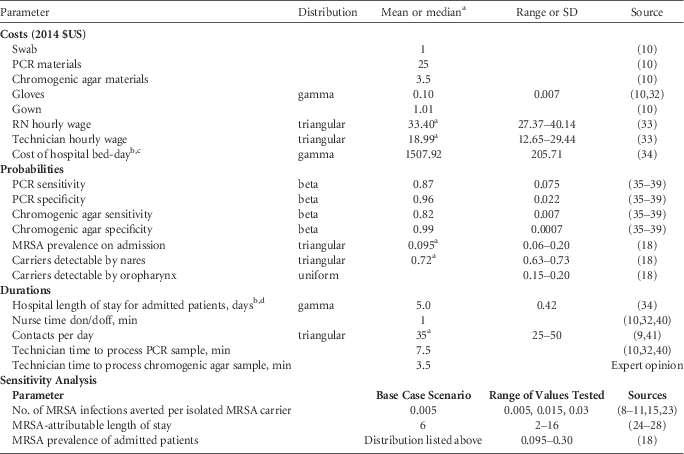
We used TreeAge Pro 2013 (TreeAge) to build a cost-benefit model to examine the implementation of a hospital-wide, universal MRSA screening program from the hospital perspective (Figure 1, Appendix 1). Briefly, each patient entering the model was categorized as either MRSA colonized or not colonized. Each patient was defined as carrying MRSA at each prespecified body site, on the basis of our previous systematic review of the literature.Reference McKinnell, Huang, Eells, Cui and Miller18, Reference McKinnell, Miller, Eells, Cui and Huang19 Input parameters for costs, MRSA epidemiology, MRSA testing characteristics, and potential benefits of contact precautions were extracted from the literature and summarized in Table 1. Several key parameters were the focus of additional sensitivity analysis as described below.
Flow of admitted patients through the model. CP, contact precautions; MRSA, methicillin-resistant Staphylococcus aureus; false negative, an MRSA carrier is not detected because the wrong site was chosen for surveillance, e.g., a patient colonized in the groin only who undergoes nares-only surveillance, or the MRSA testing is falsely negative at an MRSA-colonized body site.

Model Input Parameters, Values, and Sources
Note. Carriers detectible by multisite is the remainder of the total body colonization minus that detectable in the nares and oropharynx (this is not presented in the table). MRSA, methicillin-resistant Staphylococcus aureus; PCR, polymerase chain reaction; RN, registered nurse; SD, standard deviation.
a Denotes median values.
b Values are mean and standard error.
c Calculated from the mean cost of hospitalization divided by the mean length of stay for ICD-9 code 041.12 in Healthcare Cost and Utilization Project (HCUP) for 2011 and discounted to 2014 $US.
d Length of stay for all admissions in HCUP.
All patients underwent MRSA screening on admission using one of the following screening strategies: (1) nares only, (2) nares and oropharynx, or (3) multisite swabbing. In our model, patients test either positive or negative for MRSA depending on their colonization status and the sensitivity and specificity of the test (Table 1). In our model, patients testing positive, regardless of their true colonization status (i.e., both true and false positives) were placed in contact precautions for the remainder of their hospitalization. (Contact precautions were not used preemptively pending test results.) Separate analyses were conducted to compare screening with chromagar methods and polymerase chain reaction (PCR)–based methods. We used each of these models to test the hypothesis that better screening, either by swabbing more body sites or by using more sensitive diagnostic testing, would improve the benefit of screening and contact precautions.
Determination of Estimated Costs
The costs of the screening and contact precaution program are based on the material and labor costs to the hospital of both the screening procedures and the contact precautions (Table 1). For each simulation, the cost for each screening strategy was calculated as:
 $$(\rm{\rm Cost}\,{ of}\,{Contact}\,{Precautions}{\plus}{Cost}\,{of}\,{Screening})$$
The screening costs included the cost of swab(s), which assumed each body site was tested with its own swab. The costs of routine culture were based on chromogenic agar plates where each patient required 1 plate. For multiple body site testing, we allowed for split plate testing, maintaining 1 chromogenic agar plate per patient. For PCR-based testing, we included the cost of PCR materials. For multisite PCR testing, we assumed that the multiple body site samples could be batched for 1 PCR test. For both culture and PCR testing, we included the cost of technicians’ time to process the sample.
The cost of contact precautions included the material costs of additional gloves and gowns used and additional nursing time to don and doff gloves and gowns before each entry into patient rooms for the duration of their hospital stay. The cost of nursing time was estimated from the average hourly nurse wage from the US Bureau of Labor and Statistics (national statistics for 2012).20 We did not include additional support for infection control personnel to manage the program, nor did we include start-up costs—for example, staff training. Costs were converted from previous years to 2014 US dollars using a 3% discount rate.
Determination of Projected Benefits
The potential benefit to a hospital of a screening and contact precaution program is averting secondary MRSA infections through the appropriate implementation of contact precautions. The cost of an MRSA infection to the hospital was calculated from the MRSA-attributable length of stay and the cost of a hospital bed-day, following a method described by Graves.Reference Graves21 These additional days represent the opportunity cost of a lost bed-day, where a bed could have been used by another patient to generate revenue.
For each simulation, the benefit for each screening strategy was calculated as:
 $$\eqalign{({\rm No}.\,{\rm of}\,{\rm Infections}\,{\rm Averted}{\times}{\rm MRSA}\,{\rm Attributable}\,{\rm Length}\,\cr{\rm of}\,{\rm Stay}{\times}{\rm Cost}\,{\rm of}\,{\rm Lost}\,{\rm Bed{\hbox-}Day})$$
Cost-Benefit Analysis
The economic impact of adopting a universal surveillance and contact precautions program was based on the difference between the benefits (i.e., cost-savings from averting MRSA infections) and intervention costs. For each simulation, the economic impact to the hospital for each screening strategy was calculated as:
 $$\eqalign{({\rm No}.\,{\rm of}\,{\rm Infections}\,{\rm Averted}{\times}{\rm MRSA}{\minus}{\rm Attributable}\,{\rm Length}\,{\rm of}\, \cr {\rm Stay}{\times}{\rm Cost}\,{\rm of}\,{\rm Lost}\,{\rm Bed{\hbox-}Day})-({\rm Cost}\,{\rm of}\,{\rm Contact}\, \cr {\rm Precautions}{\plus}{\rm Cost}\,{\rm of}\,{\rm Screening)}$$
The optimal strategy was defined as the strategy with the best cost-benefit to the hospital—that is, cost-neutral (costs = benefit) or cost-saving (cost < benefit).
Model Simulations
Each simulation sent 1000 hospital admissions through the model 1000 times for a total of 1 million trials. Our model results are expressed as outcomes per 10,000 hospital admissions and include total number of colonized patients identified by the surveillance program, total number of patients placed in contact precautions, number of secondary infections averted by the intervention, and the cost-benefit (costs averted by preventing MRSA infections – intervention costs) of the intervention. Probabilistic sensitivity analyses (i.e., Monte Carlo simulations) were performed for each simulation, varying each parameter throughout its range (Table 1). The distributions varied in the Monte Carlo simulations account for variability in known parameters and were created on the basis of the available data (e.g., variability across studies or ranges/CIs from 1 source).
Sensitivity Analyses of Key Model Estimates
Additional 1- and 2-way sensitivity analysis varied key parameters in the model to determine their impact on the projected cost-benefit of each strategy. These parameters include the number of MRSA infections averted per isolated MRSA carrier, MRSA-attributable length of stay, and MRSA prevalence among admitted patients. Our baseline conditions assumed 0.005 infections averted per isolated MRSA carrier, a 7.3% nares colonization prevalence, and a 6-day attributable length of stay.
We estimated the number of MRSA infections averted per MRSA carrier placed in contact precautions as 0.005, on the basis of currently available estimates from the literature.Reference Harbarth, Masuet-Aumatell and Schrenzel8–Reference Jernigan, Titus, Groschel, Getchell-White and Farr11, Reference Lee, Bailey and Smith16 However, we recognize that the literature on MRSA contact precautions efficacy is mixed and based largely on select populations or higher prevalence settings.Reference Dancer22 We therefore used data from a randomized trial of hospital-wide, universal screening and contact precautions combined with chlorhexidine bathing as an extreme estimate for the efficacy of universal active screening followed by contact precautions—that is, 0.05 MRSA cases per patient placed in contact precautions and decolonized.Reference Robicsek, Beaumont and Paule23 Using this data, we varied contact precaution efficacy in reducing MRSA infection from 0.005 (base-case estimate), to 0.015 (optimistic estimate), to 0.03 (extreme estimate) MRSA cases averted per MRSA carrier placed in contact precautions.
We estimated the additional hospital length of stay attributed to MRSA was 6 days. However, as the attributable length of stay due to MRSA depends on the type of acquired infection (e.g., skin and soft-tissue infection vs. bacteremia vs. endocarditis), we ranged this from 2 to 16 additional hospital days (based on estimates of attributable length of stay for different types of infection available from the literatureReference Abramson and Sexton24–Reference Rubin, Harrington, Poon, Dietrich, Greene and Moiduddin28).
We designed our base-case scenario with MRSA nares colonization prevalence of 7.3% and the total body MRSA colonization prevalence was 9.5% on the basis of a recent systematic literature review on MRSA colonization.Reference McKinnell, Huang, Eells, Cui and Miller18 On the basis of this review, we varied total body MRSA colonization to range from 9.5% to 30% and nares colonization ranging from 7.3% to 22% to determine whether hospitals with a higher burden of MRSA may benefit from universal active surveillance.
RESULTS
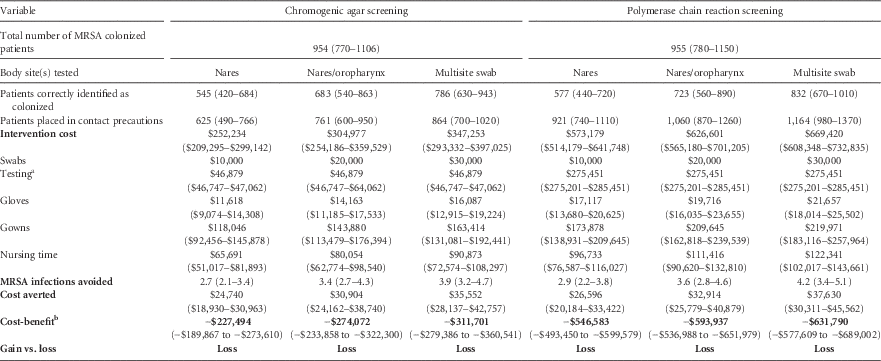
Table 2 shows results for our baseline conditions for both chromagar and PCR methods. A program of nares screening for all patients admitted to a hospital using chromogenic agar identified 545 MRSA-colonized patients/10,000 admissions (95% CI, 420–683 colonized patients/10,000 admissions) and averted 3 cases of invasive MRSA disease (95% CI, 2–3.4), preventing 18 additional hospitalization days and saving $24,740 (95% CI, $18,920–$30,960) (Table 2). The nares surveillance program improperly placed 79 patients in contact precautions. The overall economic impact to the hospital was a $237,494 loss (95% CI, $199,867–$283,610) for 10,000 admissions (Table 2).
Costs and Benefit (mean [95% CI]) per 10,000 Admissions under Baseline Conditions (Contact Precautions Avert 0.005 Methicillin-Resistant Staphylococcus aureus [MRSA] Infections per Carrier Isolated and a 6-Day Attributable Length of Stay for MRSA Infection)
a Includes test materials and technician labor to process sample; multiple samples were tested by splitting chromogenic agar plates and combining samples for PCR runs.
b Negative values indicate a economic loss to hospital given a $0 break-even threshold.
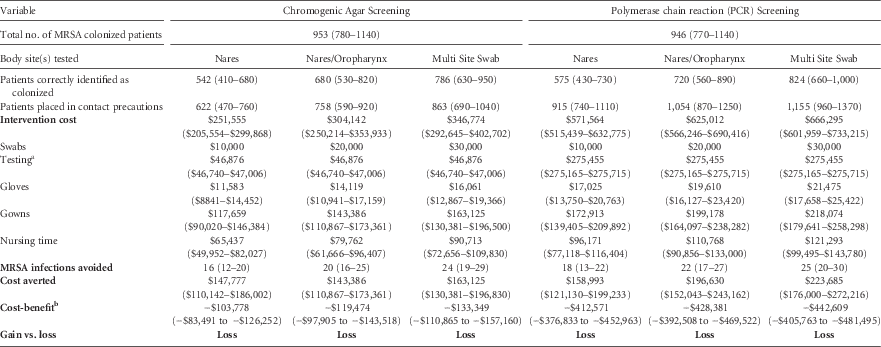
Table 3 shows results assuming an extreme estimate of contact precaution efficacy (0.03 infections averted per carrier isolated). Results were similar to less efficacious scenarios, resulting in economic losses greater than $104,000. Our results can be used to estimate the associated costs and cost-benefit for a hospital with any number of admissions. For example, a hospital with 2500 admissions implementing nares-only screening (under the baseline conditions) would isolate 156 patients (625/4) resulting in losses of $56,874 ($227,494/4).
Costs and Benefit (mean [95% CI]) per 10,000 Admissions with Baseline Methicillin-Resistant Staphylococcus aureus (MRSA) Prevalence on Admission, a 6-day Attributable MRSA Length of Stay, and an Extreme Contact Precaution Efficacy Estimate (0.03 Infections Averted per MRSA-Colonized Patient Isolated)
a Includes test materials and technician labor to process sample; multiple samples were tested by splitting chromogenic agar plates and combining samples for PCR runs.
b Negative values indicate a economic loss to hospital given a $0 break-even threshold.
Multisite Testing for MRSA
Under the baseline conditions, both the nares/oropharynx and 3-site surveillance improved the number of correctly identified carriers and improved the number of infections avoided. The multisite swabbing approaches resulted in modest increases in prevention of infection but resulted in more substantial economic losses to the hospital (Tables 2 and 3). Multisite screening was cost minimizing with relatively high estimates of attributable length of stay for MRSA infection (10 days) and optimistic estimates of contact precaution efficacy (0.03 infections per MRSA carrier isolated). Nares alone or nares/oropharynx screening were never cost-minimizing when MRSA colonization prevalence was 30% or less (Figure 2).
Two-way sensitivity analysis of methicillin-resistant Staphylococcus aureus (MRSA)–attributable length of stay (LOS [y-axis]) and efficacy of contact precaution efficacy (number of infections averted [x-axis]). The shaded area represents the optimal surveillance strategy, i.e., cost = benefits or costs < benefits. Units of number of infections averted are per MRSA carrier placed in contact isolation. Nares screening and nares/oropharynx screening were never the optimal strategy. BSI, bloodstream infection; PJI, Prosthetic Joint Infection; SST, skin and soft-tissue.
PCR versus Chromogenic Agar
Under the baseline conditions, PCR-based surveillance improved the number of correctly identified carriers and improved the number of infections avoided (Tables 2 and 3). PCR-based nares surveillance resulted in modest improvements in infection prevention but resulted in an economic loss of $546,583 (95% CI, $493,459–$599,579) for 10,000 admissions (Table 2). PCR screening was never cost-minimizing under any of the conditions tested.
Sensitivity Analyses
Figure 2 displays 2-way sensitivity analyses for the MRSA attributable length of stay (2–16 days) and number of infections averted (0.005–0.03 per carrier placed in contact precautions) by MRSA admission prevalence (9.5%–30%). The graphs display the screening strategy that results in the best cost-benefit to the hospital (i.e., optimal strategy). Under most model assumptions, no screening resulted in the best cost-benefit to the hospital. Under baseline conditions, the only time that universal screening was cost-saving occurred with extreme estimates for contact precaution efficacy (0.03 cases averted per patient placed in contact precautions) and when MRSA attributable length of stay was greater than 10. With MRSA admission prevalence of 30%, the time that universal screening became cost-saving occurred with extreme contact precaution efficacy (0.03 cases averted per MRSA carrier placed in contact precautions) and when MRSA attributable length of stay was greater than 8 days.
DISCUSSION
We found that even though MRSA screening and contact precaution programs may prevent MRSA infections, these programs have substantial cost (≥$103,000) per 10,000 admissions. These results demonstrate that there may be substantial economic cost to the adoption of an expanded MRSA surveillance and contact precautions program to include hospital-wide, universal surveillance. Our findings were robust under a wide range of MRSA prevalence, contract precaution efficacy, and attributable length of stay values. Universal active screening followed by contact precautions was never cost-saving even when the number of sites and type of screening was modified. Even using extreme estimates for contact precaution efficacy (0.03 infections averted per carrier isolated) and prolonged attributable length of stay for acquired MRSA infections (up to 16 days), universal surveillance would likely incur significant costs for hospitals, even if only nares surveillance was adopted. Our results are for general benchmarking and hospitals of any size can estimate the impact to their own facility on the basis of their own local epidemiology. Thus our results can help inform various decision makers (i.e., infection control specialists, hospital administrators, and even insurance companies) about the cost-benefits and how much they can invest in MRSA prevention and control.
Our results are important in the context of understanding the economic barriers to dissemination of potentially effective infection control practices across US hospitals. Lee et al.Reference Lee, Bailey and Smith16 demonstrated that universal MRSA surveillance is cost-effective for a wide range of MRSA prevalence and reproductive rates. However, the investigation by Lee et al.Reference Lee, Bailey and Smith16 and a similar investigation by Hubben and colleaguesReference Hubben, Bootsma and Luteijn17 analyzed the cost-effectiveness of universal surveillance from the societal or third-party perspective. Although universal MRSA screening may be beneficial to society (as previously describedReference Lee, Bailey and Smith16, Reference Hubben, Bootsma and Luteijn17), our analysis demonstrates that the expanded screening program is economically burdensome for a hospital and that the benefits of screening may be reaped only by later or external beneficiaries (e.g., other hospitals or non–hospital-based care entities). To achieve the population benefits of improved patient quality and improved patient safety for the strategy of universal surveillance and contact precautions, reimbursement to the hospital and financial incentives may need to be changed a good deal in order to overcome the economic barriers to dissemination.
We note that the results of our analysis were sensitive to the impact of MRSA invasive disease. Therefore, although a program of hospital-wide, universal surveillance may not be economically feasible, there are likely subpopulations for which screening and contact precautions may result in sizeable savings for the hospital. For example, the impact of MRSA infection on burn patients or patients following cardiothoracic surgery is substantial and may surpass the range of attributable length of stay analyzed in our investigation. Within these specific high-risk populations, invasive MRSA infection can have disastrous and costly implications. Similarly, the impact of invasive MRSA disease in intensive care units can be large. Therefore, universal screening and contact precautions within high-risk patients and intensive care units may be less economically burdensome for a hospital, but further analysis is required before specific suggestions can be made about specific subpopulations.
Another key observation from our study is that our results were sensitive to the efficacy of the MRSA intervention. Although screening and contact precautions may not result in sufficient benefit to overcome the costs of the intervention, more efficacious strategies that result in greater projected benefits may be cost-neutral or even cost-saving. For example, recent investigations of chlorhexidine and mupirocin-based MRSA decolonization have shown efficacyReference Climo, Sepkowitz and Zuccotti29, Reference Huang, Septimus and Kleinman30 and may not face such a large economic barrier to implementation. One of the benefits of our method is that our model estimates efficacy of the intervention on the basis of the number of infections prevented by application of the intervention. The number of infections prevented per intervention is mathematically related to the number needed to treat and can be calculated for other interventions, such as MRSA decolonization. The cost and benefits of universal screening and contact precautions should be weighed against other infection control strategies, such as decolonization, and other quality improvement initiatives. More work is needed to understand the relative benefits and costs of infection prevention strategies with respect to one another in reducing MRSA or other infections.
There are limitations to our analysis. Importantly, our analysis was limited by the data we used in our model to establish MRSA contact precaution efficacy in terms of the number of infections prevented. Our model did not specifically analyze preemptive isolation strategies. However, our results remained robust even when using extreme estimates for contact precaution efficacy that far exceed estimates for potential benefits of preemptive isolation.Reference Harbarth, Masuet-Aumatell and Schrenzel8 Our model did not model potential unintended costs of contact precautions, including falls or reduced patient contact.Reference Stelfox, Bates and Redelmeier31 Including these impacts would have made screening more economically burdensome. That said, there are conflicting estimates for the unintended impact of contact precautions,Reference Harris, Pineles and Belton9 so lack of modeling this consequence may be appropriate. We did not include physician time to don/doff contact precautions (although their visits are counted) because we assumed independent medical staff reimbursed by physician billing. Inclusion of physician time to don/doff contact precautions may be appropriate for some systems—that is, employed hospitalists would see larger costs. Lastly, our model did not attempt to measure the cumulative impact of universal surveillance and contact precautions. It is likely that as population benefit increases (MRSA declines), the cost-benefit of the program would continue to degrade.
Overall, our results estimate the economic burden that expanded MRSA surveillance and contact precautions will create for a hospital. If health policy experts, legislators, or patient safety advocates hope to implement universal MRSA surveillance on a large scale, they must be aware of the economic barriers to implementation and the potential economic impact from these programs. Without significant improvement in financial reimbursement to hospitals, it seems unlikely that hospital administrators can responsibly adopt expanded MRSA surveillance for the entire hospital population. Finally, many costly interventions may improve patient outcomes, but given that money is a limited resource, policy makers should consider our findings in light of other hospital-based interventions to prevent patient harm.
Acknowledgments
J.A.M. reports that he received support from the National Institutes of Health/National Center for Research Resources /National Center for Advancing Translational Sciences University of California, Los Angeles Clinical and Translational Science Institute (grant KL2TR000122). J.A.M., S.M.B., B.Y.L., S.S.H., and L.G.M. report that they received support from the Agency for Healthcare Research and Quality (grant RC4AI092327). S.S.H. reports that she is conducting a clinical trial for which participating hospitals receive contributed product from Sage Products and Molnlycke.
Appendix 1
Decision tree model comparing MRSA screening strategies, including No Screening, Nares Screen, Nares/Oropharynx, and Three-Site Swab. *“False Negative” is correct in terms of colonization, but is also a “true” negative in terms of testing. (i.e. not colonized at screening site and should therefore result in a negative test, but actually carries MRSA elsewhere).
Two-Way Sensitivity Analysis Using Chromogenic Agar Screening with the Baseline Methicillin-Resistant Staphylococcus aureus (MRSA) Colonization Prevalence
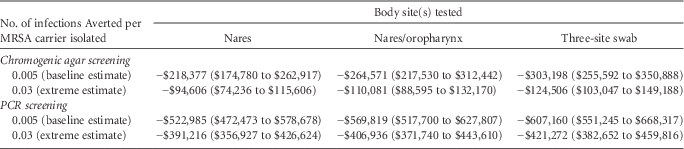
Cost-Benefit (mean [95% CI]) per 10,000 Admissions When Technician Time to Process Sample Was 1 Min Given the Baseline Methicillin-Resistant Staphylococcus aureus (MRSA) Prevalence Rate and a 6-Day MRSA Attributable Length of Stay