1 Introduction
A continuum is a compact, connected metric space. A point x in a plane continuum
 $X\subset \mathbb R^2$
is buried if x is not in the boundary (or frontier) of any component of
 $\mathbb R ^2\setminus X$
. We denote by
 $\operatorname {\mathrm {bur}}(X)$
the set of all buried points of X. Note that
 $\operatorname {\mathrm {bur}}(X)$
is a
 $G_{\delta }$
-set.
Motivation to study buried points comes from complex dynamics. Specifically, one of the difficult problems in complex dynamics asks whether
 $\operatorname {\mathrm {bur}}(J(R))$
must be zero-dimensional in case it is punctiform, where
 $J(R)$
is the Julia set of a rational function on the sphere
 $\mathbb C_\infty $
. The Devaney–Rocha examples of Sierpiński gasket like Julia sets have this property. Curry, Mayer, and Tymchatyn proposed to study it from a purely topological point of view. For more details, see [Reference Curry and Mayer1, Reference Curry, Mayer and Tymchatyn2, Reference Devaney, Rocha and Siegmund4].
In [Reference van Mill and Tuncali9, Proposition 3.1], van Mill and Tuncali prove that the set of buried points of a plane continuum can be a Cantor set. They use this to provide in §4 of their paper an example of a plane Suslinian continuum whose set of buried points is totally disconnected and weakly
 $1$
-dimensional. Their example answers in the negative Question 1 of Curry, Mayer, and Tymchatyn [Reference Curry, Mayer and Tymchatyn2], concerning whether or not a set of buried points is zero-dimensional provided it is totally disconnected. Note that if a plane continuum is regular (that is, has a basis of open sets with finite boundaries), then the set of buried points is either empty or zero-dimensional (see [Reference Curry, Mayer and Tymchatyn2, Theorem 3]).
Curry et al. showed that if X is a plane continuum with complementary components whose boundaries are locally connected and
 $\operatorname {\mathrm {bur}}(X)$
is Suslinian, then in fact X has to be Suslinian [Reference Curry, Mayer and Tymchatyn2, Theorem 6]. This is the case for the example in [Reference van Mill and Tuncali9, Section 4] (the buried point set in that example is even totally disconnected). However, it is not locally connected. A plane continuum X is locally connected if and only if the boundaries of complementary components are locally connected and form a null-sequence [Reference Whyburn13, VI Theorem 4.4]. Using this fact, we construct in §5 a locally connected plane continuum whose set of buried points is totally disconnected but not zero-dimensional. The set at which the buried points are
 $1$
-dimensional is countable. This is sharp according to the following theorem, which we prove in §3.
Theorem A Let X be a Suslinian plane continuum. If
 $Y\subset X$
is a totally disconnected Borel set, then Y is zero-dimensional at all but countably many points.
Corollary B Let X a plane continuum such that the boundary of each component of
 $\mathbb R^2\setminus X$
is locally connected (e.g. X is locally connected). If
 $\,\operatorname {\mathrm {bur}}(X)$
is totally disconnected, then
 $\operatorname {\mathrm {bur}}(X)$
is zero-dimensional at all but countably many points.
Countable sets are zero-dimensional, so under the assumptions of Corollary B the buried set is either zero-dimensional or weakly
 $1$
-dimensional. There is no almost zero-dimensional, weakly
 $1$
-dimensional space [Reference Lipham7, Theorem 1]. Therefore,
 $\operatorname {\mathrm {bur}}(X)$
cannot be almost zero-dimensional in the proper sense (cf. [Reference Curry and Mayer1, Question 2.7]). To summarize:
Corollary C Let X be a plane continuum such that each component of
 $\mathbb R^2\setminus X$
has locally connected boundary (e.g. X is locally connected).
-
(i) If
 $\,\operatorname {\mathrm {bur}}(X)$
is totally disconnected, then
$\operatorname {\mathrm {bur}}(X)$
is at most weakly
$1$
-dimensional.
-
(ii) If
$\,\operatorname {\mathrm {bur}}(X)$
is almost zero-dimensional, then
$\operatorname {\mathrm {bur}}(X)$
is zero-dimensional.


It is still unknown whether the Julia set of a rational function may have a buried set which is totally disconnected but not zero-dimensional (cf. [Reference Curry, Mayer and Tymchatyn2, Question 3]).
2 Definitions
All spaces under consideration are assumed to be separable and metrizable.
A space X is Suslinian if each collection of pairwise disjoint nondegenerate continua in X is countable.
A space X is totally disconnected if every two points of X are contained in disjoint clopen sets, and zero-dimensional if X has a basis of clopen sets. Respectively, X is zero-dimensional at
 $x\in X$
if the point x has a neighborhood basis of clopen sets (written
 $\operatorname {\mathrm {ind}}_x X=0$
, cf. [Reference Engelking3, Problem 1.1.B]).
A space X is almost zero-dimensional if X has a basis of open sets whose closures are intersections of clopen sets [Reference Lipham7, Reference Oversteegen and Tymchatyn12]. Observe that every almost zero-dimensional space is totally disconnected.
The dimensional kernel of a
 $1$
-dimensional space X is defined to be the set of points at which X is not zero-dimensional;
 $\Lambda (X)=\{x\in X:\operatorname {\mathrm {ind}}_x X=1\}.$
A
 $1$
-dimensional space X is weakly
 $\mathbf {1}$
-dimensional if
 $\Lambda (X)$
is zero-dimensional.
A domain is a connected open subset of the plane or topological
 $2$
-sphere. If X is a continuum on the
 $2$
-sphere, then each complementary component of X is a simply connected domain. Riemann’s mapping theorem implies that every simply connected domain
 $U\subset \mathbb C$
is homeomorphic to the unit disc
 $\{z\in \mathbb C:|z|<1\}$
. Carathéodory’s theorem implies moreover that if
 $\partial U$
is a simple closed curve then
 $\overline U$
is homeomorphic to the closed unit disc
 $\{z\in \mathbb C:|z|\leq 1\}$
.
3 Main result
Suppose that X is a continuum and
 $Y\subset X$
. For each
 $y\in Y$
let
 $\mathcal U_y$
be the collection of all open subsets U of X such that
 $y\in U$
and
 $\partial U\subset X\setminus Y$
. For each
 $y\in Y$
put
 $$ \begin{align*}F(y) =\bigcap_{U\in \mathcal U_y} \overline{U}.\end{align*} $$
Lemma 1 If Y is totally disconnected and
 $y\in \Lambda (Y)$
, then
 $F(y)$
is a nondegenerate subcontinuum of X and
 $F(y)\cap Y = \{y\}$
.
Proof Suppose
 $F(y)=\{y\}$
is degenerate. We show that Y is zero-dimensional at y. Let V be an arbitrary relatively open subset of Y that contains y. Pick an open subset W of X such that
 $W \cap Y = V$
. Since
 $F(y) = \{y\} \subset V$
, there is by compactness an element
 $U \in \mathcal U_y$
such that
 $\overline {U} \subset W$
. But then
 $y \in U \cap Y \subset V$
, and
 $U \cap Y$
is clopen in Y.
Now suppose that
 $y\in Y$
and
 $z\in Y\setminus \{y\}$
. Pick by total disconnectedness of Y clopen subsets
 $C_0$
and
 $C_1 = Y \setminus C_0$
of Y such that
 $y \in C_0$
and
 $z \in C_1$
. There are disjoint open subsets
 $V_0$
and
 $V_1$
of X such that
 $V_0 \cap Y = C_0$
and
 $V_1 \cap Y = C_1$
. Observe that the boundary of
 $V_0$
is contained in
 $X \setminus Y$
. Since
 $V_1 \cap V_0 = \varnothing $
, this shows that
 $z \notin F(y).$
Hence,
 $F(y)\cap Y = \{y\}$
.
It remains to prove
 $F(y)$
is connected. Just suppose
 $F(y) = A \cup B$
where A and B are disjoint closed sets with
 $y \in A$
. Let U and V be disjoint open neighborhoods of A and B in X, respectively. By compactness, there exists
 $W \in \mathcal U_y$
such that
 $\overline W \subset U \cup V$
. Then
 $W \cap U \in \mathcal U_y$
, so
 $B = \varnothing .$
Remark 1 If X is locally connected and
 $U\in \mathcal U_y$
, then the connected component of y in U is path-connected and belongs to
 $\mathcal U_y$
.
Lemma 2 Let S be a circle in the plane, and
 $a_1,a_2,a_3,a_4$
four points of S in cyclic order. Let
 $A_i$
,
 $i\in \{1,2,3,4\}$
, be pairwise disjoint arcs intersecting S only at an endpoint
 $a_i$
, with opposite endpoints
 $b_i$
in the bounded component of
 $\mathbb R ^2\setminus S$
, denoted
 $\operatorname {\mathrm {int}}(S)$
.
If
 $K\subset \mathbb R ^2\setminus (A_2\cup S\cup A_4)$
is a continuum containing
 $b_1$
and
 $b_3$
, then
 $b_2$
and
 $b_4$
are in different components of
 $\mathbb R^2\setminus (A_1\cup S\cup A_3\cup K).$
Proof We may assume that S is the unit circle in the complex plane
 $ \mathbb C$
, and
 $$ \begin{align*}a_1=1,a_2={\mathrm{i}} , a_3=-1,a_4=-{\mathrm{i}} .\end{align*} $$
Let
 $\gamma \subset \mathbb C\setminus (A_1\cup S\cup A_3)$
be any arc from
 $b_2$
to
 $b_4$
. We will show that
 $\gamma $
intersects K. This will imply that
 $b_2$
and
 $b_4$
are in different components of
 $\mathbb C\setminus (A_1\cup S\cup A_3\cup K)$
, as all such components are path-connected.
In
 $\gamma \cup A_2\cup A_4$
, there is an arc
 $\hat \gamma $
intersecting S only at endpoints
 $\pm {\mathrm {i}}$
. Let
 $\alpha $
and
 $\beta $
be the left and right halves of the circle S. By the
 $\theta $
-curve theorem [Reference Munkres10, Lemma 64.1],
 $\text {int}(S)\setminus \hat \gamma $
is the union of two disjoint domains U and V whose boundaries are
 $\alpha \cup \hat \gamma $
and
 $\hat \gamma \cup \beta $
, respectively. Let W be an open ball centered at
 $-1$
that misses
 $\hat \gamma $
. Then
 $W\cap \text {int}(S)\subset U\cup V$
. Since
 $W\cap \text {int}(S)$
is connected and
 $-1\in \partial U$
, we have
 $W\cap \text {int}(S)\subset U$
. Thus,
 $U\cap A_3\neq \varnothing $
. It follows that
 $A_3\setminus \{-1\}\subset U$
. Thus,
 $b_3\in U$
. Likewise,
 $b_1\in V$
. Now K is a connected subset of
 $\text {int}(S)$
meeting both U and V. So
 $K\cap \hat \gamma \neq \varnothing $
. Therefore,
 $K\cap \gamma \neq \varnothing $
.
We can now prove Theorem A for locally connected X.
Theorem 3 Let X be a locally connected Suslinian plane continuum. If
 $Y\subset X$
is a totally disconnected Borel set, then
 $\Lambda (Y)$
is countable.
Proof For a contradiction suppose that
 $Y\subset X$
is totally disconnected and Borel, and
 $Z=\Lambda (Y)$
is uncountable. By Lemma 1 there exists
 $\varepsilon>0$
such that for uncountably many z’s,
 $\operatorname {\mathrm {diam}}(F(z))\geq 5\varepsilon $
. The set of all z’s with this property is closed in Y, thus it is Borel and contains a Cantor set. Let us just assume that
 $Z $
is a Cantor set in Y with the property
 $\operatorname {\mathrm {diam}}(F(z))\geq 5 \varepsilon $
for each
 $z\in Z$
. We may further assume that Z lies inside of an open ball of radius
 $\varepsilon $
centered at one of its points. Let S and
 $S'$
be the circles of radii
 $\varepsilon $
and
 $2\varepsilon $
, respectively, centered at the point. Observe that every
 $F(z)$
crosses
 $S'$
.
In the claims below, all boundaries are respective to X (not
 $\mathbb R ^2$
).
Claim 4 Let U be an open subset of X intersecting Z with
 $\partial U\subset (X\setminus Y)\cup S$
. Then for every point
 $p\in \mathbb R^2$
there exists a connected open set
 $W\subset U$
intersecting Z such that
 $p\notin \overline W$
and
 $\partial W\subset (X\setminus Y)\cup S$
.
Proof of Claim 4 For each z in the uncountable set
 $Z\cap U\setminus \{p\}$
there is a nondegenerate continuum
 $K(z)\subset F(z)$
containing z and missing
 $S\cup \{p\}$
. Just take any closed neighborhood N of z missing
 $S\cup \{p\}$
, and let
 $K(z)$
be the component of z in
 $F(z)\cap N$
; by the boundary bumping theorem [Reference Nadler11, Theorem 5.4]
 $K(z)$
is nondegenerate. Note that
 $K(z)\cap Y=\{z\}$
by Lemma 1.
By the Suslinian property of X there exist
 $$ \begin{align*}z_1,z_2,z_3,z_4\in Z\cap U\setminus \{p\},\end{align*} $$
such that
 $K(z_i)\cap K(z_1)\neq \varnothing $
for each
 $i\in \{2,3,4\}$
. Let
 $U_i\in \mathcal U_{z_i}$
be pairwise disjoint. By Remark 1, we may assume that each
 $U_i$
is path-connected. Since
 $F(z_i)$
extends beyond
 $S'$
, so does
 $U_i$
. Thus, there is an arc
 $A_i\subset U_i$
from
 $z_i$
to
 $a_i\in S'$
that intersects
 $S'$
only at
 $a_i$
. By a permutation of indices
 $i\in \{2,3,4\}$
, we may assume that the
 $a_i$
’s are in cyclic order around
 $S'$
. Let
 $K=K(z_1)\cup K(z_3)$
. Note that
 $p\notin K$
.
Case 1:
 $p\in U_1\cup S'\cup U_3$
. Let W be the component of
 $z_2$
in
 $U_2\cap U\setminus S$
. Then W is a connected open subset of U intersecting Z, with
 $p\notin \overline W$
. Note also that W is clopen in
 $U_2\cap U\setminus S$
, which means that
 $\partial W\subset \partial (U_2\cap U\setminus S)$
. The boundary of any finite intersection of open sets is contained in the union of the individual boundaries. Therefore,
 $\partial W\subset \partial U_2 \cup \partial U\cup \partial (X\setminus S)\subset (X\setminus Y)\cup S$
.

Case 2:
 $p\notin U_1\cup S'\cup U_3$
. Then certainly
 $p\notin A_1\cup S'\cup A_3$
and since
 $p\notin K$
we find that
 $p\in O=\mathbb R^2\setminus (A_1\cup S'\cup A_3\cup K)$
. By Lemma 2,
 $z_2$
and
 $z_4$
are in different components of O. Of these two components, at least one does not contain p. Let’s say that V is the component of
 $z_2$
in O, and
 $p\notin V$
. The component of p in O is an open set missing V, so
 $p\notin \overline V$
. Let W be the component of
 $z_2$
in
 $U_2\cap U \cap V\setminus S$
. Then W is a connected open subset of U intersecting Z, and
 $p\notin \overline {W}$
. It remains to show that
 $\partial W\subset (X\setminus Y)\cup S$
. Note the following:
-
•
$\partial V\subset A_1\cup S'\cup A_3\cup K$
; -
•
$\overline W$
misses
$A_1\cup A_3$
because
$W\subset U_2$
; -
•
$\overline W$
misses
$S'$
because it lies in the closed disc bounded by S.


Hence,
 $\overline {W}\cap \partial V\subset K\setminus \{z_1,z_3\}\subset X\setminus Y.$
We conclude that
 $$ \begin{align*} \partial W&\subset \overline W\cap \big[\partial U_2\cup \partial U \cup \partial V\cup \partial (X\setminus S)\big] \\ &\subset \partial U_2\cup \partial U \cup \big(\overline W\cap \partial V\big)\cup \partial (X\setminus S)\\ &\subset (X\setminus Y)\cup S.\end{align*} $$
This completes the proof of Claim 4.
Claim 5 Let U be an open subset of X intersecting Z with
 $\partial U\subset (X\setminus Y)\cup S$
. Then there are connected open subsets
 $W_1$
and
 $W_2$
of U each intersecting Z, with disjoint closures, such that
 $\partial W_i\subset (X\setminus Y)\cup S$
.
Proof of Claim 5 Let
 $z_1,z_2,z_3,z_4\in Z\cap U$
. Let
 $U_i\in \mathcal U_{z_i}$
be pairwise disjoint and path-connected. Let
 $A_i$
be an arc in
 $U_i$
from
 $z_i$
to
 $a_i\in S'$
, intersecting
 $S'$
only at
 $a_i$
. We may assume that the
 $a_i$
’s are in cyclic order. Let
 $V_i$
be the component of
 $z_i$
in
 $U_i\cap U\setminus S$
. Assume that
 $\overline {V_1}$
and
 $ \overline {V_3}$
have a common point p (if they are disjoint then we’re done). Note that
 $p\notin U_2\cup U_4$
, so
 $p\notin A_2\cup A_4\cup V_2\cup V_4$
.
By Claim 4, there exist
 $z_2',z_4'\in Z$
and connected open subsets
 $W_2$
and
 $W_4$
of
 $V_2$
and
 $V_4$
whose closures miss p, such that
 $z_i'\in W_i$
and
 $\partial W_i\subset (X\setminus Y)\cup S$
. For each
 $i\in \{2,4\}$
, working within
 $V_i$
we can modify
 $A_i$
to an arc
 $A_i'$
that ends at
 $z_i'$
instead of
 $z_i$
. The other endpoint of
 $A_i'$
is still
 $a_i$
, and
 $p\notin A_i'$
. Let V be a connected neighborhood of p with closure missing
 $\overline {W_2}\cup \overline {W_4}\cup S'\cup A_2'\cup A_4'$
. For each
 $i\in \{1,3\}$
let
 $B_i$
be an arc in
 $V_i$
from
 $z_i$
into V. Let
 $K=B_1\cup B_3\cup \overline V$
. By Lemma 2,
 $z_2'$
and
 $z_4'$
are in different components of
 $\mathbb R^2\setminus (A_1\cup S'\cup A_3\cup K)$
. The continua
 $\overline {W_2}$
and
 $\overline {W_4}$
are contained in these components, hence they are disjoint.
By Claim 5, there are two connected open sets
 $W_{\langle 0\rangle }$
and
 $W_{\langle 1\rangle }$
in
 $X\setminus S$
, intersecting Z, with disjoint closures and boundaries in
 $(X\setminus Y)\cup S$
. Assuming that
 $\alpha \in 2^{<\mathbb N}$
is a finite binary sequence and
 $W_{\alpha }$
has been defined, apply Claim 5 to get connected open subsets
 $W_{\alpha ^\frown 0}$
and
 $W_{\alpha ^\frown 1}$
of
 $W_\alpha $
, each intersecting Z, with disjoint closures and boundaries in
 $(X\setminus Y)\cup S$
. Their boundaries must meet S because each
 $F(z)$
meets
 $S'$
. So for every infinite sequence
 $\alpha \in 2^{\mathbb N}$
,
 $$ \begin{align*}K_{\alpha}=\bigcap_{n=1}^\infty \overline{W_{\alpha\restriction n}},\end{align*} $$
is a continuum in X stretching from Z to S. Clearly if
 $\alpha \neq \beta $
then
 $K_{\alpha }$
and
 $K_{\beta }$
are disjoint. Therefore,
 $\{K_\alpha :\alpha \in 2^{\mathbb N}\}$
is an uncountable collection of pairwise disjoint nondegenerate subcontinua of X, a contradiction to the Suslinian property of X. Hence,
 $\Lambda (Y)$
must have been countable. This completes the proof of Theorem 3.
Theorem A is a direct consequence of Theorem 3 and:
Theorem 6 Every Suslinian plane continuum is contained in a locally connected Suslinian plane continuum.
Proof Let X be a Suslinian plane continuum. Let
 $U_0,U_1,U_2,\ldots $
be the connected components of
 $\mathbb R^2\setminus X$
with
 $U_0$
unbounded. In each domain
 $U_m$
, there is a sequence
 $S^m_0,S^m_1\ldots $
of disjoint, concentric simple closed curves limiting to the boundary of
 $U_m$
. Let
 $A^0_0=\varnothing $
, and for each
 $m\geq 1$
let
 $A^m_0$
be the closed topological disc in
 $U_m$
that is bounded by
 $S^m_0$
. For each
 $n\geq 1$
, let
 $A^m_n$
be the closed annulus in
 $U_m$
that is bounded by
 $S^m_{n-1}$
and
 $S^m_{n}$
. In
 $A^m_n$
there is a finite collection of arcs
 $\mathcal I^m_n$
covering
 $\partial A^m_n$
such that each component of
 $A^m_n\setminus \bigcup \mathcal I^m_n$
has diameter less than
 $1/(m+n)$
. We can easily arrange that the boundaries of these components are simple closed curves, and
 $X^m_n=\bigcup \mathcal I^m_n$
is connected. For the reader who’d like more details, one can assume that X is a subset of the Riemann sphere
 $\hat {\mathbb C}=\mathbb C\cup \{\infty \}$
, so that all complementary components of X are simply connected. Let
 $\mathbb D=\{z\in \mathbb C:|z|<1\}$
. Given a component U of
 $\hat {\mathbb C}\setminus X$
, apply the Riemann mapping theorem to get a continuous bijection
 $f:\mathbb D\to U$
and transfer the circles
 $\{z\in \mathbb C:|z|=1-2^{-n}\}$
to U to get the curves
 $S_n$
. Apply uniform continuity on each compact annulus
 $ \{z\in \mathbb C : 1-2^{-n} \leq |z| \leq 1-2^{-n-1}\}$
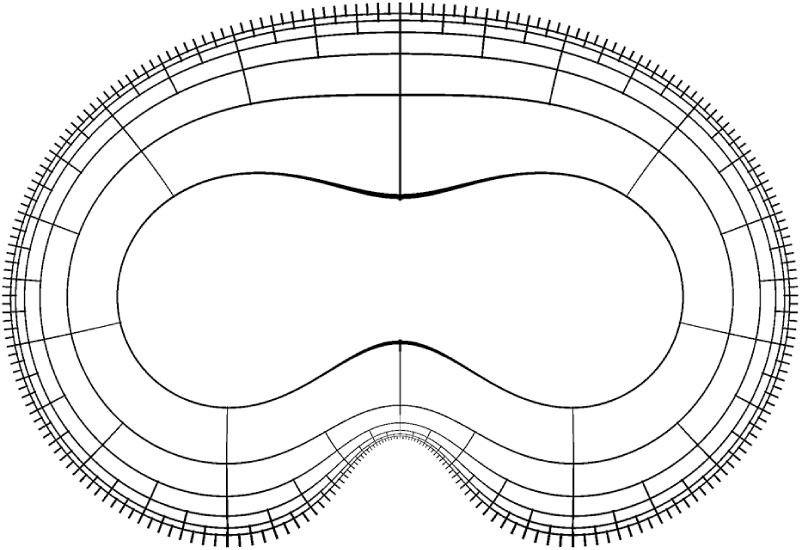
to divide it further into a grid whose cells have images with a small enough diameter. See Figure 2.
Dividing a domain into cells via a conformal mapping of
 $\mathbb D$
.

Put
 $$ \begin{align*}X'=X\cup \bigcup_{m=0}^\infty\bigcup_{n=0}^\infty X^m_n.\end{align*} $$
The components of
 $\mathbb R^2\setminus X'$
form a null sequence of domains whose boundaries are simple closed curves, so the continuum
 $X'$
is locally connected [Reference Whyburn13, VI Theorem 4.4]. Moreover,
 $X'$
is Suslinian because
 $X' \setminus X$
is a countable union of arcs.
4 Examples
First, we describe a locally connected extension of the continuum in [Reference van Mill and Tuncali9] with the same buried set, which is the totally disconnected and weakly
 $1$
-dimensional space by Kuratowski [Reference Kuratowski6], [Reference Engelking3, Exercise 1.2.E].
Remark 2 Kuratowski’s space K is the graph of a particular function
 $f:C\to [-1,1]$
defined on the middle-thirds Cantor set C. It has a simple algebraic formula based on binary representations of members of C (see §4 of [Reference van Mill and Tuncali9]). Clearly K is totally disconnected, and it is weakly
 $1$
-dimensional by the following. Let
 $C_1$
be the countable set consisting of
 $0$
and all right endpoints of the intervals
 $$ \begin{align*}\textstyle\big(\frac{1}{3}, \frac{2}{3}\big),\big(\frac{1}{9}, \frac{2}{9}\big),\big(\frac{7}{9}, \frac{8}{9}\big),\ldots\end{align*} $$
removed from
 $[0,1]$
to obtain C. For every
 $x\in C_1$
, it happens that K is
 $1$
-dimensional at
 $\langle x,f(x)\rangle $
. On the other hand, f is continuous at each point of
 $C_0=C\setminus C_1$
. Hence, if
 $x\in C_0$
, then K is zero-dimensional at
 $\langle x,f(x)\rangle $
. Therefore,
 $$ \begin{align*}\Lambda(K)=\big\{\langle x,f(x)\rangle:x\in C_1\big\},\end{align*} $$
and K is weakly
 $1$
-dimensional.
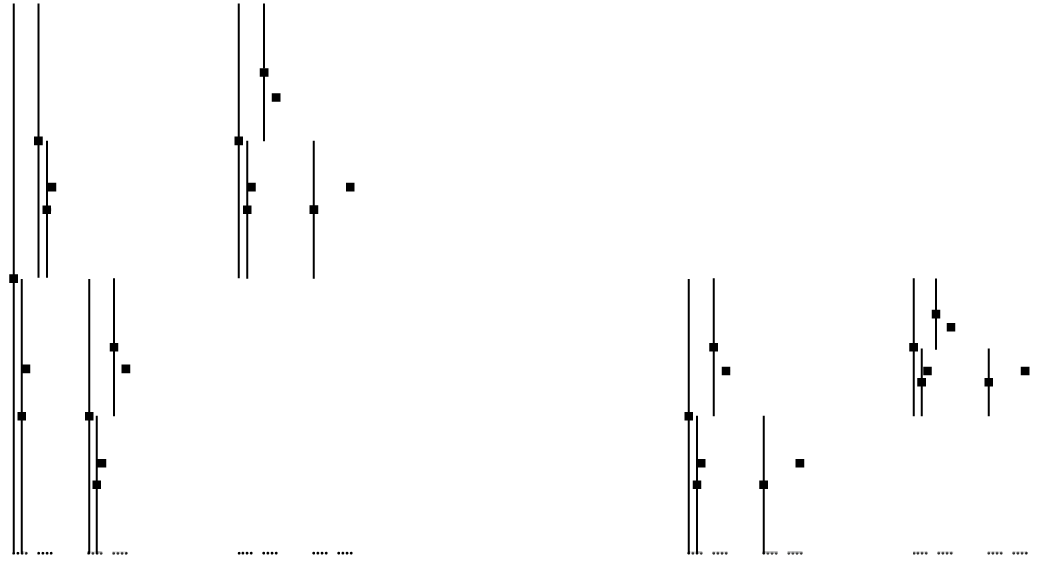
See Figure 3 for an illustration of K and its closure in
 $C\times [-1,1]$
.
The closure of K consists of the points of K and vertical arcs through points of
 $\Lambda (K)$
.

Example 1 There exists a locally connected plane continuum whose buried set is totally disconnected and
 $1$
-dimensional.
Proof Let Z be the plane continuum from [Reference van Mill and Tuncali9] which has
 $\operatorname {\mathrm {bur}}(Z)=K$
. By construction,
 $\mathbb R^2 \setminus Z $
is a countable union of disjoint connected open sets with simple closed curves as boundaries. One complementary component of Z, say
 $W_0$
, is unbounded and the others, say
 $W_1, W_2, \ldots $
, form a sequence of bounded domains. Let
 $\mathcal I_n$
, for
 $n \geq 1$
, be a finite set of arcs in
 $\overline {W_n}$
such that the collection
 $\mathcal V_n$
of components of
 $W_n \setminus \bigcup \mathcal I_n$
has mesh less than
 $1/n$
. We can easily arrange that the boundary of every element of
 $\mathcal V_n$
is a simple closed curve, and
 $Z_n=\partial W_n\cup \bigcup \mathcal I_n$
is connected. Here one can even apply Carathéodory’s theorem to get
 $Z_n$
from a grid in the closed unit disc. As in Theorem 6,
 $$ \begin{align*}Z' =Z\cup \bigcup_{n=1}^\infty Z_n,\end{align*} $$
is a locally connected continuum. Clearly,
 $\operatorname {\mathrm {bur}}(Z) \subset \operatorname {\mathrm {bur}}(Z')$
. For the other inclusion, note that points in
 $Z' \setminus Z$
have finite graph neighborhoods in
 $Z'$
, so are not in
 $\operatorname {\mathrm {bur}}(Z')$
. Now suppose
 $z\in Z\setminus \operatorname {\mathrm {bur}}(Z)$
. Then
 $z\in \partial W_n$
for some n, and there exists
 $V\in \mathcal V_n$
such that
 $z \in \partial V$
. So
 $z\notin \operatorname {\mathrm {bur}}(Z')$
. We conclude that
 $\operatorname {\mathrm {bur}}(Z') = \operatorname {\mathrm {bur}}(Z)=K$
.
The next example shows that Theorem A is false outside of the plane. By a dendroid, we shall mean a hereditarily unicoherent, arcwise-connected continuum.
Example 2 There exists a Suslinian dendroid whose endpoint set is totally disconnected and
 $1$
-dimensional at every point.
We briefly indicate the construction of such an example below. For further details, see [Reference Lipham8, Section 5.3].
Proof
Begin with a Lelek function
 $\varphi :C\to [0,1]$
whose positive graph
 $$ \begin{align*}E=\big\{\langle x,\varphi(x)\rangle:x\in C\text{ and }\varphi(x)>0\big\},\end{align*} $$
is
 $1$
-dimensional at every point [Reference Dijkstra and van Mill5]. Let
 $$ \begin{align*}L=\bigcup_{x \in C} \{x\}\times [0,\varphi(x)]\subset C\times [0,1].\end{align*} $$
The quotient of L that is obtained by shrinking
 $C\times \{0\}$
to a point is a continuum known as the Lelek fan. We will identify arcs in
 $L\setminus E$
to produce a Suslinian continuum (a dendroid, in fact) that homeomorphically contains E.
For each
 $n=1,2,3,\ldots $
let
 $\mathscr C_n$
be the natural partition of C into
 $2^n$
pairwise disjoint intervals of length
 $3^{-n}$
. For each
 $i=1,\ldots ,2^n-1$
define
 $$ \begin{align*}A_{n,i}=\big\{x\in C:\varphi(x)\geq \textstyle\frac{2i+1}{2^{n+1}}\big\}.\end{align*} $$
Put
 $\langle x,0\rangle \sim \langle x',0\rangle $
for all
 $x,x'\in C$
. If
 $y>0$
then define
 $\langle x,y\rangle \sim \langle x',y\rangle $
if there exists
 $n,i$
such that
 $x,x'\in A_{n,i}$
belong to the same member of
 $\mathscr C_n$
, and
 $y\leq i/2^n$
. It is possible to see that
 $\sim $
is an equivalence relation, the equivalence classes under
 $\sim $
form an upper semicontinuous decomposition of L, and the quotient
 $D=L/\sim $
is a Suslinian dendroid with endpoint set E.
Remark 3 The endpoint set of a smooth dendroid is always
 $G_{\delta }$
; therefore, E is Borel and Polish.