The last twenty years have witnessed a growing interest in the history of mutual aid and some authors have argued that the growth of the welfare state undermined many of the bases on which welfare provision had previously been organized. In the case of the United Kingdom, much attention has been focused on the impact of the Liberal welfare reforms of 1906–11. Yeo argued that the introduction of such measures as old-age pensions in 1908 and national insurance in 1911 undermined the “creative, public, associational life of so many English working people during the second half of the nineteenth century,”Footnote 1 and David Vincent claimed that the reforms condemned the poor to remaining “guests at the table of an increasingly prosperous society.”Footnote 2 These concerns have been echoed by more recent commentators. Garrard argued that the popularity of many friendly societies relied increasingly “upon committed but passive consent rather than active participation,” but he also claimed that the advent of national health insurance “further eroded the vibrancy of this segment of working-class civil society” and that “the expanded role of government has also undermined several of the most vibrant elements of nineteenth-century civil society—mortally in the case of friendly societies and damagingly in that of trade unions.”Footnote 3
The idea that the state’s role expanded at the expense of older forms of welfare support has also played a part in recent social policy debates. In 2010, the authors of a report for the antipoverty charity, the Joseph Rowntree Foundation, argued that although the Liberal welfare reforms of 1906–11 had not been designed to inhibit voluntary effort, “this was, in part, the effect they had, and community and mutual modes of thought and practice would be gradually marginalised.”Footnote 4 Commentators on both the left and right of the British political spectrum picked up on these arguments. One of the architects of “Blue Labour,” Maurice Glasman, argued that the creation of the “classic” welfare state after 1945 meant that “universal benefit replaced mutual responsibility as the basic principle of welfare,”Footnote 5 while the founding figure of “Red Toryism,” Philip Blond, complained that the welfare state had “nationalised a previously mutual society and refocused it according to an individualised culture of universal entitlement.”Footnote 6 The former UK Prime Minister, David Cameron, also argued that “the once natural bonds that existed between people—of duty and responsibility—have been replaced with the synthetic bonds of the state—regulation and bureaucracy.”Footnote 7
Although this renewed interest in mutual aid is welcome, it may sometimes ignore some of the more skeptical, and even critical, accounts of the role that such organizations once played. Paul Johnson concluded that “although E.P. Thompson nominated the friendly society as one influence making towards the growth in working-class consciousness and Eric Hobsbawm regards the unbroken increase in cooperative society membership as an element and indicator of a ‘growing class-consciousness’ . . . a detailed examination of the economic and social role of these institutions points to as much or more concern with self as with class or community.”Footnote 8 Thane argued that “only a minority of workers were covered by mutuals” and drew particular attention to the exclusion of women, who not only constituted the majority of the population but were also “in greater danger of poverty than most men, since their longer life expectancy . . . [and] lesser opportunities to earn and . . . save brought greater likelihood of impoverished single parenthood and old age.”Footnote 9
This article seeks to build on these accounts by offering a fresh examination of the role played by friendly societies in the development of the British welfare state between the early-nineteenth and mid-twentieth centuries. Although the size of their membership has often been disputed, these organizations have also been described as “the most conspicuous institutional evidence” of “working-class self-help” during the early part of the nineteenth century,Footnote 10 and as “always much the largest working-class civil organizations before 1914.”Footnote 11 The article begins by examining the different ways in which these organizations sought to protect the interests of their members and the problems they faced in doing so. It then provides a more detailed examination of their membership statistics before considering their role in the introduction of the Liberal welfare reforms of 1906–11. As we have already seen, it has often been claimed that the friendly societies were undermined by these reforms and the fourth section considers the way in which they adapted to changes in public policy after 1911. The final section looks at their attitude to proposals for further changes in social policy before and during World War II.
In developing this analysis, the article pays particular attention to the Ancient Order of Foresters. This was the second largest friendly society, with more than 750,000 adult members on the eve of World War I.Footnote 12 However, my examination of the Foresters’ records is supplemented by evidence drawn from official papers and from detailed accounts of the Annual Meetings of the NCFS, representing the views of the great majority of friendly society members.Footnote 13 The article also includes a quantitative analysis of the formation and longevity of both registered and unregistered friendly societies in Oxfordshire from the mid-eighteenth century onward.
As the article will demonstrate, many leading Foresters, together with other friendly society leaders, were often deeply skeptical of the growth of state welfare provision. However, they could not deny the limitations of the services they offered or the scale of the problems they faced. Although some commentators have claimed that mutual-aid organizations were “crowded out” by the state, the growth of state intervention was as much a response to the problems faced by the mutual sector as their cause. By examining the history of mutual aid both before and after the Liberal reforms, the article aims to provide a deeper understanding of the relationship between working-class self-help and the long-term growth of public welfare provision.
Self-Help and Mutual Aid
Throughout recorded history, individuals have often joined together to provide collective solutions to the economic risks associated with sickness, old age, and death.Footnote 14 In Britain, during the eighteenth and nineteenth centuries, friendly societies played a key role in this endeavour. In 1793, these organizations were defined by statute as “societ[ies] of good fellowship” established “for the purpose of raising . . . by voluntary contributions, a stock or fund for the mutual relief and maintenance of all and every the members thereof, in old age, sickness and infirmity, and for the relief of widows and children of deceased members.”Footnote 15
The earliest friendly societies were small, local societies, often centered on the local alehouse. However, during the nineteenth century, many of these societies combined to form large national organizations known as “affiliated orders,” such as the Ancient Order of Foresters (AOF) and the Independent Order of Oddfellows, Manchester Unity (MUOF). A number of other organizations also came under the general heading of “friendly societies.” These included local town, village or country societies; particular trade societies; dividing societies; deposit friendly societies; county or patronized societies; collecting societies; annuity societies; and female friendly societies. The majority were democratically controlled and primarily concerned with the provision of sickness benefits and funeral grants, or death benefits, but there were exceptions. The “county” or patronized societies were founded and managed by members of the local gentry, and the collecting societies were large, centralized organizations specializing in the provision of funeral benefits.Footnote 16
Although a small minority of friendly societies enrolled both men and women, the vast majority of friendly society members were male.Footnote 17 This was partly because it was more difficult for women to continue to pay the contributions needed to sustain the societies, and partly because the societies themselves were often reluctant to insure against “female” risks.Footnote 18 Garrard has argued that “in 1872, the Friendly-Societies Registrar recorded 283 female friendly societies, of which 237 had a combined membership of 22,690.”Footnote 19 However, the total number of recorded friendly society members (including males and females) in 1872 was over 2.25 million,Footnote 20 and the number of females aged 15 and over at the time of the 1871 UK census was 10.5 million.Footnote 21 During the second half of the nineteenth century, the gendered nature of friendly-society membership was reinforced by the more self-consciously “masculine” approach of the affiliated orders, which not only banned male members from participating in female rituals but also prohibited the rituals themselves.Footnote 22
All insurance organizations face a number of different problems, including adverse selection, information asymmetry, and moral hazard. Adverse selection occurs when an organization is more likely to attract “bad risks.” Information asymmetry occurs when either the insured party or the insurance organization knows more about the probability of a given risk than the other party. During the eighteenth and nineteenth centuries, when actuarial science was in its infancy, the advantage was more likely to lie with the insuree than the insurer. The concept of moral hazard refers to a situation in which the provision of insurance either reduces the insured party’s incentive to avoid a particular risk or increases their incentive to incur it. A person may be more likely to engage in risky behavior if they know that they are insured against its consequences.
Advocates of mutual insurance organizations argue that they are more able than other types of insurance organization to counter these problems. They can protect themselves against adverse selection and information asymmetry by restricting membership and they can minimize moral hazards by controlling behavior and giving members a collective stake in the viability of the organization as a whole. Smith and Stutzer argued that “trade unions, who were early providers of mutual health and accident insurance” in the United States “could control moral hazard . . . better than . . . commercial organizations” and that “fraternal insurers” ability to pay dividends and retroactively assess policy holders in the early days of American life insurance was critical in coping with aggregate uncertainty.”Footnote 23 Marco van Leeuwen has also claimed that “in small, homogeneous groups, where members are dependent on, and in frequent contact with, one another, monitoring is generally easier and cheaper than in large heterogeneous groups whose members meet infrequently and who are not dependent on each other.”Footnote 24
These arguments have been echoed by UK-based commentators who associate friendly societies with a tradition of individual responsibility and civic virtue that has now been lost. Norman argued that the societies were “run by . . . and for the members on a one-member one-vote basis, so that costs were low and dishonest claims kept to a minimum. . . . [They were] sustained by, and contributed to, a spirit of self-reliance and mutual support which discouraged reliance on charity and . . . state provision.”Footnote 25 Blond argued that “the great tragedy of the modern British welfare state has been the corrosion of the longstanding social values held by the working class, and thereby the effective erosion of the mutualism those values enshrined,”Footnote 26 and Green claimed that “once the state intervened, ‘rights’ increasingly became entitlements to benefit at the expense of other people, and no longer the just reward of shared responsibility.”Footnote 27
Green did not argue that earlier generations were inherently more virtuous, but that the societies possessed a series of mechanisms that enabled them to inculcate a greater sense of individual and civic responsibility. These included special passwords and titles and the introduction of elaborate initiation rituals, such as the “trial-by-combat” that the AOF imposed on new members between 1834 and 1843. Such rituals not only helped to build mutual trust and a sense of shared identity, but also served to promote good character and gave status and self-respect to “working men who found the discipline of factory and foreman onerous.”Footnote 28
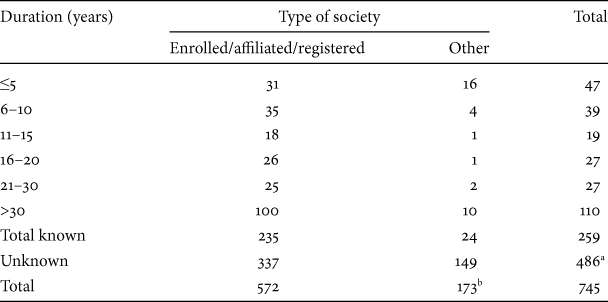
However, the societies also faced a series of major problems, including financial insecurity. Morley identified 745 societies (including branches of affiliated orders) that were established in Oxfordshire between 1750 and 1914.Footnote 29 About 29 percent of the organizations whose start- and end-dates are known ceased to exist within ten years and more than half folded within twenty-two years of their establishment (see Table 1). The first Registrar of Friendly Societies, John Tidd Pratt, claimed that approximately 36 percent of all the friendly societies that had been formed since 1793 had collapsed by 1867,Footnote 30 and that the vast majority of friendly societies faced “considerable risk of failure.”Footnote 31 The societies were also hampered by high secession rates. At the end of the nineteenth century, it is estimated that approximately 12 percent of Oddfellows left within five years of joining, and approximately 50 percent of all friendly-society members dropped out eventually.Footnote 32
Duration of friendly societies in Oxfordshire, 1750–1914

Notes:
a The total of 486 organizations whose exact duration is unknown includes 123 organizations that were still extant when the National Insurance Act was passed in 1911. More than half had a duration of at least 28 years.
b The total of 173 “other” organizations includes 170 unregistered societies, two that were initially unregistered and one whose status was unclear.
Source: Data derived from S. Morley, Oxfordshire friendly societies, 1750—1918, Chipping Norton: Oxfordshire Friendly Society, 2011.
Although the societies sought to develop a strong sense of both communal identity and civic responsibility, it is also important to recognize the limitations of their efforts. Weinbren argued that “the principles of Oddfellowship were already under threat through the decline in interest in migration, processions and regalia,”Footnote 33 and Gilbert concluded that “the glamour of the music hall, and later the cinema, dimmed the homely amenities, the singing and ritualised conviviality of the friendly society lodge.”Footnote 34 Both Alborn and Cordery have also argued that the societies struggled to compete with alternative leisure opportunities, such as the music hall and association football matches.Footnote 35 They were also finding it more difficult to maintain their traditions of democratic participation.Footnote 36 Green himself acknowledged that “complaints in the friendly-society magazines indicate [that] many branches were finding it difficult to secure good attendances at meetings,” and at least one society was forced to introduce fines for nonattendance.Footnote 37
This may have been indicative of a deeper malaise. In 1913, Alfred Watson argued that “fifty years ago, sickness benefit of friendly societies . . . was regarded more in the light of a gift than in the light of a definite insurance. That spirit did not obtain today.”Footnote 38 The proportion of members who were willing to devote time to the management of the societies’ affairs was also declining. Cordery suggested that “‘the old type of friendly society man’ willing to devote his time to draft the minutes, keep up with the correspondence, prepare the accounts or visit sick members was becoming increasingly rare,”Footnote 39 and Fisk has described how the increasing size of the Foresters’ courts, or branches, made them increasingly dependent on “a small inner core of dedicated members.”Footnote 40
Even though more people were joining friendly societies, they were more likely to affiliate either to a deposit society or to one of the more centralized societies, such as the Hearts of Oak. The Royal Commission on Friendly Societies concluded that deposit societies were “primarily individual, not social. Were they certified under the Savings Banks Act, all misapprehensions of their true character would cease, and they would be recognised as an ingenious attempt, from the Savings Bank ground, to supply most of the objects which are aimed at by Friendly Societies.”Footnote 41 J. M. Baernreither regarded societies such as the Hearts of Oak as “large centralised offices for life insurance.”Footnote 42 Its membership rose from 26,510 in 1871 to 303,000 in 1910, and then to 428,000 in 1933.Footnote 43
In 1859, Samuel Smiles argued that if a man took care of the pennies, by putting some weekly into a benefit society or insurance fund, “he will soon find that his attention to small matters will abundantly repay him.”Footnote 44 For much of the nineteenth century, many of Smiles’ followers contributed to mutual organizations that not only offered social and recreational opportunities, but also enabled them to pool their risks in the interests of greater individual security. By the end of the century, as these attractions waned, a growing proportion of the population preferred to deposit their funds in larger and more impersonal organizations that subjected them to lower levels of surveillance and allowed them to retain a greater part of their own savings.
In 2001, Alborn drew an important comparison between what he called abstract and qualitative mutualism. He argued that the friendly societies embodied a form of “qualitative mutualism” that required members “to submit aspects of their personality to a single creed.” This was now being challenged by a more “abstract” mutualism, which “allowed members to enjoy the advantages of association while being free to exist as individuals.”Footnote 45 The result was that potential members were drawn increasingly to organizations that did not subject them to the same supervisory gaze. In 1909, a former officer of the AOF wrote that “many young men today are joining the Hearts of Oak Society. Why? Because there is a certain amount of pride in the rising generation that did not exist fifty years ago. They do not want the general public to know when sickness overtakes them they are receiving sick pay from a friendly society, so they join the Hearts of Oak, send their contributions by post to the central office, and practically noone is the wiser, and they are not see[n] going to a public house to ‘pay their club’ as it is usually called.”Footnote 46
The Numbers Game
As we have seen, the vast majority of friendly-society members were male, and this meant that they offered limited support to women, except as dependants. However, there has also been a great deal of debate regarding the extent to which even the male working class was fully represented. Gilbert argued that although “nearly half the adult males in Great Britain were members of societies,” membership was “the badge of the skilled worker,” and the societies “made no appeal whatever to the grey, faceless, lower third of the working class.”Footnote 47 These estimates are not necessarily incompatible, although Johnson thought that the figure of “nearly half the adult males” was too high.Footnote 48 However, both Hanson and Green estimated that approximately 75 percent of the men who would have been eligible for national health insurance were already members of friendly societies before 1911,Footnote 49 and Garrard argued that “by around 1900 . . . the great majority of working men were linked to this crucial branch of civil society.”Footnote 50 By contrast, Garrard also argued that “only relatively well-paid, or at least secure, workers” could afford the regular subscriptions that membership required.Footnote 51
One of the many difficulties associated with this debate is the problem of identifying the “eligible” population. Hanson argued that one should compare the number of members with the male population aged 24 and over.Footnote 52 This claim was based on Samuel Daynes’s claim that “the period of joining benefit societies is 24 or 25 years of age.”Footnote 53 However, Daynes also stated that “a very great number join before that age” and other evidence supports this view.Footnote 54 More than half of the men who joined the Hampshire Friendly Society’s sickness assurance scheme between 1825 and 1939 were under the age of 18 at the time of joining.Footnote 55
The second issue that was raised, albeit indirectly, by Hanson and Green, was that of registration. In 1874, the Royal Commission on Friendly Societies attempted to summarize the available information on the number of registered friendly societies, their total membership and their financial assets. Questionnaires had been circulated to nearly 23,000 separate organizations, but only 12,927 had returned their forms, many of which had failed to complete them properly.Footnote 56 However, following the passage of the Friendly Societies Act in 1875, the chief registrar of Friendly Societies redoubled his efforts to obtain information from registered organizations, and this led to a sharp increase in the number of recorded members. In 1872, it was estimated that the total number of friendly-society members was 2.3 million, but this figure rose to 3.4 million at the end of 1875 and 4.4 million one year later. When the Chief Registrar discussed these figures in 1878, he concluded that the increase “is . . . in the main, statistical only, and reflects chiefly . . . more accurate figures, not advancing prosperity.”Footnote 57
Although it seems plausible to attribute at least part of the increase in recorded membership to improved registration, the overall figures nevertheless suggest a substantial increase in total membership between 1875 and 1914.Footnote 58 However, it does not automatically follow that all of these members contracted for the full range of benefits.Footnote 59 In the case of the Hampshire Friendly Society, the proportion of members who were eligible for sickness benefits declined from 90.54 percent in 1889 to 78.64 percent in 1909 and 75.23 percent in 1914.Footnote 60 Second, the number of individuals who joined these societies appears to have increased less rapidly than the number who joined more centralized or impersonal types of society, such as the Hearts of Oak, over the same period.Footnote 61 Third, if we discount the large collecting societies (which were essentially burial societies in any case), then the most rapidly-growing type of friendly society was the deposit society. These organizations, as the Royal Commission pointed out in 1874, were not really friendly societies at all. Instead, they were “essentially savings banks . . . primarily individual, not social.”Footnote 62
The problems posed by the partial and noncompletion of forms by registered societies were compounded by those of nonregistration. The Royal Commission on Friendly Societies concluded that “the unregistered friendly societies form really a world in themselves, in England probably nearly co-extensive with, in Scotland far surpassing, that of the registered bodies.”Footnote 63 E. W. Brabrook reiterated this conclusion when he gave evidence to a series of Parliamentary enquiries in the 1890s and 1900s,Footnote 64 and it provided the basis on which Hanson and Green sought to estimate the total number of friendly-society members before the introduction of national health insurance.Footnote 65 However, as Gorsky has demonstrated, there are also significant problems with the evidence on which both the Royal Commission and Brabrook’s figures were based.Footnote 66 These problems involve not only the number of unregistered societies but also the number of individuals who belonged to them, their character and the extent of double-counting.
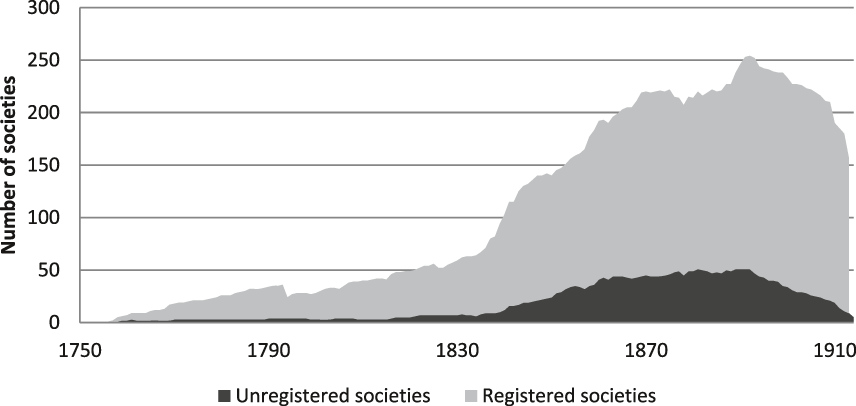
One of the main problems is that, because these societies were not registered, it is much more difficult to prove their existence. Morley identified up to 155 such societies from newspaper records, church magazines, and other printed sources, together with a number of other societies whose existence was recorded in either local or national archives.Footnote 67 However, these societies accounted for less than one-third of all the societies that are known to have existed in Oxfordshire between 1750 and 1914, and their numbers declined quite sharply from the 1890s on (Figure 1).
Oxfordshire friendly societies, 1750-1914.
Source: Data derived from S. Morley, Oxfordshire friendly societies 1750–1918, Chipping Norton: Oxfordshire Friendly Society, 2011.

The Royal Commission’s calculations also raise questions about the nature of the unregistered societies themselves. The commissioners distinguished between sixteen different types of registered friendly society, including the large affiliated orders (such as the MUOF and the AOF) and local friendly societies. However, although they suggested that approximately 40 percent of the local societies and up to 45 percent of the branches of the affiliated societies may not have been registered, they also stated that “the vast majority of unregistered societies . . . are to be found in that group of particular trade societies which are limited to particular establishments.”Footnote 68 It seems likely that a high proportion of the individuals who joined these societies did so in order to obtain burial insurance or accident insurance,Footnote 69 and the Royal Commission itself thought that many of them were “unsatisfactory,”Footnote 70 but it is worth asking why they chose to avoid registration in the first place. According to Sir George Young, “the reason . . . is [that] . . . in many of the regular friendly societies it is a rule that the members shall not belong to any other ‘benefit’ club; and these shop clubs are supposed to be outside the rule, so long as they are not called by any name of more corporate sounding than ‘sick fund,’ and abstain from claiming legal recognition.”Footnote 71 It would therefore be quite inappropriate to attempt to estimate the total number of separate individuals who belonged to some form of friendly society on the basis of these figures.
This is not the only reason for treating Hanson and Green’s figures with suspicion. As we have already seen, the commissioners stated that the number of unregistered societies was “nearly coextensive” with the number of registered societies in England and far surpassed it in Scotland, but they went on to say that “the most considerable specimens . . . are registered.”Footnote 72 One cannot therefore assume that the unregistered societies contained the same number of members as their registered counterparts.
These arguments also raise an important question about the impact of the 1875 Friendly Societies Act. In his Annual Report for 1890, J. M. Ludlow argued that the country continued to “swarm” with unregistered societies, some of which were “of considerable magnitude.”Footnote 73 However, Ludlow also stated that the act encouraged a large number of branches belonging to the affiliated societies, “which had already for a long time been in existence,” to register for the first time.Footnote 74 The registered membership of the affiliated societies grew very rapidly during the late 1870s and early 1880s, and it is hard to believe that the ratio of registered to unregistered members remained unchanged.
It is therefore very difficult to form an accurate assessment of the scale of friendly-society membership before 1911. Although many individuals may have belonged to unregistered societies, it is difficult to argue that they should all be regarded as additional to the members of the registered societies, or that membership of an unregistered society should be regarded as comparable to membership of a registered society. One of their major limitations, as Brabrook himself explained, was that the majority of the unregistered societies were likely to be “dividing societies,” which issued an annual dividend to their members at the end of each year. He told the Royal Commission on the Poor Laws that “an unregistered society, taking one with another, would be a poorer society, and a society with a less relative accumulation of funds than a registered society.”Footnote 75 This is another reason why it might be misleading to seek to compare them directly with the number of individuals who were covered by the statutory health insurance scheme from 1911 on.
The Origins of the Liberal Welfare Reforms
As I have demonstrated, traditional friendly societies were already facing a number of problems during the second half of the nineteenth century. These included a decline in at least some aspects of their traditional associational culture, a growth in the number of alternative savings vehicles, financial uncertainty, and high secession rates. However, the main problem was an increase in the proportion of members at higher ages, leading to increases in both the incidence and duration of sickness claims.Footnote 76 Many contemporaries believed that this problem was compounded by the apparent willingness of many older members to claim sickness benefits in lieu of retirement benefits or pensions.Footnote 77
Many friendly society members were also becoming more sympathetic to claims made on behalf of nonsociety members for new forms of welfare support. In 1893, the AOF’s High Court agreed to welcome any “equitable system of old-age pensions which, without interference with friendly societies or their work, shall provide for the large number of persons who are unable to avail themselves of the advantage of these institutions.”Footnote 78 Thane argued that friendly societies and other mutual-aid organizations “believed that the state should support the many hard-working people who could not help themselves, while leaving the mutuals to help those who could. They supported the campaign . . . for tax-funded redistributive noncontributory old-age pensions for those who could not afford to save for old age and had no alternative to stigmatising poor relief.”Footnote 79
The increase in the cost of the benefits paid to older members played a major role in changing attitudes to the provision of state pensions for men and women over the age of seventy. During the 1880s and 1890s, the friendly societies opposed plans for a contributory pension scheme because such a scheme would compete with their own. However, they were much more sympathetic to Charles Booth’s proposal for a noncontributory scheme, and in 1902 the NCFS endorsed calls for a state pension “of not less than 5s. a week for all thrifty and deserving persons of 65 years of age and upwards who are unable to work and in need of the same.”Footnote 80 This was a decisive turning point, and in May 1908 the National Conference Committee welcomed the Government’s proposals as “the beginning . . . [of] a more humane system of dealing with the aged people of this country.”Footnote 81
Attitudes to the introduction of national health insurance were much more varied, and even those who welcomed the pension scheme were wary of going further.Footnote 82 As Joseph Fowler explained, “the Pensions Act . . . has undoubtedly been a godsend in thousands of homes . . . [but] State sick insurance . . . touches that with which no government is familiar [and] needs which no government understands as the working members of our societies do.”Footnote 83
Men like Joseph Fowler opposed the introduction of statutory health insurance for a wide range of reasons. Many members were already expressing concerns about the decline of the traditional ethos of the friendly-society movement before the health insurance proposals were introduced, but they clung to the idea that the societies represented the cream of the independent and self-reliant working class. This led to concerns that the incorporation of both less healthy and less respectable members into the societies as part of the scheme would undermine the bonds that united them. In 1885, Thomas Ballan Stead told the Select Committee on National Provident Insurance that a “good friendly society” would object to the introduction of compulsory health insurance “because they would not take the unhealthy, and those not respectable . . . [they] would take the good men and leave out the bad.”Footnote 84 The Editor of the Foresters’ Miscellany said that “it may be a good thing that those who cannot now join a friendly society, because of ill-health, shall be provided for by the state, but what are we to say to the class who can but will not now join, the loafers, wastrels, spendthrifts etc.? What a desirable class for our members to mix with.”Footnote 85
These were not the only concerns. “Another PDCR” thought that “state aid will destroy the independent spirit of dogged perseverance by which the AOF has surmounted its difficulties in the past, and . . . result in our number . . . gradually receding to a vanishing point.”Footnote 86 C. W. Morecroft thought that “the past hundred years may be described as a period of great social uplifting and self-improvement” and that “the working man . . . is [now] more self-reliant and possesses more moral backbone than ever before. And if the state steps in and says ‘we are now going to help you to do what you have been doing for yourself for so long, and . . . compel you to accept our aid,’ do you not think that such a step savours very much of putting back the hands of the clock?”Footnote 87
These fears were by no means confined to the Foresters. In 1909, an article in the Oddfellows’ Magazine warned that the advent of state insurance “must make for the degeneration of the race, for the sapping of the manhood of the nation.”Footnote 88 In July 1914, the Oddfellows’ UK Grandmaster asserted that “a mere Government machine was a cold, calculating sort of being, with no soul. But the friendly societies had a soul—a great soul animated by the great principles of friendship, love and truth.”Footnote 89
As these comments suggest, many friendly-society members were convinced that national health insurance was both unnecessary and undesirable.Footnote 90 However, others believed that it was in the interests of the friendly societies themselves and society at large. C. W. Narlborough believed that one of the major problems facing the friendly societies was the cost of supporting members who were ill for very long periods, and that a government scheme would enable them to deal with cases of illness or invalidity extending beyond twelve months and thereby help to improve their solvency.Footnote 91 Edward Tranter argued that a state scheme would help to protect “genuine” friendly societies from the threat posed by dividing societies, remove the need for charity and strengthen the values on which friendly societies had been built by making men “realise their responsibility” and “help each other.”Footnote 92 E. B. Deadman thought that statutory insurance would help to protect friendly-society members from the shadow of the poor law. Would it not be far more desirable, he asked, “for friendly societies, while maintaining their present position, to assist in the provision of a state brotherhood, wherein the healthy should be compelled to form a permanent society, rather than to be cajoled by slate clubs organised . . . by Church, Dissent and public house, to the detriment of . . . true brotherhood?”Footnote 93
One of the most forceful supporters of statutory health insurance within friendly-society ranks was J. Lister Stead. During the late 1890s, Lister Stead had been “a tireless worker . . . in the campaign against state pensions,” but he subsequently became a strong advocate of both pensions and health insurance.Footnote 94 In November 1909, he said that “we must not look at the question simply as it affects ourselves; we must not leave out of consideration those who are outside our ranks; we must not forget to try to understand the motives of those who press changes upon us; and we must not fail to observe the stream which carries them along.”Footnote 95
Gilbert highlighted the way in which relations between Lloyd George and the friendly societies deteriorated during the course of 1910: “The Chancellor of the Exchequer, whom they had regarded as their champion, was now an object of loathing.”Footnote 96 However, this was mainly because of the way in which the societies felt that their interests had been undermined, first by the doctors, who refused to allow them to retain control over the administration of medical benefit; and then by the industrial insurance companies, who used their commercial power to insist on being allowed to enter the scheme as approved societies.Footnote 97 In other words, the main reason why relations between the societies and Lloyd George broke down was not because they objected to the principle of national health insurance but because of the way in which they believed that he might be about to sacrifice their interests to those of the medical profession and their commercial competitors.Footnote 98
The Impact of National Insurance
Although many of the main changes in the operation of friendly societies were already apparent before 1914, that does not mean that the advent of measures such as old-age pensions and, especially, national health insurance had no impact upon them. However, in a number of respects, this effect did more to reinforce existing trends than to create new ones.
As we have seen, the national health insurance scheme was built on foundations that had already been laid by a number of different mutual organizations, including friendly societies, and by commercial insurance organizations. When the Government introduced the scheme, it decided to allow these organizations to register as “approved societies” for purposes of administration. This decision was based partly on the need to appease existing providers and partly on the need to avoid the need for an entirely new set of administrative machinery.Footnote 99 Lloyd George also hoped that “far from . . . doing harm to the friendly societies,” the scheme would actually benefit them.Footnote 100 When the initial proposals were introduced, the societies had hoped to enjoy sole possession of the field, but they were forced to accept that both the trade unions and the commercial organizations would also be allowed to register.
The inclusion of a range of providers undoubtedly created tensions. In June 1912, an NCFS deputation discussed some of these with Lloyd George, Charles Masterman (chair of the National Health Insurance Commission), and a range of officials. The deputation believed that either the insurance companies or the trade unions would use the National Health Insurance scheme to poach their existing members. The Grand Master of the MUOF, and vice president of the NCFS, Alfred Warren, claimed that “the trade unions are bringing very considerable pressure to bear in this matter” and that “we have been brought into a very fierce state of competition.”Footnote 101 However, Lloyd George disputed these claims,Footnote 102 and, in reality, the unions remained “minor players” throughout the lifetime of the scheme.Footnote 103
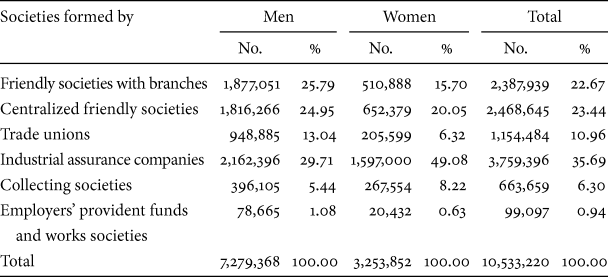
Table 2 summarizes the overall breakdown of approved society membership at the start of the National Health Insurance scheme. Approximately 4.8 million individuals registered with friendly societies. Just under half belonged to societies with branches and just over half to “branchless” or centralized societies. Although the friendly societies recruited 46 percent of approved society members, they accounted for 51 percent of male members. The societies’ Parliamentary Agents welcomed the underrepresentation of women because “from a sickness insurance point of view, and on the present actuarial basis, they have been proved to be decidedly inferior.”Footnote 104
Members of approved societies, 13 April 1913

Source: J. N. Lee, A. H. Warren, and W. Marlow, “The Parliamentary Agent’s Report,” Second Quarterly Report of the 81st Executive Council of the AOF, 1915, 232.
National health insurance also enabled the approved societies to offer a range of additional benefits alongside the statutory benefits that were guaranteed by the state. The most common types of benefit included access to dental and ophthalmic services, convalescent homes, and surgical appliances.Footnote 105 The societies used these benefits to compete for new members and they played an important, if not always fully recognized, role in the growth of health service provision during the interwar years. However, the competitive nature of these schemes also led to inequalities in access to health care, and this played an important role in debates about the need for more fundamental reforms before the establishment of the National Health Service.Footnote 106
Although the number of members was increasing before 1911, the fastest-growing societies were those offering more individualistic forms of saving, such as deposit accounts, or by the more impersonal or centralized societies such as the Hearts of Oak. More traditional organizations, such as the AOF and the Oddfellows, were becoming increasingly concerned by the decline of their associational activities and the continued expansion of the collecting societies and industrial assurance companies, and this increased the need for new and more directly commercial forms of recruitment activity. In January 1911, the AOF circulated a number of different examples of advertising material in the Annual Supplement to the Second Quarterly Report. New members were exhorted to join Court “Cardross” because it offered good benefits for low contributions and benefits were secure. Court “Earl Leofric” highlighted the fact that benefits were “definite and permanent.” Court “Delhi” offered high rates of interest on deposit accounts, sickness benefits throughout life, and the opportunity to contract for higher benefits in the event of either sickness or death.Footnote 107 As the Oddfellows’ Magazine noted in 1913, “the friendly societies will have to compete with great organizations who look to State Insurance acting as a feeder to the profit-making industrial insurance. The competition is at present unequal. The death-hunting canvasser takes the state’s business as a sideline. Sickness Insurance has been the main line in the work of a friendly society and, if we are to equalise the conditions, it will be essential to widen the range of our activities.”Footnote 108
The use of advertising and the development of more professional approaches to the recruitment and retention of members intensified after the National Insurance Act came into operation. This was partly related to the decline in the friendly societies’ social activities. In 1919, the AOF’s Executive Council reported that “a marked change has manifested itself in the attitudes of the majority of members to their Courts and . . . many Court meetings are but poorly attended. The record of the past twenty-five years demonstrates that entire reliance cannot be placed upon the existing methods of securing new entrants” and “the High Court endorsed the proposal . . . that Canvassing Agents should be appointed.”Footnote 109 The Foresters also introduced a wide range of new publicity measures, including the sale of pocket calendars,Footnote 110 tinted leaflets,Footnote 111 paid recruiters,Footnote 112 and the purchase of advertising space in newspapers and on billboards.Footnote 113 In 1931, the council concluded that “advertising plays a greater part in all business life today than it ever did before” before warning Districts and Courts “to take definite and systematic action to ensure that enquiries received as a result of advertisements are properly dealt with and that the prospective candidates are given adequate and competent attention.”Footnote 114
These developments show how the boundaries between the traditional friendly societies and their commercially minded rivals were becoming increasingly blurred, but they did not disappear entirely. The societies fought hard to retain the principle of self-management and to continue some of their traditional social and recreational activities. In September 1922, the Foresters’ Executive Council reminded Districts and Courts that “the return of the long evenings” gave them the opportunity “to prepare an attractive social programme for the winter months.”Footnote 115 In 1923, Henry Loe claimed that “social activities had received a fillip, and many a man and woman owes the Order a debt of gratitude for the homely kindliness and genial outlook . . . engendered by our many gatherings.”Footnote 116 The Foresters also sought to incorporate their history and social programs into their promotional activities, as was shown when they organized two well-publicized “pilgrimages” to the grave of “Little John” in 1928 and 1929.Footnote 117 However, the appeal of these aspects of friendly-society life was undoubtedly waning. In 1947, the Executive Council regretted that “the counter-attractions of today have tended to minimize the importance of the order as a social and fraternal organization,”Footnote 118 and one of Loe’s successors, A. J. Howell, concluded that “it would be folly to attempt to encourage the view that the restoration of Court life is even a possibility.”Footnote 119
This view was widely shared. In August 1947, Mass Observation published the results of an enquiry into the attitudes of friendly-society members and officials, as well as the general public. It took evidence from members of twenty-two organizations, including the Foresters, the Druids, the Rechabites, and the Oddfellows, as well as more centralized societies such as the Hearts of Oak and the Liverpool Victoria. Of 150 respondents, “only three people said they had attended any sort of meeting . . . regularly [and] not more than 25 attended . . . occasionally; the reminder never attended meetings and merely paid their subscription.” When friendly-society members were asked whether they knew or wished to know other members of their societies, the almost invariable answer was “no.” The majority of friendly-society members stated that “they did not attend meetings; felt no desire to take part in the election of officials; knew very few members of their society and had no wish to meet others. . . . The attitude of the individual member towards active participation . . . is negative or resistant.”Footnote 120
Within the affiliated orders, there was also growing pressure to amalgamate the “courts” or branches around which they had originally formed. The movement toward larger branches had already become apparent during the nineteenth century and was seen as a possible cause of increased sickness rates.Footnote 121 However, it also reflected the growing financial pressure on individual branches and the need to adopt a more commercial perspective. In 1910, the Foresters reported that Districts “now had the power to order any weak or decayed Court to amalgamate with another Court, or other Courts, connected with their District or other District.”Footnote 122 In 1913, the Foresters’ Executive Council reported that forty-nine amalgamations had taken place during the past year “due probably to the operation of the National Insurance Act,”Footnote 123 and in 1915 the Oddfellows’ directors asked lodges with fewer than one hundred members to merge with neighboring lodges.Footnote 124 The pressure for administrative reorganization was also bound up with the need to deal with the administrative burdens associated with running an approved society. The Oddfellows claimed that “if the friendly society is to hold its place among the approved societies, many of our secretaries will have to devote their whole time to the work and the numerical development of their lodges.”Footnote 125 The AOF’s John Dunford opined that “every District should be large enough to enable it to keep a full-time Secretary.”Footnote 126
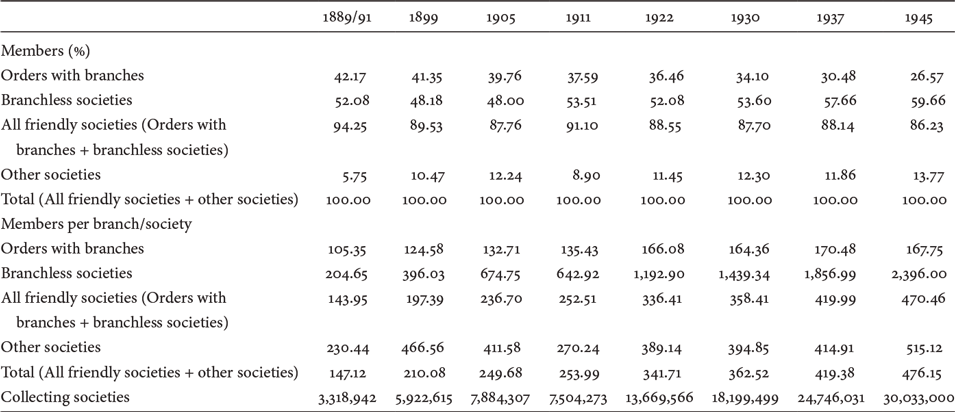
Many writers have regarded the National Insurance Act as a watershed in friendly-society history. In 1913, the Secretary of the Charity Organization Society, Charles Loch, described the act as the societies’ “death warrant,”Footnote 127 a view echoed by one of the anonymous witnesses who gave evidence to Mass Observation thirty-four years later.Footnote 128 Whiteside attributed “the dwindling participation by friendly society members” to “the increasing complexity of regulations and directives concerning the financing of benefit and the legitimacy of claims which developed during the interwar period,”Footnote 129 and Penn claimed that societies that joined the national health insurance scheme became less autonomous, more centralized, and more bureaucratic.Footnote 130 The decline of conviviality may also have been reflected in the declining number of separate branches within the affiliated orders and the increase in the number of branchless societies, which meant that the average size of each branch or friendly society also increased.Footnote 131 However, the establishment of the national health insurance scheme did not create these tendencies (Table 3). The proportion of friendly-society members who belonged to the affiliated orders was already falling during the 1890s, and the proportion of members who belonged to “branchless societies” changed only slightly between 1911 and 1930. The average size of affiliated society branches increased by more than 28 percent between 1889/91 and 1911, and the average size of branchless societies more than trebled.
Friendly Societies in Great Britain, 1889/91–1945
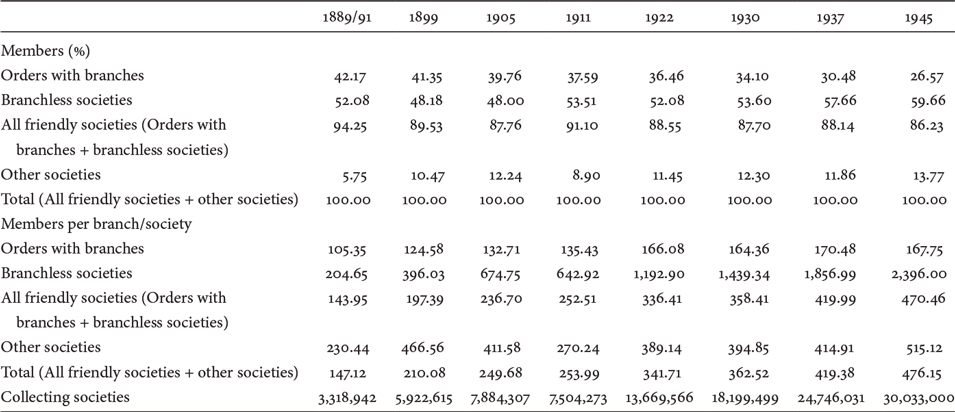
Notes and sources: See B. Harris, The origins of the British welfare state: society, state and social welfare in England and Wales, 1800–1945 (Basingstoke, 2004), 82–83, 194.
Table 3 also shows that the number of policies held by collecting societies rose by more than 300 percent between 1911 and 1945. In view of the fact that life insurance was excluded from the national health insurance scheme, one might conclude that this explains why the collecting societies grew much more rapidly than the friendly-society movement as a whole. However, the collecting societies were already growing much more rapidly than “ordinary” friendly societies before this,Footnote 132 and their own growth was dwarfed by the increase in the number of industrial insurance policies. This reinforces the view that the underlying cause of the change in friendly-society fortunes was not the rise of state welfare, but the individualization of savings behavior and the growing predominance of commercial competitors.
Attitudes to Social Policy Between the Wars
Friendly-society attitudes to state welfare were already changing before 1911. This was especially true of old-age pensions, and it was increasingly true of health insurance. So far as the latter was concerned, they were particularly anxious to ensure that their own interests were protected. That was why they were so offended when they thought that their position might be threatened by concessions to the industrial assurance companies and the doctors.
The protection of friendly-society interests continued to be a major theme. In 1915, the NCFS joined forces with the industrial assurance companies in objecting to any proposals for the formation of a “state friendly society,”Footnote 133 and in 1917 the president of the National Conference warned of “a bad day for this country of ours” if the state ever attempted to raid the accumulated savings of friendly-society members to subsidize the statutory scheme.Footnote 134 However, the societies were also determined to keep their options open if further changes in welfare provision were proposed. In 1920, they lobbied unsuccessfully for a share in the administration of unemployment insurance benefits.Footnote 135 When unemployment rose, their initial resentment was replaced by a definite sense of relief.Footnote 136
The societies also continued to advocate the importance of the values upon which they had been built. Alfred Warren argued that the act provided an opportunity to “[build] up . . . manly self-reliant characters” among the state insured members.Footnote 137 In 1928, the Foresters’ High Chief Ranger argued that the primary function of the friendly societies within the health insurance scheme was “to instil into the minds of our . . . state-insured members . . . that they are members of organizations through whose veins flows the blood of sympathy” and that the absence of this infusion would leave the scheme “without a soul.” He also argued that “we have to be very careful that [social] legislation shall not remove from the individual his or her own responsibility.”Footnote 138 Joseph worried that “possibly the one quality most to be desired in our national life today is a reawakened sense of individual responsibility” and that “modern legislation . . . has gone far to destroy that sturdy individualism which for many centuries distinguished the inhabitants of this country.”Footnote 139 S. Parker concluded that “there is need above all else for a quickening of individual responsibility and . . . more self-reliance. It is by these qualities that the operation of the state and of the great friendly societies . . . complement each other, and enable both to protect . . . the welfare of the workers.”Footnote 140
As these comments suggest, the friendly societies continued to position themselves as defenders of individualism and autonomy. However, this did not prevent them from supporting calls for the state to adopt more generous positions in other respects.Footnote 141 During the late nineteenth and early twentieth centuries, they had become increasingly concerned about the way in which the authorities’ refusal to discount friendly-society benefits when assessing claims for poor relief constituted a “tax on thrift,”Footnote 142 and this debate was only sharpened by the advent of old-age pensions in 1908.
When the Government introduced old-age pensions, it stipulated that they should only be paid to men and women whose annual incomes were below £21.Footnote 143 This meant that many friendly-society members were denied a pension because their friendly-society benefits raised them above the income limit.Footnote 144 During World War I, when the value of both pensions and benefits was eroded by inflation, the societies argued that friendly-society benefits should be discounted, but they also called for the means-testing of old-age pensions to be abolished completely. In 1919, the AOF’s John Dunford joined other members of the Departmental Committee on Old Age Pensions in recommending that “the means test be abolished altogether and that the old age pension be given to all citizens at the age of seventy.”Footnote 145 In 1921, the Order’s Parliamentary Agent, William Marlow, complained bitterly when Members of Parliament failed to translate the committee’s recommendation into law.Footnote 146
The societies’ ambivalent relationship to the expansion of public welfare provision was also reflected in their attitude to the raising of benefit levels and the expansion of statutory insurance provisions. World War I witnessed substantial increases in both prices and wages, and this led to calls for increases in health insurance benefits. Many friendly societies believed that prices would subsequently fall and that members would then be overinsured. During an impassioned debate, an MUOF delegate told the NCFS that “friendly society men have a right to consider whether the granting of that increase would not create a greater evil in injuring the work and the position of the friendly society movement.” However, other participants recognized that it would be extremely difficult for the societies to oppose measures designed to generate enhanced cash benefits for their members. W. Davies of the Sons of Temperance suggested that “no friendly society that wants to gauge the feeling of the country would admit that the ten shillings under the Act is adequate, or in keeping with the principle accepted when they adopted the national health insurance conditions, and the ten shillings is the minimum.” The AOF’s John Dunford agreed that “an increase in cash benefits under the National Insurance Act is not only desirable but inevitable, and . . . it is no good knocking our heads against a brick wall.” A motion to oppose the increase was duly defeated.Footnote 147
In his classic history of interwar British social policy, Gilbert argued that “the approved societies . . . fought, usually successfully, every extension of public medicine,”Footnote 148 but the evidence presented to the Royal Commission on National Health Insurance contradicts this. As Whiteside showed, “the Foresters, the Manchester Oddfellows and other major societies advocated that specialist and consultant services should be added to statutory medical benefit,” and “the Rechabites and Shepherds both advocated the extension of medical benefit to dependants.”Footnote 149 The Oddfellows and the Foresters, as well as the Hearts of Oak, also insisted on the need to include dental care, and both the Oddfellows and the Foresters argued that coverage should be extended to workers who retired before the age of seventy.Footnote 150 The NCFS argued that “few will deny that it is highly wasteful and inefficient to allow six or more separate organizations for medical services to exist side-by-side” and called for “all existing forms of public medical service” to be merged “into one . . . unified organization for the prevention and cure of disease.”Footnote 151
The societies also supported other efforts to extend the reach of the health insurance scheme. In 1924, G. Walker said that although “the present time appears to be opportune for the consideration of an extension of social insurance . . . the basic principle underlying most of the suggested schemes . . . consists of too much spoon-feeding, offering something for nothing, outrivalling the once-familiar slogan, ninepence for fourpence.”Footnote 152 However, other observers were at least a little more sanguine. W. J. Torrance wanted to know “where the process of governmental cuckooing . . . is to end,” but he also conceded that the objects of the new Widows’, Orphans’ and Old Age Contributory Pensions Bill “are such as to commend themselves to every right-thinking man and woman,”Footnote 153 and the Foresters went on to support proposals to lower the age of entry into the national insurance scheme and to reduce the age at which the wives of insured men became eligible for contributory pensions.Footnote 154
Many of these themes were also reflected in responses to the debates generated by the Government’s review of social insurance and allied services during World War II.Footnote 155 The NCFS told the Beveridge Committee that “most of the public services now subject to a varying degree of government control were founded upon, and indeed made possible by, the activities of voluntary agencies,”Footnote 156 but it also viewed “with some alarm” the proposal to transfer responsibility for the administration of social insurance from approved societies to local or national government departments,Footnote 157 and it regarded the overall trend toward greater statutory provision with some ambivalence. The Executive Council of the AOF argued that “many of the extensions and reforms . . . have for very many years been advocated by our Order,”Footnote 158 and the NCFS welcomed “the further progress of social insurance,” which the Government subsequently proposed.Footnote 159 However, the societies were also concerned about the threat that this posed to traditional values. In 1944, the Oddfellows’ secretary, H. A. Andrews, warned that “the right national policy . . . is not to make changes which tend nearer and nearer to a totalitarian state but . . . to do everything possible to preserve existing voluntary organizations.”Footnote 160 In 1947, the AOF’s High Chief Ranger echoed these fears:
Since we met at Tunbridge Wells last year, the condition of our country has shown no improvement. We are exhorted at every corner to “work or want,” but the general tendency on all hands seems to indicate a greater desire to work less and want more. This is suicidal and all who have the future of this great nation at heart cannot but be disturbed at the way we seem to be heading. A crisis in our affairs appears to be insufficient to awaken the nation to its plight, and it is apparent that appeals are of little value—what we require is a moral re-awakening, and until we get that I have not much confidence in our ability to quickly pull out of the economic situation we have found ourselves in.Footnote 161
Conclusions
A wide range of academic and political commentators have sought to rescue the friendly societies from what E. P. Thompson once called the “enormous condescension of posterity.”Footnote 162 It has been claimed that the societies offered a viable alternative to the development of state welfare at the end of the nineteenth century and that this alternative was then snuffed out by the growth of the state. In this article, I have challenged this account by highlighting the limitations of the services the societies offered and emphasizing the challenges they faced. I have also suggested that the growth of statutory provision was as much a response to these difficulties as their cause.
One of the main questions concerns the robustness and vitality of friendly societies before World War I. It has sometimes been suggested that the societies’ rich associational culture only came under threat following the expansion of state welfare provision during the early years of the twentieth century. However, many aspects of this culture were already under threat before the Liberals came to power. The main danger came less from the expansion of state welfare than from the increasing individualization of working-class life and the rise of more impersonal and commercial insurance opportunities. Judged from this standpoint, the rise of state welfare looks less like a cause of the friendly societies’ decline and more a response.
This impression is reinforced by a study of the societies’ own attitudes to demands for the expansion of public welfare provision from the 1890s. Although many organizations were initially hostile, both to old-age pensions and national insurance, they accepted that such developments might not only be inevitable but also desirable. As the AOF’s Executive Council explained in January 1912, “The National Insurance Bill has become law, and we trust that it will lead to a large accession of members and create a more extended sphere of usefulness for the Order. . . . This is a year of ‘many possibilities’ . . . and . . . we must not be left behind.”Footnote 163
Even if the national insurance scheme was not responsible for the demise of the societies, some historians have claimed that it fundamentally weakened them. However, many of the trends identified by these authors, such as the increasing size of friendly-society branches and the decline of their social and recreational functions, were already apparent before the legislation took effect.
However, this does not mean that the societies were unaffected either by their new responsibilities or by the changing context within which they operated. During the nineteenth century, the societies existed alongside the statutory poor law as part of Britain’s “mixed economy of welfare,” but they also sought to emphasize their separation from the machinery of poor relief and from the “class” of people who depended on it. During the twentieth century, they became part of the machinery of statutory health insurance and the majority of their members were pleased to become eligible for state benefits. This meant that, although the societies continued to rail against the erosion of the “spirit of independence,” they also tried to advance the interests of their members by advocating the relaxation of restrictions on access to benefits, increases in benefit rates, the introduction of new benefits, and the expansion of their own responsibility for the administration of the system.
Many of the tensions within this position became more apparent in the run-up to the National Insurance and National Health Service Acts of 1946. As we have already seen, the societies were not only anxious to emphasize the importance of their contributions to the growth of state welfare but also to retain a role in the administration of state services, but the government was concerned by inequalities in the distribution of health services and believed that the state should take direct responsibility for the provision of the services it financed.Footnote 164 In 1946, after the government had published its National Insurance Bill, the NCFS launched a national petition to protest against its exclusion from the scheme.Footnote 165 Although the affiliated societies numbered more than 6.4 million “voluntary” members and more than 6.7 million “state” members, many of whom would of course have belonged to both schemes, the petition attracted fewer than four hundred thousand signatures and was eventually withdrawn.Footnote 166 The societies’ experience therefore reflected that of other voluntary insurance and mutual aid schemes that sought to oppose the “nationalization” of social welfare at the end of World War II.Footnote 167