Introduction
Methicillin-resistant Staphylococcus aureus (MRSA) is a strain of Staphylococcus aureus that has become a common clinical pathogen throughout the world.Reference Fluit, Wielders and Schmitz1, 2 Methicillin-resistant Staphylococcus aureus in non-hospital settings is an important health care issue that is a challenge to public safety and is contributing to increased morbidity in the general population.Reference Popovich, Weinstein and Hota3
Methicillin-resistant Staphylococcus aureus colonization is contagious and can easily be transmitted; rendering colonized individuals prone to subsequent MRSA infections as a result of the invasion of microorganisms through broken skin.Reference Muto4 Therefore, MRSA colonization among health care workers (HCWs) can put both patients and HCWs at an increased risk.Reference Boggs5
Emergency Medical Services (EMS) personnel provide patient care in both the community and hospital settings. Therefore, they are in the position to acquire microbes in the community and transmit them to their patients while still in the community, thus helping make community-acquired MRSA (CA-MRSA) an EMS-related nosocomial infection.
The effects of MRSA can reach beyond patient safety to include the entire EMS system and its personnel. The aim of this study is to quantify the prevalence of MRSA colonization among EMS personnel. By estimating the degree of MRSA colonization among EMS personnel, this study, and further related research, can help decision makers and policy reviewers understand the extent of this problem in the field, and re-evaluate EMS infection control policies and the effectiveness of their implementation.
The prevalence of MRSA colonization on the national level was 1.5% in the general population.Reference Elie-Turenne, Fernandes and Mediavilla6, Reference Gorwitz, Kruszon and McAllister7 The hypothesis of this study was that the prevalence of MRSA colonization is higher among EMS personnel than in the general population, (ie, H0 = P ≤ 1.5%, H1 = P > 1.5%). It was assumed there was no change in the prevalence of MRSA colonization among the general population from the survey conducted in 2004 in the US, which showed a value of 1.5%.
Although this study was dedicated to quantifying the degree of MRSA colonization among EMS personnel, it has a much broader context related to infectious disease management in EMS, including the potential for bioterrorism, in which EMS personnel would become both vectors (colonized) and victims (infected).
Methods
Study Design
A cross-sectional, descriptive point prevalence study was conducted from late 2009 through early 2010 among EMS personnel (basic (EMT-B), intermediate (EMT-I), and paramedic (EMT-P)) selected from two fire departments in a small Mid-Atlantic state in the US.
Baseline data included the number of years of experience as a prehospital health care provider (which excluded firefighters who had minimal exposure to patients unless the firefighters were cross-trained), previous diagnosis of MRSA infection, previous diagnosis of unspecified skin and soft tissue infections (SSTI), and previous treatment for that infection, in addition to any current use of antibiotics.
Sample Selection
Approval for the use of human subjects was requested and granted from the Institutional Review Board (IRB) at University Of Maryland, Baltimore County (UMBC). After giving their verbal consent, subjects were selected from two major Mid-Atlantic fire departments, one in a major urban district and the other in a suburban jurisdiction.
The inclusion criteria were any state-certified EMS personnel (EMT-B, EMT-I, and EMT-P) who worked full time and had at least one year of experience. Excluded were any subjects who worked part time, or had less than one year of experience in prehospital patient care. Firefighters who were cross-trained were included only if they were actively involved in direct patient care and had more than one year of experience.
Data Collection and Culture
Methicillin-resistant Staphylococcus aureus colonization was detected by swabbing anterior nares bilaterally for each subject using sterile culture swabs with Stuart's transport medium (BBL culture devices, BD, Sparks, MD). The role of anterior nares is evidenced in several studies as the main reservoir of Staphylococcus aureus, as well as the association of nasal colonization with higher risks of S. aureus infections.Reference Elliott, Kellum, Tenover and Pettriess8–Reference Chang, Sethi, Stiefel, Cadnum and Donskey11
Each culture was inoculated onto a selective medium for MRSA; MRSA CHROMagar (C-MRSA) (BD, BBL, Sparks, Maryland USA), which is highly sensitive (97.6% at 18-24 h of incubation and 100% at 48 h) and 99.9% specific for identifying MRSA from positive blood cultures.Reference Pape, Waldin and Nachamkin12 It has also been used in other controlled studies to detect nasal colonization of MRSAReference Ellis, Griffith and Dooley10, Reference Flayhart, Hindler and Bruckner13 with an overall specificity of 99.7%.Reference Flayhart, Hindler and Bruckner13 Readings of MRSA growth were obtained at 24 and 48 hours, with an expected result of pink/mauve colonies.
Laboratory Methods
Microbiology Methods
Within four hours, collected samples were used to inoculate C-MRSA agar and obtain isolated bacterial colonies. Plates were incubated at 37°C, and colony formation was monitored after 24 hours and 48 hours of incubation.
Pink (mauve) colonies, indicating positive MRSA growth, were then used to inoculate 5 ml of Tryptic Soy Broth (TSB), a rich medium routinely used to grow S. aureus and MRSA in laboratories.Reference Brown, Edwards, Hawkey, Morrison, Ridgway, Towner and Wren14 The culture was incubated for 24 hours at 37°C under aeration. Clones that grew in TSB were further used to perform a molecular biology analysis.
Molecular Biology
Complementary to the initial phenotypic analysis, and to minimize false positive readings by further confirming the findings, a genotypic analysis was conducted by means of polymerase chain reaction (PCR) experiments to look for the presence of the mecA gene in the clones that were selected as potential MRSA isolates. Two milliliters of culture that grew in TSB were used to collect cells by centrifugation. Cells were further treated for genomic DNA (gDNA) extraction using the GenElute Bacterial Genomic DNA Kit (Sigma, St Louis, Missouri USA). Cells were treated with lysozyme and lysostaphin to degrade the peptidoglycan cell wall and the resulting protoplats were then lysed in a salt-containing solution. The DNA was then extracted by affinity to a silica-based membrane. The kit allows the extraction of highly pure genomic DNA and the quality of the extracted gDNA was assessed by gel electrophoresis and concentration determination.
The PCR experiments were performed using the Taq DNA polymerase (New England Biotech, Ipswich, Massachusetts, USA), using 50 μg of gDNA as template and the primers oMec1 5′-GTT GTA GTT GTC GGG TTT GG-3′ and oMec2 5′-CTT CCA CAT ACC ATC TTC TTT AAC-3′ (Integrated DNA Technologies, Inc., Coralville, Iowa, USA). The PCR consisted of a first step of five minutes at 95°C, followed by 30 cycles of template denaturation (95°C for 30 seconds), primer hybridization (50°C for 30 seconds), and DNA polymerization (72°C for two minutes) completed with a final DNA extension step at 72°C for five minutes. A PCR control was performed in the same cycle conditions using the primers oMRSA16S1 5′-AGG CCC GGG AAC GTA TTC AC-3′ and oMRSA16S2 5′-GAG GAA GGT GGG GAT GAC GT-3′ to amplify a region within the gene encoding the 16S RNA.
The PCR reaction products were visualized by eletrophoresis on a 1% agarose gel using ethidium bromide staining to reveal the presence of DNA under ultraviolet (UV) transilluminator lights.
Molecular Benchmarking
To minimize false positive results, a second, back- up, round of tests was conducted to confirm each presumed growth. Steps in this study were performed by using the GenElute Bacterial Genomic DNA Kit (Sigma, St Louis, Missouri USA), a kit that is used to isolate pure DNA from a variety of cultured bacteria, and has been used by several studies on different bacteria including Staphylococcus.Reference Porwollik, Frye, Florea, Blackmer and McClelland15–Reference Frye, Jesse and Long19
The PCR test is a robust molecular analysis for MRSA because it detects and amplifies a target DNA sequence that is specific for Methicillin resistance; mecA gene.Reference Wielders, Fluit, Brisse, Verhoef and Schmitz20 This gene encodes a Penicillin-binding protein which pertains to a high level of resistance to Methicillin.Reference Wielders, Fluit, Brisse, Verhoef and Schmitz20 PCR is proven effective in molecularly indentifying MRSA and excluding false positive growth from convenient cultures.Reference Brown, Edwards, Hawkey, Morrison, Ridgway, Towner and Wren14
Methods of Analysis
Randomization was ineffective due to a general reluctance of EMS personnel to participate. Since the study participation was voluntary, there was a need for a convenience sampling.
With a one-sided binomial distribution obtained using the StudySize 2.0 Web calculator (CreoStat HB, Enbarsv.11. V, Frolunda. Sweden), for a p (H0 proportion) = 1.5%; a difference (H1-H0) ‘Δ’ = 4.5% can be detected at α = 5% and power = 80% with N = 110. For a sample size of 110, and based on this study design, statistical significance of α = 5% is observed when the number of positive MRSA colonization exceeds rejection region “S” meaning when S is seen in five or more EMS personnel; Pr (S ≥5) = 2.5495%. The S value was determined by using a binomial distribution calculator (StatTrek.com).
Results
Population Demographics
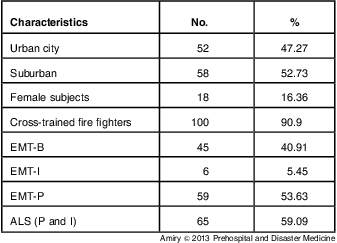
The total number of participants was 110. Among them, 47.3% were selected from the urban fire department, and 52.7% were from the suburban department.
The mean age of the sample population was 35.2 years. Female participants (n = 18) accounted for 16.36% of the total sample size.
The majority of subjects (90.9%) were cross-trained firefighters, with 59 (53.6%) EMT-P, six (5.4%) EMT-I, and 45 (40.9%) EMT-B personnel (Table 1). All study participants had direct patient care experience in prehospital settings, with a mean of 10.5 years of experience in prehospital health care (SD = 7.6, range 1-40 yrs).
Characteristics of participants (page 3)
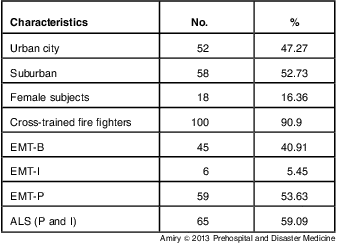
Abbreviations: ALS, Advanced Life Support; EMT-B, Emergency Medical Technician – Basic; EMT-I, Emergency Medical Technician – Intermediate; EMT-P, Emergency Medical Technician – Paramedic
Colonization
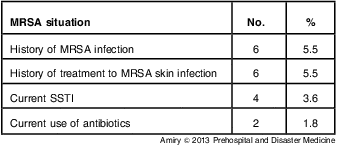
Six participants (5.5%) had a history of MRSA infection; two of them were found to be positive for MRSA in this study. Four subjects (3.6%) had some type of SSTI; none of them were on antibiotics. One was found to be colonized for MRSA; this person had had a history of MRSA infection. Six participants had history of unknown SSTI (5.5%) (Table 2).
MRSA characteristics in participants (page 3)
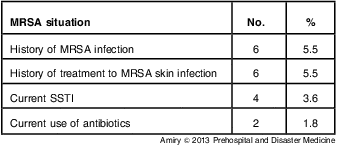
Abbreviation: MRSA, Methicillin-resistant Staphylococcus aureus; SSTI, skin and soft tissue infections
Participants were classified as MRSA colonized or not based on the final results of the PCR test after inoculation onto C-MRSA and TSB media respectively. Only 11 samples with MRSA clones showed pink (mauve) colonies on C-MRSA agar; eight of these samples were cultivated in TSB medium. Highly pure genomic DNA was extracted from 12 samples (eight from this study and four laboratory control samples) by using the GenElute Bacterial Genomic DNA Kit (Sigma, St Louis, Missouri, USA).
In the succeeding PCR analysis, the mecA gene was successfully amplified, an absolute indication of MRSA, in seven samples out of the eight the analysis started with; one was a false positive. This test is a final molecular analysis. At the conclusion of this study, S = 7 workers were observed to be positively colonized with MRSA bacteria and therefore study prevalence = 7/110 = 6.4% (95% CI, 1.8%-11.0%), P < .0003). Therefore, the alternate hypothesis (H1) was accepted (ie the prevalence of MRSA colonization among EMS personnel is higher than among the general population). There was no statistically significant evidence that urban personnel were more at risk for MRSA colonization than the suburban personnel (RR 1.5; 95% CI, 0.4-6.3).
Discussion
Findings
This was the first study in the Mid-Atlantic region to test EMS personnel for MRSA colonization. There are neither sufficient published studies nor established surveillance systems that monitor EMS personnel for MRSA colonization. Extra precaution is required in light of the association between MRSA colonization and the subsequent contamination of skin and the surrounding environment.Reference Chang, Sethi, Stiefel, Cadnum and Donskey11, Reference Patrick and Burns21
Despite the relatively small sample size, the study found a prevalence of MRSA colonization of 6.4% as compared to 1.5%, which is the prevalence of MRSA colonization among the general population, with strong statistical significance. Therefore, MRSA colonization among EMS personnel in this study population is significantly higher than among the general population.
This study's findings did not contradict other studies regarding MRSA colonization among health care providers. A number of studies have found a high prevalence of MRSA colonization, ranging from 4.3%-19.4%, among employees at several emergency departments.Reference Boggs5, Reference Eveillard, Martin, Hidri, Boussougant and Joly-Guillou22, Reference Suffoletto, Cannon, Ilkhanipour and Yealy23 In one study, EMS personnel were found to be positive for MRSA colonization significantly more than the general population, with a prevalence of 5.5%.Reference Elliott, Kellum, Tenover and Pettriess8 However, a recent study found an unexplained low prevalence of MRSA-colonized paramedics (1.9%) when compared to health care providers at a local emergency department (9.6%).Reference Elie-Turenne, Fernandes and Mediavilla6
In the present study, personnel in two different jurisdictions were surveyed to expand the geographic field and represent urban and suburban regions in the selected state. The logistic regression shows no evidence that EMS personnel working in the urban site are at higher risk for exposure to MRSA than colleagues working in the suburban.
Using logistic regression, there was no evidence of association between MRSA colonization and years of experience, current skin infection, or type of EMS personnel (BLS or ALS providers). However, a history of MRSA infection is a predictable variable of MRSA colonization.
MRSA Transmission
Infected and colonized individuals with MRSA are the main source of transmission,Reference Chang, Sethi, Stiefel, Cadnum and Donskey11 and the main mode of transmitting MRSA is through the hands of HCWs;2 therefore, they can act as vectors of MRSA. It is assumed that the increased exposure to patients puts HCWs at an increased risk for MRSA colonization more than the general population.Reference Noda, Brown and Christ24
Chang et al have demonstrated that transmitting MRSA by nasally-colonized individuals is very likely because they contaminate the surrounding environment through their contaminated skin.Reference Chang, Sethi, Stiefel, Cadnum and Donskey11 Moreover, individuals colonized with MRSA are more prone to MRSA infections.Reference Patrick and Burns21, Reference Scarsi25 Nasal colonization in general can lead to subsequent MRSA invasive infections,Reference Honda, Krauss and Coopersmith26 with a four-fold increase of risk.Reference Safdar and Bradley27 These findings suggest a risk for an increased morbidity among colonized individuals, which may impact the workforce and performance of EMS.
MRSA in Health Care Settings and EMS
Cross-transmission of MRSA is facilitated by health care providers who play a significant role in the spread of MRSA through their hands.Reference Harbarth28 Some studies assume that EMS personnel have poor adherence to the recommended infection control guidelines.Reference Alves and Bissell29, Reference Mencl, Birkle, Blanda and Gerson30
Patient safety in prehospital settings has been questioned recently after several studies identified nosocomial pathogens in the prehospital environment. One study found a “significant degree of MRSA contamination” isolated from operating ambulances;Reference Roline, Crumpecker and Dunn31 this was supported by another study in which species of nosocomial pathogens with significant antibiotic resistance were swabbed from several sites inside ambulances.Reference Alves and Bissell29 In addition, MRSA isolates have been recovered from commonly-used equipment such as stethoscopes.Reference Mencl, Birkle, Blanda and Gerson30
Environmental contamination by MRSA has been linked to nasal colonization. In a recent study, skin and surrounding surfaces exposed to MRSA were assessed within seven hours of admission of confirmed nasally-colonized patients with MRSA.Reference Chang, Sethi, Stiefel, Cadnum and Donskey11 According to Chang et al, the severity of nasal colonization with MRSA is significantly associated with increased skin and environmental contamination.Reference Chang, Sethi, Stiefel, Cadnum and Donskey11
Prevention and Elimination
Preventing the transmission of MRSA depends on adherence to infection control policies.Reference Eveillard, Martin, Hidri, Boussougant and Joly-Guillou22 Only proper infection control procedures, especially effective hand washing, can eliminate the spread of MRSA.2
Methicillin-resistant Staphylococcus aureus patients require advanced personal protection barriers. Methicillin-resistant Staphylococcus aureus isolates have been found in 37%-65% of HCWs’ white gowns;Reference Muto4 therefore, donning disposable gowns becomes an important procedure in the prehospital settings. Further, the use of masks has been found to be effective in protecting HCWs against nasal colonization.Reference Muto4
Additionally, MRSA isolates have been recovered from patients’ gowns, floors, bed linens, blood pressure cuffs, and stethoscopes.Reference Muto4 Therefore, equipment and surfaces inside the unit must be decontaminated effectively after transporting each patient with MRSA.
Frequent routine screening after exposure to MRSA-infected individuals is not recommended by the US Centers for Disease Control and Prevention (CDC) among asymptomatic persons under normal conditions.Reference Gorwitz, Kruszon and McAllister7 Efficiency of these surveillance systems can be achieved when limiting surveillance to the targeted population with the higher risk.Reference Simons and Alcabes32
Decolonization is a method to either eliminate colonization or prevent recurrence,Reference Kowalski, Berbari and Osmon33 and the CDC recommends the use of agents for this purpose.Reference Herman, Kee, Moores and Ross34 Nonetheless, there is a major concern about implementing widespread decolonization due to the possibility of developing resistance to these decolonizing agents.Reference Gorwitz, Jernigan, Powers and Jernigan35
Protection of the Front Line
There is a need to improve protection of the front-line EMS personnel. Because colonized individuals are significantly more prone to MRSA infections,Reference Patrick and Burns21, Reference Scarsi25 MRSA colonization should be viewed as an occupational health hazard. Ultimately, having EMS personnel with MRSA infections will increase lost work days, thus increasing costs for EMS departments. Therefore, tackling this issue can be seen as a cost-effective measure, especially in institutions with high colonization prevalence.Reference Lee, Bailey and Smith36
Understanding the role of EMS personnel in cross-transmitting simple microorganisms with the public can help clarify their potential role in spreading diseases in bioterrorism, and help improve the applications of infection control practices to contain more difficult microorganisms.
The likelihood of bioterrorism is unknown; should it occur, EMS personnel will be the first line of defense. They are in direct contact with the public; therefore, successful response to such incidents will depend heavily on EMS preparation.Reference Shalala37 When ill-prepared, prehospital health care providers can be victims themselves, and their health care services can be affected severely. Surveillance systems not only can detect a new infection, but also can provide active monitors as response tools for biological incidences.
The key principle of MRSA prevention lies in empowering health care providers with information about the infection and its basic preventive measures.Reference Kowalski, Berbari and Osmon33 Further efforts can be focused on the development of guidelines for proper management of MRSA outbreaks in communities.Reference Weber38
MRSA control is considered a national priority, and its rapid spread supports the need for collaborative infection control efforts by both hospitals and communities.Reference Klein, Smith and Laxminarayan39 Since EMS is a vital sector of community services, this national priority can be viewed as a motivation for governmental grants to upgrade EMS departments’ infection control policies and improve their quality of care.
Limitations of the Study
No randomization was applied in selecting the study sample. Moreover, only career employees were involved; no EMS volunteers (personnel who work on ambulances without compensation) participated in this study. This may have led to under-representation of volunteer EMS personnel.
The dynamic nature of the disease makes it possible to have “intermittent carriers” where they shift from being colonized to negative in a small period of time.Reference Ellis, Griffith and Dooley10 Because this study was a cross-sectional survey, it could not be assessed whether the colonization is persistent. In addition, this study involved investigating one site of MRSA colonization; however, colonization can occur in other parts of the body, including the trachea, skin folds and rectum.Reference Noda, Brown and Christ24
Conclusion
There is evidence that EMS personnel have a higher prevalence of MRSA colonization than the general population. This can be a risk to patients and can be recognized as an occupational hazard.