INTRODUCTION
Variationist sociolinguistics seek to determine if a state of variability in the language represents either a stable variation or a change in progress. Once this has been determined, other questions immediately arise. For example, in the case of stable variation, is one of the forms stigmatized or highly valued in the community? In the case of change, is this a change from above or from below? Who is at the forefront of the change?
In the present article we use different lines of evidence in an attempt to answer these questions. Our study is based on the synchronic analysis of the speech of three generations of speakers from the same community. We document the trajectory of a morphosyntactic variable, the alternation between the use of the (non-standard) conditional and the (prescribed) indicative forms in the protasis of hypothetical si-clauses in Quebec French.Footnote 2 We are concerned with sentences in which the relationship between the two clauses is either potential or counterfactual and for which the imperfect (IMP) and pluperfect indicative (PLUP), as in (1a) and (1b), alternate respectively with the present conditional (PRES COND) in (1c) and the past conditional (PAST COND) in (1d).Footnote 3
- (1)
a. Si c’était (IMP) à mon choix, je les enlèverais de là.
(XXth/025/657)Footnote 4
‘If it were up to me, I'd get them out of there.’
b. Si je l’avais pas faite (PLUP) je pourrais pas en parler.
(XXth/028/1514)
‘If I hadn't done it, I wouldn't be able to talk about it.’
c. Si ça serait (PRES COND) pas bon, je le mangerais pas.
(XXth/018/1912)
‘If it wouldn't be good, I wouldn't eat it.’
d. Si elle aurait eu (PAST COND) un petit, moi je l'aurais pris.
(XXth/099/938)
‘If she would have had a baby, I would have taken it (with me).’
LeBlanc (Reference LeBlanc1999) dealt largely with the linguistic factors constraining the variation in the Corpus du français parlé à Ottawa-Hull (Poplack, Reference Poplack, Fasold and Schiffrin1989). In this article, we focus on the demographic and socioeconomic aspects of the variation for the subgroup of speakers from Hull (Quebec). We investigate the development of the variation by performing a comparative analysis of the language-external constraints for the different generations. In doing so, we are able to follow the trajectory of the forms during the transition period and to demonstrate how each one has acquired a social value. We propose that the variation is an instance of change away from the standard norm, originating in the working class male group and nearing its completion. Our results also suggest that the older form should remain in the language as a marker of prestige.
In Section 1, we discuss the construct of apparent time, with emphasis on its relation to the generational change and age grading patterns. Section 2 provides a description of the corpus of data and the overall distribution of the variants in the community. This is followed by Section 3, which deals with the time aspect of the variation. We look at the results for the conditional variant according to age and discuss the three steps in its development. These next two sections serve as a backdrop for the analysis that will take place in the second half of the article. In Section 4, we give an overview of the social value of the conditional in si-clauses in the development of the language. Section 5 summarises the methodological and statistical methods that will be used to measure the social value of the conditional in the community (Section 6) and its progress in the speech of the three generations (Section 7).
1 THE STUDY OF LANGUAGE VARIATION
The main difficulty when studying language variation from a synchronic point of view lies in the interpretation of the distribution of variants according to age, referred to as apparent time. In an instance of a generational change, the distribution is monotonic; if the proportions increase or decrease with each new generation, it is inferred that a change is ongoing in the community. The same distributional pattern may, however, also be interpreted as indicating age grading, a phenomenon often linked to stable variation, at least in the case of adults.
Before turning to the evidence supporting each interpretation, a few notes about their backgrounds should be made. With his pioneer work in the 1960s on speech from Martha's Vineyard and New York City, Labov postulated that the differences between generations (from the same background and speech style) might indicate the latest developments in the language (Labov, Reference Labov1966). The main tenet behind this interpretation is the concept of a critical age period (Lenneberg, Reference Lenneberg1967) by which point a person's language is fixed. The speech of older speakers is then taken to reflect the state of the grammar when it was acquired, and differences between generations to indicate change in progress. In Labov (Reference Labov1972: 24, cited in G. Sankoff, Reference Sankoff2006), the author suggested that age grading could also be a secondary influence on the age distribution that was found. Age grading is the pattern displayed when a linguistic community is stable and differences are taken to represent the behaviour typical of each generation. The hypothesis is based on the premise that some changes repeat themselves and are thus part of the natural (social) development of languages.
While there are many studies inferring generational changes based on apparent-time results, Chambers (Reference Chambers2003:188) notes that there are few reported cases of age-grading. To document change in adult speech requires longitudinal studies spanning decades; evidence therefore relies heavily on those involving children and adolescents. The next two examples will illustrate the first line of evidence for our study: the stability of vernacular features in adult speech. Cukor-Avila (2000) set out to test the stability of the vernacular in rural Texas. She analysed the speech of two adults and two adolescents who were interviewed three times over ten years: the former were stable but the adolescents had modified their speech regarding four variables. In Guy and Boyd's (Reference Guy and Boyd1990) study on past tense t/d deletion in English, the variable was stable but there was also an age grading effect with regards to one category of verbs. The comparison of individual speakers in both studies revealed the typical steep curve pattern of language acquisition in childhood and adolescence, which tends to level off in adulthood when the vernacular stabilises.
A second line of evidence is underlined by stable variables in the community: the social stratification effect on age grading. For example, Chambers (Reference Chambers1995: 208–11) proposed that Macaulay's Reference Macaulay1977 study of glottal stops in Glasgow was a case of age grading involving a non-standard variant that was sharply stratified in the community. The speech of all the ten-year-old children mirrored that of the working-class speakers, but once they reached fifteen, the working-class children continued to display the same proportions while the others modelled their behaviour on older siblings and adults. Downes (Reference Downes1984: 190–1) discusses the social structure of stable variables in New York based on Labov's work. When the variants are stratified stylistically and socially, the normal age pattern is for adolescents and young adults, as well as older informants, to use more non-standard variants than the middle age groups.
Well-established stable variables such as the glottal stop in Glasgow or -ING in the United States allow us to better understand the social stratification of language. Yet, it is in the analysis of real time data that researchers provide us with the two most compelling lines of evidence on age grading and generational change. Real time studies compare language at two points in time, either for the same speakers (panel studies) or for the same community (trend studies), bringing new arguments to the central question: Who is changing, the individual or the community? Most importantly, these studies have demonstrated how the two patterns are ongoing processes intertwined with each other and with normative pressure.
Trudgill's trend study of Norwich (Reference Trudgill1974 and Reference Trudgill, Breivik and Jahn1989) as well as Cedergren's restudy of Panama City (Reference Cedergren1973 and Reference Cedergren and Lowenberg1988) both found a combined effect of age grading and generational change. Their results suggested that age grading and generational change might not be mutually exclusive. More recently, G. Sankoff et al. (Reference Sankoff, Blondeau, Charity, van de Velde and van Hout2001) and G. Sankoff and Wagner (Reference Sankoff and Evans Wagner2006) performed panel and trend analyses based on Montreal corpora that indicate that the speech of adults generally remains stable throughout life but that some speakers change along with the community. Based on G. Sankoff's Reference Sankoff, Ulrich, Dittmar, Mattheier and Trudgill2005 and Reference Sankoff and Evans Wagner2006 reviews of the state of research, these speakers can be divided into two groups: those who are part of the active population and follow in the direction of the change and those who go in the opposite direction. Even if an entire speech community has begun to change, speakers from the upper social strata will resist changes from below due to normative pressure. This effect has also been observed by Zilles (Reference Zilles2005) and Blondeau (Reference Blondeau2001) who likewise used both panel and trend approaches.
The purpose of this section was to give an overview of the wider paradigm of linguistic research to which the present analysis wishes to contribute and the background against which our results will be interpreted. The brief overview of the literature dealing with the ambiguity of apparent time results permits four main points to be drawn: first, the general stability of the adult vernacular; second, the younger and older informants’ similar behaviour for stable variables; third, the possibility for some adults to join in generational changes; and fourth, the resistance of the upper social classes with regards to changes from below.
As just seen, the dual reading of apparent time results entails a methodological choice for the study of linguistic variation and change. On the one hand, only real time studies can establish the truth about changes; on the other, apparent time's validity as a means of assessing new developments in the language remains largely undisputed. Real time analyses, especially detailed panel studies, are crucial for an understanding of lifetime sociolinguistic changes, but so far trend studies have for the great majority confirmed the interpretations that were postulated based on apparent time.
2 THE DATA
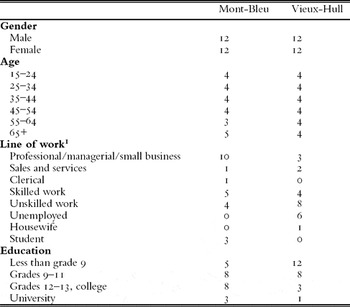
The data for this study come from the Corpus du français parlé à Ottawa-Hull (Poplack, Reference Poplack, Fasold and Schiffrin1989) housed at the University of Ottawa's Sociolinguistics Laboratory. The Ottawa-Hull area straddles the provinces of Ontario and Quebec and is called the national capital region of Canada. We selected forty-eight informants who were born and raised in Hull (in the province of Quebec) and still resided there at the time of the interview. When the corpus was originally compiled, informants were chosen according to their neighbourhood of residence, age and gender. There are a total of twenty-four speakers for each of the two neighbourhoods, one working class and the other upper middle class. The interviews took place in 1982, following standard sociolinguistic techniques, and were transcribed according to a strict protocol detailed in Poplack (Reference Poplack, Fasold and Schiffrin1989). Table 1 gives a general overview of the demographics and socioeconomics of the sample based on the abovementioned article.
Sub-sample based on Tables 3, 6 and 8 in Poplack (Reference Poplack, Fasold and Schiffrin1989)

1Housewives and students were classified according to the line of work of a spouse or parent, and the retired according to the position they occupied upon retiring.
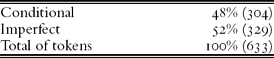
From the transcription of the interviews, we extracted every hypothetical utterance headed by the subordinator si where the relation between the two clauses was either potential or counterfactual and for which the verbal morphology could be clearly identified.Footnote 5 The overall distribution of the two variants is shown in Table 2.
Overall distribution of variants in the si-clauses in Hull
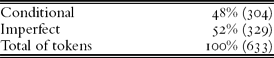
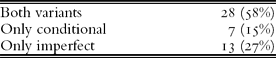
We notice that the conditional, with a distribution of 48%, does not constitute the preferred form for the Hull residents. Table 3 indicates, however, that the variation is endemic for the majority of members in the community and that the percentages in Table 2 are not simply the result of the amalgamation of data from different speakers who categorically use one variant or the other.
Number of speakers according to variants in Hull
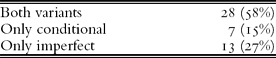
Indeed, overall, we have twenty-eight speakers (58%) who make use of both variants while only twenty speakers display a categorical usage: seven (15%) have only the conditional, and thirteen (27%) use only the imperfect. We will return to these two groups of informants who display categorical results in the next sections. By analyzing the social characteristics associated with each one we will be able to better determine who is at the vanguard and who is lagging behind.
As a first generalization, we can say that for the majority of speakers, both the conditional and the imperfect are an integral part of the grammar; in this community, the actual spoken norm is variation, or a co-existence of forms.
3 CHANGE IN SPACE AND TIME
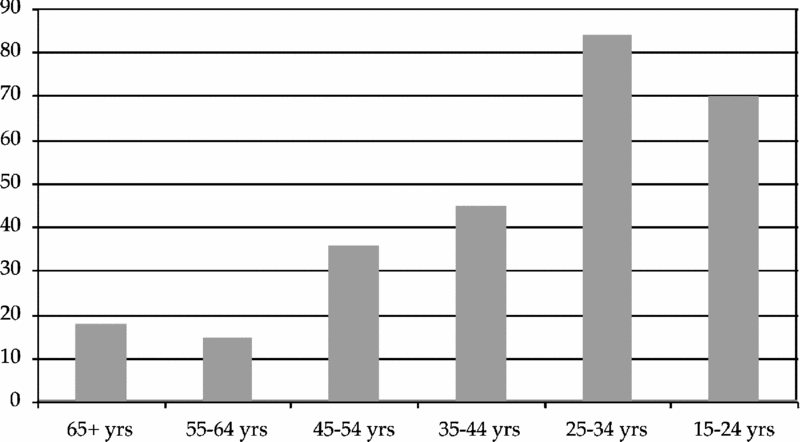
The historical documents consulted indicate that the conditional in the si-clause has been attested to since the Middle French period. However, we have no way of knowing how widespread the usage was at the time. A cohabitation of forms can persist in the language for prolonged periods before a change occurs. Figure 1 shows the percentages of conditional usage for the speakers from Hull according to age by ten-year increments. The distribution supports the hypothesis of an older, stable variant which gradually began to change as it became more popular.
Percentage of conditional forms in si-clauses according to age.
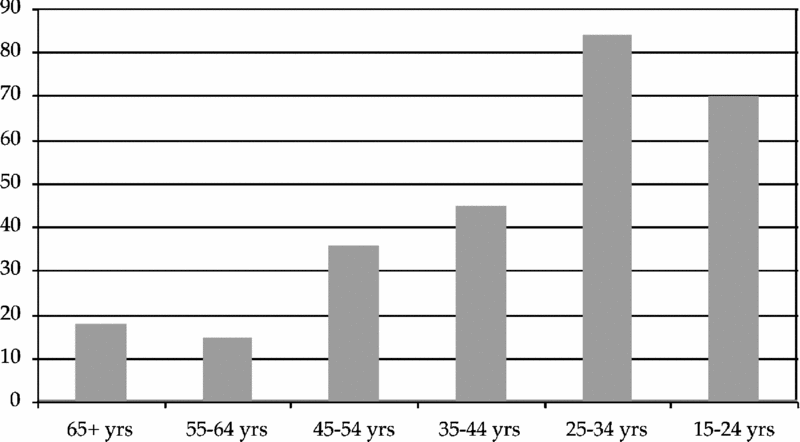
Figure 1 shows the three different steps in the development of the variable. The overall rate of conditional in the community has increased significantly since the 1920s. The community depicted in Figure 1 does not display the typical behaviour of stable non-standard variants that was discussed in Section 2. Younger and older informants are not patterning together; one group has the highest rates of occurrence for one variant while the other group leads for the other variant. Moreover, the middle age groups, which also comprise adults, do not pattern with the older group either; each generation is different.
In more detail, the non-standard conditional has very low rates, less than 20%, for speakers over 55 years old at the time of the interview (born before 1926). The variant was still marginal at the time and likely used by a specific segment of the population. There is an increase in the use of the conditional form for the 35 to 54-year-old groups (born between 1926 and 1945): the rates range from 36% to 45%. These speakers are the innovators who adopted the old marginal variant and spread it beyond the original user group. Finally, for speakers between the ages of 15 and 34, the conditional is the quantitative norm with rates of 84% and 70%. These informants were all born after 1945; they have acquired the variation between the forms from the previous generations and are pushing it further.
Overall, the pattern in Figure 1 is that of apparent time where each generation shows increasingly higher frequencies in the use of one variant. The percentages also attest that, even if not entirely absent, the conditional appears to have been rare in the first half of the 20th century, and possibly before. This is supported by historical evidence. Seutin (Reference Seutin1975) reported on a rural variety of French spoken in Quebec and considered to be very conservative. The author found a 20% use of the conditional in si-clauses in the speech of a group of men over the age of 50 (born before 1920) from the Île-aux-Coudres area. Seutin's report and our results so far support the hypotheses that the variation between the forms existed in the language before corpora of spoken data allowed us to document it, that the conditional was a rather marginal variant, and that a rapid generational change is likely occurring.
4 THE SOCIAL DISTRIBUTION OF THE VARIANTS
Although non-standard, use of the conditional in si-clauses is widespread today.Footnote 6 The conditional is still very poorly regarded in the prescriptive literature and expressions such as Les SI mangent/chassent les RAIS (‘IF eats/chases WOULD’) are still used when teaching the rule. The sociohistorical treatment of the variant (LeBlanc, Reference LeBlanc1999) revealed its negative evaluation in school manuals and general grammars. From the 17th to the mid-19th century (e.g. Oudin, Reference Oudin1640; Carpentier, Reference Carpentier1860), the conditional was seen as a regional and provincial variant.Footnote 7 Then it became clearly marked as a form of the français populaire Footnote 8 (e.g. Bescherelle, Reference Bescherelle1877). By the 20th century, it was labelled as non-standard and not pertaining to the bon usage Footnote 9 in both European and North American publications (e.g. Riegel et al., Reference Riegel, Pellat and Rioul1998; Laurence, Reference Laurence1957). As the distribution of the data in Table 2 and Figure 1 have demonstrated, this condemnation by the grammatical tradition has not halted the progress of the conditional in Hull French, and, as we will see now, the distribution of the change in the community is a reflection of this stigmatization.
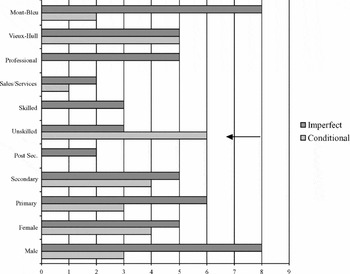
We will begin with the speakers who display categorical usage for each variant. In Figure 2, the speaker characteristics are listed on the vertical axis and the number of speakers on the horizontal axis. A dark grey bar refers to categorical usage of the imperfect, and a light grey bar refers to categorical usage of the conditional.
Number of speakers with categorical use of the variants according to extra-linguistic characteristics.

The distribution in Figure 2 corresponds to what we know of the variable's social value as inferred by its historical treatment. The arrow indicates that the unskilled workers are the only group with a greater number of categorical users of the conditional; all other characteristics have a greater (or equal) number of speakers with a categorical use of the imperfect. The groups also showing significant categorical use of the imperfect are males and those living in the upper-class neighbourhood of Mont-Bleu. Three of the subgroups have no categorical users of the conditional: skilled workers, professional workers, and those with a post-secondary education. Figure 1 and Figure 2 indicate a change from below originating in the unskilled workers group; this is compatible with the increasing stigmatisation we alluded to earlier. The speakers who belong to the groups associated with the more privileged in western society do not actively take part in the change. The only factor that does not fit the picture is gender: here, males are surprisingly correlated with categorical use of the more standard imperfect; usually females display the more conservative attitude towards non-standard (e.g. Eckert, Reference Eckert1988; Fasold, Reference Fasold1984). We will return to this issue later on.
5 THE MULTIVARIATE ANALYSIS OF THE EXTERNAL FACTORS
In order to measure the effects that language-external factors have on the choice of variants in the si-clause, we used the socioeconomic and demographic characteristics depicted in Table 1 as independent variables. As discussed in Section 2, the interplay between age and the other external factors will pattern differently for stable variables and for those involved in a change.
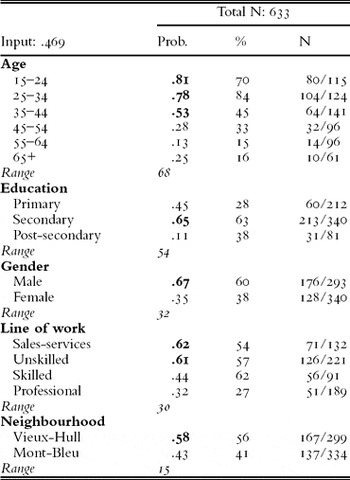
The amplitude of the effects was measured using the multivariate analysis statistical method. The computer software GoldVarb X (D. Sankoff et al., Reference Sankoff, Tagliamonte and Smith2005), especially designed for linguistic analysis, was used for the calculations. In Table 4, the speaker characteristics selected as statistically significant (p < 0.05) are listed on the left. The conditional was the application value; therefore all numbers in the table reflect the likelihood that speakers will select it. The input figure simply represents the overall probability of its occurrence for the data set being analysed. To each factor on the left are three corresponding numbers. First, the factor weights, in probabilities ranging from 0 to 1, indicate which factor has the strongest effect within the group. The difference between the highest factor weight and the lowest within each group is referred to as the range, in italics at the bottom of each factor group. They are in a descending order of strength called the constraints ranking (Poplack and Tagliamonte, Reference Poplack and Tagliamonte2001). In the second column is the percentage of the use of the conditional for each characteristic. In the third, we have the total number of uses of the conditional over the total number of si-clauses used by the group of speakers with that characteristic.
Multivariate analysis of the contribution of factors to the occurrence of conditional in the si-clauses – All speakers

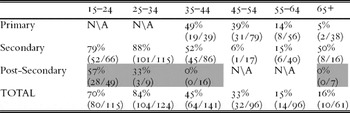
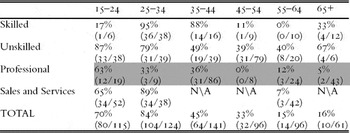
As we can see in Table 4, the results describe a variable affected by factors such as speaker gender, age, educational level, socioeconomic status and neighbourhood of residence. By far the greatest effect is – not surprisingly – speaker age. The range of 68 indicates that the youngest speakers use the conditional significantly more than the oldest. The threshold appears to be located somewhere between the age of 35 and 45. The results for education and line of work intersect with age. This is why the hierarchy of percentages and probabilities are slightly different. For example, primary education, which disfavours the conditional (prob. 0.45) is comprised exclusively of people older than 35, a group that uses the conditional less; the sales and services group, which favours the conditional the most (prob. 0.62), is made up almost entirely of people under the age of 35, which is the age group using the conditional the most. Thus, the only real independent effects are found with upper middle class professionals who clearly disfavour the conditional (prob. 0.32) and the post-secondary-educated individuals who also strongly disfavour it (prob. 0.11). Such results are even more striking since these informants are for the majority between 15 and 35 years of age, the group with the highest percentage of conditionals. We have placed the details (percentages and raw numbers) of the intersection between age, education and line of work in Tables 5 and 6.
Results for the distribution of education according to age

Results for the distribution of line of work according to age

We can see the constant effect a post-secondary education has on the use of the conditional by comparing the hierarchy of percentages within each column. This is especially interesting in the case of the younger generation which is supposed to favour the use of conditional variants.
In Table 6, we can see once again the effect the professional line of work has on lowering the percentage of conditional, especially for the second youngest group (25–34). The table also confirms that the unskilled workers are at the forefront of the change for all the age groups. In line with the strong effect of education and line of work, the middle-class Mont-Bleu disfavours the conditional (prob. 0.43) as opposed to the working-class Vieux-Hull (prob. 0.58).
The first multivariate analysis reveals that the conditional is not only gaining ground with time, but it is avoided by those of the upper levels of the social hierarchy and that the oldest speakers as a group are not concerned with the change. These results are reinforced by the fact that the post-secondary-educated and professional informants are not only young for the most part but, in the case of the under-35, post-secondary-educated, they are also exclusively male: young and male, the two characteristics that favour the conditional the most according to the probabilities are overridden by the strong higher education effect. The third factor group in terms of importance in Table 4 is gender, and the probabilities go in a different direction from the results for categorical use in Figure 2. Female speakers disfavour the conditional (prob. 0.35) and males favour it (prob. 0.67). In summary, there is a definite social stratification: higher probabilities of conditional use for males, youth, secondary education, unskilled and sales and services workers as well as working-class neighbourhood Vieux-Hull. The lower probabilities are associated with older speakers, professionals and post-secondary educated. Once again, we see the pattern of resistance observed in real time studies as discussed in Section 2. Even the younger speakers from the upper strata of the social hierarchy tend to avoid the conditional variant.
When we look at the distribution of the conditional according to age (Figure 1) in the light of its social distribution (Table 4) we have a case of a well-behaved S-shaped curve change in apparent time. First observed by Wang and Cheng (Reference Wang and Cheng1970), the pattern is postulated to represent the trajectory followed by the rates of occurrence in use of variants over time. This is the path followed by vigorous and fast changes in progress; at both the onset and the last stages of the change, preferences for a variant are expected to be restricted to segments of the speech community (Labov, Reference Labov1972; Downes, Reference Downes1984; Milroy and Milroy, Reference Milroy and Milroy1985) while the rest of the speakers will display variable behaviour. In the case of the conditional, the lower extremity of the S-shaped curve would comprise the original users of the variant; older speakers from the lower social hierarchy. The middle part of the curve would represent those who adopted the change, a more heterogeneous group; the steeper distribution relates to the fact it is vigorous and fast. Finally, the upper extremity of the S would contain those who hold on to the old variant, speakers from the upper scale of the social hierarchy.
6 THE DISTRIBUTION ACCORDING TO GENERATIONS
A third component was added to refine this analysis: the comparison of the hierarchy of the factor weights within factor groups and of the ranges for each generation. It is important to trace the trajectory of the variants within the speech community over time for our understanding of the transition period. As already mentioned, at the onset of a change, an incoming variant is usually favoured by a subgroup of speakers. Consequently, that variant should then show a sharper correlation with the social factors for the young leaders. If we were to study the same community forty years later, the leaders, who would now form the older generation, should have retained the social differentiation. During the diffusion stage, the variant loses some of its social meaning. We now turn to the patterning of the different generations in relation to the characteristics. We expected that the time depth of our data would be sufficient to observe movements within the groups since the corpus totals forty-eight informants and the oldest was born in 1895 whereas the youngest was born in 1965. We thus compared the results of independent multivariate analyses performed for each generation. If the comparison revealed that the external conditioning changes as the conditional frequency increases, we would have additional proof for a change in progress.
The generations were divided based on the three steps in the development of the variable observed in Figure 1. The divisions are: 1) speakers with the highest rates of occurrence of conditional and born after 1946 (AGE 15–34), 2) speakers in the mid range and born between 1926 and 1945 (AGE 35–54), and 3) speakers with the lowest rates and born before 1925 (AGE 55+). Each subgroup counts sixteen speakers in total.
Before we begin the discussion, we need to explain Table 7. In sociolinguistics, contrary to experimental studies, all the contexts are not always represented in the data. Indeed, some of the cells (the numbers in parentheses) such as post-secondary education contain no instances of the conditional at all while four other cells contain fewer than ten occurrences of it. The fact that the numbers vary depending on the context makes it almost impossible to perform a statistical analysis using a procedure that assumes an even distribution of data (Tagliamonte, Reference Tagliamonte2006: 137). For the interested reader, D. Sankoff (Reference Sankoff, Ammon, Dittmar and Mattheier1988) details the steps of the special logistic regression of the variable rule program that was elaborated to handle this problem and that was integrated into the Goldvarb software package used in this study.
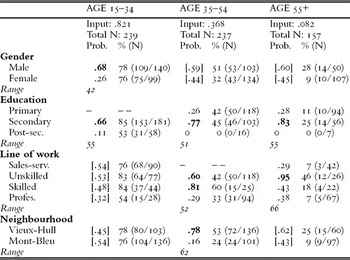
Three multivariate analyses of the contribution of factors to the occurrence of conditional in si-clauses – Three generations

We will first discuss the factors that were chosen as significant: the probabilities that appear in bold in Table 7. Only two factors are selected for the younger informants: male (prob. 0.68) and secondary education (prob. 0.66). Considering that there is no AGE 15–34 with a primary education, and that a post-secondary education strongly disfavours the non-standard variant (prob. 0.11), we can conclude that despite the fact that young informants have the highest rates of conditional, the variation still retains some of its social value.
We now go back in time; the AGE 35–54 division is made of the first generation who displays middle rates of non-standard forms. As expected of an incoming variant spreading quickly, the variability is socially more constrained. Three factors are now selected as significant and the neighbourhood is chosen only for this age group. Secondary education (prob. 0.77) still strongly favours the conditional; skilled and unskilled workers (prob. 0.81 and 0.60 respectively) as well. A closer look at education reveals that there is not one instance of the non-standard variant (0/16) for post-secondary education. The education effect is stronger for this age group than for the younger speakers. Interestingly, the working-class Vieux-Hull is the strongest factor favouring the choice of conditional (prob. 0.78), in contrast with Mont-Bleu (prob. 0.16). The middle-aged group diffused the variant in the community but the correlation with the original users characteristics is strong; these early promoters were working-class residents of Vieux-Hull with a secondary education and a skilled or unskilled line of work.
With an overall percentage of less than 20%, only two factors were selected as significant for the AGE 55+ generation: secondary education and unskilled work. With regards to education, older informants with a primary education clearly prefer the imperfect variant and no informant with a post-secondary level uses the conditional for this age group. This group obtains the widest range of the whole table for any factor group, 66 points for the line of work; unskilled work strongly favours the choice of the conditional. We take this as further evidence about the social origin of the original users.
We now add the probabilities in square brackets. These numbers indicate that the factor group was not selected as significant by the statistical program. The numbers come from the first iteration of the step down analysis when all the factors are included in the regression procedure. Therefore, our attention should be directed to the order of the factors within the groups. We want to compare the constraint hierarchy for the three generations and see where they pattern in the same direction across the board in terms of a favouring or disfavouring effect. This step in the analysis helps confirm the tendencies observed with percentages and raw numbers.
Firstly, there is the male-female dichotomy. The gender difference is constant over time until it is selected as significant for the AGE 15–34 group; the females are clearly less likely to use the non-standard variant. This is not surprising as males are usually further ahead in implementing a change away from the prestige norm. Trudgill (Reference Trudgill1974), who found a similar case in his study of Norwich, attributed the tendency to the fact that there was a connotation of masculinity associated with less standard speech that females wanted to dissociate themselves from. Conversely, males tended to use more non-standard forms and be more sensitive to changes from below than females.
Secondly, we have the opposition of secondary education versus the others, most importantly versus post-secondary. The effect remains constant and operational for all age groups. The more educated an informant is, the less he or she will use the conditional, independently of what the rest of the group is doing and apparently even opposite to the general trend.
Thirdly, we have a polarisation for the line of work. The unskilled workers favour and professionals disfavour the variant; the other groups, more heterogeneous, are typically less stable than these two. Two interesting aspects are revealed by the comparison. First, there is decreasing effect over the years as indicated by the ranges (66 points for AGE 55+, 52 points for AGE 35–54, and non-significant for AGE 15–34). Second, only the professionals remain faithful in their allegiance to the imperfect as the conditional progresses in the community. This is also reflected in the results for the neighbourhood, which follow the social stratification according to area of residence in the city for all informants, except those under 35 years of age who reverse the hierarchy. For the latter, being a young man is more important than where you live – non-standard forms are no longer restricted to the working class neighbourhood.
The results for the different generations compared to those for the amalgamated speakers in the previous table have clarified the time and space trajectories of the linguistic variable. Even for the older speakers, who do not really take part in the change, the status of the imperfect in hypothetical si-clauses remains important for post-secondary educated and professionals. This effect is however in slow decline since only education and not line of work is selected for the younger informants. As the rate of the conditional increased, it slowly spread to other groups outside the original males, unskilled workers and residents of Vieux-Hull, although it remains very strong within these subgroups.
7 CONCLUSION
In the present article, we have used different lines of evidence to investigate the apparent time pattern of distribution for the conditional in hypothetical si-clauses in Quebec French. The use of the conditional increased gradually as the age of the informants decreased, and we proposed that the correct interpretation was likely generational change rather than age grading and its correlate, stable variation.
A lack of speech data from previous centuries prevents knowing how frequent the variants were and which constraints were in place. A closer look at the speakers with categorical use indicated that the unskilled workers were the only ones with a greater number of users of the non-standard form. This finding agrees with the working class origin for the variation suggested by the historical review in LeBlanc (Reference LeBlanc1999) and the report on usage from Seutin (Reference Seutin1975). This was then further refined by the results of a multivariate analysis of the socioeconomic and demographic characteristics of all the amalgamated speakers. The factor weights revealed that the younger informants and the lower socioeconomic groups were more advanced in the change than the rest of the community and that those from the upper end of the social scale resisted the change. The patterning was similar to that found in changes from below with correction from above (Labov, Reference Labov2001) and departed from that found in stable variation (Downes, Reference Downes1984).
The comparative analysis of the three generations helped clarify the transition period. There was an increasing correlation between males and the conditional on one side and a fairly stable correlation between imperfect and post-secondary education on the other. Speakers from all groups, regardless of their age, were sensitive to the prestige norm prescribing the imperfect. The line of work effect, which was the strongest for the older generation, kept the same ordering of constraints but weakened as time went by to the point that it is now no longer selected as significant for the younger group.
The fact that the hierarchy of constraints was almost entirely identical for the three age groups, despite overall rates ranging from 20% to 84%, clearly shows that the diffusion of change is an orderly process. Labov (Reference Labov1972) makes a clear distinction between an innovation and its diffusion. The mechanisms by which an innovation comes to exist would be largely system internal and involve the remapping between forms and functions. Its diffusion would however depend on linguistic-external forces at play in the speech community. The present article addressed a situation where a low-occurring variant gradually took over a grammatical function of another variant. The situation went from an (almost) categorical use of the imperfect for the oldest generation of speakers to a state of alternation between the imperfect and conditional for the middle generation and then progressed to the point of an (almost) categorical use again for the younger speakers, this time in favour of the conditional.
Our analysis also supports the hypothesis that it is possible for a variant with a very low threshold of occurrence to remain in the language for a length of time before it is adopted by a group, enters a period of a change and becomes the quantitative norm. The increasing popularity of the conditional in the 20th century Quebec goes hand in hand with its increasingly firm condemnation in prescriptive works. The most noticeable increase in favour of the conditional is found in the speech of those born after WWII, the first generation schooled under the new (free and state-run) educational system. It is possible that this situation is linked to the social transformations in the province of Quebec since the Quiet Revolution which began in the late 1950s. These high rates correspond to the period when a modern Quebec society and state emerged during the global changes of the post-WWII era, followed by new legislation on language and the assertion of a distinctive (French) identity. The converging circumstances have entailed a certain legitimisation of the vernacular forms, observable in the arts and media alike. They may also have accelerated the propagation of changes from below that were already taking place in the language, to the extent that by the 1980s the conditional could be used by most segments of society. The upper socioeconomic class is using language to differentiate themselves from the other groups by sticking to the standard form.
Data from other varieties will be useful to determine if the change, found elsewhere in the francophonie, is following a similar development path, and real time analyses of Quebec French to determine if the trend is continuing. The imperfect/pluperfect variable, due to its social value as a marker of prestige may never disappear even if the conditional spreads to all linguistic contexts and social groups. It could very well remain as a non-productive stylistic insertion in elevated registers – a similar development that has taken place in Quebec for the negation marker ne (Sankoff and Vincent Reference Sankoff and Vincent1981).