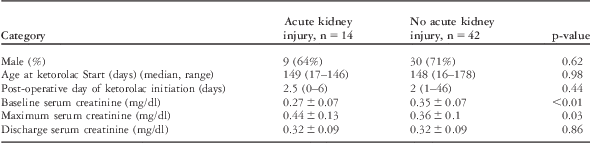
Ketorolac has been used for analgesia in children who have undergone cardiac surgery.Reference Moffett, Wann, Carberry and Mott 1 – Reference Dawkins, Barclay, Gardiner and Krawczeski 5 Neonates and infants <6 months of age were thought to be at increased risk for adverse events when prescribed ketorolac in the post-cardiac surgical setting, but recent literature has demonstrated that ketorolac does not appear to increase bleeding or have excessive renal morbidity in this patient population.Reference Moffett, Wann, Carberry and Mott 1 – Reference Gupta, Daggett, Drant, Rivero and Lewis 3 , Reference Dawkins, Barclay, Gardiner and Krawczeski 5 , Reference Inoue, Caldarone and Frndova 6 However, in spite of excellent safety profiles, a small number of patients may still experience renal morbidity secondary to ketorolac therapy. Prevention of acute kidney injury in this patient population is of utmost importance, as even small increases in serum creatinine have been reported to have substantial impact on patient outcomes.Reference Zappitelli, Bernier and Saczkowski 7 Therefore, it is of utmost importance that risk factors for acute kidney injury in neonates and infants who have received ketorolac be identified so that morbidity can be minimised.
Purpose
To identify risk factors for acute kidney injury in infants and neonates who have received ketorolac after a cardiac surgical procedure.
Methods
A retrospective case–control study was designed, and the pharmacy database was queried from June, 2007 to June, 2011 to identify patients <6 months of age who received ketorolac after a cardiac surgical procedure. Patients were identified through the laboratory system when there was a 50% or greater increase in serum creatinine (pRIFLE status “I”) from baseline after initiation of ketorolac therapy, and controls when there was <50% change in serum creatinine. Patients were matched on a 1 case to 3 control ratio by age at the start of therapy. Patients were included if they were initiated on ketorolac after a cardiac surgical procedure, had a serum creatinine at baseline, and had at least one serum creatinine after initiation of ketorolac therapy. Patients were excluded if they did not have a match.
Data collection included patient demographics, age at the start of therapy, date and type of cardiac surgery, dose and length of ketorolac therapy, and other potentially nephrotoxic medications administered concomitantly with ketorolac. First maximum serum creatinine after initiation of ketorolac therapy was used for pRIFLE categorisation. Patient's serum creatinine values were followed up for up to 72 hours after the last dose of ketorolac.
The pRIFLE criteria for acute kidney injury were used on the basis of change in serum creatinine values.Reference Akcan-Arikan, Zappitelli, Loftis, Washburn, Jefferson and Goldstein 8 Data were analysed using descriptive statistical methods, Student's t-test for continuous data, and chi-squared analysis for categorical data.
Results
A total of 14 patients met the study criteria as cases (pRIFLE “I” – a 50% increase in serum creatinine or greater) and were matched by age to 42 control patients. Patient demographics and kidney function information are listed in Table 1. In all, 59% of patients had cyanosis (saturation <85%) before surgery and 46% of patients had single-ventricle physiology. The most common surgical procedure was the bidirectional Glenn, occurring in 41% of the population. A statistically significantly higher proportion of patients with acute kidney injury underwent the bidirectional Glenn procedure (33% versus 64%, p-value = 0.04). There was no difference in cardiopulmonary bypass times between acute kidney injury and non-acute kidney injury groups (133 ± 84 minutes versus 114 ± 62 minutes, p-value = 0.41). Dose interval was every 6 hours, with the exception of two patients – one in each group – who were dosed every 8 hours. There was no statistically significant difference in the dose of ketorolac (0.48 ± 0.03 versus 0.49 ± 0.15 mg/kg per dose, p = 0.73), or number of doses of ketorolac (median 6 (range 4–10) versus median 6 (range 1–12), p = 0.64) between patients with acute kidney injury and those without acute kidney injury.
Patient demographics.

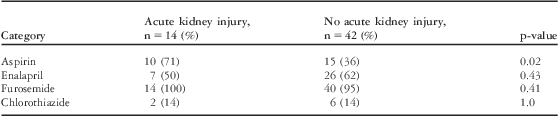
Significantly more patients with acute kidney injury received aspirin, in comparison to other medications (Table 2). Patients received either 20.25 mg – acute kidney injury equals 70%, non-acute kidney injury equals 60% – or 40.5 mg – acute kidney injury equals 30%, non-acute kidney injury equals 40%, and the proportion was not statistically different (p = 0.61). No statistically significant differences were identified between patients with acute kidney injury and without acute kidney injury in regard to dose of enalapril (0.37 ± 0.19 versus 0.29 ± 0.14 mg/kg per day, p-value = 0.24) or dose of furosemide (2.1 ± 0.4 versus 2.1 ± 0.7 mg/kg per day, p-value = 0.95). Only one patient received gentamicin (non-acute kidney injury), one patient received captopril (non-acute kidney injury), and one patient received ethacrynic acid (non-acute kidney injury). There were two patients who received vancomycin – one patient in each group – and two patients who received sulfamethoxazole/trimethoprim – both non-acute kidney injuries. In addition, two patients were receiving epinephrine – non-acute kidney injury, two patients were receiving a calcium chloride infusion – one in each group, four patients were receiving milrinone – non-acute kidney injury, and no patients were receiving norepinephrine. The presence of vasopressors/inotropic agents was not statistically significantly different between groups (p-value >0.05). The serum creatinine values at discharge were not statistically different between groups (Table 1).
Concomitant nephrotoxic medications.
Discussion
This study shows that the association of the use of aspirin and ketorolac can increase renal morbidity in young infants after cardiac surgery. Previous studies have shown that the use of ketorolac in post-operative cardiac surgical infants has minimal renal morbidity.Reference Moffett, Wann, Carberry and Mott 1 – Reference Gupta, Daggett, Drant, Rivero and Lewis 3 , Reference Dawkins, Barclay, Gardiner and Krawczeski 5 , Reference Inoue, Caldarone and Frndova 6 This has made it beneficial to use in select patient populations to control pain and reduce opiate utilisation. However, the risk of acute kidney injury, and the associated morbidity in this vulnerable population, may give some practitioners pause before implementing ketorolac therapy.Reference Zappitelli, Bernier and Saczkowski 7 In this study population, only two patient factors were identified that contributed to acute kidney injury.
Significant factors for acute kidney injury included the use of aspirin and undergoing a bidirectional Glenn procedure. Many patients who underwent a bidirectional Glenn were also receiving aspirin as a continuation from first stage single-ventricle palliative surgery in order to maintain patency of the Glenn anastomosis. The use of aspirin is likely the primary contributor to renal morbidity in this study population. Ketorolac and aspirin both inhibit prostaglandin production, and prostaglandins vasodilate the afferent arteriole of the kidney. In general, polypharmacy has been noted to be a contributor to renal morbidity in cardiac intensive care unit patients and non-intensive care unit patients, and aspirin has been noted for having nephrotoxic potential.Reference Moffett, Goldstein, Adusei, Kuzin, Mohan and Mott 9 – Reference D'Agati 11 Evaluation of prescribing habits, and review of patient medication profiles is necessary to prevent acute kidney injury in paediatric cardiac intensive care patients.
The limitations associated with a retrospective review are present with this report. The impact of acute kidney injury on this patient population was not assessed other than through laboratory values. The risk of acute kidney injury for a particular patient population, that is, bidirectional Glenn procedure, is not currently known, and future evaluations in this area are necessary. A complete evaluation of potentially nephrotoxic medications and their impact on patient outcomes is necessary, including the intensity of exposure of nephrotoxic medications.
Conclusion
Concomitant ketorolac administration with aspirin is a significant factor for ketorolac-associated acute kidney injury in young infants who have undergone cardiac surgery.