Introduction
In 2021, bronze Polar Medals to a father and son were sold together at Warren and Wignall auction house at Leyland, UK. The recipients were John Joseph Miller who served as sailmaker on the RRS Discovery on the BANZAR expedition and his son Leslie John Miller who served with the Discovery Investigations as an assistant steward on the second and third commissions of the RRS Discovery II. John Joseph received a George V bronze Polar Medal with the clasp antarctic 1929–31 (London Gazette, 17 May 1934). Leslie John received a George VI bronze with the clasp 1931–35 (London Gazette, 7 October 1941). The medals were accompanied by a large quantity of Antarctic and other memorabilia including WW1 service medals, photographs, newspaper cuttings, both men’s certificates of membership of the Antarctic Club and their Antarctic diaries. The medals were advertised as probably being the only father-and-son combination and sold on the hammer for £24,500 (to which a 17.5% buyer’s premium and tax must be added).
The Polar Medal was established in 1904 after the return of Captain Robert Falcon Scott’s first expedition to the Antarctic. As such it was the third British medal to be awarded for polar exploration. The first two polar awards were Arctic awards issued during Queen Victoria’s reign to the officers and crew on Arctic voyages of discovery looking for the North West Passage, or to rescue parties trying to determine the fate of Sir John Franklin. Interestingly, the crew of Sir James Clark Ross’s 1839–43 Antarctic voyage of exploration in HMS Terror and HMS Erebus did not receive any medallic reward for their participation in what was a highly successful expedition.
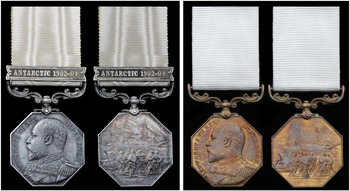
The 1904 pattern Polar Medal is exceedingly rare and since its inception it has only been awarded to some 1500 recipients, with bronze medals awarded to member of the ship’s crews and silver medals to winterers (Fig. 1). Bronze medals are no longer awarded but before the Second World War (WW2) 251 were awarded to 239 male recipients on Antarctic expeditions. Over the same period, 256 silver awards were given to 215 men on Antarctic and/or Arctic expeditions. Since WW2 only silver medals have been awarded and around 1000 men and women on Arctic and Antarctic expeditions have received Elizabeth II’s silver Polar Medal or its Commonwealth replacement (The Australian Antarctic Medal, the Polar Medal (Canada) and the New Zealand Antarctic Medal). Bronze and silver Polar Medals are not mutually exclusive and 18 men have received both. One of these men, James Paton, was the recipient of five awards – three bronze and two silver.
Silver and bronze Polar Medals as awarded to the officers and men on Captain Scott’s British National Antarctic Expedition. Octagonal in shape and suspended from a white ribbon, the medals carry an effigy of the reigning sovereign at the time of the award on the obverse, while the reverse depicts a polar scene with HMS Discovery in the background and a six-man sledging party in the foreground. The recipient’s name is inscribed on the rim. Usually, both medals carry a dated clasp, but the rules and regulations vary from expedition to expedition and for Scott’s British National Antarctic Expedition bronze medals were issued without a clasp – instead their years of service was inscribed on the rim. Additional awards within the same class are denoted by an extra clasp. Photos courtesy of Spink and Son.

John and Leslie Miller are in fact one of five father-and-son pairs of recipients of the Polar Medal that I know of – the others are listed below.
Father and son recipients
Along with John and Leslie Miller, the following father-and-son pairs have been awarded Polar Medals.
Alexander Smith, carpenter, and his son also Alexander Smith, carpenter’s mate, both served on the Steam Yacht (SY) Morning, one of two relief ships to Captain RF Scott’s British National Antarctic Expedition 1902–04. Both men received Edward VII bronze Polar Medals without a clasp but with their years of service engraved around the medal’s rim (Public Records Office, Kew, file ADM 1/7848).
William Colbeck, Captain of the aforesaid SY Morning in 1902–04, also received the Edward VII bronze Polar Medal with his years of service engraved around the rim (Public Records Office, Kew, file 1/7848). His son William Robinson Colbeck, 2nd Officer on the RRS Discovery for the British, Australian and New Zealand Antarctic Research (BANZAR) Expedition, received the George V bronze Polar Medal with the clasp antarctic 1929–31 (Public Records Office, Kew, file ADM 1/8495).
George Harris Serjeant Dovers, cartographer with Mawson’s Australasian Antarctic Expedition (1912–14) was awarded the George V silver Polar Medal with the clasp antarctic 1912–14 (Public Records Office, Kew, file ADM 1/8407) while his son Robert George Dovers, surveyor and subsequently Officer-in-Charge, was awarded the Elizabeth II silver Polar Medal with two clasps antarctic 1952 and antarctic 1954–55 (London Gazette, 1 March 1955, 24 January 1956).
Eric William Kevin Walton, a Royal Navy engineering officer at Marguerite Bay with the Falkland Islands Dependencies Survey (FIDS), received the Elizabeth II silver Polar Medal with the clasp antarctic 1946–47 (London Gazette, 17 July 1953), His son Jonathan Launcelot William Walton, a glaciologist and surveyor with the British Antarctic Survey (BAS), was awarded the Elizabeth II silver Polar Medal with clasp antarctic to 1986 (London Gazette, 23 December 1986).
The Antarctic community, particularly during the heroic age, was a very small one and various pieces of equipment – ranging from ships to Lucas sounding machines (small mechanical devices that accurately measure the depth of the ocean at that point) – were loaned or sold to other expeditions and many of the men changed their allegiances. For example, John Robert Francis “Frank” Wild served with Captain Robert Falcon Scott (British National Antarctic Expedition 1902–04), Sir Ernest Henry Shackleton (British Antarctic Expedition 1907–09 and the Imperial Trans–Antarctic Expedition 1914–16) and Sir Douglas Mawson (Australasian Antarctic Expedition 1912–14) (Poulsom & Myres, Reference Poulsom and Myres2000). Clearly, some prior Antarctic experience was highly regarded by expedition leaders – so much so that earlier indiscretions were overlooked and several men who were denied Polar Medals because their conduct was considered unsatisfactory on their first trip south were nevertheless recruited for subsequent expeditions. Thus, William Edward Knowles, who had served on the SY Morning in 1903–04 but was denied a bronze medal, was nevertheless recruited as an Able Seaman on Scott’s Last Expedition (1910–13), for which he received the George V bronze Polar Medal with the clasp antarctic 1910–13 (Dartnall, Reference Dartnall2017).
Having a relative to serve with, or who had served on an earlier Antarctic expedition, also seems to have been a distinct advantage when it came to selection, as illustrated by the five father-and-son combinations listed above, but what of other family links? To be included herein, both relatives must have been awarded a Polar Medal or its Australian, New Zealand or Canadian equivalent.
Brother recipients
One might expect brothers to be the most obvious pairing but, again, I can only find five pairs – two sets of brothers who served on the same expedition and three pairs who served on different expeditions.
John Frederick was a fireman on the Terra Nova in 1903–04, while his brother, David Henderson Frederick, was an able seaman on the same ship. The Terra Nova was the second relief ship to the British National Antarctic Expedition (1902–04). Both brothers received Edward VII bronze medals without a clasp but with their years of service engraved around the medal rim (Public Records Office, Kew, file ADM 1/7848).
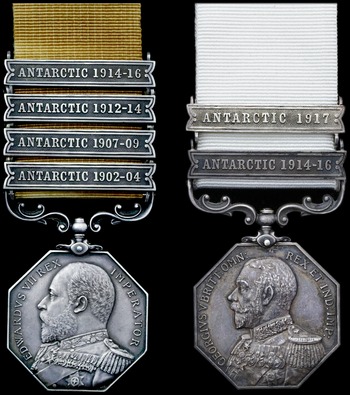
The aforementioned Frank Wild received an Edward VII silver medal with the four clasps antarctic 1902–04 (Public Records Office, Kew, file ADM 1/7848), antarctic 1907–09 (London Gazette, 23 November 1909), antarctic 1912–14 (Public Records Office, Kew, file ADM 1/8407) and antarctic 1914–16 (Public Records Office, Kew, file ADM 1/8495). His younger brother Harry Ernest Wild served with the Ross Sea Party during Sir Ernest Shackleton’s ill-fated Imperial Trans-Antarctic Expedition (1914–16) and received a George V silver medal with the clasps antarctic 1914–16 and antarctic 1917 (Public Records Office, Kew, file ADM 1/8495) (Fig. 2).
Eric Stewart Marshall, surgeon and cartographer, served on Shackleton’s (1907–09) Nimrod Expedition and was a member of the polar party that got to within 97 miles of the pole. He was awarded the Edward VII silver Polar Medal with the clasp antarctic 1907–09 (London Gazette, 23 November 1909). His brother Edward Hillis Marshall, also a medical officer, received a George V bronze Polar Medal with the clasp antarctic 1925–31 (Public Records Office, Kew, file ADM 1/8495) for his time as a whaling observer and for his service with the Discovery Investigations (1925–39).
Mortimer McCarthy served as an able seaman on Captain Scott’s Last Expedition (1910–13) and received a George V silver Polar Medal with a clasp antarctic 1910–13 (London Gazette, 25 July 1913). His brother Timothy, also an able seaman, served on Shackleton’s Imperial Trans-Antarctic Expedition (1914–16) and was one of the men who manned the tiny boat James Caird on her epic voyage from Elephant Island to South Georgia. Timothy McCarthy received a George V bronze Polar Medal with the clasp antarctic1914–16 (Public Records Office, Kew, file ADM 1/8495).
Lisle Charles Dudley Ryder and his brother Robert Edward Dudley “Red” Ryder, 2nd mate and captain respectively of the three-masted schooner Penola, the expedition ship for the British Graham Land Expedition (1935–37), both received George VI silver Polar Medals with the clasp antarctic 1935–37 (London Gazette, 20 October 1939).
Four-bar (clasp) silver Polar Medal awarded to John Robert Francis “Frank” Wild and the two-bar silver Polar Medal awarded to his younger brother Harry Ernest Wild. Photos courtesy of Spink and Son.

Grandfather and grandson recipients
I know of only one grandfather-and-grandson pair.
John Lachlan Cope served as surgeon with the Ross Sea Party as part of Sir Ernest Shackleton’s Imperial Trans–Antarctic Expedition and received a George V silver Polar Medal with two clasps antarctic 1914–16 and antarctic 1917 (Public Records Office, Kew, file ADM 1/18495). His grandson Thomas Anthony Lachlan–Cope received an Elizabeth II silver Polar Medal with clasp antarctic 2006 for his service with the British Antarctic Survey (London Gazette, 12 December 2006).
Uncle and nephew recipients
Similarly, I have identified only one uncle-and-nephew pair.
Ernest Edward Mills Joyce served on three expeditions and received a silver Edward VII medal with the clasp antarctic 1902–04 (Public Records Office, Kew, file ADM 1/7848) for his service as an able seaman with Captain Scott’s British National Antarctic Expedition (1902–04). He also served on Shackleton’s Nimrod Expedition as a petty officer, for which he was awarded the clasp antarctic 1907–09 (London Gazette, 23 November 1909) and with Shackleton’s Imperial Trans–Antarctic Expedition as dog driver and subsequently leader of the Ross Sea Party, for which he received two clasps antarctic 1914–16 and antarctic 1917 (Public Records Office, Kew, file ADM 1/8495). His nephew John Raymond Foggan Joyce served as a geologist at Marguerite Bay with the FIDS and received the Elizabeth II silver Polar Medal with clasp antarctic 1946 (London Gazette, 17 July 1953).
Cousin recipients
Of course, there are cousins to consider, though here it gets more complicated to trace, as cousins do not necessarily share a family name.
Bertram Armitage was in charge of the ponies on Shackleton’s Furthest South Expedition and received an Edward VII silver Polar Medal with the clasp antarctic 1907–09 (London Gazette, 23 November 1909). His cousin Herbert Dyce Murphy was in charge of the stores on Douglas Mawson’s Australasian Antarctic Expedition and he received a George V silver Polar Medal with the clasp antarctic 1912–14 (Public Records Office, Kew, file ADM 1/8407).
Arthur S Bailey, a petty officer in the Royal Navy, served with the Northern Party on Captain Scott’s Last Expedition and was awarded a George V silver Polar Medal with clasp antarctic 1910–1913 (London Gazette, 25 July 1913). His cousin Bernard J Stone served as a stoker on the same expedition but only served on one voyage in the south and received a bronze Polar Medal with clasp antarctic 1910–13 (London Gazette, 25 July 1913).
Belgrave Edward Sutton Ninnis, who died when he fell down a crevasse whilst on Mawson’s Australasian Antarctic Expedition, was awarded posthumously a George V silver Polar Medal dated antarctic 1912–14 (Public Records Office, Kew, file ADM 1/8407). His cousin Aubrey Howard Ninnis served as a motor engineer on the SY Aurora as part of Shackleton’s Imperial Trans–Antarctic Expedition, for which he received a George V silver Polar Medal with clasp antarctic 1914–16 (Public Records Office, Kew, file ADM 1/8495), and on the 1917 Aurora Relief Expedition which earned him a George V bronze Polar Medal without a clasp (Public Records Office, Kew, file ADM 1/8495).
Irvine Owen Gaze was a member of Shackleton’s Imperial Trans-Antarctic Expedition and was one of ten men marooned when the SY Aurora was blown from her moorings in May 1915. He received a George V silver Polar Medal with clasps antarctic 1914–16 and antarctic 1917 (Public Records Office, Kew, file ADM 1/8495). His cousin the Reverend Arnold Spencer-Smith, padre and expedition photographer, served on the same expedition. Spencer-Smith was posthumously awarded the same combination as his cousin (Public Records Office, Kew, file ADM 1/8495) including the second clasp antarctic 1917 somewhat surprisingly as he had died on 9 March 1916.
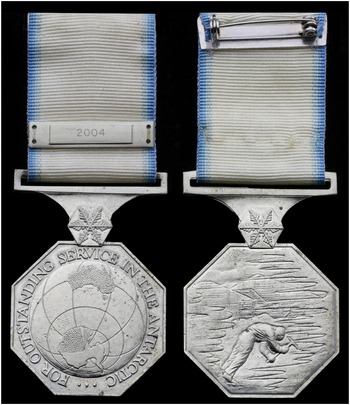
Andrew Keith Jack was also a member of Shackleton’s Imperial Trans–Antarctic Expedition and was one of the men marooned along with Gaze and Spencer-Smith (see above). He, too, received a George V silver Polar Medal with clasps antarctic 1914–16 and antarctic 1917 (Public Records Office, Kew, file ADM 1/8495) (which is identical to Harry Ernest Wild’s award shown in Fig. 2). Patricia Margaret Selkirk, a first cousin twice removed of Andrew Jack, served as a botanist on the sub-Antarctic islands of Macquarie Island, Heard Island and Kerguelen Islands, and on the Antarctic mainland at Casey and in the Dry Valleys, and was awarded the Australian Antarctic Medal with dated clasp 2004 (Commonwealth of Australia Gazette, 21 June 2004) (Fig. 3 ).
Eric Hatfield Back served as a FIDS Medical Officer at Port Lockroy (1944) and then at Hope Bay (1945) for which he received an Elizabeth II silver Polar Medal with the clasp antarctic 1944–45 (London Gazette, 17 July 1953). His third cousin once removed Eric Kenneth Prentice Back, a meteorologist and Base Commander with BAS, spent six winters south and his Elizabeth II silver Polar Medal’s clasp is dated antarctic 1973–75 (London Gazette, 17 July 1979).
The Australian Antarctic Medal with dated clasp 2004 awarded to Dr Patricia M. Selkirk. Made of nickel-silver this octagonal medal is surmounted by an ice crystal and plain suspension on snow-white moiré ribbon 32 mm wide with three narrow blue stripes merging into the white at the edges. The obverse has a map showing both Australia and Antarctica with the legend “FOR OUTSTANDING SERVICE IN THE ANTARCTIC” encircling said map, while the reverse has a polar explorer wielding an ice axe and leaning into a blizzard in front of Sir Douglas Mawson’s hut. Photo courtesy of Spink and Son.

Family relationships through marriage
A number of expeditioners are related through marriage, and it is interesting to note that the most common of these relationships is that of spouses.
Husband and wife recipients
Given that it was not until 1980 that a woman was awarded a Polar Medal it is somewhat surprising that there have already been six husband and wife pairs.
Lady Virginia Twisleton-Wykeham-Fiennes was the first woman Polar medallist. She was responsible for the expedition communications during the Trans Globe Expedition (1980–1982) and wintered in both the Antarctic and Arctic, receiving Elizabeth II silver Polar Medal with clasp antarctic 1980 (London Gazette, 17 July 1986). Her husband, Sir Ranulph Twisleton-Wykeham-Fiennes, was leader of the Trans Globe Expedition and was awarded an Elizabeth II Polar Medal with clasp arctic and antarctic to 1980–82 (London Gazette, 20 December 1994) for three unsuccessful attempts to walk to the North Pole in 1988, 1989 and 1990, and his unsupported traverse of the Antarctic continent in 1993 with Dr Michael Stroud.
Walter Brian Harland and Elisabeth Margaret Ethelwyn Harland received Elizabeth II silver Polar Medals for their work together on Arctic expeditions. Walter Harland, a geologist, received his medal with the clasp arctic to 1977 (London Gazette, 17 July 1979) while his wife Elisabeth, who acted in numerous supporting roles, was awarded her medal 18 years later (London Gazette, 2 December 1997) with the clasp arctic to 1992.
Michael Robert Alexander Thomson, geologist and noted palaeontologist, received an Elizabeth II Polar Medal with two clasps antarctic 1964–65 (London Gazette, 30 December 1971) and antarctic to 1986 (London Gazette, 23 December 1986) while his wife, Janet Wendy Thomson, received the same award 31 years later but with the clasp antarctic to 1999 (London Gazette, 20 December 2002).
Prof John Dudley Bradshaw was awarded the New Zealand Antarctic Medal (NZAM) in the New Zealand New Year honours list 2007. Prof Bradshaw is the husband of Margaret Bradshaw, who received the Elizabeth II Polar Medal with the clasp antarctic to 1992 (New Zealand Gazette, 3 June 1993).
Myrtle Lillias Simpson received the Elizabeth II silver Polar Medal with clasp arctic to 2007 (London Gazette, 19 January 2017). She was the first woman to ski across Greenland, accompanied by four others on an unsupported expedition. Her husband, Hugh Walter Simpson, was awarded the same accolade as a medical officer with BAS 54 years earlier, an Elizabeth II silver Polar Medal with clasp antarctic 1956–58 (London Gazette, 13 December 1963).
Sally Elizabeth Poncet received her silver Polar Medal with clasp antarctic to 2012 (London Gazette, 9 January 2015) for her services as an Antarctic environmentalist, wildlife and heritage surveyor and ambassador. Her husband, Jérôme Poncet, received the same award but with the clasp antarctic to 2015 (London Gazette, 8 January 2016) as a ship’s Master, supplying logistics in support of polar science and Antarctic wildlife documentaries.
Other relationships
There are several other relationships-by-marriage between expeditioners I know of.
Captain Robert Falcon Scott was leader of the British National Antarctic Expedition 1902–04 (Discovery) and the British Antarctic Expedition 1910–13 (Terra Nova, also known as Scott’s Last Expedition) for which he received an Edward VII silver medal with the clasp antarctic 1902–04 (Public Records Office, Kew, file ADM 1/7848) and the clasp antarctic 1910–13 (London Gazette, 25 July 1913). On Captain Scott’s second expedition, Wilfred Montague Bruce was one of the ship’s officers for which he received a George V silver medal with clasp antarctic 1910–13 (London Gazette, 25 July 1913). Lieutenant Bruce was the brother of Captain Scott’s wife Kathleen, and therefore Captain Scott’s brother-in-law.
Charles Seymour Wright, physicist, and Thomas Griffith Taylor, senior geologist with Scott’s Last Expedition, both received the George V silver Polar Medal with clasp antarctic 1910–13 (London Gazette, 25 July 1913). They each married sisters of Raymond Edward Priestley to become brothers-in-law. Priestley served as a geologist with Shackleton’s British Antarctic Expedition 1907–09 (Nimrod), for which he received the Edward VII silver Polar Medal with clasp antarctic 1907–09 (London Gazette, 23 November 1909), and with Scott’s Last Expedition, receiving the clasp antarctic 1910–1913 (London Gazette, 25 July 1913).
Joseph Russell Stenhouse, who served on the Aurora during Shackleton’s Imperial Trans-Antarctic Expedition received a George V silver medal with clasp antarctic 1914–16 (Public Records Office, Kew, file ADM 1/8495). He married Gladys Mackintosh, widow of Aeneas Lionel Acton Mackintosh. Mackintosh was awarded, due to a clerical error, two silver Polar Medals. He was first awarded an Edward VII silver medal with clasp antarctic 1907–09 (London Gazette, 23 November 1909) then a George V silver Polar Medal with the clasps antarctic 1914–16 and antarctic 1917 (Public Records Office, Kew, file ADM 1/ 8495) for Shackleton’s Imperial Trans-Antarctic Expedition. He should have received just the two additional clasps to adorn his Edward VII Polar Medal. Further, as he died on or about 8 May 1916, I am at a loss to understand why he received the antarctic 1917 clasp. Victor Hayward, who died with him on or about 8 May 1916 and the Rev Arnold Patrick Spencer-Smith, who died earlier on 9 March 1916, also received the antarctic 1917 clasp.
Conclusion
It would appear from the above examples that having a relative who has previously served on, or is going to take part in the same expedition, has an advantage when applying to be a member. It is easy to see how knowing about the existence, opportunities and conditions, in other words just being aware of what to expect as an expedition member, would be an advantage. It probably has always been the case and holds true for members of earlier Arctic expeditions – one only has to think of Sir John Ross (3 polar voyages between 1818 and 1851) and his nephew Sir James Clark Ross (7 polar voyages between 1818 and 1849), both of whom received the first Arctic Medal 1818–55 (Poulsom & Myres, Reference Poulsom and Myres2000). Also, Sir Clements Robert Markham, who served on HMS Assistance 1850–51, gained the first Arctic Medal 1818–55, while his cousin Sir Albert Hastings Markham received the second Arctic Medal 1875–76 (Poulsom & Myres, Reference Poulsom and Myres2000).
There are even some family links between these Victorian expeditions and today’s expeditioners. For example, cousins Eric Hatfield Back and Eric Kenneth Prentice Back (see above) are collateral descendants of Sir George Back, who received the first Arctic Medal 1818–1855 for service on board the HMS Trent in 1818 under Sir John Franklin, and on three Land Expeditions (1819–22, 1825–27 and 1833–35) while in search of Ross, and as Captain of HMS Terror in the voyage to the frozen strait 1836–37 (Myres, Reference Myres2019).
Belgrave Ninnis, who served as a surgeon on the 1875–76 Arctic Expedition and received the second Arctic Medal, was the father of Belgrave Edward Sutton Ninnis and uncle of Aubrey Howard Ninnis (see above).
Wyatt Rawson, a lieutenant on HMS Discovery and also served on HMS Alert during the 1875–76 Arctic Expedition and received the second Arctic Medal, was related to Charles William Rawson Royds, first lieutenant on Captain Scott’s first expedition. Royds was awarded an Edward VII silver Polar Medal with the clasp antarctic 1902–04 (Public Records Office, Kew, file ADM 1/7848).
I feel sure there are numerous other links of which I am not aware. One only has to look through the list of recipients of the first Arctic Medal (almost 2500 men eligible and 1500 medals were issued), the second Arctic Medal (155 awarded) (Myres, Reference Myres2019) and the Polar Medal and its Australian, Canadian and New Zealand equivalents (circa 1500 so far issued) (Poulsom & Myres, Reference Poulsom and Myres2000) to realise there are numerous recipients that share family names, some of whom are bound to be related. I should be most grateful to learn of any family links that I have missed.
Conflict of interest
The author declares none.