Biological studies dealing with molecular data use fresh specimens by preference, but in taxonomy molecular data must sometimes be obtained from herbarium material, particularly for type material or for rare taxa not collected recently. Whereas modern taxonomic studies use genotype data from rather recent samples for confirmation of phenotype-based taxa, the names of such taxa may be based on old type specimens whose genotype has not been investigated. We decided to attempt to sequence old herbarium samples in order to solve some nomenclatural problems in modern taxonomy.
DNA degrades gradually over time, so amplifying DNA from old specimens is difficult. Fragmentation is one of the main degradation processes but rather short DNA regions may be successfully PCR-amplified and sequenced even from old material (e.g., Ubaldi et al. Reference Ubaldi, Luciani, Marota, Fornaciari, Cano and Rollo1998). Old and fossil DNA may be well-preserved in materials such as amber (DeSalle et al. Reference DeSalle, Gatesy, Wheeler and Grimaldi1992; Cano & Borucki Reference Cano and Borucki1995), and also sometimes in herbarium specimens (Rogers & Bendich Reference Rogers and Bendich1985). The oldest successfully sequenced herbarium specimen dates from more than 200 years ago and is from a collection of the vascular plant Phaulopsis talbotii S. Moore (Andreasen et al. Reference Andreasen, Manktelow and Razafimandimbison2009). Successful PCR amplification of a 100 year-old specimen of the liverwort Bazzania trilobata (L.) Gray is a record for bryophytes (Jankowiak et al. Reference Jankowiak, Buczkowska and Szweykowska-Kulinska2005). Sequences have also been obtained from very old herbarium samples of some plant pathogens from Stramenopila: May & Ristaino (Reference May and Ristaino2004) succeeded with 159 year-old Phytophthora infestans (Mont.) de Bary, and Telle & Thines (Reference Telle and Thines2008) with a 129 year-old oomycete. In lichen-forming fungi herbarium specimens up to 35 years old have been used routinely for successful DNA extraction (Grube et al. Reference Grube, DePriest, Gargas and Hafellner1995). Recently, Sohrabi et al. (Reference Sohrabi, Myllys and Stenroos2010) successfully sequenced ITS regions from a 75 year-old herbarium specimen of Aspicilia aschabadensis (J. Steiner) Mereschk., previously the record for old lichen specimens. In our study, we assess PCR amplification and sequencing of ITS regions (rDNA) from herbarium samples of lichens up to 151 years old; a collection from 1859 sequenced in 2010. The 151 year-old, successfully sequenced lichen mycobiont is a record not only for lichen-forming but for all fungi.
We isolated DNA using the CTAB-based protocol from Aras & Cansaran (Reference Aras and Cansaran2006) with the following minor modifications. Five to ten fruit-bodies of each lichen were put in 1·5-ml tubes, frozen in liquid nitrogen and ground to a fine powder using a pestle. All centrifugation steps were carried out at 14 600× g . Isopropanol and ethanol solutions were kept at −20°C until used. The DNA pellet was air-dried in a dry bath to remove residual ethanol, resuspended in 25–30 µl of TE buffer, treated with 15 µg of RNase A (Fermentas) and stored at −20°C until used. The ITS region was amplified using primers ITS1F (Gardes & Bruns Reference Gardes and Bruns1993) and ITS4 (White et al. Reference White, Bruns, Lee, Taylor, Innis, Gelfand, Sninsky and White1990). PCRs were performed in a reaction mixture containing 1µl of genomic DNA, 2·5 mM MgCl2, 0·2 mM of each dNTP, 0·2 µM of each primer (Invitrogen), 1·25 U Taq polymerase (Top-Bio, Praha, Czech Republic) in the manufacturer's buffer, and sterile water to make up to a final volume of 25 µl. A negative control was included in PCR assay, and no recent lichen DNA samples were utilized for PCRs together with old samples at the same time. Cycling parameters followed Ekman (Reference Ekman2001).
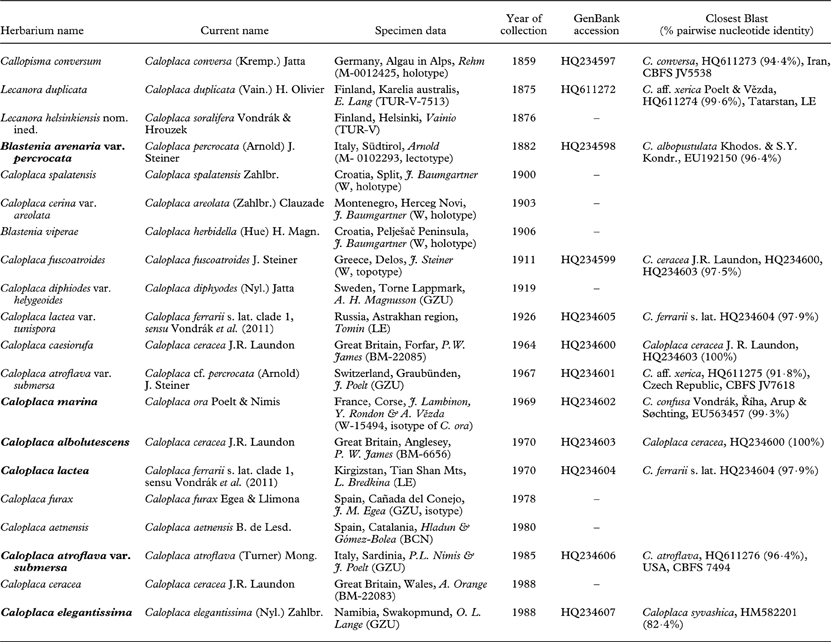
ITS nrDNA sequences of full lengths (560–850 bp; the difference in lengths is mainly due to the c. 200 bp indel at the beginning of the region sequenced) were obtained from 12 of 20 mycobionts of Caloplaca (lichenized fungi of Teloschistaceae), collected between 1859 and 1988 (Table 1). We succeeded with three of four samples collected in the 19th century, with two of six samples from 1900–1950, and with seven of ten samples collected after 1950.
List of herbarium samples used for the sequencing experiment. Samples successfully ITS sequenced are highlighted in bold
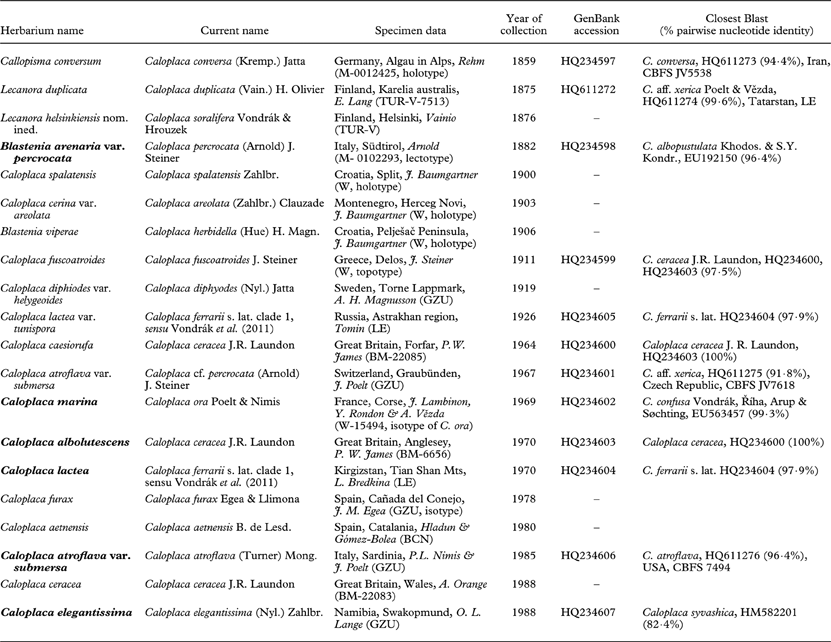
The most similar BLAST hits to our sequences (Table 1) were in accordance with our knowledge on phylogeny and morphology of the taxa analyzed. Among the four oldest herbarium specimens successfully sequenced, the 1859 specimen is the holotype of Caloplaca conversa (Kremp.) Jatta. Its sequence is most similar to our C. conversa sample from Iran, HQ611273 (94·4% nucleotide identity). The 1875 specimen of C. duplicata (Vain.) H. Olivier is 99·6% identical to our sequence of a morphologically similar specimen of C. cf. xerica Poelt & Vězda, HQ611274, from Tatarstan. The 1882 specimen is the holotype of C. percrocata (Arnold) J. Steiner and shows 96·4% similarity with C. albopustulata Khodos. & S. Y. Kondr., EU192150. The 1911 specimen was identified by us as C. fuscoatroides J. Steiner and shows 97·5% similarity with the haplotypes of C. ceracea J. R. Laundon from 1964 and 1970, a species which is probably conspecific with C. fuscoatroides. The sequences obtained were included in Bayesian molecular analyses, which support identifications of sequences using the BLAST search.
It is probable that the degradation of DNA sometimes slows enough to allow sequencing of old herbarium material of lichens. Nevertheless, DNA extraction is probably a crucial step for successful PCR amplification (Telle & Thines Reference Telle and Thines2008). Based on our results, the CTAB method seems to be suitable for obtaining DNA from herbarium specimens. It has a clear advantage of providing a relatively high yield of isolated DNA which is likely to be critical when processing old samples with partially degraded DNA. Besides methods using reagents such as CTAB or SDS for lysis of cell membranes and selective DNA precipitation, various commercially available DNA kits involving DNA binding on silica spin-columns are widely used in processing lichen samples; they are also promising for old herbarium specimens (e.g. Sohrabi et al. Reference Sohrabi, Myllys and Stenroos2010). Telle & Thines (Reference Telle and Thines2008) analyzed oomycetes from old herbarium specimens using several extraction methods and concluded that most CTAB-based protocols and commercial DNA kits gave sufficient results, although DNA yield varied to some extent. An advantage of commercial kits over other extraction methods is the higher DNA purity. On the other hand, DNA yields of commercial kits are lower than those obtained by CTAB protocol and its modifications (Niu et al. Reference Niu, Kebede, Auld, Woodward, Burow and Wright2008; Telle & Thines Reference Telle and Thines2008).
According to the results of Soltis & Soltis (Reference Soltis and Soltis1993) and Jankowiak (Reference Jankowiak, Buczkowska and Szweykowska-Kulinska2005), it seems more likely to obtain successful PCR amplification of ancient DNA in regions up to 500 bp. Nevertheless, we successfully amplified ITS regions which were considerably longer, between 560–850 bp. This could be due to the multi-copy nature of the rDNA, which facilitates PCR amplification, and makes it feasible even from ancient samples (Álvarez & Wendel Reference Álvarez and Wendel2003).
When working with old material, much care must be taken in all laboratory procedures especially during DNA extraction and PCR setup. It is also essential to check the sequences obtained for possible contamination. Gutiérrez & Marín (Reference Gutiérrez and Marín1998) warn against the risk of contamination of samples causing false positive results, for example in the case of sequences from amber samples (Cano et al. Reference Cano, Poinar, Pieniazek, Acra and Poinar1993) or from glacier-covered subfossil Umbilicaria samples (DePriest et al. Reference DePriest, Ivanova, Fahselt, Alstrup and Gargas2000). In order to avoid uncertainties, taxonomic identities of sequences obtained by ourselves were further analyzed by BLAST similarity search, which confirmed that the DNA of the target organism was correctly amplified (Table 1).
Our research was supported by grants from the Synthesys (DK-TAF, 2010), the Visegrad Fund (50810325, 51100753), Institute of Botany AS ČR (AV0Z60050516) and the Ministry of Education of the Czech Republic (MSM 6007665801). We thank the curators of the following herbaria for the loan of material: BM, GZU, LE, M, TUR, W. We are grateful to Linda in Arcadia for the linguistic corrections.