Introduction
Airway management is critical in the management of unresponsive patients. First responders, as well as the lay public, have various degrees of training in providing positive pressure ventilation (PPV), whether by mouth or by mask, as an initial, temporizing step in this process. Common complications of PPV include difficult ventilation, aspiration of gastric contents, and gastric distension. Gastric rupture is a rare, life-threatening complication that can rapidly lead to death.
Report
A 26-year-old woman with a history of heroin addiction was brought in by ambulance complaining of severe abdominal pain. Twenty minutes beforehand, she had been found unresponsive by her husband, who called 911 and then performed mouth-to-mouth ventilation without cardiopulmonary resuscitation (CPR) until help arrived. On arrival, paramedics performed facemask ventilation while administering 2mg of naloxone intravenously, again without CPR. The patient responded immediately, awakening and becoming agitated.
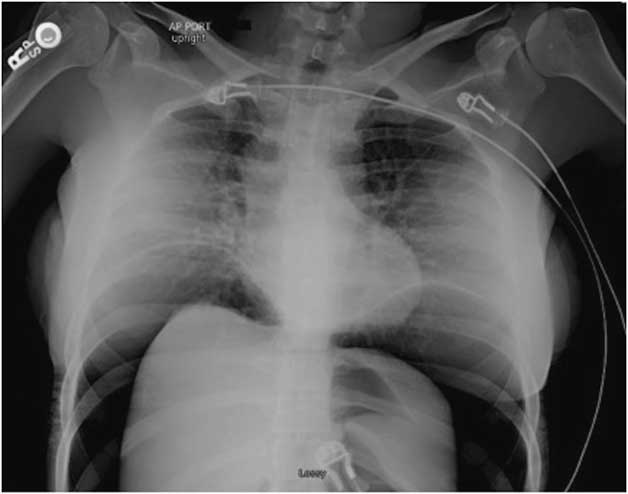
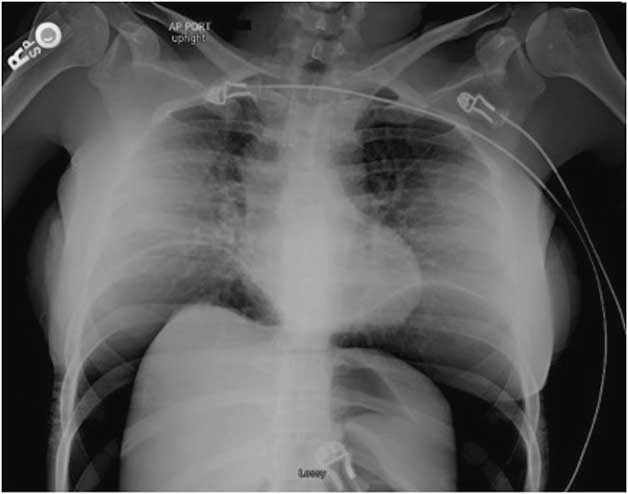
On arrival to the emergency department, the patient admitted to injecting heroin earlier in the evening. She complained of intense, diffuse abdominal pain radiating to her back. Her heart rate was 144, while her abdomen was distended, rigid, and extremely sensitive to palpation with rebound tenderness. A stat anterior-posterior chest radiograph was performed, revealing massive peritoneal free air with elevation of both hemidiaphragms (Figure 1).
Extensive Pneumoperitoneum Causing Elevation of Both Hemidiaphragms.
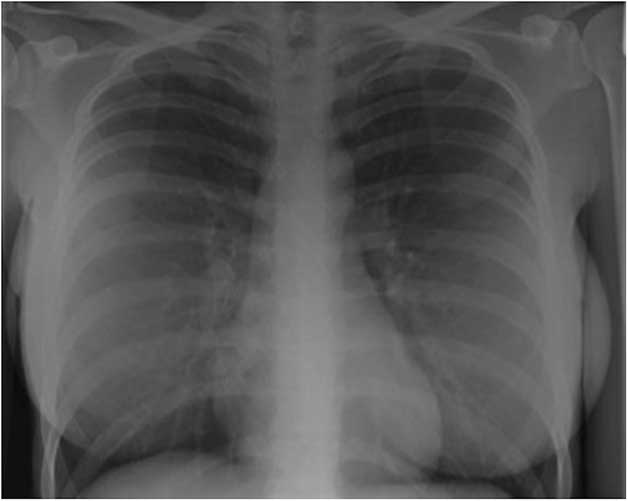
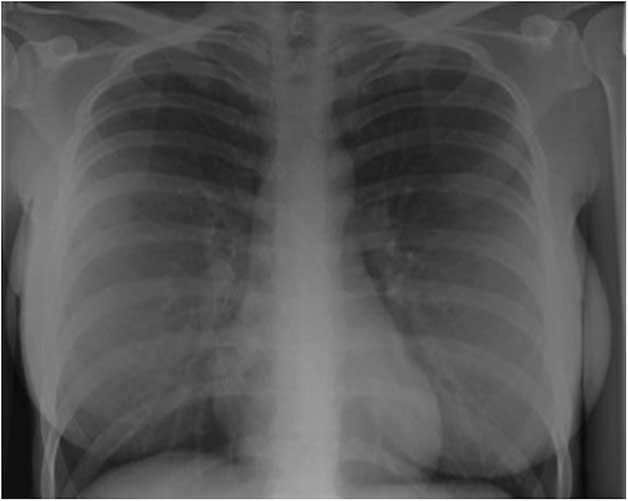
The patient was transferred to the operating room expeditiously for exploratory laparotomy, finding and repairing a 4cm perforation of the lesser gastric curvature, with no evidence of erosion or ulceration. H. pylori testing was negative and surgical pathology did not suggest an alternative etiology for the rupture. Further discussion with the patient revealed that she had once taken large amounts of non-steroidal, anti-inflammatory medications daily for migraines, but had discontinued them several months prior to the overdose. The patient clinically improved and was discharged home on Hospital Day 6. A repeat chest radiograph from approximately one month later was completely normal (Figure 2).
Follow-Up Chest X-Ray Two Months Later.
Discussion
Positive pressure ventilation causes insufflation of the stomach in up to 50% of patients, but gastric perforation is a rare event.Reference Yamada, Nishimiya, Kurokawa, Yuasa and Masaka 1 Though not extensively studied, small investigations on cadavers have suggested that perforation can occur when positive pressures exceed approximately 120mm Hg.Reference Wolff and Hohenstein 2 In at least five of the seven previously reported cases of gastric perforation secondary to mouth-to-mouth rescue breathing, the bystander was a family member or friend.Reference Wolff and Hohenstein 2 - Reference O’Hanlon 8 It is plausible that such a person would inadvertently deliver excessively large and forceful rescue breaths, causing over-distension of the stomach and subsequent rupture.
In the one pediatric case identified, the father of a 16-week-old infant delivered a “large breath” through the infant’s nose in an effort to clear her nasal secretions, after which the infant’s abdomen became distended and she became short of breath. The resulting massive pneumoperitoneum produced an abdominal compartment syndrome that impaired the infant’s lung expansion, requiring emergent needle decompression.Reference O’Hanlon 8
Accordingly, it does not appear that prolonged mouth-to-mouth resuscitation is necessary to produce rupture. The father mentioned above delivered only one rescue breath; another patient developed a rupture after only two rescue breaths from her “husky son.”Reference Cassebaum, Carberry and Stefko 4 Although the details are less clear, a similarly brief period of rescue breathing seems to have occurred in the case described above.
All reported cases involving mouth-to-mouth resuscitation occurred within the lesser curvature of the gastric antrum, and it has been asserted that 80% of all gastric ruptures occur there. This may be because the area lacks mucosal folds, compromising its elasticity.Reference Schvadron, Moses and Weissberg 9 The same anatomical area has been implicated in related gastric perforations secondary to over-distension: bag-valve mask and bilevel positive pressure ventilation (bipap),Reference Smally, Ross and Huot 10 - Reference Bednarz, Filipovic, Schoch and Mauermann 12 esophageal intubation,Reference Schvadron, Moses and Weissberg 9 , Reference Song, Stern and Beaty 13 CPR,Reference Spoormans, Van Hoorenbeeck, Balliu and Jorens 14 and even acute asthma.Reference McQueen, Gollock and Fergusson 15
With the expanded use of community naloxone, the need for rescue breaths as part of the resuscitation for opiate overdose should be diminished. Complications from rescue breathing should only further bolster arguments of its utility as a safe life-saving measure. 16
Limitations
This report is limited by the second-hand nature of the history, as the event occurred out of hospital, and by the small number of scientific and clinical studies on this subject.
Conclusion
While rare, it is important for emergency medical personnel to be aware of the potential for gastric perforation in patients who undergo PPV, bystander-initiated or otherwise. The clinical triad of dyspnea, abdominal distension, and severe, diffuse abdominal pain should prompt consideration for gastric rupture and the possibility of abdominal compartment syndrome.
Author Contributions
Both authors contributed directly and substantially to the drafting and revision of this manuscript.