INTRODUCTION
Reconstructing the transition from the wetter, cooler climate of the terminal Pleistocene to the warmer, drier conditions of the early Holocene is critical for understanding vegetation change, landscape evolution, and the early peopling of the American Southwest. Few dated, continuous records of sedimentation through this transition are available, however. This paper reports on one such record available from Chupadera Draw, adjacent to the Mockingbird Gap archaeological site in south-central New Mexico, approximately 40 km southeast of Socorro.
The site is known for producing an abundant assemblage of artifacts from the earliest well-dated and well-documented archaeological tradition on the continent, called Clovis (Weber, Reference Weber1997; Holliday et al., Reference Holliday, Huckell, Weber, Hamilton, Reitze and Mayer2009; Hamilton et al., Reference Hamilton, Buchanan, Huckell and Holliday2013). Mockingbird Gap is one of the largest Clovis sites in the western United States. The artifacts were found on the surface and therefore are not dated, but across the continent Clovis generally dates ~13,400 to ~12,800 yr (Holliday, Reference Holliday2000a; Waters and Stafford, Reference Waters and Stafford2007; Miller et al., Reference Miller, Holliday and Bright2013; Sanchez et al., Reference Sanchez, Holliday, Gaines, Arroyo-Cabrales, Martínez-Tagüeña, Kowler, Lange, Hodgins, Mentzer and Sanchez-Morales2014). Since the 1960s (Weber, Reference Weber1997; Weber and Agonino, 1997), archaeological survey and test excavations, along with geologic probing, yielded insights into the way of life of ancient Clovis inhabitants and background on environmental conditions during and since the Clovis occupation (Huckell et al., Reference Huckell, Holliday, Hamilton, Sinkovec, Merriman, Shackley and Weber2008; Holliday et al., Reference Holliday, Huckell, Weber, Hamilton, Reitze and Mayer2009; Hamilton et al., Reference Hamilton, Buchanan, Huckell and Holliday2013). The site is along an 800-m stretch of Chupadera Draw. Subsurface geologic investigations show that the draw contains an abundant record of past environmental conditions, including the existence of a long-lived ciénega providing the resources that likely attracted Clovis people (Holliday et al., Reference Holliday, Huckell, Weber, Hamilton, Reitze and Mayer2009).
This paper focuses on the use of microinvertebrates and calcareous algae to identify the history of environmental change at the late Pleistocene-early Holocene transition comparing the site with other neighboring locations and the Southwest.
CIÉNEGA MICROFAUNA
Geomorphologically, a ciénega is somewhat similar to a wet meadow; the former forms a depression that permits standing water to accumulate aquatic and riparian vegetation (e.g., cattails, grasses), trapping aeolian, alluvial, and/or fluvial sediments that contribute shelter to the organisms (see Hendrickson and Minckley, Reference Hendrickson and Minckley1984 for a detailed description); whereas the latter consists of saturated grounds along perennial streams where spring and groundwater discharge moves over the surface without ponding (Hall et al., Reference Hall, Penner, Palacios-Fest, Metcalf and Smith2012). Both are fed by springs and seeps (Hall et al., Reference Hall, Penner, Palacios-Fest, Metcalf and Smith2012).
By contrast to paludal (swamp) environments characterized by trees, ciénegas only contain herbaceous vegetation (Hendrickson and Minckely, 1984). While a ciénega is a shallow setting, a lake may be very deep hole ranging from a few meters to more than 1000 meters around the world (Cohen, Reference Cohen2003).
Worldwide the paleoecology of ciénega microinvertebrates (ostracodes and mollusks) is poorly known compared with that of lacustrine environments. Reconstructing the aquatic environment of the Mockingbird Gap site is of major significance because it aids in understanding the Younger Dryas chronozone (YDC)/early Holocene transition and environmental setting for earliest Americans in southeastern New Mexico. Ostracodes (micro-crustaceans), mollusks, and calcareous algae are used in this study to interpret the history of the ciénega.
Ostracodes, microscopic crustaceans, have a bivalve carapace made of calcite and they range in size between 0.5 and 2 mm. Disarticulated or articulated carapaces are the only body part preserved to the geologic record (Pokorný, Reference Pokorný1978). They are diverse and abundant in marine and nonmarine environments. Over the past 30 years, neontologists and ecologists have made significant progress using ostracodes to understand hydrogeologic variations in springs and seeps, as well as their associated wetlands or ciénegas (De Deckker, Reference De Deckker1983; Forester, Reference Forester1983, Reference Forester1986; Palacios-Fest, Reference Palacios-Fest1994; Palacios-Fest et al., Reference Palacios-Fest, Cohen and Anadón1994, Reference Palacios-Fest, Mabry, Nials, Holmlund, Miksa and Davis2001; Holmes and Chivas, Reference Holmes and Chivas2002). Ostracodes are often accompanied by mollusks in ciénega environments.
Water chemistry and temperature play a major role in the geographic distribution of ostracodes. Their reproductive and survival ability depends on their ability to adapt to changing conditions (Delorme and Zoltai, Reference Delorme and Zoltai1984; Forester, Reference Forester1987; De Deckker and Forester, Reference De Deckker and Forester1988). It is this sensitivity to temperature that makes ostracodes from the geologic record very useful for paleoclimate reconstructions (Delorme, Reference Delorme1969; Palacios-Fest, Reference Palacios-Fest1994, Reference Palacios-Fest2002; Cohen et al., Reference Cohen, Palacios-Fest, Negrini, Wigand and Erbes2000; Palacios-Fest, Reference Palacios-Fest2002; Horne et al., Reference Horne, Cohen and Martens2002).
Bivalvia (clams and mussels) and Gastropoda (snails and limpets) form the Phylum Mollusca. Characterized by a soft and unsegmented body, mollusks secrete a shell of proteinaceous and crystalline calcium carbonate (aragonite) materials. Mollusks reflect the water quality, salinity, and streamflow (Rutherford, Reference Rutherford2000; Dillon and Stewart, Reference Dillon and Stewart2003). Because of these traits, mollusks in stratigraphic contexts have long been used in paleoenvironmental reconstructions (De Francesco and Hassan, Reference De Francesco and Hassan2009; Sharpe, Reference Sharpe2009). Like the ostracode signatures, the signatures of mollusks are used in this study to integrate the paleoecological characteristics of the Mockingbird Gap site, New Mexico.
The gyrogonites of the calcareous algae Chara may be used to reconstruct the alkalinity, time of colonization, and paleohydraulics of the ciénega. Charophytes are small, branching algae normally living in carbonate-rich freshwater. Dimorphic, the female gametangia are protected by a calcium carbonate coating called gyrogonite. The orange-red antheridia (male reproductive organs) are not coated; hence, they do not preserve to the geologic record. The Characeae or Charophyta are a strange, isolated group of aquatic plants growing entirely underwater. Modern species prefer ponds or lakes, although they are occasionally found in running water, and are partial to somewhat brackish conditions, such as freshly dug ditches in marshes near the sea. In deeper environments subject to inundation, they soon give way to more vigorous vegetation such as cattails (Typha). Gyrogonites are used in this study to complement the microinvertebrate record.
NEW MEXICO PALEOENVIRONMENTS
Research on the paleoenvironmental history of New Mexico’s aquatic systems is scattered. Allen and Anderson (2000) found a continuous ostracode record at paleo-lake Estancia from 23,290 yr that abruptly ended around 12,430 yr in response to lake desiccation, or at least a sharp drop to low stand levels, around 11,500 14C yr BP (13,000 cal yr BP), followed by erosion of younger sediments (Anderson et al., Reference Anderson, Allen and Menking2002). Ballenger et al. (Reference Ballenger, Holliday, Kowler, Reitze, Prasciunas, Miller and Windingstad2011) also identified geomorphic evidence for complete desiccation of paleo-lake Estancia between 11,500 14C yr BP and 9,700 14C yr BP (13,400–11,100 cal yr BP), interrupted by a short-lived low stand. The patchy records of aquatic systems in the region during the post-last glacial maximum late Pleistocene-Holocene (here we are referring to the Allerød, Younger Dryas, and Holocene chronozones) transition is a major obstacle for understanding the patterns of paleoenvironmental change that characterized the YDC in the region. The recently studied Scholle wet meadow (sensu Hall et al., Reference Hall, Penner, Palacios-Fest, Metcalf and Smith2012) at Abo Canyon, ~60 km north-northwest of the Mockingbird Gap site, is a rare example. Hall et al. (Reference Hall, Penner, Palacios-Fest, Metcalf and Smith2012) reported a rich and diverse ostracode fauna during the transition from the Allerød-Younger Dryas to the Holocene, before the site turned too arid to host microinvertebrates.
By contrast, at the San Agustin dry playa in Central New Mexico, Forester (Reference Forester1987) found a continuous ostracode assemblage from at least 22,000 yr to about 5000 yr including the Allerød-Younger Dryas-Holocene, although the age control is sparse and may not be completely reliable. Unfortunately, to the best of our knowledge no ostracode work from ciénegas or springs are available from New Mexico other than the modern study of Drumheller Spring north of Albuquerque (Forester, Reference Forester1991) and the recent paleoecologic work of Palacios-Fest at Scholle wet meadow (Hall et al., Reference Hall, Penner, Palacios-Fest, Metcalf and Smith2012).
AREA OF STUDY
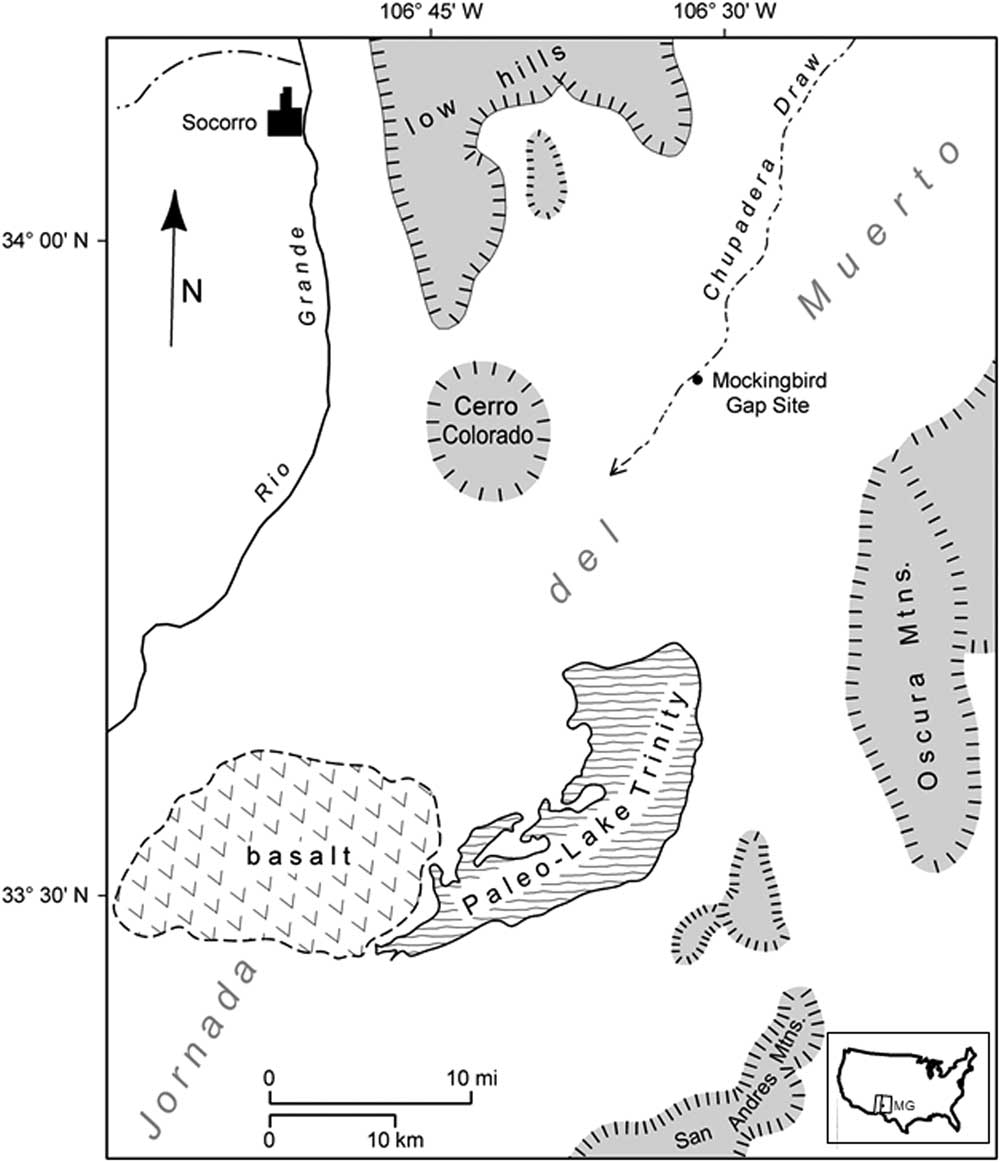
The Mockingbird Gap site occupies approximately 800×150 m along a low ridge adjacent to Chupadera Draw in the northern Jornada del Muerto drainage basin (Fig. 1). The area is a low-relief desert grassland characterized by low rainfall (ca. 20 cm/year) responsible for the intermittent flow of Chupadera Draw (Weber, Reference Weber1997). The site was discovered in 1959 by Robert Weber, who conducted archaeological and geological investigations along the Chupadera Draw (Weber, Reference Weber1997; Weber and Agogino, Reference Weber and Agogino1997). Holliday et al. resumed research in the area in 2009.
Central New Mexico and the northern Tularosa Basin, with the location of the Mockingbird Gap site, Chupadera Draw, paleo-lake Trinity, the Jornada basalt flow, and other key physiographic and cultural features described in Holliday et al. (Reference Holliday, Huckell, Weber, Hamilton, Reitze and Mayer2009). Inset shows the location of the Mockingbird Gap site (MG) in New Mexico (after Holliday et al., Reference Holliday, Huckell, Weber, Hamilton, Reitze and Mayer2009).

The Jornada del Muerto is a fault-block intermontane basin on the east flank of the Rio Grande Rift (Pazzaglia and Hawley, Reference Pazzaglia and Hawley2004; Hawley, Reference Hawley2005). Cerro Colorado and Cerro de la Campana, along with other low hills, separate the basin from the Rio Grande Valley to the north and west; whereas the Chupadera Mesa and the Oscura Mountains constitute its southern and eastern flanks (Holliday et al., Reference Holliday, Huckell, Weber, Hamilton, Reitze and Mayer2009). The Jornada basin was isolated from Rio Grande during the middle Pleistocene by the incision of the river. In the later Pleistocene, the Jornada volcanic fields, in the west-central part of the basin, blocked drainage of the northern end causing the impoundment that formed paleo-lake Trinity (Hawley, Reference Hawley1978, p. 96, Reference Hawley1993, p. 15). The paleo-lake reached a maximum lake level of about 1431 m above mean sea level (m amsl) covering an extension of approximately 200 km2 with a maximum depth of 6.4 m (Kirkpatrick and Weber, Reference Kirkpatrick and Weber1996). To date, no further information is available from this paleo-lake.
The Mockingbird Gap site is located about 15 km north of and 80 m higher than the highest shoreline of Lake Trinity (Holliday et al., Reference Holliday, Huckell, Weber, Hamilton, Reitze and Mayer2009). Chupadera Draw may have drained into the lake. Between 2007 and 2008, 11 cores were taken in a line running across the draw. They provided a dated stratigraphic record of a depositional environment that evolved from alluvial to ciénega to arroyo cut-and-fill cycles (Holliday et al., Reference Holliday, Huckell, Weber, Hamilton, Reitze and Mayer2009). Five lithostrata (1–5, oldest to youngest) were recognized. For the purposes of this paper we focus only on strata 1 and 2.
MATERIALS AND METHODS
Thirty sediment samples from the Mockingbird Gap site were selected for microinvertebrate and calcareous algae analysis to reconstruct its paleoenvironmental history. Core 08-1 was recovered using a Giddings trailer-mounted coring rig and a 6.5 cm (2.5 inch) diameter barrel. It was sub-sampled from Stratum 2, “an organic-rich, massive to laminated black to dark gray to gray muds (including silt mud and muddy clay, interbedded with gray to tan to yellow silt and medium to fine sand)”, (Holliday et al., Reference Holliday, Huckell, Weber, Hamilton, Reitze and Mayer2009:364) for the interval between 600 cm below ground surface (bgs) to the bottom of the core at 1080 cm bgs. Several intervals were not sampled because they consisted of clean alluvial sand (760–810 cm bgs; 830–850 cm bgs; 870–920 cm bgs; and 950–1000 cm bgs). The sediment samples were prepared using routine procedures (Forester, Reference Forester1988) modified by Palacios-Fest (Reference Palacios-Fest1994). Samples were air-dried, weighed, and soaked in boiling distilled water with 1 g of Alconox to disaggregate the sediments. The samples in solution were let sit at room temperature for five days stirring them once a day. Using a set of three-sieves, the samples were wet-sieved to separate the coarse (>1 mm), medium (>106 µm), and fine (>63 µm) sand fractions to help identify the system’s paleohydraulics. The very fine sand, silt, and clay fractions were washed out at this stage. Therefore, the particle-size analysis departs from the formal USDA procedure (USDA, 2003) and it is used only as a rough reference in this study. It is important to highlight that the possible discrepancy between the approach used in this investigation and that of the USDA is the result of grouping the very fine sands with the finer fractions, which, in fact, changes the total percentage of sand but does not affect the actual behavior of sands in the ecosystem. The value of the approach used here is that it provides a quick and easy way to process the data and to estimate the patterns of water discharge into the ciénega overtime. The data are shown in Supplementary Table 1.
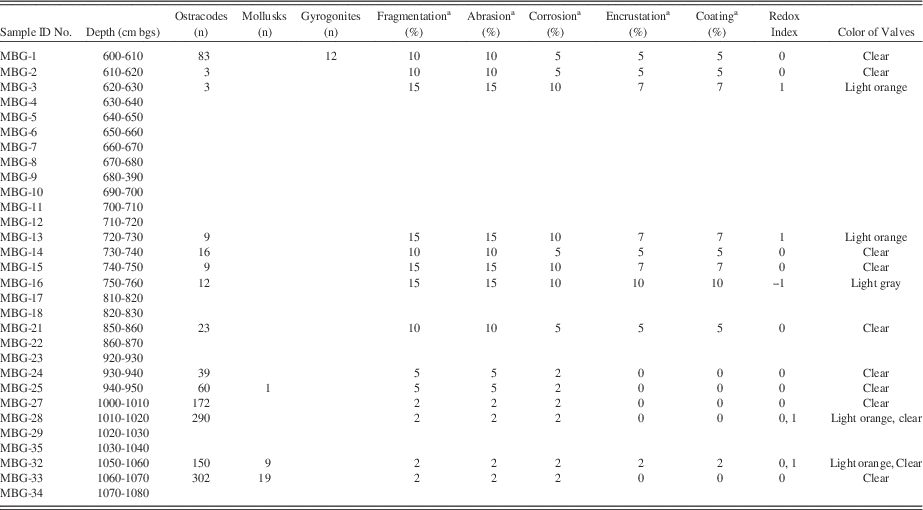
Paleontological composition and taphonomic characteristics of ostracodes, mollusks, and gyrogonites in samples.

a Based on Delorme (Reference Delorme1969, Reference Delorme1989)
The samples were analyzed under a low-power microscope. All samples were examined to identify fossil contents and faunal assemblages (Table 1). Total and relative abundance was recorded from the sediment samples. Based on Delorme (Reference Delorme1969, Reference Delorme1989), standard taphonomic parameters, like fragmentation, abrasion, disarticulation (carapace/valve, C/V ratios), and adulthood (adult/juvenile, A/J ratios) were recorded to establish the synecology (ecology of the communities), as opposed to the autoecology (ecology of single species), of the ecosystem (Adams et al., Reference Adams, Smith and Palacios-Fest2002). However, autoecology was implemented to integrate the environmental framework. The specimens were placed in micropaleontological slides and saved in Terra Nostra Earth Sciences Research, LLC collection.
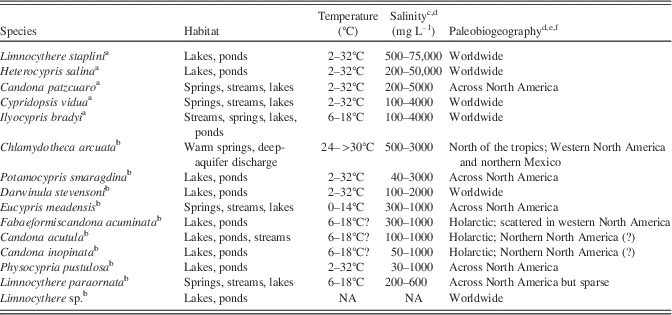
Ecological requirements of ostracode species recovered from the Mockingbird Gap site ciénega, Chupadera Draw, New Mexico.

a Permanent or ephemeral
b Permanent
c Forester et al. (2005).
d Külköylüoğlu (2009)
e Anderson et al. (Reference Anderson, Darring and Benke1998)
f Forester (Reference Forester1991).
NA=Not Applicable.
The taphonomic parameters were used to recognize degrees of transport and/or burial characteristics like desiccation and sediment compaction. The rates of fragmentation, abrasion, and disarticulation are realistic indicators of transport; commonly these parameters show increasing damage with increasing transport. One must be cautious in using this criterion, but the nature of the deposits suggests that microinvertebrates may reflect the wetland’s hydraulic properties. Other features like encrustation and coating were used to determine authigenic mineralization or stream action, respectively. The redox index and color of valves reflected burial conditions. The A/J and C/V ratios were used as indicators of biocenosis (Whatley, Reference Whatley1983; Palacios-Fest et al., Reference Palacios-Fest, Mabry, Nials, Holmlund, Miksa and Davis2001).
Based upon the ostracode faunal composition we developed a qualitative paleosalinity index. The index is founded on the salinity tolerance of each species present in the ciénega according to our current knowledge of their ecological requirements as shown in the North American Nonmarine Ostracodes Database (NANODe) website (Forester et al., Reference Forester, Smith, Palmer and Curry2005) and other references (Palacios-Fest, Reference Palacios-Fest1994; Curry, Reference Curry1999). Equation 1, used for the present study, is:
 $$\eqalignno{ {\rm SI}\,{\equals}\, & \left[ {7\left( {\,\%\,\,Limnocythere\,\,staplini} \right){\plus}6\left( {\%\,\,Heterocypris\,\,salina} \right)} \right. \cr & {\plus}5\left( {\,\%\,\,Candona\,\,patzcuaro} \right){\plus}4\left( {\%\,\,Cypridopsis\,\,vidua} \right) \cr & {\plus}3\left( {\,\%\,\,Ilyocypris\,\,bradyi} \right){\plus}2\left( {\%\,\,Chlamydotheca\,\,arcuata} \right) . \cr& {{\plus}\left( {\,\%\,\,Potamocypris\,\,smaragdina} \right)} \right] \cr & {\minus}\left[ {\left( {\,\%\,\,Darwinula\,\,stevensoni} \right){\plus}2\left( {\%\,\,Eucypris\,\,meadensis} \right)} \right. \cr & {\plus}{\rm }3\left( {\,\%\,\,Fabaeformiscandona\,\,acuminata} \right) \cr & {\plus}{\rm }4\left( {\,\%\,\,Candona\,\,acutula} \right){\plus}5\left( {\%\,\,Candona\,\,inopinata} \right) \cr & {\plus}{\rm }6\left( {\,\%\,\,Physocypria\,\,pustulosa} \right) \cr & {\plus}7\left( {Limnocythere\,\,paraornata} \right)} \right] $$
The index positively weighs species with incrementally higher salinity tolerances and negatively weighs species with incrementally lower salinity tolerances.
Mollusks and calcareous algae are not as abundant, hence this study relies mostly on the presence/absence patterns of ostracodes and their ecological preferences (Table 3). Continental ostracodes inhabit in a wide range of hydrochemical conditions, from eurytopic (wide) to stenotopic (restricted) conditions. Accordingly, ostracode assemblages may be used to recognize the three major water types defined by Eugster and Hardie (Reference Eugster and Hardie1978), that is, dilute (Type I), calcium-rich (Type II), and bicarbonate-rich (Type III).
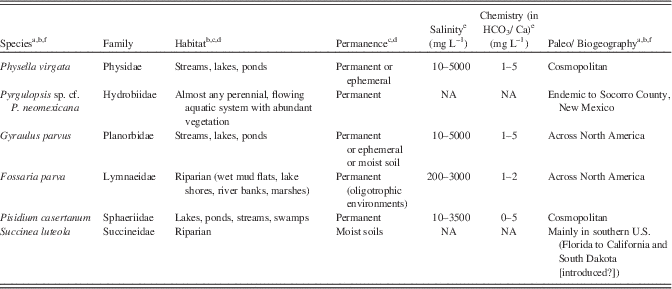
Ecological requirements of mollusk species recovered from the Mockingbird Gap site ciénega, Chupadera Draw, New Mexico.

a Sources: Bequaert and Miller (Reference Bequaert and Miller1973); bDillon (Reference Dillon2000); cMiksicek (Reference Miksicek1989); dSharpe (Reference Sharpe2002); eVokes and Miksicek (Reference Vokes and Miksicek1987); and fWebb (Reference Webb1942).
RESULTS
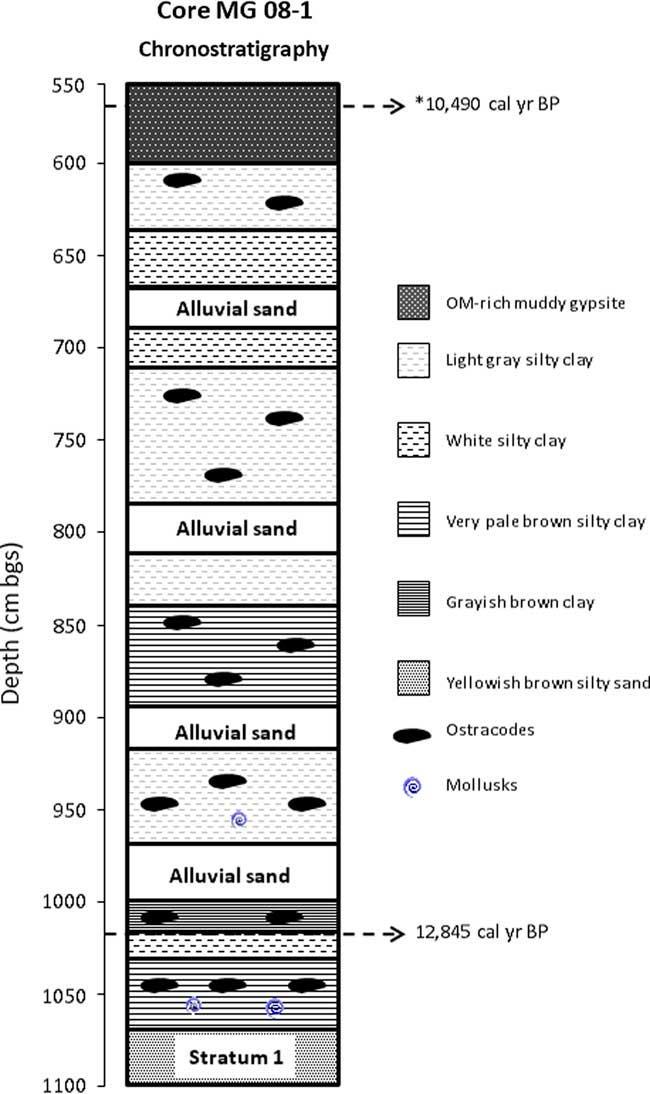
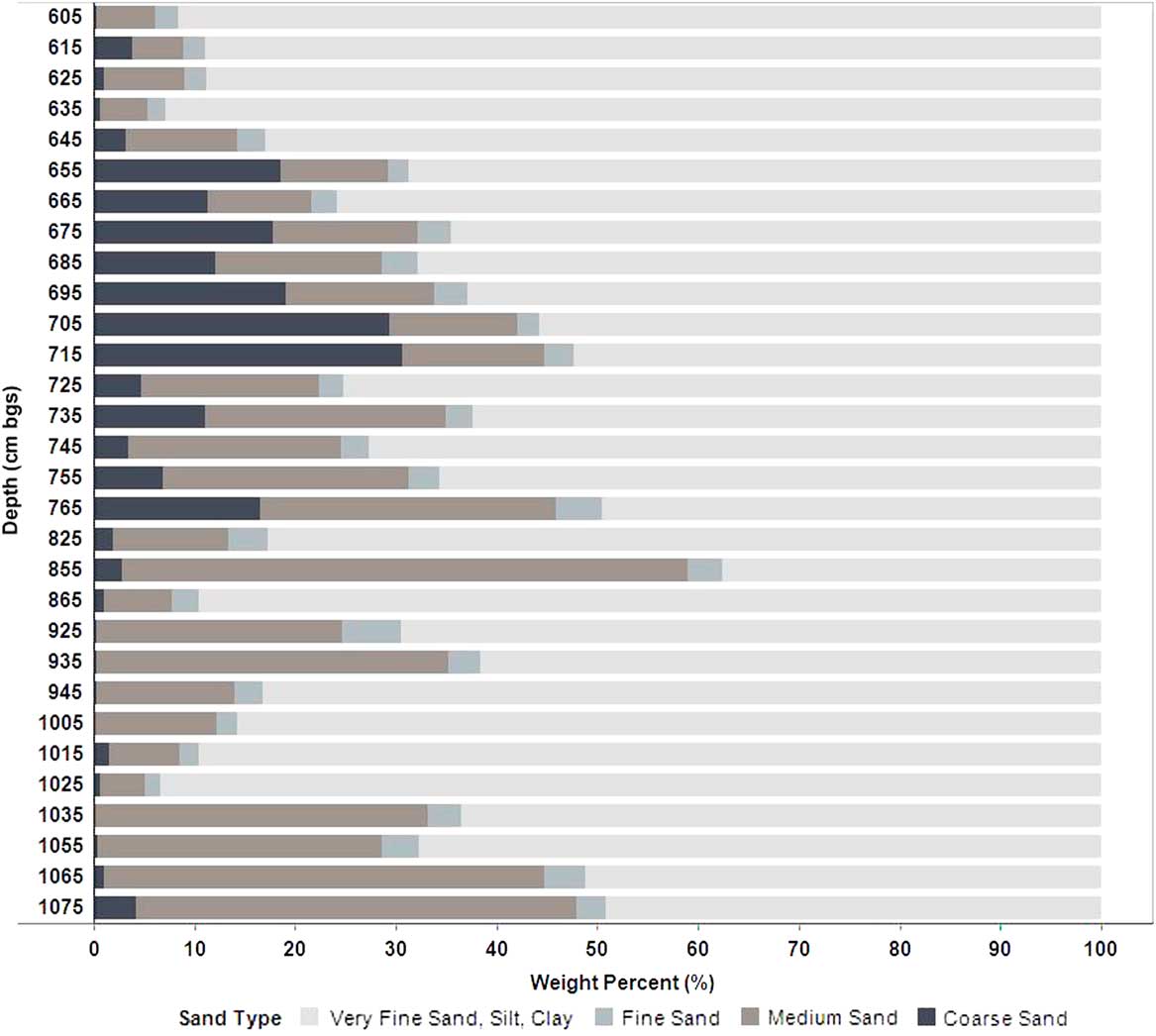
Supplementary Table 1 shows the sample identification number, depth (cm bgs), bulk and fraction weight, textural classification, and Munsell color of sediment fractions. The core revealed a distinctive lithostratigraphy and texture similar to that observed in other cores recovered nearby (Holliday et al., Reference Holliday, Huckell, Weber, Hamilton, Reitze and Mayer2009). It mostly consists of light gray (10YR 7/1) to white (10YR 8/1) silty clay to clay, occasionally alternating with very pale brown (10YR 8/2) to grayish brown (10YR 5/2) or yellowish brown (10YR 5/6) silty clay to silty sand (Fig. 2). The dominant minerals recognized in the wetland deposits are gypsum, carbonate nodules, and root casts. Coarser clastic particles of quartz, feldspars, and other materials gradually increase in percentage upcore from 1080 cm bgs (base of core) to about 750 cm bgs (Fig. 3).
(color online) Stratigraphic column from Core 08-1 (strata 1 [below 1070 cm bgs] and 2) showing alternating alluvial and floodplain sand, silt, and clay with evaporites (calcium carbonate nodules and gypsum crystals). Using microinvertebrates (mainly ostracodes), four environmental phases were identified in the area of study showing the transition from Allerød to Younger-Dryas to early Holocene between 12,900 cal yr BP and 10,490 cal yr BP according to Haynes (Reference Haynes2008). *14C date at 555–585cm extrapolated from core 07–5 (~80 m north-northeast of 08–1; Holliday et al., Reference Holliday, Huckell, Weber, Hamilton, Reitze and Mayer2009).

Particle-size diagram from the Mockingbird Gap site ciénega, Chupadera Draw, New Mexico (see text for explanation).

The geochronology of the samples is based on three radiocarbon dates: one from core 07-5 (Holliday et al., Reference Holliday, Huckell, Weber, Hamilton, Reitze and Mayer2009) and two from core 08-1 (Supplementary Table 1) 80m south-southwest of 07-5 (Holliday and Killick, Reference Holliday and Killick2013). The samples below ~800 cm bgs were collected from stratified muds and sands likely in a channel fill (Holliday and Killick, Reference Holliday and Killick2013). Holliday and Killick (Reference Holliday and Killick2013: Figure 2) hypothesize that the base of the channel is at ~1000 cm bgs, but in this paper we interpret all samples below ~800 cm bgs as coming from the channel fill and thus younger than core 07-9 below 800 cm bgs. The oldest date in the sequence, near the bottom of the channel fill (at 1020 cm bgs), is ~10,984 14C yr BP (12,845 [12,911–12,749] cal yr BP). The wetland or ciénega deposit prevailed until ~9285 14C yr BP, the uppermost date in the sequence (at 555–585 cm bgs; 10,490 [10,596–10,270] cal yr BP). The geochronology thus shows that sediments deep in Chupadera Draw span the YDC and continue into the early Holocene. Here we follow the definition of the YDC as 11,000 14C yr BP (12,900 cal yr BP) to 10,000 14C yr BP (11,700 cal yr BP), following Stuiver et al. (Reference Stuiver, Groots and Braziunas1995) and Rasmussen et al. (Reference Rasmussen, Andersen, Svensson, Steffensen, Vinther, Clausen, Andersen, Johnsen, Larsen, Bigler, Röthlisberger, Fischer, Goto-Azuma, Hansson and Ruth2006). 10,000 14C yr BP (11,700 cal yr BP) is also the base of the Holocene.
Table 1 summarizes the biological contents of the ciénega and the overall taphonomic characteristics recorded. Fourteen samples contained ostracodes (Table 2); three had mollusks (Table 3), and only one held gyrogonites.
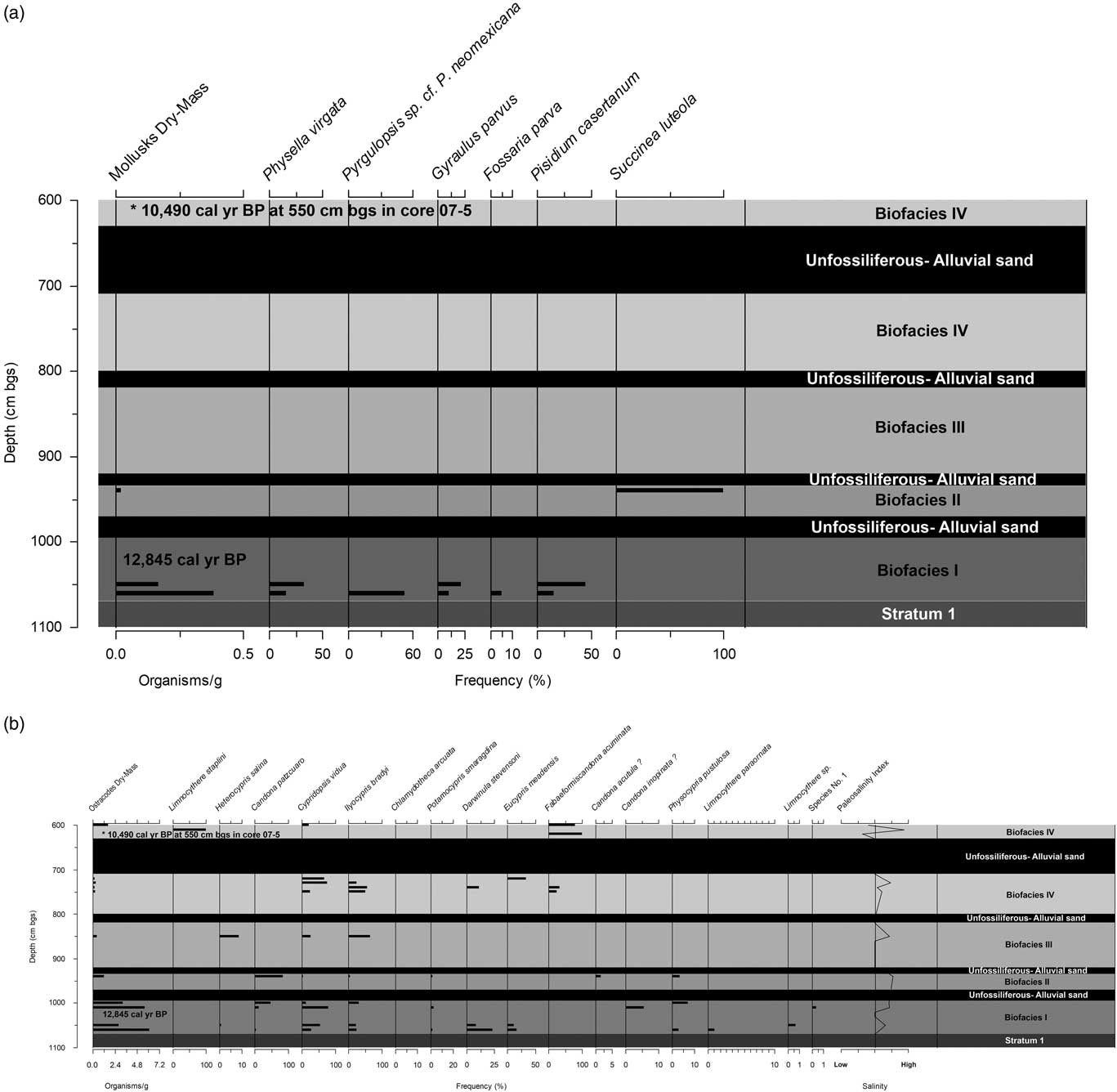
Mollusks are extremely rare to rare (1–19 specimens) and of poor diversity (6 species), including the Physiidae Physella virgata, the Hydrobiidae Pyrgulopsis sp. cf. P. neomexicana, the Planorbidae Gyraulus parvus, the Lymnaeidae Fossaria parva, the Sphaeriidae Pisidium casertanum, and the Succineidae Succinea luteola (Fig. 4a).
Microinvertebrate paleoecology for Mockingbird Gap site ciénega, Chupadera Draw, New Mexico. (a) Mollusk chronostratigraphy showing the species relative abundance, the four biofacies identified in this study, and age range in cal yr BP. (b) Ostracode chronostratigraphy displaying the paleosalinity index in addition to the species relative abundance and biofacies; age range in cal yr BP.

Ostracodes are extremely rare to extremely abundant (3–302 specimens: extremely rare <5; 6< very rare <10; 11< rare <20; 21<common <50; 51< abundant <100; 101< very abundant <300; extremely abundant >301) and diverse (16 species). The species identified are: Limnocythere staplini, Heterocypris salina, Candona patzcuaro, Cypridopsis vidua, Ilyocypris bradyi, Chlamydotheca arcuata, Potamocypris smaragdina, Darwinula stevensoni, Eucypris meadensis, Fabaeformiscandona acuminata, Candona acutula?, Candona inopinata?, Physocypria pustulosa, Limnocythere paraornata, Limnocythere sp., and fragments of an unknown Species No. 1 (Fig. 4b). H. salina, as E. meadensis and C. vidua, is a crenophilous species (thriving in springs).
Gyrogonites of Charophyta occurred only once in the stratigraphic record. Rare (12) specimens of Chara globularis were identified at the uppermost sample analyzed (600–610 cm bgs). The species prefers a high pH (7.5–10.5; optimum 9.5–10.5), Ca-rich, slow lentic or lotic waters; it is occasionally associated with springs and seeps and cannot support eutrophic conditions. In addition, Chara globularis grows better between mid-January to late September, reaching its optimum between late April and mid-July (Allen, Reference Allen1950).
INTERPRETATION
The ciénega provided important sedimentologic and micropaleontologic information to reconstruct its history during the latest Pleistocene--early Holocene (Fig. 2–4). Based on the microfossils presence/absence and abundance patterns, four biofacies in the evolution of the ciénega are recognized from Mockingbird Gap site: Biofacies I (Allerød); (2) Biofacies II (YDC); (3) Biofacies III (early Holocene); and (4) Biofacies IV (late early Holocene).
Aquatic mollusks (P. virgata, cf. P. neomexicana, F. parva, and P. casertanum) occurred only during Biofaices I, whereas extremely rare land snails (S. luteola) appeared near the base of Biofaices III. Chara globularis (calcareous algae) occurred associated with the ostracode F. acuminata at the end of Biofacies IV (Fig. 4a).
Cypridopsis vidua, the dominant species, remained the most common through time but showed a sharp change in abundance above and below 1010 cm bgs. E. meadensis is a low salinity-tolerant species that prefers springs and streamflow, reflecting dilute water input (see Table 2). The two Holarctic candonids (C. acutula? and C. inopinata?) occurred at the top of Biofacies II and the base of Biofacies III associated with C. patzcuaro, a eurytopic candonid. I. bradyi, P. pustulosa (also spring and streamflow indicators), P. smaragdina (a standing, moderately dilute water indicator), and D. stevensoni (a perennial, moderately dilute water indicator) shared the environment with E. meadensis at this time. F. acuminata is scarce but was found throughout the geologic record, whereas Limnocythere staplini appeared only once near the upper end of Stratum 2 (Biofacies IV). Fragments of Ch. arcuata (a very large ostracode, 2–3 mm in length) indicate warm water input; the species, however, occurred once near the base of Biofaices III but after a dry period not sampled for this study (Fig. 4b). The sequence of species distribution and inferred paleoecology are used to interpret the environmental conditions over time
Based on Delorme (Reference Delorme1969, Reference Delorme1989), taphonomic features are used to recognize allochthonous from autochthonous populations. Low fragmentation and abrasion (~5%) and a suite of juvenile and adult valves during Biofacies I indicate a biocenosis. Both fragmentation and abrasion ( >10%) increased overtime as aridity of Mockingbird Gap site increased implying that they resulted from post-burial stress. The carbonate-rich environment, however, favored post-mortem shell encrustation and coating (5–10%). Mollusks and gyrogonites are very rare; however, the occurrence of some species contributes to the interpretation of the ostracode record.
The Mockingbird Gap site ciénega paleoenvironment is reconstructed based on: (1) the ecological requirements of ostracodes with minor comments on mollusks and calcareous algae; and (2) the four biofacies described above. Lacustrine taxa are better understood than spring or seep species because the latter are usually perceived as less important in the geologic record (Forester, Reference Forester1991). They, however, have proven a significant tool for understanding groundwater fluctuations overtime in response to climate change (Quade et al., Reference Quade, Forester, Pratt and Carter1998; Kaufman et al., Reference Kaufman, O’Brien, Mead, Bright and Umhoefer2002; Hall et al., Reference Hall, Penner, Palacios-Fest, Metcalf and Smith2012). According to Holliday et al. (Reference Holliday, Huckell, Weber, Hamilton, Reitze and Mayer2009), the Mockingbird Gap site ciénega expanded starting shortly after 12,845 cal yr BP (12,911–12,749 cal yr BP) and continuing until to 10,490 cal yr BP (10,596–10,270 cal yr BP), correlating well with the onset of the YDC reported elsewhere (Stuiver et al., Reference Stuiver, Groots and Braziunas1995). The ciénega provided important sedimentologic and micropaleontologic information to reconstruct its history during the latest Pleistocene--early Holocene (Fig. 2–4). Microinvertebrate population and diversity responded to climate change by increasing or decreasing as a result of rising or falling water table. The ciénega’s paleoecology is based on Delorme (Reference Delorme1989), Forester (Reference Forester1991), Hall et al. (Reference Hall, Penner, Palacios-Fest, Metcalf and Smith2012), and NANODe’s website (Forester et al., Reference Forester, Smith, Palmer and Curry2005).
Biofacies I (Allerød, pre-13,000 cal yr BP)
In Stratum 1 at the base of the core (below 1070 cm bgs, >13,000 yr) the sediments consist of alluvial deposits, suggesting a competent stream origin that gradually desiccated, locally shifting to a wetland or ciénega (Stratum 2; Holliday et al., Reference Holliday, Huckell, Weber, Hamilton, Reitze and Mayer2009) during the Allerød (Biofacies I). This phase is unfossiliferous. The textural composition shown in Figure 2 and Supplementary Table 1 is consistent with Holliday et al.‘s (2009) interpretation.
Biofacies II (YDC, 13,000-12,500 cal yr BP)
The microinvertebrate fauna reached its greatest diversity at the Mockingbird Gap site (12 ostracode species and 6 mollusk species) during the early ciénega (Biofacies II). C. patzcuaro, C. vidua, I. bradyi, P. smaragdina, E. meadensis, D. stevensoni, P. pustulosa, L. paraornata, and C. inopinata (?) thrived during this phase associated with the aquatic mollusks P. virgata, cf. P. neomexicana, G. parvus, F. parva, and P. casertanum, indicating a dilute water system that slowly salinized as the environment became more xeric (see Discussion, below). However, no adult mollusks were recovered from this interval suggesting that the juveniles arrived during a warm season but failed to establish a community (Rutherford, Reference Rutherford2000).
The possible occurrence of Holarctic species (C. inopinata? and C. acutula?) indicates a dilute cold environment with a salinity range no greater than 600 mg L−1 of total dissolved solids (TDS) co-existing with L. paraornata (200–600 mg L−1 TDS; 6–18°C), E. meadensis (300–1000 mg L−1 TDS; 0–14°C) and I. bradyi (100–4000 mg L−1 TDS; 6–18°C; Table 2). The latter is mostly represented by specimens containing three to four protuberances on the carapace’s surface, characteristic of dilute water conditions. A freshwater setting continued throughout Biofacies II; however, L. paraornata disappeared from the record suggesting salinity rose above its maximum tolerance of 600 mg L−1 TDS, (Forester et al., Reference Forester, Smith, Palmer and Curry2005).
Disappearance of L. paraornata from the record is consistent with the gradual transition from a silty sand environment at the termination of Stratum 1 to a silty clay wetland during the early phase of Stratum 2 (Fig. 3). Holarctic species at the base of the Biofacies II and the gradual salinization of the wetland may indicate cold-dry conditions during this interval consistent with Holliday (Reference Holliday2000b) and Holliday et al. (Reference Holliday, Huckell, Weber, Hamilton, Reitze and Mayer2009). These interpretations contradict other interpretations of the YDC in the American Southwest, where the occurrence of organic-rich ciénega deposits is interpreted to represent a cold-wet environment (Haynes, Reference Haynes2008; Hall et al., Reference Hall, Penner, Palacios-Fest, Metcalf and Smith2012). However, a cold-dry YDC is reported from the Great Lakes (Ellis et al., Reference Ellis, Carr and Loebel2011) and very limited or complex changes in vegetation and climate during the late Allerød to YDC to early Holocene are reported from other parts of North America (Fedje et al., Reference Fedje, Fedje, Lacourse and McLaren2011; Goebel et al., Reference Goebel, Hockett, Adams, Rhode and Graf2011; Lothrop et al., Reference Lothrop, Newby, Spiess and Bradley2011; Reeder et al., Reference Reeder, Erlandson and Rick2011; Meeks and Anderson, Reference Meeks and Anderson2012).
Biofacies III (early Holocene, 12,500–12,000 cal yr BP)
Gradually, the site evolved into Biofacies III, where hydrochemical precipitates (calcium carbonate and some gypsum) alternated with clastic sediments, indicating fluctuations in the water table and flooding from the Chupadera Draw. Salinity rose, limiting the ostracode fauna to four common species (C. patzcuaro, C. vidua, I. bradyi, and P. smaragdina), and more rarely C. acutula?, P. pustulosa, L. paraornata, and Ch. arcuata. Most of them concentrate at the base of the biofacies, suggesting a gradual transition from freshwater to saline conditions. Later, the appearance of ostracodes is patchy, consistent with isolated episodes of flooding introducing dilute water species (e.g., C. acutula? and L. paraornata). Fragments of Ch. arcuata are controversial, as the species requires warm water conditions (Forester, Reference Forester1991). However, it may indicate a period of increasing temperature (probably monsoon climate) that favored the species. The scarcity and fragmentary record does not warrant further interpretation. A single shell of the land snail Succinea luteola may be consistent with episodes of moist soils in the area (Table 3; Fig. 4).
Absence of mollusks throughout the whole unit suggests salinity rose above the maximum tolerance of most species identified in this study ( >3500 mg L−1 TDS; Sharpe, Reference Sharpe2002). Decreasing microinvertebrate diversity and population, absence of mollusks, and increasing hydrochemical precipitates are consistent with a period of rising temperature and depleting rainfall conducive to desiccation as shown by the several unfossiliferous units recorded within Biofacies III. This scenario is also consistent with pollen and packrat midden records documented across the American Southwest by Irwin-Williams and Haynes (Reference Irwin-Williams and Haynes1970), Davis (Reference Davis1989), Van Devender (Reference Van Devender1990), Holliday (Reference Holliday1997), Holmgren et al. (Reference Holmgren, Peñalba, Rylander and Betancourt2003), and Wigand (Reference Wigand2007), amongst others, and interpretation of increasing warmer and drier conditions in the region after 12,000 cal yr BP, i.e., the evolution of the Southwest monsoon.
Biofacies IV (late early Holocene, 12,000-10,490 cal yr BP)
Desertification of the Mockingbird Gap site continued into the late early Holocene. Sporadic intervals of flooding or water table rise favored the arrival of scarce ostracodes and, more rarely, calcareous algae in response to the Southwest monsoon season rainfall. Ostracodes occur mainly at the base of the phase, where C. vidua and I. bradyi alternate with the rare occurrence of D. stevensoni, E. meadensis, and F. acuminata. The latter three species failed to settle a community; it is inferred that they were reworked or introduced as juveniles but unable to tolerate the high salinity of the ciénega (Table 2). Arid conditions prevailed throughout the unit’s history interrupted late in the sequence as F. acuminata, L. staplini, and the calcareous algae Chara globularis entered the Mockingbird Gap site at the end of the record. A hypersaline environment is suggested by the monospecific occurrence of L. staplini about 610–620 cm bgs. Seasonal storms were responsible for short-term flooding of the basin. Subsequent inundation permitted the ostracode F. acuminata and the gyrogonites of Chara globularis to settle a biocenosis at the uppermost interval 600–610 cm bgs, dated at 10,490 cal yr BP, implying that calcareous algae were introduced during a warm season, likely the Southwest monsoon. Based upon the biological composition of this layer we infer a brief episode of moderately dilute water (~1000 mgL−1 TDS; Forester et al., Reference Forester, Smith, Palmer and Curry2005). Biofacies IV record ends with the abrupt introduction of alluvial sand capping the gypsiferous deposits accumulated during low-energy flooding and desiccation.
In summary, and following the interpretations of Holliday et al. (Reference Holliday, Huckell, Weber, Hamilton, Reitze and Mayer2009), prior to the formation of the ciénega, relatively high-energy stream flow deposited Stratum 1. Stream flow waned and a ciénega appeared, but clastic sedimentation continued, producing interbedded sand and organic-rich mud, suggestive of a stable floodplain setting where YDC Biofacies II formed between 1000–1070 cm bgs (>~12,845 cal yr to ~12,500 cal yr). Gradually, the wetland evolved into a xeric environment that favored periods of calcium carbonate precipitation and eventually gypsum precipitates alternating with clastic layers characterizing the transition into the early Holocene Biofacies III (810–950 cm bgs; <12,500–12,000 cal yr BP). The sedimentary record concludes with a hyper-arid episode (Biofacies IV), during which gypsum is the dominant mineral alternating with clastic intervals that suggest water discharge from the Chupadera Draw between 600–810 cm bgs (early Holocene; >10,490 cal yr) as a result of the monsoon season.
DISCUSSION
Wetlands respond to changes in hydrology and evapotranspiration by changes in water table and water chemistry. This study offers the unique opportunity to compare the subtle microhabitat differences among three neighboring locations: the Mockingbird Gap site, Abo Arroyo (Scholle wet meadow; ~60 km north-northwest of the Mockingbird Gap site), and the Blackwater Draw site in eastern New Mexico, ~330 km east-northeast of the Mockingbird Gap site.
Currently, little information is available on the ostracode fauna of Blackwater Draw. Unpublished data (Manuel Palacios-Fest, unpublished data) show the occurrence of only three species in the Folsom Wedge: Candona patzcuaro, Ilyocypris bradyi, and Eucypris meadensis, also present at the Mockingbird Gap site. Scholle wet meadow lacks C. patzcuaro but contains a slightly more diverse assemblage including Pseudocandona stagnalis, Cypridopsis vidua, C. okeechobei, Herpetocypris brevicaudata, Candona caudata, Physocypria pustulosa, Darwinula stevensoni, and Limnocythere bradburyi (for a total of 10 species). The Mockingbird Gap, by contrast, has 16 ostracode species, 9 of which (L. staplini, H. salina, P. smaragdina, D. stevensoni, F. acuminata, C. acutula, C. inopinata, P. pustulosa, and Limnocythere sp.) prefer standing water settings.
Mollusks at Blackwater Draw include 20 aquatic and terrestrial (riparian and woodland) forms (see Hill et al., Reference Hill, Wendorf, Sears and Papazian.2008); the same is true for Scholle wet meadow (Hall et al., Reference Hall, Penner, Palacios-Fest, Metcalf and Smith2012). By contrast, mollusks are poorly abundant and poorly diverse at the Mockingbird Gap site. Kilby and Crawford (Reference Kilby and Crawford2013) identify the Blackwater Draw as a slightly saline marsh (wetland or ciénega) similar to Mockingbird Gap site but with a more diverse and abundant mollusk fauna. Hall et al. (Reference Hall, Penner, Palacios-Fest, Metcalf and Smith2012), however, determine that Scholle is a wet meadow that seasonally dried-out.
Springs and local streams fed these three sites. In terms of microhabitats, Blackwater Draw and the Mockingbird Gap site formed standing water environments permitting lacustrine species to thrive in them. A detailed ostracode analysis from Blackwater Draw is necessary to establish a comparison with the other two sites; whereas, Scholle wet meadow did not form ponding conditions in spite of the few lacustrine ostracodes identified in the site.
In a regional context, the American Southwest differs from other regions. For example, Shane and Anderson (Reference Shane and Anderson1993), report cooler air temperature and increased precipitation south of the Great Lakes during the YDC, but others, noted above, reconstruct a cold-dry YDC in the Great Lakes (Ellis et al., Reference Ellis, Carr and Loebel2011). Haynes (Reference Haynes1991) identifies a “Clovis [i.e., late Allerød] Drought” and wet YDC on the High Plains of northwestern Texas and eastern New Mexico, but Holliday (Reference Holliday1997, Reference Holliday2000a, Reference Holliday2001) proposes essentially the opposite reconstruction, i.e., a drying trend from Late Allerød time, through the YDC into the early Holocene.
Other investigations from across the Southwest and Great Basin provide a range of interpretations. In the southern Great Basin black mats (spring deposits) may have formed, in part, as a response to the YDC climate, but their inception pre-dates the YDC, they peak in frequency late in the YDC, and they disappear through the early Holocene, illustrating gradual rather than abrupt hydrologic change (Quade et al., Reference Quade, Forester, Pratt and Carter1998). During the YDC, unstable climatic conditions are recorded at Owens Lake (Benson et al., Reference Benson, Burdett, Lund, Kashgarian and Mensing1997), a relatively wet period was observed at Lake Russell (paleo-Lake Lahontan), and paleo-Lake Bonneville expanded between 12,500 and 11,000 cal yr BP (Benson et al., Reference Benson, Currey, Dorn, Lajoie, Oviatt, Robinson, Smith and Stine1990, Reference Benson, Currey, Lao and Hostetler1992). Closer to and north of Mockingbird Gap site, Lake Estancia was shrinking and disappearing at the close of the Pleistocene but Anderson et al. (Reference Anderson, Allen and Menking2002) argue that there is evidence for a brief YDC highstand during the YDC. However, they provide no direct data.
Haynes (Reference Haynes2008) associates the YDC with less intense and more general rainfall that favored valley aggradation in the Southwest. The fluctuating sedimentary patterns, observed in the particle-size analysis diagram of the ciénega deposits, is consistent with a prolonged and stable water table that frequently inundated the surface during wet-dry cycles (Fig. 3). The microinvertebrates show the system’s evolution from onset to offset of the YDC (sensu Haynes, Reference Haynes2008).
The paleoecological data (Fig. 4) show the paleohydrochemical and paleotemperature characteristics of the Mockingbird Gap site ciénega during the YDC, as well as the paleoenvironmental trend of the wetland overtime. Subtle variations in faunal assemblages appear to be associated with changes in water table in the area. During Biofacies II (YDC), the dominant ostracode species in the samples are known from groundwater discharge settings such as small springs, large wetlands, and the littoral zones of lakes. C. vidua and I. bradyi are common in spring settings (Kaufman et al., Reference Kaufman, O’Brien, Mead, Bright and Umhoefer2002). C. patzcuaro lives in a broad range of environments ranging from seeps to littoral zones of lakes (Quade et al., Reference Quade, Forester, Pratt and Carter1998). E. meadensis prefers water temperatures ranging from 0°C to 14°C and inhabits moderate-to-high discharge springs (Kaufman et al., Reference Kaufman, O’Brien, Mead, Bright and Umhoefer2002). Both I. bradyi and E. meadensis imply flowing rather than standing water (Curry, Reference Curry1999). The faunal assemblage indicates waters with total dissolved solids >300 mg L−1, and probably closer to 600 mg L−1, that occasionally exceeded 1000 mg L−1 but not 2000 mgL−1, and water temperatures averaging 16°C but ranging from 6°C to 25°C (Forester, Reference Forester1991; Quade et al., Reference Quade, Forester, Pratt and Carter1998; Mezquita et al., Reference Mezquita, Tapia and Roca1999).
The Mockingbird Gap site ciénega scenario resembles other ciénega deposits of the YDC in western North America, such as the Scholle wet meadow at Abo Arroyo, San Pedro Valley’s Clanton Ranch Clay (found at both the Murray Springs and Lehner Ranch sites), Sulfur Springs, Double Adobe I site, (Martin, Reference Martin1963; Mehringer and Haynes, Reference Mehringer and Haynes1965; Haynes and Huckell, Reference Haynes and Huckell2007; Hall et al., Reference Hall, Penner, Palacios-Fest, Metcalf and Smith2012), the Blackwater Draw Clovis site in New Mexico (Haynes, Reference Haynes1995; Haynes et al., Reference Haynes, Stanford, Jodry, Dickenson, Montgomery, Shelley, Rovner and Agogino1999), the Lubbock Lake site, Texas (Holliday, Reference Holliday1985), and the black organic bands of the Arlington Springs in California (Haynes et al., Reference Haynes, Stanford, Jodry, Dickenson, Montgomery, Shelley, Rovner and Agogino1999). The transition from a competent stream during deposition of Stratum 1 into a wetland setting as Stratum 2 formed indicates the steady decline of effective precipitation that favored the accumulation of finer sediments and the arrival and settlement of microinvertebrates. In spite of the gradual decrease in moisture, temperatures were still cold enough to host a number of Holarctic species suggesting that the transition from mesic to xeric conditions observed by Holliday et al. (Reference Holliday, Huckell, Weber, Hamilton, Reitze and Mayer2009) in the Jornada del Muerto area, was significantly slow. Similar to the Scholle wet meadow, the area of study shows a gradual transition from the Allerød to the YDC that in most other cases is marked by a hiatus (Haynes, Reference Haynes2008).
The Mockingbird Gap site ciénega shows a close correlation with the Scholle wet meadow, New Mexico, and the Murray Springs site, Arizona. For example, Hall et al. (Reference Hall, Penner, Palacios-Fest, Metcalf and Smith2012) found that the pre-Ciénega phase at Scholle wet meadow occurred sometime after 12,700 cal yr BP and before 12,100 cal yr BP. At the Mockingbird Gap site, Biofacies II formed before 12,900 cal yr BP. The overall span of the Mockingbird Gap site ciénega phases correlate closely with the Scholle wet meadow record, indicating a contemporary event. In addition, the Mockingbird Gap site is approximately 65 km south of Abo Canyon, where Scholle wet meadow formed providing the first and closest comparison of YDC records in New Mexico using microinvertebrates.
In this investigation we infer that >12,900 yr ago, the ciénega formed as competent discharge declined significantly as the warm-mesic Allerød became more arid and cold at the onset of the YDC. The shift from a flowing stream to a wetland favored the settlement of diverse microfauna as discussed in this paper and is consistent with Holliday (Reference Holliday2000b) and Holliday et al. (Reference Holliday, Huckell, Weber, Hamilton, Reitze and Mayer2009).
In addition, the results of this study compare well with the study of San Agustin dry playa in Central New Mexico (Forester, Reference Forester1987). In his study, Forester found that L. bradburyi is the dominant species in the lake during the Allerød indicating warm-dry conditions, an interpretation consistent with the current investigation, as the water table was low and the Mockingbird Gap site ciénega was deprived of microinvertebrates. During the YDC Limnocythere ceriotuberosa, a cold to temperate water indicator gradually increased in abundance in San Agustin dry playa. At this time the Mockingbird Gap site ciénega shows increasing water table introducing Holarctic species (C. acutula? and C. inopinata?) alternating with the dominant ostracodes C. vidua and I. bradyi and the freshwater mollusks P. virgata, Pyrgulopsis sp. cf. P. neomexicana, G. parvus, F. parva, and P. casertanum during the early YDC, gradually salinizing upwards to the early Holocene.
Regionally, the microinvertebrate paleoecology of the Mockingbird Gap site ciénega is in good agreement with the pattern of appearance/disappearance of pinyon pine in association with the occurrence of oak-juniper woodland at the late Pleistocene-Holocene transition recorded at Murray Springs, Lehner Ranch, Double Adobe I site, and Sulfur Springs, Arizona (Martin, Reference Martin1963; Mehringer and Haynes, Reference Mehringer and Haynes1965; Holmgren et al., Reference Holmgren, Peñalba, Rylander and Betancourt2003). Southwestern North America experienced a transition from mesic to xeric conditions during the Allerød-YDC-Holocene period. As suggested by Denton et al. (Reference Denton, Alley, Comer and Broecker2005), the Younger Dryas may not have been cold year-round, as attested by the occurrence of Ch. arcuata, a warm water indicator, rarely occurring throughout the record. Consistent with Denton et al.‘s hypothesis, the Mockingbird Gap site records suggest that Younger Dryas winters were colder and, probably, more prolonged than at present.
CONCLUSIONS
In summary, the Mockingbird Gap site provides valuable clues to ciénega paleoecology based on ostracodes, mollusks, and the gyrogonites of calcareous algae. The diverse population recorded from the ciénega show microinvertebrates’ sensitivity to water chemistry, salinity, and temperature. Stream flow and the hydrochemical conditions of Chupadera Draw affected the sensitive microinvertebrates present in the ciénega. The possible occurrence of Holarctic species during the early ciénega phase suggests a cooling period in the formation of the wetland. Further analysis of springs and ciénegas in the geologic record will provide important information on the paleoenvironmental history of groundwater levels in southwestern North America.
In addition, our comparison and contrast of YDC reconstructions from other localities across the American Southwest demonstrate that diverse ecological conditions governed the area at this time leaving a unique mark at sites as close to each other as the Mockingbird Gap site and Scholle wet meadow just 65 km apart. This final conclusion highlights the conclusions of Meltzer and Holliday (Reference Meltzer and Holliday2010) regarding different patterns of climate conditions prior to, during, and following the time of the Younger Dryas.
Acknowledgments
The coring at the Mockingbird Gap site was supported by the Argonaut Archaeological Research Fund (University of Arizona Foundation; V.T. Holliday, Director). The microfaunal analyses reported here was funded by a Faculty Exploratory Research Grant (University of Arizona Institute of the Environment) to V.T. Holliday. We are deeply in debt with our reviewers Stephen A. Hall and an undisclosed colleague for their valuable comments that helped us improve this paper.
Supplementary Material
To view supplementary material for this article, please visit https://doi.org/10.1017/qua.2017.82