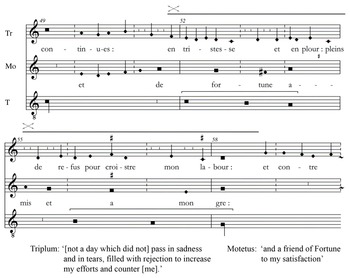
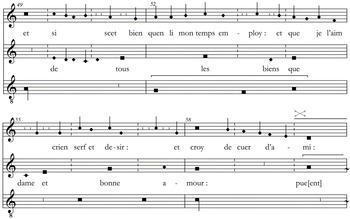
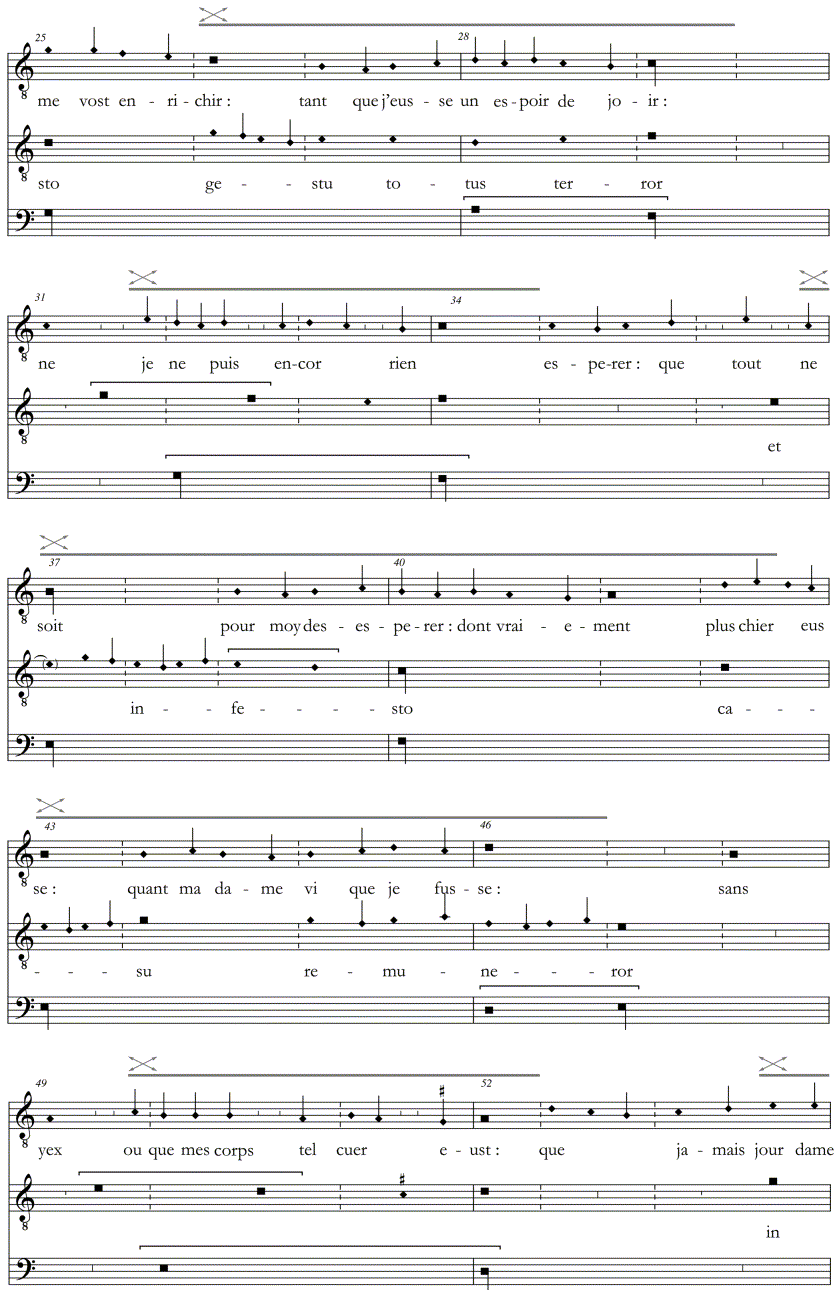
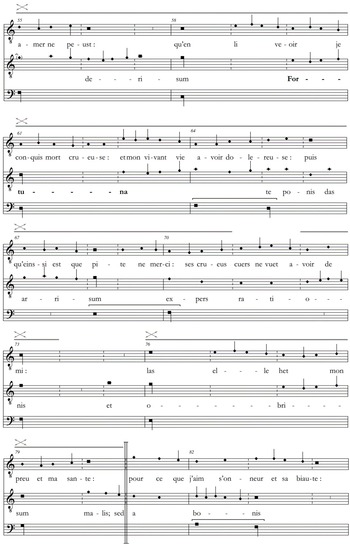
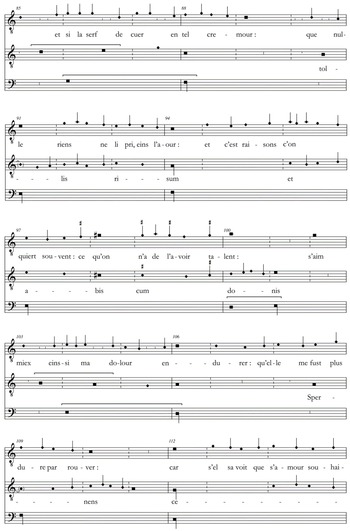
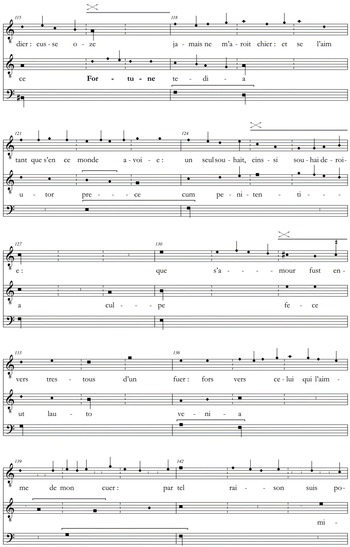
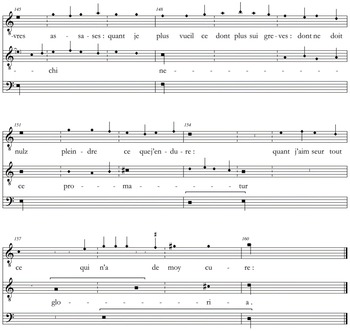
Fortune is a fickle goddess. To be scorned for her unfairness, to be berated for her deceit – these are her functions within the French lyric tradition, where her name almost always appears in the context of a lover's complaint. Thus it seems strange to hear the deity praised as an ally by the motetus of Machaut's Motet 14, Maugré mon cuer/De ma dolour/Quia amore langueo: ‘[I am] a friend of Fortune to my satisfaction’, the happy lover proclaims.Footnote 1 And as if to ensure that we do not miss this extraordinary admission in the motetus voice, the triplum drops down from its customary position, allowing the motetus to sound at the top of the texture as though carried up by its jubilation (see Example 1, where the voice-crossing is marked with arrows).Footnote 2 A subversion of the poetic norm is thus accompanied by a reversal in registral hierarchy. Significantly, these unusual circumstances coincide also with a moment of marked intertextual opposition: while the motetus brags on, the normally higher triplum, here relegated to the middle of the texture, complains of the usual courtly state: tears, sadness and futile efforts. What does Machaut's use of a voice-crossing at this contradictory moment signify?
Motet 14, breves 49–59

To answer this question it is necessary to examine Machaut's use of crossed voices in the motets more generally. Against a backdrop of ‘normal’ usage, we will find several remarkable passages that cue a network of ideas connected with Fortune, including circularity, reversal, contradiction and falseness.Footnote 3 In this context Motet 12, Helas!/Corde mesto/Vidi dominum, will emerge as the work in which Machaut's use of voice-crossing to comment upon Fortuna's actions is at its most systematic and accessible. I will then turn to Motet 15, which cleverly reuses and reinterprets some poetic and compositional devices developed in Motet 12. Finally, I will return to the above-quoted passage and to Motet 14, in which Fortuna's presence is more subtly signalled, though no less pervasive.
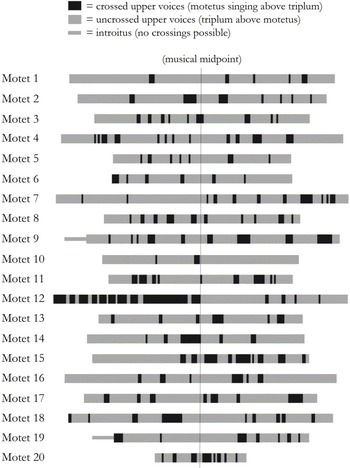
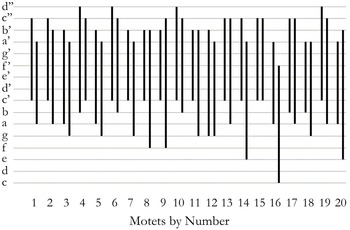
The question of voice-crossing in Machaut's motets has rarely been addressed by scholars.Footnote 4 The ‘voice exchange’ technique of earlier repertories was generally abandoned after 1300, giving way to the gradual registral separation of the upper voices that produced the tenor–motetus–triplum arrangement found in many fourteenth-century motets and discussed by theorists of the time.Footnote 5 It is often true that a motetus is, as Ernest Sanders defines it, the ‘voice immediately above the tenor’.Footnote 6 And yet, Machaut's first twenty motets contain some 165 instances in which the motetus sings above the triplum and tenor – a phenomenon I will refer to here as ‘voice-crossing’.Footnote 7 Together, these passages account for approximately 17 per cent of the combined length of the motets (Figure 1 represents these voice-crossings by dark shading for Motets 1–20). Indeed, such a statistic is not difficult to believe of voices that are often close and sometimes identical in range (ranges for each of the first twenty motets are indicated in Figure 2).
Voice-crossings between triplum and motetus in Machaut's Motets 1–20

Ranges of upper voices in Motets 1–20

But attributing these crossings to the similar ranges of voices does not tell the whole story. A comparison of Figures 1 and 2 reveals that closeness of range does not appear to be a primary determining factor of the likelihood of voice-crossings. The upper voices of Motets 6 and 10, for example, have nearly identical ranges, but cross three times more often in the former than in the latter. The same situation exists in Motets 3 and 5. Thus there is no strong correlation between the closeness of the upper voices in range and the frequency of their crossing. This would suggest that Machaut's local control of range is at least partially independent of a given part's ambitus in relation to other voices in the same work.
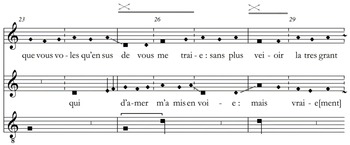
Scrutiny of specific crossings confirms the intentional nature of the device. Consider the passage from Dame, je sui cils/Fins cuers dous/Fins cuers doulz (Motet 11) reproduced as Example 2. The crossing in bars 25–6 is only made possible by the downward fall of a fifth in the triplum (indicated in the example by a diagonal line between the notes). This sudden change in ambitus allows a remarkable imitative passage to occur, with the motetus repeating the triplum's bars 23–5 as its own 25–7. In the course of this imitation the motetus leaps down a fifth in bar 27, allowing the triplum to continue the imitation with its a′–g′–a′.Footnote 8 The crossing that follows in bar 28 marks the beginning of a new line in the motetus: the sounding of this voice above that of the triplum draws attention to a new syntactic verse. Neither of these crossings is necessitated contrapuntally, nor do they result in smooth vocal lines; rather, they are deliberately punctuated (and caused) by unusually wide leaps.
Motet 11, breves 23–9

There are only two other melodic leaps of a fifth in this motet, also between d′ and a′, and they too serve to facilitate transitions between crossed and uncrossed voices. In Motet 11, then, crossings between triplum and motetus are achieved only by means of large intervals. If Machaut had simply redistributed the melodic material to avoid registral exchange and allow for smoother melodic lines, the ‘sonic image’ of the piece would not be radically different – the same notes would sound, though they would be texted differently. But as it is, the motet is written with crossings, and the conclusion must be that here they are deliberate.Footnote 9
Bar 28 of Example 2 deserves a second glance because it is typical of Machaut's voice-crossings. Indeed, approximately 70 per cent of the crossings in his motets begin with the start of a poetic line, whether in triplum or motetus, and last at most a few breves. The purpose of these crossings, which I believe to be the intelligibility of the motetus text, is beyond the confines of this study.Footnote 10 But what is significant here is that, regardless of their purpose, Machaut's voice-crossing practices are extremely regular. Against the background of these typical crossings, certain remarkable passages in his works come into greater relief.
Let us briefly return to Figure 1. Even a passing glance reveals that this crossing from Motet 14 is noteworthy. At eight breves, it is among the longest in the motets. Furthermore, it is conspicuously placed, ending just before the midpoint of the piece (the vertical dotted line in Figure 1 marks the midpoints). But nothing speaks as clearly for the purposefulness of Machaut's use of voice-crossing as Motet 12, Helas!/Corde mesto/Vidi dominum. As Figure 1 shows, the motet's two halves employ two entirely different vocal hierarchies (an edition of Motet 12 is given as Appendix I). In its first half, there are only six or seven breves in which the motetus is in its customary position below the triplum; the rest of the time, the voices are crossed. But after the midpoint, there are no more than five or six breves of crossings; elsewhere, the motetus is in its usual place ‘immediately above the tenor’.
What could have motivated Machaut to compose such counterpoint? Motet 12's crossing – and uncrossing at the midpoint – cannot be merely a by-product of voices that are too close in range, since this would have resulted in crossings throughout the piece, not just in the first half. Moreover, the crossings that dominate the motet's first eighty breves are entirely inconsistent with Machaut's usual practice, being much longer than usual and coinciding only rarely with the beginnings of poetic lines. These circumstances, combined with the careful placement of the point of uncrossing at the midpoint of the piece, suggest a deliberately conceived and executed authorial plan – something as central to the form of the piece as the tenor's color and talea.
That midpoints are important in Machaut's musical and poetic works is often stressed,Footnote 11 but a midpoint as starkly articulated as that in Motet 12 is hard to find. The question all but inevitably follows: is there anything in the text to warrant such an unusual manipulation of the musical texture?
THE MOTETUS CORDE MESTO CANTANDO CONQUEROR
Helas!/Corde mesto/Vidi dominum (Motet 12) is unusual in Machaut's oeuvre for mixing upper-voice texts in two languages: its triplum is in French; its motetus, Latin (see Appendix II for full texts and translations).Footnote 12 This disparity in language between the texts is matched by another in poetic voice. The triplum keeps to a stylised courtly register, presenting us with the familiar figure of a lover whose lady ignores his affection and suffering. The Latin motetus, however, does not fit comfortably into the conventions of any one poetic register. In the first stanza the speaker seems to be a usual courtly lover complaining of his lady's indifference to his suit. The second stanza represents a generic complaint against Fortune's unfairness. And by the third stanza the lover has waxed religious, turning to prayer and penitence, ‘that to me, cleansed of the filth of guilt by forgiveness, at my death may glory be given’. As a whole, then, the motetus text represents a sublimation of love into purely religious fervour.Footnote 13 Now, we should not be surprised to find amorous desire transformed into something more noble and lasting in Machaut's poetry. Indeed, Sylvia Huot sees the ‘elaboration of a love independent of desire’ as ‘a hallmark of Machaut's poetry’.Footnote 14 However, the third stanza of the motetus goes rather too far. Instead of the usual repainting of the lady as eternally available to the lover's imagination, though unyielding to his desire, the text rejects her outright. This kind of sublimation is much rarer in Machaut's work.Footnote 15
If stanzas 1 and 2 are part of the usual courtly register, then Stanza 3's sudden shift seems inexplicable. But does the shift occur there? Or is there something in the middle stanza to help explain the ultimate rejection of fin'amors? The topic of the second stanza has been identified by Huot as ‘the implicit allegorisation of the courtly lady as Fortune’.Footnote 16 That is, where in the first stanza the focus is on the protagonist's futile servitude, the second stanza addresses – not his lady, but the goddess:
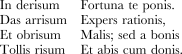
Is Fortune identical with the lady implied in stanza 1? It is possible to read the text that way. However, the middle stanza can also be read as separate both from what came before it and what comes after, if we consider its context to be not courtly, but purely Boethian.
The influence of Boethius's Consolation of Philosophy on Machaut's work generally, and his motet texts specifically, is well known and extensive.Footnote 18 And indeed the Consolatio, with its insistence that those suffering injustices should merely turn to God, who ‘orders all things and directs them towards goodness’ despite occasional appearances to the contrary, is a comfortable fit with the change of focus that takes place in the text's second stanza.Footnote 19
Thus the three stanzas of Motet 12 live in three different realms: courtly – philosophical – religious. And it is philosophy's Consolation that creates the shift from the first to the third. We leave the Dame behind in the first stanza, only to encounter her much less nice allegorical twin in the second. And if there were to be a lady in the final stanza, perhaps it would be Our Lady. Fortune, a goddess but a disreputable one, thus mediates between the earthly and the divine.Footnote 20
SINGING FROM FORTUNE'S WHEEL
Behind every medieval description of Fortune lies the image of the tool through which she interferes in human affairs: her ever-spinning wheel. Its four inhabitants articulate the cardinal axes of the wheel: at the top sits a king, labelled ‘regno’ (I reign); at the bottom, a powerless fool or drunkard ‘sine regno’ (without a kingdom). On the left and rising to the top is the aspirant who will reign, ‘regnabo’, and on the right, falling towards the bottom is the has-been, ‘regnavi’ (I have reigned). That the wheel is symbolic is clear; its inevitable turning means that the well-being of those on it is for ever in a state of flux. And while Boethius and those following in his tradition often draw upon the metaphor's explanatory power, there is also a physical aspect to the turning of the wheel: the vertical motion, in real space, of those on it. It is this motion that is on the mind of the narrator of the Roman de la Rose after Jealousy has imprisoned his beloved Fair Welcome: ‘She has a wheel that turns, and when she wishes she raises the lowest up to the summit, and with a turn plunges him who was on top of the wheel into the mud.’Footnote 21
These words, in fact, are an apt description of a voice-crossing, where a normally low voice is raised to the highest place, while the highest voice is plunged downwards. The image of Fortune's wheel aligns happiness and sadness with the vertical extremes of the circle itself, and the central stanza of the motetus in Motet 12 echos this alignment: the strongly articulated musical midpoint (marked ‘|’ below and in breves 80–1 of the edition in Appendix I) is centred between ‘malis’ (the evil men) and ‘bonis’ (the good). And because of the voice-crossing, ‘evil’ is indeed raised up, while ‘good’ is sung at the motetus's normal range, below the newly restored triplum (compare bars 80 and 82–3). Meanwhile, Fortune herself is close at hand. She appears twice in the text, once before and once after the midpoint, first helping the mali, then hindering the boni:
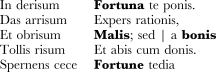
I suggest that the extended crossing and uncrossing of voices in Motet 12 actually depicts the effect of Fortuna upon her victims and thus achieves a musical representation of the goddess's spinning wheel. The moment of uncrossing is perfectly centred between the ‘evil’ men whom she has placed at the top, and the ‘good’, who are relegated to the bottom. In the first stanza, while she has influence over the speaker, his world is, as it were, inverted, and it is only with his refutation of Fortune's claim on him that the speaker can see things as they are. The motet stages the change from a world controlled by Fortune to one that is free of her wickedness by returning to its own natural state (triplum above motetus) in the centre of the pivotal Boethian stanza.
Can we not see in all this the lover, sitting on Fortuna's wheel and singing of his woes, as he and his song are raised up to the highest level, only to be plunged downwards into the mud? The singer is doubly unlucky: unlucky in having the woes of which he sings, and unlucky in that the very notes of his song seem to be controlled by Fortune: while speaking about her unfairness, he finds himself subject to it; while singing that the good are thrown down, he and his voice are cast into the abyss.
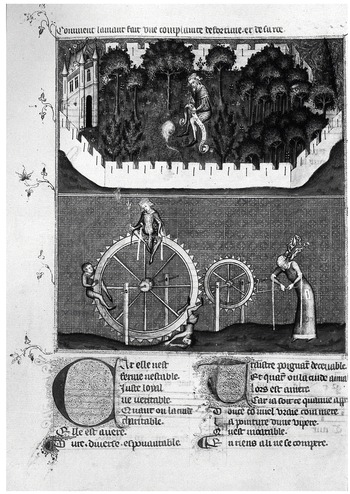
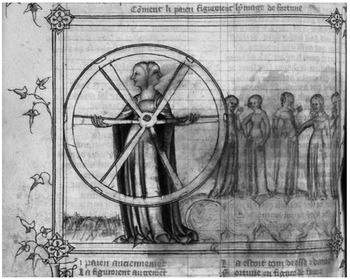
Just such a scene – that of the lover sitting on Fortune's wheel – is depicted in the famous illuminated miniature that accompanies Machaut's Remede de Fortune in Paris, Bibliothèque Nationale de France f. fr. 1586 (Machaut Manuscript C). While ‘the lover composes a complainte about Fortune and her wheel’ in the top frame of the image, the contents of his complainte play out in the bottom frame (see Figure 3).Footnote 22 There, Fortune cranks a wooden gear which causes her own wheel to turn. The machine is at once fantastical and practical, perhaps reminiscent of a real Fortune's wheel built for clerical or courtly entertainment and apparently giving the goddess a 4:3 mechanical advantage.Footnote 23 In addition to the rare iconography of the gears, another departure from the usual awaits the viewer in the person representing ‘regno’ on top of the wheel. Though usually depicted as a crowned king, the figure here wears a small pink cap. As Dominic Leo has shown, this garment is rare in fourteenth-century iconography and seems in the Machaut manuscripts to be reserved for the author and his lady.Footnote 24
The lover composes a complainte about Fortune and her wheel. Paris, Bibliothèque Nationale de France, f. fr. 1586 (Machaut MS C), fol. 30v

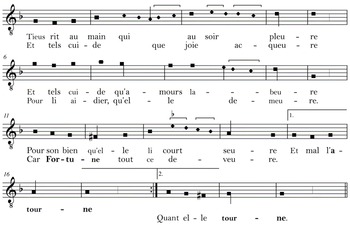
The complainte being illustrated, Tels rit au main qui au soir pleure, is a discursive tour de force whose 576 lines in thirty-six strophes focus obsessively on Fortune. Though eventually the tone settles down into a courtly lover's complaint, the first strophe is clerical in tone, focusing on the character and actions of Fortune. Here, the action of turning dominates the text. The use of ‘-ourne’ as one of the strophe's two rhymes echoes that choice, causing the sound as well as the sense of the phrase to turn constantly:
The musical setting highlights the ‘-ourne’ rhyme-sounds and adds its own circularity: the first appearance of ‘tourne’ (in ‘et mal l'atourne’) coincides with a repeat, and thus leads immediately to a return to the beginning (Example 3, longs 15–17). In both musical and textual terms, the action of turning dominates here. Such emphasis is no accident in the important first stanza of the complainte, and speaks rather to Machaut's tendency to foreground this aspect of the goddess's character.Footnote 26
The Lover's complaint about Fortune, from the Remede de Fortune (longs 1–10)

The image on the other side of the parchment page in MS C echoes this arrangement.Footnote 27 Representing the contents of the Complainte, it shows us the lover, and therefore the singer, momentarily perched on top of the wheel. I picture the singer situated exactly thus within the imaginary world of Motet 12: as Fortuna's wheel goes round, his notes follow suit, their pitch at the mercy of a sort of allegorical Doppler effect.
But if in one sense the structure of Motet 12 depicts the effect of a spin of Fortuna's wheel, in another it depicts that wheel itself by invoking circular imagery. There are several contemporary precedents for connecting music and the visual. Guillaume tells us in his Prologue that ‘Musique est une science’.Footnote 28 Not only can it morally influence the hearer in an Aristotelian manner, it can also have visible manifestations: ‘ce sont miracles apertes / Que Musique fait’.Footnote 29 The circle is inherent in the name of the rondeau, a relationship which Machaut underlines in his famous Ma fin est mon commencement et mon commencement est ma fin. Though the words describe the retrograde canon that forms the piece, they are also a riddle that has a circle as its answer – any point on a circle is its end and its beginning.
The analogy of fourteenth-century musical forms to geometric patterns is evocatively summarised by Daniel Poirion:
the formal structure [of the formes fixes] provides the language with a parallel to the system of the universe. The ballad looks like a trefoil … the rondeau has a small circle inscribed around a larger one; the virelai has three circles bound together … the motet, which distributes text among different levels, or we could say different spheres … [has] the story of the lover circling about a religious prayer … The polyphony reflects the cosmos' hierarchy, with its homocentric spheres. Man himself is subject to similar movements. Footnote 30
In other words, the circular movement of the heavens is mirrored in man's trajectory through a motet. As he circles around its sacred tenor, his motion might well trace the outlines of a ruthlessly turning wheel.
Is a listener meant to see a circle in his mind's eye while listening to such a piece? It seems probable that this would be part of the experience. For it is right around this time – in the first half of the fourteenth century – that visualisation is usually considered to have emerged as a new and persistent mode of cognition. Johan Huizinga already saw the importance of this change, noting that ‘the basic characteristic of the late medieval mind is its predominantly visual nature’, though he characteristically linked this tendency ‘to explain images through images, and to hold up mirrors to mirrors’ with ‘the atrophy of the mind’.Footnote 31 More recent studies have celebrated the change, connecting it instead with broader developments in quantitative reasoning, painting, and composition.Footnote 32
As visually suggestive ideas go, that of Fortune is perhaps one of the most vivid. The link between the goddess and the notion of circular movement through different spheres is explicated by Boethius in the Consolatio. When the narrator asks Philosophy about the relationship between Fate (Fortune) and divine Providence, her answer is geometric in its precision:
Imagine a set of revolving concentric circles. The inmost one comes closest to the simplicity of the centre, while forming itself a kind of centre for those set outside to revolve round … Anything that joins itself to the middle circle is brought close to simplicity, and no longer spreads out widely. In the same way whatever moves any distance from the primary intelligence becomes enmeshed in even stronger chains of Fate, and everything is the freer from Fate the closer it seeks the centre of things. The relationship between the ever-changing course of Fate and the stable simplicity of providence is like that between reasoning and understanding, between that which is coming into being and that which is, between time and eternity, or between the moving circle and the still point in the middle.Footnote 33
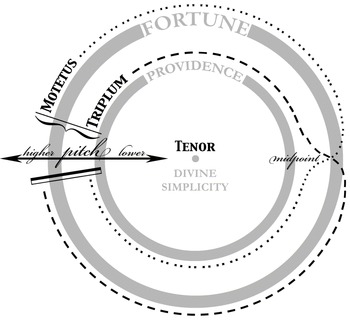
Here, circular imagery is used as an exemplum to explain a universe in which bad things often seem to happen to good people. The smaller circle represents divine providence, while the larger is the means by which Fortune inflicts pain on those who stray too far from the divine ‘simplicity of the centre’.
In the light of all this, I suggest that the motetus of Motet 12 may be seen as moving between Boethian spheres. Before the midpoint, the unfortunate narrator endures and implores Fortune. While he is in her power, he necessarily inhabits Boethius's outer circle, where he is subject to the goddess's fickle whims. But after the midpoint, Fortuna is spurned and nullified by the speaker's religiosity. Refuting the goddess's claim on him, the lover is able to move inwards to the circle of Providence, where he is musically and semantically closer to the motet's sacred tenor.
Figure 4 diagrams the proposed reading, which equates Motet 12's voice-crossings with shifts between Boethius's concentric circles. Here pitch and virtue find themselves on the same axis: the outermost circle, a space for the topmost voice, is Fortune's realm. The inner circle, Providence's domain, contains the middle voice. And the tenor, the only voice in this motet that is unmoving in terms of its relative register, is in the centre of the circle, sharing space (appropriately, given its origin in chant) with divine simplicity. The triplum does not participate as obviously in the shifts of meaning – its text remains courtly throughout and therefore (presumably) in the realm of Fortune. However, Boogaart has argued that the triplum can in fact be split into two semantic halves: ‘the text is divided exactly in half: during the first half of the poem the poet only complains about his distress, whereas in the second half he accepts suffering and wants to suffer even more, to reach a higher degree of merit than others “for whom the love of the Lady is equally of value”’.Footnote 34 Thus the triplum may be shifting spheres as well. Nearer to the centre, he perceives his lady's unjust ways and complains bitterly. But after the midpoint he is forced silently to endure ill treatment back in cruel Fortune's domain. Thus both voices can be said to undergo a transition at once registral and philosophical.
The voices of Motet 12 mapped onto Boethius’ concentric circles

If the analogy between circular spheres and pitch seems far-fetched, we need only recall Baude Cordier's Tout par compass. This famous rondeau is notated on two concentric circular staves: the outer transmits a canon for the upper voices, the inner contains the tenor. The arrangement of a smaller circle within a larger one is reminiscent of Boethius' description and also powerfully evokes (or provokes?) Poirion's idea of the song as inhabiting several different spheres.
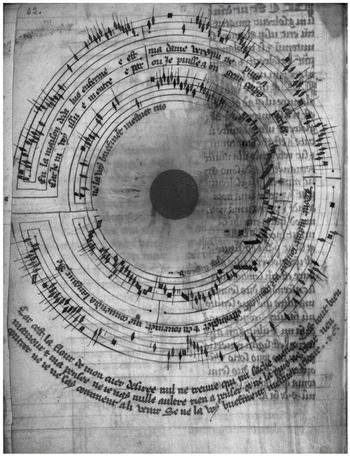
We see a similar arrangement in an earlier and less often cited example of circular notation, the canonic ballade En la maison Dedalus, preserved in Berkeley's Music MS 744 (see Figure 5).Footnote 35 Whereas Tout par compas refers simply to a circle, ‘as befits a rondeau’,Footnote 36 the earlier ballade references Daedalus’ labyrinth, in which the singer is lost:
En la maison Dedalus. Jean Gray Hargrove Music Library, University of California, Berkeley, MS 744, p. 62

The arrangement of the piece in the manuscript cleverly takes up the idea of the labyrinth, so that the return to the beginning that a singer normally makes in a ballade is reconstrued as part of the labyrinth's winding path.Footnote 38 And given the difficulties in this outer stave, it is easy to imagine that the singer's striving is inwards, towards the centre, where his love is presumably imprisoned.Footnote 39 In fact, he almost gets there: since the canonic upper voices do not fit completely onto the outer circle, they must move inwards for their last line. In the inner circle they encounter the tenor and share a staff with it for long enough to say that the lover will die if he does not find his lady soon. The spinning of the first part of the song seems resolved, and the move inwards is the only one that would allow stillness, in this case perhaps the stillness of death. But then a new strophe begins, and the lover must again move outwards, cast back to the entrance of the labyrinth by a pitiless and unrelenting form.
What both circular chansons have in common is the association of the centre of a circle with the tenor of a work – an arrangement I am suggesting also for Machaut's Motet 12. But En la maison Dedalus goes a step further than the later rondeau, in that its outer/upper voices profess a desire to leave the outer circle and move inwards – to be, in other words, closer to the tenor. Even more so than Tout par compas, the ballade illustrates the tension between a poetic yearning for stillness and the same musically induced perpetual motion that is dramatised by different compositional means in Motet 12.
Quite apart from symbolic considerations, layout also helps explain the choices made by scribes and composers for the circular pieces: upper/outer voices have more notes than lower/inner ones. The same holds true for Machaut's motets: the tenor, motetus and triplum operate on increasingly complex levels of rhythmic activity, with the result that the triplum has the most notes, the motetus fewer, and the tenor fewest. By the same reasoning, the three voices of a motet could fit on three concentric circles, with the tenor at the centre (as in Tout par compas) and the triplum on the outermost orbit. It is not hard to imagine these motets curling up around their own tenors, even as they evoke the ‘order perfectly proportioned’ that their texts describe.Footnote 40
CECE FORTUNA AND BLIND ISAAC
Though the motetus is able to escape ‘cum penitencia’, a closer look at Motet 12's other voices reveals that they too are subject to Fortune. The triplum text is a seemingly standard courtly text, in which the lover bemoans his lady's harsh treatment. It is built around the oft-repeated paradoxical problems of courtly love: the lover desires the lady, but in doing so he desires that which may hurt him. Though the theme is a fundamental one, it receives almost too much emphasis in this text:Footnote 41
nor can I even now hope for anything / that would not be wholly to my despair. (ll. 7–8)
we often pursue / that which we have no wish to possess (l. 21)
I most want that by which I am most grieved (l. 32)Footnote 42
I love above all else that which does not care about me (l. 34)
By stressing unfair duality, the lover is strengthening the affinity between his lady and Fortune, who is indeed cruel to the good.
Equally telling is the fact that the triplum text twice mentions the eyes: ‘Why did my eyes ever see my dear … lady?’ (l. 1) and ‘if I had been / without eyes’ (l. 11). Though Machaut's motet texts often mention seeing, nowhere else does he name the organs of sight.Footnote 43 Meanwhile, the motetus complains of ceca Fortuna – blind Fortune. The depiction of Fortune as blind is common in medieval art and literature. In fact, we have already seen her in this guise in Figure 3 (see above), where she is blindfolded. The Roman de la Rose proclaims that Fortune is not only blind herself, but also blinds her victimsFootnote 44 – a theme taken up by Machaut in his Voir Dit:
By focusing on eyes and on paradox, the triplum glosses two important aspects of Fortuna, but does so from within its own courtly world. And yet, if we remember the ambiguity as to the lady's identity in the first stanza of the motetus, where the offending goddess has not yet been named, the similarities between the two voices are brought once more into focus. The triplum's lady might well be Fortune; the motetus's Fortuna might well be a lady.Footnote 46
Not surprisingly, the tenor of Motet 12, ‘Libera me’, also fits into this web of associations. Its text is Jacob's plea from Genesis 32: 11: ‘Libera me, domine, de manibus Esau, quia valde contremit cor meum, illum timens’ (Free me, Lord, from the hands of Esau, for my heart quakes greatly, fearing him). Esau indeed had cause to be angry with Jacob, who had tricked their father Isaac into blessing him, even though the honour properly belonged to Esau as firstborn. Jacob accomplished his trick because his father was not only old, but also blind. Thus Isaac, like Fortune, blesses the ‘wrong’ person. Giving riches to the false Jacob, he leaves Esau, who had been promised the blessing, to fend for himself.
Thus Fortune invades the contents of all three voices of Motet 12. Obviously present in the motetus and dividing that voice in two, she effects a similar division in the triplum, lending it her paradoxical nature and hinting at a likeness between herself and the dame. As for the tenor, a new dimension is now added to the biblical story it references. We are accustomed to reading the upper voices of medieval motets as derivative of the sacred tenor: in Robertson's estimation, Machaut's motets are ‘secular-looking’ but are at heart the description of a spiritual journey.Footnote 47 But if the upper voices of Motet 12 are a gloss on the tenor, they are not a particularly orthodox one. Recasting the biblical story in a new light, the triplum and motetus offer a reading that stresses Isaac's blindness and his unfairness and dresses Jacob and Esau in the costumes of Regno and Regnavi. The result is as much a casting of the biblical source in a secular light as it is the opposite. Nor is the comparison between Fortune's actions and the story of Jacob and Esau limited to Motet 12, as I will argue in the following discussion of Motet 15.
CONTRADICTORY GESTURES IN MOTETS 15 AND 12
A final glance at Figure 1 and its shaded beams reveals that there is another motet in which voice-crossings seem to be more prevalent in one half than in the other. This is Amours qui a le pouoir/Faus Samblant m'a deceü/Vidi Dominum, Motet 15. Here the pattern is reversed: it is in the second half that the motetus tends to sing above the triplum. Granted, there is no strongly articulated midpoint here, and the frequency of crossing is not as great. If it were not for the case of Motet 12, there would perhaps be no reason to pay any special attention the voice-crossings in the second half of Motet 15. But given Motet 12's programme, we can ask: is there any kind of reversal at the heart of Amours/Faus Samblant/Vidi Dominum? Indeed, there is. We have a good deal of analytical perspective into Motet 15 thanks to a pair of articles by Margaret Bent and Kevin Brownlee.Footnote 48 Their full reading of the motet need not be rehearsed here, but two important points of similarity between Motets 12 and 15 should be noted: one in the motetus, one in the tenor.
A remarkable aspect of Motet 15 is the division of its motetus into two semantically opposite halves of its motetus. In the first half (ll. 1–6), False Seeming has deceived the lover, causing him to hope. In the second half (ll. 7–12) he undeceives, showing the lover his true unhappy fate. Thus, the motetus text of Motet 15, like that of Motet 12, cuts nicely in half to reveal two contrasting states of courtly being: first elated, then dejected:Footnote 49


And if our experience with Motet 12 leads us to posit that the point of voice-crossing would fall at the division between the two texts, we are not far off. In fact, the uncrossing occurs not at the exact midpoint, but on the words ‘m'a descongneu’ – ‘Has undeceived me’. This seems an appropriate place for a crossing, in that it stages a reversal.
The biggest obstacle to reading Motet 15 as a parallel to Motet 12 is, of course, the absence of Fortune. However, it seems that she is there in spirit. Indeed, the tenor voice here, as in Motet 12, is in the words of Jacob – that same deceitful son whose blind father ought not to have blessed him. And his words, ‘Vidi Dominum facie ad faciem’ (I have seen the Lord face to face), recall his duplicity and deceit. In Bent's reading:
Jacob is yoked to [the motet's theme of falseness] by his own earlier ‘two-faced’ deception of his father Isaac (by cheating his older twin brother Esau both of his birthright and of his father's blessing), as he was in turn deceived by Laban when he served seven years for Rachel and was then given her sister Leah … Jacob's twinned relationship to deceit, as both a perpetrator and a victim, is implicit in the choice of his words; his two-faced history is now resolved in his face-to-face encounter with his God.Footnote 51
Though Bent does not link Jacob to Fortune, but only to Faus Semblant, the connection is implicit. Jacob has faced the ups and downs of Fortune, first reaping her benefits with his undeserved blessing, then being cast down and himself victimised. Furthermore, the tenor's words ‘facie ad faciem’ may in themselves be enough to recall the goddess, since she is often depicted with two faces (see Figure 6). Finally, the theme of deception is strongly linked to Fortune – a point to which I will return below.
A two-faced Fortune from the Livre dou Voir Dit, Machaut MS A, fol. 301v, reproduced from Machaut, Le Livre dou Voire Dit, p. 596

Thus much unites these two motets, and the use of crossed voices for half of each becomes more than coincidental: it becomes thematic. Is there anything to the fact that the state of undeception is represented in one as uncrossed voices, and in the other as crossed? Is Motet 15 an answer to Motet 12, rejecting its vision of a rational world and reminding us that even the undeceived lover is still subject to Fortune's vicissitudes? In this view Motet 15 might be a rejection of the Boethian claim. Or is Motet 12 the answer to Motet 15's question, arguing that the realisation of a lady's inconstancy is not enough to set the lover free: he must cease to be a lover.Footnote 52 I do not want to push one answer above the other, especially as they take us into the tricky realm of compositional order. But clearly there is a kind of conversation going on here, and we can listen in, and perhaps weigh in, if we listen carefully enough.
Motet 15's voice-crossings have never been commented upon. Those of Motet 12 have been discussed rarely and only tentatively linked to Fortune.Footnote 53 And though the analyses of Motet 15 already cited have placed much emphasis on the upper-voice texts, most commentators on these motets – indeed, on Machaut's motets in general, follow a bottom-up approach, where the tenor text dictates the terms and extent of analysis. But though they certainly confirm the ideas expressed in the upper voices, the tenors of Motets 12 and 15 do not have the kind of explanatory power that the motetus wields in each case. And thus the usual bottom-up approach to these motets naturally leads to much more general readings, since the words ‘Free me’ and ‘I have seen the Lord’, even with their exegetical context, are much less detailed and therefore easily adaptable to any reading.Footnote 54 However, if we view these works first through the lens of their motetus voices, the interesting connection between Isaac's blindness and that of Fortuna is highlighted in Motet 12, and the dramatic structural schemes of both motets can be reconciled with the texts of all of their voices.
To be clear: I am not suggesting that we always look first to the motetus. It seems that each motet will suggest its own point of entry, perhaps with a textual detail, or perhaps with a formal device such as voice-crossing. Significantly, in Motets 12 and 15 it is not a subtle, but a rather large and obvious formal gesture that takes centre stage in each case. And, as it happens, both readings begin in this case with the motetus – a procedure which has led me to a kind of ‘inside-out’ analysis, one that places the upper voices, and their texts, on an equal footing with the texts of the tenors.Footnote 55 I believe that the resulting readings bring us closer to the ‘interest’ these pieces might have held for their creator, performers and listeners.
At the end of such an inside-out analysis, Motet 15's texts, which already seemed unified, are enriched by a possible intertextual link with Motet 12. And the three texts of Motet 12, whose content seemed at first to be unconnected if not mutually exclusive, are brought into semantic unity. But where Motet 12's voices seemed benignly disjointed, the texts of Motet 14, with which I began, apparently stand in direct conflict. Can an attention to crossings help in a situation that seems wholly contradictory?
MOTET 14'S LYING VOICES
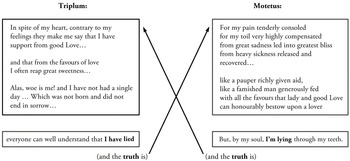
Of all of Machaut's motets, Maugré mon cuer/De ma dolour/Quia amore langueo (Motet 14) contains the most strikingly contrasting upper-voice texts. Here the triplum says that those who force him to sing happy songs cause him to lie, because he is in fact miserable and endures all manner of ill-treatment at the hands of his lady: ‘Never did my noble and gentle-mannered lady give any joy to my constant and suffering heart’ (ll. 15–18; see full texts and translation in Appendix III). Meanwhile, the motetus declares his good fortune where matters of love are concerned: he is ‘like a pauper richly given aid, like a famished man generously fed with all the favours that lady and good Love can honourably bestow upon a lover’ (ll. 8–11). Then, in the final line of each text, each speaker seems to negate everything that he has said: ‘everyone can well understand that I have lied’, admits the triplum in an echo of the motetus's confession of the previous breve: ‘by my soul, I'm lying through my teeth’. A large amount of shared vocabulary at this and other points confirms that the two voices were clearly conceived together.Footnote 56 And indeed, unlike the voices of Motet 12, which occupy different linguistic and semantic spheres, the triplum and motetus of Motet 14 are similar in tone. Yet their contradiction is perhaps more striking than their similarities. Although some have read the voices as being in agreement,Footnote 57 others see oppositional,Footnote 58 or even paradoxicalFootnote 59 relationships between them.
If the voices are in disagreement, then their final lines must be read as mutually contradicting. Thus for the triplum, the reality would be the state of affairs described by the motetus, while for the motetus the triplum's complaints are the truth. This arrangement has been described by Marie-Bernadette Dufourcet as ‘opposition symétrique’, and would strongly suggest two speakers, or one speaker in two distinct situations. This dual opposition is represented in Figure 7.
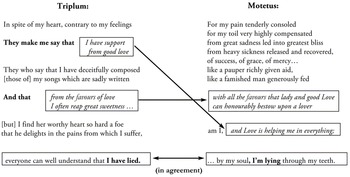
However, another interpretation of the relationship between the voices is possible – one which neither pits them against each other, nor equates them. The triplum complains of having to sing that he is comforted by good love. Could the motetus be an example of the kind of song the triplum is forced to perform? An indication that the motetus text may well be the triplum's falsely written song is found in the fact that the motetus text contains the two specific things that the triplum bemoans being forced to sing. ‘They make me say’, says the triplum, ‘that I have support from good Love’ (ll. 2–3) and the motetus indeed claims that ‘Love is helping me in everything’ (l. 10). The triplum is also forced to sing that ‘from the favours of love (biens amorous) I often reap great sweetness’ (ll. 6–7). The motetus incorporates this sentiment too, saying that he is well provided ‘with all the favours that lady and good Love (biens que Dame et bonne Amours) can honourably bestow upon a lover’ (ll. 8–9). Thus the triplum's description of the saccharine chans he is obliged to perform perfectly fits the motetus text (see Figure 8).
The motetus and triplum of Motet 14 in opposition

The motetus and triplum of Motet 14 in agreement; the motetus as a song

The idea of the motetus as the triplum's song is strengthened by its stylised and rhetorical structure, with repeated initial line sounds and internal rhymes: ‘De ma dolour … ’, ‘De mon labour …’, ‘De grant tristour …’, ‘De grief langour …’, etc. The parallel grammatical construction of the first four lines and the intricacy of the single sentence that takes up lines 7–11 also serve to heighten our sense of the artfulness of the text. Within this careful structure, the content and diction are well in line with the amorous register of the lyric je of Grand chant courtois, whose own poetic persona is, in Kevin Brownlee's formulation, ‘identical with his song and with his love’.Footnote 60 The triplum, in contrast, adapts the identity of ‘Poet-Narrator as Lover-Protagonist’.Footnote 61 Not only does he tell us in lines 4–5 that he has written songs (‘j'ay fait … mes chans’), but his text opens and closes with allusions to his audience: in the beginning, it is they who make the poet say that he is happy, and in the last line, each of them (chascuns) can well know that the poet has lied.
A very physical example of the relationship I am proposing between triplum and motetus can again be seen in the Remede de Fortune image in Figure 3. One frame shows the lover composing a complainte, while the other shows the scholar/narrator participating in his own creation. The lower image of the illumination is a product of, and provides more information about, the upper. Machaut's Motet 14 works in exactly this way: the amatory motetus is generated by the authorial triplum and acts as a thematic expansion of it.
A final corroboration of this proposed relationship between motetus and triplum is found in the tenses of the statements of lying that conclude each text. The motetus lies in the present – ‘je mens’ – while the triplum notes a past lie one breve later, using a perfect tense – ‘j'ay menti’. Thus both statements can easily refer to the same lie, and the concluding remarks of the upper voices are not opposite, but equivalent. In both cases, the lover is unhappy in his love.
THE DISHONESTY OF POETS
In fact, it is precisely the question of truthfulness that aligns the triplum of Motet 14 so strongly with the poetic voice, since the veracity of poetry, and therefore of poets, was traditionally in doubt. We find a pithy presentation of this attitude in Conrad of Hirsau's twelfth-century Dialogus super auctores. Here, the grammarian defines a ‘poet’ as ‘a maker (fictor), or one who gives shape to things (formator), because he says what is false instead of the truth, or else sometimes intermingles truth with falsehood’.Footnote 62 In fourteenth- century French literary circles, Jacqueline Cerquiglini-Toulet has demonstrated the centrality of the concern that a ‘professional’ poet's honesty is compromised by his audience's demands – a tendency to question the veracity of the poet-dependant that arose from a conflict between aesthetic and social conditions for poets who ‘found themselves faced with the contradiction of having to sing when they felt like weeping’.Footnote 63
Machaut's own work shows a continuous awareness of the tension between poetic authenticity and an entertainer's flexibility. In a famous passage from the Remede de Fortune the narrator endorses the authenticity of the lover: ‘Car qui de sentement ne fait / Son oeuvre at son chant contrefait’ (For he who does not write his sentement counterfeits his poems and his songs).Footnote 64 Later in the Remede, the poet-lover confirms that the truth of a work is guaranteed by its authentic authorship:
The implication here is that when the words and music are a poet's own, truth is guaranteed. And yet, the need is there for the assertion. Perhaps default incredulity is expected of the lady. Machaut explores this issue of authorial authenticity in several of his musical works, most notably Pour ce que tous (Ballade 12) and Aucune gent m'ont demandé/Qui plus aimme plus endure/Fiat voluntas tua (Motet 5). In the former, Elizabeth Eva Leach has discussed the tension set up when the poet apologises for singing less than he used to because his honest but sad songs are not in line with the idealised use of music to celebrate the joy of love.Footnote 66 The triplum of Motet 5 also ‘refuses’ to sing but, like the singer of Ballade 12, does so in song:
Ballade 12 and the tripla of Motets 5 and 14 all complain of their inability to sing happy songs, but the motetus of Motet 14 actually attempts to do just this. Yet he admits that he is lying, in essence putting a giant set of quotation marks around all but the last two lines of his text. Since we know that the words of the motetus are not, in spirit, authentic, we do not take them at face value. It is a testament to Machaut's self-awareness that the motet's ambiguity is both a result of the difficult situation into which its narrator has been placed, and a solution to the problem caused by that situation. By remaining ambiguous with regard to his own truthfulness, the fictor actually avoids lying.
FAUSSE FORTUNE AND AMOUR LANGUOUR
Thus we arrive (full circle) back at the passage with which we began – the crossing on the words ‘et de Fortune amis et a mon gré’ in bars 49–60. That Fortune should be present in the seemingly contradictory Motet 14 is not surprising. After all, she is the epitome of duality, an embodiment of opposites. She is often described as having two faces – one happy, one sad – or two eyes, of which one laughs and the other weeps. Fortuna's right hand does good; her left, evil. This contradictory status is not confined to her person – it invades everything with which she associates, and is most manifest in the description of her dwelling. In her forest, even the trees contradict each other:
One is sterile and bears nothing; another delights in bearing fruit. One never stops producing leaves; another is bare of foliage … Every tree is deformed in some way; one takes the shape of another. The laurel, which should be green, has tarnished leaves; the olive in its turn dries up when it should be fecund and living; the willows, which should be sterile, flower and bear fruit.Footnote 68
In the midst of these false woods stands Fortune's house – a structure built half out of gold and precious stones, half out of mud. Duality leads to duplicity, and the Roman de la Rose warns that Fortune is not to be believed: ‘Pleasant, agreeable Fortune lies to men, tricks them, and makes fools of them [as] she confuses their understanding.’Footnote 69 Machaut's detailed description in the Remede's complainte (Figure 3 and Example 3) retains the arboreal metaphor of the Rose and makes an even more explicit liar of the goddess in stanza 16: ‘she is split between gold and excrement … She is the tree of inhumanity, rooted in falsity; / The trunk signifies that in her truth, she lies.’Footnote 70
It should by now be clear that the duality that infects everything Fortune touches is reflected by the upper voices of Machaut's Motet 14. On one level this results in the seemingly contradictory emotional states of the triplum and motetus, who simultaneously evoke a frustrated and a satisfied lover. As I have argued above, this contrasting state is dramatised by the presence of Fortuna – a presence heightened and enacted by the voice-crossing in Example 1.
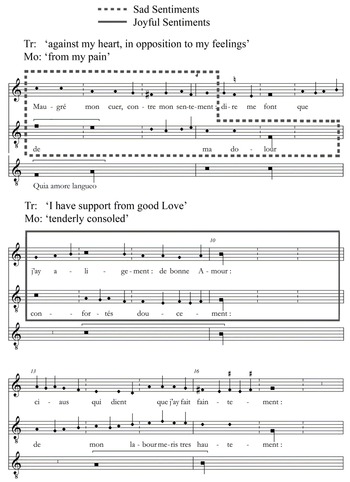
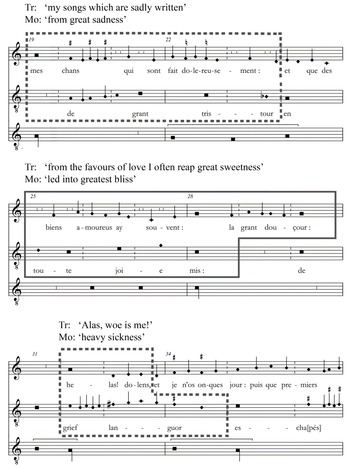
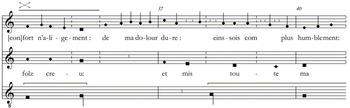
But long before the crossing, which comes near the midpoint, the motet's opening explores the contrast between opposing emotions. Given that the motetus and triplum voices are in seeming opposition, the appearance of these two together in a bitextual framework is surprising. Where we would expect actual, mutual disagreement such as that in Example 1, we find instead that words of happiness and sadness coincide in the voice parts. Some striking examples include the sad sentiments in both voices in bars 1–4, the happy text in both for bars 7–10 and the co-utterance of ‘dolereusement’ and ‘tristour’ in bar 22, and ‘dolens’ and ‘languor’ in bar 33. Thus a significant amount of semantic correspondence links the two seemingly opposite voices (these instances of vertical semantic correspondence are boxed in Example 4).
Motet 14, breves 1–36


Such unity between two seemingly opposite voices is made possible by the structures of both texts. The triplum, though dejected, nevertheless gives voice to joyful utterances as examples of the words he is forced to sing. Meanwhile the motetus, in bragging of his good fortune, provides a list of the grievances that love has righted. This carefully crafted structure must have come early in the plans for the motet. The first four lines of the motetus text can actually be divided vertically into regions employing sad and happy vocabulary:
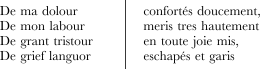
A poem that can be split down the middle into opposite semantic zones enacts an attractive and self-referential contemplation of form, and it is this aspect of Machaut's artistry that would later appeal to the grands rhétoriqueurs. But within the context of a motet about Fortuna, the endeavour is more than a formal game. The texts are set in a way that allows the motetus's righted wrongs to coincide with the triplum's wretchedness, while the triplum's examples of the joyful lies he is forced to tell match up with the motetus's ‘real’ happiness. Rather than projecting the seeming contradiction that a simple reading of the texts might give, their combination in the motet gives the effect of a constant teeter-totter between two opposite states.
The Lover's changes of mood are especially significant in the light of the motet's tenor, ‘quia amore langueo’ (for I languish with love). This emotionally charged phrase appears twice in the Song of Songs. First, it is accompanied by sweetness. The bridegroom has taken his amica to his wine cellar, and there, having overwhelmed her with love, he elicits from her a request for sustenance: ‘fulcite me floribus, stipate me malis, quia amore langueo’ (‘support me with flowers, fill me with apples, for I languish with love’; 2: 5). The second time the words appear, the mood has darkened. The Lovers are separated, Amica calls for her bridegroom, but cannot find him anywhere (5: 7). Running out into the street, she finds only the guards, who strike and wound her, and take away her veil. Again using the imperative, the sponsa makes a desperate plea: ‘Adjuro vos, filiae Jerusalem, si inveneritis dilectum meum, ut nuntietis ei, quia amore langueo’ (‘I implore you, daughters of Jerusalem, if you find my beloved, to tell him that I languish with love’) (5: 8). The striking contrast between the two passages is put into sharp relief by their use of the same phrase. Though the sponsa languishes in both, we must assume that these are two very different kinds of languor.
The chant used for the tenor of Motet 14 is taken from the Marian antiphon Anima mea liquefacta est, which incorporates the second of these two passages.Footnote 71 But the earlier, sweeter context for the languor was surely known to Machaut, and he may well have enjoyed the resulting juxtaposition – manifest in his motet in the seeming opposition between the upper-voice texts. But as important as the scriptural context of the tenor text is that text itself. ‘Quia amore langueo’, sometimes translated as ‘for I am sick with love’, often refers specifically to the state of lovesickness. In fact, this particular passage from the Song of Songs served as a key biblical source for medieval discussions of lovesickness.Footnote 72 Certainly the association was already a valid one for Baldwin of Ford, the twelfth-century archbishop of Canterbury who based his sermon on lovesickness (amor languor) on the first of the Song of Songs appearances of ‘quia amore langueo’.Footnote 73 Machaut makes this connection explicit in the motetus when the lover echoes the tenor's choice of words while complaining that his lady's heart delights in the things from which he suffers: ‘se delite es maus dont je langui’ (l. 26).
And indeed, the ups and downs of the combined texts of Motet 14 show all the symptoms of that most courtly of maladies. In this unenviable state, which had a rich pathology in antiquity and the Middle Ages, a lover suffering from his beloved's absence or neglect suffers bodily and psychological harm. Some of the symptoms associated with the disease still contain a modern ring: the lover loses weight, his or her breathing becomes erratic, and the face blushes and goes pale in turn.Footnote 74 In line with the physiognomic oscillation there is an instability of mood. Richard de Fournival (d. 1260) writes that the true lover ‘looks at you as though he will cry while laughing’, while Avicenna, the eleventh-century Persian physician cited in Gerard of Berry's influential commentary on the Viaticum, prefers alternation to simultaneity, noting that lovers ‘easily swing between crying and laughing’.Footnote 75 Other commentators singled out the story of Amnon and Thamar (2 Kings), in which a sudden shift from love to hate accompanies the satisfaction of a lovesick ‘patient’.Footnote 76 Nor can the sanity of a lovesick man be trusted: ‘Amour rend fou’ (Love makes us foolish) is a common proverb of the time, and one quoted by Machaut, but ‘Amour rend sage’ (Love makes us wise) is another.Footnote 77
This emphasis on coinciding extremes goes a long way towards explaining the relationship between the disparate voices of Motet 14. In accordance with the subject matter of the tenor, the Lover suffers from a restless delirium in which he cannot tell wish from fear, luck from misfortune, or lies from the truth. The duality of love and the ardour of his feelings have turned the speaker's rhetoric into a confused babble of alternating emotional states. It is curiously apt that this condition of the amans – a constant alternation between elation and anguish, between smiles and tears – makes him resemble that tormentor of lovers, fausse Fortune herself. In the words of the Remede:
Here we have, in Machaut's own words, the link between Fortune and lovesickness: the opposites embodied in the goddess are the very symptoms of the malady, and a man under the control of Fortune is particularly susceptible to amor languor. This connection is underlined further by the composer's use of the voice-crossing in Example 1. While in itself explicable as simply a way of making the motetus's comment about Fortune more audible, what we know about the symbolism of voice-crossings in Motets 12 and 15 suggests that the gesture is here also evocative of the set of ideas that surrounds Fortune, who raises the low and casts down the high. So involved is she in the piece when her connection with lovesickness is explored that we might even see her as a character in its action.Footnote 79 It is in Machaut's own Voir Dit that we find, in Fortune's own voice, an admission that could easily pass from the lips of either of the upper voices in Motet 14:

OTHER ‘FORTUNA CROSSINGS’
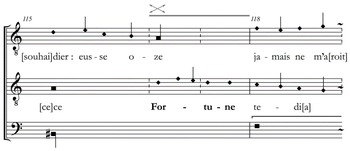
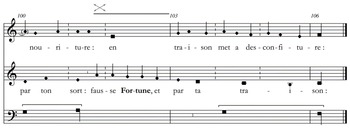
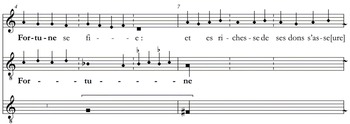
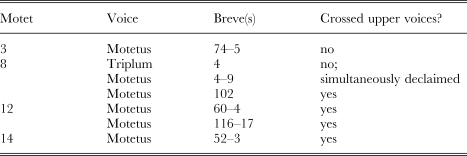
Although the crossings in the first half of Motet 12, the second half of Motet 15, and the ‘Fortune’ passage of Motet 14 are unusually prominent, they are actually participating in a wider trend. One of the few voice-crossings that happens after the midpoint of Motet 12, for example, is exactly long enough to allow the motetus to sing ‘Fortune’ during the goddess's second and final appearance in that piece (see Example 5). We find a similar moment in Motet 8, where the words ‘fausse Fortune’ are pronounced by a motetus singing above the triplum (Example 6). Adding to this the crossed ‘Fortuna’ from the first half of Motet 12 (App. I, breves 60–4) and the ‘Fortune’ who is the friend of Motetus 14 (Example 1, breves 52–3), we arrive at a short but significant list of ‘Fortune crossings’ (see Table 1). There are actually only two instances in Machaut's motets in which ‘Fortune’ is present without a voice-crossing, and in one of these a different kind of emphasis is placed on her name when both voices sing it together (Example 7).Footnote 81 In the other four instances in which her name is sung, the motetus rises above the triplum to declaim the name of the fickle, inverting goddess.
Motet 12, breves 115–18

Motet 8, breves 100–6

Motet 8, breves 4–9

Occurrences of ‘Fortune’/‘Fortuna’ in Machaut's motets
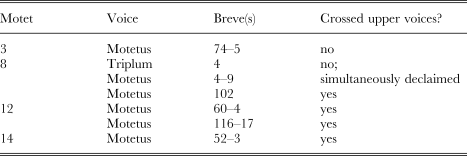
In the case of Motet 3, it may well be argued that Fortune, though present, is not a key element in that motet's text. But in the other examples, Machaut's treatment of the theme is compelling. Furthermore, the use of crossings to enact Fortune's actions in motets may not be unique to Machaut: the anonymous motet Fortune mere à dolour/Ma dolour ne cesse pas/Dolour meus, which survives in the Ivrea Codex, has a deliberate voice-crossing between the triplum and motetus during the last two of its five taleas.Footnote 82 And it may also be relevant that Vitry's famous Tribum que/Quoniam secta/Merito hec patimur mentions Fortuna and her agency in causing sudden falls and reversals while placing the tenor unusually and consistently above the motetus.Footnote 83 Another candidate for participation in a network of motets using significant voice-crossings to evoke Fortune is Amer/Durement/Dolor meus which has been attributed to Vitry on stylistic grounds.Footnote 84 This piece has the color ‘dolor meus’ in common with Fortune mere à dolour/Ma dolour ne cesse pas/Dolour meus, while sharing with Tribum que/Quoniam/Merito hec patimur the technique of crossing tenor and motetus. But here the tenor's place is not permanent. Rather, the motet's color is transposed up a fifth for its first iteration, which results in a voice-crossing lasting for the first half of the motet and uncrossing at the midpoint, just like Machaut's Motet 12.Footnote 85 Careful consideration of these pieces and of their possible relationships to each other and to the techniques used by Machaut is outside the scope of this article, and more work will need to be done to determine the direction of any influence.Footnote 86 However, I believe that these motets also participate in the general phenomenon of illustrating Fortuna's actions with the crossing of voices and reversal of standard contrapuntal procedures. Can we begin to speak of a musical iconography?
Clearly, some caution is called for. After all, in the case of each crossing, it is the motetus voice that pronounces the goddess's name, and the crossings could be interpreted simply as devices that bring an important word to the forefront of the texture. Furthermore, most of Machaut's voice-crossings have nothing to do with Fortune. Meanwhile, there are many other ways of treating the theme of Fortune in music. For example, Machaut's ballades on this theme gave him a mono-textual, strophic medium in which to explore the subject at length, and Boogaart has argued that particular rhythmic figures in the tenor taleas of the motets signal her presence.Footnote 87 In the Lai de la confort, Virginia Newes has shown that the form of the piece itself – a three-voice canon or rota – symbolises Fortune's ever-turning wheel, and in that same Complainte from the Remede, the important ‘-ourne’ words of the first stanza signal both the actions of the goddess and those of the singer, who returns to the beginning after singing his first ‘-ourne’ word (‘atourne’, breves 15–17 in Example 3 above).Footnote 88 Text, rhythm, form and range: as the elements of a purported iconography these are impractical, because Machaut uses these tools to indicate the presence not only of Fortune, but also of everything else: musical parameters cannot be consistently reflexive. More broadly, the musical moments we most often choose as examples of signification (or as hermeneutic windows) are by definition unusual and extraordinary: if they were not, then they would not signify. Thus it is only against the background of more usual activity that these significant moments can be appreciated. And against this backdrop, the difference will usually be one of degree, and not of kind. So ‘crossings mean Fortuna’ does not prove practical. Furthermore, looking for ‘rules’ of musical depiction may not be the most productive of enterprises. The art historian Michael Camille warned that iconography has the potential of being ‘as abstracting and idealising a critical practice as philology’, and advocated instead for a mode of analysis grounded in the psychology of the viewer.Footnote 89
The extended voice-crossings of Motets 12, 14 and 15 stand noticeably apart from ‘normal’ vocal behaviour, and the consistency with which Fortune is accompanied by crossings in these and other motets is striking. Clearly this particular type of manipulation of range and musical texture is among Machaut's tools for evoking the concept of inversion of fate. How then do we move our analysis beyond the realm of semiotics (‘voice-crossings mean Fortuna’) and into the land of history of ideas? For this we must finally look, or rather listen, to the way that voice-crossings sound.
INVERTED SOUND-WORLDS
The inversion of range during the ‘Fortuna crossings’ is certainly a symbolic way to encapsulate the idea of Fortune and her effect on lovers. But its result is more than an intellectual commentary on the goddess's actions cleverly encoded into music. There is a palpable sonic effect resulting from these crossings – the inversion of range is audible, because the triplum and motetus never cease to sound like themselves.
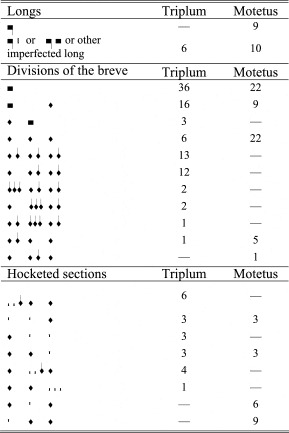
It is not difficult even for the modern informed listener to tell the triplum of one of Machaut's motets from the motetus, owing to the incredible consistency with which the two voices are crafted.Footnote 90 A triplum, with its longer text, uses a faster rhythmic vocabulary and much faster speech rhythm, often declaiming on the level of prolation (semibreves and minims). A motetus, by contrast, generally sings with the tempus (breves and semibreves), which is suited to its significantly shorter texts. Thus the rhythmic vocabularies of the voices are also overlapping but distinct. Quant en moy/Amour et biauté/Amara valde (Motet 1), which Boogaart has identified as paradigmatic, provides a good example.Footnote 91 Here different groupings of notes, though equally characteristic of the mode, appear with radically differing frequencies in each voice (see Table 2). This is especially noticeable on the level of prolation, where the triplum employs a much greater variety of figures. As Margaret Bent has observed, Machaut's use of rhythmic figures within a given piece tends to be limited not only by the possibilities of the mode, but as a matter of compositional choice, with certain figures appearing in only one or two of the motets, but there with frequency.Footnote 92 This short list of figures is further divided among the voices, so that each has a small and therefore characteristic list of rhythmic patterns that permeate its texture. The triplum of Motet 1, for example, can be accounted for almost exclusively by its isorhythmic hockets and four other patterns.
Rhythmic vocabulary of the upper voices in Motet 1

The usual difference in tessitura between the upper voices (when they are not crossed) further reinforces their distinct aural profiles, and we are very used to hearing a tiered relationship between the voices: the tenor's relative stillness in the bottom voice, the verbose triplum on top, and the motetus between them, intermediate in terms of both range and verbal rhythm.
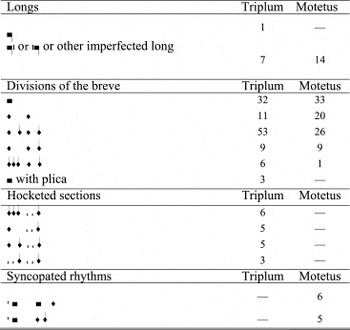
During a voice-crossing, this habitual hierarchy of range is disrupted, but the more important rhythmic elements of vocal identity remain firmly in place. The motetus of Motet 12 can never be mistaken for some new, hybrid voice. Rather, what is striking is the extent to which it looks and sounds like a motetus despite its initial height. As in Motet 1, the rhythmic vocabulary of the two upper voices here is overlapping but distinct (see Table 3). In fact, whereas in the former the two voices share certain rhythms during hocketed sections, the Motetus of Motet 14 has no such analogous moments. During each of the triplum's hockets, the motetus sings syncopated untexted melismas (breve 31–3, 49–51, 85–7, 103–5, 139–41, and 157–9).
Rhythmic vocabulary of the upper voices in Motet 12

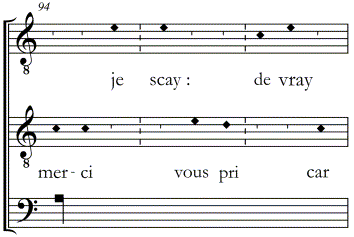
Hockets are usually the places in Machaut's motets where the two upper voices sound most alike. During the hockets of Motet 1, for example, the motetus and triplum are equal in verbal rhythm, melodic rhythm, and approximate musical range (see Example 8). Not so in Motet 12: here there are no hockets in the motetus part, and it would be impossible to mistake its long-winded and melismatic profile for that of a triplum.
Motet 1, breves 94–6
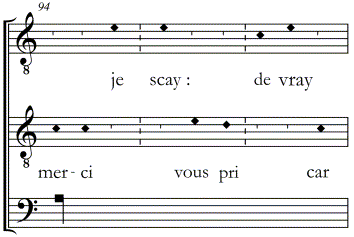
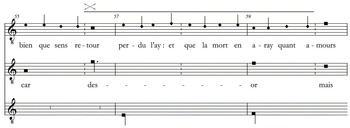
It is telling that the ‘one-sided hockets’ of Motet 12 are also present in Motet 14. While the triplum's stream of text is interrupted with typically hocket-like minim rests, the motetus sings smooth, drawn-out syncopated lines that could not be mistaken for those of any other voice (Example 9). Motet 15 also participates in this trend. Although the motetus there alternates with the triplum in declaiming the text (as would often be the case in a hocket), it sings no short notes (Example 10).
Motet 14, breves 49–60

Motet 15, breves 34–40

Motets 12, 14 and 15 are unique in Machaut's oeuvre in having hocket sections in which only one of the two upper voices participates.Footnote 93 That these three are also the motets that make the most expressive use of voice-crossings is no coincidence. Machaut often exaggerates vocal identity during moments of crossing: when the motetus sings high, it does so in a typically – even stereotypically – motetus-like way. This tendency in itself is wholly unconnected with any concept of Fortuna, as an excerpt from Motet 3 can remind us (see Example 11).
Motet 3, breves 55–60

The result is that voice-crossings, especially extended ones, are readily audible.Footnote 94 A motetus, when it is singing below the triplum, may sometimes increase its rate of text declamation or sing the occasional minim. But when the motetus sings above the triplum, as it does for the first half of Motet 12, it compensates by behaving even more like a motetus. In such unfamiliar territory, it dare not even hocket, signalling to the listener that it is very much a motetus – and very much out of place. The result is more than symbolic: it is palpable. A singer or a listener used to the sound of the motets would instinctively feel that something was wrong with Motet 12. The reversal of voices in the first half of the motet – the long, drawn-out notes of the Latin motetus, soaring above the usually dominant triplum, could even inspire some measure of audience discomfort.
And for the singers, who must certainly have been part of the motet's intended audience (and would have been the only listeners present during rehearsals) the effect may have been even more alarming. I think that a modern singer and a medieval one might well agree that there is nothing as uncomfortable as a voice-crossing. If one has been singing motetus and listening to the triplum above in order to stay in tune, a voice-crossing inevitably feels like a mistake. The effect could only be heightened by singing from parts, since the score would not be present to provide reassurance that the mistake is not your own, and that in fact there is no mistake. And even after the singer ascertains that she is in fact singing the part correctly, something still feels distinctly off. The usual point of reference has been moved, leaving her sounding exposed and vulnerable.Footnote 95
Not only in terms of contrapuntal norm, then, but more importantly within the realm of bodily comfort and mental ease, the midpoint of Motet 12 functions as a locus of resolution.Footnote 96 In Motet 15, the situation is reversed: just as we have settled into hearing/singing a normal motet, the crossings begin, and with them potential difficulties for the performer and unsettling, abnormal sounds for the audience. For a performer of Motet 14, too, the idea that Fortune turns things on their heads and deceives her victims is rendered visceral in the big crossing before the midpoint. In all three motets Machaut has seamlessly integrated musical, formal, poetic and exegetical elements – but he has gone beyond this. By their precise and unusual voice-crossings, the motets powerfully evoke a world that has been turned upside down for the poet, for the lover, for Esau, for Jacob, for the triplum, for the motetus, and for the listener.
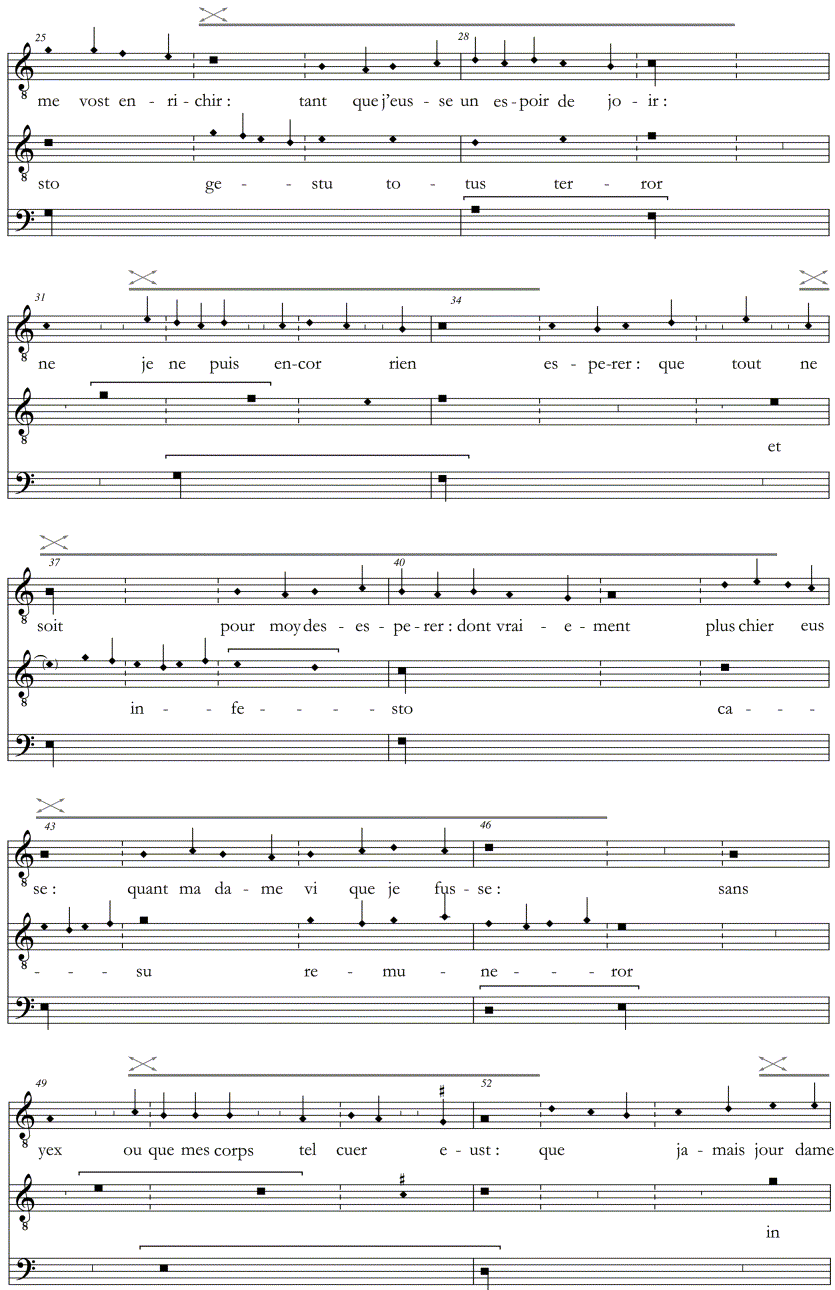
APPENDIX I
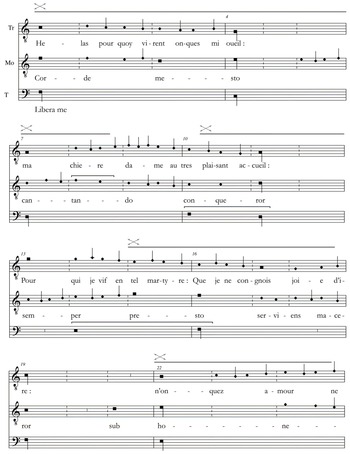
Helas!/Corde mesto/Libera me (Motet 12)
The edition follows Machaut MS Vg, except for the motetus at breve 147, which is missing there and supplied from MS C. Vertical bars mark the midpoint of the motet at breve 81.



APPENDIX II
Texts and Translation of Motet 12
The French and Latin texts are taken from Vladimir Chichmaref's edition of Guillaume de Machaut, Poesies lyriques, vol. 2, pp. 509–10. The triplum translation is my own. For the translation of the Latin motetus Corde mesto cantando conqueror, I am indebted to Rob Getz.
Triplum

MotetusFootnote 1

Tenor: Libera me [Free me]
APPENDIX III
Texts and Translation of Motet 14
French texts taken from Chichmaref, Poesies lyriques, vol. 2, pp. 511–12. Translations are my own.
Triplum

Motetus

Tenor: Quia amore langueo [For I languish from love]