The rate at which children build their vocabularies varies from child to child and changes with development as a result of factors that are not completely understood. Studies of children three years and older suggest that phonological memory is a component of word learning skill, but the hypothesis that phonological memory plays a role in very early lexical development has been relatively unexplored. We outline here the rationale and empirical evidence for this hypothesis, and we report two studies which establish a method for further research.
Part of the word learning task consists of forming lexical entries for newly encountered words, and several findings in the literature suggest that this learning of word forms (apart from learning word meanings) contributes to the time it takes children to build their lexicons. One relevant finding is that familiar sound sequences are more easily learned as new words than are unfamiliar sound sequences. Swingley (Reference Swingley2007) found, with children aged 1 ; 6, that making word forms familiar through exposure prior to a word learning task resulted in those forms being learned as new words more rapidly than unfamiliar forms. Storkel (Reference Storkel2001) found, with children between three and six years, that novel words made up of common sound sequences were easier to learn than novel words made up of rare sound sequences.
A second relevant finding, supported by a large body of research, is that individual differences in phonological memory (i.e. memory for sound sequences) are related to individual differences in word learning ability (Gathercole, Reference Gathercole2006). For example, measures of phonological memory are correlated with three- to five-year-old children's word learning in a laboratory setting and, in longitudinal studies, phonological memory skills predict actual vocabulary growth (see Gathercole, Reference Gathercole2006). Also, among adolescent foreign language learners, phonological memory is related to success at vocabulary learning in the new language (Service & Kohonen, Reference Service and Kohonen1995), and poor phonological memory skills are characteristic of children with atypical language development, who characteristically have small vocabularies for their age (see Coady & Evans, Reference Coady and Evans2008).
Despite the evidence that phonological memory is one component of word learning ability, this ability and its role in word learning has been studied relatively little in children who are the most prodigious word learners – children between one and three years. Most previous studies of phonological memory and its relation to word learning have focused on children four years and older, and none, to our knowledge, have looked at children younger than two years. Thus, we know relatively little about phonological memory and its relation to vocabulary development during the period of time when children's vocabularies are growing rapidly and their phonological representations are also developing.
There is reason to think that changes in phonological representations occurring in this early period may affect children's phonological memory skills. Although phonological memory was first conceptualized as an unlearned, unchanging cognitive capacity (Baddeley, Gathercole & Papagano, Reference Baddeley, Gathercole and Papagano1998), more recent treatments incorporate the idea that phonological memory relies on the quality of children's phonological representations (Gathercole, Reference Gathercole2006). In fact, several sorts of findings support the idea that phonological memory capacity depends on underlying phonological representations and may therefore change with phonological development. At five years, children who are better at identifying phonemes and producing rhymes show better phonological memory skills (Bowey, Reference Bowey2001), and adults show better memory for sound sequences that conform to the language they know than for sound sequences in a foreign language (Service & Kohonen, Reference Service and Kohonen1995). This should not be surprising, as memory capacity in other domains has been shown to depend on a representation system for encoding the to-be-remembered stimuli. For example, adults are better at repeating word sequences that conform to grammatical rules than anomalous word sequences (Miller & Isard, Reference Miller and Isard1963), and chess experts are better at remembering possible middle-game configurations of chess pieces than random arrangement of chess pieces (Chase & Simon, Reference Chase and Simon1973).
Taken together, the evidence that word learning depends on phonological memory and that phonological memory depends on phonological knowledge suggests that children's word learning depends, to a degree, on the phonological knowledge they have achieved. That is, phonological memory, as the capacity to learn new word forms, is one link between phonological knowledge and word learning. Put another way, the hypothesis is that children who are more advanced in phonological development have more robust phonological representations and are therefore better able to remember new word forms as they encounter them, which in turn supports word learning. This hypothesis is consistent with Werker & Curtin's (Reference Werker and Curtin2005) proposal that the emergence of phonemic representations during the second year of life contributes to the word learning explosion seen in that period.
This hypothesized link between the development of phonological representations and phonological memory would provide an explanatory mechanism for other relations that have been observed between children's phonological development and lexical development. These relations include lexical selection effects in children's early vocabularies, which result in earlier-acquired phonemes being over-represented in first words (see Stoel-Gammon & Sosa, Reference Stoel-Gammon, Sosa, Hoff and Shatz2007), and within-child effects of early phonological development, which result in words that conform to a child's phonology being more readily learned than words that do not (Leonard, Schwartz, Morris & Chapman, Reference Leonard, Schwartz, Morris and Chapman1981). Also, children with larger phonetic inventories tend to have larger vocabularies (Stoel-Gammon & Sosa, Reference Stoel-Gammon, Sosa, Hoff and Shatz2007), and the phonological properties of the speech produced by lexically precocious two-year-olds are more advanced than the phonological properties of the speech produced by two-year-olds with vocabularies more typical for their age (Smith, McGregor & DeMille, Reference Smith, McGregor and DeMille2006). Although these findings all are evidence that lexical development is supported by the children's growing phonological knowledge, they do not explain how phonological knowledge might actually provide support. Phonological memory is a candidate mediating mechanism.
Investigating the role of phonological memory in early lexical development requires a means of measuring phonological memory in very young children. The most widely used measure of phonological memory capacity is the non-word repetition task (Coady & Evans, Reference Coady and Evans2008; Gathercole, Reference Gathercole2006). Accuracy of non-word repetition (NWR) has been found to be independently associated with language development when auditory memory and intelligence are also measured and to be more strongly associated with language skills than another verbal memory task, digit span (Gathercole, Reference Gathercole2006). Non-word repetition tasks also have high sensitivity for language impairment and even identify adolescents whose earlier language impairments had resolved (Stothard, Snowling, Bishop, Chipchase & Kaplan, Reference Stothard, Snowling, Bishop, Chipchase and Kaplan1998).
The use of non-word repetition as a measure of phonological memory is not without controversy, however. NWR has been criticized as not providing a ‘pure’ measure of phonological memory because the task requires multiple abilities. One proposal is that that non-word repetition measures a phonological processing ability that underlies both the repetition task and other phonological skills. Other abilities proposed to contribute to non-word repetition accuracy include speech perception, phonological encoding, phonological assembly and articulation (see Coady & Evans, Reference Coady and Evans2008). None of these proposals is damaging to the current hypothesis that NWR taps an underlying ability that depends on phonological knowledge and is recruited for word learning, except the proposal that NWR measures articulation skill. Although articulation has been argued to reflect underlying phonological representations (Gierut, Reference Gierut1998; Rvachew, Ohberg, Grawburg & Heyding, Reference Rvachew, Ohberg, Grawburg and Heyding2003), it also reflects peripheral motoric limitations – particularly in children under two years. That notwithstanding, the few studies that have looked at NWR in children under three years suggest that NWR accuracy also reflects something other than articulation skill, even in children this young (Gathercole & Adams, Reference Gathercole and Adams1993; Chiat & Roy, Reference Chiat and Roy2007). The aim of the present studies was to pursue the hypothesis that NWR taps a memory ability that is required by the word learning process in very young word learners.
The present studies were designed to accomplish the following: (1) to develop a procedure for assessing non-word repetition in younger children than existing procedures allow; (2) to establish its validity as a measure of the capacity to remember speech sound sequences separate from the ability to articulate those sounds; and (3) to establish its concurrent relation with vocabulary development. In two studies, children younger than two years were administered an NWR task and their vocabulary development was assessed. To address the concern that inaccuracies in non-word repetition might reflect problems with articulation rather than memory, the children were also administered a test of real word repetition accuracy, on the logic that real words can be remembered with reference to pre-existing lexical entries but non-words cannot – at least not as easily or completely. The phonemes in real words should not, however, be easier to articulate than the phonemes in non-words. Thus, to the degree that children showed inaccuracy in non-word repetition that they did not show in real word repetition, inaccuracy in non-word repetition can be taken as a phonological memory failure, not articulation failure.
STUDY 1
METHOD
Participants
Fifteen monolingual English-learning children, 6 boys and 9 girls, participated. One additional child was tested, but those data were not included because the child did not attempt to repeat any of the non-words presented. The participants ranged in age from 1 ; 9 to 2 ; 0 (Mean age in months=22·81, SD=0·64). They were recruited through word-of-mouth and flyers posted at places with programs for mothers and young children.
Procedure
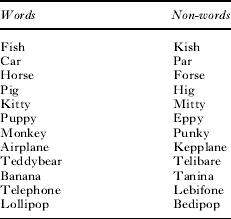
The real and non-word repetition tasks were administered in a toy play activity with the examiner in a laboratory playroom. For the real word repetition task, the examiner presented toys one at a time and asked the children to repeat the labels for the real word stimuli (e.g. ‘This is a butterfly; Can you say butterfly?’). For the non-word repetition task the examiner presented toy animals or people and presented the stimuli as names (e.g. ‘This is clird; Can you say clird?’). The examiner presented each stimulus up to three times. If the child made no attempt to repeat after the third presentation, the examiner moved to the next stimulus. Two additional attempts at repetition were allowed in order to minimize data loss due to the fluctuations in attention that are characteristic of young children. In order to maximize children's engagement, the stimuli were presented live and in the context of a fairly natural naming game, rather than using prerecorded stimuli or with the examiner covering her mouth, as is sometimes done in testing older children. Chiat & Roy (Reference Chiat and Roy2007) similarly used live presentation without covering the mouth in their procedure designed for use with two- to four-year-olds. If children do make use of visual cues in non-word repetition, then they should similarly make use of visual cues in encoding novel sound sequences as part of word learning, and that ability is what we wish to tap in the present procedure. The child's primary caregiver filled out the MacArthur (now the MacArthur-Bates) Communicative Development Inventory: Words and Sentences (CDI; Fenson et al., Reference Fenson, Dale, Reznick, Thal, Bates, Hartung, Pethick and Reilly1993). The procedure was videotaped. The child's mother sat in the room, filling out the CDI and a background questionnaire during the procedure. Mothers were instructed not to participate and for the most part cooperated. No mother presented any stimuli.
Stimuli
The non-word stimuli were derived from previous work with older children (Gathercole, Willis, Emslie & Baddeley, Reference Gathercole, Willis, Emslie and Baddeley1991), but using fewer stimuli and eliminating the 4-syllable non-words to accommodate the younger participants of the present study. The resultant list of non-word stimuli included 3 1-syllable, 3 2-syllable, and 3 3-syllable non-words. Real words were selected from the CDI for children aged 1 ; 4 to 2 ; 6 so that they were likely to be words in the children's experience, although not necessarily in their productive vocabularies. The real words were selected to correspond to the non-words in terms of length in syllables and approximate phoneme difficulty (stimuli are provided in Appendix A). Phonotactic probability is another feature of word and non-word stimuli that has been shown to affect accuracy of repetition (Coady & Aslin, Reference Coady and Aslin2004). The mean phonotactic probability of the stimuli was 0·013 for real words and 0·021 for non-words, calculated following Vitevitch & Luce (Reference Vitevitch and Luce2004). These means were not significantly different (t=1·35, p=0·20, two-tailed), indicating that the frequency with which adjacent phonemes in the stimuli appear as adjacent phonemes in real English words did not differ between the real word and the non-word stimuli. Digit span, which is a frequently used measure of auditory memory with older children, was not used here because for children this age it is not clear whether digit span would tap memory for real words or non-words, and, in any case, the phonological properties of digit names could not be controlled.
Measures
Repetitions of real and non-words were transcribed using broad IPA transcription by the second author, a trained phonologist. To calculate inter-rater reliability, a graduate student trained in phonetic transcription transcribed data from one randomly selected subject (10% of the total data) from the data collection sessions. Point-by-point inter-rater reliability was calculated to be 86% agreement (33/39 total consonants transcribed), using procedures described in Shriberg, Lewis, McSweeny & Wilson (Reference Shriberg, Lewis, McSweeny and Wilson1997). Based on the second author's transcriptions, average percent consonants correct (PCC) for each set of words and non-words was calculated for each child. PCC was chosen as the measure of accuracy of production to maximize reliability of scoring. Transcription of vowels is generally regarded as more difficult than transcription of consonants due to variation in perception among transcribers and variability of production in young children. Only words and non-words that the child attempted to repeat were included in the calculations. This decision was based on the following logic: if children do not attempt to repeat a presented word or non-word for reasons of inattention or reticence that have nothing to do with repetition ability, then non-attempts are not relevant data and should be excluded. If, in contrast, children do not attempt to repeat a sequence because they realize they cannot do so accurately, then the decision not to score non-attempts will have the effect of reducing variability in the measure of NWR accuracy, thus reducing the power of the study. It is, therefore, the conservative approach to scoring. (This topic is considered again in the method section for Study 2.) Vocabulary percentile was calculated for each child from the CDI norms. The current hypothesis, that phonological memory skills are related to word learning ability, makes vocabulary percentile, rather than raw score, the appropriate outcome measures. In the present sample, in fact, the age range was so narrow that raw vocabulary score and vocabulary percentile were almost perfectly correlated (r (n=15)=0·95).
RESULTS
The mean vocabulary percentile for the participants was 63·27 (SD=26·74). Mean repetition accuracy for real words was 51·07% (SD=16·55), and for non-words it was 42·2% (SD=17·66). This difference was statistically significant (t (14)=2·75, p=0·008, one-tailed, ηp2=0·351). The inter-correlations among real word repetition accuracy, non-word repetition accuracy and vocabulary percentile are presented in Table 1. All correlations were significant.
Study 1 inter-correlations among vocabulary percentile, real word repetition accuracy and non-word repetition accuracy (n=15)

** p<0·01, *** p<0·001, all one-tailed.
To provide the most stringent test of the hypothesis that the capacity to meet the memory demands and not the articulatory demands of repetition underlay the correlation between NWR and vocabulary, a partial correlation between children's non-word repetition accuracy and vocabulary percentile, removing the variance shared with real word repetition accuracy, was calculated. This calculation revealed that non-word repetition accuracy uniquely accounted for 20% of the variance in vocabulary percentile (r (12)=0·45). This effect size is substantial, but given the small sample size, the partial correlation did not reach the conventional 0·05 level of significance (p=0·055, one-tailed).
DISCUSSION
The finding that real word repetition was more accurate than non-word repetition supports the assumption that the memory demands of the real word repetition task were less than the memory demands of the non-word repetition task. Put another way, non-word repetition required something more than did the real word repetition task. Individual differences in that ‘something more’ are captured in these data in the form of the variance in non-word repetition accuracy not explained by real word repetition accuracy. That residual variance accounted for a substantial portion of the variance in vocabulary size, suggesting that the capacity to remember meaningless sound sequences is a component of word learning skill.
The non-word repetition task probably also taps other capacities that are used for word learning, and these were also partialled out of the variance in NWR accuracy when real word repetition accuracy was held constant. That is, although the partialling of real word repetition accuracy was done in order to remove irrelevant variance in articulation skill and general cooperativeness from the measure of non-word repetition accuracy, it almost certainly also removed variance in capacities that are truly related to word learning. These sources of variance likely include variance in articulation accuracy that reflects underlying phonetic representations, variance in phonological memory – to the extent that the real words were stored phoneme by phoneme, and variance in memory for whole word representations. Therefore, the partial correlation is, in all likelihood, an underestimate of the variance in vocabulary development account for by the skills tapped by the NWR task. These results provide strong support for the hypotheses of the present study, that phonological memory can be measured in children younger than two years using a non-word repetition task and that individual differences in NWR accuracy are related to the rate at which children have built their vocabularies, as indexed by their CDI percentile score.
STUDY 2
Given the small sample size and the small number of stimuli employed in Study 1, replication seemed in order. The purpose of Study 2 was to provide a replication with a different sample of children and different stimuli. In addition, the stimuli in Study 2 were constructed so that the real words and non-words were more exactly matched in terms of their phonological properties than were the stimuli in Study 1. In Study 1, the non-word stimuli were drawn from the previous literature, and the real words were selected to match them as closely as possible in terms of phonological difficulty. However, the real- and non-word stimuli did differ in several aspects of phonology. The non-words contained more consonant clusters and more complex syllable shapes than did the real words. The non-words had more consonants in word-initial and word-final position than did the real words, and there were more /r/ consonants and r-colored vowels in the non-words than in the real words. In Study 2, new real words were selected, and new non-words were generated to match the real words on a phoneme-by-phoneme basis.
METHOD
Participants
Twenty-one monolingual English-learning children, 7 boys and 14 girls, between 1 ; 8 and 2 ; 0 (mean age in months=22·15, SD=1·42) participated. An additional 6 children were tested but excluded. Two were unwilling to attempt any repetitions; an additional 4 children repeated some real words but were unwilling to repeat any non-words.
Procedure
The procedure for administering the real-word and non-word repetition tasks was the same as in Study 1, with the exception that 12 words and non-words were presented and the toddler short-form version of the CDI (Level II, Form B) (Fenson, Pethick, Renda, Cox, Dale & Reznick, Reference Fenson, Pethick, Renda, Cox, Dale and Reznick2000) was used to assess productive vocabulary. The procedure was conducted in the participants' homes and was audio-recorded. For all but two of the participants, the real-word task preceded the non-word task.
Stimuli
Twelve real words were selected from the long form of the CDI for 16- to 30-month-olds, including equal numbers of 1-syllable, 2-syllable, and 3-syllable words. Twelve non-words were created from the same segments and word shapes as the real words. Non-words were created to have the same consonants in syllable-initial position as real words of the same length, and as a result onset and final consonants for each syllable of the non-word stimuli were the same as in the real words of the same length. Real and non-words were matched for stress pattern. Phonotactic probability of the real words and non-words (measured as the mean biphone probability, following Vitevitch & Luce, Reference Vitevitch and Luce2004) were not different (means=0·015 and 0·013, respectively, F<1·0). The stimuli are listed in Appendix A.
Measures
The participants' real- and non-word repetitions were phonetically transcribed by the third author, a graduate student in developmental psychology, who achieved 83·2% phoneme-by-phoneme agreement with the second author on the consonants in non-words and real words repeated by 5 of the participants. Percentage of consonants correct in real and non-words attempted was calculated for each child. Vocabulary was measured as percentile score using short-form version CDI norms (Fenson et al., Reference Fenson, Pethick, Renda, Cox, Dale and Reznick2000); the correlation between percentile and raw vocabulary score was r (n=21)=0·89. The number of stimulus presentations preceding children's attempts at repetition were also recorded.
Non-responders
The observed rate of non-compliance was sufficiently high in this study (6 out of 27, compared to the one non-compliant child tested in Study 1) to raise the question of whether the excluded children were systematically different from those whose data were analyzed. Chiat & Roy (Reference Chiat and Roy2007), in their sample of two- to four-year-olds, found a refusal rate of 6% and no differences between those who refused to participate and those who did. They thus concluded that refusal reflected verbal reticence rather than inability. Non-compliance in the present study may additionally reflect the influence of the setting – the children were tested in their homes rather than in the less distracting and perhaps more imposing setting of the laboratory playroom used in Study 1. Comparison of the 6 children who attempted no repetitions of non-words to the 21 children whose data were included yielded no significant differences in age or vocabulary, but the size and direction of the differences suggested that sometimes refusal may reflect inability. That is, compared to the sample of 21, the children who would not repeat had a smaller mean raw vocabulary score (30·5 vs. 44·0) and a lower mean vocabulary percentile (28·3 vs. 40·4). They also included proportionately more boys: boys were 50% of the non-compliant children and 33% of the children whose data were included. These hints from the data, along with the higher refusal to imitate non-words compared to real words (which was also observed by Chiat & Roy, Reference Chiat and Roy2007) suggest, as do our impressions from testing the children, that in some children general reticence is the cause of refusal to participate, but that sometimes refusal also reflects a child's awareness that they will be unable to repeat accurately. The present data-analytic procedure of excluding those subjects who would represent the bottom of the distribution in repetition accuracy, if non-attempts were scored, and who do represent the bottom end of the distribution in vocabulary development, thus works against finding support for the hypothesis under test.
RESULTS
The mean vocabulary percentile for all children was 40·43 (SD=28·35). Mean repetition accuracy (PCC) for real words was 63·45 (SD=15·30) and for non-words was 57·85 (SD=12·67). This difference was statistically significant (t (20)=2·34, p=0·015, one-tailed, ηp2=0·215). The mean number of stimulus presentations for real and non-words did not differ; they were 1·43 and 1·38, respectively. The inter-correlations among real word repetition accuracy, non-word repetition accuracy and vocabulary percentile are presented in Table 2. All correlations were significant. As in Study 1, the partial correlation between children's non-word repetition accuracy and their vocabulary percentile, removing the variance shared with real-word repetition accuracy was calculated. This was statistically significant (r (18)=0·40, p=0·04, one-tailed).Footnote 1
Study 2 inter-correlations among vocabulary percentile, real word repetition accuracy and non-word repetition accuracy (n=21)

* p<0·05, ** p<0·01, *** p<0·001, all one-tailed.
Discussion
The participants and the stimuli in Study 2 differed from those in Study 1, yet the essential findings of Study 1 were replicated. The participants differed in being less advanced in vocabulary development, although they were approximately the same age. (This is not surprising, as we cast a larger net in recruiting participants for Study 2.) The stimuli differed in being phonologically simpler, and thus average repetition accuracy was higher in Study 2. Despite these differences and despite careful phonological matching of real- and non-word stimuli, Study 2 revealed, as did Study 1, that repetition accuracy is greater for real words than for non-words; that real-word repetition accuracy, NWR accuracy and vocabulary size are significantly correlated; and that NWR accuracy is significantly correlated with vocabulary even partialling out the variance attributable to real-word repetition accuracy.
GENERAL DISCUSSION
The results of these two studies support two conclusions: (1) non-word repetition accuracy reflects phonological memory capacity, not just articulation skill, in children younger than two years; and (2) at this early point in both phonological and lexical development, phonological memory capacity is related to the level of vocabulary development children have achieved. Previous studies have found concurrent relations between NWR accuracy and vocabulary in first-language acquisition from two years through nine years and in second-language learning through adulthood (Coady & Evans, Reference Coady and Evans2008). The present study is the first, to our knowledge, to demonstrate this relation in children younger than two years. The present study is also the first to find a relation between NWR accuracy and vocabulary partialling out the variance shared with real-word repetition accuracy, and this relation proved robust across two samples and two different stimulus sets. This finding contrasts with that of Gathercole & Adams' (Reference Gathercole and Adams1993) study of three-year-olds, which did not find a significant relation between NWR accuracy and receptive vocabulary when the variance attributable to real-word repetition accuracy was removed. That study did, however, find significant zero-order correlations among NWR, real word repetition and vocabulary. There are several possible explanations for this difference in findings, which will require further research: There may be a real age-related difference in the relation of phonological memory to vocabulary development, there may be an age-related difference in the factors that underlie NWR performance or there may be a difference in the relation of NWR to production vocabulary versus receptive vocabulary. Another question for future research concerns the causal relations that underlie the concurrent correlation between NWR and vocabulary observed in the present studies. Previous longitudinal research with children over four years has supported a causal path in which phonological memory skills underlie subsequent vocabulary growth (Gathercole, Reference Gathercole2006), but it may also be that vocabulary growth during this early period drives changes in phonological representations. In fact, there may be mutual and spiraling effects between phonological and lexical development such that word learning yields more fine-grained and robust phonological representations, which in turn support further word learning (see Snowling, Reference Snowling2006 and Werker & Curtin, Reference Werker and Curtin2005).
In sum, the present findings make both a substantive and a methodological contribution to the study of the relation between phonological and lexical development. Substantively, the relation between phonological memory and vocabulary development observed suggests that phonology and the lexicon are related in early development. Methodologically, the present findings establish the feasibility and validity of the non-word repetition task as a means to assess phonological memory in young children. Thus, the findings of the present study provide a reason and a means to ask further questions about how phonological development contributes to lexical development in young word learners.
APPENDIX A
Study 1 stimuli
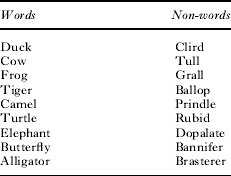
Study 2 stimuli