Labidiaster annulatus, Sladen (1889) is a multi-rayed (9–50) voracious Antarctic sea star with numerous large, conspicuous crossed pedicellariae. An active and opportunistic predator, it commonly preys upon euphausiids, amphipods, and small fish in the water column (Dearborn et al. Reference Dearborn, Edwards and Fratt1991). Labidiaster annulatus is distributed around the Antarctic, Kerguelen, South Orkney, South Sandwich Islands, South Georgia, and Shag Rocks, at recorded depths of 30–440 m (Fisher Reference Fisher1940, unpublished data).
Nothing is reported on the mode of reproduction in Labidiaster. Furthermore, the recognized family Labidiasteridae, composed of Labidiaster, Coronaster Rathbunaster, and Plazaster, is unlikely to be monophyletic, and the closest extant relative to Labidiaster remains unknown (Mah Reference Mah2000, Foltz et al. Reference Foltz, Bolton, Kelley, Kelley and Nguyen2007). In such a case larval identification by barcoding can be an important tool for examining life history (Webb et al. Reference Webb, Barnes, Clark and Bowden2006). Here we use DNA barcoding techniques on partial mitochondrial 16S sequences, which serendipitously matched adults of L. annulatus to an unknown asteroid larvae collected along the western Antarctic Peninsula and Bransfield Strait region.
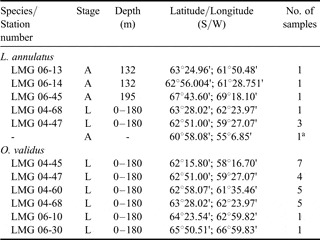
Larvae and adult specimens were collected during two five week Antarctic voyages aboard the RV Laurence M. Gould from 23 November–22 December 2004 and 12 May–13 June 2006 (Table I). Larval specimens were collected using a conical 75 cm plankton net and with a 250 micron mesh towed for 20 min in a slow oblique decent to a depth of c. 180 m and then similarly returned to the surface. Benthic samples were collected using a Blake trawl, wire dredge, or epibenthic sled. Adult voucher specimens have been deposited at The Smithsonian Institution National Museum of Natural History (USNM 1115369 and 1115370).
Collection information for Labidiaster annulatus and Odontaster validus.

Stage: A = adult, L = larva.
afrom Foltz et al. 2007.
Individual asteroid larvae (19 bipinnaria and eight brachiolaria) were subjected to whole genome amplification using the GenomiPhi Kit following the manufacturer's recommendations (GE Healthcare) without prior DNA extraction because the protocol's first heating step lyses cells. DNA of adult specimens was extracted using the DNeasy® Tissue Kit (Qiagen). An approximately 500 bp region of the 16S gene was amplified using the 16SarL and 16SbrH primers following Palumbi (Reference Palumbi, Martin, Romano, McMillan, Stice and Grabowski1991). Purified products were sequenced in both directions on a CEQ 8000 Genetic Analysis System (Beckman Coulter). Novel sequences are deposited under Genbank accession numbers EU248958-EU248964. Edited sequences were compared to Genbank sequences using “blastn” (Altschul et al. Reference Altschul, Gish, Miller, Myers and Lipman1990). Genetic distances (uncorrected p-distance values) were calculated using PAUP*4.0 (Swofford Reference Swofford2003). To objectively confirm that all the sequences probably represented a single species, sequences were analysed using TCS 1.21 (gaps treated as missing) to create a parsimony network with a 95% connection limit between haplotypes (Clement et al. Reference Clement, Posada and Crandall2000).
Of the 27 larvae examined, four (three bipinnaria and one brachiolaria) from the 2004 voyage showed > 99% sequence similarity to the L. annulatus sequence reported by Foltz et al. (Reference Foltz, Bolton, Kelley, Kelley and Nguyen2007; Genbank accession AY706154). All other larvae sampled were Odontaster validus. To confirm the result, we sequenced three adult L. annulatus and found uncorrected p-distances of > 0.378% when compared to larval samples and the Foltz et al. sample (representing four unique haplotypes). The parsimony network found all samples to be within a single network with a maximum distance of three nucleotide changes in the network (data not shown).
Thus, Labidiaster annulatus has an indirect mode of development with planktonic bipinnaria and brachiolaria larvae. The less than 0.4% uncorrected distance values recovered among L. annulatus individuals are considerably lower than the 5–7% interspecific mtDNA sequence divergences generally found in echinoderms (Foltz Reference Foltz1997, Hart et al. Reference Hart, Byrne and Smith1997, Waters & Roy Reference Waters and Roy2003, Waters et al. Reference Waters, O'Loughlin and Roy2004). Furthermore, 16S sequence data are known to be informative and variable in intraspecific studies for Antarctic marine invertebrates (Raupach & Wagele Reference Raupach and Wagele2006, Wilson et al. Reference Wilson, Hunter, Lockhart and Halanych2007, Hunter & Halanych Reference Hunter and Halanych2008, Mahon et al. Reference Mahon, Arango and Halanych2008) as well as within asteroids (Waters et al. Reference Waters, O'Loughlin and Roy2004).
Unfortunately, we cannot determine with certainty the morphology of the L. annulatus larvae. Larval samples were destroyed in data collection and no photographs could be taken of live larvae. Larvae were examined under a dissecting microscope and L. annulatus larvae seem to be superficially similar to those of Odontaster. Substantial morphological differences were not immediately obvious, and as such it is most likely that these are feeding (planktotrophic) larvae, but future research should further explore this issue.
Linking larval and adult forms together via DNA barcoding raises some interesting issues about L. annulatus. We now know that this organism has planktonic development, but the duration of larvae in the water column is unknown because length of larval development can vary greatly and there can be a long delay in settlement after reaching competence if cues for metamorphosis are lacking (e.g. Strathmann & Strathmann Reference Strathmann and Strathmann2007). Moreover, studies of modes of reproduction in Antarctic marine invertebrates indicate that larvae often spend very long periods of time in the plankton (Pearse et al. Reference Pearse, McClintock and Bosch1991). Larvae of L. annulatus were present in the summer 2004 but not in May/June 2006. Although our numbers are low, the fact that more bipinnaria were found suggest that larvae were in the water column well past the May/June time frame during which we sampled. Our results suggest that the South American sister species, Labidiaster radiosus may also have planktonic larval development. Future efforts should expand the temporal and spatial sampling of larvae so that a better understanding of the life history of this conspicuous predatory sea star can be obtained.
Acknowledgements
We gratefully acknowledge all the help we received aboard the RV Laurence M. Gould. Helpful comments were provided to this manuscript by Scott Santos and Rebecca Hunter. This work was supported by a National Science Foundation grants (OPP9910164, OPP0338087, and OPP0338218) to R.S. Scheltema and K.M. Halanych. This work is AU Marine Biology Program contribution #42.