Introduction
Welfare has become one of the most important issues in livestock farming in industrial countries. In ancient agricultural societies, the treatment of animals was regulated by tradition. Although management conditions in most cases were not animal-friendly by present welfare standards in Europe and other industrialised countries, there was consent within the societies on appropriate animal treatment. In industrial countries the rural population represents only 3% of the total population, while 40 to 50% of the population in developing countries lives in rural areas (Ribbekk, Reference RIBBEKK2005). The interdependence of industrialisation/urbanisation, intensification of farming systems and the development of animal welfare is shown in Figure 1. Industrialisation has led to migration of manpower from rural to urban areas, and loss of manpower in agriculture had to be compensated for by intensification and mechanisation of plant and animal production. This development resulted in reduced prices for food, including products of animal origin.
Intensification of agricultural production is closely linked to industrialisation, urbanisation and human wealth, which in turn stimulate animal welfare activities.

Such increase in income and reduced cost of food were the basis for rapidly increasing wealth of the urban population and increased attention to the conditions of animals kept under intensive husbandry conditions. Changes related to intensification of animal production were more dramatic in poultry than in any other livestock species. Until the middle of the 20th century most families in rural areas kept small flocks of chickens in unlimited free range. Within 20 years, there was a transition from this system to restricted free range, indoor deep litter systems and finally, battery cages. The extreme changes provoked animal welfare organisations to opposition.
Animal welfare organisations have been established since the 19th century in Europe. Their main concern at that time was the conditions of animals, mainly horses, working in mines and road transport. When working animals used in haulage and transport in Europe were successively replaced by machines, farm animals became the main target of animal welfarists. Arguments against the industrialisation of farm animals have been published in ‘Animal Machines’ (Harrison, Reference HARRISON1964) and ‘Animal Liberation’ (Singer, Reference SINGER1995). The main criticisms were the limited space to move and the barren environment. The role of ‘freedom’ in the debate on animal welfare is reflected by the ‘Five freedoms’ (FAWC, 1995) or ‘Freedom Food’ (RSPCA, 2012). The ‘Five freedoms’ not only comprise freedom to move, freedom from hunger, thirst, discomfort, pain, injuries and distress, but give an allowance of positive feelings, i.e. to express natural behaviour (Mench, Reference MENCH1998). This shows that the perception of animal welfare is closely related to the prevailing conditions of the human society. Call for freedom of caged laying hens and other animals can be considered as continuation of the engagement for freedom of slaves in the 18th and 19th century, and of women and children thereafter (Bacot et al., Reference BACOT, BARATAY, BARBET, FAURE and MAYNAUD2003).
The discussion on poultry welfare has been limited for several decades to European countries. A few years ago, the conditions of laying hens and broilers have become subject of public discussion in the USA (Vizzier-Thaxton et al., Reference VIZZIER-THAXTON, CHRISTENSEN, MENCH, RUMLEY, DAUGHERTY, FEINBERG, PARKER, SIEGEL and SCANES2016; Windhorst, Reference WINDHORST2008; Reference WINDHORST2016), Australia (Drake, Reference DRAKE2015), Japan (Sato and Ohara, Reference SATO and OHARA2014) and Korea (Kim, Reference KIM2014; Ohh et al., Reference OHH, JUNG, LEE and LEE2014). As the market of poultry eggs and meat is highly internationalised, welfare has now become a global issue.
The aim of this paper is to review the changes in welfare perception in Western societies, definitions of welfare and methods of assessment, regulations and standards for poultry meat and egg production in different countries, the effect of high welfare standards on production costs and the influence of different stakeholders on development and implementation of welfare standards.
Definitions, criteria and assessment of animal welfare
definitions
Theoretically, animal welfare is understood as subjective state of animals, ranging from extreme suffering to total wellness. There exist numerous definitions of animal welfare (LayWel, 2006), which cover a wide range, from physical damages, diseases, physiological, behavioural and psychological disturbances towards adverse experiences and positive feelings. Since positive and negative events can occur simultaneously under practical conditions, welfare status has to be considered as the balance of the positive and negative influences (Mench, Reference MENCH1998). The definitions have been further developed by findings that animals and humans establish expectations on the basis of their experience and compare these with the present situation (Montague and Berns, Reference MONTAGUE and BERNS2002). Stimuli are perceived as ‘rewarding’ only when the balance of all impressions is positive. That means constant conditions, even under good management, produce a zero balance and are not perceived as ‘well-being’. Consequently, husbandry conditions which cover all biological needs, such as feed, water, shelter, protection against adverse climatic conditions, disease and predators do not necessarily produce positive feelings. The latter is expected from the provision of environmental enrichment objects which are beyond the basic behavioural needs. Increased awareness of cognitive competences of animals (Duncan and Petherick, Reference DUNCAN and PETHERICK1991; Meyer et al., Reference MEYER, PUPPE and LANGBEIN2010) will lead to a further extension of welfare definitions. In this regard adequate husbandry conditions should ensure the possibility to use the animal`s cognitive capacity.
criteria of welfare
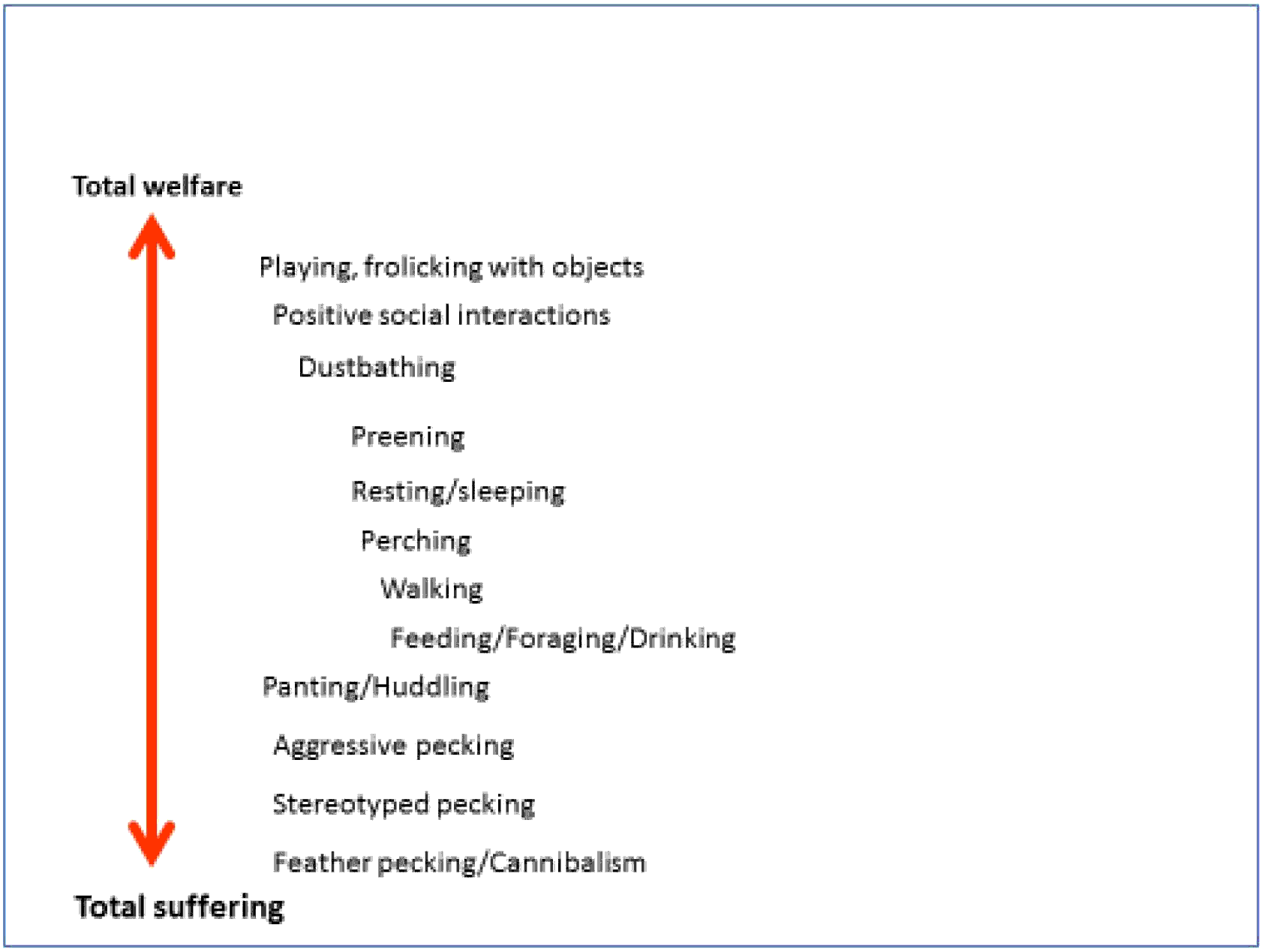
Regarding the variation in welfare definitions it is extremely difficult to assess all aspects of welfare in poultry production practice. Physical damage, such as wounds produced by cannibalism, bone breakage, and disease can be easily assessed by established scoring systems and veterinary diagnosis, and it is generally accepted that these conditions impair the wellbeing of animals. Physiological and ethological criteria are more difficult to measure and their relationship with well-being is often not fully understood. Stress as a physiological response to environmental stimuli is frequently mentioned in the context of welfare (Rushen, Reference RUSHEN1991). Release of corticosterone and epinephrine and the change in the heterophil-lymphocyte ratio (H/L) (Gross and Siegel, Reference GROSS and SIEGEL1983; Maxwell, Reference MAXWELL1993) are usually used as indicators of stress. The validity of these criteria as indicators of poor welfare has been demonstrated under extreme environmental conditions and under experimental situations. Their application under practical husbandry conditions, however, is difficult and cannot be clearly related to the state of well-being (Moe et al., Reference MOE, GUÉMENÉ, BAKKEN, LARSEN, SHINI, LERVIK, SKJERVE, MICHEL and TAUSON2010). Behavioural criteria are used to assess the psychological conditions of animals (Figure 2). Indicators of psychological disturbances are changes in the normal behaviour, the occurrence of displacement activities (e.g. displacement preening), damaging behaviour (e.g. feather pecking and cannibalism, aggression, fear, and stereotyped behaviour). Positive psychic conditions are assumed to be expressed through comfort behaviour, such as dustbathing, stretching and play. There exists, however, a great variability in these manifestations, and it is difficult to distinguish between normal and abnormal or disturbed behaviour. Only damaging activities, such as feather pecking and cannibalism are unanimously accepted as indicators of poor welfare.
Suggested ranking of different behaviours in poultry on the scale of welfare from total suffering to total welfare.

A positive emotional state of animals is even more difficult to assess. Preening, dustbathing, playing and positive social contacts are performed when the animals are not threatened by adverse stimuli. However, a high uncertainty remains when we try to interpret these behaviours with regard to the animal`s positive feelings. Functional Magnetic Resonance Imaging (fMRI) provides more reliable information on positive and negative emotions (Montague and Berns, Reference MONTAGUE and BERNS2002). However, the use of this technique is not possible under practical conditions at present.
welfare assessment
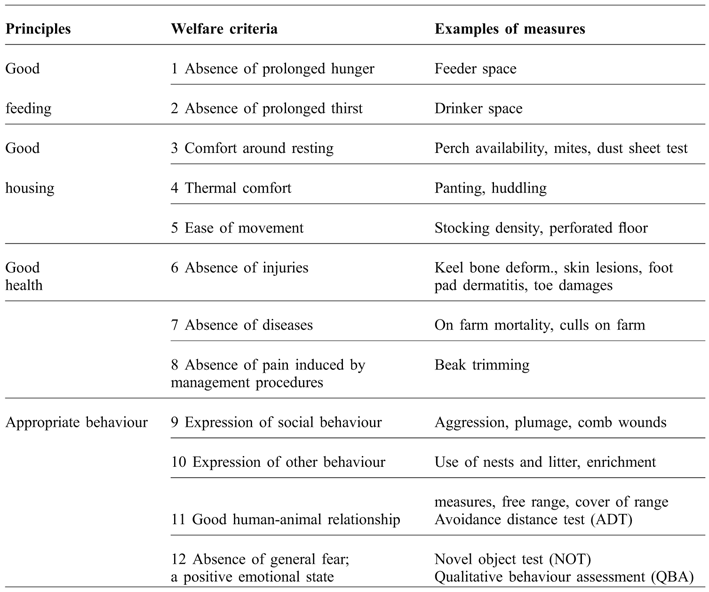
In spite of the above-mentioned problems of welfare definitions, various assessment schemes have been developed. The most sophisticated scheme for on farm welfare assessment of broilers and turkeys has been elaborated by the Welfare Quality project (EFSA, 2012). This scheme is based on four principles: ‘good feeding, good housing, good health and appropriate behaviour’ (Table 1). There exists a voluminous assessment protocol which comprises environmental and animal based criteria. All criteria are aggregated in a welfare score, which is being used to appraise the state of welfare among farms and production systems (Table 1). There is an increasing number of studies where this scheme has been applied (Keeling, Reference KEELING2009; Souza et al., Reference SOUZA, DE OLIVEIRA SANS, MÜLLER and MOLENTO2015). Its applicability however needs further development (De Jong et al., Reference DE JONG, HINDLE, BUTTERWORTH, ENGEL, FERRARI, GUNNINK, PEREZ MOYA, TUYTTENS and VAN REENEN2016).
Principles, criteria and measures of welfare of laying hens (Welfare Quality 2009).

International comparison of welfare regulations
Comparisons of welfare regulations in different countries have been reported in recent studies (Van Horne and Achterbosch, Reference VAN HORNE and ACHTERBOSCH2008; Bracke, Reference BRACKE2009; ECON; 2010; Lichter and Kleibrink, Reference LICHTER and KLEIBRINK2015). These studies show that welfare regulations for farm animals, and particularly for poultry, are more elaborate in the EU and in Switzerland than in other countries. The EU (1999) directive regulates in detail stocking density, lightning, climate, noxious gases, feed and feeding systems, perches, nests, health care, inspection, hygiene measures, and mutilations (e.g. beak trimming) in laying hens. Welfare of broilers is regulated in similar detail (EU, 2007). Since the EU tolerates deviation from the directives, provided minimum standards are followed, some countries apply stricter rules.
Legislation related to poultry welfare in countries outside the EU has been reported from Switzerland, Argentina, Australia and Brazil. Mandatory codes of recommendation exist in New Zealand, with voluntary codes of practice in Canada, China and USA. Van Horne and Achterbosch (Reference VAN HORNE and ACHTERBOSCH2008) analysed a large number of countries for their level of welfare legislation, using scores from 1 (low standard) and 5 (high standard). Switzerland and Northern European countries attained the highest scores, followed by other Western European countries, South European countries, Australia, Japan, Middle East, South America, East Europe, and Asian countries. The authors pointed out that their scoring system was based on ‘selected standards of welfare, which are not, on their own, good indicators’.
In a study on legislation of broiler and turkey welfare in different countries, Lichter and Kleibrink (Reference LICHTER and KLEIBRINK2015) identified four clusters with Germany, Austria and Sweden exceeding the minimum requirements of the EU regulation (EU, 2007), followed by Brazil, USA and Russia. Federal welfare regulation regarding livestock in the US was traditionally focused on transport (Twenty-Eight Hours Law) and slaughter (Human Methods of Slaughter Act) (Mench, Reference MENCH2008). Since individual states in the US have a high level of autonomy there exists a great variation in animal welfare legislation. On the basis of a referendum in California minimum requirements for laying hens have been formulated in a way which restricts or even outlaws conventional cages. Similar legislation was later established in Michigan, Ohio, Washington and Oregon (Vizzier-Thaxton et al., Reference VIZZIER-THAXTON, CHRISTENSEN, MENCH, RUMLEY, DAUGHERTY, FEINBERG, PARKER, SIEGEL and SCANES2016). An attempt to pass a federal law on keeping laying hens (Federal Egg Bill) which has been initiated by the Human Society of the USA (HSUS) and the United Egg Producers (UEP) failed in 2013. Missing detailed legal regulation does not necessarily reflect poor status of welfare under practical conditions. There exist various voluntary commitments for welfare-friendly poultry production. Recommendations of the National Chicken Council (NCC) in the US may be implemented under the control of large scale broiler integrations (Robins and Phillips, Reference ROBINS and PHILLIPS2011). In Brazil large broiler enterprises which produce for the European market comply with EU regulations. In Russia relevant welfare standards for broilers are laid down in a specific law. In most other countries there are no official standards for broilers. Activities to improve the welfare of farm animals in Central and South America have been reported by Huertas et al. (Reference HUERTAS, GALL and GALINDO2014). Animal welfare activities in this region are mainly supported by OIE Collaborating Centers for Animal Welfare and Livestock Production (OIE 2013a; 2013b).
Welfare standards
broilers and turkeys
Under the influence of different welfare regulations prevailing management conditions diverge considerably among countries. Most regulations provide a basic stocking density which can be exceeded when special good management practices are ensured. The basic stocking density (based on body weight) for EU countries is 33 kg/m². Up to 42 kg/m² can be allowed under improved management conditions. In some European countries the allowed maximum stocking densities is lower than 42 kg/m². In Sweden for instance, basic stocking density is 20 kg/m², but up to 36 kg/m² can be allowed when the farmers take part in a control scheme where housing and animals are regularly inspected. Maximum stocking density is 39 kg/m² in Germany. There is no regulation for stocking density for broilers in Brazil, but due to high ambient temperature only 10 to 12 broilers (approximately 35 kg/m²) are kept per m². There is no legal limit of stocking density in the USA, and recommendations of the National Chicken Council (NCC, 2017) vary from 31.5 to 43.6 kg/m², depending on the live weight (Mench and Blatchford, Reference MENCH and BLATCHFORD2014). In organic production the maximum stocking density is generally lower than in conventional production: 21 kg/m² in the EU, Canada and New Zealand and 10 kg/m² in Australia. Additional space in free range has to be provided in all organic systems. The EU Directive (EU, 2007) regulates further details of broiler management such as minimum light intensity (20 lux), duration of the darkness (eight hours), and maximum level of ammonia (20 ppm). During recent years numerous welfare agreements with higher welfare standards have been established among welfare-oriented NGOs, retailers and farmers. In most cases stocking density is reduced and other criteria, which are not regulated by laws, are included. In the ‘Initiative Tierwohl Gefluegel’ (Initiative Poultry Wellbeing, 2017) Germany broilers have to be provided with enrichment materials, such as pecking blocks, hay baskets or other suitable materials. According to some schemes for organic broiler production maximum growth rate is restricted and perches have to be provided.
There is no EU regulation for turkey production, and the only country where turkey production is regulated by law is The Netherlands (NL, 2006). Recommendations for turkey production are considered in the European Convention for the Protection of Animals Kept for Farming Purposes (EU, 2001). This document contains a comprehensive list of welfare criteria, including behaviour, integument, performance, health and mortality. Other recommendations are provided by the Farm Animal Welfare Council in the UK (FAWC, 1995), the WelfareQuality Consortium (EFSA, 2012) and other NGOs. Turkey production in Germany is regulated through a ‘Voluntary Agreement’, where producer associations, welfare-oriented NGOs and the ministries concerned signed an agreement on maximum stocking density and other details of good management practice and animal care (Voluntary Agreement, 1999).
laying hens
A greater abundance of welfare standards exists for laying hens, with the most detailed regulations in Switzerland and the EU. As with broilers, stocking density plays a central role. Maximum stocking density in furnished cages in EU countries is 750 cm²/bird (EU, 1999). There are however, EU countries with stricter regulations. In Germany maximum stocking density is 890 cm²/bird and minimum space per cage is 2.5 m². There is a strong resistance from welfare organisation to furnished cages in Germany and retailers have decided not to sell eggs from any type of cages. Therefore, most egg producers have replaced conventional cages with barn, aviary or free-range systems. After conventional cages were banned in the EU, the debate started in the US where most layers are still kept in this manner. The United Egg Producers (UEP) recommends 432 - 555 cm² usable space per bird, depending on hen size and cage design (Mench and Blatchford, Reference MENCH and BLATCHFORD2014). Compliance with the UEP regulations is subjected to third party audit. Higher standards regarding available space and freedom to move have been established in California and some other states. Though cages are not legally prohibited, compliance with the regulations may be difficult using small conventional cages (Mench and Blatchford, Reference MENCH and BLATCHFORD2014; Vizzier-Thaxton et al., Reference VIZZIER-THAXTON, CHRISTENSEN, MENCH, RUMLEY, DAUGHERTY, FEINBERG, PARKER, SIEGEL and SCANES2016). Important fast food chains and retailers recently announced that they would stop using or selling cage eggs (Windhorst, Reference WINDHORST2008). ‘Cage-free eggs’ have become a common slogan in the attempt to ban cages (Lay et al., Reference LAY, FULTON, HESTER, KARCHER, KJAER, MENCH, MULLENS, NEWBERRY, NICOL, O'SULLIVAN and PORTER2011; Vizzier-Thaxton et al., Reference VIZZIER-THAXTON, CHRISTENSEN, MENCH, RUMLEY, DAUGHERTY, FEINBERG, PARKER, SIEGEL and SCANES2016). The USA hence follows the trend in European countries in providing laying hens more freedom to move.
Beak trimming, forced moult and killing day-old male chicks of layer lines are intensively discussed in various countries. Beak trimming, as a means to reduce damages through feather pecking and cannibalism, is allowed by EU regulation in chicks up to 10 days of age. In Switzerland, Sweden, Norway and Finland beak trimming is prohibited. In the UK beak trimming is allowed only using infra-red methods (Fiks van Niekerk and De Jong, Reference FIKS VAN NIEKERK and DE JONG2007). Several European countries announced a ban of beak trimming recently. Egg producers in Germany anticipated a ban of beak trimming through a voluntary renunciation in 2017 and have launched various research and extension projects which assist egg producers to manage intact-beak birds.
The traditional procedure to induce moult by depriving hens of feed, water and light for several days, is not permitted in the EU, as this does not comply with the general formulation of the EU-Directive on the welfare of laying hens (EU, 1999). There are ‘soft’ methods of inducing a laying pause using special feeding and lighting programmes which do not rely on feed and water deprivation and which comply with the EU directive. According to the welfare regulations of UEP in the US, only non-feed withdrawal moult methods are permitted (UEP, 2016).
Killing day-old chicks from layer lines has become a major welfare issue in Germany. So far, this procedure has not been prohibited under the condition that adequate methods are applied. There exists, however a general paragraph in German law of animal protection that no animal should be killed without sound reasons. The fact that male chicks of layer lines cannot be economically raised for meat production is not generally accepted as ‘sound reason’ and attempts are underway to formulate a law to ban killing of day-old chicks generally. Methods to identify the sex of embryos in an early phase of incubation are being developed (Weissmann et al., Reference WEISSMANN, REITEMEIER, HAHN, GOTTSCHALK and EINSPANIER2013; Galli et al., Reference GALLI, PREUSSE, UCKERMANN, BARTELS, KRAUTWALD-JUNGHANNS, KOCH and STEINER2016; Göhler et al., Reference GÖHLER, FISCHER and MEISSNER2017). These methods are, however, not ready to be applied in practice. Using dual purpose breeds presents an alternative to avoid killing of day-old chicks (Leenstra et al., Reference LEENSTRA, VAN HORNE and VAN KRIMPEN2010). Performance of males as meat producers and the females as layers have been reported by Damme et al. (Reference DAMME, URSELMANS and SCHMIDT2015) and will be discussed further below.
Welfare labels
Special welfare labels for conventional and organic production, which consider the above-mentioned problems, exist in many countries. The situation in the US has been reported by Mench (Reference MENCH2008), whereby producer associations, such as UEP and NCC, as well as animal protection organisations, such as Global Animal Partnership (GAP) and Human Society of the United States (HSUS), have established important certified welfare labels. ECON (2010) listed voluntary welfare schemes of 10 European countries and there exist numerous other welfare-related labels of regional interest. The multitude and complexity of different welfare labels in poultry eggs and meat may lead to confusion of the consumers. There are plans to introduce general and simplified systems which indicate different welfare levels, like the three-star system in the Netherlands (Beter Leven, 2017 or the Five-Step-Program of Global Animal Partnership (GAP, 2017) in the US. These labels aim at improving transparency on the level of welfare and support the consumer`s decision when buying eggs and poultry meat. The so-called Rondeel system for laying hens for example was granted three stars by the Beter Leven (translated as ‘better life’) system, which represents the highest standard of welfare (van Niekerk and Reuvekamp, Reference VAN NIEKERK and REUVEKAMP2011). Rating of production systems on the international level may be more complicated. Regarding the variation in perception of animal welfare by consumers and poultry farmers within and among different countries and regions (Vanhonacker and Verbeke, Reference VANHONACKER and VERBEKE2009; Tuyttens et al., Reference TUYTTENS, VANHONACKER and VERBEKE2014; Stadig, Reference STADIG2015; Stadig et al., Reference STADIG, AMPE, VAN GANSBEKE, VAN DEN BOGAERT, D'HAENENS, HEERKENS and TUYTTENS2016), it is not likely that there will be welfare schemes which are accepted by all groups of stakeholders within countries and on an international level.
Economic aspects of welfare
Improving welfare in layers and broilers is related to increased space, provision of enrichment devices and intensified control. Transition from cages to aviaries and barns bears increased risk for feather pecking and cannibalism (Sherwin et al., Reference SHERWIN, RICHARDS and NICOL2010; Lambton et al., Reference LAMBTON, KNOWLES, YORKE and NICOL2010; Reference LAMBTON, KNOWLES, YORKE and NICOL2015). This effect will be more pronounced when birds are not beak trimmed (Hartcher et al., Reference HARTCHER, TRAN, WILKINSON, HEMSWORTH, THOMSON and CRONIN2015). Free range production increases energy requirement for exercise and requires compensation for low ambient temperature under moderate and cold climatic conditions. In broilers there is a linear increase of production cost with decreasing stocking density and the profit per m² surface of a poultry house decreases correspondingly (Shanawany, Reference SHANAWANY1988). The main effect of stocking density on the economic result is based on the decreased cost for housing, heating and labour. Costs further increase when material for enrichment is provided. According to our own unpublished calculations, production costs increase by 0.03 €/kg live weight when stocking density was decreased from 39 to 35 kg/m² in broilers. Installation of commercial pecking blocks leads to further increase of costs of 0.003 €/kg live weight. In conventional cages for laying hens high stocking density of 350 to 400 cm² has proved to produce optimum economic results (Bell, Reference BELL2000). Production costs increase with increases space allowance in furnished cages (750 cm²/bird) and barn systems (1111 cm²/bird) under EU standards (van Horne and Achterbosch, Reference VAN HORNE and ACHTERBOSCH2008). According to Matthews and Sumner (Reference MATTHEWS and SUMNER2015) cost increase per egg was 13% in furnished cages and 36% in aviaries as compared to conventional cages. Using intact-beak birds as compared to beak trimmed birds results in increased production costs of 0.22 to 0.49 € per hen and year (Damme and Urselmans, Reference DAMME and URSELMANS2013). The main factors which cause the difference in production cost of intact-beak and beak-trimmed layers are increased feed consumption due to poor feathering and increased mortality caused by cannibalism. Recent experience with intact-beak layers in different states of Germany have shown that the requirement of time to observe the birds (pullets and layers) and to provide occupation material lead to further considerable increase in production costs. Extra costs for feed, housing, pullets, labour and enrichment materials varied from 2.11 to 3.33 €/hen housed and year. These costs include provision of enrichment materials of 1.07 to 1.74 €/hen housed and year (Damme, Reference DAMME2016 unpublished).
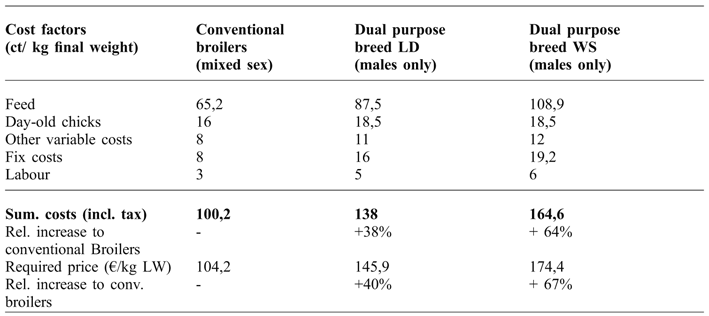
The scenario of a ban of killing day-old chicks from layer strains and the use of dual purpose breeds instead of conventional layer and broiler lines has been analysed by Leenstra et al. (Reference LEENSTRA, VAN HORNE and VAN KRIMPEN2010) and Damme et al. (Reference DAMME, URSELMANS and SCHMIDT2015). Depending on the dual-purpose strain used Damme et al. (Reference DAMME, URSELMANS and SCHMIDT2015) found an increase in production cost of 38 to 64% (Table 2). The most important influencing factor was the poor feed conversion ratio of the males of dual purpose breeds. For layers, a lower number of marketable eggs and poor feed conversion ratio produced a reduction in income over feed cost of 34 to 40%. In order to compensate for the increased overall production cost of dual purpose breeds the egg price needs to increase by €0.026 to 0.039.
Production costs and required increase in sales price for two dual purpose breeds (Lohmann Dual, LD, and Walesby Special, WS) to achieve equal profit as in conventional broilers (Ross 308; Cobb 500) (Damme, Reference DAMME2016).

The relative increase in production cost seems to be small and consumers in Europe are supposed to be willing to pay for higher welfare standards. There exists, however, a large divergence in the consumers attitude when responding to questions on their attitude to animal welfare in general and their behaviour when buying animal products. Where 65 to 87% are reported to think about animal welfare in general but only 26 to 54% consider animal welfare when buying egg and meat products (Kjaernes et al., Reference KJAERNES, MIELE and ROEX2007). This corresponds with earlier studies on the consumer attitudes towards buying eggs from caged hens (Haris and Gschwindt-Ensinger, Reference HARIS and GSCHWINDT-ENSINGER1982; Trinh, Reference TRINH1997). Vanhonacker and Verbeke (Reference VANHONACKER and VERBEKE2009) identified consumer groups with high and low frequency of buying eggs and poultry meat produced under welfare-friendly conditions (pro-welfare). The willingness to pay for a higher price for welfare-friendly production decreased in all groups, but the decrease was less pronounced in the pro-welfare group. A French study on consumers perception and behaviour when buying poultry meat showed a strong preference for birds kept as free range (Walley et al., Reference WALLEY, PARROTT, CUSTANCE, MELEDO-ABRAHAM and BOURDIN2015). The motivation for this preference was, however, based on the assumption of higher gustatory characteristics, while welfare aspects had only a moderate impact on the buying decision.
Retailers respond to extremely low-price differences and extra costs for welfare are not accepted if there is no special label to justify higher consumer prices. In the EU a numbered code for the housing system (cage, barn/aviary, free range and organic) is stamped on eggs. Consumers are generally informed about the code and pay higher price for eggs from free range and organic production. Additional welfare measures, like enrichment materials and renouncing of beak-trimming, force moult and killing day-old male chicks need still to be communicated to the consumers.
Driving factors in animal welfare development
Requests for improvement of welfare standards are typically brought to the attention of legislative authority which incorporates them into laws or directives. Since legislation for farm animal welfare is usually a compromise of interests between welfare organisations, farmers, retailers and consumers, the resulting legal act does not, in most cases, fully satisfy the particular interests of all stakeholders involved. Consequently, different coalitions of shareholders have developed their own welfare standards. Such standards are widespread in organic production systems where animal welfare plays a prominent role.
Organic farms in Europe are usually organised in producer associations which have specific regulations on animal husbandry. Regulations beyond the legally fixed minimum requirements on welfare also exist in conventional poultry production. In Germany there is a ‘voluntary agreement’ between poultry farmer organisations, welfare organisations and government authorities which regulates minimum requirements in turkey production on the national level. A similar agreement which existed for broilers has now been replaced by a legal regulation.
Retailers have become the most important driving forces in many non-government welfare regulations, and welfare organisations are involved in the development of such standards. This protects the retailers from adverse campaigns of welfarists in public media or in shopping centres. Farmers, however, who were not involved in the discussion, have had to bear the higher costs of welfare-friendly production. Retailers and food chains in the USA have committed themselves to improve animal welfare in the production systems of their suppliers (Vizzier-Thaxton et al., Reference VIZZIER-THAXTON, CHRISTENSEN, MENCH, RUMLEY, DAUGHERTY, FEINBERG, PARKER, SIEGEL and SCANES2016). Recently poultry farmers organisations in Germany decided to initiate their own welfare labels in direct cooperation with retailer chains (Initiative Poultry Wellbeing, 2017). The retailers pay 0.04 Eurocent per kg of poultry meat into a central welfare fund, and participating certified farms are remunerated for the higher costs of production through that fund. By taking a leading role in setting welfare standards, poultry farmers not only abide by regulations which are scientifically sound and economically viable, but also improve the farmers’ reputation in the public. In addition, the farmer's initiatives generate awareness of retailers and consumers on the actual costs of welfare.
Conclusions
Perception of welfare differs largely among countries and continents. Definitions of welfare not only depend on the cultural background but also on the living standard of the human population. This is reflected in different levels of welfare legislation and welfare standards among countries. The main welfare issues in egg production are cage rearing, stocking density, beak trimming, force moult, and killing of day-old chicks of layer lines. In broilers stocking density, light programmes, litter conditions and leg problems are the main points of welfare concern. Higher levels of welfare lead to considerable increase of productions costs. Under competitive international market conditions the different legal welfare standards will shift the production towards countries with lower levels of welfare. At present, retailers of poultry products in cooperation with welfare-oriented NGOs and/or poultry producer organisations establish special welfare standards which are independent of the legal situation of the country of production. Such standards would attenuate the differences in welfare-born production costs and lead to harmonisation of welfare standards among countries.