


Introduction
Theories of OCD are focused on the maintenance of the disorder (Wells, Reference Wells1997). Perhaps the most supported cognitive model is the inflated responsibility hypothesis (Salkovskis, Reference Salkovskis1989). The hypothesis states that the majority of young people experience intrusive thoughts (Allsopp and Williams, Reference Allsopp and Williams1996), which some people interpret as a sense of personal responsibility for a negative outcome for self or other. Their response is to carry out repetitive behaviours (compulsions). Little research has investigated what might give rise to an inflated sense of responsibility in people with OCD.
Salkovskis, Shafran, Rachman and Freeston (Reference Salkovskis, Shafran, Rachman and Freeston1999) proposed a set of five pathways that could explain development of inflated responsibility: 1) A broad and heightened sense of responsibility that is encouraged by significant figures. 2) Rigid codes of conduct. 3) Being shielded from responsibility during development or being treated as incompetent to cope with responsibility. 4) A specific incident, or series of incidents, in which one's actions or inactions contribute to some negative outcome for self or other(s). 5) A specific incident in which one's thoughts or actions are incorrectly considered to have led to some negative outcome for self or other(s). A novel measure, the Origins Questionnaire for Adolescents (OQA), was therefore developed for this study with 5 subscales: 1) Broad sense of responsibility; 2) Rigid codes of conduct; 3) Shielded from responsibility; 4) Incident associated with negative outcome; 5) Extremes of responsibility.
Method
Design
This was a cross-sectional interview and questionnaire study. The hypothesized between group differences under investigation relate to experiences of responsibility during development, that is, a possible vulnerability factor for the development of OCD. For this study, therefore, an ideal clinical group would be similar to a non-clinical group in terms of current OCD symptomatology. This would ensure that, where differences were found in terms of responsibility during development, they would not be due to a halo effect from current OCD symptoms, but could represent a vulnerability factor for the development of OCD. Therefore, inclusion criteria for the clinical group included having received treatment for OCD, which would make recovery from OCD more likely, and current OCD symptomatology more similar to a non-clinical group.
All adolescent participants completed the same set of measures, with the difference that the non-clinical group completed a non-clinical version of the “Origins Questionnaire”. Similarly, parents of all adolescent participants completed the same set of measures, with the parents of the non-clinical adolescents completing the non-clinical version of the “Independent Living Questionnaire”.
Participants
Participants, aged 14 -21 years, were recruited for one of two groups, clinical or non-clinical. Inclusion criteria for the clinical group were a history of a primary diagnosis of obsessive-compulsive disorder diagnosed using DSM-IV criteria (APA, 1994), having received treatment for their OCD, and English as a first language.
Recruitment
The clinical participants were identified by Child and Adolescent Mental Health Services (CAMHS) clinicians as those who had received treatment for a primary diagnosis of OCD. Non-clinical participants were recruited via advertisements in state secondary schools in Oxfordshire and Berkshire.
Measures
Self-report measures. The Child Obsessive-Compulsive Inventory (Child OCI) (Waite and Williams, Reference Waite and Williams2009) comprises 42 items divided into 7 subscales.
Researcher administered measures. The Origins Questionnaire for Adolescents (OQA) is a semi-structured interview with 10 questions, comprising 54 items (see online Extended report).
Parent self-report measures. The Child Development Questionnaire – Revised (CDQ-R) (S. Perrin, personal communication, 2008 – see online Extended report) is an 18-question version of the Child Development Questionnaire (Zabin and Melamed, Reference Zabin and Melamed1980).
Independent Living Questionnaire. The Independent Living Questionnaire (ILQ) (see online Extended report) is derived from the OQA and contains 11 probes with 46 detail items.
Reliability of the OQA: design and procedure
The reliability was investigated with data gathered from a sample (4 males and 10 females) of university undergraduates who completed the OQA on two occasions, separated by one week. The test-retest reliability was in the appropriate range, intraclass coefficients were high, in the range .838 to .954. The internal consistency of the OQA was found to vary between subscales and between groups, with alphas between .377 and .880.
Results
Sample characteristics
Gender and age. Five male and 11 female adolescents (mean age 17.3 years, SD = 2.13) were recruited for the clinical group. The non-clinical group also comprised 5 males and 11 females (mean age 16.8 years, SD = .96). Parent participants in the clinical group were 15 mothers and 4 fathers. Parent measures were received from parents of 14 adolescents (13 mothers, 2 fathers) in the non-clinical group.
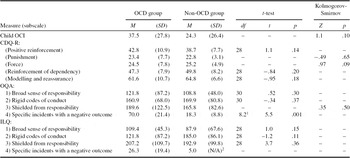
No significant differences were found between groups on the self-report questionnaire measures (Child OCI, CDQ-Revised see Table 1). On the Child OCI, neither group scored in the clinical range. This suggests that the groups did not differ in terms of current OCD symptomatology. Table 1 also shows scores for adolescents and their parents on subscales 1, 2, 3 and 4 (Broad sense of responsibility, Rigid codes of conduct, Shielded from responsibility and Specific incidents with a negative outcome) of the OQA and ILQ. The only significant difference was found on subscale 4 (Specific incidents with a negative outcome) where the OCD group reported a significantly higher sense of responsibility for these events.
Means (standard deviations) and tests for differences between clinical and non-clinical group responses on Child OCI, CDQ-R, OQA and ILQ

1indicates that variances were significantly different. t statistic does not assume homogeneity of variance.
2insignificant data. Statistics not calculated for this variable.
Child OCI: Child Obsessive-Compulsive Inventory; OQA: Origins Questionnaire for Adolescents; ILQ: Independent Living Questionnaire.
Discussion
The results of the main study suggest that there are few significant differences between adolescents with a history of OCD and non-clinical adolescents in terms of their experiences of responsibility during development. However, the OCD group reported a greater sense of responsibility in terms of experienced responsibility for specific incidents. The OQA appears to be reliable over time, albeit with a slightly older sample, but internal consistency is only partly satisfactory.
From a practical perspective it might be that, because data were collected retrospectively, participants' recall of how responsible they felt at the time of the incident was affected by memory bias associated with anxiety symptoms. That is, one would report a higher sense of responsibility when one has elevated anxiety symptoms. The groups did not differ in self-reported OCD symptoms, so a halo effect from current symptoms to reports of responsibility during development is not a compelling explanation.
An alternative explanation for the lack of significant differences between groups is that the measures used to detect differences (OQA and ILQ) were insensitive to different experiences. Salkovskis et al. (Reference Salkovskis, Shafran, Rachman and Freeston1999) suggested that the development of an inflated sense of responsibility might take the form of an accumulation of multiple small experiences, each of which has nugatory effect in isolation. Alternatively, the OQA and ILQ might be suitably sensitive, but an inflated sense of responsibility is not centrally important in the development of OCD.
Information in this study was collected retrospectively, and therefore has inherent limitations. These include that adolescent participants' responses regarding their experiences of responsibility during development were reliant on their ability to recall information from a period of potentially 21 years ago. Additionally, where parents of participants had more than one child, their recall of the experiences of responsibility of the child taking part in the study might have become confused with their other children's experiences of responsibility during development. The reliability and validity of the information, therefore, warrants caution in the interpretation of information gathered retrospectively (that is, using the OQA and ILQ).
The sample is potentially limited in two ways. First, the sample is small. Potentially, further work using these measures can use the results to calculate more appropriate sample sizes. Second, the clinical sample was not assessed within the study for a diagnosis of OCD according to the diagnostic criteria of the two most commonly used classification systems, but was characterized by a diagnosis within CAMHS using DSM-IV criteria.
Future research might use a prospective design to investigate the development of an at-risk group, to establish what factors, including experiences of responsibility, might interact in the development of OCD.




Comments
No Comments have been published for this article.