Glyphosate-resistant (GR) weeds continue to be important in weed management strategies of cotton producers in the midsouth and southeast regions of the United States (Klingaman and Oliver Reference Klingaman and Oliver1994; Steckel Reference Steckel2007; Webster and Sosnoskie Reference Webster and Sosnoskie2010). Palmer amaranth is currently the most prevalent and prolific GR weed affecting cotton cropping systems. Palmer amaranth is a dioecious, summer-annual species native to the southwest region of the United States (Ehleringer Reference Ehleringer1983; Sauer Reference Sauer1957). Palmer amaranth has a wide germination window, aggressive growth habit, and produces numerous viable seeds (Bond and Oliver Reference Bond and Oliver2006; Horak and Loughin Reference Horak and Loughin2000; Keeley et al. Reference Keeley, Carter and Thullen1987; Sellers et al. Reference Sellers, Smeda, Johnson, Kendig and Ellersieck2003). While Palmer amaranth is considered a summer-annual species, it has been observed germinating from March 1 until October 1 (Keeley et al. Reference Keeley, Carter and Thullen1987). A long germination period and high rate of early growth make this weed very competitive for resources and makes timely POST herbicide application a challenge (Klingaman and Oliver Reference Klingaman and Oliver1994; Sellers et al. Reference Sellers, Smeda, Johnson, Kendig and Ellersieck2003). This weed commonly reduces yields of agronomic crops if adequate control is not obtained (Klingaman and Oliver Reference Klingaman and Oliver1994; MacRae et al. Reference MacRae, Webster, Sosnoskie, Culpepper and Kichler2013; Morgan et al. Reference Morgan, Baumann and Chandler2001).
Currently, there are few POST options for controlling GR Palmer amaranth in cotton. Glufosinate, pyrithiobac, and trifloxysulfuron have shown some utility (Branson et al. Reference Branson, Smith and Barrentine2005; Corbett et al. Reference Corbett, Askew, Thomas and Wilcut2004; Culpepper et al. Reference Culpepper, York, Roberts and Whitaker2009; Everman et al. Reference Everman, Burke, Allen, Collins and Wilcut2007; Gardner et al. Reference Gardner, York, Jordan and Monks2006; Whitaker et al. Reference Whitaker, York, Jordan and Culpepper2011). Pyrithiobac and trifloxysulfuron are acetolactate synthase (ALS)-inhibiting herbicides that will control small Palmer amaranth plants. Unfortunately, Palmer amaranth populations resistant to ALS-inhibiting herbicides are widespread, and in many cases have multiple resistance to these herbicides and glyphosate (Bond et al. Reference Bond, Oliver and Stephenson2006; Culpepper and York Reference Culpepper and York1998; Wise et al. Reference Wise, Grey, Prostko, Vencill and Webster2009). The registration of glufosinate-resistant cotton cultivars has provided cotton producers with success in controlling GR Palmer amaranth (Gardner et al. Reference Gardner, York, Jordan and Monks2006). Like glyphosate, glufosinate is a non-selective herbicide that provides broad-spectrum control of monocot and dicot weeds (Corbett et al. Reference Corbett, Askew, Thomas and Wilcut2004). Glufosinate must be applied to Palmer amaranth in a timely manner (Coetzer et al. Reference Coetzer, al-Khalib and Peterson2002; Culpepper et al. Reference Culpepper, Webster, Sosnoskie and York2010), and thorough coverage must be achieved to ensure adequate control (Corbett et al. Reference Corbett, Askew, Thomas and Wilcut2004). Effective application of glufosinate can prove difficult to accomplish due to the robust growth habit of Palmer amaranth (Coetzer et al. Reference Coetzer, al-Khalib and Peterson2002).
Mechanical and cultural control methods such as tillage, crop rotation, row spacing, and integration of high-residue cover crops have proved beneficial in controlling this problematic weed species (Edmisten et al. Reference Edmisten, Yelverton, Spers, Bowman, Bacheler, Koenning, Crozier, Meijer and Culpepper2010; Price et al. Reference Price, Balkcom, Culpepper, Kelton, Nichols and Schomberg2011). Many cotton producers have adopted conservation tillage because its use was enabled by the availability of a glyphosate-based weed control program (Duke and Powles Reference Duke and Powles2009; Fernandez-Cornejo and Caswell Reference Fernandez-Cornejo and Caswell2006; Young Reference Young2006). Currently, the Natural Resources Conservation Service in Tennessee is promoting the use of cover crops and is offering a cost-share program with producers to provide incentive to use these tools (Natural Resources Conservation Service 2014). Therefore, interest in integrating cover crops into cotton production systems is increasing (Price et al. Reference Price, Balkcom, Duzy and Kelton2012).
Winter-annual cover crops have long been used as a conservation practice. Cover crops improve soil quality, increase soil organic matter, increase soil moisture retention, reduce erosion, and can provide early-season weed control provided they obtain good winter growth which can lead to substantial spring biomass (Hartwig and Hoffman Reference Hartwig and Hoffman1975). Cereal rye and winter wheat are common winter-annual grass cover crops that reduce pressure from several weed species (Liebel et al. Reference Liebel, Simmons, Wax and Stoller1992; Moore et al. Reference Moore, Gillespie and Swanton1994). Other cover crop species such as hairy vetch and crimson clover have not only been investigated for weed suppression, but also for their ability to biologically fix atmospheric nitrogen that becomes available to the subsequent crop (Duck and Tyler Reference Duck and Tyler1996; Fisk et al. Reference Fisk, Hersterman, Shrestha, Kells, Harwood, Squire and Sheaffer2001; Norsworthy et al. Reference Norsworthy, McClelland, Griffith, Bangarwa and Still2010). Winter-annual grasses and legumes have been implemented in several crops, including corn (Zea mays L.), cotton, and soybean (Glycine max L. Merr.) (Reddy Reference Reddy2001; White and Worsham Reference White and Worsham1990; Wiggins et al. Reference Wiggins, McClure, Hayes and Steckel2015, Reference Wiggins, Hayes and Steckel2016).
From a Palmer amaranth management standpoint, two recent cover crop studies conducted in cotton showed that cover crops integrated with herbicides improved weed control and yield (Price et al. Reference Price, Balkcom, Duzy and Kelton2012, Reference Price, Monks, Culpepper, Duzy, Kelton, Marshall, Steckel, Sosnoskie and Nichols2016). The Price et al. (Reference Price, Monks, Culpepper, Duzy, Kelton, Marshall, Steckel, Sosnoskie and Nichols2016) study was conducted across five southeastern states in the United States comparing high-residue cover crops to deep tillage, and found that the cover crops studied provided adequate Palmer amaranth control to improve cotton yield. Although cover crops suppress many winter-annual weed species during the early spring, cover crop residues typically do not provide season-long weed control for agronomic crops, particularly in areas with cold winters and where cover crop biomass accumulation may be more limited (Price et al. Reference Price, Monks, Culpepper, Duzy, Kelton, Marshall, Steckel, Sosnoskie and Nichols2016; Teasdale Reference Teasdale1996; Wiggins et al. Reference Wiggins, McClure, Hayes and Steckel2015, Reference Wiggins, Hayes and Steckel2016). Thus, POST herbicides are commonly needed alongside cover crop residues to achieve adequate weed control.
There is some research showing cover crop benefits for weed control in cotton. However, data are limited in the northern range of the cotton-growing region of the United States, where cover crop establishment in the winter is more challenging. Therefore, a study was conducted to evaluate the effectiveness of integrating high-residue cover crops into a glyphosate- and glufosinate-based weed control system in cotton. The objective of this research was to identify which integrated herbicide and cover crop system offers cotton produces the most Palmer amaranth control.
Materials and Methods
Experiments to determine the efficacy of high-residue cover crops integrated with POST herbicides to control GR Palmer amaranth were conducted in 2013 and 2014 at the West Tennessee Research and Education Center in Jackson, Tennessee (35.633°N, 88.856°W). This location was infested with nearly a 100% GR Palmer amaranth population (LE Steckel, unpublished data). Cereal rye, winter wheat, crimson clover, and hairy vetch were seeded at 67, 67, 17, and 22 kg ha−1, respectively, using a no-till drill, and allowed to overwinter. All cover crop treatments were compared with areas of native winter vegetation consisting of henbit (Lamium amplexicaule L.), annual bluegrass (Poa annua L.), and horseweed [Conyza canadensis (L.) Cronq.]. These nontreated plots that consist of native winter annual vegetation are typical of Tennessee production practices (Wiggins et al. Reference Wiggins, Hayes and Steckel2016). Plots were a 9.1-m length of two rows with a row spacing of 97 cm.
A 25-cm band of paraquat (Gramoxone® SL 2.0, Syngenta Crop Protection, LLC, PO Box 18300, Greensboro, NC) at 851 g ai ha−1 plus 0.25% (v/v) nonionic surfactant (Induce®, Helena Chemical Company, 225 Schilling Blvd, Collierville, TN) was applied over each row 90 d before anticipated cotton planting using a shielded sprayer and a tractor with real-time kinematic (RTK) (John Deere Greenstar 2, John Deere, Moline, IL) for guidance (Wiggins et al. Reference Wiggins, Hayes and Steckel2016). Shortly before chemical desiccation of the cover crops, biomass yields were obtained from the nontreated area between the desiccated strips by clipping a 0.1 m2 quadrat at ground level. These cover crop samples were dried in a forced-air oven at 60 C for 48 h. Approximately 3 wk prior to estimated cotton planting date, the entire test area was treated with glyphosate (Roundup POWERMAX®, Monsanto Company, 800 N. Lindbergh Blvd, St. Louis, MO) at a rate of 887 g ae ha−1. It was determined that a sequential burndown application was necessary as the first application of glyphosate did not control the cover crops effectively (Fisk et al. Reference Fisk, Hersterman, Shrestha, Kells, Harwood, Squire and Sheaffer2001). A sequential application of paraquat plus nonionic surfactant controlled all vegetation at least 97% in the trial area. Cotton was then planted into the desiccated bands using the RTK technology.
Cotton cultivar ‘FM 1944GLB2’ (Bayer CropScience, Research Triangle Park, NC), with resistance to glyphosate and glufosinate, was no-till planted into the existing cover crop residue 2 cm deep at a seeding rate of 10 to 12 seeds per meter of row. Cover crop planting date, cover termination dates, cotton planting dates, POST application dates, cotton harvest date, and environmental data can be found in Table 1.
Dates of cover crop and cotton planting, cover crop termination, postemergence (POST) herbicide applications, cotton harvest, and early-season Palmer amaranth control, along with total precipitation and growing degree days.

a POST herbicides were applied to nontreated check when Palmer amaranth reached 10 cm height.
b Date of first POST herbicide application to most efficacious cereal cover (cereal rye) when Palmer amaranth reached 10 cm height.
c Climate information recorded from cotton planting date to harvest date at West Tennessee Research and Education Center, Jackson, TN.
A randomized complete block design with a factorial arrangement of treatments and four replications was used. Treatment factors included five cover crops and three POST herbicide programs in all combinations. The first POST herbicides were applied when Palmer amaranth reached a height of 10 cm in each treatment, i.e., the winter cereal rye was treated first 14 d after the nontreated (Table 1). A second treatment with the same herbicide was applied 14 d after the initial application. Treatments were glyphosate at 1,277 g ae ha−1, glufosinate (Liberty® 280 SL, Bayer CropScience Ag, Alfred-Nobel-Str. 50, Monheim am Rhein, Germany) at 602 g ai ha−1, and a nontreated check. Herbicides were applied using a CO2-pressurized backpack sprayer calibrated to deliver 140 L ha−1 and equipped with AIXR11002 nozzles (AIXR TeeJet Air Induction Extended Range Flat Fan Spray Tips, TeeJet Technologies, Wheaton, IL).
All production practices other than weed control and nitrogen application followed University of Tennessee Extension recommendations for cotton production (Main Reference Main2014). The current recommendation for cotton following a legume cover crop that has reached early bloom stage is to reduce the nitrogen rate by 67 to 90 kg ha−1 (Savoy and Joines Reference Savoy and Joines2009). However, in this trial, a side-dressing implement was used to apply 32-0-0 liquid nitrogen at a rate of 90 kg ha−1 to the entire plot area when the cotton had six true leaves. Nitrogen rates were not adjusted for the legume covers to reduce the potential for cover crop and herbicide treatments to be confounded by nitrogen rates.
Palmer amaranth control was visually estimated weekly for 4 wk, starting 7 d after application (DAA) using a scale of 0 (no control) to 100 (complete control). Palmer amaranth density was counted in one 0.5-m2 quadrat per plot prior to POST application and after the fourth visual rating of Palmer amaranth control. A sequential broadcast application of a tank mixture of glufosinate at 602 g ha−1 plus glyphosate at 1,277 g ha−1 was applied to all plots after these assessments to ensure harvestable plots. Cotton was harvested using a spindle cotton picker adapted for small-plot harvesting. Lint yields were calculated using a 35.5% gin turnout.
The data collected as described above on cover crop biomass was regressed against Palmer amaranth control using an exponential growth model (Equation 1) using the NLIN procedure in SAS (version 9.3, SAS Institute, Cary, NC) to determine if biomass affected Palmer amaranth control.
 $$y\,{\equals}\,x{\plus}\left( {{\rm log}\,{\rm a}} \right){\rm a}^{{\rm x}} $$
In this model, x represents the percent control that was acquired when 50% of the cover crop biomass was generated, and a is the asymptote. Cover crop biomass was also regressed against time taken for Palmer amaranth to germinate and grow to 10 cm with a logistic model (Equation 2) to determine the effect cover crop biomass had on speed of Palmer amaranth to grow to 10 cm.
 $$y\,{\equals}\,a/\left( {1{\plus}{\rm exp}\left( {{\minus}\left( {x{\minus}c} \right) /\! b} \right)} \right)$$
In this model, a is the asymptote or total cover crop biomass, c is the estimate of days taken for half the biomass to delay Palmer amaranth the reach 10 cm in height, and b is an estimate of the number of days taken for Palmer amaranth to reach 5 cm.
Palmer amaranth control, density, and yield data were analyzed using the PROC MIXED procedure of SAS (version 9.3; SAS Institute; Cary, NC). ANOVA was used to test for significant main effects and interactions. Means were separated using Fisher’s protected LSD procedure at the 0.05 significance level. Cover crop species and herbicide regime were considered fixed effects and replication and years were considered random.
Results and Discussion
Cover Crop Biomass
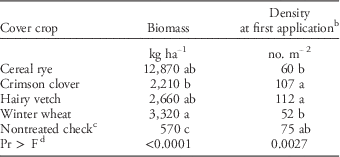
Cover crop biomass accumulation was variable among plots and differed among cover crop species (Pr > F = 0.0001) (Table 2). Dry biomass ranged from 570 to 3,320 kg ha−1. All cover crop species accumulated 2,000 kg ha−1 of biomass or greater. The winter-annual grass crops evaluated produced the greatest amount of biomass, with winter wheat producing 3,320 kg ha−1 and cereal rye producing 2,870 kg ha−1. The amount of biomass is about half that (6,000 to 6,790 kg ha−1) reported from research conducted in more southern latitudes of the United States (Price et al. Reference Price, Balkcom, Duzy and Kelton2012, Reference Price, Monks, Culpepper, Duzy, Kelton, Marshall, Steckel, Sosnoskie and Nichols2016). Hairy vetch biomass was similar to that of the winter-annual grass crops. Crimson clover produced the least biomass. However, all cover crops accumulated more biomass than did the areas of native winter vegetation.
Cover crop dry biomass effect upon Palmer amaranth density.Footnote a

a Means within a column followed by the same letter are not significantly different according to Fisher’s Protected LSD at P < 0.05.
b Early-season Palmer amaranth density prior to POST herbicide treatment application.
c Weeds in the nontreated cover crop check included henbit, annual bluegrass, and horseweed.
d Probability of a greater F.
Palmer Amaranth Densities
Early-season Palmer amaranth densities varied depending on cover crop species, and ranged from 52 to 112 weeds m−2 (Table 2). Winter wheat and cereal rye accumulated 3,320 kg ha−1 and 2,870 kg ha−1 of biomass, respectively, which increased in-season Palmer amaranth suppression and decreased Palmer amaranth density (Figure 1). However, none of the evaluated cover crop species suppressed Palmer amaranth to a point where no herbicide application would be needed. Similar results were reported by MacRae et al. (Reference MacRae, Webster, Sosnoskie, Culpepper and Kichler2013) and Morgan et al. (Reference Morgan, Baumann and Chandler2001). Though the legume cover crops evaluated produced greater biomass than did the natural vegetation in the nontreated plots, they allowed more rapid Palmer amaranth emergence than did the native vegetation (Figure 2). The additional biomass produced by cereal rye and wheat reduced Palmer amaranth density compared to both the vetch and crimson clover as well as the no cover nontreated check (Table 2.). These results suggest that Palmer amaranth germination and populations could be affected by legume cover crops, possibly due to additional nitrogen resulting from nitrogen fixation or by the rapid decomposition of plant tissue (Table 2).
Cover crop biomass effect on Palmer amaranth control in cotton. Solid line is 14d after planting assessment, dashed line is 28d after planting assessment. Exponential growth model y=yo+(loga)ax. Solid line, y=33.4+(log1)1x R2 0.61. Dashed line, y=38.1+(log1)1xR2 0.92. ■ = winter wheat; ● =cereal rye; ♦ =crimson clover; ▲ =vetch; ▼ =check.

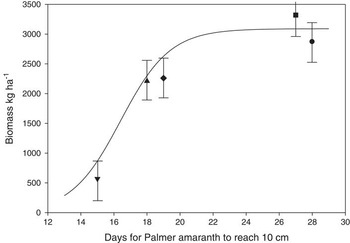
Cover crop biomass effect on the time taken for Palmer amaranth to germinate and grow to 10 cm. Models were F=a/(1+exp(-(X-X0)/b)) F=3090/(1+exp(-(X-16.5)/1.49)). R2 0.80. ■ =winter wheat; ● =cereal rye; ♦ =crimson clover; ▲ =vetch; ▼ =check.

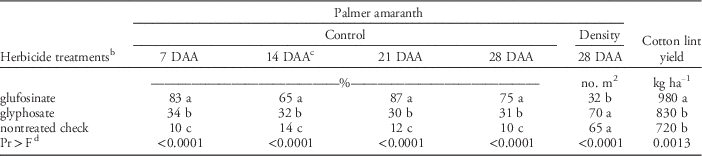
Palmer amaranth density 28 DAA varied by herbicide treatment and ranged from 32 to 70 weeds m−2 (Table 3). Cover crop effect (P=0.5981) and the interaction effect of cover crop and herbicide treatment (P=0.1978) were not significant. POST herbicide treatments that included glufosinate had the greatest in-season weed control and the lowest Palmer amaranth density (32 weeds m−2). However, control was inadequate and required additional measures to ensure a harvestable crop. MacRae et al. (Reference MacRae, Webster, Sosnoskie, Culpepper and Kichler2013) and Morgan et al. (Reference Morgan, Baumann and Chandler2001) reported similar results. There were no differences in Palmer amaranth density between glyphosate and the non–herbicide treated check.
In-season Palmer amaranth control, density, and impact on cotton lint yield as affected by POST herbicide treatments, averaged across cover crops.Footnote a

a Means within a column followed by the same letter are not significantly different according to Fisher’s Protected LSD at P < 0.05.
b The first POST herbicide treatments were applied when Palmer amaranth reached a height of 10 cm in each treatment.
c A second herbicide treatment of the same herbicide was applied 14 d after the initial application.
d Probability of a greater F.
Cover Crop Biomass Effect on Palmer Amaranth Growth and Control
Cover crop biomass was regressed against Palmer amaranth control using an exponential growth model (Figure 1). By the 14 d after planting assessment, the parameter estimates of the model were y=33.4+(log1)1x with a R 2=0.61. This model would estimate that 33.4% control of Palmer amaranth was achieved by 14 DAA when the cover crops had generated at least 2,200 kg ha−1. By the 28 d after planting evaluation, the parameter estimates of the model were y=38.1+(log1)1x with an R 2=0.92. This model would estimate that 38.1% Palmer amaranth was controlled by 28 d after planting when the cover crop biomass was greater than 2,500 kg ha−1.
The estimates for the logistic regression which regressed cover crop biomass against time in d for Palmer amaranth to emerge and grow to 10 cm had an R 2=0.80 and was F=3,090/(1+exp(-(X-16.5)/1.49)) (Figure 2). These estimates indicate that 1,540 kg ha−1 (half the total biomass acquired by the wheat and cereal rye cover crops over the course of the season) would delay Palmer amaranth emerging and growing to 10 cm by an estimated 16.5 d. The Palmer amaranth that emerged in the cereal rye (28 d) and wheat (27 d) cover crop treatments took a longer time to reach 10 cm than did the hairy vetch (18 d) and crimson clover (19 d) treatments. The hairy vetch and crimson clover covers delayed Palmer amaranth reaching 10 cm in height compared to the non–cover crop check by 3 and 4 d, respectively (Figure 2). Delaying the establishment of Palmer amaranth three days compared to no cover treatment is consistent with results from Wiggins et al. (Reference Wiggins, McClure, Hayes and Steckel2015), who found that hairy vetch and crimson clover delayed Palmer amaranth emergence 3 to 4 d. Results of this trial indicate that cereal cover crops can provide some suppression of Palmer amaranth. These results are consistent with those of Price et al. (Reference Price, Monks, Culpepper, Duzy, Kelton, Marshall, Steckel, Sosnoskie and Nichols2016), who found that the number of Palmer amaranth escapes declined exponentially as a function of cover crop biomass. In that study, some of the more southern-latitude US locations provided over 6,000 kg ha−1 of biomass compared with only 2,870 to 3,320 kg ha−1 seen in this study. These results show that the more northern latitudes of the cotton belt will often produce less biomass from cover crops than will the more southern latitudes, and therefore will need to integrate herbicides earlier. Cereal rye and wheat cover crops both reduced and delayed emergence of Palmer amaranth, while hairy vetch and crimson clover only reduced emerged populations, but did not reduce the rate of Palmer amaranth emergence from the surface cover crop mulch.
Control of Palmer amaranth also differed across herbicide treatments (Pr > f=0.0001) (Table 3). On average, glufosinate provided greater control than did glyphosate (75% vs. 31%), indicative of a GR Palmer amaranth population. Control 7 DAA ranged from 10% to 83% for all herbicide treatments. Glufosinate provided more control (83%) than did glyphosate (34%) at 7 DAA. Palmer amaranth control decreased by 14 DAA in both herbicide treatments. A sequential herbicide treatment application was made at the 14 DAA timing to control large and newly emerged Palmer amaranth plants. Palmer amaranth control at 21 and 28 DAA followed a similar trend. Glufosinate provided the greatest level (75%) of control 28 DAA. Therefore, these results show that a weed management system that relies solely on POST herbicide application is not effective for areas with GR Palmer amaranth. Seventy-five percent control is not adequate (MacRae et. al Reference MacRae, Webster, Sosnoskie, Culpepper and Kichler2013). Using multiple strategies, including cultural control (e.g., cover crops) and herbicide applications that overlay residual and POST herbicide applications, will aid in stewarding the glufosinate-based weed management system producers have come to rely on and help provide season-long weed control (Steckel and Culpepper Reference Steckel and Culpepper2016).
Cotton Yield
Cotton lint yield differed by herbicide treatment (P=0.0013) (Table 3). Cover crop species (P=0.1054) and the interaction of cover crops and herbicide programs (P=0.9459) had no effect on cotton yield, with yields ranging from 980 kg ha−1 to 720 kg ha−1 (data not shown). The glufosinate treatment had the highest lint yield. The glyphosate treatment had a similar yield as did the nontreated check, as expected, because the cotton was competing with high populations of GR Palmer amaranth. Therefore, glufosinate must be recommended where GR Palmer amaranth is present. However, the widespread use of glufosinate as a single effective mode of action for controlling GR Palmer amaranth in cotton is of concern. Current recommendations, other than timely POST herbicide applications, include applying and overlapping residual herbicides and integrating additional control measures, such as winter-annual cover crops that can aid in weed suppression.
Using winter-annual cover crops did increase suppression of Palmer amaranth in this study. Winter wheat and cereal rye provided the greatest amount of Palmer amaranth suppression due to the large amounts of biomass produced. Both of these cover crops reduced early-season Palmer amaranth density and provided in-season weed control, albeit inadequate. It should be noted that Tennessee winter weather does not allow these cover crops to develop the greater amount of biomass that has been reported in states with milder winters such as Alabama and Georgia (Price et al. Reference Price, Balkcom, Duzy and Kelton2012, Reference Price, Monks, Culpepper, Duzy, Kelton, Marshall, Steckel, Sosnoskie and Nichols2016). Because of their more robust winter growth, research in those states would indicate better Palmer amaranth control from cover crops than was found in our study. One or more POST herbicide treatments are needed for Palmer amaranth control in the northern latitudes of the cotton-growing area. The glufosinate-based system had the greatest GR Palmer amaranth control. Unfortunately, like the cover crops, POST herbicides alone provided inadequate Palmer amaranth control and would need additional measures, such as PRE residual herbicides, to ensure a harvestable crop. Therefore, this study suggests that integrating timely applications of glufosinate, and cultural tactics such as cover crops, are useful in the management of GR Palmer amaranth. Using these different control tactics is beneficial from a resistance management perspective because it reduces the selection pressure for glufosinate resistance and may help preserve this technology as an effective mode of action in the fight against GR Palmer amaranth.
Acknowledgments
The authors would like to thank Cotton Incorporated for the financial support for this research. Also, they would like to thank Kelly Barnett, Patricia Brawley, Ernest Merriweather, Garret Montgomery, and Whitney Crow for their assistance in establishment, maintenance, and harvest of these trials.