Significant outcomes
Sensitivity analyses showed separation from placebo for brexpiprazole, consistent with that observed in other short-term clinical studies
Functional unblinding of patients experiencing typical side effects associated with the active reference could have been a contributing factor for its numerical advantage over brexpiprazole.
Limitations
The post hoc analysis approach for analyzing potential expectancy bias.
Introduction
Brexpiprazole is a serotonin–dopamine activity modulator that is a partial agonist at 5-HT1A and dopamine D2 receptors and an antagonist at 5-HT2A and noradrenaline alpha1B/2C receptors, all with subnanomolar potency (Maeda et al., Reference Maeda, Sugino, Akazawa, Amada, Shimada, Futamura, Yamashita, Ito, Mcquade, Mork, Pehrson, Hentzer, Nielsen, Bundgaard, Arnt, Stensbol and Kikuchi2014).
Brexpiprazole was first approved in the US in 2015 and subsequently in other countries and regions, including EU, Japan, Canada and Australia for the treatment of schizophrenia, including maintenance treatment.
The efficacy, safety and tolerability of brexpiprazole in the treatment of an acute exacerbation of schizophrenia was demonstrated in two pivotal 6-week, fixed-dose, placebo-controlled studies [Vector (Correll et al., Reference Correll, Skuban, Ouyang, Hobart, Pfister, Mcquade, Nyilas, Carson, Sanchez and Eriksson2015) and Beacon (Kane et al., Reference Kane, Skuban, Ouyang, Hobart, Pfister, Mcquade, Nyilas, Carson, Sanchez and Eriksson2015)]. The efficacy and tolerability of brexpiprazole as a maintenance treatment of schizophrenia were demonstrated in a 52-week maintenance study [Equator (Fleischhacker et al., Reference Fleischhacker, Hobart, Ouyang, Forbes, Pfister, Mcquade, Carson, Sanchez, Nyilas and Weiller2017)]. Further, the efficacy and tolerability of brexpiprazole were also evaluated in a 6-week, flexible-dose, placebo-controlled, active-reference (quetiapine XR) study [Lighthouse; NCT01810380 (Marder et al., Reference Marder, Hakala, Josiassen, Zhang, Ouyang, Weiller, Weiss and Hobart2017)].
This latter study did not meet its primary end point, with the difference in change from baseline to Week 6 in Positive and Negative Syndrome Scale (PANSS) total score between brexpiprazole and placebo approaching, but not reaching, statistical significance (p = 0.0560). The active reference, quetiapine XR, was added for assay sensitivity only but separated from placebo.
There are numerous challenges in the conduct of clinical trials, and negative or inconclusive trials within the field of psychiatry, even with licensed products, are not uncommon (Kane & Leucht, Reference Kane and Leucht2008; Schatzberg, Reference Schatzberg2015). Among the challenges is preserving the blind when a study condition is associated with side effects that can be easily discerned by clinicians, raters, and study subjects. The detection of this signal has the potential for introducing expectancy bias, which, in turn, may affect the study results.
This paper provides a closer look at the primary result from the Lighthouse study and also investigated potential expectancy bias from the well-known side effect profile of quetiapine XR, with prominent sedation, that could have affected the study outcome.
Material and methods
Study design and patients
This is a secondary analysis of Lighthouse (NCT01810380) from which the primary results were published in Marder et al. (Reference Marder, Hakala, Josiassen, Zhang, Ouyang, Weiller, Weiss and Hobart2017). The Lighthouse study was a Phase 3, multicentre, randomised, double-blind, parallel-group, placebo-controlled, active-reference, flexible-dose, 6-week study conducted at 62 sites across 9 countries (Estonia, France, Poland, Romania, Russia, Serbia, Slovakia, Ukraine, and the USA).
Briefly, the study included male and female outpatients, ≥18 and ≤65 years of age, with a primary diagnosis of schizophrenia according to diagnostic and statistical manual of mental disorders - IV - text revision (DSM-IV-TR™) criteria (American Psychiatric Association. and American Psychiatric Association. Task Force on DSM-IV, 2000), who had an acute exacerbation of psychotic symptoms evidenced by PANSS total score ≥80 and PANSS single-item score ≥4 for at least two of the following items: hallucinatory behaviour, unusual thought content, conceptual disorganisation, or suspiciousness/persecution, and a Clinical Global Impression–Severity of Illness (CGI-S) score ≥4 at the screening visit and at the baseline visit. Further, patients should be willing to be hospitalised from the screening visit until the completion/withdrawal visit.
Exclusion criteria included a DSM-IV-TR® Axis I diagnosis other than schizophrenia; presenting with suicidal ideation or behaviour, substance abuse or dependence within the past 180 days.
All patients provided written informed consent prior to the start of the study.
The study consisted of a 1- to 14-day screening period and a 6-week double-blind treatment period with placebo, brexpiprazole (2–4 mg/day), or quetiapine (400–800 mg/day). Following the blinded treatment period, there was a safety follow-up for 30 days after the last dose of study medication for patients not continuing in the open-label extension study.
At the baseline visit, patients who fulfilled the selection criteria were assigned to treatment with placebo, brexpiprazole (2–4 mg/day), or quetiapine (400–800 mg/day) in a 1 : 1 : 1 ratio.
Patients randomised to brexpiprazole received brexpiprazole 1 mg/day for the first day, 2 mg/day for the second day, and 3 mg/day for the third day. From Day 4 onwards, the dose of brexpiprazole could be increased or decreased in 1 mg/day intervals but should stay within the range of 2–4 mg/day.
Patients randomised to quetiapine XR received quetiapine 300 mg/day for the first day and 600 mg/day for the second and third day. From Day 4 onwards, the dose of quetiapine XR could be increased or decreased in 200 mg intervals, no more than once per day, but should stay within the range of 400–800 mg/day.
Quetiapine XR was included as an active reference for assay sensitivity only.
End points
The primary end point was change from baseline to Week 6 in PANSS total score.
Key secondary end point was change from baseline to Week 6 in CGI-S score.
Secondary end points included CGI-I score at Week 6; response at Week 6 is defined as a reduction of ≥30% from baseline in PANSS total score or a CGI-I score of 1 or 2.
Safety was assessed by spontaneous reporting of adverse events (AEs), clinical laboratory tests, physical examination, vital signs, body mass index, and electrocardiograms. Extrapyramidal symptoms were formally assessed using the Simpson–Angus Scale (Simpson & Angus, Reference Simpson and Angus1970), Barnes Akathisia Rating Scale (Barnes, Reference Barnes1989), and Abnormal Involuntary Movement Scale (Guy, Reference Guy and Guy1976). Suicidality was assessed using the Columbia Suicide Severity Rating Scale (Posner et al., Reference Posner, Brown, Stanley, Brent, Yershova, Oquendo, Currier, Melvin, Greenhill, Shen and Mann2011).
Statistical methods
The analyses were based on all randomised patients who took at least one dose of double-blind study medication and who had a baseline assessment and at least one post-baseline assessment of the PANSS total score, covering the period until withdrawal/completion (efficacy population).
The sample size calculation was based on the comparison of brexpiprazole and placebo using a significance level of 5%, and assuming a standard deviation of 20 for the primary end point. A total of 450 patients (150 per treatment arm) were needed to provide a power of approximately 90% for finding brexpiprazole statistically significantly superior to placebo if the effect was an improvement of 7.5 points. To account for 3% of the patients not contributing to the analysis, a total of 465 patients (155 per treatment group) were to be enrolled in the study.
The primary analysis of the primary end point was based on a restricted maximum likelihood-based mixed model for repeated measures (MMRM) approach. The model included site (with small sites pooled), visit, and treatment as fixed effects, baseline score as a continuous covariate, treatment-by-visit interaction, and baseline score-by-visit interaction. The mean differences between brexpiprazole 2–4 mg/day and placebo at Week 6 were estimated based on the least square (LS) means from MMRM.
Pre-planned sensitivity analyses of the primary end point were performed using analysis of covariance (ANCOVA) observed cases (OC) and last observation carried forward (LOCF), using the same covariates as for the MMRM analysis.
Post hoc analysis of change from baseline in PANSS total score was performed with the same MMRM model as used for the primary analysis, but with the brexpiprazole and quetiapine XR treatment groups split by having typical treatment-emergent adverse events (TEAEs) with potential for functional unblinding (with an incidence >5% in the study and/or highlighted in the US prescribing information (USPI) for quetiapine XR (2013) at or before Week 2: Somnolence, increase in weight, dizziness, dry mouth and sedation).
Results
Patients
The study was initiated on 25 March 2013 and completed on 17 December 2014. A total of 679 patients were screened and 468 were randomised.
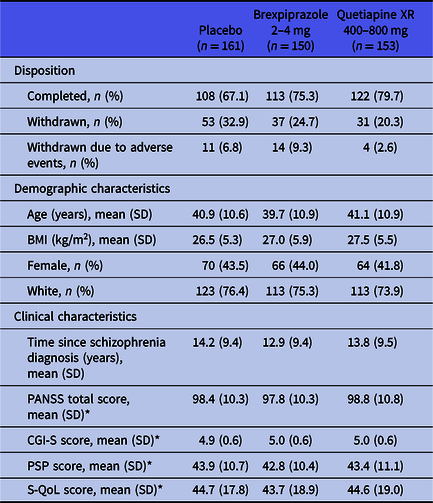
A total of 161, 150 and 153 patients received at least one dose of placebo, brexpiprazole or quetiapine, respectively, and formed the safety population. The efficacy population comprised 159, 150 and 150 patients receiving placebo, brexpiprazole and quetiapine XR, respectively.
Baseline demographic and clinical characteristics were similar between the treatment groups (Table 1).
Disposition, baseline demographic and clinical characteristics
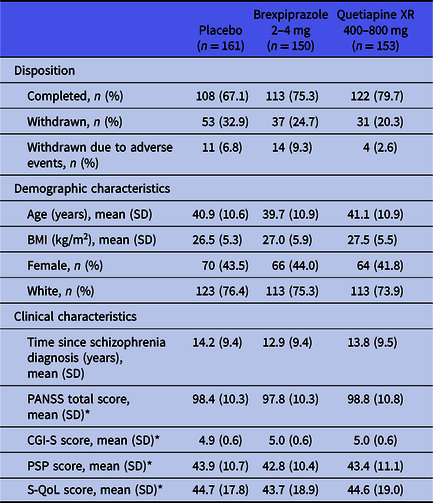
* Figures based on efficacy population.
At the completion/withdrawal visit, 99% of the patients in the brexpiprazole group received 3 or 4 mg/day brexpiprazole and 90% of the patients in the quetiapine XR group received 600 or 800 mg/day quetiapine XR.
Primary efficacy analysis
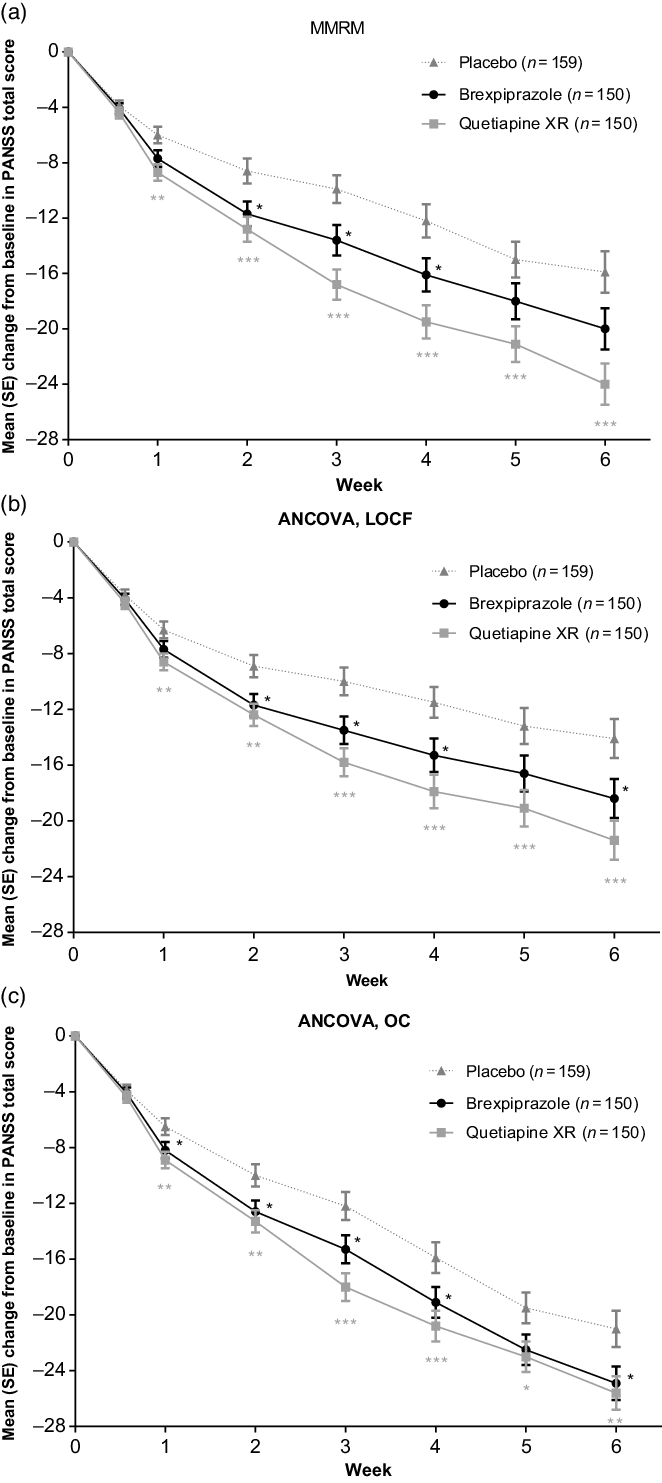
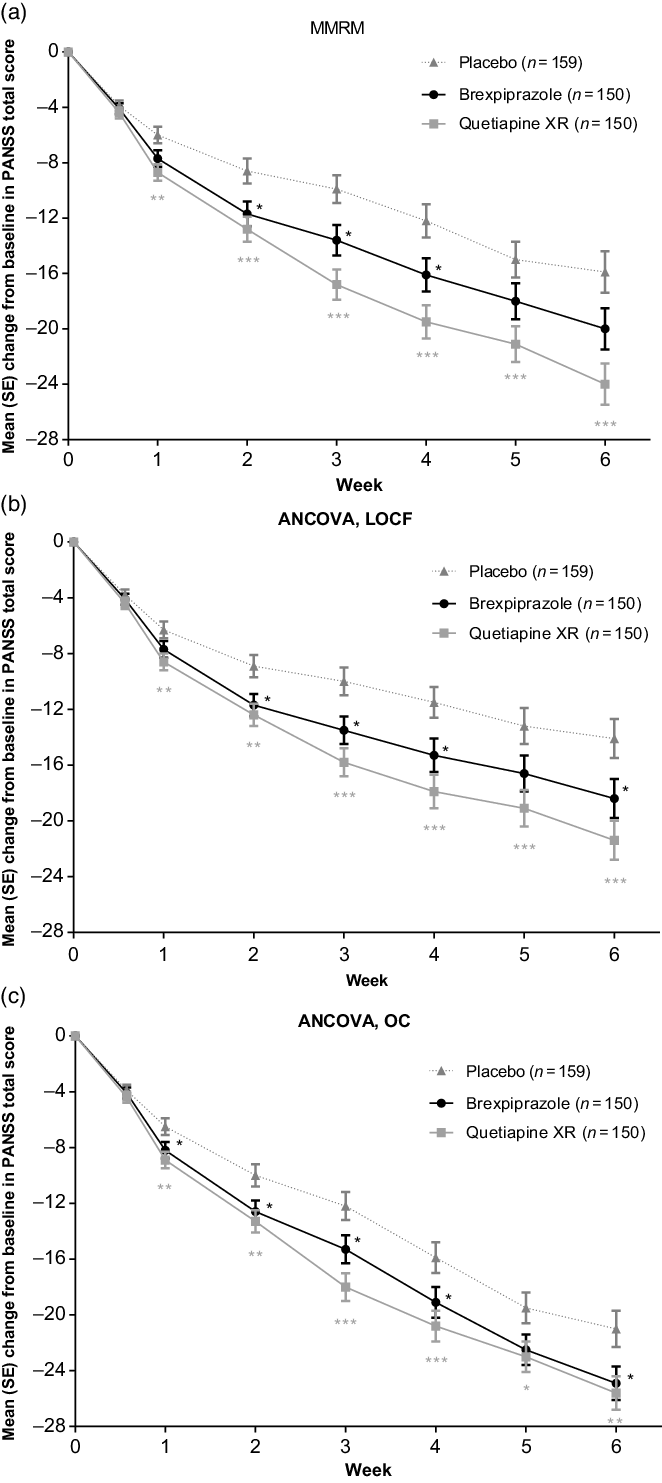
As previously reported (Marder et al., Reference Marder, Hakala, Josiassen, Zhang, Ouyang, Weiller, Weiss and Hobart2017), the difference in change from baseline to Week 6 in PANSS total score between brexpiprazole and placebo approached, but did not reach, statistical significance: −4.1 [95% CI (−8.2, 0.1), p = 0.0560] (Fig. 1). The LS mean change from baseline to Week 6 in PANSS total score was −20.0 and −15.9 in the brexpiprazole and placebo groups, respectively. Quetiapine XR separated from placebo: −8.0 [95% CI (−12.2, −3.9), p = 0.0002], and the LS mean change from baseline to Week 6 in PANSS total score was −24.0.
Analyses of change from baseline to Week 6 in PANSS total score. SE = standard error; MMRM = mixed model for repeated measures; ANCOVA, analysis of covariance; LOCF, last observation carried forward; OC, observed cases. *p ≤ 0.05; **p ≤ 0.01; ***p ≤ 0.001.
Pre-specified sensitivity analyses of the primary end point
To assess the robustness of the results of the primary efficacy analysis, sensitivity analyses of the primary end point using OC and LOCF, ANCOVA was performed. Both approaches showed separation from placebo for brexpiprazole at Week 6 [Fig. 1(B) and (C)]: LOCF, ANCOVA: −4.3 [95% CI (−8.0, −0.5), p = 0.0254]; OC, ANCOVA: −3.9 [95% CI (−7.3, −0.5), p = 0.0260].
Post hoc analysis of the primary end point, not end point
In order to assess the potential effect of expectancy bias from the well-known side effect profile of quetiapine XR, potentially resulting in a perceived higher efficacy for the active reference, the primary efficacy model, based on MMRM, was used with the brexpiprazole and quetiapine XR treatment groups split by patients with and without typical TEAEs with potential for functional unblinding before or at Week 2.
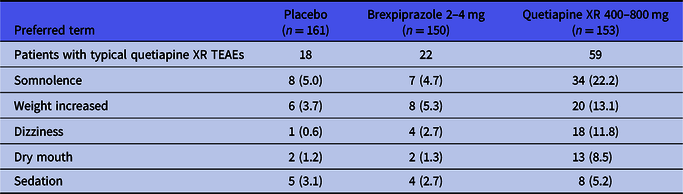
The TEAEs typically observed during quetiapine XR treatment with potential for functional unblinding and observed with an incidence >5% in the study were somnolence, increase in weight, dizziness, dry mouth and sedation (Table 2).
TEAEs typically (incidence >5%) observed with potential for functional unblinding – safety population
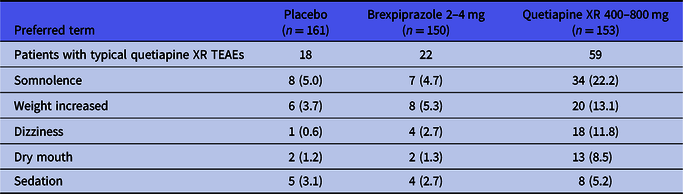
Data are n (%); TEAEs, treatment-emergent adverse events.
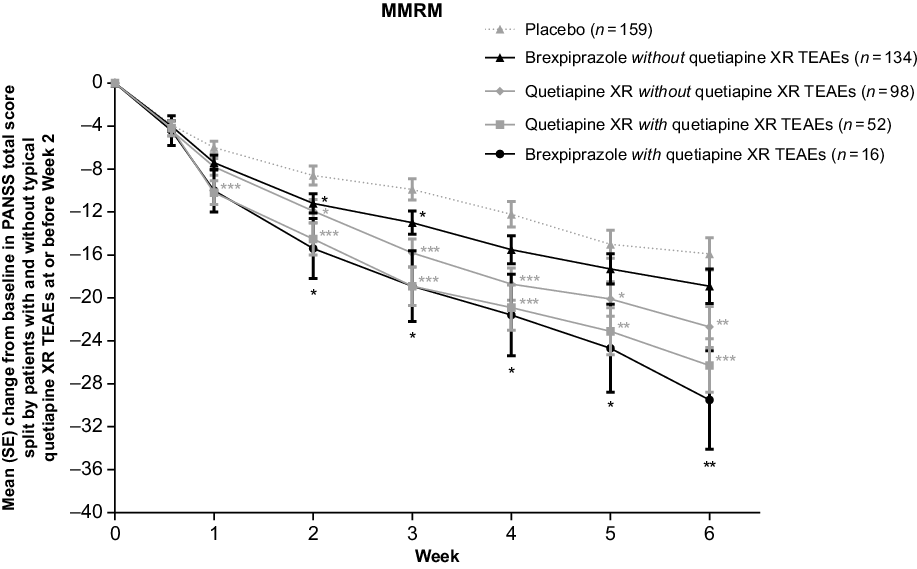
Patients treated with brexpiprazole and who experienced typical TEAEs with potential for functional unblinding before or at Week 2 had an LS mean PANSS change of −29.5 (improvement), with a mean difference in change from baseline to Week 6 in PANSS total score between brexpiprazole and placebo of −13.5 [95% CI (−23.1, −4.0), p = 0.0057], and those who did not had an LS mean change of −18.9 and a mean difference between brexpiprazole and placebo of −2.9 [95% CI (−7.2, 1.4), p = 0.1809], (Fig. 2).
Mean change from baseline in PANSS total score split by patients with and without typical TEAEs with potential for functional unblinding before or at Week 2. SE, standard error; MMRM, mixed model for repeated measures. *p ≤ 0.05; **p ≤ 0.01; ***p ≤ 0.001.
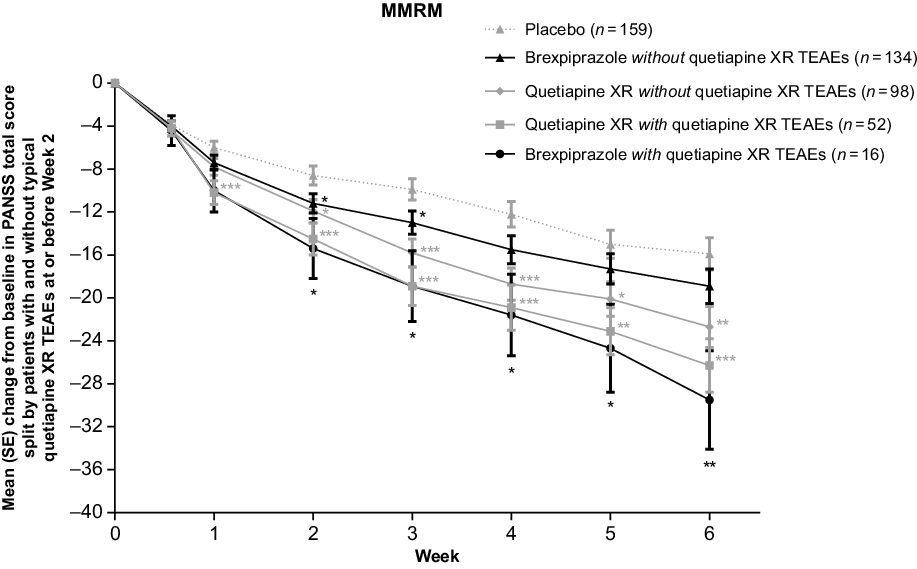
Patients treated with quetiapine XR and who experienced typical TEAEs with potential for functional unblinding before or at Week 2 had an LS mean PANSS change of −26.3, with a mean difference in change from baseline to Week 6 in PANSS total score between quetiapine XR and placebo of −10.3 [95% CI (−16.0, −4.6), p = 0.0004], and those who had, not have an LS mean change of −22.7 and a mean difference between brexpiprazole and placebo of −6.8 [95% CI (−11.4, −2.1), p = 0.0046), (Fig. 2).
Discussion
The Lighthouse study resulted in clinically meaningful improvement in the PANSS total score in patients treated with brexpiprazole (−20.0 points) over 6 weeks. However, with a larger than expected improvement in the PANSS total score in the placebo group (−15.9 points), the difference between brexpiprazole and placebo only approached significance (Marder et al., Reference Marder, Hakala, Josiassen, Zhang, Ouyang, Weiller, Weiss and Hobart2017).
In contrast, pre-specified sensitivity analyses of the primary end point, presented here and performed to assess the robustness of the results, showed separation from placebo for brexpiprazole at Week 6. Further, the improvement in the PANSS total score in patients treated with brexpiprazole was consistent with that observed in the other short-term clinical studies in the brexpiprazole schizophrenia development program (Correll et al., Reference Correll, Skuban, Ouyang, Hobart, Pfister, Mcquade, Nyilas, Carson, Sanchez and Eriksson2015; Kane et al., Reference Kane, Skuban, Ouyang, Hobart, Pfister, Mcquade, Nyilas, Carson, Sanchez and Eriksson2015). Given the totality of the clinical data on brexpiprazole, regulators concluded that brexpiprazole is beneficial to patients with schizophrenia (European Medicines Agency, 2018).
Negative studies are not uncommon in psychiatry due to several reasons, one being the large placebo response often observed (Kane & Leucht, Reference Kane and Leucht2008; Schatzberg, Reference Schatzberg2015). The Lighthouse study showed a clinically meaningful improvement also on placebo, with the change from baseline of −15.9 points on the PANSS total score representing the largest placebo response of the three short-term brexpiprazole phase 3 studies (Correll et al., Reference Correll, Skuban, Ouyang, Hobart, Pfister, Mcquade, Nyilas, Carson, Sanchez and Eriksson2015; Kane et al., Reference Kane, Skuban, Ouyang, Hobart, Pfister, Mcquade, Nyilas, Carson, Sanchez and Eriksson2015; Reference Marder, Hakala, Josiassen, Zhang, Ouyang, Weiller, Weiss and HobartMarder et al., 2017).
Another important aspect is the potential expectancy bias from the well-known side effect profile of an marketed product, potentially resulting in a perceived higher efficacy for the active reference versus the compound under investigation (Kane & Leucht, Reference Kane and Leucht2008).
Quetiapine XR has a distinctive adverse reaction profile and a pronounced sedating effect with 25% of patients in the pivotal short-term studies experiencing somnolence and sedation (2013). This is potentially identifiable by the rater in the clinical trial setting and may lead to the assumption that a given patient is on active treatment and not in the placebo group. Conversely, if a sedating effect is not observed by the rater, it may lead to the assumption that the patient was taking placebo.
Indeed, when performing the primary analysis split between patients with and without side effects associated with quetiapine XR, patients treated with brexpiprazole experiencing typical TEAEs with potential for functional unblinding displayed the numerically largest mean PANSS improvement (29.5 points) from baseline of all groups, with a significant difference in change from baseline to Week 6 in PANSS total score between brexpiprazole and placebo (−13.5 points; p = 0.0057). It is however pertinent to mention that this group consisted of only 16 patients, which needs to be taken into account when interpreting the results. Those patients on brexpiprazole who did not experience typical TEAEs with potential for functional unblinding had a mean improvement of 18.9 points, and a nonsignificant difference between brexpiprazole and placebo of −2.9 points (p = 0.1809).
Initial sedation or somnolence as seen with quetiapine XR in acute treatment of schizophrenia, particularly in the hospital setting in which the Lighthouse study was conducted, may be perceived as a beneficial effect that consequently could have led to a more advantageous efficacy rating by the rater.
As shown in a 12-week randomised, double-blind, placebo-controlled study in major depressive disorder (Laferton et al., Reference Laferton, Vijapura, Baer, Clain, Cooper, Papakostas, Price, Carpenter, Tyrka, Fava and Mischoulon2018), patients believing to be on active medication midway through the study had significantly higher improvement in depressive symptoms at end point than patients believing to be on placebo. This result indicates expectancy effects due to assumed treatment assignment, which may also be relevant for patients with schizophrenia.
Limitations of this analysis must be considered when interpreting the results and include the use of a post hoc analysis approach with the resulting relatively skewed or possibly too low number of patients per treatment group and the absence of data on patients’ perception of treatment assignment.
In conclusion, pre-specified sensitivity analyses of the primary end point showed separation from placebo for brexpiprazole at Week 6, with improvements in the PANSS total score in patients treated with brexpiprazole being consistent with that observed in other short-term clinical studies in the brexpiprazole development program. In addition, the results of the post hoc analysis suggest a potential confounding of efficacy rating towards symptom improvement in patients who experience known side effects of quetiapine XR, which may have been a contributing factor for the numerical advantage of quetiapine XR.
Acknowledgements
Under the direction of the authors, Johan Hellsten, PhD (a full-time employee of H. Lundbeck A/S), drafted the initial version of the manuscript and edited subsequent versions. The authors are entirely responsible for the scientific content of this paper.
Author contributions
SRM was the signatory investigator for the original study. SRM, HE, YZ and MH were involved in the data analysis, interpretation and writing of the manuscript.
All authors reviewed and approved the manuscript before submission
Financial support
This work was supported by Otsuka Pharmaceutical Development & Commercialization, Inc. (Princeton, NJ, USA) and H. Lundbeck A/S (Valby, Denmark).
Conflict of interest
SRM has served on advisory boards for Otsuka, Lundbeck, Allergan, Teva, Takeda, Roche, Targacept and has received research support from Forum and Neurocrine.
HE was a full-time employee of H. Lundbeck A/S at the time of conduct of the research for the study.
YZ is a full-time employee of H. Lundbeck A/S.
MH is a full-time employee of Otsuka Pharmaceutical Development & Commercialization, Inc.
Ethical standards
The authors assert that all procedures contributing to this work comply with the ethical standards of the relevant national and institutional committees on human experimentation and with the Helsinki Declaration of 1975, as revised in 2008.