1. Introduction
Since 1985, when Rogoff proposed that the ‘inflationary bias’ produced by the time-inconsistency problemFootnote 1 might be reduced by delegating monetary policy to an independent and conservative central bank, a large number of empirical and theoretical studies have been undertaken on the relationship between inflation and central bank independence (CBI). Cukierman et al. (Reference Cukierman, Web and Neyapti1992) were among the first to attempt to measure CBI and explore its relationship with inflation. They developed four CBI indexes: the legal CBI index or so-called de jure independence of central banks, an index showing the turnover rate of central bank governors (TOR), a questionnaire-based index and an index based on aggregation of the first two indexes.Footnote 2 They found that the legal CBI index has a statistically significant relationship with inflation in developed countries, while insignificant results are, found in the case of developing countries. On the contrary, the turnover rate of central bank governors demonstrated the opposite effect; it was found to be statistically insignificant in developed countries, but statistically significant and positively related with inflation in developing countries.Footnote 3 Based on these results, Cukierman et al. (Reference Cukierman, Web and Neyapti1992: 375–6) proposed that in developing countries, the legal CBI index cannot be used as an independence measure because, in these countries, written law differs from actual practice. Later, Loungani and Sheets (Reference Loungani and Sheets1997: 388) and Walsh (Reference Walsh2005: 5) suggested the same idea, namely that in countries with a weak rule of law, there might be a difference between the institutional arrangement and its adherence to the law.
Thus, according to these works, the absence of the rule of law may hinder the central bank from maintaining low inflation, even when it has a high level of legal independence. In reality, countries with a weak rule of law do not fully eliminate the time-inconsistency problem by appointing a formally independent central bank. Under low law adherence, a government may neglect the central bank's independence, as stated in the law, and enforce monetary authority to pursue its short-run objectives, which may conflict with its previous commitment to maintaining price stability. Hence, even high legal CBI does not guarantee consistency in monetary policy unless the rule of law is sufficiently robust. Following this view, we propose that the rule of law, in interaction with legal CBI, is an important determinant in maintaining low inflation.
In most of the contemporary works on the relationship between CBI and inflation, scholars usually use ‘low inflation’ and ‘price stability’ interchangeably; in this work, however, we use ‘price stability’ to mean not only low-level inflationFootnote 4 but also stable inflation. We propose that the time-inconsistency problem also can cause high inflation volatility.
Indeed, Svensson (Reference Svensson1997) showed that the time-inconsistency problem creates not only a well-investigated ‘inflationary bias’, but is also the reason for the so-called ‘stabilization bias’,Footnote 5 which could be the reason for high inflation volatility. He argues that in the presence of the time-inconsistency problem, policy makers tend to stabilize output at the cost of inflation stability. In forward-looking models, commitment-based central bankers respond to a cost-push shock by signalling their intent to maintain low inflation today and in the future, thereby stabilizing economic agents’ expectations. In contrast, in the case of discretionary central bankers, who may easily renege upon previously made commitments, their promise to keep a tight monetary policy in the future is not credible, and economic agents would expect higher inflation both today and in the future, decreasing the ability of the central bankers to stabilize inflation. This fact indicates that CBI, by diminishing the time-inconsistency problem, might also have a negative effect on inflation volatility. However, we propose that legal CBI does not reduce inflation volatility in countries with a weak rule of law because, as noted above, legal CBI is ineffective in diminishing the time-inconsistency problem when the law differs from actual practice.Footnote 6 Hence, we hypothesize that the effect of legal CBI on inflation and inflation volatility depends on the strength of the rule of law, and the aim of this research is to empirically investigate these relationships.
To the best of our knowledge, no empirical studies to date have focused on the effect of the interaction between institutional qualities and legal CBI on inflation volatility, whereas there is a significant body of literature exploring the effect of this interaction on inflation.
For instance, Moser (Reference Moser1999) and Keefer and Stasavage (Reference Keefer and Stasavage2003) theoretically and empirically demonstrated that legal CBI reduces inflation only in the presence of checks and balances. Acemoglu et al. (Reference Acemoglu, Johnson, Querubín and Robinson2008) provided evidence suggesting that medium political constraints in interaction with legal CBI significantly reduce inflation, while low and high constraints are not effective in decreasing inflation. Hielscher and Markwardt (Reference Hielscher and Markwardt2012) showed that some institutional qualities (democratic accountability, political stability) in interaction with legal CBI negatively affect inflation. In a more recent paper, Bodea and Hicks (Reference Bodea and Hicks2014) provided empirical evidence that freedom of the press, and checks and balances in interaction with legal CBI, reduce inflation.
In addition, there are several works that, as with our approach, explicitly investigate the relationship between the rule of law–CBI interaction and inflation. For example, Eijffinger and Stadhouders (Reference Eijffinger and Stadhouders2003), using cross-sectional regression, provided evidence that the rule of law, both directly and in interaction with legal CBI, significantly and negatively affects inflation. Hayo and Voigt (Reference Hayo and Voigt2008) studied the influence of the legal system–TOR index interaction. Their findings suggest that the legal system reduces the turnover rate of central bank governors. They also found that the legal system has a direct negative effect on inflation.
Finally, Gollwitzer and Quintyn (Reference Gollwitzer and Quintyn2010) also studied the effect of the rule of law and CBI on inflation. They obtained statistically significant results indicating that the rule of law can reduce inflation. However, they argued that the rule of law does not increase CBI efficiency, which is not in line with the results of Eijffinger and Stadhouders (Reference Eijffinger and Stadhouders2003). Gollwitzer and Quintyn (Reference Gollwitzer and Quintyn2010: 22) proposed that the difference between the two works lies in the different time periods employed in their respective investigations.Footnote 7 In addition, they contend that Eijffinger and Stadhouders miss-specified their model as they omitted constitutive terms while using an interaction term, leading to invalid conclusions about the marginal effect of the interaction (Gollwitzer and Quintyn, Reference Gollwitzer and Quintyn2010: 7).
Hence, researchers should regard Eijffinger and Stadhouders’ results with caution. In fact, even Hayo and Voigt's and Gollwitzer and Quintyn's works have some flaws and also require such treatment: first, they used cross-sectional regression, which may create omitted-variable bias, and second, they failed to address the potential endogeneity problem between variables. Indeed, Koyama and Johnson (Reference Koyama and Johnson2015) argued that high and unstable inflation undermines the rule of law, and that monetary stability and the rule of law are mutually self-supporting, indicating that there may be endogeneity between inflation and the rule of law. In addition, some researchers argue that there is endogeneity between CBI and inflation (Crowe, Reference Crowe2008; Hayo and Hefeker, Reference Hayo and Hefeker2002). Moreover, Eijffinger and Stadhouders fail to control for other inflation determinants, which is another indicator that their model might be biased.
As noted above, the effect of the interaction of institutional qualities and legal CBI on inflation volatility remains unexplored. Yet several studies have investigated the determinants of inflation volatility without considering their interactions with legal CBI. Ghosh et al. (Reference Ghosh, Gulde, Ostry and Wolf1997) and Bleaney and Fielding (Reference Bleaney and Fielding2002) found that countries with a fixed exchange rate regime can achieve lower inflation volatility. According to Gruben and McLeod (Reference Gruben and Mcleod2004), Bowdler and Malik (Reference Bowdler and Malik2005) and Granato et al. (Reference Granato, Lo and Wong2006), openness can reduce inflation volatility, while Rother (Reference Rother2004) revealed that discretionary fiscal policies have a strong positive link to inflation volatility. Finally, Aisen and Veiga (Reference Aisen and Veiga2007) presented research showing that political instability is associated with higher inflation volatility.
Overall, this study extends the existing literature in several important ways. First, it fills the gap in the current literature by examining the effect of the interaction between the rule of law and legal CBI on inflation volatility. Second, we re-examine the relationship between the rule of law, legal CBI and inflation by addressing the lacunas of the previous literature that caused the controversial and inconclusive results. Unlike previous works, we employ a dynamic panel data regression by using the system generalized method-of-moments model (system-GMM) on an unbalanced dataset covering up to 124 countries over the period from 1970 to 2013. Using panel data together with this estimator allows us to control for endogeneity and address unobserved country-specific effects. This research also employs a new legal CBI dataset developed by Garriga (Reference Garriga2016), which is a largely complete dataset covering 182 countries between 1970 and 2012. Furthermore, we also depart from previous works by analysing how the marginal effect of legal CBI on price stability indicators behaves as the rule of law changes, which facilitates understanding of how the interaction really works.
The employment of these new economic techniques and this new database helps us to obtain more conclusive results to answer our main question: ‘How does the rule of law affect the relationship between legal CBI and price stability?’ In addition, we aim to answer two supplementary questions. The first is designed to investigate the suggestion that legal CBI itself does not reduce inflation and inflation volatility, as noted above. The second supplementary question is designed to check Hayo and Voigt's (Reference Hayo and Voigt2008) second transaction channel of the rule of law. Thus, our supplementary questions are: ‘Does legal CBI affect price stability?’ and ‘Does the rule of law affect price stability?’
On our main question, our findings suggest that the effect of legal CBI on price stability depends on the strength of the rule of law, a weakness being the reason a de jure independent central bank cannot maintain price stability. The results also indicate that 67% of advanced countries have enough rule of law to maintain price stability through increasing legal CBI, while more than 95% of developing countries do not. Regarding our supplementary questions, the findings show that legal CBI does not have a significant direct effect on price stability, while the rule of law has a negative and significant effect on both inflation and inflation volatility.
The remainder of this paper is organized as follows. Section 2 describes the data and the methodology implemented. Section 3 is devoted to the empirical results and sensitivity tests. Finally, section 4 offers some concluding remarks and policy implications.
2. Data and methodology
Data
To explore the relationship between the rule of law, legal CBI and inflation, we use an unbalanced panel dataset comprising 124 countries; we split the sample period of 1970–2013 into nine non-overlapping periods averaging five years.Footnote 8 In our research, we used the weighted legal CBI dataset developed by Garriga (Reference Garriga2016). Garriga calculated the dataset based on the Cukierman et al. (Reference Cukierman, Web and Neyapti1992) index, and it covers 182 countries between 1970 and 2012. The dataset has major advantages in comparison with the other publicly available datasets previously used in determinating the relationship between CBI and price stability. The previous datasets developed by Cukierman et al. (Reference Cukierman, Web and Neyapti1992), Polillo and Guillén (Reference Polillo and Guillén2005), Crowe and Meade (Reference Crowe and Meade2007) and Bodea and Hicks (Reference Bodea and Hicks2014) all cover fewer than 100 countries and shorter time periods than Garriga's dataset.
As a measure of the rule of law, in our baseline model, we use the Legal System and Property Rights data from the Fraser Institute's Economic Freedom of the World dataset developed by Gwartney et al. (Reference Gwartney, Lawson and Hall2016). We chose this dataset because of its availability over a long period of time (1970–2013) and the fact that it covers up to 157 countries. In addition, to test the sensitivity of our results, we employed alternative rule of law indicators.
The data on inflation, our dependent variable, come from the International Monetary Fund's (IMF) International Financial Statistics database as annual and quarterly percentage changes of consumer prices. As an indicator of inflation, we use five-year averages of the annual percentage changes of consumer prices, while for inflation volatility, we employ the standard deviation of the quarterly percentage changes in consumer prices for every five-year period. To control for the presence of hyperinflationary outliers, we use natural logs of our variables.
The World Bank's World Development Indicators database is a source of some of our control variables. For instance, we use GDP per capita in constant 2005 US$ in natural logs, the share of natural resources rents in the country's GDP and the country's trade as a share of GDP as an openness measure.
The next control variables are dummy variables for monetary policy regimes. We control for the inflation-targeting policy, set to one to indicate the presence of inflation targeting and zero otherwise. To control for fixed exchange rate regimes, we use the exchange rate regime classification data from Shambaugh (Reference Shambaugh2004), where the dummy variable takes a value of one when there is a currency peg, and zero otherwise. Furthermore, we use the soft peg dummy variable from Obstfeld et al. (Reference Obstfeld, Shambaugh and Taylor2010), which covers regimes allowing ± 5% movements in the exchange rate.
As is popular in recent empirical literature on inflation determinants, we also include the political stability indicator in our regression. We use the adverse regime changes indicator from the Political Instability Task Force dataset of the Center for Systemic Peace (CSP). We constructed a dummy variable from this indicator that takes a value of one when a country experiences adverse regime change, and zero otherwise. We also obtained data on international warfare from the Major Episodes of Political Violence dataset of the CSP.
Gruben and McLeod (Reference Gruben and Mcleod2002) and Gupta (Reference Gupta2008) showed that capital account openness is negatively related to inflation; therefore, in our regression, we add the capital account openness index developed by Chinn and Ito (Reference Chinn and Ito2006).
We also control for systemic banking crises and sovereign debt crises using data by Laeven and Valencia (Reference Laeven and Valencia2013), from which we created a dummy variable: one indicates the presence of a crisis in a particular year and zero represents no crisis.
One may suggest controlling for the goals of central banks, since this is an important factor that also changes over time.Footnote 9 However, we do not need additional variables to control for central banks’ objectives when using the legal CBI index developed by Cukierman et al. (Reference Cukierman, Web and Neyapti1992), as this index already takes into account (and thus controls for) central banks’ objectives. The index considers various main objectives for a central bank, including, for example, the price stability goal or other goals, such as unemployment; it also considers situations in which the bank has several different goals, which may conflict with each other. For example, when price stability is the major or only objective in a central bank's charter, the bank is rated gets highest ranking (between 0.8 and 1.0),Footnote 10 when price stability is a goal, among other potentially conflicting goals, such as full employment, the bank is classified as less independent and is, consequently, rated from 0.4 to 0.6. Finally, when a central bank's stated objectives do not include price stability, the bank's independence is rated between 0 and 0.2.
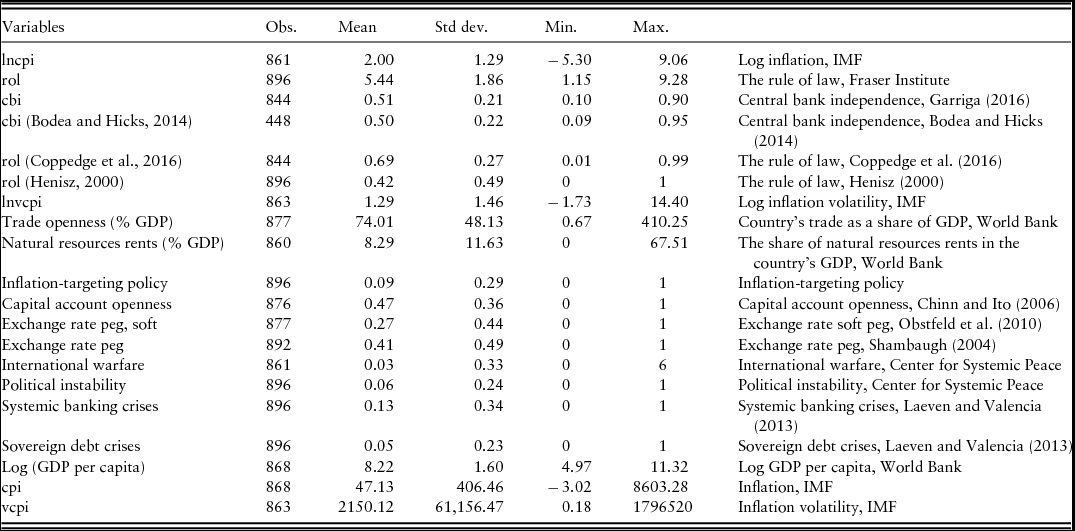
Descriptive statistics for the data used in the regressions are reported in Table A.1 in the Appendix.
Empirical model and methodology
As Hayo and Voigt (Reference Hayo and Voigt2008) and Gollwitzer and Quintyn (Reference Gollwitzer and Quintyn2010) showed, there is a negative relationship between the rule of law and inflation. To empirically investigate the relationship, we estimate the following dynamic panel data model:
 $$\begin{equation}
prices{t_{i,t}} = {\beta _0}prices{t_{i,t - 1}} + {\beta _1}ro{l_{i,t}} + {\beta _3}{X_{i,t}} + {\mu _t} + {\delta _i} + {\varepsilon _{i,t}}
\end{equation}$$
where pricest stands for price stability indicators, which are the natural log of inflation (lncpi) and the natural log of inflation volatility (lnvcpi), in country i at time t; rol is a proxy of the rule of law; X represents a vector of control variables;Footnote 11μ and δ denote unobservable time-specific and country-specific effects respectively; while ε is the error term.
We then investigate the effect of legal CBI on inflation. To do this, we add the cbi variable, which stands for the legal CBI indicator. The regression equation is then the following:
 $$\begin{equation}
prices{t_{i,t}} = {\beta _0}prices{t_{i,t - 1}} + {\beta _1}ro{l_{i,t}} + {\beta _2}cb{i_{i,t}} + {\beta _3}{X_{i,t}} + {\mu _t} + {\delta _i} + {\varepsilon _{i,t}}
\end{equation}$$
Finally, we reach our baseline model. To observe the interaction effect of the rule of law and legal CBI on inflation, we extend equations 1 and 2 by including the interaction term between cbi and rol. The regression equation with the interaction term is the following:
 $$\begin{eqnarray}
prices{t_{i,t}} & = & {\beta _0}prices{t_{i,t - 1}} + {\beta _1}ro{l_{i,t}} + {\beta _2}cb{i_{i,t}} + {\beta _3}{X_{i,t}} \nonumber\\
&&+\, {\beta _4}\left( {cb{i_{i,t}}*ro{l_{i,t}}} \right) + {\mu _t} + {\delta _i} + {\varepsilon _{i,t}}
\end{eqnarray}$$
The marginal effect of legal CBI on inflation as the rule of law changes is shown in equation 4:
 $$\begin{equation}
\frac{{\partial pricest}}{{\partial cbi}} = {\beta _2} + {\beta _4}ro{l_{i,t}}
\end{equation}$$
Its corresponding standard errors are given by:
 $$\begin{equation}
{\hat{\sigma }^2}_{\frac{{\partial pricest}}{{\partial cbi}}} = var({\beta _2}) + ro{l^2}_{i,t}var\left( {{\beta _4}} \right) + 2ro{l_{i,t}}cov\left( {{\beta _2}{\beta _4}} \right)
\end{equation}$$
The next issue is to find a proper estimator. Most widely used OLS and fixed-effect (FE) estimators have some limitations in estimating our models. First, according to Nickell (Reference Nickell1981) and Bond (Reference Bond2002), the OLS estimator of the dynamic panel model will be biased upwards, while the FE estimator obtains downward-biased results, as the lagged dependent variable is correlated with the fixed effects in the error term. Second, the OLS and FE estimators do not address the endogeneity issue among variables. Indeed, several works claim that there is endogeneity between inflation and the rule of law and between inflation and legal CBI. Hence, to find the true relationship between the rule of law, legal CBI and inflation, we need to control for these issues.
To cope with these problems in dynamic panel data models, Arellano and Bond (Reference Arellano and Bond1991) propose the difference-GMM estimator. To get rid of country fixed effects, this estimator takes the differences of a model and uses lagged levels of explanatory and dependent variables as instruments to address the possible endogeneity of variables and correlation between a lagged dependent variable and the error term.
We take the first differences of equations 1–3, so we have (here Δpricest i, t = pricest i, t − pricest i, t − 1 and so on):
 $$\begin{equation}
\Delta prices{t_{i,t}} = {\beta _0}\Delta prices{t_{i,t - 1}} + {\beta _1}\Delta ro{l_{i,t}} + {\beta _3}\Delta {X_{i,t}} + \Delta {\delta _i} + \Delta {\varepsilon _{i,t}}
\end{equation}$$
 $$\begin{equation}
\Delta prices{t_{i,t}} = {\beta _0}\Delta prices{t_{i,t - 1}} + {\beta _1}\Delta ro{l_{i,t}} + {\beta _2}\Delta cb{i_{i,t}} + {\beta _3}\Delta {X_{i,t}} + \Delta {\delta _i} + \Delta {\varepsilon _{i,t}}
\end{equation}$$
 $$\begin{eqnarray}
\Delta prices{t_{i,t}} & = & {\beta _0}\Delta prices{t_{i,t - 1}} + {\beta _1}\Delta ro{l_{i,t}} + {\beta _2}\Delta cb{i_{i,t}} + {\beta _3}\Delta {X_{i,t}} \nonumber\\
&&+\, {\beta _4}\Delta \left( {cb{i_{i,t}}{\rm{*}}ro{l_{i,t}}} \right) + \Delta {\delta _i} + \Delta {\varepsilon _{i,t}}
\end{eqnarray}$$
The marginal effect of legal CBI on inflation as the rule of law changes becomes:
 $$\begin{equation}
\frac{{\partial \Delta pricest}}{{\partial \Delta cbi}} = {\beta _2} + {\beta _4}\Delta ro{l_{i,t}}
\end{equation}$$
and the corresponding standard errors become:
 $$\begin{equation}
{\hat{\sigma }^2}_{\frac{{\partial \Delta pricest}}{{\partial \Delta cbi}}} = var({\beta _2}) + \Delta ro{l^2}_{i,t}var\left( {{\beta _4}} \right) + 2\Delta ro{l_{i,t}}cov\left( {{\beta _2}{\beta _4}} \right)
\end{equation}$$
However, the estimator pioneered by Arellano and Bond has a weakness. Blundell and Bond (Reference Blundell and Bond1998) showed that if the variables are persistent over time, lagged levels of these variables are weak instruments for their differences. To overcome this issue, one can employ the system-GMM estimator developed by Arellano and Bover (Reference Arellano and Bover1995) and Blundell and Bond (Reference Blundell and Bond1998). This new estimator, under the assumption that first differences are not correlated with country effects, combines first-differenced equations and the equations in levels into one system, which improves efficiency by increasing the number of available instruments.
Since the consistency of system-GMM estimates depends on the instrument validity and the absence of the second-order serial correlation, we test it with the Arellano–Bond test for autocorrelation, and we test the validity of our estimates using the Hansen test of over-identifying restrictions.
In our work, we employ a two-step variant of system-GMM because it is asymptotically more efficient compared to the one-step estimator, and we implement a finite-sample correction to the standard errors in the two-step estimation (Windmeijer, Reference Windmeijer2005).
3. Results
Estimation results
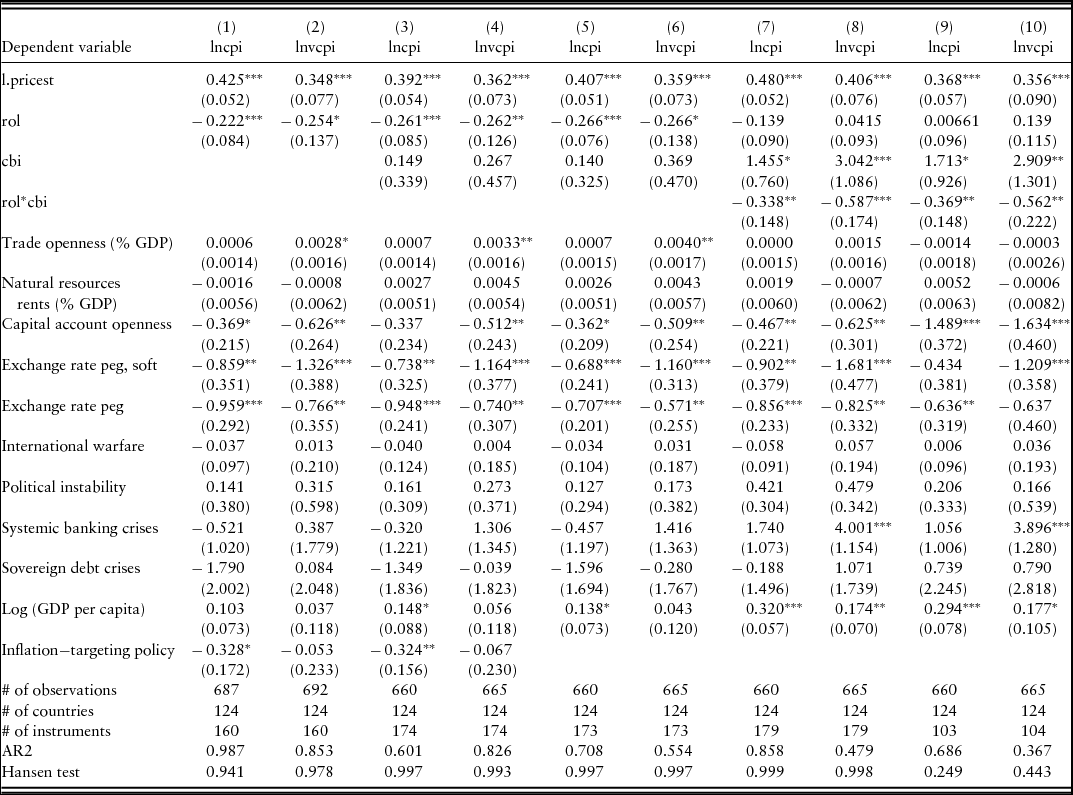
Table 1 reports our estimation results. We treated all right-hand side variables as endogenous variables, except international warfare, which is treated as exogenous. These endogenous variables are instrumented using their lagged values. It is important to note that AR2 provides no evidence of second-order serial correlation in the error term, and the Hansen test confirms the validity of the instruments. In all tables below, odd columns show regressions for lncpi, while even columns show the same for lnvcpi.
The Rule of law, legal CBI, and price stability

Note: Estimations based on two-step system-GMM estimator. Robust, standard errors (Windmeijer correction is implemented) are in parentheses. The notations ***, **, and * represent statistical significance at the 1%, 5% and 10% levels respectively. lncpi stands for natural log of inflation, while lnvcpi - natural log of inflation volatility; pricest denotes the price stability indicators (i.e. lncpi, lnvcpi); rol stands for the rule of law and cbi indicate legal central bank independence.
Columns 1 and 2 of Table 1 show the estimations of equation 6, including all explanatory variables, calculated using system-GMM. The first column shows that rol has a negative and significant effect on both lncpi and lnvcpi, indicating that the rule of law has a direct and negative effect on inflation, which is in line with the results of Hayo and Voigt (Reference Hayo and Voigt2008) and Gollwitzer and Quintyn (Reference Gollwitzer and Quintyn2010), and on inflation volatility. In columns 3 and 4, we add the cbi variable (equation 7). According to the estimations, legal CBI does not have a statistically significant effect; moreover, it reveals unexpected positive coefficients in both columns. Meanwhile, the inclusion of cbi slightly changes the coefficients of rol, but their significance stays at the previous level.
As is widely known, one of the essential elements of an inflation-targeting policy is CBI, which may create a multicollinearity problem between the cbi and Inflation-targeting policy variables. In the next two columns, we estimate our model by dropping Inflation-targeting policy. From columns 5 and 6, we can observe that even after dropping Inflation-targeting policy, cbi still has neither the right sign nor significant results. The findings from column 5 are in line with some of the contemporary literature (Campillo and Miron, Reference Campillo, Miron, Romer and Romer1997; Klomp and de Haan, Reference Klomp and Haan2010b), which shows legal CBI does not have a significant effect on inflation, while the insignificant coefficient of cbi in column 6 corresponds with our suggestion that legal CBI also has no significant effect on inflation volatility.
In the next two columns, we examine the effect of the interaction between rol and cbi on price stability (equation 8). In this regression, along with the inclusion of the interaction term, we exclude the time dummies. We do this because the cbi variable changes rarely over time, due to its legal nature. Indeed, as we already know, the cbi variable is measured based on legal statutes, and as with all legal statutes it tends to be constant over time. Consequently, the time dummies would capture most of the changes of the cbi variable, which would create a multicollinearity problem.
Column 7 shows that the inclusion of the interaction term makes rol insignificant, while on the contrary, cbi becomes positive, though still with the wrong sign.Footnote 12 The interaction term (rol*cbi) is also statistically significant, with the negative sign indicating that the effect of legal CBI on inflation depends on the strength of the rule of law. Similarly, in column 8, the interaction term has a negative and significant effect on inflation volatility, while cbi and rol have positive coefficients; as in the previous column, cbi has a statistically significant coefficient. The results support our hypotheses that the rule of law is an important factor in the relationship between legal CBI and price stability and that the effect of legal CBI depends on the strength of the rule of law.
In the first six columns and the last two columns, in particular, we used only second lags of instruments to prevent over-fitting endogenous variables. This procedure is recommended by Roodman (Reference Roodman2009a, Reference Roodman2009b), but he also proposes, as a rule of thumb, keeping the number of instruments below the number of cross-sections in the GMM regressions. However, in our estimations, the number of instruments used exceeds the number of cross-sections. To address this issue, instead of limiting the lag depth, we applied principal components analysis (PCA), as proposed by Mehrhoff (Reference Mehrhoff2009) and Bontempi and Mammi (Reference Bontempi and Mammi2012), which replaces instruments with their principal components.Footnote 13 Mehrhoff showed that PCA produces lower bias and root mean squared error than other techniques addressing instrument proliferation.
In columns 9–10, we recalculated the model of the previous two columns by applying PCA. This new technique allowed allowed the instrument count to fall below the number of cross-sections. Nevertheless, the reduced instruments count did not change the results for our variables of interest: the coefficients of the interaction terms are relatively similar to those in the previous two columns and are still highly significant.
In columns 7–10, we observe that Log (GDP per capita) is significant and has the wrong sign. This might be due to possible multicollinearity between Log (GDP per capita) and rol.Footnote 14 One of the methods of addressing multicollinearity is to drop a non-interest variable; in our case, however, Log (GDP per capita) is too important a variable to simply leave out. Therefore, it was decided not to drop this variable in these columns; instead, we estimated our model replacing this variable with an emerging-countries dummy variable, to control for countries’ development level.Footnote 15 The results of these two new estimations correspond with those of the baseline model in columns 9–10.
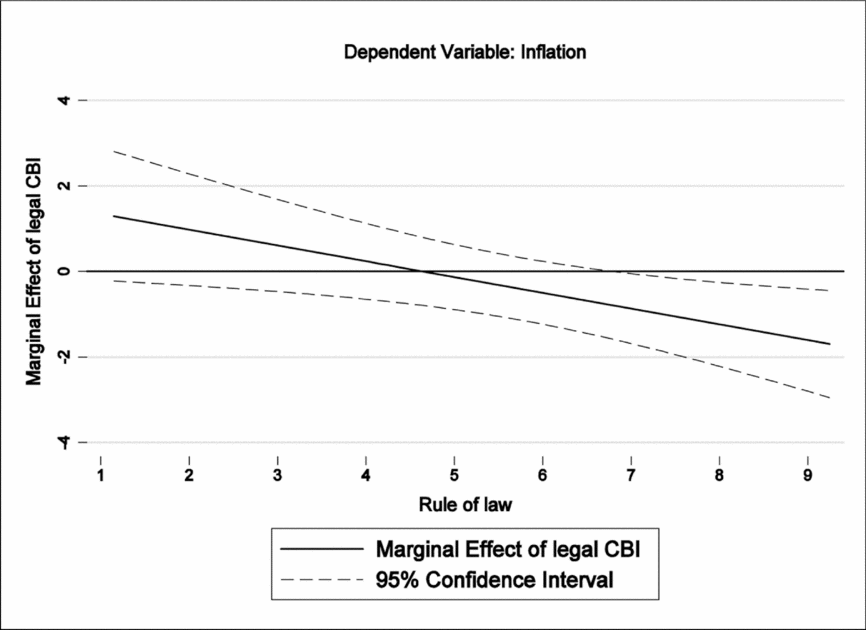
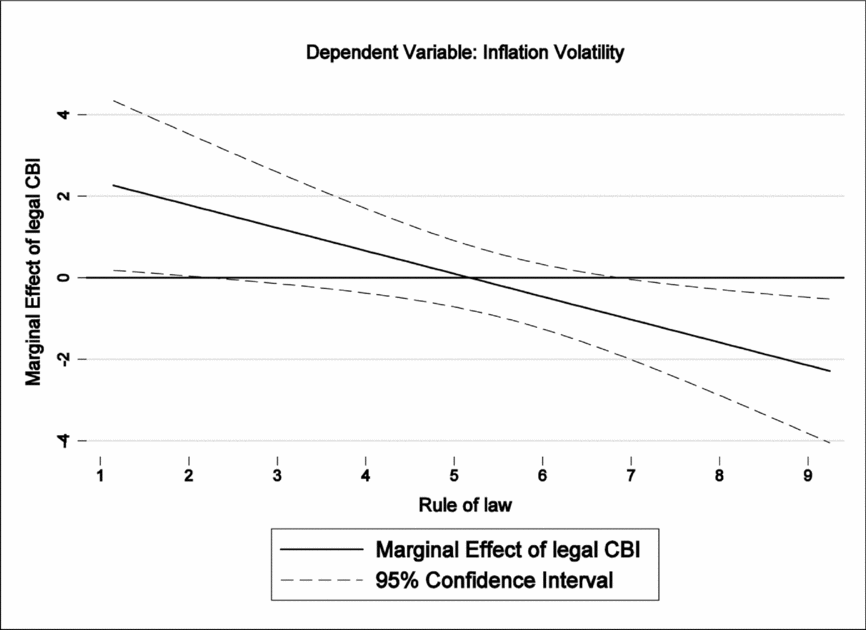
Table 1 does not provide enough information about either the marginal effect of legal CBI on inflation depending on changes in the rule of law or the corresponding standard errors. According to Brambor et al. (Reference Brambor, Clark and Golder2006), the best way to show this relationship is to illustrate it graphically. Thus, based on equations 9 and 10, we plot Figures 1 and 2, which illustrate the marginal effect of legal CBI on inflation and inflation volatility, respectively, as the rule of law changes and their corresponding 95% confidence intervals, using the results of the baseline model.
Marginal effect of legal CBI on inflation as the rule of law changes

Marginal effect of legal CBI on inflation volatility as the rule of law changes

Figure 1 shows that cbi has a statistically significant and negative effect on inflation only when the rule of law is higher than 6.78; thus, for countries above that threshold, legal CBI does not differ from the actual practice of the central bank or its de facto CBI. Only 25% of our observations fall within that statistically significant and negative range. It is important to note that if we regard advanced countries separately, we see that 70.37% of the observations lie in the negative and significant range, while in the case of developing countries, only 5.43% lie in this range. These findings support the theory of Cukierman et al. (Reference Cukierman, Web and Neyapti1992) that, in developing countries, legal CBI cannot reduce inflation due to the weak rule of law.
Figure 2 reveals that cbi has a negative and significant effect on inflation volatility only when rol exceeds 6.85, accounting for 23.44% of our sample observations. As in Figure 1, more than half of the advanced countries (67.4%) lie in the negative and significant range, while only a very small portion of developing countries (4.47%) fall within that range. The results imply that a strong rule of law is essential to decrease inflation volatility through increasing legal CBI; furthermore, the strength required to reduce inflation volatility is slightly more than that required to maintain low inflation. However, on closer examination of the figure, an additional and somewhat unexpected result can be seen: when the rule of law is lower than 2.23, legal CBI has a positive and significant effect on inflation volatility. One might treat this as a set of outliers, as only 27 observations (3.01% of our total sample) lie in this range. Nevertheless, we seek to explain this result.
Clearly, countries with a very weak rule of law are those with low overall institutional development. Most finance their budget deficit through inflation tax; consequently, they do not tend to reduce inflation and, most importantly, they are unable to do so, since they cannot collect a sufficient amount of output tax to cover the budget deficit because of their weak institutional development. However, high inflation is detrimental to the population, and increases social unrest. To alleviate social turmoil, the government may undertake some reforms to reduce inflation or at least demonstrate its intention to address high inflation; in this regard, the easiest reform is to give greater legal independence to the country's central bank. Increased legal independence obliges the central bank to reduce inflation, and the government may allow this during periods of social unrest. Nevertheless, such countries still have fundamental problems with other institutions, such as those responsible for taxation. Therefore, the government remains highly reliant on inflation tax, and keeping in mind that the country has a very weak rule of law, it can force the central bank to pursue an inflationary policy to cover its budget deficit at any time. Therefore, when the rule of law is below 2.23, two different forces may influence inflation: on the one hand, there is a central bank that is de jure independent and obliged to maintain low inflation; on the other hand, the government, from time to time, allows the central bank to keep inflation relatively low to mitigate social unrest, but still exploits inflation tax as a main source of budget revenues. In short, countries with a very weak rule of law and high legal CBI have higher inflation volatility than countries with as much law enforcement but lower CBI: the former because from time to time they have relatively low inflation from time to time, increasing their volatility, while the latter group has constantly high inflation.
Overall, this section's findings indicate that the improvement in price stability over the last five decades was not solely due to greater de jure CBI but was also influenced by developments in legal institutions. For example, Argentina and Turkey are two countries that have granted their central banks greater independence since the 1970s. In the 1970s, both countries had high average inflation (132.3% and 23.3% respectively) and average inflation volatility (146.4 and 16.63),Footnote 16 with legal CBI of 0.39 and 0.55. In the 2000s and 2010s, legal CBI reached 0.81 in Argentina and 0.83 in Turkey, reflecting fairly high levels of independence surpassed by only 8.7% of our sample. However, in the period from 2000 to 2013, the countries still had relatively high average inflation (9.06% in Argentina and 19.01% in Turkey) and high average inflation volatility (8.2 and 19.0). The failure of legal CBI to maintain price stability might be due to these countries’ rule of law being weaker than the thresholds indicated in our results: the average rule of law was scored at 4.20 in Argentina and 5.49 in Turkey in the first 13 years of the 21st century, impeding the ability of legal CBI to overcome the time-inconsistency problem.
Another good example of a country increasing legal CBI since the 1970s is Chile, which also suffered from unstable prices in the 1970s. In the Chilean case, greater de jure CBI (0.82) was followed by lower average inflation (3.01%) and average inflation volatility (2.26) in the 2000s and 2010s. The country's success in establishing price stability may be due to Chile's managing to exceed the threshold level of the rule of law, unlike Turkey and Argentina. The average strength of the rule of law in Chile grew from 3.82 in the 1970s to 6.85 in the 2000s and 2010s. Hence, Chile has come much closer to an institutional model in which de jure is equal to de facto than either Argentina or Turkey. To maintain price stability further, Chile should maintain, or even improve, the current strength of its legal institutions and legal CBI. To maintain their current capacity, despite changing external and internal circumstances, Chile's institutions should improve their ‘robustness and resilience’. The robustness and resilience of institutions are concepts that have been developing rapidly over the last two decades among policy researchers and policy makers. An institution's robustness is its ability to cope with external and internal shocks without adapting, while its resilience is its ability to adapt for shocks without changing its main functions.Footnote 17 Thus, Chile and other countries seeking to maintain their current institutional development should adopt policies that improve their institutions’ robustness and resilience.
Robustness tests
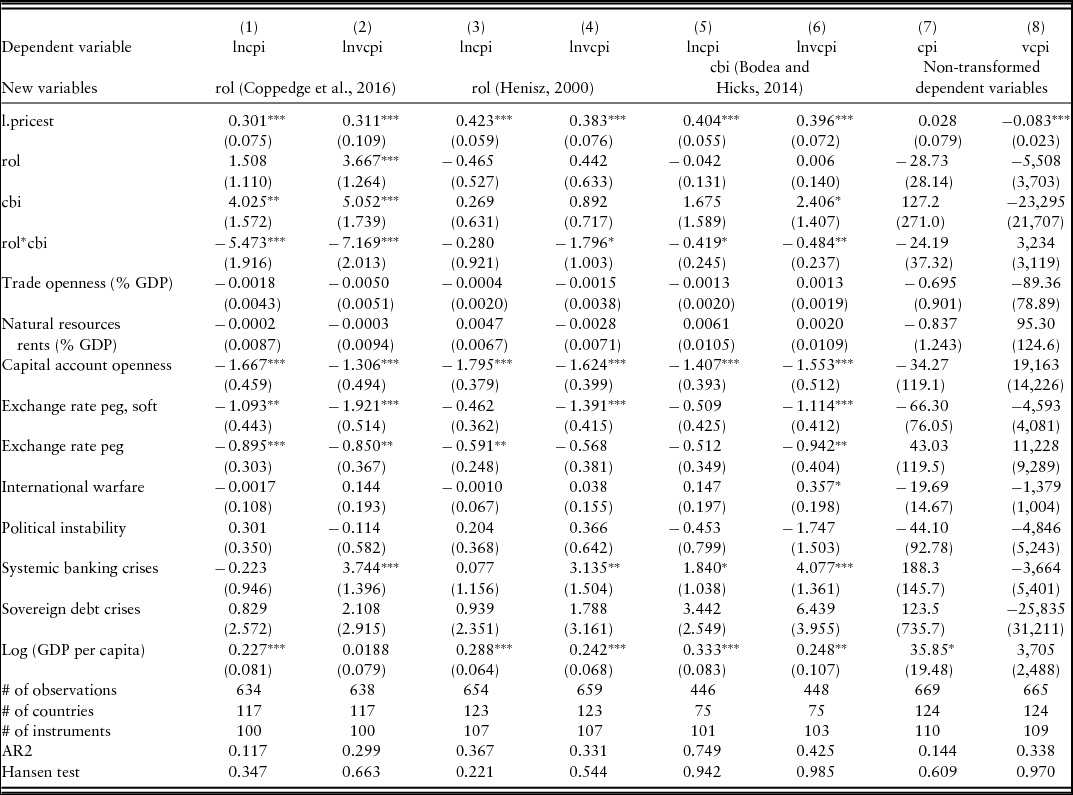
To show the robustness of the model we conducted several sensitivity tests. The first test checks whether our baseline model is robust to alternative measures of the rule of law and legal CBI. In the first two columns of Table 2, we use the ‘Equality before the law and individual liberty’ index from the Varieties of Democracy project developed by Coppedge et al. (Reference Coppedge, Gerring, Lindberg, Teorell, Altman, Bernhard, Fish, Glynn, Hicken, Knutsen, McMann, Pemstein, Skaaning, Staton, Tzelgov, Wang and Zimmerman2016), which covers 173 countries between 1900 and 2014, as an alternative measure of the rule of law. The findings obtained from this new indicator show significant robustness with the results from columns 9 and 10 of Table 1. In columns 3 and 4, we use the ‘judicial independence’ categorical indicator developed by Henisz (Reference Henisz2000), which covers 170 countries from 1960 to 2012, as an alternative measure of the rule of law. The interaction term of this rule of law indicator with cbi has the expected negative sign in both columns, but has a significant impact only on lnvcpi.
Robustness check: Alternative measures

Note: Estimations based on two−step system−GMM estimator. Robust, standard errors (Windmeijer correction is implemented) are in parentheses. The notations ***, **, and * represent statistical significance at the 1%, 5%, and 10% levels, respectively. lncpi stands for natural log of inflation, while lnvcpi − natural log of inflation volatility; pricest denotes the price stability indicators (i.e. lncpi, lnvcpi); rol stands for the rule of law and cbi indicates legal central bank independence.
In columns 5 and 6 of Table 2, we use the legal CBI dataset developed by Bodea and Hicks (Reference Bodea and Hicks2014). This new indicator is the second largest dataset after our main dataset, covering 81 countries from 1972 to 2010. The results confirm that the interaction of rol and cbi has a negative and significant effect on lncpi and lnvcpi, and all of these interest variables are significant. Moreover, the regression coefficients are similar to the coefficients from our baseline regression.
Overall, columns 1–6 of Table 2 show that our main specifications have robust inference for the alternative measures of the rule of law and legal CBI.
In the baseline specification, we used a natural log of our price stability variables, because of the presence of hyperinflationary episodes in our sample. However, we decided to calculate price stability indicators without that transformation. Columns 7–8 in Table 2 show that our model with untransformed dependent variables performs rather poorly: none of the coefficients is significant, except the lagged dependent variables in column 8. These findings reflect that the results in these columns are mostly driven by hyperinflationary episodes.
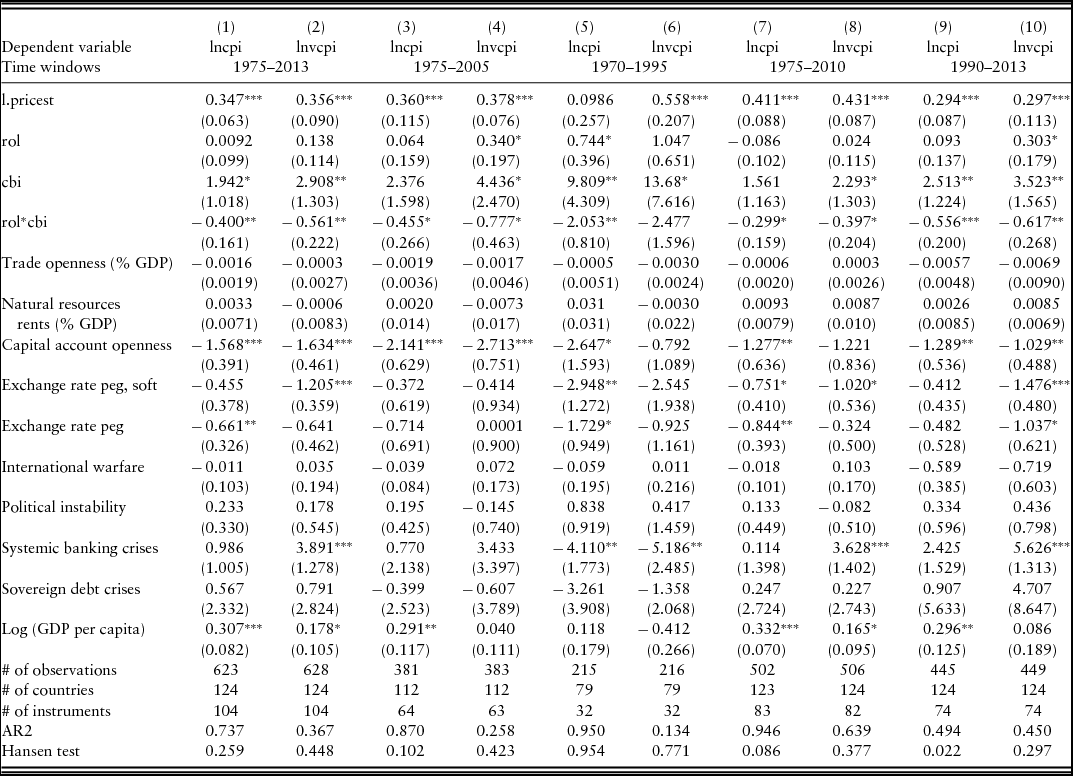
Since we do not include a time dummy in our basis regression, the model might be affected by structural changes over time. To check robustness to the structural changes, we subject our baseline model to a test using the different time horizons in Table 3. We estimated our specification for five different time horizons. Our sample covers 1970–2013, which includes the final years of the Bretton Woods system.Footnote 18 The presence of this system might distort our model because, under it, countries could not conduct their monetary policy independently. To estimate our model without the effect of the Bretton Woods system, we bound our time horizon from 1975 to 2013 in the first two columns. The next two columns are estimated for the time span covering the post-Bretto Woods period to the global financial crisis in 2007–8, i.e. 1975–2005. Columns 5 and 6 cover the first 25 years of our sample (1970–94), while columns 7 and 8 cover the middle 40 years by dropping the first five and last three years. Finally, columns 9 and 10 cover the last 24 years of our sample (1990–2013). We also checked other time periods, such as 1975–2000, 1980–2005 and 1985–2010; all show a significant and negative relationship between the interaction term and price stability indicators.Footnote 19 The findings in this table show that the interaction of rol and cbi has a negative effect on lncpi and lnvcpi, revealing significant results with the proper sign for all time windows (except column 6). Therefore, our baseline model is robust to different time windows.
Robustness check: Different time horizons

Note: Estimations based on two-step system-GMM estimator. Robust, standard errors (Windmeijer correction is implemented) are in parentheses. The notations ***, **, and * represent statistical significance at the 1%, 5%, and 10% levels, respectively. lncpi stands for natural log of inflation, while lnvcpi - natural log of inflation volatility; pricest denotes the price stability indicators (i.e. lncpi, lnvcpi); rol stands for the rule of law and cbi indicate legal central bank independence.
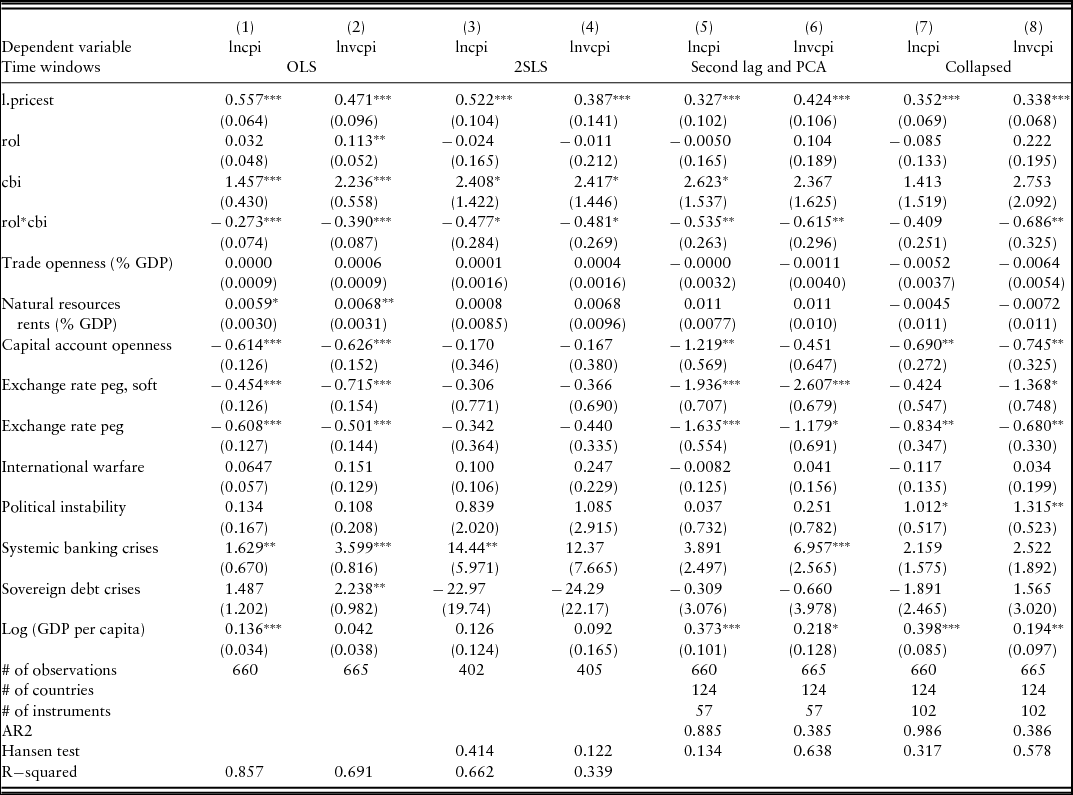
Table 4 presents the last robustness check of our baseline regression results. In particular, columns 1 and 2 re-estimate our baseline model using the OLS estimator. The following two columns use the 2SLS estimator, which is another instrumental variable estimator. In the 2SLS estimator, endogenous variables are instrumented by their second and third lags. In the next six columns, we employed other techniques to limit the instrument count. In columns 5–6, we applied a combination of the techniques used above, namely PCA and limited lag depth (the second lags of the instruments were employed). In columns 7–8, we ‘collapsed’ the instrument set proposed by Roodman (Reference Roodman2009a). The collapse technique makes the instrument count linear in time periods T, rather than quadratic.
Robustness check: different estimation methods

Note: Estimations based on two-step system-GMM estimator. Robust, standard errors (Windmeijer correction is implemented) are in parentheses. The notations ***, **, and * represent statistical significance at the 1%, 5%, and 10% levels, respectively. lncpi stands for natural log of inflation, while lnvcpi - natural log of inflation volatility; pricest denotes the price stability indicators (i.e. lncpi, lnvcpi); rol stands for the rule of law and cbi indicate legal central bank independence.
The estimation obtained from the OLS estimator shows that, as expected, the interaction term is significant and has a negative sign. Similarly, the estimations from 2SLS are also in line with our baseline model. Furthermore, the Hansen test suggests that the instruments are valid.
The combination of two techniques in columns 5–6 allowed us to decrease the number of instruments in our baseline model from 103–4 to 52, while the interaction term remained negative and statistically significant. In columns 7–8, presenting the results of applying the collapse technique, the interaction term has a negative effect on price stability, while it is significant only in the case of inflation volatility.
4. Concluding remarks
Today, it is widely accepted that time-inconsistency produces inflationary bias and stabilization bias, leading to high inflation and inflation volatility respectively. Increasing CBI is usually treated as a solution to the time-inconsistency problem. Hence, countries adopt formal CBI to maintain price stability. However, increasing the de jure independence of central banks does not lead to price stability unless there is strong respect for the rule of law, which guarantees that the authorities do not neglect the laws that underpin CBI. Therefore, this work mainly investigates the effect of the rule of the interaction of law and legal CBI on inflation and inflation volatility; it also shows how the rule of law and legal CBI affect the price stability indicators separately.
Our findings show that the rule of law is negatively associated with inflation and inflation volatility, while, as expected, legal CBI does not have a significant effect on them. However, the interaction of our two focus independent variables has a negative and significant effect on the price stability indicators. We plotted graphs to see how changes in the rule of law affect the relationship between legal CBI and price stability. According to these graphs, 70.37% of advanced countries have enough rule of law to maintain low inflation through increasing legal CBI, while only 5.43% of developing countries have enough. These findings are in line with the proposal of Cukierman et al. (Reference Cukierman, Web and Neyapti1992) that most developing countries have a weak rule of law, nullifying the effect of legal CBI on price stability. There is a similar situation with inflation volatility, where 67.4% of advanced countries and only 4.47% of developing countries possess enough rule of law. The results are robust for alternative measures of our interest independent variables, different time horizons and alternative estimation techniques. Interestingly, the results also indicate that with a very weak rule of law, legal CBI actually has a positive association with inflation volatility, indicating that, in a country with very weak legal institutions, it is actually detrimental for inflation volatility to grant greater independence to the central bank.
In general, our study suggests that the effect of legal CBI on price stability depends on the strength of the rule of law. Furthermore, it reveals that a de jure independent central bank does not have any significant effect on price stability when the rule of law is weak. Therefore, to maintain price stability, countries should first implement reforms to develop institutions to secure the rule of law and only then assign a de jure independent central bank. As anecdotal evidence, one can observe the experiences of Argentina, Turkey and Chile. All three countries have significantly increased the independence of their central banks since the 1970s, but only Chile has been able to establish price stability. Chile's better performance is likely to be a result of its ability to create more sophisticated legal institutions since the 1970s, which the other two countries have failed to do.
Strengthening the rule of law is a somewhat trivial suggestion, as many previous works have already proposed this as an important factor in socioeconomic development. Moreover, it is hard to achieve a strong rule of law in the short- and medium-term. Therefore, we are far from suggesting it as the only solution to high inflation and inflation volatility. We suppose that, for countries seeking to maintain price stability while hampered by a weak rule of law in their early stages of development, implementing other reforms might be more effective, such as a fixed exchange rate or even reneging on their national currency, as Ecuador and Zimbabwe have recently done. We do not offer any empirical evidence regarding our last suggestion because the issue is beyond the main subject of this work; nonetheless, it is a promising direction for further research to investigate whether dollarization might be a better option in countries with a weak rule of law.
Acknowledgements
The author is grateful for comments from two anonymous referees, and to Bernd Hayo, Konstantin Sonin, Ana Carolina Garriga and Ayca Simsek. The views expressed in this paper are those of the author and do not necessarily represent those of the Eurasian Research Institute. All remaining errors are mine.
Appendix
Descriptive statistics