Introduction
There are over 300 species of hibiscus around the world. Hibiscus sabdariffa L., also called sereni, roselle or red rossel, is a member of the Malvaceae family. Its origin is not fully known, but it is believed to be native of tropical Africa (Morton, Reference Morton and Morton1987; Rhodin and Panchoo, Reference Rhodin and Panchoo1990, Tounkara et al., Reference Tounkara, Amadou, Guo-Wei and Yong-hui2011). Roselle is now cultivated in tropical and subtropical regions of the world for its calyxes, leaves, fibres and seeds, which are used for nutritional, medicinal and industrial purposes (Morton, Reference Morton and Morton1987; Rhodin and Panchoo, Reference Rhodin and Panchoo1990).
In Africa, roselle is commonly cultivated in savannah and semi-arid areas (Schippers, Reference Schippers2000). Roselle calyxes have often been shown to have positive health effects (Tseng et al., Reference Tseng, Kao, Chou, Chou, Lin Wu and Wang1997; Faraji and Tarkhani, Reference Faraji and Tarkhani1999). They are also used to make cold and hot beverages, usually named karkade or red tea, in many of the world's tropical and subtropical countries (Watt and Breyer-Bradndwijk, Reference Watt and Breyer-Brandwijk1962). Roselle has been reported to have interesting popular medicine properties, from antiseptic and antimicrobial activities to hypertension control (Perry, Reference Perry1980; Faraji and Tarkhani, Reference Faraji and Tarkhani1999; Onyenekwe et al., Reference Onyenekwe, Ajani, Ameh and Gamaniel1999), or to prevent hepatic diseases (Salah et al., Reference Salah, Gathumbi and Vierling2002). Roselle is an economically important crop for the African continent, particularly in the Sahel zone of West Africa (Atta et al., Reference Atta, Sarr, Diallo, Bakasso, Lona and Saadou2013). In Niger during the period 2000–2011, the average total area under cultivation of roselle was 103,441 ha with an average production of 18,259 tons. In 2012, this area increased to 169,508 ha with an average production of 47,648 tons (DSA, 2013). Despite its importance in Niger, little is known about its genetics and genetic diversity, which is supposed to be large when considering its wide geographical distribution.
In order to characterize the extent and distribution of the genetic diversity of H. sabdariffa and its structure in Niger, we genotyped 124 H. sabdariffa accessions collected from different agroecological zones in southern Niger with amplified fragment length polymorphism (AFLP) markers.
Materials and methods
Sample collection
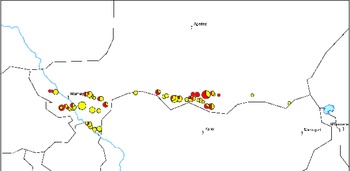
A total of 124 H. sabdariffa accessions, representing diverse cultivated ecotypes, were selected from 161 ecotypes sampled in different agroecological areas in southern Niger (Fig. 1). Each ecotype is characterized by geographical information (name of the village, latitude, longitude and elevation) as well as calyx colour and aspects (Table S1, available online). Ecotypes are called differently, depending on the calyx shape: (1) the ‘yakua’ group had a less developed calyx adhering to the capsule and (2) the ‘waré’ group had a very developed calyx rising above the capsule. We also used 16 accessions from two closely related species (eight Hibiscus cannabinus and eight Abelmoschus esculentus). All ecotypes were planted for agromorphological characterization and then used for genetic diversity studies with AFLP markers.
Distribution of the H. sabdariffa samples studied. Each circle indicates a sampling site. Circle sizes are related to the number of the sampled ecotypes. Percentages of the ‘waré’ (yellow) or ‘yakua’ (red) categories are given.

Agromorphological characterization
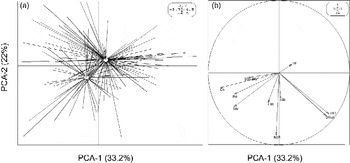
The ecotypes were planted during the 2002 rainy season at two locations in southern Niger, Gaya (11°53′N and 3°19′E) and Maradi (13°28′N and 7°05′E). Over the last 10 years (1992–2001), the average recorded rainfall has been 806 mm over 57 d at the Gaya station and 476 mm over 37 d at the Maradi station. The average rainfall during the 2002 trial was 857 mm over a period of 58 d at the Gaya station and 511 mm over 40 d in the Maradi station. A randomized complete block design with three replications was used to test the influence of environmental factors. In each block, each ecotype was represented by a 6 m long row, in which five mounds were positioned every 1.5 m. Successive rows were 1.5 m apart and the blocks were 3 m apart. At least five seeds were sown in each mound. One week after germination, the plants were thinned to two plants per mound and to one plant per mound at the first weeding. At each of the two locations, the ten following parameters were recorded: (1) number of days to emergence (DE), (2) number of days to flowering (Dfl), which corresponds to the time when 50% of the plants have started flowering, (3) number of days to 50% maturity (Dmat), (4) plant height at maturity (PH), (5) number of branches per plant at maturity (NbR), (6) basal diameter of the principal stem at maturity (Dia), (7) capsule number per plant at maturity (Cn), (8) total seed weight per plant (SW), (9) calyx dry weight per plant at maturity (CW) and (10) 100-seed weight (100-SW). For each parameter, data were collected from 15 plants (five plants × three replicates). Discriminant analysis was carried out for ten agrophenological characteristics (Fig. 2).
Principal component analysis (PCA) in 161 H. sabdariffa ecotypes using ten agromorphological characteristics. (a) Plot of the ecotype groups as 1 being Waré local name and 2 being Yakua local name. (b) Projection of characteristics in the plane formed by PCA axes 1 and 2. Dfl, days to flowering; Dmat, maturity cycle; PH, plant height at maturity; NbR, number of ramifications; Dia, collar diameter; Cn, capsule number; SW, seed weight per plant; Cw, calyx weight per plant; 100-SW, 100-seed weight.

DNA extraction and AFLP analysis
DNA from individual plants was extracted from 3-d-old fresh leaves ground in 750 μl extraction buffer (Tris 0.1 M, pH 8, NaCl 1.25 M, EDTA (Ethylene Diamine Tetraacetic Acid) 0.02 M and MATAB (Mixed Alkyl Trimethyl Ammonium Bromide) 4%) using a previously published protocol (Mariac et al., Reference Mariac, Luong, Kapran, Mamadou, Sagnard, Deu, Chantereau, Gerard, Ndjeunga, Bezançon, Pham and Vigouroux2006). After 4 h incubation at 65°C, DNA extraction was performed using chloroform–isoamyl alcohol (24:1). After centrifugation (9000g, 10 min, 4°C), DNA was precipitated from the supernatant using 550 μl of isopropanol (centrifugation 9000g, 10 min, 4°C), washed with 70% ethanol, dried and resuspended in 200 μl sterile water. The positions of the different individual DNA extractions were then randomized on 96-well plates.
For AFLP analysis, we used a previously published method (Allinne et al., Reference Allinne, Mariac, Vigouroux, Bezançon, Couturon, Moussa, Tidjani, Pham and Robert2008). Genomic DNA (0.4 μg per sample) was digested using both EcoRI and TruI enzymes for 4 h at 37°C, and EcoRI and TruI adapters were ligated to the digested DNA fragments overnight at 27°C. About 5 μl of ligation mixture were used as template DNA for pre-amplification reaction with EcoRI+C and TruI+A primers. Twenty-one cycles were run for 30 s at 94°C (denaturation), 60 s at 56°C (annealing), 60 s at 72°C (extension), with one 10 min cycle at 72°C (final extension) in a Biometra Mastercycler. The pre-amplification products were diluted 1:7 and used as a template for selective amplification with a multiplex of IRD-700 and IRD-800-labelled specific primers targeted to the EcoRI adapter (ACTGCGTACCAATTCAG, with three specific bases listed in Table 1) and a reverse primer targeted to the TruI adapter (GATGACTCCTGAGTAA with the three specific bases listed in Table 1). A total of four primer pairs were used. Selective amplification was performed for 13 cycles of 30 s at 94°C, 30 s at 65°C, 60 s at 72°C extension, followed by 25 cycles, i.e. 10 s at 94°C, 30 s at 56°C, 60 s at 72°C and ending with 10 min at 72°C.
AFLP primers and number and percentage of polymorphic bands in the H. sabdariffa population from Niger and its closely related species (A. esculentus and H. cannabinus)

Scoring and data analysis
The AFLP amplified products were separated on a two-dye LI-COR automated DNA sequencer (Li-Cor Biosciences) at the joint Université Abdou Moumouni/IRD laboratory in Niamey (Niger). AFLP-Quantar (Keygen) software was used to identify and count the number of polymorphic bands. Genotypes were scored for the presence (1) or absence (0) of all polymorphic bands. Differences in band intensity among different samples were not considered during the scoring. Both monomorphic and polymorphic bands were included in the dataset to enable unbiased estimation of genetic variation.
To identify genetic relationships between samples, a dissimilarity matrix was calculated using the Sokal and Michener index with DARwin version 5 software (Perrier et al., Reference Perrier, Flori, Bonnot, Hamon, Seguin, Perrier and Glaszmann2003). An overall representation of the diversity structure was obtained by a factorial analysis based on a distance matrix, while individual relations were analysed with a weighted neighbour-joining (NJ) method, as implemented in DARwin version 5 software (Perrier et al., Reference Perrier, Flori, Bonnot, Hamon, Seguin, Perrier and Glaszmann2003). To test for sample clustering in conjunction with admixtures between subgroups, Bayesian statistics based on the Markov chain Monte Carlo algorithm were used with Structure version 2.3.1 software (Pritchard et al., Reference Pritchard, Stephens and Donnelly2000; Falush et al., Reference Falush, Stephens and Pritchard2003), with the ‘absent’ allele being coded as recessive. Runs were performed at Cornell University Computational Biology Service Unit (Ithaca, New York, USA). A burn-in period of 100,000 iterations followed by 100,000 iterations was used for each run. Fifty replicates were performed for each K value, with K being the number of considered clusters. For a given K value, we selected the analysis presenting the highest likelihood and assignation to groups was based on an ancestry threshold of 0.8. The most likely population number (K) was estimated according to Evanno et al. (Reference Evanno, Regnaut and Goudet2005), with an R (http://www.r-project.org/) script modified from Ehrich (2006). The information content of each AFLP marker was computed as polymorphic information content (PIC) i = 1–Σpi2, where pi is the frequency of the ith band. The mean PIC was calculated for AFLP markers across assay units by applying the above formula, proposed by Powell et al. (Reference Powell, Morgante, Andre, Hanafey, Vogel, Tingey and Rafalski1996). The discrimination power of each AFLP marker was evaluated by the PIC. Geographic origins were also used as priors in the Bayesian statistical analysis.
In order to assess the relationships between geographic and genetic distances, a Mantel test was performed to correlate the two genetic and geographic matrices. To assess the significance of the Mantel test, 1000 permutations were performed.
Results
Agromorphological parameters
Large variations between ecotypes were observed for all traits (for detailed measures per ecotype, see Table S2, available online). For example, Dfl ranged from 65 d after sowing to 97 d after sowing. For some traits like collar diameter (1.33–2.67 cm) or 100-seed weight (2–4.33 g), the variation ranged from one- to two-fold. The greatest variation was recorded for seed weight per plant, which ranged from 31.7 to 616.0 g (Table S2, available online).
Discriminant analysis of the ecotypes (yakua/waré) explained 33.2% on the first axis and 22% on the second axis (Fig. 2(a)). Axis 1 compared the developmental cycle (Dfl, Dmat) with the PH, Cn and SW, Axis 1 thus represented the precocity axis (Fig. 2(b)). Axis 2 also compared the germination (DE) with all the other studied characteristics; it represented the vigour and productivity axis (Fig. 2(b)).
To identify the agromorphological traits that would differentiate the two local ecotypes, an analysis of variance (ANOVA) was performed to compare the two classes for each trait (Table 2). This analysis showed that PH, NbR, Cn, SW and 100SW were significantly different between the two classes (Table S3, available online).
ANOVA for the agromorphological traits

ns, non-significant; Dfl, days to flowering; Dmat, maturity cycle; PH, plant height at maturity; NbR, number of ramifications; Dia, collar diameter; Cn, capsule number; SW, seed weight per plant; Cw, calyx weight per plant; 100-SW, 100-seed weight.
Statistical significance: *P≤ 0.05, **P≤ 0.01, ***P≤ 0.001
Diversity analysis
Four primer pairs were used in this study (Table 1). These four primer combinations produced 267 bands across all the 141 individuals and 260 in H. sabdariffa, 41 of which were polymorphic (18.41% polymorphism). Regarding the other species, the primer combination E-AAT/M-CTG showed the highest polymorphism (37.73%) while E-AGC/M-CTT gave the fewest polymorphic bands (5%). The percentage of polymorphic bands within species was 18.41% in H. sabdariffa, 10.33% in H. cannabinus and 8.62% in A. esculentus (Table 1). Overall, polymorphism was low in the collection. This was substantiated by the low PIC values exhibited by H. sabdariffa (0.166), H. cannabinus (0.106) and A. esculentus (0.101).
Genetic differences among the three species
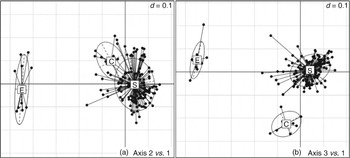
Factorial analysis (Fig. 3) based on the Sokal and Michener dissimilarity index showed that, for the overall collection, the first axis (representing 24.9% of the complete inertia) clearly differentiated H. sabdariffa and H. cannabinus species from A. esculentus. In contrast with the second axis (8.2% of inertia; Fig. 3(a)), the third axis (6.2% inertia; Fig. 3(b)) separated H. cannabinus species from H. sabdariffa. The NJ tree confirmed the separation of A. esculentus samples from the other, H. cannabinus samples being grouped into H. sabdariffa samples (Fig. S1, available online).
Factorial analysis based on the Sokal and Michener distance matrix of the accessions of H. sabdariffa (S), A. esculentus (E) and H. cannabinus (C). (a) Axis 1 (X, 24.9% inertia) versus axis 2 (Y, 8.2% inertia). (b) Axis 1 (X, 24.9% inertia) versus axis 3 (Y, 6.2% inertia).

Genetic diversity within H. sabdariffa
Based on the genetic distance matrix of only H. sabdariffa samples, the first axis explained 12.6% of the genetic variation and the second axis 8.5% of the genetic variation, respectively (Fig. S2, available online). Farmers' classification for ‘yakua’ (Y) and ‘waré’ (W) ecotypes did not seem to correspond to the different genetic groups (Fig. S2, available online). Moreover, no significant isolation by distance could be detected (Mantel test between genetic and geographic distances, P>0.05).
Bayesian analysis of the sample structure
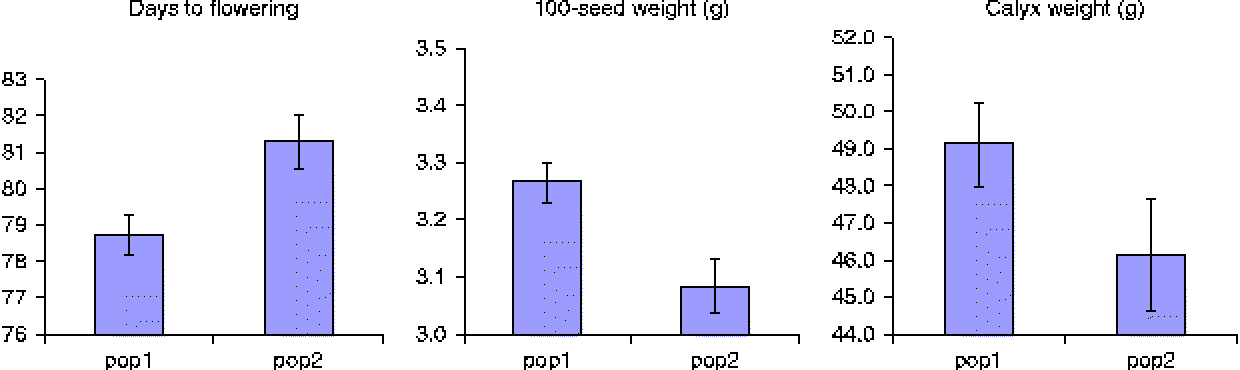
The Bayesian method was used to assign H. sabdariffa samples to different groups. Group numbers (K) from 1 to 5 were tested. K= 2 was considered to be the best value based on the criteria of Evanno et al. (Reference Evanno, Regnaut and Goudet2005) (Fig. S3, available online). Each accession was assigned to one of the two clusters, with an ancestry threshold of 0.8. Intermediate accessions were classified as ‘hybrid’. Based on these two groups, we performed an ANOVA using the agrophenological traits, including group and block effects and their interaction. The results showed a highly significant group effect for the number of Dfl, 100-seed weight and calyx weight (Table 2). For most of the studied phenological parameters, the block effect was also highly significant, but the interaction group × block effect was not. The traits that best differentiated the two groups were number of Dfl and 100-seed weight. Plants with the largest calyxes were also the earliest to flower (Fig. 4).
Flowering time, 100-seed weight and calyx weight of yakua (pop1) and waré (pop2).

Discussion
In this study, 48 AFLP markers clearly differentiated the three species of the Malvaceae family, namely H. sabdariffa, H. cannabinus and A. esculentus. However, the polymorphism is overall very low when compared with the one reported by Satya et al. (Reference Satya, Karan, Kar, Mahapatra and Mahapatra2013) using ISSR (Inter Simple Sequence Repeat) and SSR (Simple Sequence Repeat) markers in roselle varieties cultivated in India. Although low genetic diversity was observed in roselle varieties with AFLP markers (Zhou et al., Reference Zhou, Bao-Rong, Kazuhiko, Da-Xu and Jia-Kuan2004), this method seems to be a reliable technique for assessing genetic diversity between Hibiscus species (Braglia et al., Reference Braglia, Bruna, Lanteri, Mercuri and Portis2010).
To our knowledge, this is the largest study in which roselle diversity was analysed using genetic markers, including AFLP markers. In a previous study, Zhou et al. (Reference Zhou, Bao-Rong, Kazuhiko, Da-Xu and Jia-Kuan2004) investigated genetic diversity in 23 kenaf (H. cannabinus) accessions and included only two roselle accessions. Torres-Moran et al. (Reference Torres-Moran, Escoto-Delgadillo, Ron-Parra, Parra-Tovar, Mena-Munguia, Rodriguez-Garcia, Rodriguez-Sahagun and Castellanos-Hernandez2011) performed a similar study with only 12 accessions from Mexico. Our large study revealed no significant relationship between the genetic and geographic isolation, thus supporting the hypotheses of a major flow of seeds across the country. This is in agreement with Allinne et al. (Reference Allinne, Mariac, Vigouroux, Bezançon, Couturon, Moussa, Tidjani, Pham and Robert2008), who reported similar results in pearl millet in southwestern Niger as a consequence of substantial seed flow. Different factors can preclude such genetic diversity homogenization: pollen transfer through insects (Bricage, Reference Bricage1978), cultural practices in which all ecotypes are cultivated together in the fields, seed migration, particularly in the east of Niger, where all farmers are used to buy and or exchange seeds before sowing, and finally late sowing with remaining seeds due to heavy farmers' schedule.
Bayesian statistics using molecular data obtained from four primer pairs in an AFLP analysis structured the roselle ecotypes in two major genetic groups. An ANOVA for the agromorphological characteristics in the two subpopulations showed that they differ for traits such as flowering time, with the seed weight being the most significant and the calyx weight the least. A first group was thus composed of the earliest ecotypes, with a higher 100-seed weight. These ecotypes matured generally before the end of the rainy season and therefore produced seeds, while ecotypes of the second group often matured more than a month after the end of the rainy season. The traits characterizing the first group are closer to the ‘yakua’ ecotype group (early and large seeds), while those of the second group are closer to the ‘waré’ group. The flowering time seemed to be the most stable trait and therefore could be used for roselle classification, as suggested by Zhou et al. (Reference Zhou, Bao-Rong, Brian, Kazuhiko and Jia-Kuan2002) for kenaf. However, the composition of the two genetic subpopulations was not completely consistent with the two local ecotype groups defined by farmers, which was a mixture of the ‘yakua’ and ‘waré’ ecotypes. These ecotypes were defined by farmers primarily on the basis of the calyx size, an important useful trait. However, similar to many other traits, this characteristic is associated with the strong block effect (F block= 23.19; P= 0.000) (Bakasso et al., Reference Bakasso, Saadou, Zongo, Baidou Forson and Toujani2009), suggesting strong environment-dependent variability. Indeed, the ‘yakua’ calyx can have a development pattern close to that of ‘waré’ under certain environmental conditions (Bakasso et al., Reference Bakasso, Saadou, Zongo, Baidou Forson and Toujani2009).
The most important characteristic structuring roselle diversity in Niger is not the calyx but rather the flowering time and seed weight. Similar morphological structuring was observed in Mexico (Torres-Moran et al., Reference Torres-Moran, Escoto-Delgadillo, Ron-Parra, Parra-Tovar, Mena-Munguia, Rodriguez-Garcia, Rodriguez-Sahagun and Castellanos-Hernandez2011) in a study with ISSR markers. These morphological characteristics should be taken into account for the in situ management of this diversity. One important point is that the morphological traits used by farmers to define their local ecotype groups do not perfectly match the genetic and morphological structuring, which actually highlights the fact that those analysed traits are not the only traits taken into consideration by farmers for their selection (Mckey et al., Reference Mckey, Emperaire, Elias, Pinton, Robert, Desmouliere and Rival2001; Pinton and Emperaire, Reference Pinton and Emperaire2001).
It is of particular interest that the two genetic groups were significantly different in terms of flowering time. This difference in flowering time has certainly led to some form of reproductive isolation, giving rise to the two distinct genetic groups. Otherwise, the main morphological characteristic upon which farmers based their classification, i.e. calyx size, was less significantly different between the two genetic groups. Understanding farmers' morphological trait management strategies as well as how they match the genetic groups is particularly important to ensure the effective management of agronomic diversity.
Supplementary material
To view supplementary material for this article, please visit http://dx.doi.org/10.1017/S1479262113000531
Acknowledgements
The authors thank the Computational Biology Service Unit of Cornell University (Ithaca, New York, USA).