Staphylococcus aureus bacteremia is associated with significant morbidity and mortality in adults.Reference Dantes, Mu and Belflower 1 The incidence and outcomes of S. aureus bacteremia in hospitalized children, particularly since the emergence of community-onset (CO) methicillin-resistant S. aureus (MRSA), remains relatively unknown. Published reports are limited to single-center studies with few patients,Reference Dantes, Mu and Belflower 1 – Reference Klevens, Morrison, Nadle and Petit 5 and they often focus on MRSA infectionsReference Dantes, Mu and Belflower 1 , Reference Klevens, Morrison, Nadle and Petit 5 and examine either CO or hospital-onset (HO) infections individually.Reference Hsiang, Shiau, Nadle, Chan, Lee, Chambers and Pan 3 , Reference Kaplan, Hulten, Gonzalez, Hammerman, Lamberth, Versalovic and Mason 4 We sought to determine the epidemiology and outcomes of S. aureus bacteremia using a large, nationally representative cohort of children hospitalized in the United States.
PATIENTS AND METHODS
Study Design/Population
To determine the incidence, resistance profile, clinical characteristics and outcomes associated with pediatric S. aureus bacteremia, we assembled a cohort of nonneonatal children <19 years of age hospitalized between 2009 and 2012 using the Premier PerspectiveTM Database (PPD). PPD is an administrative database of 600 US acute-care hospitals that includes patient demographics, admission/discharge dates, admission and discharge diagnoses, procedure codes, discharge disposition, and medications.Reference Fisher, Lindenauer and Feudtner 6 Microbiology data, including blood culture results and sensitivity testing were available for 146 hospitals, served as the source for this cohort.
Study Definitions
We identified all unique hospitalizations with a S. aureus bloodstream infection. Adults (≥19 years), neonates (based on the All Patient Refined Diagnosis Related Groups [APR-DRG] subclass code), and patients transferred from outside hospitals or with an initial positive outpatient culture for S. aureus were excluded. S. aureus isolates resistant to nafcillin, oxacillin, or cefazolin were considered MRSA; those sensitive to these antibiotics were considered methicillin-sensitive S. aureus (MSSA). Isolates not tested against any of these antibiotics were considered to have an unknown resistance status. S. aureus blood cultures obtained within the first 2 days of hospitalization were considered to originate from CO infections; 7 those obtained beyond 2 days were considered were considered to originate from HO infections.
To determine the likely primary source of bacteremia, two infectious disease physicians (BF and JG) independently reviewed all International Classification of Diseases, Ninth Revision (ICD-9) codes per admission using predefined infection categories. Discrepancies were resolved through subsequent review and discussion.
We used a previously validated, ICD-9-CM code-based diagnostic classification system to identify underlying complex chronic conditions.Reference Feudtner, Christakis and Connell 8
Statistical Analysis
The χ2 test for categorical variables and Wilcoxon rank-sum test for continuous variables were used to compare CO versus HO infections. Tests were 2-tailed, and results with P<.05 were considered significant. All analyses were conducted using SAS, version 9.3 (SAS Institute).
RESULTS
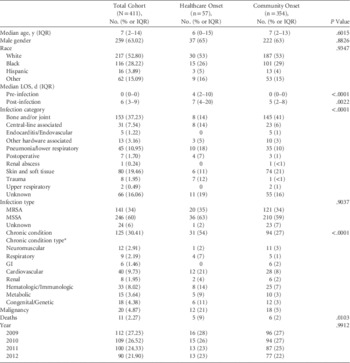
We identified 411 unique episodes of S. aureus bacteremia for a rate of 1.54 per 1,000 hospitalizations. A total of 57 patients (14%) had HO infections and 354 (86%) had CO infections (Table 1). Patients were more frequently white (n=217, 53%) and male (n=259, 63%), with median age of 7 years (interquartile range [IQR], 2–14 days). Median length of stay (LOS) prior to onset of S. aureus bacteremia was 4 days (IQR, 2–10 days) for HO patients. Median LOSs following onset of S. aureus bacteremia were 5 days (IQR, 2–8 days) for CO patients and 7 days (IQR, 4–20 days) for HO (P=.002). Patients with HO infection were more likely to have at least 1 underlying complex chronic condition (54% vs 27%, P<.001).
Patient and Infection Characteristics of Staphylococcus aureus BacteremiaCharacteristic

NOTE. IQR, interquartile range; LOS, lenght of (hospital) stay; MRSA, methicillin-resistant S. aureus; MSSA, methicillin-sensitive S. aureus; GI, gastrointestinal.
* Patients may have more than one chronic condition.
A primary source of bacteremia was identified for 345 (84%) admissions. Among HO episodes, the most common etiologies were pneumonia/lower respiratory infection (n=10, 18%), central-line associated bloodstream infections (n=8, 14%) and bone and/or joint (n=8, 14%). For CO bacteremia, bone/joint (n=145, 41%), skin/soft tissue (n=74, 21%), and pneumonia/lower respiratory infections (n=35, 10%) were most common. Of the 387 (94%) S. aureus episodes for which antibiotic sensitivities had been assessed, 141 (34%) were identified as MRSA, which was not significantly different between those with HO (35%) and CO (34%) infections (P=.904).
Mortality was higher among HO patients (9% vs 2%, P=.010). Median time to death from bacteremia onset, however, was significantly longer for HO patients: 6 days (IQR, 3–31 days) versus 3 days (IQR, 1–10 days) (P=.002).
DISCUSSION
The incidence of S. aureus bacteremia among US hospitalized children (1.54 per 1,000 hospitalizations) that we observed using microbiology data from the PPD was similar to that reported in a prior study of US freestanding children’s hospitals using ICD-9 codes (1.95 per 1,000 hospitalizations)Reference Gerber, Coffin, Smathers and Zaoutis 2 and in a study of 17 Australian hospitals using microbiology data (1.48 per 1,000 hospitalizations).Reference Collignon, Nimmo and Gottlieb 9
While only 10% of episodes in this cohort were HO infections, HO bacteremia cases accounted for nearly 50% of the mortalities and were associated with longer postinfectious LOS. These data suggest that optimizing prevention and/or treatment of HO S. aureus bacteremia will reduce inpatient mortality and LOS. Of those who died with CO S. aureus bacteremia, death occurred relatively soon after infection onset (median: 3 days) compared with those who ultimately died with HO infections. Thus, early therapy and close monitoring are paramount.
The distribution of the source of S. aureus bacteremia differed between CO and HO patients. More than 60% of CO patients had bone/joint or skin/soft tissue infections, which is not surprising given the predominance of S. aureus as a cause of these conditions. Alternatively, HO bacteremia was most commonly associated with pneumonia, suggesting that this result was driven by hospital-acquired infection in mechanically ventilated children, who are at much higher risk for S. aureus pneumonia than children with CO disease.
This study had several limitations. Most PPD hospitals are not children’s hospitals, which might limit the generalizability of this study. Also, the observed mortality is not necessarily attributable to S. aureus bacteremia. Finally, using ICD-9 codes to assign bacteremia source may lead to the misclassification of the infection source.
Acknowledgments
Financial support: No external funding was secured for this study. None of the authors have financial relationships relevant to this article to disclose.
Potential conflicts of interest: None of the authors have conflicts of interest to disclose.