





Impact statement
This paper contributes to the Biodesign community by offering pathways for the development of self-healing Engineered Living Materials, positioning anticipated societal implications as a central point of attention. It presents a design-led approach for unpacking these implications within multidisciplinary material development teams.
Introduction
Imagine a table that erases the scratches carved into the surface, removing them over the weekend. Or a climbing helmet that heals itself overnight, shifting in colour as it recovers. These scenarios help us consider how self-healing might be experienced and how it might reshape relationships between users and objects. They open up possibilities for creating more sustainable and responsive solutions. This study aims to uncover anticipated societal implications of self-healing Engineered Living Materials (ELMs) through the co-design of these scenarios within a multidisciplinary workshop.
ELMs are emerging hybrid materials that embed living cells into structural or functional matrices (Gilbert et al. Reference Gilbert, Tang, Ott, Dorr, Shaw, Sun, Lu and Ellis2021; Molinari et al. Reference Molinari, Tesoriero and Ajo-Franklin2021; Nguyen et al. Reference Nguyen, Courchesne, Duraj-Thatte, Praveschotinunt and Joshi2018). With advances in synthetic biology and materials science, these materials can grow, sense, adapt and repair themselves, promising new possibilities across construction to biomedicine (Lu et al. Reference Lu, Huang, Cui, Wu, Jiang, Gu, Cao and Yin2024; Srubar Reference Srubar2021). Specific examples include biomineralising building materials that embed bacteria to autonomously repair cracks (Heveran et al. Reference Heveran, Williams, Qiu, Artier, Hubler, Cook, Cameron and Srubar2020; Jonkers Reference Jonkers and van der Zwaag2007), engineered fungal composites that retain living properties such as self-healing or responsiveness (Elsacker et al. Reference Elsacker, Zhang and Dade-Robertson2023) and bacterial cellulose-based materials developed for biosensing, biocatalysis or structural applications (Gilbert and Ellis Reference Gilbert and Ellis2018).
Current research largely focuses on technical performance: enhancing robustness, efficiency and control. Yet as these materials move towards real-world integration, a new question arises: What implications do they entail for society? In this paper, we approach these concerns collectively as societal dimensions, referring to the ecological, economic, experiential and relational conditions through which ELMs become embedded in everyday contexts. Emerging work points towards societal challenges (Aleixandre et al. Reference Aleixandre, Shrikrishnan, Dalby and Salmeron-Sanchez2021; Ebbesen et al. Reference Ebbesen, Korvink, Islam and Lantada2024; Heveran et al. Reference Heveran, Gerlach, Hernandez, Intemann, Meyer, Ajo-Franklin, Charrier, Srubar, Joshi and Nelson2024). However, there remains a limited understanding of how diverse stakeholders involved in developing such materials consider and interpret these challenges.
Societal dimensions become particularly important when self-healing unfolds over time, leaves visible traces or behaves unpredictably. In such cases, it is not only a technical function, but also a process perceived and experienced by users. In this paper, we therefore approach self-healing not as a single technical mechanism, but as a broader class of material behaviours. These range from repair-oriented processes such as biomineralisation to more speculative and experiential forms of change, including growth, visible transformation or reconfiguration over time. From a design perspective, this positions self-healing as an expressive, temporal and relational process that shapes how materials are interpreted and engaged with, offering distinctive living aesthetics (Karana et al. Reference Karana, Barati and Giaccardi2020) that must be considered in the development of these materials. Bridging these aesthetic and expressive potentials with technical function and viability within multidisciplinary teams is therefore crucial when articulating the broader societal implications of emerging materials (Barati et al. Reference Barati, Karana and Hekkert2019; Karana et al. Reference Karana, Barati, Rognoli and Zeeuw Van Der Laan2015a)
To explore these societal dimensions of self-healing ELMs, we conducted a co-design workshop on biomineralised bacterial cellulose (BMBC) (Yu et al. Reference Yu, Spiesz, Balasubramanian, Schmieden, Meyer and Aubin-Tam2021), used as a design probe to explore speculative self-healing scenarios. This ELM is currently under development by the research consortium (NextSkins 2026). Participants, from two research consortia, NextSkins (NextSkins 2026) and Fungateria (FUNGATERIA 2026), with different disciplinary perspectives, including biodesign, bio-nanoscience, materials science and engineering, were invited to design applications and self-healing behaviours and to reflect on societal implications, including user experience, ecological and economic impact. Rather than treating BMBC as a finished product, we used it as a design probe to investigate how participants engage with emerging material capabilities and how self-healing behaviours might be imagined for future application contexts.
This study makes three key contributions:
-
1. A set of design concepts that explore potential applications of self-healing ELMs;
-
2. Insights into how designers of ELMs shape self-healing as an expressive, temporal and relational process, resulting in a set of emerging design orientations;
-
3. Insights into anticipated societal implications of self-healing ELMs, as well as the further development trajectory.
Related work
Engineered living materials
ELMs are materials in which living cells function as structural or active components, enabling behaviours such as growth, regeneration, sensing and self-healing (Gilbert et al. Reference Gilbert, Tang, Ott, Dorr, Shaw, Sun, Lu and Ellis2021; Molinari et al. Reference Molinari, Tesoriero and Ajo-Franklin2021; Nguyen et al. Reference Nguyen, Courchesne, Duraj-Thatte, Praveschotinunt and Joshi2018). Situated at the intersection of synthetic biology and materials science, ELMs leverage biological processes to create responsive and adaptive material systems (An et al. Reference An, Wang, Huang, Wang, Liu, Xun, Church, Dai, Yi and Tang2022; Gilbert and Ellis Reference Gilbert and Ellis2018; Wang et al. Reference Wang, Hu, Li, Liu and Bian2025). Compared to conventional materials, ELMs can self-assemble, repair damage and interact with environmental stimuli (Rivera-Tarazona et al. Reference Rivera-Tarazona, Campbell and Ware2021; Wang et al. Reference Wang, Liu, Li, Chen, Liu and Zhong2022). Recent research has demonstrated their potential across domains, including biomedicine (Lavrador et al. Reference Lavrador, Gaspar and Mano2021; Omer et al. Reference Omer, Mohsin, Mohsin, Mushtaq, Huang, Guo, Zhuang and Huang2022), environmental remediation (Datta et al. Reference Datta, Weiss, Wangpraseurt, Hild, Chen, Golden, Golden and Pokorski2023; Wang et al. Reference Wang, Zhang, Ge, An and Zhong2024), energy production (An et al. Reference An, Wang, Huang, Wang, Liu, Xun, Church, Dai, Yi and Tang2022; Yuan et al. Reference Yuan, Xu, Liu, Zhang, Li, Liang, An, Paternò, Zhang and Tang2025) and construction (Geng et al. Reference Geng, Jia and Li2024; Wang et al. Reference Wang, Hu, Li, Liu and Bian2025). Because ELMs rely on biological growth and self-regeneration, they are often positioned as promising contributors to sustainability, potentially reducing resource extraction and enabling circular material lifecycles (An et al. Reference An, Wang, Huang, Wang, Liu, Xun, Church, Dai, Yi and Tang2022). However, while their transformative potential is widely articulated, many ELM materials remain at relatively low technology-readiness levels, and their long-term environmental performance, scalability and lifecycle impacts require further investigation.
Recent trends in the field of ELMs include diversification of organism types, scaling from microscale to macroscale structures, and increasing emphasis on controllability, durability and functional optimisation (Gilbert and Ellis Reference Gilbert and Ellis2018; Lu et al. Reference Lu, Huang, Cui, Wu, Jiang, Gu, Cao and Yin2024). Despite these technical advances, translation beyond laboratory contexts raises new challenges. While scholars increasingly acknowledge ethical and societal questions surrounding safety, regulation and responsible innovation (Heveran et al. Reference Heveran, Gerlach, Hernandez, Intemann, Meyer, Ajo-Franklin, Charrier, Srubar, Joshi and Nelson2024), empirical and design-oriented investigations of these dimensions remain scarce. One of the few studies addressing public perception highlights the potential “yuck factor,” suggesting that materials incorporating microorganisms may elicit affective responses such as disgust (Intemann et al. Reference Intemann, Lavoie, Elsass, Scott and Gerlach2025), linked to concerns about contamination, naturalness and moral boundaries. Relatedly, Ertürkan et al. (Reference Ertürkan, Karana and Mugge2022) propose a vocabulary for describing living materials across technical, experiential and relational dimensions, reflecting growing recognition that ELMs require new language to articulate qualities such as agency and responsiveness. However, while such conceptual efforts offer important groundwork, systematic design research examining how these dimensions are interpreted and negotiated in practice remains limited. More broadly, integrating living systems introduces uncertainties regarding lifespan, maintenance, user trust and interpretability (Kleiner et al. Reference Kleiner, Oh and Aubin-Tam2025; Molinari et al. Reference Molinari, Tesoriero and Ajo-Franklin2021). As a result, a gap persists between rapidly advancing technical capabilities and a deeper understanding of how ELMs might be meaningfully integrated into everyday contexts, particularly regarding how diverse stakeholders engage with these dimensions during development.
Social dimensions of emerging materials
Research across emerging material domains, including nanomaterials, smart and adaptive systems, and circular bio-based materials, demonstrates that material innovation reshapes not only technical performance but also ecological systems, economic structures, regulatory frameworks and everyday practices (Karana et al. Reference Karana, Pedgley and Rognoli2015b; Poblete et al. Reference Poblete, Romani and Rognoli2024; Rosato and Triana Reference Rosato and Triana2025). In many cases, environmental risks, governance gaps and user-trust issues became visible only after materials were scaled up or embedded in products and infrastructure (Gottardo et al. Reference Gottardo, Mech, Drbohlavová, Małyska, Bøwadt, Sintes and Rauscher2021; Le et al. Reference Le, Salomone and Nguyen2023; Linkov et al. Reference Linkov, Kurth, Hristozov and Keisler2015). These cases illustrate that material development is never purely technical, it reconfigures relationships between materials, users and institutions. In response, scholars argue that the implications of emerging materials should be explored during early development stages (Barati et al. Reference Barati, Karana and Hekkert2019; Ferraro Reference Ferraro, Ferraro, Kääriäinen, Pasold and Morer-Camo2023; Wilkes et al. Reference Wilkes, Wongsriruksa, Howes, Gamester, Witchel, Conreen, Laughlin and Miodownik2016).
Work on materials experience emphasises that sensory qualities, temporality and responsiveness influence how materials are trusted and integrated into practice (Karana et al. Reference Karana, Barati, Rognoli and Zeeuw Van Der Laan2015a). Speculative and critical design approaches further demonstrate that engaging with emerging materials through artefacts and co-creation can surface ecological, socio-economic and future imaginaries before infrastructures stabilise (Tufail et al. Reference Tufail, Wang, Tian, Li, Leung, Uzma, Park and Kim2023). These lessons are particularly relevant for living materials. Like other emerging materials, they promise sustainability and innovation while introducing uncertainties around safety, governance and adoption (Li et al. Reference Li, Fornasiero, Xu, Jia, Xu, Sun, Müllen, Zhang and Novoselov2025; Tang et al. Reference Tang, An, Huang, Vasikaran, Wang, Jiang, Lu and Zhong2021) However, they have the ability to grow, self-repair or have other ongoing biological activities, which challenge assumptions of stability and control, foregrounding questions of agency, care and co-evolution (Zhou et al. Reference Zhou, Doubrovski, Giaccardi and Karana2024). In biodesign, such materials can be conceptualised as Living Artefacts that unfold over time and require relational engagement rather than passive use (Karana et al. Reference Karana, Barati and Giaccardi2020). Despite increasing recognition of these dimensions, structured design approaches for exploring social implications during early-stage ELM development remain limited. In this paper, we use the term societal dimensions to refer to the interconnected ecological, social, economic, experiential and future-oriented considerations that shape how emerging materials are interpreted, governed and integrated into everyday life.
Co-design workshops in multidisciplinary settings
Co-design has become a widely used approach for exploring emerging technologies, particularly when they introduce uncertainty, complexity or open-ended future implications (Avila-Garzon and Bacca-Acosta Reference Avila-Garzon and Bacca-Acosta2024). By bringing together participants from different disciplinary backgrounds, co-design workshops create structured environments for mutual learning, shared framing and collaborative concept development (Bisson and Perondi Reference Bisson and Perondi2024; Penuel et al. Reference Penuel, Allen, Henson, Campanella, Patton, Rademaker, Reed, Watkins, Wingert and Reiser2022; Steen Reference Steen2013; White et al. Reference White, Deevy, Casey, Patocs and Raina2023). Rather than assuming a common language, such workshops function as translation spaces in which participants negotiate terminology, assumptions and problem framings across fields (Calvo and Sclater Reference Calvo and Sclater2021; Nofal Reference Nofal2023). This quality is especially relevant for designing (with) emerging materials with unique temporal behaviour. In such settings, card-based design tools have been shown to support inclusive ideation and shared vocabulary development, helping to bridge considerations of temporal, functional and experiential qualities (Parisi et al. Reference Parisi, McQuillan and Karana2024).
In domains such as synthetic biology and smart materials, co-design workshops have been used to examine how novel systems might be interpreted, maintained or trusted before implementation (Huang et al. Reference Huang, Lin, Chou and Hsu2024; Kim et al. Reference Kim, Zeng, Ellis and Karana2024; Moreira et al. Reference Moreira, Marshall and Staykova2023). For materials that may behave autonomously or appear “alive,” such early dialogue becomes particularly important, as participants must collectively define what acceptable, meaningful or responsible behaviour entails (Elsacker et al. Reference Elsacker, Zhang and Dade-Robertson2023; Kim et al. Reference Kim, Risseeuw, Groutars and Karana2023). Building on this body of work, the workshop presented in this study engages multidisciplinary teams in collaboratively developing applications and expressive self-healing processes for an emerging ELM. The aim is not only to generate concepts but to facilitate shared articulation of material behaviour and its broader implications before technical pathways are fixed.
Methodology
Workshop context and aims
The co-design workshop was designed to explore how multidisciplinary teams engage with the design of an emerging self-healing ELM, in particular, how they conceptualise the application and expressive behaviour of a self-healing ELM, while also reflecting on its societal implications. The participants were recruited from two research consortia, NextSkins (2026) and FUNGATERIA (2026), which develop ELMs under the EU’s EIC-Pathfinder Challenge funding scheme. Twenty participants were invited from these consortia to reflect a range of disciplinary perspectives, including biodesign, bio-nanoscience, material science and engineering. Approximately half of the participants had prior knowledge or work experience with the self-healing BMBC (Yu et al. Reference Yu, Spiesz, Balasubramanian, Schmieden, Meyer and Aubin-Tam2021), which we used in the workshop. Prior to the workshop, a BMBC ELM material expert provided an introduction to this specific material, explaining its fabrication, properties and current and future capabilities. Furthermore, participants were able to touch and feel samples of the BMBC material. After that, participants were randomly assigned to six groups of three to four participants, ensuring that the backgrounds and two project consortia were mixed. The workshop was structured in three sequential phases: (1) concept development, (2) self-healing process design and (3) a group discussion on broader implications, to explore answers for the following research questions:
-
• What future concepts are developers of self-healing materials envisioning?
-
• What underlying motivations shape their imaginaries?
-
• What concerns and opportunities do they foresee for self-healing ELMs?
BMBC material and self-healing capabilities
The material used as a case in this study was an ELM currently under development in the EIC-Pathfinder research project NextSkins (2026). The base material, known as Biomineralised Bacterial Cellulose (BMBC), is a bio-composite inspired by nacre (Yu et al. Reference Yu, Spiesz, Balasubramanian, Schmieden, Meyer and Aubin-Tam2021). It consists of biologically produced bacterial cellulose reinforced with calcium carbonate minerals through microbial activity. Based on the work of Yu et al. (Reference Yu, Spiesz, Balasubramanian, Schmieden, Meyer and Aubin-Tam2021), BMBC is strong, lightweight, impact- and fire-resistant and demonstrates high compressibility. It can be moulded, is biodegradable and is recyclable. In this study, self-healing was explored as a speculative extension of this material. The envisioned capability draws on microbial biomineralisation, a process in which microorganisms produce minerals that can strengthen or repair material structures, discussed as a promising pathway for regenerative and self-healing material futures (Vekemans et al. Reference Vekemans, Parisi, Martins, Wu, Aubin-Tam and Karana2024). For example, dormant bacterial spores could be embedded within the material structure and activated by environmental triggers such as moisture or pH, initiating local mineral formation at damaged areas. While such self-healing behaviour is not demonstrated in the current BMBC material as described by (Yu et al. Reference Yu, Spiesz, Balasubramanian, Schmieden, Meyer and Aubin-Tam2021), this envisioned capability served as a design case for the workshop.
Workshop procedure
Phase 1: concept development
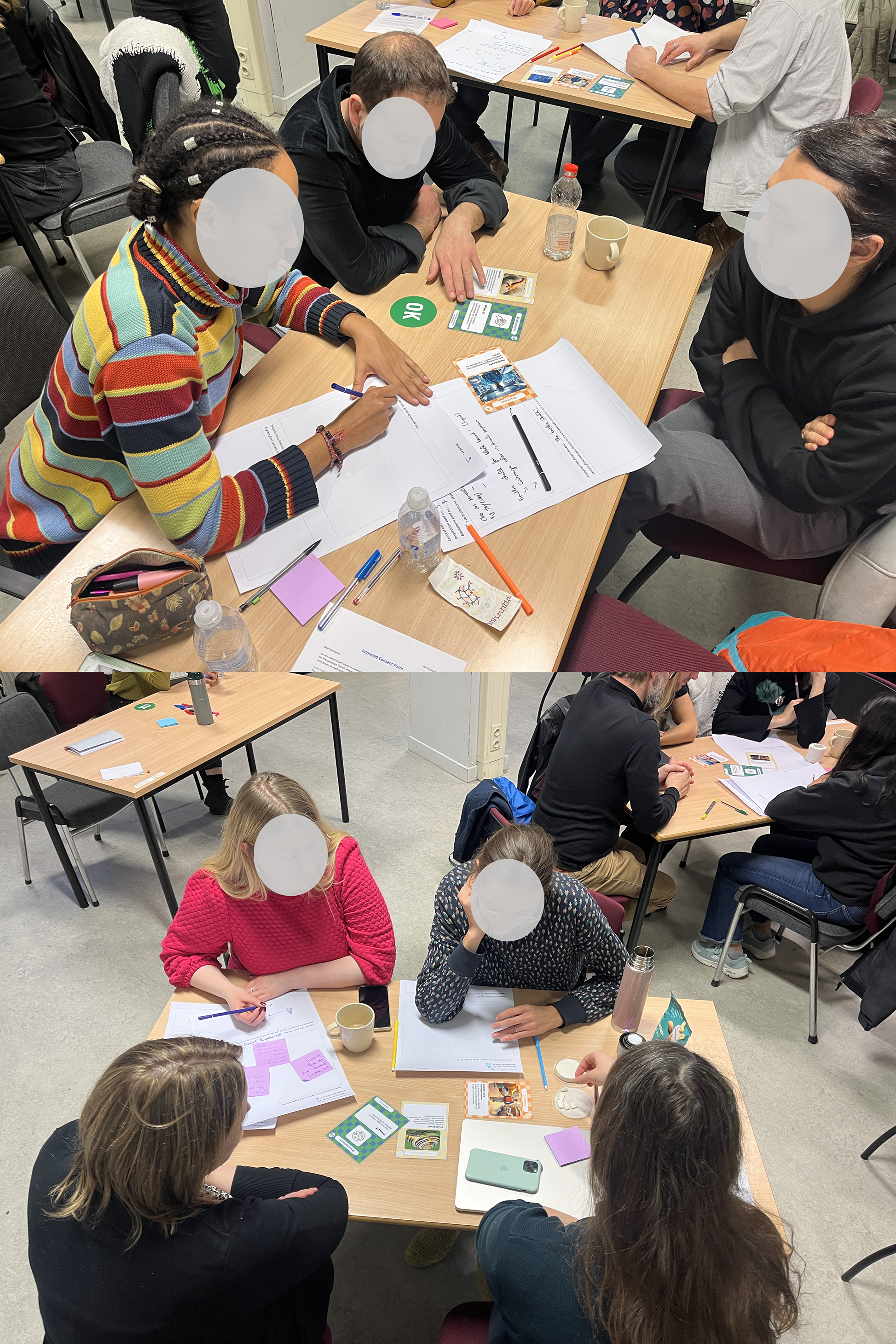
This phase consisted of three rounds of ideation, in which groups generated and refined design concepts for the self-healing ELM. The first round lasted 8–10 minutes to familiarise participants with rapid brainstorming, followed by two shorter rounds of 5–7 minutes. Each round concluded with a concept, resulting in three distinct concepts per group by the end of the phase. After all three rounds, each group selected one of their three concepts and presented it in a short pitch to the plenary before further developing it in the following phase. In each round, participants received three design cards: a context card, a brainstorm card and an inspiration card. These cards were intended to provoke cross-domain associations and guide divergent thinking. A structured brainstorming canvas supported documentation of ideas, card selections and concept outcomes. For each round, one card from each of the three sets was randomly distributed to each group, allowing for diverse and unpredictable combinations (see Figure 1 for an impression of the co-design workshop during this phase). In the first two rounds, participants used general “What if?” brainstorm cards to stimulate divergent thinking. In the third round, these were replaced by a set of cards informed by the pillars of Living Artefacts for Regenerative Ecologies (Karana et al. Reference Karana, McQuillan, Rognoli and Giaccardi2023), to encourage participants to shift from object-scale functionality towards regenerative and ecosystem-oriented considerations.
Impression of the co-design workshop, groups brainstorming about application concepts.

Phase 2: self-healing design process
In this phase, each group selected one emotion card to frame the experiential qualities of their self-healing process. Participants were asked to design how healing would unfold over time in a way that evoked both a sense of livingness and the chosen emotion, acknowledging that ELMs exhibit dynamic, biologically driven behaviours rather than static repair. Before beginning the assignment, participants received a brief introduction to the X_Heal Toolkit (Vekemans et al. Reference Vekemans, Parisi, Zeng, Wu and Karana2025), and its underlying taxonomy to ensure shared understanding of key structure and variables. Using the provided annotation template derived from the X_Heal Toolkit, groups were asked to design and document how self-healing would unfold over time. They specified changes in material variables (e.g., colour, texture, hardness, dimension) and temporal dynamics. Each group was given 15 minutes to complete the template. Afterwards, they delivered a pitch presenting their envisioned self-healing process and explaining how it would unfold and be experienced.
Phase 3: group discussion
The final phase consisted of a moderated plenary discussion among all participants, focused on the ecological, societal and future-oriented dimensions of self-healing ELMs. Each thematic topic was discussed for approximately 10 minutes. Each group was invited to reflect on their concept in response to three guiding questions:
-
1. How would your concept interact with and affect the environment at various stages of its lifecycle (e.g., during use and at the end of its life)?
-
2. What are the main challenges (technical, economic or societal) that could influence the feasibility and acceptance of your concept? How might these be addressed?
-
3. How do you imagine your concept evolving over the next 20 years? Consider environmental impact, technological advancements and societal needs.
Probes in the co-design workshop
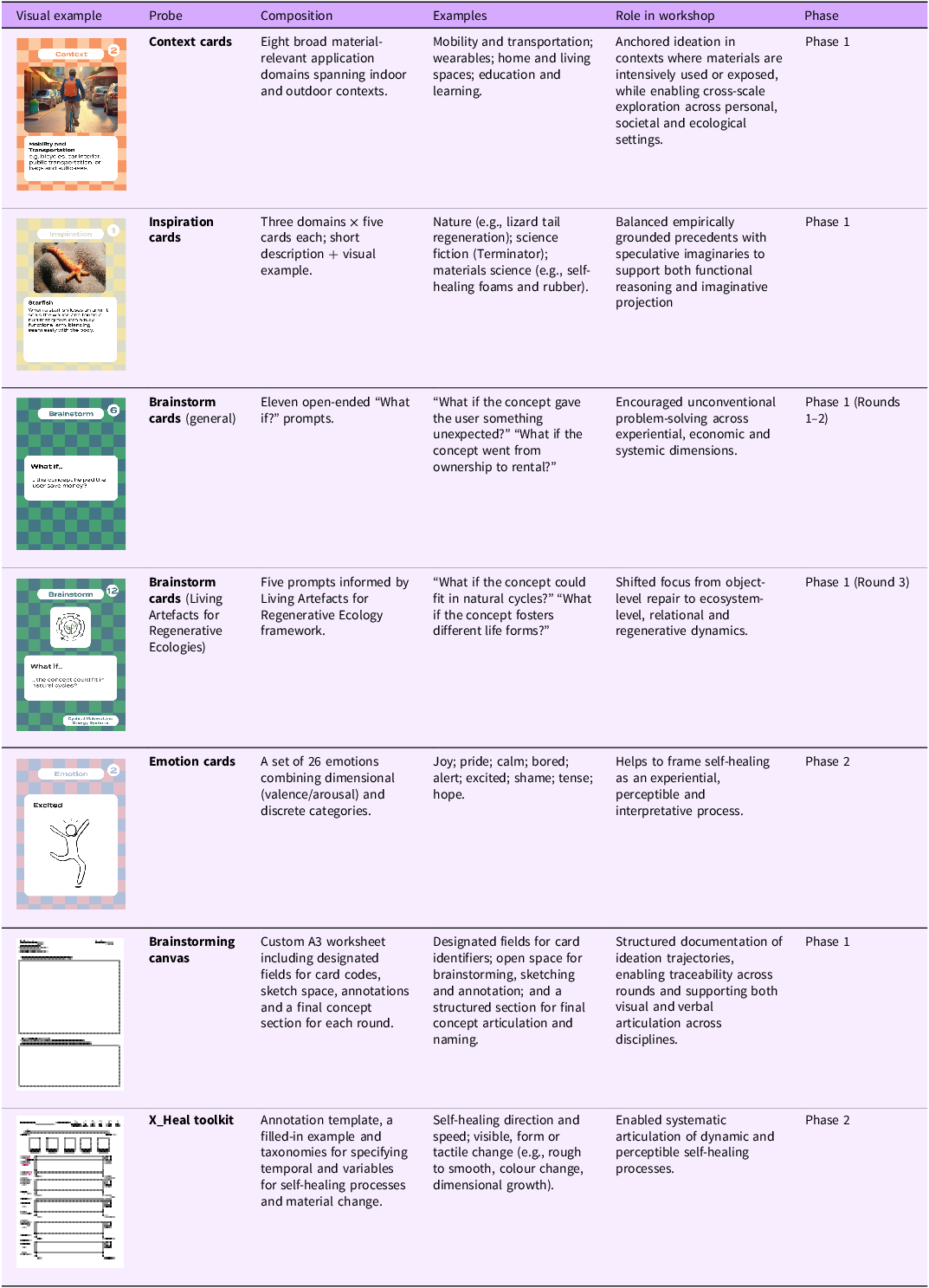
Since not all participants were trained in iterative design or creative brainstorming methods, the workshop incorporated structured probes to support inclusivity, stimulate imagination and facilitate shared understanding across disciplines. Four types of cards were developed: context cards, inspiration cards, brainstorm cards and emotion cards. The design of these probes was informed by literature on co-design, speculative design and design fiction, which use structured prompts to provoke cross-domain associations and challenge existing assumptions (Halskov and Dalsgård Reference Halskov and Dalsgård2006; IDEO 2015; Peters et al. Reference Peters, Loke and Ahmadpour2021; Roy and Warren Reference Roy and Warren2019).
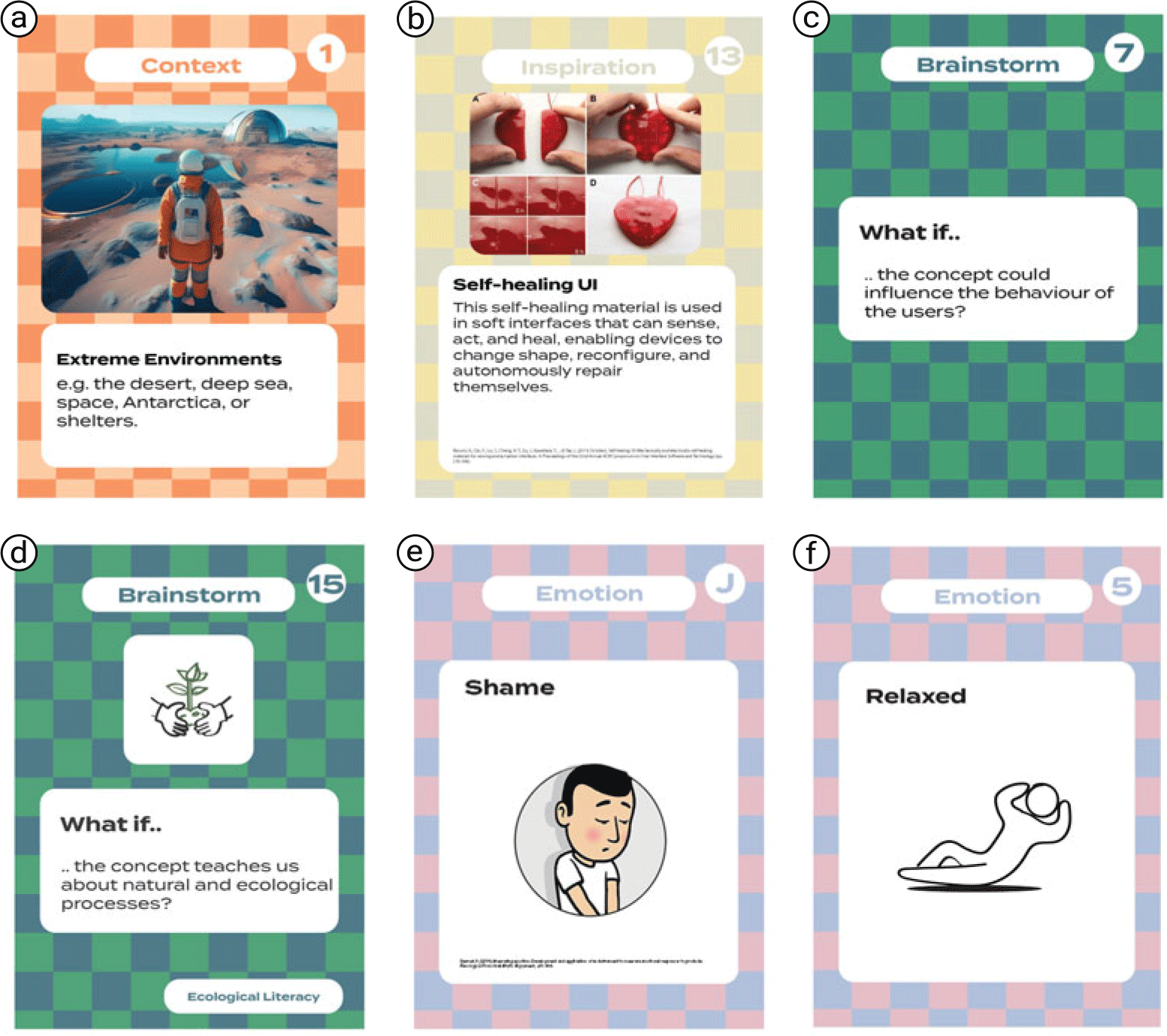
The context cards introduced broad, material-relevant application domains in which materials are intensively used, exposed or embedded in everyday life and infrastructure. The selected domains spanned indoor and outdoor settings, ranging from personal-scale applications (e.g., wearables) to infrastructural contexts (e.g., mobility and transportation) and extreme environments, and were intentionally broad and not exhaustive to stimulate diverse interpretations across personal, societal and ecological scales. Inspiration cards were curated across three domains: nature, science fiction and materials science, each including a short description and visual example to support both functional reasoning and imaginative envisioning. The brainstorm cards consisted of open-ended “What if?” prompts designed to stimulate divergent thinking (Board of Innovation 2026; Peters et al. Reference Peters, Loke and Ahmadpour2021). The eleven prompts used in the first two rounds addressed experiential, configurational and economic dimensions (e.g., surprise, sharing, rental models). In the third ideation round, five prompts informed by the Living Artefacts for Regenerative Ecologies framework (Karana et al. Reference Karana, McQuillan, Rognoli and Giaccardi2023), intentionally shifted the focus from product-level functionality to ecosystem-level, relational and regenerative thinking.
The emotion cards were derived from two complementary affect classification models (Barrett and Russell Reference Barrett and Russell2014; Desmet Reference Desmet2018), combining dimensional accounts of affect (e.g., valence and arousal) with discrete emotion categories (e.g., joy, pride), thereby offering both structured and interpretable emotional framings. Some overlap between categories was intentionally retained to allow interpretative flexibility and enable different groups to explore related affective qualities from distinct angles. The probes were iteratively refined through collaborative discussions among the authors and piloted in a rehearsal session prior to the workshop to assess clarity, timing and usability.
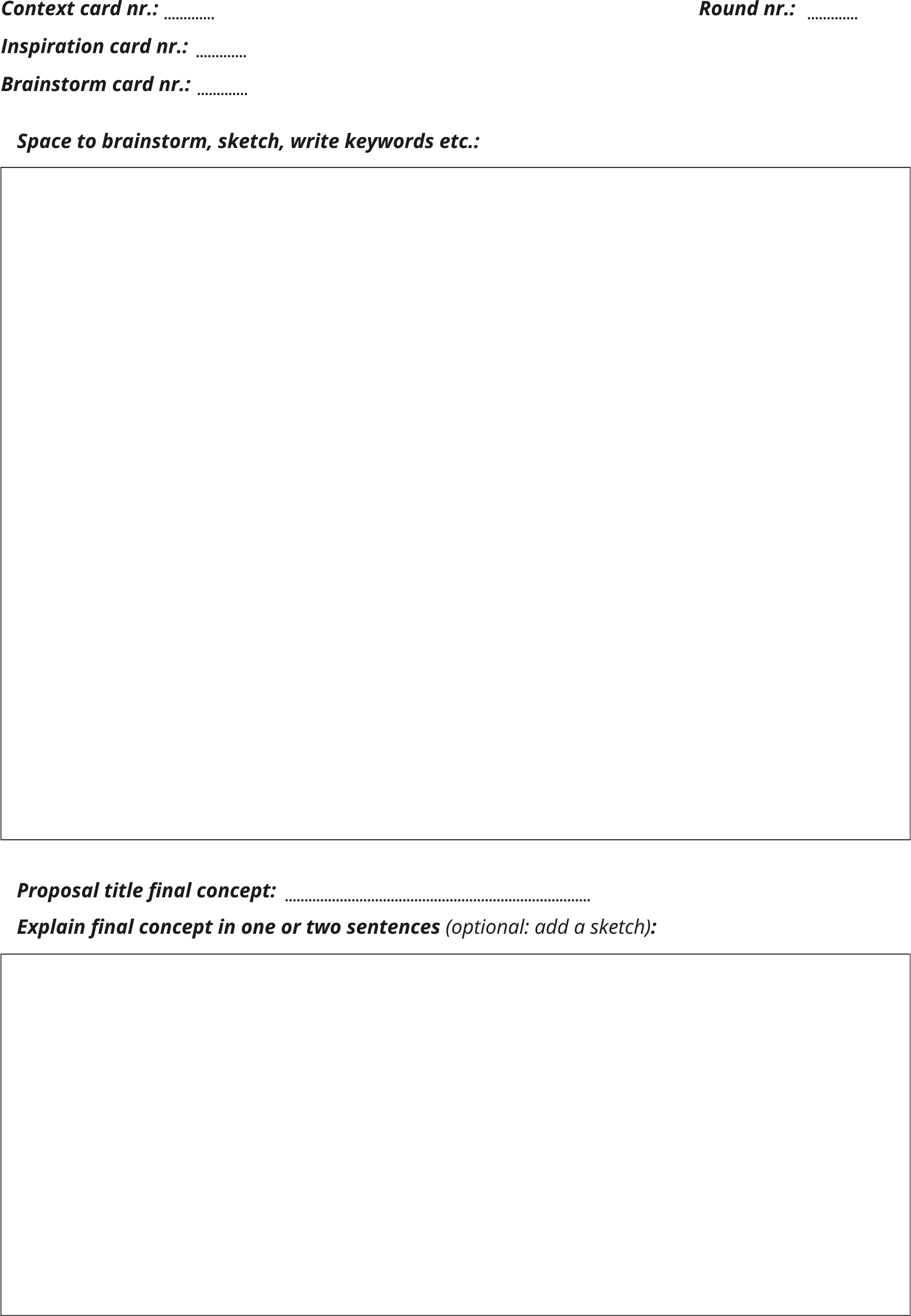
In addition to the cards, a structured A3 brainstorming canvas was developed to scaffold documentation and iterative concept development, supporting visual and verbal articulation across disciplines (Medeiros Leopoldino et al. Reference Medeiros Leopoldino, Aguirre González, de Oliveira Ferreira, de Melo and de Vasconcelos2017). To guide the detailed articulation of self-healing processes, participants used the X_Heal Toolkit, developed in prior design research as a structured framework for analysing and characterising dynamic, temporal self-healing behaviours in living materials (Vekemans et al. Reference Vekemans, Parisi, Zeng, Wu and Karana2025). Before engaging with the toolkit, participants received a brief introduction to its underlying taxonomy and an example application to ensure shared understanding of key variables such as colour, texture, hardness, dimensional change and temporal dynamics. This enabled participants to specify perceptible transformations and healing trajectories in a systematic and comparable manner. An overview of all materials is provided in Table 1. Representative visual examples of the probes are included in Appendix A, and the full set of brainstorm prompts is listed in Appendix B.
Overview of design probes and materials used in the co-design workshop

Table 1. Long description
The table presents seven design probes used throughout the workshop together with visual examples, composition, examples, role, and workshop phase. Visual examples include digital context cards showing application domains, inspiration cards combining images and short descriptions, brainstorm cards containing “What if?” prompts, emotion cards with a sketch of the emotion and the word, a structured brainstorming canvas with spaces for card identifiers, sketches and concept descriptions, and the X_Heal annotation template used to map self-healing processes over time through variables such as colour, texture, dimensional change, direction, and speed. The table explains how each probe supported ideation, reflection, or specification of self-healing behaviours during different workshop phases.
Data collection and analysis
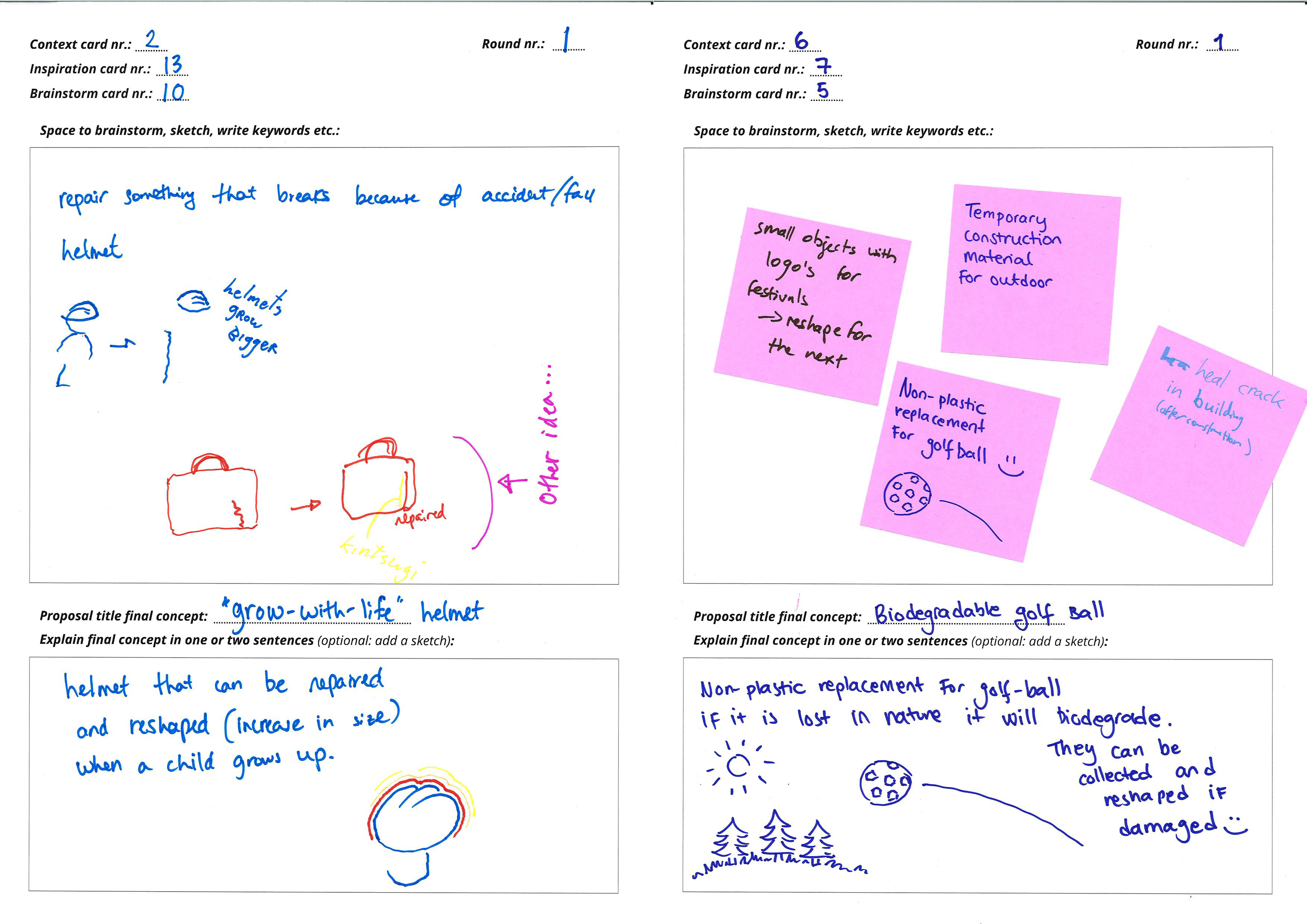
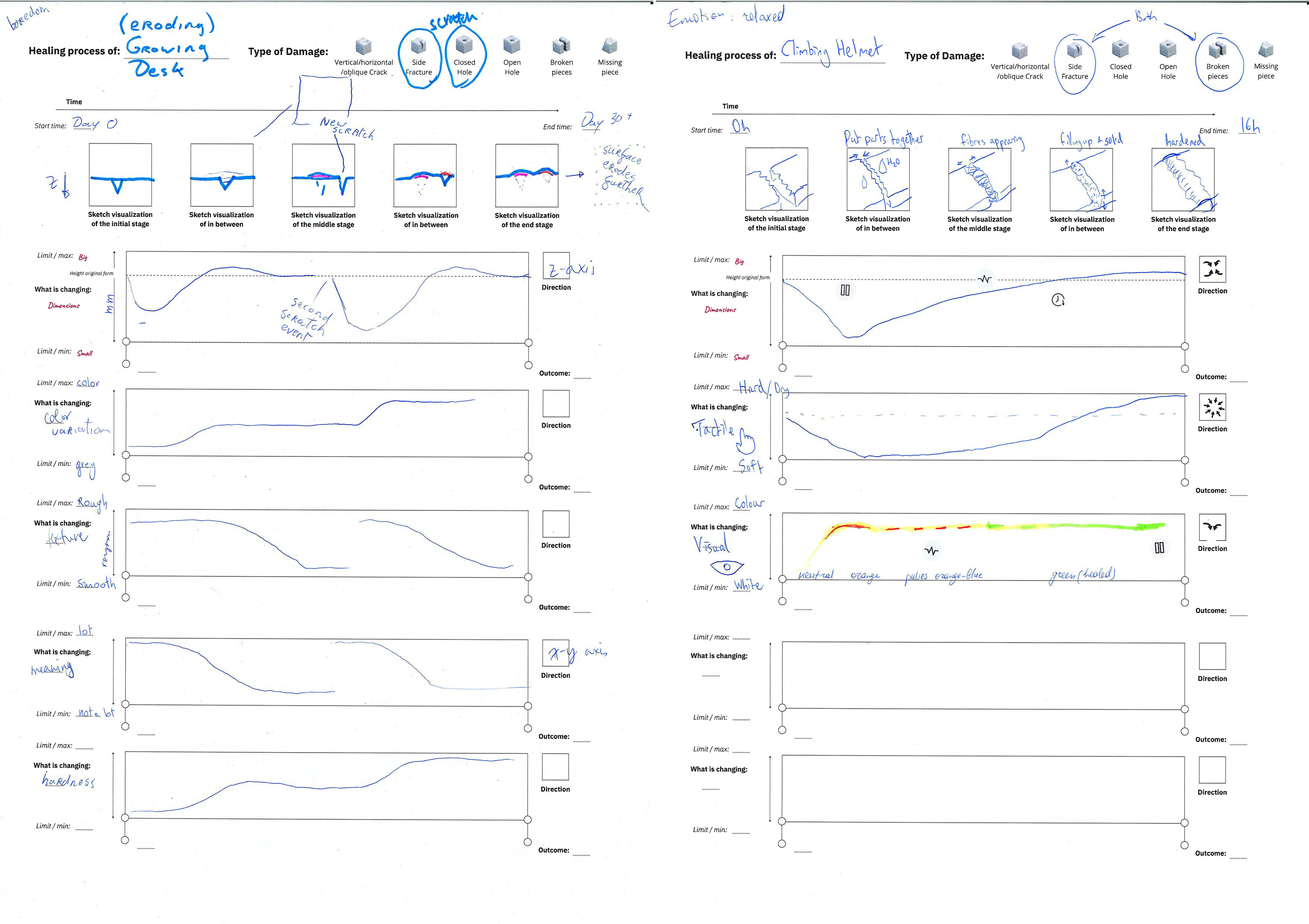
The collected workshop data included brainstorming canvases, X_Heal Toolkit annotation templates, concept sketches and descriptions, as well as transcriptions of team pitches and the final plenary discussion. Figure 2 provides representative examples of completed brainstorming canvases from Round 1 of the workshop, illustrating how participants documented ideas, card combinations and emerging concepts. Figure 3 presents two completed X_Heal Toolkit annotation templates, demonstrating how temporal changes and material variables were specified during the self-healing design phase. Together, these materials comprised visual and verbal representations of participant thinking. A two-part thematic analysis (Braun and Clarke Reference Braun and Clarke2006) was conducted to examine (1) the design modes and orientations that emerged during the workshop and (2) the reasoning participants used about the future implications of self-healing ELMs.
Two filled-in Brainstorming Canvases of two different groups during the co-design workshop, round 1.

Figure 2. Long description
The figure shows two completed A3 brainstorming canvases from different workshop groups. Each canvas contains fields for context, inspiration, and brainstorm card identifiers, spaces for sketching and note-taking, and a section for describing a final concept. Handwritten annotations, sketches, keywords, and concept descriptions illustrate how participants documented and developed ideas during the first ideation round. The examples demonstrate the use of the canvas to structure brainstorming, combine prompts, and record emerging application concepts for self-healing materials.
Two completed X_Heal Annotation Templates from two different groups during the co-design workshop, phase 2.

Figure 3. Long description
The figure presents two completed X_Heal Annotation Templates produced by different workshop groups during Phase 2 of the co-design workshop. Each template is organised around a timeline of a self-healing process and includes fields for describing the type of damage, healing direction, duration, and changes in material properties. Participants documented transformations in variables such as colour, texture, hardness, dimension, and form, together with sketches representing different stages of the healing process. The completed examples illustrate how the template was used to systematically describe and communicate dynamic self-healing behaviours, making temporal and perceptible material changes explicit during concept development.
Application concepts and self-healing processes analysis
The first author conducted a thematic analysis of the concept development and self-healing design phases (Phases 1 and 2). Patterns were identified in the types of problems addressed, envisioned transformations and interpretations of self-healing behaviour. These insights were iteratively clustered into recurring design modes and orientations, supported by visual and textual evidence. The second author contributed to discussions during the clustering and refinement process to ensure thematic clarity and alignment with workshop objectives. Concept visualisations were generated by the first author using an AI image generation model (OpenAI 2026) and iteratively refined through prompt engineering.
Discussion analysis on implications
A separate thematic analysis was conducted of the Phase 3 group discussion, focusing explicitly on the ecological, technical and social, and future-oriented implications of the designed concepts. This analysis was conducted collaboratively by the first author and two co-authors. In the first round, each researcher independently reviewed the full transcript and generated preliminary codes. These codes were then discussed collectively to identify overlaps, resolve interpretive differences and agree on a set of final themes. A second round of refinement was undertaken by the first author in collaboration with the second author, during which codes were consolidated and themes structured into coherent clusters. A final iteration was reviewed with the last author to finalise theme labels and section structure. This multi-stage, collaborative process ensured analytical rigour through investigator triangulation (Carter Reference Carter2014), enabling multiple interpretive lenses to inform the final thematic framework.
Results
Application concepts & self-healing processes
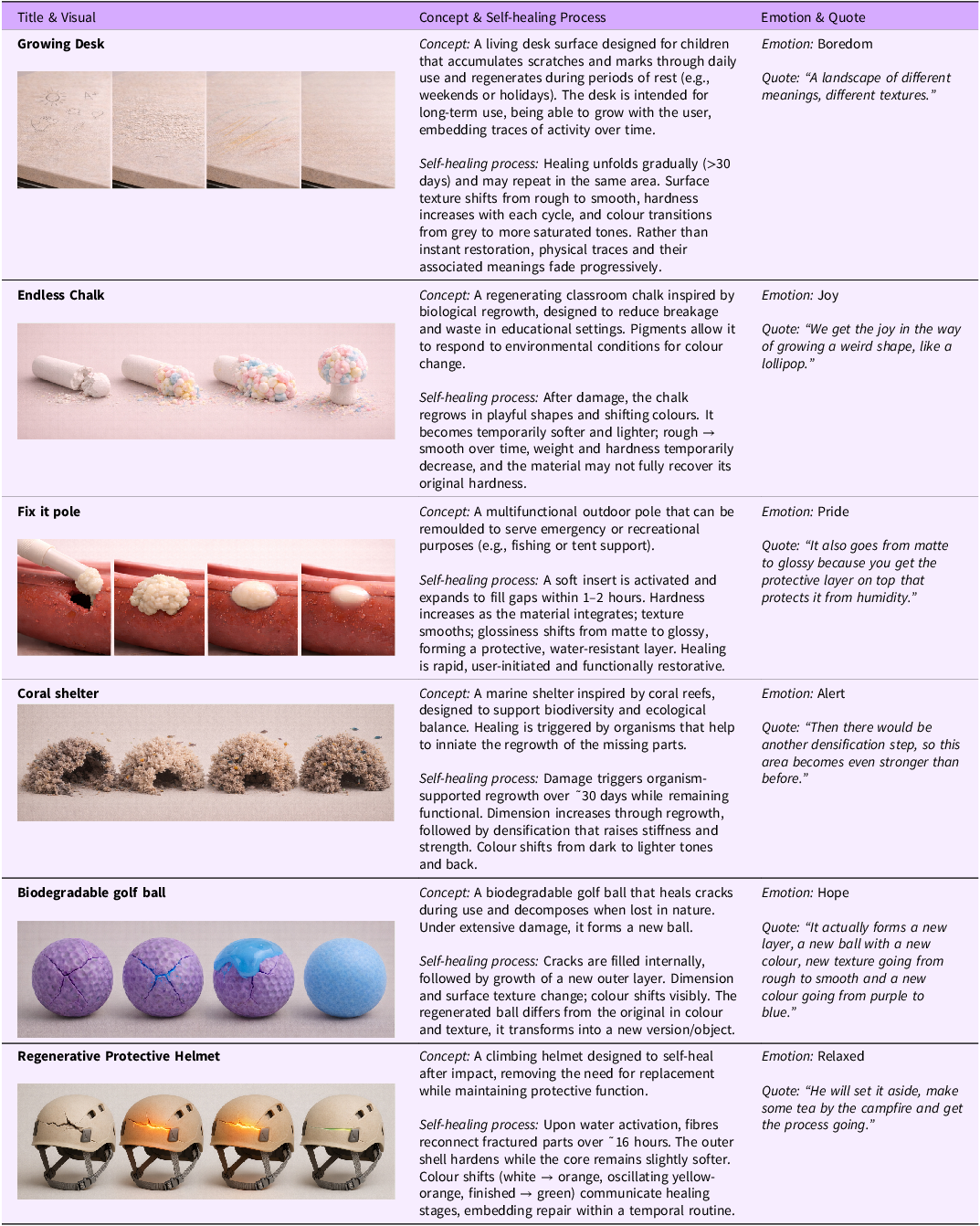
During the workshop, six multidisciplinary teams developed application concepts for the self-healing material BMBC. Across three ideation rounds, each group generated multiple concepts and selected one to further elaborate and present to the plenary. The concept titles were defined by the participants during this process. In the second phase, groups articulated a detailed self-healing process for their selected concept, guided by a chosen emotion as an experiential lens and by an intention to evoke a sense of livingness in the material behaviour. Using the X_Heal annotation template (Vekemans et al. Reference Vekemans, Parisi, Zeng, Wu and Karana2025), they specified temporal dynamics and changing material variables (e.g., colour, texture, hardness, dimension). The resulting six concepts, including their participant-defined titles, articulated self-healing processes, selected emotions and representative participant quotes, are presented in Table 3.
Modes of self-healing across concepts

Table 2. Long description
The table presents six concepts developed during the co-design workshop: Growing Desk, Endless Chalk, Fix it Pole, Coral Shelter, Biodegradable Golf Ball, and Regenerative Protective Helmet. Each row includes an AI-generated visualisation consisting of four sequential images illustrating the proposed application and its self-healing process over time. The table also describes the concept, the envisioned healing behaviour, an associated emotion selected during the workshop, and a representative participant quote. Across the concepts, self-healing is imagined as regeneration, remoulding, biological growth, organism-supported repair, or transformation into a modified state. Healing durations range from hours to more than thirty days and involve changes in colour, texture, hardness, dimension, stiffness, and form. The concepts collectively illustrate different interpretations of self-healing and how it may be experienced, perceived, and integrated into everyday or ecological contexts.
Overview of six concepts and their articulated self-healing processes developed during the co-design workshop. Concept visualisations were generated by the first author using openai_dalle_2026 based on the descriptions of participants

Table 3 Long description
A table titled ‘Overview of six concepts and their articulated self-healing processes’ with three columns: Title & Visual, Concept & Self-healing Process, and Emotion & Quote. The table has six rows, each representing a different concept. Row 1: Growing Desk. Concept involves a living desk surface for children that regenerates during rest periods. Self-healing process takes over 30 days, shifting texture and color. Emotion is Boredom. Quote: ‘A landscape of different meanings, different textures.’ Row 2: Endless Chalk. Concept is a regenerating classroom chalk that reduces breakage. Self-healing process involves regrowth in playful shapes and shifting colors. Emotion is Joy. Quote: ‘We get the joy in the way of growing a weird shape, like a lollipop.’ Row 3: Fix it pole. Concept is a multifunctional outdoor pole for emergency or recreational use. Self-healing process involves a soft insert that expands to fill gaps within 1-2 hours. Emotion is Pride. Quote: ‘It also goes from matte to glossy because you get the protective layer on top that protects it from humidity.’ Row 4: Coral shelter. Concept is a marine shelter inspired by coral reefs to support biodiversity. Self-healing process involves organism-supported regrowth over 30 days. Emotion is Alert. Quote: ‘Then there would be another densification step, so this area becomes even stronger than before.’ Row 5: Biodegradable golf ball. Concept is a biodegradable golf ball that heals cracks and decomposes when lost. Self-healing process involves internal filling of cracks and formation of a new outer layer. Emotion is Hope. Quote: ‘It actually forms a new layer, a new ball with a new color, new texture going from rough to smooth and a new color going from purple to blue.’ Row 6: Regenerative Protective Helmet. Concept is a climbing helmet designed to self-heal after impact. Self-healing process involves fiber reconnection over 16 hours. Emotion is Relaxed. Quote: ‘He will set it aside, make some tea by the campfire and get the process going.’
Modes of self-healing and design orientations
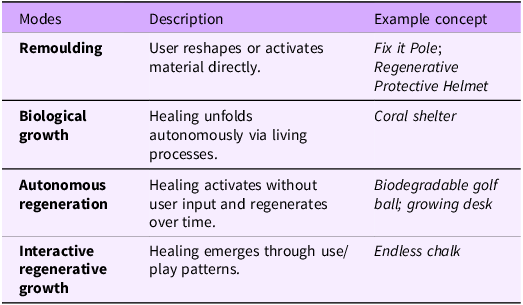
Our analysis revealed that the concepts of participants reflected different modes of self-healing, which varied according to the intended context and application. While not mutually exclusive, these modes structured the form, timing and user-material relationship of the self-healing process. By structuring and analysing variations in concepts and self-healing processes, we identified four modes of self-healing, which are presented in Table 2.
Through thematic analysis, we identified five common design orientations present in both the concepts and self-healing processes. These orientations reflect how participants reasoned about when self-healing occurs, how it unfolds over time, what changes are made visible and how users relate to and intervene in the process.
Tackling material problems through regeneration and replacement
Several concepts were grounded in pragmatic concerns such as durability, waste or environmental degradation. Self-healing was positioned as a functional solution to common material failures, particularly those linked to unsustainable practices or frequent replacement. For example, Endless Chalk addressed chalk breakage and consumption in classrooms, proposing a material that regrows and reduces waste. Biodegradable Golf Ball replaced conventional plastic-based golf balls, offering both biodegradability and self-regeneration. The Regenerative Protective Helmet removed the need to discard protective gear after a single impact, extending its lifespan.
Designing for growth, personalisation and co-evolution
Other concepts foregrounded the capacity of ELMs to grow and change alongside users. In these cases, self-healing was framed as a medium for emotional expression, memory and customisation rather than merely structural repair. The Growing Desk was imagined as evolving over time, retaining traces of use and gradually becoming personalised through interaction. The Regenerative Protective Helmet visualised its healing process through colour shifts, embedding use history into the object and making repair perceptible. The Endless Chalk regenerated in playful forms and changing colours, inviting joyful engagement.
Self-healing as transformation, not just repair
Some groups conceptualised self-healing not as a return to an original state, but as a transformation. Damage was treated as a generative condition, an opportunity for the material to evolve rather than a defect to erase. The Biodegradable Golf Ball, for instance, regenerated into a ball with altered colour and texture, remaining functional but no longer identical to its previous form. The Growing Desk retained and modified scars over time, allowing meaning to persist and gradually shift. In the Coral Shelter, regeneration was followed by densification, resulting in a structure that could become stronger than before.
Cooperative and environmental interactions
In several concepts, self-healing was imagined not as an isolated material response but as a process emerging through interaction with broader systems. Self-healing was situated within ecological, environmental and interspecies dynamics. The Coral Shelter relied on other organisms to germinate spores and regenerate damaged structures, functioning as part of an ecological collective. The Fix It Pole adapted to urgent needs in outdoor contexts, such as canoe repair, responding to environmental circumstances and user intervention. The Growing Desk was envisioned as ageing and adapting in response to its surroundings, including light and environmental conditions. These concepts reframed the material not as a passive object but as an actor embedded within a larger ecology.
Temporalities of self-healing and perceivable change
Across all concepts, self-healing was designed as a temporal process rather than an instantaneous event. Self-healing unfolded over varying durations, from one to two hours (Fix it Pole) to approximately 16 hours (Regenerative Protective Helmet), and up to 30 days (Growing Desk, Coral Shelter). In some cases (Biodegradable Golf Ball, Endless Chalk), duration was left unspecified. Importantly, time was closely synchronised with perceivable material change. Self-healing was rarely imagined as invisible. Instead, participants designed changes in colour, texture, hardness, stiffness or form to communicate different stages of repair. In the Regenerative Protective Helmet, colour oscillations signalled activation and completion. In the Growing Desk, slow smoothing and colour saturation evoked memory and gradual strengthening. The Coral Shelter marked regeneration through densification and chromatic variation. The Biodegradable Golf Ball and Endless Chalk framed healing as transformation, emphasising new layers, altered textures or emergent shapes. In the Fix it Pole, rapid expansion and hardening made the repair visibly functional within an urgent context.
On the anticipated implications of self-healing ELMs
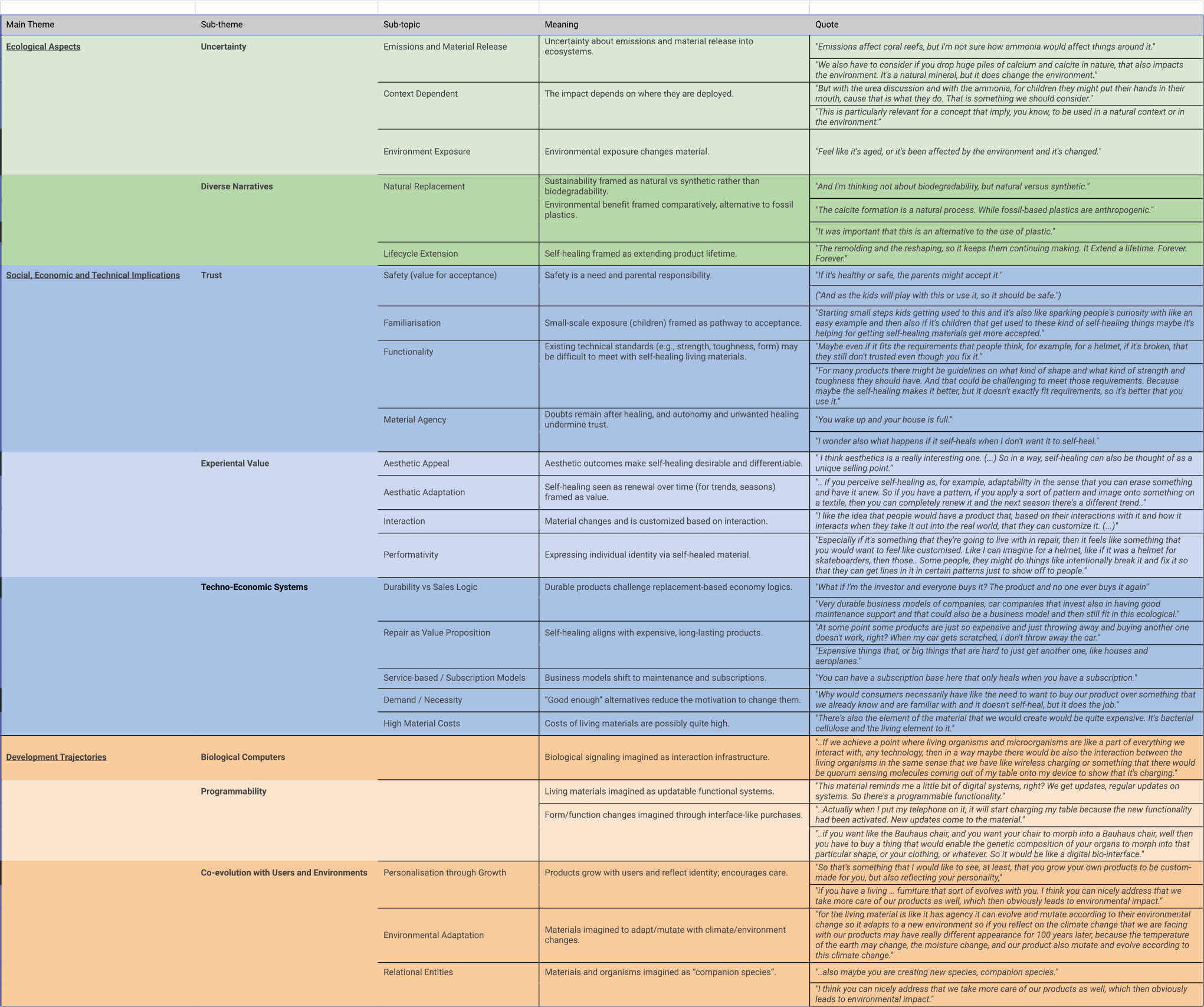
Following the pitches of the design concepts and their associated self-healing processes (Phase 1 and 2), participants engaged in a collective discussion to reflect on the anticipated implications of the proposed applications. Reflections moved fluidly across environmental concerns, social expectations, technical constraints and imagined futures, often addressing multiple dimensions simultaneously. The discussion transcripts were analysed using thematic analysis (Braun and Clarke Reference Braun and Clarke2006), resulting in the identification of three interrelated clusters of implications: (1) Ecological Aspects , (2) Social, Economic and Technical Implications and (3) Development Trajectories for self-healing ELMs . This means the final themes were reframed to reflect cross-cutting patterns in how participants articulated materials experience, systemic considerations and future imaginaries. These clusters reflect recurring concerns, opportunities and speculative directions raised when considering the integration of self-healing ELMs into everyday contexts (see Appendix C for an overview of the thematic analysis table). In the following section, we elaborate on the themes, associated subthemes and subtopics identified through our analysis, situating them within and beyond the context of self-healing ELMs.
Ecological implications of self-healing ELMs
Participants discussed ecological implications primarily through two subthemes: Uncertainty and Diverse narratives.
-
• Uncertainty
A recurring topic was uncertainty about emissions and material release. Participants questioned how substances involved in the self-healing process (e.g., ammonia, calcium, calcite) might interact with ecosystems, especially in sensitive natural contexts, such as the proposed Coral Shelter concept. Ecological uncertainty was further articulated as context-dependent. Participants distinguished between closed, domestic environments and open, natural contexts and discussed how risks might differ across these contexts. Concerns about exposure were particularly salient in scenarios involving children, for example, in relation to the Endless Chalk or Growing Desk concepts, including accidental ingestion or frequent touch. In addition to concerns about emissions, participants also speculated on how environmental exposure might affect the material itself over time. Rather than framing this solely as degradation, some described environmental interaction as a visible and meaningful transformation, for example, when the Regenerative Protective Helmet was imagined to “age” through colour shifts as part of its healing cycle.
-
• Diverse narratives
Alongside uncertainty, participants articulated different narratives for framing sustainability. One common comparison was between the proposed living material and fossil-based plastics, in which participants described BMBC-based concepts as natural replacements and self-healing processes as closer to “natural” ones. Another recurring framing focused on lifecycle extension, in which participants described remoulding and reshaping as mechanisms that enable objects to persist for long periods, thereby reducing material replacement. However, this was often framed as harm reduction rather than ecological regeneration. One participant explicitly noted that the benefit lay not in positive regeneration, but in “the absence of things that are worse.”
Experiential, economic and techno-functional implications
Participants discussed feasibility and acceptance through intertwined considerations rather than separating “social,” “economic,” and “technical” into distinct areas. Three interrelated subthemes were identified: Trust, Experiential value and Techno-economic systems.
-
• Trust
Trust emerged as a foundational condition for the acceptance of self-healing ELMs through our study. Participants consistently framed safety as a requirement, particularly in applications involving children, such as the Growing Desk and Endless Chalk concepts. In these contexts, acceptance was not seen as an individual choice but as a matter of responsibility, with parents as decision-makers. Beyond safety, trust was challenged by uncertainties regarding the reliability of materials after healing. Participants questioned whether repaired or regenerated materials would be trusted to perform as intended, focusing on functionality, especially in safety-critical contexts such as protective equipment, for example, in the Regenerative Protective Helmet or the Fix It Pole when used in emergency repair situations. Even when healing restored form or function, participants suggested that confidence might not be automatically regained. Concerns about trust were further addressed by perceptions of material autonomy and loss of control. Participants expressed discomfort with materials that heal or grow without explicit user intention, raising questions about predictability and material agency. Remarks such as “You wake up, and your house is full” and “What happens if it self-heals when I don’t want it to?” reflect anxieties about unwanted or excessive material behaviour. At the same time, participants identified familiarisation over time as a possible pathway to trust. Exposure through low-risk, everyday contexts, such as classroom use of Endless Chalk, particularly with young children, was framed as a means of normalising self-healing behaviours and gradually building acceptance.
-
• Experiential value
In parallel with concerns about trust, we identified multiple forms of experiential value associated with self-healing ELMs through our study. Aesthetic appeal was highlighted as a key driver of desirability. Rather than being only perceived as a maintenance function, self-healing was framed as a potential unique selling point, capable of differentiating products through aesthetic adaptation, such as visible transformations and regeneration over time, as exemplified by the Regenerative Protective Helmet’s staged colour shifts and the Biodegradable Golf Ball’s transformation into a visibly altered new version. Self-healing was imagined as enabling surfaces or forms to be refreshed, reconfigured or renewed in response to changing preferences, trends or seasons. Interaction and performativity could also play a central role in the appeal of self-healing materials. Damage and repair were not always seen as negative events, but as opportunities for expression and personalisation, for instance in the Regenerative Protective Helmet’s visible healing cycle or the Growing Desk’s gradual transformation of scratches into evolving surface patterns.
-
• Techno-economic systems
Through the reflections, a recurring tension emerged between relationship durability and sales logic. Highly durable, self-healing products could challenge replacement-based economic models. Participants questioned how such products could fit within current market structures and whether people would be willing to invest in a product that everyone buys and no one buys again. At the same time, participants identified contexts in which self-healing aligns with established economic practices. In domains involving expensive or long-lasting products, such as cars, buildings or large equipment, maintenance is already an accepted norm and has repair as a value proposition. In these cases, self-healing can be framed as a logical extension of existing value propositions rather than a disruption. Service-based and subscription models were proposed as one way to combine durability with economic sustainability. Technical feasibility also emerged as a constraint within these discussions. Participants questioned whether there would be demand or necessity for self-healing ELMs, as there are already products made from materials that “do the job.” To that end, high material costs were identified as a concern.
Development trajectories
In the final part of the plenary discussion, participants reflected on how self-healing ELMs and their associated concepts might evolve over the next 20 years. These reflections extended beyond immediate feasibility and focused on possible long-term transformations in how ELMs could function and relate to users and environments. Three subthemes were identified: Biological Computers, Programmability and Co-evolution with Users and Environments.
-
• Biological Computers
Participants envisioned future self-healing ELMs as part of bio-digital or bio-electrical infrastructures, in which biological processes function as communication, sensing or signalling mechanisms. Rather than relying on conventional electronic components, living organisms and microorganisms were imagined as integral to how materials interact with their surroundings and with other devices. In this trajectory, biological signalling, such as quorum sensing or bioluminescence, was described as an alternative mode of interaction comparable to wireless or digital communication systems. Participants speculated about materials that could signal states such as charging, damage or activity through biological responses rather than screens or indicators.
-
• Programmability
A second development trajectory focused on the programmability and upgradability of self-healing ELMs. Participants frequently drew analogies to digital systems, particularly software updates, to describe how living materials might gain new capabilities over time. In this framing, materials were imagined not as static objects, but as systems that could be extended, modified or reconfigured after deployment. Participants described scenarios in which materials receive “updates” that activate new functions, such as sensing, interaction or energy transfer. In some cases, programmability was linked to interface-like mechanisms that allowed users to intentionally trigger changes through external inputs or purchases. For example, participants imagined acquiring specific capabilities that enable materials to morph into different forms or styles, drawing parallels to digital filters or downloadable content.
-
• Co-evolution with Users and Environments
The third development trajectory focused on co-evolution with users and environments. Participants framed materials as having a degree of agency, capable of adapting, mutating or growing over time rather than remaining fixed. At the user level, co-evolution was associated with personalisation through growth. Participants imagined products that grow with users, for example, the Regenerative Protective Helmet, to reflect individual identities and accumulate traces of interaction over time, as illustrated by the Growing Desk. This ongoing adaptation was linked to increased care and emotional attachment, as materials become specific to a person or context rather than interchangeable. At the environmental level, participants extended this idea to climate and ecological change and described material adaptation. Materials were envisioned to adapt their appearance or properties in response to long-term environmental shifts, such as changes in temperature or humidity. In the end, a participant further described living materials as relational entities and reframed the materials as companion species.
Discussion
We discuss the findings through the lens of our three research questions: (1) what future concepts developers envision for self-healing ELMs, (2) what motivations shape these imaginaries and (3) what concerns and opportunities they foresee for integration into everyday contexts. We then reflect on how these findings invite a reframing of “self-healing” within ELM research and reflect on the methodology. In the end, we discuss limitations and directions for future work.
Envisioned futures: how developers imagine self-healing ELMs
Across the six concepts, participants envisioned self-healing ELMs not as a single repair function but as diverse future material roles. In safety-critical applications such as the Regenerative Helmet, healing ensured protective continuity by restoring structural integrity after impact. In the Fix It Pole, self-healing enabled adaptive versatility, allowing the material to shift from soft and mouldable to hard and stable in response to situational demands. Other concepts emphasised transformation rather than strict restoration: both the Growing Desk, the Endless Chalk and the Biodegradable Golf Ball incorporated visible change, altered material qualities or the formation of new layers, suggesting that healing could produce difference rather than return to an original state. In ecological applications such as the Coral Shelter, regeneration was imagined as distributed across organisms and environment, where damaged structures not only regrew but sometimes densified and strengthened within a broader ecosystem. Taken together, these orientations suggest how participants, as developers of ELMs, imagine self-healing less as a technical upgrade and more as a situated capability shaped by context, value systems and intended relationships between materials, humans and broader ecological systems.
At the level of agency, the identified self-healing modes span a spectrum from user-activated remoulding to autonomous biological regeneration and interactive growth. This spectrum aligns with perspectives in materials-oriented (interaction) design that frame materials as active participants in interaction rather than passive substrates (Karana et al. Reference Karana, Barati, Rognoli and Zeeuw Van Der Laan2015a; Parisi and Rognoli Reference Parisi and Rognoli2016; Vallgårda and Redström Reference Vallgårda and Redström2007). The longer-term trajectories further extend these imaginaries towards programmable, bio-digital and co-evolving infrastructures (Breed et al. Reference Breed, Karana, Bozzon and Song2026; Rotondi Reference Rotondi2023; Tang et al. Reference Tang, An, Huang, Vasikaran, Wang, Jiang, Lu and Zhong2021; Walther Reference Walther2020). Together, these findings suggest that participants imagine self-healing ELMs as future-facing material systems that reframe how durability, interaction and environmental participation are understood (An et al. Reference An, Wang, Huang, Wang, Liu, Xun, Church, Dai, Yi and Tang2022; Elsacker et al. Reference Elsacker, Zhang and Dade-Robertson2023; Nguyen et al. Reference Nguyen, Courchesne, Duraj-Thatte, Praveschotinunt and Joshi2018).
Motivations behind imagineries
The futures imagined by participants were shaped by three recurring motivations: resource continuity, experiential meaning-making and relational embedding. First, self-healing was framed as a response to disposability and material waste, positioning durability and lifecycle extension as central values. Sustainability, however, was not assumed to be inherent. Ecological benefits were treated as conditional and context-dependent, aligning with calls for lifecycle-oriented and Safe and Sustainable by Design approaches (Cassee et al. Reference Cassee, Bleeker, Durand, Exner, Falk, Friedrichs, Heunisch, Himly, Hofer and Hofstätter2024; Salieri et al. Reference Salieri, Barruetabeña, Rodrguez-Llopis, Jacobsen, Manier, Trouiller, Chapon, Hadrup, Jiménez and Micheletti2021; Subramanian et al. Reference Subramanian, Peijnenburg, Vijver, Blanco, Cucurachi and Guinée2023). Second, self-healing was often designed to be perceptible and expressive. Rather than concealing repair, participants staged visible transformations, scars and colour shifts, suggesting that living material change can function as a meaningful trace of interaction, as earlier motivated by Groutars et al. (Reference Groutars, Risseeuw, Ingham, Hamidjaja, Elkhuizen, Pont and Karana2022) with the concept of living traces with Flavobacteria. This resonates with material traces perspectives in design research, where wear and transformation become inscriptions of use rather than defects (Gill and Lopes Reference Gill and Lopes2011; Lilley et al. Reference Lilley, Bridgens, Davies and Holstov2019; Rosner et al. Reference Rosner, Ikemiya, Kim and Koch2013). Third, self-healing was embedded within ecological and more-than-human relations, particularly in concepts that distributed regeneration across organisms and environments. This resonates with recent approaches in biodesign that foreground multispecies orientations, ecological sensibilities and inclusive modes of thinking when designing with living organisms (Bell et al. Reference Bell, Coffie and Alistar2024; Groutars et al. Reference Groutars, Kim and Karana2024; Ikeya et al. Reference Ikeya, Wakkary and Barati2023; Kim et al. Reference Kim, Zeng, Ellis and Karana2024; Zhou et al. Reference Zhou, Doubrovski, Giaccardi and Karana2024). These layered motivations indicate that imaginaries of developers are shaped not only by technological novelty but also by values of durability, expressiveness and inclusivity.
Concerns, conditions and systemic tensions
Alongside these motivations, participants articulated anticipated concerns and systemic conditions shaping the feasibility of self-healing ELMs. Three interrelated challenges emerged: trust and legibility, ecological uncertainty and techno-economic alignment. Trust was foundational. Participants questioned safety, reliability after healing and unwanted autonomy, suggesting that self-healing must operate as a communicative process as much as a mechanical one. Visible and staged healing, therefore, becomes not only expressive but necessary for interpretability and accountability. Ecological sustainability was similarly treated as conditional rather than guaranteed. Participants critically questioned emissions, exposure and deployment contexts, indicating that “naturalness” does not equate to harmlessness (An et al. Reference An, Wang, Huang, Wang, Liu, Xun, Church, Dai, Yi and Tang2022; Ebbesen et al. Reference Ebbesen, Korvink, Islam and Lantada2024). At the economic level, durability was recognised as potentially disruptive to replacement-driven business models, prompting speculation about service and stewardship-oriented alternatives (Bocken and Short Reference Bocken and Short2016; Han et al. Reference Han, Heshmati and Rashidghalam2020). These concerns were not framed as reasons to reject self-healing, but as systemic conditions that must be addressed. Participants identified opportunities in durability, new experiential engagements and ecological regeneration imaginaries, yet their realisation depends on governance structures, lifecycle assessment and economic models capable of supporting long-term material relationships.
Rethinking self-healing in ELMs
A key contribution of this study is demonstrating that, in early-stage multidisciplinary exploration, self-healing is not treated as a stable engineering category but as a design space. Rather than being defined solely by mechanical recovery or biological functionality, self-healing was articulated through (1) configurations of agency, (2) temporal and perceptible material change and (3) relational and systemic embedding. In this framing, self-healing shifts from hidden restoration to staged regeneration, in which transformation becomes intertwined with interpretation, care and responsibility. The Regenerative Protective Helmet illustrates this shift particularly clearly. Healing was designed as a 16-hour colour oscillation embedded within a camping routine, transforming repair into an experiential event. Rather than merely returning the helmet to its prior state, the process produced visible anticipation and meaning. This resonates with Living Artefacts that conceptualise living materials as evolving artefacts embedded in experiential and ecological relations (Karana et al. Reference Karana, Barati and Giaccardi2020; Karana et al. Reference Karana, McQuillan, Rognoli and Giaccardi2023). In this study, these insights are articulated as descriptive patterns and emerging design orientations derived from the workshop, rather than as a formalised framework or validated taxonomy.
Much ELM research has emphasised performance optimisation, which often treats self-healing as a measurable return to a predefined original state. From an ELM development perspective, our study implies that evaluation cannot remain limited to mechanical recovery metrics alone. Legibility, acceptable autonomy, experiential coherence and contextual sustainability emerge as equally relevant dimensions. This reframing shifts self-healing from a performance indicator to an interactional and systemic design question. For ELM research and development, this motivates earlier integration of design-led exploration alongside laboratory optimisation.
Reflection on our methodology
Beyond generating application concepts, the co-design workshop positioned materials experience itself as a site of inquiry. By requiring participants to specify how self-healing unfolds, its duration, visibility, colour changes and tactile changes, the process foregrounded perceptual and temporal qualities as primary design variables rather than secondary effects. The discussion, therefore, shifted from “Can the material heal itself?” to “How is self-healing perceived, interpreted, and trusted?”. The use of emotion cards and the X_Heal Annotation Template (Reference Vekemans, Parisi, Zeng, Wu and KaranaVekemans et al. 2025) structured this process. As a result, colour oscillations, hardening phases and scar retention were not incidental details but became central to later discussions on trust, agency and desirability. This means that experiential ideation functioned as an anticipatory method, surfacing social, ecological and systemic implications before technical pathways stabilised. The inclusion of Living Artefacts for Regenerative Ecologies brainstorm cards encouraged participants to consider the environmental and relational dimensions of self-healing. This enriched sustainability-oriented reflections and illustrates how methodological scaffolding can orient co-design discussions towards particular thematic directions. In this sense, the workshop highlights both the generative and formative role of structured probes in shaping how emerging materials are imagined and framed.
Limitations and future work
This study has several limitations that should be taken into consideration when interpreting the findings. Participants engaged with physical samples of the material. However, the self-healing mechanism itself was still under development and could not be demonstrated during the workshop. As a result, self-healing processes were envisioned based on projected capabilities rather than direct observation. Furthermore, the study focused on a single emerging material (self-healing BMBC). While this enabled in-depth exploration, other ELMs may exhibit different behaviours, constraints, governance challenges or ethical considerations. Replicating similar co-design approaches across diverse ELMs would clarify whether comparable design orientations and implication patterns emerge, or whether imaginaries vary substantially across biological platforms.
The workshop was deliberately designed to address multiple dimensions of implications simultaneously, including ecological, experiential and socio-economic. Although this breadth enabled a holistic exploration, it limited the depth with which any single dimension could be examined. Future research could therefore adopt a more focused lens, for example, investigating affective and trust dynamics in detail (Intemann et al. Reference Intemann, Lavoie, Elsass, Scott and Gerlach2025; Moreira et al. Reference Moreira, Marshall and Staykova2023), analysing techno-economic feasibility and governance structures (Heveran et al. Reference Heveran, Gerlach, Hernandez, Intemann, Meyer, Ajo-Franklin, Charrier, Srubar, Joshi and Nelson2024; Srubar Reference Srubar2021) or conducting lifecycle and environmental assessments tailored to specific material systems (Aleixandre et al. Reference Aleixandre, Shrikrishnan, Dalby and Salmeron-Sanchez2021; An et al. Reference An, Wang, Huang, Wang, Liu, Xun, Church, Dai, Yi and Tang2022). Such targeted investigations may generate more granular insights into particular dimensions of ELM integration.
The use of structured prompts, including inspiration cards, emotion cards and regenerative ecology stimuli cards, supported multidisciplinary dialogue and surfaced cross-cutting considerations. At the same time, such scaffolding may have shaped the direction of discussion, foregrounding certain themes while potentially constraining others. Iterative refinement of these tools, or comparison with less-structured ideation formats, would help assess how methodological framing influences emerging imaginaries.
Finally, while concerns regarding the ethical and regulatory aspects of ELMs have been highlighted in the related literature, this study did not systematically examine these dimensions. Future work should integrate inquiry into these dimensions to better understand pathways towards responsible development and long-term integration of ELMs.
Conclusion
ELMs are moving from laboratory innovation towards everyday life integration, bringing not only new technical capabilities but also new societal questions. While much research on ELMs focuses on performance optimisation, this study examined how ELM developers engage with and reflects on the implications of emerging self-healing ELMs before their applications and trajectories become fixed. Our findings through a multidisciplinary co-design workshop frame self-healing as more than functional repair: it is a visible, temporal and relational process. A process that transforms objects, leaves traces and invites interaction. The future concepts revealed recurring orientations around regeneration, co-evolution, environmental embedding and perceptible change. Further discussions of implications showed that concerns about trust, safety, economic logic and ecological responsibility were equally significant as technical considerations. These findings suggest that integrating living behaviour reconfigures how materials are interpreted and evaluated. As ELMs become more autonomous and adaptive, questions of agency, control and meaning become central to their development. Supporting responsible and context-dependent ELM innovation may therefore require not only advances in biofabrication, but also sustained engagement with design and collective reflection.
Data availability statement
All raw data from the workshop is available upon request. The context cards, inspiration cards, brainstorm cards, emotion cards and brainstorming canvas are available here: https://www.regenerativematerialecologies.com/self-healing-tools. The X_Heal Toolkit is available here: https://www.regenerativematerialecologies.com/xheal-toolkit.
Acknowledgements
This work was conducted as part of the NextSkins project. We gratefully acknowledge the members of the NextSkins and Fungateria for enabling the interdisciplinary collaboration that made this workshop possible. We thank the members of the Centre of Design Research for Regenerative Material Ecologies (DREAM) at the Faculty of Industrial Design Engineering, TU Delft, for their valuable feedback and support. Special thanks to Fanzhe Zeng for assistance during the co-design workshop. We also sincerely thank all participants for their time, insights and thoughtful engagement.
Author contributions
Conceptualisation: V. Vekemans, E. Karana and S. Parisi. Data curation: V. Vekemans and S. Parisi. Formal analysis: V. Vekemans. Investigation: V. Vekemans. Methodology: V. Vekemans, E. Karana and S. Parisi. Project administration: E. Karana. Resources: E. Karana. Supervision: E. Karana, S. Parisi and J. Wu. Visualisation: V. Vekemans. Writing original draft: V. Vekemans. Writing review & editing: All authors.
Financial support
This research was funded by the European Union’s Horizon Europe research and innovation programme under Grant Agreement No. 101071159 (NextSkins project).
Competing interests
The authors declare no competing interests.
Ethical standards
This study was conducted in accordance with institutional ethical guidelines. All participants provided informed consent prior to participation.
Appendix
Appendix A. Examples of workshop probes
This appendix provides representative examples of the workshop probes used during the co-design session. The probes were designed to structure ideation, stimulate cross-domain associations and support systematic articulation of self-healing behaviours. The full set of prompts is provided in Appendix B.
Representative examples of the workshop probes. From left to right and top to bottom: (a) context card, (b) inspiration card (material science), (c) brainstorm card (general), (d) brainstorm card (regenerative ecologies), (e) emotion card (Barrett and Russell Reference Barrett and Russell2014) and (f) emotion card (Desmet Reference Desmet2018).

Figure A1. Long description
Figure group showing six representative workshop probes used during the co-design workshop. The probes include a context card, an inspiration card, two types of brainstorm cards, and two emotion cards. Together they illustrate the materials used to stimulate ideation, reflection, and discussion across disciplinary backgrounds.
Blank brainstorming canvas used to document card combinations, sketches and evolving concepts during each ideation round.

Figure A2. Long description
A structured A3 brainstorming worksheet used during the co-design workshop. The canvas contains designated fields for recording context, inspiration, and brainstorm card identifiers, open areas for sketching and note-taking, and a section for describing and naming a final concept. The template was used to document ideas and concept development during each ideation round and to support collaboration across disciplinary backgrounds.
Appendix B. Full prompt list brainstorm cards
This appendix presents the complete set of “What if?” prompts used during the co-design workshop. The prompts were designed to stimulate divergent thinking and encourage alternative framings of repair, transformation and material behaviour. General prompts were used in Rounds 1–2. In Round 3, prompts informed by the Living Artefacts for Regenerative Ecologies framework (Karana et al. Reference Karana, McQuillan, Rognoli and Giaccardi2023) were introduced to foreground ecological and relational dimensions of self-healing materials.
B1. General prompts (Rounds 1–2)
-
1. What if. the concept gave the user something unexpected?
-
2. What if. the concept can be moved to different locations?
-
3. What if. the concept offers full customisation?
-
4. What if. the concept could be shared?
-
5. What if. the concept went from ownership to rentals?
-
6. What if. the concept helped the user save money?
-
7. What if. the concept could be influenced the behaviour of the users?
-
8. What if. the only driver to buy the concept was sustainability?
-
9. What if. the concept had no limits in cost or technology?
-
10. What if. the concept could bring joy?
-
11. What if. the concept could solve a problem in a unique way?
B2. Regenerative Ecologies Prompts (Round 3)
-
12. What if. the concept could fit in natural cycles? (Cyclical Material and Energy Systems)
-
13. What if. the concept fosters different life forms? (Biodiversity)
-
14. What if. the concept creates awareness and collaboration with other organisms? (More-than-human Sensibilities)
-
15. What if. the concept teaches us about natural and ecological processes? (Ecological Literacy)
-
16. What if. the concept inspire
Appendix C. Thematic Analysis Overview
This appendix provides an overview of the final thematic framework derived from the analysis of workshop materials and group discussion transcripts. Themes were iteratively developed through investigator triangulation and clustered around recurring patterns in future imaginaries, motivations and integration concerns.
Thematic Analysis framework with main themes, subthemes, subtopics and illustrative quotes.

Figure C1. Long description
Diagram summarising the thematic analysis of workshop discussions. The framework is organised hierarchically, linking main themes to associated subthemes, subtopics, and representative participant quotes. The three main themes are Ecological aspects, Social, economic and technological implications, and Development trajectories. Together, the framework illustrates how participant reflections were organised into interconnected concerns, opportunities, and future imaginaries surrounding self-healing engineered living materials.

 Open access

