Externalizing problems include aggression, impulsivity, and other overt symptoms that characterize child psychopathology such as attention-deficit/hyperactivity and conduct disorders (Hinshaw, Reference Hinshaw2002). Externalizing problems in toddlerhood and preschool are robust predictors of more severe adjustment problems in the school-age years (Campbell, Shaw, & Gilliom, Reference Campbell, Shaw and Gilliom2000). However, most young children who show elevated levels of disruptive behavior do not progress to more serious and pervasive forms of maladjustment (Olson, Sameroff, Kerr, & Lunkenheimer, Reference Olson, Sameroff, Kerr, Lunkenheimer, Olson and Sameroff2009). Understanding risk processes that exacerbate early onset problems is an issue of great theoretical and practical importance. In this prospective longitudinal study, we highlight three risk constructs associated with the growth of early externalizing behavior: heightened levels of maternal distress, suboptimal levels of mothers’ inductive discipline and warmth, and deficits in child effortful control. In what follows, we briefly discuss each construct in relation to the progression of children's early externalizing behavior. Afterward, we address gaps in research by proposing an integrative model (see Figure 1) that examines how these risk factors operate together during the preschool years to contribute to later externalizing behavior.
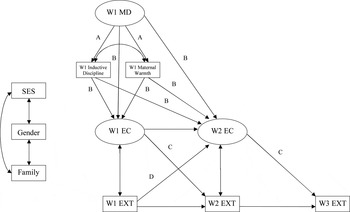
Integrative model of maternal distress, inductive discipline, maternal warmth, and child EC and externalizing behavior. SES, Socioeconomic status; Gender, Child gender (boys = 0, girls = 1); Family, number of parents in household; W1, Wave 1, age 3; W2, Wave 2, age 6; W3, Wave 3, age 10; MD, maternal distress; SES, socioeconomic status; EC, effect of control; EXT, externalizing behavior. Paths of covariates and latent factors indicators are not shown.

Heightened Maternal Distress
Heightened levels of maternal emotional distress disrupt mother–child interactions and contribute to a range of children's adjustment problems (Du Rocher Schudlich & Cummings, Reference Du Rocher Schudlich and Cummings2007; Elgar, Mills, McGrath, Waschbusch, & Brownridge, Reference Elgar, Mills, McGrath, Waschbusch and Brownridge2007; Munson, McMahon, & Spieker, Reference Munson, McMahon and Spieker2001). Maternal distress predicts elevated externalizing behavior in clinical and community samples of children and adolescents (e.g., Chronis et al., Reference Chronis, Lahey, Pelham, Williams, Baumann and Kipp2007; Cummings, Keller, & Davies, Reference Cummings, Keller and Davies2005; Gartstein & Fagot, Reference Gartstein and Fagot2003; Weinfield, Ingerski, & Moreau, Reference Weinfield, Ingerski and Moreau2009). Young children exposed to elevated maternal distress are at greatest risk of externalizing problems because of their dependence on caregivers and their greater likelihood of experiencing compromised parenting (Beardslee, Bemporad, Keller, and Klerman, Reference Beardslee, Bemporad, Keller and Klerman1983; Connell & Goodman, Reference Connell and Goodman2002; Cummings & Davies, Reference Cummings and Davies1994; Lovejoy, Graczyk, O'Hare, & Neuman, Reference Lovejoy, Graczyk, O'Hare and Neuman2000). Heightened distress exacerbates maternal caregiving pivotal to children's behavioral adjustment, thus contributing to self-regulatory difficulties and externalizing problems (Berg-Nielsen, Vikan, & Dahl, Reference Berg-Nielsen, Vikan and Dahl2002; Kochanska, Murray, & Harlan, Reference Kochanska, Murray and Harlan2000; Lovejoy et al., Reference Lovejoy, Graczyk, O'Hare and Neuman2000; Spinrad et al., Reference Spinrad, Eisenberg, Gaertner, Popp, Smith and Kupfer2007). However, relatively few studies with a developmental perspective examine underlying mechanisms of maternal distress that influence growth of adjustment problems in young children (Connell & Goodman, Reference Connell and Goodman2002). Longitudinal research integrating study of parenting and child self-regulation can clarify processes through which early maternal distress contributes to later externalizing problems. Next, we turn the discussion to qualities of early parenting that transmit adverse effects of maternal distress on children's emerging self-regulatory competence and subsequent externalizing behavior.
Maternal Distress and Suboptimal Levels of Inductive Discipline and Warmth
Mothers who experience heightened emotional distress tend to show more disengaged or actively negative parenting and less positive parenting vis-à-vis their young children (Lovejoy et al., Reference Lovejoy, Graczyk, O'Hare and Neuman2000). These patterns of parenting associated with maternal distress hinder gains in young children's self-regulation that often coincide with, and are a direct result of, mothers’ expanding efforts to socialize children from primarily rules about safety to social conventions and autonomous behavior (Gralinski & Kopp, Reference Gralinski and Kopp1993). For example, mothers reporting elevated levels of distress were observed as being more negative, intrusive, and hostile toward toddlers’ attempts at autonomy and social behavior, and less sensitive and responsive in their face-to-face interactions (Campbell et al., Reference Campbell, Brownell, Hungerford, Spieker, Mohan and Blessing2004). Active guidance and support provided by sensitive caregivers promote optimal growth of self-regulation in young children who lack competency to independently modulate their attention, emotion, and behavior (Eisenberg et al., Reference Eisenberg, Zhou, Spinrad, Valiente, Fabes and Liew2005; Kochanska et al., Reference Kochanska, Murray and Harlan2000; Sameroff, Reference Sameroff2009; Sroufe, Duggal, Weinfield, & Carlson, Reference Sroufe, Duggal, Weinfield, Carlson, Sameroff, Lewis and Miller2000). In contrast, less sensitive and responsive parenting increases children's risk for self-regulatory difficulties that are associated with school-age externalizing problems (Deater-Deckard, Dodge, Bates, & Pettit, Reference Deater-Deckard, Dodge, Bates and Pettit1998; Rothbaum & Weisz, Reference Rothbaum and Weisz1994). Elevated maternal distress may contribute to children developing poor self-regulation and more subsequent externalizing behavior by compromising positive aspects of early parenting essential to their behavioral adjustment.
Parental discipline is an important domain of parenting associated with maternal distress and child adjustment (Gershoff, Reference Gershoff2002; Lovejoy et al., Reference Lovejoy, Graczyk, O'Hare and Neuman2000). Distressed mothers tend to use fewer discipline techniques that help children internalize adaptive strategies for self-regulation, but most studies of maternal discipline and distress focus on physical punishment (Cummings & Davies, Reference Cummings and Davies1994; Huang, Caughy, Lee, Miller, & Genevro, Reference Huang, Caughy, Lee, Miller and Genevro2009). For example, mothers who are distressed often rely on power assertive techniques like spanking when responding to children's disruptive behaviors, which often exacerbate externalizing problems (Berg-Nielsen et al., Reference Berg-Nielsen, Vikan and Dahl2002; Downey & Coyne, Reference Downey and Coyne1990; Gershoff, Reference Gershoff2002). In contrast, inductive discipline provides young children with external support to refrain from externalizing behavior in lieu of prosocial alternatives (Hart, DeWolf, Wozniak, & Burts, Reference Hart, DeWolf, Wozniak and Burts1992; Pettit, Bates, & Dodge, Reference Pettit, Bates and Dodge1997). Inductive discipline involves use of limits setting, explanation of consequences, and reasoning to elicit understanding from children about proper conduct (Hart et al., Reference Hart, DeWolf, Wozniak and Burts1992). These behaviors permit caregivers to serve as external regulators of young children's behavioral adjustment as a means of helping them learn to inhibit disruptive behaviors. Thus, limited use of inductive discipline may serve a salient role mediating the effect of maternal distress on child self-regulation.
We found no studies examining relations between maternal distress and inductive discipline, but maternal distress is linked with ineffective scaffolding of young children's performance on laboratory tasks (Hoffman, Crnic, & Baker, Reference Hoffman, Crnic and Baker2006). Although scaffolding is distinct from inductive discipline in that the latter is discipline oriented, both constructs contribute to children's internalization of rules for conduct (Pettit et al., Reference Pettit, Bates and Dodge1997). An essential feature of a child's socialization is the “zone of proximal development,” an internal developmental process that represents the distance between a child's independent ability and a higher level of performance achieved with adult guidance (Vygotsky, l978). Vygotsky posited that mental processes developed from external support become internalized over time through repeated exposure. Young children who encounter fewer opportunities to internalize regulatory strategies from mothers, via reasoning and explanations, likely develop smaller gains in self-regulation, which further compromises their ability to attend to and learn from inductive discipline techniques (Kopp, Reference Kopp, Skinner and Zimmer-Gembeck2009). Moreover, inductive discipline strategies that accompany responsive, sensitive caregiving encourage children to cooperate with maternal requests (Kochanska & Aksan, Reference Kochanska and Aksan2006). Thus, use of inductive discipline helps orient children's attention to rules, motivates them to follow maternal requests, and socializes their self-regulatory abilities. However, no studies have examined infrequent use of inductive discipline as a risk mechanism underlying adverse effects of maternal distress on children's behavioral adjustment.
Suboptimal levels of maternal warmth may also transmit negative effects of maternal distress on children's behavioral adjustment. Maternal warmth is defined as parenting that is nurturing, supportive, reassuring, and emotionally sensitive to children's needs (e.g., Berg-Nielsen et al., Reference Berg-Nielsen, Vikan and Dahl2002). Maternal warmth provides young children social–emotional resources that lower their negative arousal and reactivity to stress, which puts them in states that are easier to self-regulate (Sroufe et al., Reference Sroufe, Duggal, Weinfield, Carlson, Sameroff, Lewis and Miller2000). Children who experience warm parenting demonstrate decreases in stress reactivity from infancy to later childhood, whereas unsupported children continue showing more acute stress responses (Kopp, Reference Kopp, Skinner and Zimmer-Gembeck2009). In addition, mothers who demonstrate sufficient warmth model effective emotion regulation that can be internalized in young children (Feng et al., Reference Feng, Shaw, Kovacs, Lane, O'Rourke and Alarcon2008; Kopp, Reference Kopp, Skinner and Zimmer-Gembeck2009). Consistently high levels of maternal warmth are linked with fewer externalizing problems in early childhood (Eisenberg et al., Reference Eisenberg, Zhou, Spinrad, Valiente, Fabes and Liew2005; Olson, Sameroff, Kerr, Lopez, & Wellman, Reference Olson, Sameroff, Kerr, Lopez and Wellman2005). Conversely, low maternal warmth describes parenting that is insensitive to and unsupportive of children's social–emotional development, which may contribute to their smaller relative gains in self-regulation and more externalizing behavior.
Research indicates mothers experiencing elevated emotional distress display lower levels of warmth during interactions with their children, which can negatively arouse young children, overwhelm their self-regulatory abilities, and contribute to further dysregulation (Cummings & Davies, Reference Cummings and Davies1994; Cummings et al., Reference Cummings, Keller and Davies2005; Downey & Coyne, Reference Downey and Coyne1990; Feng et al., Reference Feng, Shaw, Kovacs, Lane, O'Rourke and Alarcon2008). Moreover, negatively aroused children are less likely to benefit from their parents’ attempts to scaffold their emerging self-regulatory skills (Eisenberg et al., Reference Eisenberg, Zhou, Spinrad, Valiente, Fabes and Liew2005). Thus, low levels of maternal warmth and inductive discipline leave young children with heightened levels of arousal, less encouragement to follow maternal requests, and fewer internalized strategies for self-regulation that hinder the early growth of self-regulatory abilities needed to refrain from externalizing behavior.
As mentioned, heightened maternal distress and low levels of maternal warmth and inductive discipline may be particularly detrimental in early childhood given young children's substantial dependence on caregivers for cognitive and social–emotional stimulation and physical care (Beardslee et al., Reference Beardslee, Bemporad, Keller and Klerman1983; Connell & Goodman, Reference Connell and Goodman2002; Cummings & Davies, Reference Cummings and Davies1994; Lovejoy et al., Reference Lovejoy, Graczyk, O'Hare and Neuman2000). An important factor to also consider in explaining this period of elevated vulnerability is the critical development of self-regulation during early childhood. Individual differences in self-regulation are measureable as early as in toddlerhood and remain moderately stable into middle childhood (Bell & Deater-Deckard, Reference Bell and Deater-Deckard2007; Kochanska et al., Reference Kochanska, Murray and Harlan2000; Posner & Rothbart, Reference Posner and Rothbart2000). Self-regulatory abilities compromised at an early age may be more likely to persist at suboptimal levels across childhood and elevate risk for later externalizing problems. The key role of deficient levels of child effortful control (EC) in this process is discussed next.
Deficits in Child EC
Researchers have linked elevated maternal distress to poorer EC and later adjustment problems in children (Lengua, Bush, Long, Kovacs, & Trancik, Reference Lengua, Bush, Long, Kovacs and Trancik2008; Sektnan, McClelland, Acock, & Morrison, Reference Sektnan, McClelland, Acock and Morrison2010). EC is a temperament-based mechanism of self-regulation that improves rapidly during early childhood and enables voluntary control of executive attention (Bell & Deater-Deckard, Reference Bell and Deater-Deckard2007; Posner & Rothbart, Reference Posner and Rothbart2000; Rothbart & Bates, Reference Rothbart, Bates, Damon and Damon1998). Gains in children's EC reflect an increasing flexibility and control of behavior, attention, and emotion, facilitating goal-directed behavior (Kochanska & Askan, Reference Kochanska and Aksan2006). Good EC is associated with better emotion regulation (Kochanska & Aksan, Reference Kochanska and Aksan2006; Kochanska et al., Reference Kochanska, Murray and Harlan2000) and social competence (Spinrad et al., Reference Spinrad, Eisenberg, Gaertner, Popp, Smith and Kupfer2007; Valiente, Lemery-Chalfant, & Castro, Reference Valiente, Lemery-Chalfant and Castro2007). Conversely, delayed growth of EC is associated with more externalizing problems in preschool-age children (Eisenberg et al., Reference Eisenberg, Zhou, Spinrad, Valiente, Fabes and Liew2005; Martel & Nigg, Reference Martel and Nigg2006; Olson et al., Reference Olson, Sameroff, Kerr, Lopez and Wellman2005; Rothbart & Bates, Reference Rothbart, Bates, Damon, Lerner and Eisenberg2006). Thus, the development of EC is critical to children's socialization and risk for psychopathology (Muris, Van Der Pennen, Sigmond, & Mayer, Reference Muris, Van Der Pennen, Sigmond and Mayer2008; Posner & Rothbart, Reference Posner and Rothbart2000).
Sensitive and responsive maternal caregiving supports critical gains in young children's EC and subsequent social–emotional functioning (Kochanska et al., Reference Kochanska, Murray and Harlan2000; Spinrad et al., Reference Spinrad, Eisenberg, Gaertner, Popp, Smith and Kupfer2007). Without sufficient caregiving resources, young children exposed to early maternal distress are at greater risk of developing self-regulatory difficulties and school-age externalizing problems. Examining children's early exposure to these risk mechanisms is critical to understanding how they contribute to growth in adjustment problems. Moreover, examining an integrative model can disentangle the unique contributions of maternal distress and parenting, and child EC on the development of externalizing behavior.
The Need for an Integrative Model
Maternal distress and adverse parenting exacerbate young children's externalizing behavior (e.g., Chronis et al., Reference Chronis, Lahey, Pelham, Williams, Baumann and Kipp2007), but many children with these risk factors do not develop later adjustment problems (Berg-Nielsen et al., Reference Berg-Nielsen, Vikan and Dahl2002; Olson et al., Reference Olson, Sameroff, Kerr, Lunkenheimer, Olson and Sameroff2009). Deficits in child EC influence this process by elevating individual vulnerability to maternal psychosocial risk factors, such as insensitive, unresponsive, and ineffective parenting associated with maternal distress (Cummings & Davies, Reference Cummings and Davies1994; Downey & Coyne, Reference Downey and Coyne1990; Lengua et al., Reference Lengua, Bush, Long, Kovacs and Trancik2008; Sektnan et al., Reference Sektnan, McClelland, Acock and Morrison2010). The early interplay of these compromised social and developmental processes may subsequently contribute to growth of externalizing behavior. However, few researchers have examined the progression of children's externalizing behavior in relation to maternal distress, parenting, and child self-regulation, which are traditionally examined separately (Du Rocher Schudlich & Cummings, Reference Du Rocher Schudlich and Cummings2007; Gartstein & Fagot, Reference Gartstein and Fagot2003). To our knowledge, no longitudinal study has tested suboptimal levels of positive maternal parenting and EC as mechanisms contributing to adverse effects of early maternal distress on the development of children's externalizing behavior.
This study extends Goodman and Gotlib's (Reference Goodman and Gotlib1999) integrative model of mechanisms underlying the interplay of mother and child psychopathology by examining whether elevated maternal distress in preschool contributes to higher levels of childhood externalizing behavior through lower levels of positive parenting and EC. While most researchers focus on maternal depression, this investigation examined multiple dimensions of emotional distress consisting of depressive symptoms, hostility, anxiety, and interpersonal sensitivity (i.e., the ability to sense, accurately perceive, and appropriately respond to one's personal and interpersonal social context; Bernieri, Reference Bernieri, Hall and Bernieri2001). Our conceptualization of maternal distress as a dimensional construct is broader and partially overlapping with maternal depression, and therefore it is more sensitive to a subclinical range of symptoms. Small samples, short-term follow-ups, retrospective reporting, and a lack of a developmental perspective have limited most studies of children exposed to maternal distress (Campbell, Matestic, von Stauffenberg, Mohan, & Kirchner, Reference Campbell, Matestic, von Stauffenberg, Mohan and Kirchner2007; Goodman & Gotlib, Reference Goodman and Gotlib1999). This prospective longitudinal study included data collected with multiple methods and from different informants for a relatively large community sample. Measures were available in preschool (i.e., age 3), the early school years (age 6), and middle childhood (around age 10).
We examined associations among maternal distress, positive parenting, and their effects on children's self-regulation and externalizing behavior in an integrative structural equation model (SEM; see Figure 1). Family socioeconomic status (SES), number of parents in the household, and child gender were included as covariates to account for their relations with maternal distress, parenting, and children's EC and externalizing problems (Campbell et al., Reference Campbell, Matestic, von Stauffenberg, Mohan and Kirchner2007; Deater-Deckard et al., Reference Deater-Deckard, Dodge, Bates and Pettit1998; Dodge & Pettit, Reference Dodge and Pettit2003; Eiden, Edwards, & Leonard, Reference Eiden, Edwards and Leonard2007; Else-Quest, Hyde, Goldsmith, & Van Hulle, Reference Else-Quest, Hyde, Goldsmith and Van Hulle2006; Lengua, Reference Lengua2006; Lovejoy et al., Reference Lovejoy, Graczyk, O'Hare and Neuman2000). As illustrated in Figure 1, our integrative model depicts A, effects of maternal distress on inductive discipline and maternal warmth in preschool; B, effects of maternal distress, inductive discipline, and maternal warmth on children's EC in preschool and the early school years; C, effects of EC on externalizing behavior from preschool to middle childhood; and D, effects of externalizing behavior in preschool on EC in the early school years.
Prior research led us to hypothesize that more maternal distress would be associated with less inductive discipline and maternal warmth at age 3 (e.g., Lovejoy et al., Reference Lovejoy, Graczyk, O'Hare and Neuman2000) and lower levels of EC at ages 3 and 6 (Lengua et al., Reference Lengua, Bush, Long, Kovacs and Trancik2008). We hypothesized that low levels of positive parenting would mediate adverse effects of maternal distress on children's EC (Lengua, Honorado, & Bush, Reference Lengua, Honorado and Bush2007), less EC would be concurrently associated with more externalizing behavior (Gartstein & Fagot, Reference Gartstein and Fagot2003; Olson et al., Reference Olson, Sameroff, Kerr, Lopez and Wellman2005), and lower levels of EC at ages 3 and 6 would, respectively, predict higher levels of externalizing behavior at ages 6 and 10 (Murray & Kochanska, Reference Murray and Kochanska2002). Finally, we hypothesized that EC would mediate reductions in externalizing behavior explained by higher levels of inductive discipline and maternal warmth (Spinrad et al., Reference Spinrad, Eisenberg, Gaertner, Popp, Smith and Kupfer2007).
Method
Participants
Participants were 241 children (118 girls, 49%) and mothers living in communities surrounding a university in the Midwest. Families were involved in an ongoing longitudinal study of children considered to be at risk for school-age conduct problems. Eighty-six percent of children were European American and the remaining were biracial (8%), African American (4%), or identified as other (2%). Eight percent of children resided in single-parent households. Hollingshead (Reference Hollingshead1979) four-factor scores for family SES were created with occupational statuses and highest levels of education attained by parents living in the household at recruitment. Scores for family SES ranged from 22 to 66 (M = 54.35, SD = 10.94), representing the top four of five possible social strata in the Hollingshead (Reference Hollingshead1979) system. The preponderance of families (87%) resided in the two highest social strata. Two percent of families did not report this information.
Procedure
Children were recruited to represent the full range of externalizing symptom severity of the Child Behavior Checklist for Ages 2–3 (Achenbach, Reference Achenbach1992) with an oversampling of children in the medium-high to high range of the Externalizing Problem Scale (T ≥ 60; 40.6%). This was done to attain enough variance in children's early adjustment problems to study the etiology of school-age conduct problems. Families were recruited through newspaper ads, fliers at childcare centers, and by pediatrician referral. One ad targeted hard-to-manage toddlers, and the other targeted typically developing toddlers. Parents who expressed interest filled out a screening questionnaire and were interviewed briefly by telephone. Families experiencing extreme economic hardship were not recruited to allow investigators to focus on parenting issues rather than severe environmental risk. Children with chronic health problems, physical disabilities, or severe cognitive deficits were excluded.
Mothers were interviewed in their homes by a female social worker, during which they responded to questions about demographic information and discipline strategies. They completed a packet of questionnaires assessing their child's behavioral adjustment, parenting, and their emotional distress. Mothers and teachers provided information at Wave 1 (W1) when children were about 3 years old (M = 37.64 months, SD = 2.77), at Wave 2 (W2) when children were almost 6 (M = 63.42 months, SD = 2.71), and at Wave 3 (W3) when children were about 10 (M = 10.42 years, SD = 0.63). Families were paid for participating.
Children's self-regulation was directly assessed in the laboratory at two time points. At W1, 93% of children participated in a 3- to 4-hr behavioral assessment at a local preschool on a Saturday morning. After building a rapport with children and obtaining their assent, graduate student testers administered self-regulatory tasks. At W2, almost 75% of children were able to participate in similar assessments. Children received small gifts for participating.
About 78% of children's teachers provided ratings of externalizing behavior in preschool at W1, 79% in the early school years at W2, and 80% in middle childhood at W3. At W3, about 86% of children were in fourth or fifth grade, 9% were in third grade, and the remaining children were in either sixth or seventh grade. Teachers received gift certificates for participating.
Measures
Maternal distress
At W1 mothers completed the Brief Symptom Inventory (BSI), a self-report measure of nine primary dimensions of psychological distress (Derogatis, Reference Derogatis1993). The BSI's sensitivity to psychological distress across a range of conditions is supported extensively (Derogatis & Fitzpatrick, Reference Derogatis and Fitzpatrick2004). Mothers rated their levels of distress in the last week to 53 items using a 5-point scale (0 = not at all to 4 = extremely). Four scales of the BSI were used to create a latent measure of maternal distress: depression, interpersonal sensitivity, anxiety, and hostility. Symptoms of depression, interpersonal sensitivity, anxiety, and hostility are often comorbid and predictive of one another in clinical and subclinical populations (American Psychiatric Association, 2000; Boyce, Hickie, & Parker, Reference Boyce, Hickie and Parker1991; Downey & Coyne, 1993; Matthey, Barnett, Ungerer, & Waters, Reference Matthey, Barnett, Ungerer and Waters2000; Sakado et al., Reference Sakado, Kuwabara, Sato, Uehara, Sakado and Someya2000). In this study, these dimensional scales represent frequently co-occurring internalizing symptoms that may precede diagnosis of a major depressive disorder and indicate emotional distress.
Scale scores were calculated by aggregating responses within that scale and dividing by the number of endorsed items. The depression scale consisted of six items (α = 0.82) indicating dysphoric mood, loneliness, feeling blue, lack of interest in things, suicidal thoughts, and feelings of worthlessness and hopelessness. The interpersonal sensitivity scale consisted of four items (α = 0.80) indicating emotional sensitivity, negative social attributions, self-consciousness, and feelings of inferiority. Mothers’ scores on depression and interpersonal sensitivity were highly correlated (r = .74, p < .001) and averaged into a composite, depressive sensitivity, to prevent problems with multicollinearity. The anxiety scale consisted of six items (α = 0.60) indicating tension, nervousness, restlessness, and feelings of fear, panic, and terror. The hostility scale consisted of five items (α = 0.69) indicating annoyance and irritability, frustration, temper outbursts, aggressive urges, and arguments with others.
Mothers reported a wide range of distress scores when compared to the BSI's subscale norms for nonpatient adult females (Derogatis, Reference Derogatis1993). Mothers reported an average depression score (M = 0.29, SD = 0.44) close to the 60th percentile for nonpatient women (T = 52); 15 mothers scored above the 90th percentile (T > 63, 6.2%), and another 119 mothers scored at or above the 50th percentile (T ≥ 50, 49.4%). Mothers reported an average interpersonal sensitivity score (M = 0.41, SD = 0.56) just below the 70th percentile (T = 54); 32 mothers scored at or above the 90th percentile for interpersonal sensitivity (T ≥ 63, 13.3%), and another 60 mothers scored above the 50th percentile (T > 53, 24.9%). Mothers reported an average anxiety score (M = 0.26, SD = 0.32) around the 50th percentile for nonpatient women (T = 49); 6 mothers scored above the 90th percentile (T > 63, 2.5%), and another 85 mothers scored above the 50th percentile (T > 51, 35.3%). Mothers reported an average hostility score (M = 0.41, SD = 0.40) in the 70th percentile (T = 55); 25 mothers scored above the 90th percentile (T > 65, 10.4%), and another 174 mothers scored above the 50th percentile (T > 50, 72.2%). Seven mothers (2.9%) did not report this data.
Parenting
Mothers at W1 completed the Parenting Dimensions Inventory (PDI; Power, Kobayashi-Winata, & Kelley, Reference Power, Kobayashi-Winata and Kelley1992), a multidimensional 47-item parent-report instrument that assesses parental support, control, and structure. The PDI produced scores for multiple dimensions of parenting falling under these three categories. A composite measure of inductive discipline was created by averaging standardized scores for two types of control: reminding of rules (α = 0.73, item N = 5) and reasoning (α = 0.66, item N = 5). These control scores were related empirically (r = .67, p < .001) and conceptually to inductive discipline, because they emphasized noncoercive and proactive attempts at increasing children's awareness of their misconduct (Hart et al., Reference Hart, DeWolf, Wozniak and Burts1992). A composite measure of maternal warmth was created with scores from two dimensions of support: nurturance (α = 0.74, item N = 6) and responsiveness (α = 0.36, item N = 4). These dimensions were the most theoretically related to maternal warmth (Eisenberg et al., Reference Eisenberg, Zhou, Spinrad, Valiente, Fabes and Liew2005), and their scores were moderately correlated (r = .47, p < .001).
EC
Child temperament, defined as individual differences in reactivity and self-regulation (Rothbart & Bates, Reference Rothbart, Bates, Damon and Damon1998), was assessed by mother report at W1 and again at W2 using abbreviated versions of the Child Behavior Questionnaire (Ahadi, Rothbart, & Ye, Reference Ahadi, Rothbart and Ye1993). Child Behavior Questionnaire scales for inhibitory control (αs = 0.82–0.85, item N = 13) and attentional focusing (αs = 0.83–0.85, item N = 14) are the constituents of temperament that are most theoretically related to EC (Posner & Rothbart, Reference Posner and Rothbart2000). These scales provided indicators for latent measures of children's EC at W1 and W2. Children's total performance scores on laboratory batteries assessing EC at W1 and W2 were included in these latent measures to supplement mother-reported scales, creating more comprehensive and objective measures that capture the traitlike nature of temperament-based self-regulation (Rothbart & Bates, Reference Rothbart, Bates, Damon and Damon1998).
A toddler-age behavioral battery (Kochanska, Murray, Jacques, Koenig, & Vandegeest, Reference Kochanska, Murray, Jacques, Koenig and Vandegeest1996) was administered at W1 to assess individual differences in toddlers’ EC via six tasks (i.e., turtle and rabbit, tower, delay, whisper, tongue, and lab gift tasks; α = 0.70) described in detail in Olson et al. (Reference Olson, Sameroff, Kerr, Lopez and Wellman2005). An early school-age behavioral battery consisting of six tasks (α = 0.59) was administered at W2 (Kochanska, Murray, & Coy, Reference Kochanska, Murray and Coy1997). These observational behavioral batteries are highly internally consistent and correspond meaningfully with mothers’ ratings of EC (Kochanska et al., Reference Kochanska, Murray, Jacques, Koenig and Vandegeest1996, Reference Kochanska, Murray and Coy1997). All tasks were administered as games, and children were reminded of the rules halfway through each. Individual tasks from the early school-age battery are described next.
Simon says
The Simon says task measured the ability to initiate or suppress a movement according to changing instructions. The child was instructed to follow a tester's command only when it was preceded by the phrase “Simon Says” and was given up to 3 practice trials. The tester instructed the child to play Simon Says with a young woman in a video. Children's responses to 10 trials of the “Simon Says” command were scored as: 2 (correct), 1 (self-correct after error), or 0 (incorrect). Children's responses to 10 trials when “Simon Says” did not precede the command were coded in a similar manner. The child's scores for the suppression trials were aggregated into a final score for the task.
Kansas Reflectivity/Impulsivity Scale for Preschoolers
Wright's (Reference Wright1971) Kansas Reflectivity/Impulsivity Scale for Preschoolers task measured cognitive reflectivity and required a picture notebook placed in clear view of the child who was instructed to point at the picture on the bottom of the page matching the same picture at the top (Kochanska et al., Reference Kochanska, Murray and Coy1997). The child was given three items to practice on and was provided with hints when incorrect and brief reinforcement when successful. The child could make up to three incorrect choices for each of the 15 matching trials before moving on. The total number of errors was reverse coded and aggregated into a final score for the task.
Walk-a-line-slowly
The walk-a-line-slowly task measured the ability to slow down gross motor activity and required a stopwatch and a 6 in. wide by 6 ft. long piece of red tape placed as a straight line on the floor. For each trial, the tester recorded the time it took for the child to walk the line from one end to the other. During a baseline trial, the child was instructed to walk down the path and stop at the end. In the next two trials, the child was instructed to walk as slowly as possible along the path. The final score was the mean of the two slow trials.
Green–red signs
The green–red signs task measured the ability to initiate or suppress a movement according to changing instructions. The tester instructed the child to keep his/her hands flat on the floor while in a seated position. The tester explained that when the green sign is raised, the child should raise whichever hand is on the same side as fast as possible. The tester then turned on the videotape, and the child completed 10 trials with the green sign only. Next, the tester explained that she would now use the red sign only, which the child had to raise the opposite hand to. After 10 video trials, the tester explained that she would now use both signs for 20 trials. Scoring for each trial was as follows: 3 (correct), 2 (self-correct), 1 (partial self-correct), and 0 (incorrect). The final score was the sum of scores for each series of trials.
Shapes
The shapes task is a version of the Stroop paradigm (Rothbart & Bates, Reference Rothbart, Bates, Damon and Damon1998) and measured effortful attention. The child was first shown a sheet of all shapes and reviewed names of each with the tester. During practice trials, the child was instructed to identify small shapes that formed a large shape. If the child named the large shape, he was reminded to name the smaller shape only. Twelve consistent trials had a large shape made up of identical smaller shapes, and the 12 inconsistent trials had a large shape made up of different smaller shapes. The tester scored the child's responses as follows: 2 (correct), 1 (self-corrects), and 0 (incorrect). Only inconsistent trials were coded, and their sum represented the final score for the task.
Drawing
Circle/star. Two drawing trials assessed the ability to slow down motor activity. The child was instructed to draw a line along either a circle or a star on three separate trials for each shape and at three different speeds (i.e., regular for baseline Trial 1, slow for Trial 2, and fast for Trial 3). The tester recorded the time it took for the child to draw the shape for each trial. The final score was the average difference in latency time between the fast and slow trials.
W2 EC laboratory score
The final standardized scores of the six tasks were aggregated into a total EC laboratory score at W2 following procedures reported in detail by Kochanska and colleagues (Reference Kochanska, Murray and Coy1997; Murray & Kochanska, Reference Murray and Kochanska2002).
Externalizing behavior
Externalizing behavior at W1 was reported by preschool teachers using the Caregiver–Teacher Report Form for Ages 1.5–5 (Achenbach, Reference Achenbach1997), a commonly used measure of early childhood adjustment. The Caregiver–Teacher Report Form for Ages 1.5–5's externalizing problem score consisted of two highly correlated scales (r = .79, p < .001): 17 items for attention problems (α = 0.92) and 23 items for aggressive behavior (α = 0.94). Teachers at W2 and W3 completed the Teacher's Report Form for Ages 6–18 (Achenbach & Rescorla, Reference Achenbach and Rescorla2001), a popular measure of children's functioning in school (Achenbach, Reference Achenbach2001; Achenbach, Dumenci, & Rescorla, Reference Achenbach, Dumenci and Rescorla2002). The Teacher's Report Form for Ages 6–18's externalizing problem score consisted of two scales: 12 items for rule-breaking behavior (αs = 0.61–0.70) and 20 items for aggressive behavior (αs = 0.93–0.95). Teacher-reported raw externalizing problem scores indicated children's externalizing behavior.
In addition, mothers reported on children's externalizing behavior at W1 using the Child Behavior Checklist for Ages 2–3 (Achenbach, Reference Achenbach1992) and at W2 and W3 using the Child Behavior Checklist for Ages 6–18 (Achenbach et al., Reference Achenbach, Dumenci and Rescorla2002; Achenbach & Rescorla, Reference Achenbach and Rescorla2001). The proportions of children rated by mothers as falling in borderline clinical and clinical ranges were contrasted to teacher-reported data across all waves. The proportions of children in the borderline clinical range of the externalizing problem scale (T ≥ 60) were between 5.8% and 29% according to mothers and between 4.1% and 5.8% according to teachers. Similarly, proportions of children in the clinical range (T ≥ 64) were between 7.1% and 11.6% based on mothers’ reports and between 7.5% and 8.3% based on teachers’ reports.
Attrition and missing data
Attrition was due largely to family relocation. Thirty families did not participate at W3, leaving almost 88% of the original sample. Families lost to attrition and those remaining in the study were compared on all demographic variables and study measures using t tests, and no significant differences were found. Data from families lost to attrition were used in final analyses since they did not differ on study measures from the remaining families.
Teachers’ ratings of externalizing behavior across all waves and W2 EC laboratory scores were missing for 20% to 24% of children. Mother-reported inhibitory control and attentional focusing were missing at W2 for less than 14% of children. Participants missing these data were compared by t tests to those with full data, and no group differences were found. All other variables were missing values for 5% or less of the sample. Missing data were treated with our method of estimation described below.
Analytic strategy
Descriptive statistics including means, standard deviations, and correlations among study measures were first analyzed to examine distributions and shared variance. Scores for attentional focusing, inhibitory control, and externalizing behavior from multiple waves were compared across time with repeated-measure t tests. Latent measures were then created for maternal distress at W1 and children's EC at W1 and W2. As shown in Figure 1, a SEM model was created combining these latent measures with measures of inductive discipline and maternal warmth at W1 and externalizing behavior across all three waves. Covariates of the model in Figure 1 include family SES, child gender, and the number of parents in the household. Lines with arrows at both ends in the Figure 1 model represent covariances between variables. Inductive discipline and maternal warmth were covaried because they are both positive parenting behaviors consisting of scales from the PDI. Within-time covariances were set between children's EC and externalizing behavior at W1 and W2 to account for their concurrent associations when predicting change in one another. Although not shown in Figure 1, indicators of EC (e.g., W1 and W2 inhibitory control) were covaried across time to account for their identical scales and repeated measurements.
Our SEM model was tested using Mplus 5.21 with maximum likelihood estimation with robust standard errors (MLR; Muthén & Muthén, Reference Muthén and Muthén2007). MLR is a conservative form of full information maximum likelihood (FIML) estimation with missing data that is robust to nonnormality (Yuan & Bentler, Reference Yuan and Bentler2000). Nonnormal distributions were found for W1 depression, W1 interpersonal sensitivity, and W2 externalizing behavior. FIML extracts available statistical information to estimate parameters and retains all cases for analysis, resulting in unbiased parameter estimates and standard errors when data are missing at random (Acock, Reference Acock2005; Kline, Reference Kline2005). Levels of significance for indirect effects were estimated with bootstrapping, which is considered to be more powerful than other commonly used tests of mediation (Hayes, Reference Hayes2009).
Following Boomsma (Reference Boomsma2000) and Raykov, Tomer, and Nesselroade (Reference Raykov, Tomer and Nesselroade1991), SEM results include values for model chi-square, including degrees of freedom and p values, comparative fit index (CFI), the estimated root mean square error of approximation (RMSEA), and 90% confidence interval (CI) for RMSEA. RMSEA values ≤ 0.05 indicate close approximate fit; between 0.05 and 0.08 suggest reasonable error of approximation; and 1.0 or more suggests poor fit. CFI values greater than 0.90 reflect reasonably good fit (Kline, Reference Kline2005).
Results
Preliminary analyses
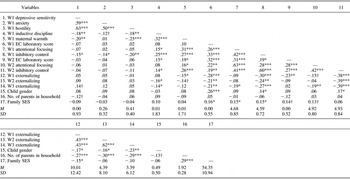
Descriptive statistics for study variables are reported in Table 1. The second lowest row of columns 7, 8, 10, and 11 of Table 1 displays small increases from ages 3 to 6 in mean scores of children's attentional focusing (W1: M = 4.68, SD = 0.85; W2: M = 4.92, SD = 0.80) and inhibitory control (W1: M = 4.59, SD = 0.72; W2: M = 4.93, SD = 0.84). Repeated-measure t tests indicated increases from W1 to W2 in attentional focusing, t (205) = –4.69, p < .001, and inhibitory control, t (205) = –6.52, p < .001. The bottom two rows of columns 12, 13, and 14 of Table 1 illustrate decreases in means and variability of children's raw scores for externalizing behavior across W1 (M = 10.01, SD = 12.42), W2 (M = 4.39, SD = 8.10), and W3 (M = 3.39, SD = 6.12). Repeated-measure t tests indicated decreases in externalizing behavior from W1 to W2, t (152) = 6.87, p < .001, and from W1 to W3, t (156) = 7.33, p < .001, but not from W2 to W3, t (166) = 1.32, p = ns. Children's externalizing behavior was at its highest level at W1, but it did not change between W2 and W3.
Correlations, means, and standard deviations of major study variables and covariates

Note: Child gender is coded as 0 = boys, 1 = girls. W1, Wave 1, age 3; W2, Wave 2, age 6; W3, Wave 3, age 10; EC, effortful control; EXT, externalizing behavior; SES, socioeconomic status.
†p < .10. *p < .05. **p < .01. ***p < .001.
Measurement models
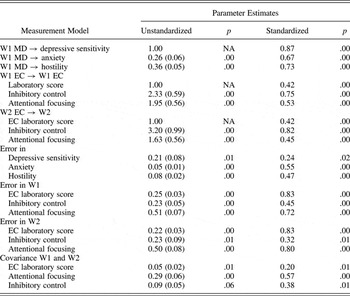
Estimates for latent measures of maternal distress at W1 and children's EC at W1 and W2 are shown in Table 2. Loadings for all latent measures were highly significant (ps < .001). As shown in Table 2, our latent measure of W1 maternal distress loaded onto BSI scales for anxiety, hostility, and depressive sensitivity with standardized estimates ranging from 0.67 to 0.87. Latent measures of EC at W1 and W2 loaded more strongly on mother-reported inhibitory control (βs = 0.75 and 0.82, respectively) than on attentional focusing (βs = 0.53 and 0.45) and laboratory scores of EC (βs = 0.42).
Unstandardized and standardized estimates of measurement models (standard errors)

Note: W1, Wave 1, age 3; W2, Wave 2, age 6; MD, maternal distress; NA, not available; EC, effortful control.
Structural equation modeling
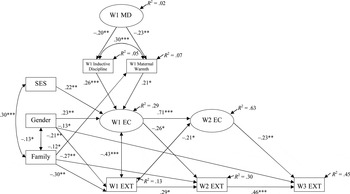
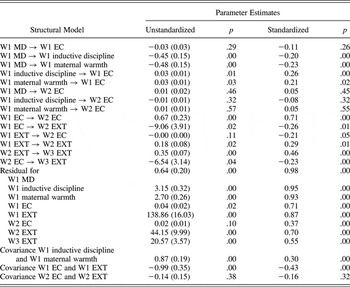
Figure 2 displays significant estimates for our integrative SEM of early maternal distress, inductive discipline, maternal warmth, and the development of EC and externalizing behavior in childhood. The model in Figure 2 produced χ2 (80, N = 241) = 136.91, p = .0001, CFI = 0.93, RMSEA = 0.05, 90% CI = (0.04, 0.07). Fit-indices indicated a close approximate fit of the model, which predicted 2% of the variance of maternal distress, 5% of inductive discipline, 7% of maternal warmth, 29% of W1 EC, 63% of W2 EC, 13% of W1 externalizing behavior, 30% of W2 externalizing behavior, and 45% of W3 externalizing behavior. Only standardized estimates are reported in Figure 2 and in the text. Unstandardized and standardized estimates are provided in Table 3. Results of bootstrap analyses testing for mediation are reported in the text in standardized and unstandardized forms. Standard errors for these unstandardized estimates are in parentheses in the text and in Tables 2 and 3.
Results of integrative model of maternal distress and parenting, and child effortful control and externalizing behavior. SES, Socioeconomic status; Gender, Child gender (boys = 0, girls = 1); Family, number of parents in household; W1, Wave 1, age 3; W2, Wave 2, age 6; W3, Wave 3, age 10. All nonsignificant paths are excluded. Standardized solution: χ2 (80; N = 241) = 136.91, p = .0001; comparative fit index = 0.93, root mean square error of approximation = 0.05, 90% confidence interval (0.04, 0.07). *p ≤ .05. **p < .01. ***p < .001.

Unstandardized and standardized mean (standard errors) estimates of model

Note: W1, Wave 1, age 3; W2, Wave 2, age 6; W3, Wave 3, age 10; MD, maternal distress; EC, effortful control; EXT, externalizing behavior. Estimates for covariates are not shown. In this model, χ2 (80, N = 241) = 136.91, p = .0001. Comparative fit index = 0.93, root mean square error of approximation = 0.05, 90% confidence interval = 0.04, 0.07.
Maternal distress, parenting, and children's effortful control in early childhood
We hypothesized that more maternal distress would be associated with less inductive discipline and maternal warmth at age 3 and lower levels of children's EC at ages 3 and 6. Partial support was found for our hypothesis. As depicted in Figure 2, maternal distress was associated with less inductive discipline (β = –0.20, p = .002) and maternal warmth (β = –0.23, p = .001) at age 3 but was not related to children's W1 EC (β = –0.11, ns). Inductive discipline (β = 0.26, p < .001) and maternal warmth (β = 0.21, p = .02) were associated with higher levels of children's W1 EC. Maternal distress (β = 0.05, ns), inductive discipline (β = –0.08, ns), and maternal warmth (β = 0.05, ns) at W1 did not predict change in W2 EC. Although no direct effect of maternal distress on child EC emerged, mothers experiencing higher levels of distress reported lower levels of inductive discipline and maternal warmth, which in turn were related to poorer EC in 3-year-old children. Indirect effects operating through parenting were tested next to determine whether they served as mediating mechanisms.
We hypothesized that low levels of positive parenting would mediate adverse effects of maternal distress on children's EC. A bootstrap analysis supported our hypothesis by revealing a significant indirect effect of maternal distress on children's EC at age 3 operating through both inductive discipline and maternal warmth, β = –0.10, p = .004; b = –0.03 (0.01), p < .01. Separate estimates indicated that inductive discipline, β = –0.05, p = .03; b = –0.01 (0.01), p = .06, and maternal warmth, β = –0.05, p = .06; b = –0.01 (0.01), p = .06, marginally mediated unique, indirect effects of maternal distress on children's EC. Mothers experiencing heightened distress reported lower levels of inductive discipline and maternal warmth, which in turn were associated with lower levels of EC in 3-year-olds. In preliminary modeling, we examined a model identical to that in Figure 2, except without parenting measures, and found a direct effect of maternal distress on child EC at W1 (β = –0.19, p < .05). This direct effect disappeared once we included parenting measures; thus, sufficient evidence indicates that inductive discipline and maternal warmth mediated negative effects of maternal distress on children's EC. Next, we tested whether these relationships predicted changes in children's externalizing behavior.
Children's EC and externalizing behavior across childhood
The model in Figure 2 illustrates the development of children's EC from ages 3 to 6, the development of externalizing behavior from ages 3, 6, and 10, and their cross-lagged effects. Children's EC at W1 was associated with their EC at W2 (β = 0.71, p < .001). Children's externalizing behavior at W1 was associated with their externalizing at W2 (β = 0.29, p = .01), and their W2 externalizing was associated with their externalizing at W3 (β = 0.46, p < .001). We expected less EC to be concurrently associated with more externalizing behavior, which was partially supported. Preschool teachers reported more externalizing behavior for 3-year-olds with low EC (r = –.43, p < .001). Children's EC and externalizing behavior at W2 were not related (r = –.16, ns) when accounting for lagged and cross-lagged effects from W1. Thus, only children's EC and externalizing behavior at age 3 were concurrently associated.
We also hypothesized that lower levels of EC at ages 3 and 6 would predict higher levels of externalizing behavior at ages 6 and 10. Supporting our hypothesis, children's EC at W1 predicted change in externalizing behavior at W2 (β = –0.26, p = .01), and EC at W2 predicted change in externalizing behavior at W3 (β = –0.23, p = .004). Children with higher levels of EC at ages 3 and 6 showed greater relative decreases in externalizing behavior at ages 6 and 10. There was an effect of W1 externalizing behavior on W2 EC (β = –0.21, p = .05); however, its unstandardized estimate was not significant, b = –0.00 (0.00), ns. To summarize findings up to this point: Heightened maternal distress was related to less inductive discipline and maternal warmth; lower levels of positive parenting were associated with poorer EC in 3-year-olds; and lower levels of EC at ages 3 and 6 predicted smaller decreases in externalizing behavior across childhood. Next, we tested whether EC mediated effects of parenting on children's externalizing behavior.
Parenting and the development of EC and externalizing behavior
We hypothesized that children's EC would mediate reductions in externalizing behavior explained by higher levels of inductive discipline and maternal warmth. A bootstrap analysis partially supported our hypothesis by indicating a marginal indirect effect of inductive discipline at W1 on children's externalizing behavior at W2 operating through their W1 EC, β = –0.07, p < .08; b = –0.29 (0.17), p = .08. Inductive discipline was associated with higher levels of EC in 3-year-old children, which in turn predicted greater decreases in externalizing behavior by age 6. As shown in Table 1, inductive discipline at W1 was correlated with externalizing behavior at W2 (r = –.16, p < .01), illustrating a direct relationship. Evidence indicates that EC at age 3 marginally mediated the effect of inductive discipline on children's externalizing behavior in kindergarten. EC did not mediate indirect effects of maternal warmth on externalizing behavior.
Although not a focus of this study, we found children's W1 EC also mediated the effect of inductive discipline at W1 on their EC at W2, β = 0.18, p = .01; b = 0.02 (0.01), p = .03. Similarly, W1 EC mediated the effect of family SES on children's EC at W2, β = 0.16, p = .04; b = 0.00 (0.00), p = .07. Inductive discipline and family SES at age 3 contributed to higher levels of EC at age 6 through their influence on children's EC at age 3. Children's externalizing behavior at W2 mediated the effect of W1 EC on W3 externalizing behavior, β = –0.12, p = .04; b = –3.20 (1.84), p = .08. Children with poorer EC at age 3 had more externalizing behavior at age 10, and their elevated externalizing behavior at age 6 accounted for this. Thus, children's EC in toddlerhood mediated effects of inductive discipline and SES on their EC in kindergarten and contributed to the development of externalizing behavior. As reviewed below, all relationships were found while accounting for demographic factors related to major study variables.
Contributions of demographic variables
Figure 2 displays significant paths from family SES, child gender, and number of parents in the household to study variables. Higher levels of family SES were associated with better EC at W1 (β = 0.22, p < .01). Child gender was associated with W1 EC (β = 0.23, p < .01) and externalizing behavior at W1 (β = –0.21, p = .001) and W3 (β = –0.13, p = .01). Boys had poorer EC and higher levels of externalizing behavior at age 3 and lower decreases in externalizing behavior by age 10 than did girls. The number of parents in the household was associated with maternal warmth at W1 (β = –0.12, p = .02) and children's externalizing behavior at both W1 (β = –0.30, p = .002) and W2 (β = –0.27, p < .01). Single mothers reported more maternal warmth when their children were 3-years-old, although their children demonstrated more externalizing behavior at age 3, with fewer decreases by age 6. Although not shown in Figure 2, family SES (β = –0.06, ns), child gender (β = 0.09, ns), and number of parents in the household (β = –0.05, ns) were not associated with maternal distress at W1. Thus, girls and children from high SES families had higher levels of EC at age 3, whereas boys and children living in single-parent homes had higher levels of externalizing behavior during early childhood.
Discussion
Our primary goal was to identify mechanisms underlying effects of early maternal distress on children's externalizing behavior. Goodman and Gotlib's (Reference Goodman and Gotlib1999) integrative model was extended to our investigation testing whether suboptimal maternal parenting and child EC mediated effects of early maternal distress on the development of children's externalizing behavior. Overall findings indicated (a) heightened maternal distress was associated with less inductive discipline and maternal warmth but was not directly related to children's EC when accounting for parenting; (b) inductive discipline and maternal warmth mediated adverse effects of maternal distress on children's EC; (c) higher levels of children's EC predicted greater decreases in externalizing behavior across childhood; and (d) children's EC marginally mediated the effect of inductive discipline on their later externalizing behavior, but it did not mediate the effect of maternal warmth. These findings illustrate multiple interconnected mechanisms through which early maternal distress contributes to growth in young children's adjustment problems.
Early exposure to maternal distress in preschool was expected to predict lower levels of inductive discipline and maternal warmth, which was supported in the model. Contrary to our hypothesis, there was no direct effect of maternal distress on EC at age 3, when accounting for parenting. This is inconsistent with evidence linking maternal depressive symptoms with poorer self-regulation in early childhood (Sektnan et al., Reference Sektnan, McClelland, Acock and Morrison2010). Our investigation relied on multiple methods of assessing self-regulation, whereas the previously cited study used informant reports with a much larger nationally representative sample. Furthermore, Sektnan and colleagues (Reference Sektnan, McClelland, Acock and Morrison2010) did not examine parenting. Thus, our inability to identify a direct effect of maternal distress on children's EC in the main model was due to limited power and parenting measures fully mediating this effect. However, our results are consistent with research linking more maternal distress with less maternal warmth (Campbell et al., Reference Campbell, Matestic, von Stauffenberg, Mohan and Kirchner2007; Cummings et al., Reference Cummings, Keller and Davies2005) and contribute to the literature by demonstrating a negative effect of maternal distress on inductive discipline. These findings support evidence that maternal distress contributes to less sensitive and responsive caregiving and use of ineffective discipline strategies (Berg-Nielsen et al., Reference Berg-Nielsen, Vikan and Dahl2002; Downey & Coyne, Reference Downey and Coyne1990; Feng et al., Reference Feng, Shaw, Kovacs, Lane, O'Rourke and Alarcon2008; Goodman & Gotlib, Reference Goodman and Gotlib1999; Lovejoy et al., Reference Lovejoy, Graczyk, O'Hare and Neuman2000).
We expected lower levels of inductive discipline and maternal warmth to be associated with poorer EC in preschool and that these parenting behaviors would mediate negative effects of maternal distress on children's EC. Our results confirmed these hypotheses by demonstrating mediating effects of inductive discipline and maternal warmth at age 3. This is consistent with research indicating that parenting mediates adverse effects of contextual risk factors on toddlers’ EC and provides evidence of promotive effects of maternal warmth on EC, which has been inconsistent in studies relying on observational measures of maternal warmth (e.g., Eisenberg et al., Reference Eisenberg, Zhou, Spinrad, Valiente, Fabes and Liew2005; Lengua et al., Reference Lengua, Honorado and Bush2007). The mediating effects of inductive discipline and maternal warmth were marginal, but their combined indirect effect was highly significant. Our findings suggest the combination of inductive discipline and maternal warmth is a more robust mediator of maternal distress and child EC than either parenting construct alone, further supporting the utility of an integrative model. Thus, experiencing emotional distress may make it more difficult for mothers to meet key parenting duties requiring responsive, nurturing, and inductive caregiving that in concert promotes children's self-regulatory competence.
Lower levels of EC were expected to predict heightened externalizing behavior across childhood. In support, EC at ages 3 and 6 negatively predicted children's externalizing behavior at ages 6 and 10, respectively. Thus, young children with poorer self-regulation had higher levels of externalizing behavior from preschool to middle childhood. This supports research indicating that self-regulatory difficulties in toddlerhood may be precursors of child and adolescent psychopathology (Murray & Kochanska, Reference Murray and Kochanska2002; Olson et al., Reference Olson, Sameroff, Kerr, Lopez and Wellman2005; Spinrad et al., Reference Spinrad, Eisenberg, Gaertner, Popp, Smith and Kupfer2007).
Children's EC was expected to mediate effects of inductive discipline and maternal warmth on their externalizing behavior. Our hypothesis was confirmed, albeit marginally, for an indirect effect of inductive discipline, but not for maternal warmth. Higher levels of inductive discipline at age 3 predicted greater decreases in externalizing behavior at age 6, and children's EC at age 3 accounted for this effect. These findings are consistent with research indicating that inductive discipline prevents children's externalizing problems (Hart et al., Reference Hart, DeWolf, Wozniak and Burts1992; Pettit et al., Reference Pettit, Bates and Dodge1997). Although researchers have not examined effects of inductive discipline on children's EC, more maternal limits setting, a constituent of inductive discipline, and scaffolding have been linked to higher levels of EC in 3-year-olds (Lengua et al., Reference Lengua, Honorado and Bush2007). Based on these findings, it appears instructive parenting behaviors that center on reasoning and reminding of rules help contribute to self-regulatory competency during the preschool years and fewer subsequent externalizing behaviors. Children's understanding of mothers’ expectations for their behavior and consequences for not meeting them are essential to their socialization (Kopp, Reference Kopp, Skinner and Zimmer-Gembeck2009), and maternal use of inductive discipline appears to support this process.
We found no evidence that EC mediated effects of maternal warmth on child externalizing behavior, which is inconsistent with other studies (Eiden et al., Reference Eiden, Edwards and Leonard2007; Eisenberg et al., Reference Eisenberg, Zhou, Spinrad, Valiente, Fabes and Liew2005). In this study, mother-reported warmth was correlated with all constituents of EC and externalizing behavior in preschool, but in the early school years only EC remained correlated to maternal warmth in preschool. Inductive discipline may be more directly related to children's later externalizing behavior, since evidence indicates that maternal use of inductive discipline increases with age (Huang et al., Reference Huang, Caughy, Lee, Miller and Genevro2009). Children who do not experience age-appropriate increases in inductive discipline receive fewer opportunities to capitalize on maternal instruction, which may increase their risk of self-regulatory difficulties and later adjustment problems. Experiencing little maternal warmth may be more immediately noxious during toddlerhood and the preschool years when young children require greater nurturance and responsive caregiving to self-regulate their arousal (Sameroff, Reference Sameroff2009; Sroufe et al., Reference Sroufe, Duggal, Weinfield, Carlson, Sameroff, Lewis and Miller2000). Nonetheless, these findings indicate early maternal distress is associated with lower levels of positive parenting that influence children's emerging self-regulation and risk for future adjustment problems.
Evidence from this study and others support the role of early self-regulation in setting a foundation for children's adjustment. Consistent with research (e.g., Bell & Deater-Deckard, Reference Bell and Deater-Deckard2007), children's self-regulation was highly stable from ages 3 to 6 compared to externalizing behavior. The majority of children who demonstrate externalizing problems show a gradual decrease in symptoms between ages 2 and 8 (Shaw, Gilliom, Ingoldsby, & Nagin, Reference Shaw, Gilliom, Ingoldsby and Nagin2003), which parallels substantial increases in children's EC abilities from ages 2 to 7 (Rothbart & Bates, Reference Rothbart, Bates, Damon and Damon1998). This suggests declines in externalizing behavior beginning in toddlerhood reflect in part a normative developmental process in which children gain more self-regulation. Early influences that contribute to the suboptimal growth of children's self-regulation therefore elevate risk for subsequent externalizing problems. For example, Spinrad and colleagues (Reference Spinrad, Eisenberg, Gaertner, Popp, Smith and Kupfer2007) found toddlers’ EC mediated negative effects of supportive parenting on their externalizing problems, but these effects appeared to weaken with age. Based on robust effects found in early toddlerhood, these researchers hypothesized that relationships among parenting, self-regulation, and externalizing problems are set at a very early age (pp. 1183). Therefore, self-regulation during the early school years and middle childhood may be less malleable to contextual influences than during toddlerhood and preschool when self-regulatory abilities are increasing exponentially (Kochanska et al., Reference Kochanska, Murray, Jacques, Koenig and Vandegeest1996; Lengua et al., Reference Lengua, Bush, Long, Kovacs and Trancik2008; Posner & Rothbart, Reference Posner and Rothbart2000).
The developmental continuity of children's EC and early effects of maternal distress and parenting found in this study support the contention that toddlerhood and preschool may be sensitive periods for the development of self-regulation. We found that maternal distress and parenting, family SES, and child gender explained almost one-third of the variance of EC in preschool, but these factors did not predict change in EC across early childhood. Children's EC was highly stable across ages 3 and 6, which left little variance at the second wave for contextual measures to predict change. Researchers have found negative associations between social–contextual risk factors and older children's EC, and similarly, these factors were not predictive of changes in self-regulation (Lengua et al., Reference Lengua, Bush, Long, Kovacs and Trancik2008). These same researchers were able to predict growth in EC across 6 months in toddlerhood with cumulative risk and parenting measures (Lengua et al., Reference Lengua, Honorado and Bush2007). Short intervals between assessments in early toddlerhood may provide a more robust means of predicting critical changes in children's self-regulation. Nonetheless, several meta-analyses have indicated that infants, toddlers, and preschoolers are more vulnerable to the detrimental effects of maternal distress than are older children, suggesting a sensitive period when children are more susceptible to external influence (Connell & Goodman, Reference Connell and Goodman2002; Lovejoy et al., Reference Lovejoy, Graczyk, O'Hare and Neuman2000). Young children who initially develop self-regulatory competence likely continue showing well-regulated functioning across childhood and more resilience to social–contextual risk factors in comparison to their poorly regulated peers. In this case, poor self-regulation could be considered an individual vulnerability factor that increases risk for later externalizing problems and psychopathology when children are exposed to early psychosocial stressors.
Aside from maternal distress and parenting, SES and gender were related to EC in preschool. Boys and toddlers from lower SES families had lower levels of EC, which is consistent with research indicating poorer EC among boys (Kochanska et al., Reference Kochanska, Murray and Harlan2000; Olson et al., Reference Olson, Sameroff, Kerr, Lopez and Wellman2005; Valiente et al., Reference Valiente, Lemery-Chalfant and Castro2007) and children exposed to demographic and psychosocial risk factors (Lengua et al., Reference Lengua, Honorado and Bush2007; Li-Grining, Reference Li-Grining2007). Supporting other research (Dodge & Pettit, Reference Dodge and Pettit2003), children in single-parent households had elevated levels of externalizing behavior in the preschool and early school years. Single mothers reported more maternal warmth, which may have been to compensate for a lack of another parent in the household. Consistent with the literature, boys had higher levels of externalizing behavior at age 3 and showed smaller relative decreases by age 10 than did girls (e.g., Deater-Deckard et al., Reference Deater-Deckard, Dodge, Bates and Pettit1998).
Limitations and future directions
Several limitations encourage cautious interpretation of the findings and further replication. One issue was excluding maternal distress and parenting at other ages, which prevented examination of how their persistence over time influenced children's adjustment. Chronic maternal distress is theorized as being more adverse than a single exposure, but empirical evidence supporting this is inconsistent; stronger support indicates children exposed to early maternal distress do not recover to similar levels of functioning as nonexposed children (Goodman & Gotlib, Reference Goodman and Gotlib1999). In a recent study, maternal distress enduring from preschool to adolescence predicted more emotional distress in adult offspring, but effects did not differ from a single exposure in preschool when accounting for adolescent adjustment (Hamilton, Reference Hamilton2009). In addition, maternal use of inductive discipline is relatively stable during toddlerhood, and a mother's rank order relative to others does not change over time (Huang et al., Reference Huang, Caughy, Lee, Miller and Genevro2009). Moreover, relatively little is known about the stability of warm emotional exchanges between mothers and young children (Campos, Frankel, & Camras, Reference Campos, Frankel and Camras2004). The continuity and change of maternal distress and parenting are relevant to developmental processes examined in this study; however, little evidence suggests excluding maternal distress and parenting at other ages limited our ability to identify their early contributions to children's future behavioral adjustment. To the contrary, the reviewed findings suggest child outcomes are predicted just as well by the early onset of maternal distress and suboptimal parenting as their general stability over time. Preliminary tests were performed with maternal distress and parenting at age 6 in our model, and no contributions to child self-regulation were observed. Therefore, repeated measures were limited to variables we were interested in observing change over time, thereby creating a more parsimonious integrative model with greater power to identify indirect effects of maternal distress.
Our integrative model was similar in design to developmental cascade models, which examine how effects of early experience alter development through a chain of many interactions and transactions occurring across multiple system levels (Masten & Cicchetti, Reference Masten and Cicchetti2010). Within this framework, investigators can examine reciprocal influences in mother–child dyads and disentangle their interface. Transactional effects between parenting such as rejection and child EC have been found in middle childhood (Lengua, Reference Lengua2006). These factors predicted change in one another over time, and their changes were related to children's adjustment problems. Future studies can extend our integrative model by testing developmental cascade models with repeated measures of both maternal and child constructs in order to tease apart their reciprocal interplay.
Another limitation of this study was assessing maternal distress by self-report, which was problematic because distributions for depression and interpersonal sensitivity scores were positively skewed since many mothers reported having zero symptoms. Creating the depressive sensitivity composite helped correct for some nonnormality, and using the MLR estimator in SEM analyses made them more robust to normality violations but resulted in more conservative estimates than standard FIML. Using FIML would have yielded more robust effects and a better model fit; however, we wanted to ensure that some skewed data would not lead to inaccurate estimates. However, this does not compensate for the possibility that some mothers may have underreported their levels of symptom severity.
Given this conservative approach, it is noteworthy that we found direct and indirect effects of subclinical distress on parenting and child behavioral adjustment in a community sample. Clinic-referred mothers yield larger effects in studies of parental psychopathology than do community samples or clinic-referred children (Connell & Goodman, Reference Connell and Goodman2002). Given our focus on mothers’ emotional distress rather than diagnosed psychopathology, it was imperative to be sensitive to a constellation of comorbid internalizing symptoms with ranging severities. Studies of maternal depression that use symptom ratings versus clinical diagnoses have similar effect sizes (Lovejoy et al., Reference Lovejoy, Graczyk, O'Hare and Neuman2000), which supports our use of the BSI for assessing dimensions of hostility, anxiety, depression, and interpersonal sensitivity that underlie maternal distress. Between 3% and 13% of mothers scored in the 90th percentile for these scales, indicating a subset of mothers had at least borderline levels of internalizing psychopathology. The BSI's sensitivity to a range of psychological distress made it a valid measure of subclinical emotional distress that may precede clinical depression. Future research examining relationships in this study with mothers who are depressed would yield stronger support for our hypothesized model, because comorbid symptoms would be greatly elevated and parenting would be even more compromised than what was observed in this study. However, such an endeavor would be challenging, given confounding effects of co-occurring risk factors that exacerbate maternal psychopathology such as martial conflict (Cummings et al., Reference Cummings, Keller and Davies2005) and economic hardship (Campbell et al., Reference Campbell, Matestic, von Stauffenberg, Mohan and Kirchner2007).
Further, there is controversy regarding whether distressed mothers provide biased reports about themselves and their children (Goodman & Gotlib, Reference Goodman and Gotlib1999; Kim-Cohen, Moffitt, Taylor, Pawlby, & Caspi, Reference Kim-Cohen, Moffitt, Taylor, Pawlby and Caspi2005). Mothers contributed data on their distress, parenting, and children's behavioral adjustment, and attempts were made to offset shared variance from maternal reports with laboratory measures of EC and teacher ratings of externalizing behavior. Multiple informants and methods of assessment are useful in studies of children's behavioral adjustment for reducing reporting biases and creating more objective measures (Kerr, Lunkenheimer, & Olson, Reference Kerr, Lunkenheimer and Olson2007; Rothbart & Bates, Reference Rothbart, Bates, Damon and Damon1998). Future studies implementing a mixture of assessments and informants can more rigorously examine our research questions by reducing shared variance among measures and by providing an exhaustive assessment of children and families.
Finally, external validity of our findings is limited, given that most mothers reported relatively high levels of educational attainment and family income, few environmental risk factors, but wide ranges of emotional distress and early externalizing behavior among targeted children (although levels of externalizing behavior after age 3 were lower than expected based on attempts to recruit more at-risk children). These qualities indicated our sample was suitable for teasing apart risk mechanisms operating between maternal and child mental health problems without pervasive confounds of poverty and other environmental risks. Furthermore, results suggest even normative levels of maternal distress contribute to parenting deficits that increase children's risk of maladjustment. Future work can extend our findings by sampling families that are more representative of the US population.
Future studies should examine biological mechanisms underlying long-term effects of early maternal distress on children's behavioral adjustment. A promising direction is research on dysregulated stress response systems in mother–child dyads. Animal models indicate disruptions in early maternal caregiving contribute to the intergenerational transmission of atypical stress reactivity, specifically hyperactive behavioral and neuroendocrine responses to stress (Meaney, Reference Meaney2001). Humans who show hyperactive stress responses via the hypothalamic–pituitary–adrenal axis and sympathetic nervous system are at elevated risk for psychopathology (pp. 1163). Excessive levels of or hypersensitivity to stress hormones interfere with attentional processes relevant for learning and memory, which may hinder growth of executive attention and thus EC (Meaney, Reference Meaney2001; Posner & Rothbart, Reference Posner and Rothbart2000). Human research indicates exposure to maternal depression in infancy is a robust predictor of elevated cortisol levels, which predict more subsequent internalizing and externalizing problems (Essex, Klein, Cho, & Kalin, Reference Essex, Klein, Cho and Kalin2002). Early exposure to maternal distress sensitizes children's hypothalamic–pituitary–adrenal responses to stress, elevates risk for dysregulation, and puts young children in physiological states that are difficult to self-regulate (Essex et al., Reference Essex, Klein, Cho and Kalin2002; Sroufe et al., Reference Sroufe, Duggal, Weinfield, Carlson, Sameroff, Lewis and Miller2000). Deficient functioning of these biological systems may hinder self-regulatory gains in early childhood and consequently elevate risk for externalizing problems in childhood and adolescence such as aggression, substance use, and other risky behaviors associated with poor executive control (Buckner, Mezzacappa, & Beardslee, Reference Buckner, Mezzacappa and Beardslee2003). Evidence suggests that the earlier children experience maternal distress, the greater their risk for maladjustment due to compromised parenting and dysregulated stress responses. Future research can extend our findings by examining the interplay of child behavioral adjustment and maternal distress with physiological measures of various stress response systems.
Conclusion
The findings from this study indicate that heightened distress may impair mothers’ abilities to meet the needs of their young children with warm parenting and inductive discipline. Suboptimal levels of these positive maternal behaviors were related to poorer self-regulation in preschool, which in turn predicted smaller decreases in externalizing behavior across childhood. Evidence of mediation was found for positive parenting and children’ self-regulation, suggesting they contribute to distal effects of maternal distress on children's behavioral adjustment. Preschool-age self-regulation and exposure to contextual influences had long-term effects on the development of children's externalizing behavior. Prevention of early externalizing problems is imperative, given that they increase risk for school-age behavior problems and future psychopathology, particularly when occurring with family adversity (Campbell et al., Reference Campbell, Shaw and Gilliom2000). Furthermore, school-age behavior problems severe enough to warrant clinical diagnoses are relatively resistant to treatment (Kazdin, Reference Kazdin1993). Concerted efforts examining the pathways through which maternal distress influences parenting and the development of children's self-regulation can inform interventions and prevention efforts targeting at-risk children and mothers.