Various patient- and management-specific factors have the potential to interact and manifest as a spectrum of developmental dysfunction in infants with congenital heart disease.Reference Ballweg, Wernovsky and Gaynor1 Prospective studies to date have revealed cognitive and, more commonly, motor dysfunction during infancy in a large proportion of children that have cardiac surgery in the first 6 months of life.Reference Snookes, Gunn and Eldridge2 Although these studies have provided valuable quantitative information on motor performance, they have not described how motor skills evolve over time following early cardiac surgery. Instead, prospective studies have typically been limited to motor assessments taking place at only one time-point during infancy. Results may therefore be distorted by the natural variability that occurs throughout infant gross motor development, that is, differences in gross motor ability are observed in typically developing infants over time.Reference Darrah, Redfern, Maguire, Beaulne and Watt3 In patients with congenital heart disease, this variability may be magnified by the additional burden of repeated hospital admissions or frequent medical care, and as such longitudinal assessment of gross motor development is preferable.
The aim of this longitudinal study was to describe gross motor development of infants who had undergone early cardiac surgery. A secondary analysis of primary outcome data pertaining to study participant exposures and potential confounders was also performed.
Materials and methods
The Human Research and Ethics Committee of the Royal Children's Hospital, Melbourne, Australia (#26030), approved this prospective cohort study. Neonates and young infants with congenital heart disease who underwent elective or emergency cardiac surgery at less than or up to 8 weeks of age were included. Infants with known chromosomal abnormalities or congenital syndromes such as the 22q deletion spectrum or Down syndrome were excluded from participation, as were families in which the primary caregiver did not speak English, and families who lived more than 100 kilometres outside the Melbourne metropolitan area. A senior paediatric physiotherapist (S.L.) conducted all recruitment for this study; the primary caregiver gave signed informed consent to participate.
Gross motor assessment: Alberta Infant Motor Scale
Gross motor performance was assessed at the Royal Children's Hospital when infants were 4, 8, 12, and 16 months of age (corrected) with the Alberta Infant Motor Scale. Where families were unable to attend scheduled appointments, home visits were organised. All Alberta Infant Motor Scale assessments were conducted in accordance with manual guidelines.Reference Piper and Darrah4 The Alberta Infant Motor Scale is a discriminative gross motor outcome measure that may be used to assess infants from birth to independent walking. Discriminative tests differentiate between individuals with or without a specific characteristic or function and are often norm-referenced.Reference Rosenbaum, Russell, Cadman, Gowland, Jarvis and Hardy5 Consisting of 58 gross motor items, each item evaluates the infant in one of four different positions – prone, supine, sitting, and standing – and is scored on a dichotomous scale as observed (1 point) or not observed (no points) according to specific criteria relating to three components of movement: posture, weight-bearing, and anti-gravity movement. Infants were videotaped during the assessment and assessments were scored from digital versatile discs more than 1 month after the assessment by S.L., and separately by a second senior paediatric physiotherapist (K.D.) who was blinded to each infant's medical history, including previous clinical assessments.
A normative data set for the Alberta Infant Motor Scale was developed by the scale authors through observations of a birth cohort (1990–1992) from Alberta, Canada. The normative sample comprised a random sample of 2202 children, stratified by geographical region, age, and sex.Reference Piper, Pinnell, Darrah, Maguire and Byrne6 The existence of normative data allows Alberta Infant Motor Scale total raw scores to be transformed into age-based percentile ranks. Extensive reliability testing by the authors and subsequent scale users has consistently demonstrated high levels of inter- and intra-rater reliability.Reference Piper, Pinnell, Darrah, Maguire and Byrne6–Reference Spittle, Doyle and Boyd8
Peri-operative data collection
Peri-operative variables were collected prospectively from Royal Children's Hospital databases. Categorical and continuous variables included gestational age; birth weight; primary diagnosis; age at admission; age at surgery/surgeries; surgery performed; surgical variables, including cardiopulmonary bypass time, cross-clamp time, deep hypothermic circulatory arrest time, temperature; extra-corporeal membranous oxygenation time; ventilation time; respiratory support time, including ventilation time and non-invasive ventilation time; intensive care length of stay; and hospital length of stay. Binary variables included sex, cardiopulmonary bypass (yes/no), cyanotic or acyanotic congenital heart disease, palliative or corrective cardiac surgery, and social risk (high/low). Social risk was assessed using the Social Risk Index, which is a composite measure comprising six aspects of social status including family structure, education of primary caregiver, occupation of primary income earner, employment status of primary income earner, language spoken at home, and maternal age at birth.Reference Roberts, Howard, Spittle, Brown, Anderson and Doyle9–Reference Treyvaud, Anderson and Howard11
Missing data were retrieved, where possible, by examination of individual patient unit records.
Statistical methods
Retrospective data review before study commencement suggested that 50 infants would be eligible for this study over a 24-month period. Precision-based sample size calculations for 50 study participants estimated the width of the 95% confidence interval for mean Alberta Infant Motor Scale total raw scores at 4, 8, 12, and 16 months of age to be 2.4, 3.9, 2.6, and 0.3 items, respectively. This amount of precision was thought to be clinically meaningful to detect a difference between the sample studied and Alberta Infant Motor Scale normative data across the ages studied.
Linear interpolation of normative data was used to convert Alberta Infant Motor Scale total raw scores to an Alberta Infant Motor Scale percentile rank for each study participant at 4, 8, 12, and 16 months corrected age. Each percentile rank was categorised according to groupings provided by the Alberta Infant Motor Scale authors.Reference Piper and Darrah4 Study participants with a percentile rank that was less than or equal to the 10th percentile on three or more assessment occasions were classified as having atypical gross motor development (Fig S1). Study participants with a percentile rank that was less than or equal to the 10th percentile on two of at least three assessment occasions were classified as having suspicious gross motor development. Cases where the percentile rank was categorised as more than the 10th to less than or equal to the 25th percentile were also included in these atypical and suspicious classifications if they occurred in series with a lower percentile classification, for example a study participant that performed on the 8th, 15th, and 5th percentile at 4, 8, and 12 months, respectively, would be categorised as having atypical gross motor development.
Descriptive statistics were used to describe binary, categorical, and continuous variables collected in the peri-operative period, as well as Alberta Infant Motor Scale total raw scores for infants assessed at 4, 8, 12, and 16 months of age. Bivariate linear regression was used to describe the association between Alberta Infant Motor Scale total raw score data, with separate dependent variables for study participants at 4, 8, 12, and 16 months of age, and risk factors – continuous or categorical variables – collected in the peri-operative period. Hypothesis tests (two sample t-tests, equal variance not assumed) were performed to examine differences in Alberta Infant Motor Scale total raw score data and independent binary variables.
Intra-class correlation statistics were used to evaluate intra- and inter-rater reliability. Intra-rater reliability for K.D. was evaluated by scoring 15 (20%) of the 8-month Alberta Infant Motor Scale assessment segments on a second occasion after at least a 3-month interval. Alberta Infant Motor Scale total raw scores from all assessments were used to assess inter-rater reliability between S.L. and K.D.
Results
Participants
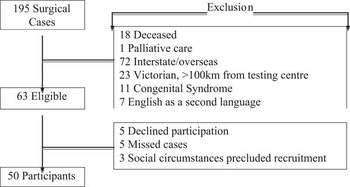
Eligibility for study participation was assessed in 195 infants who underwent cardiac surgery between the 5th of July 2006 and the 2nd January 2008. In all, 63 infants were eligible, and thus our sample represented 79% of eligible participants (Fig 1). There were five families that declined participation in this study, and reasons for non-participation included not wanting to put their baby through additional hospital experiences or appointments (four families) and difficulty committing to the study schedule of assessments (one family). In addition, five cases were missed and families of three infants had social circumstances that precluded recruitment. Of the 55 families approached for participation, 50 (91%) were recruited.
Flow chart of individuals assessed for eligibility.

Of the 50 patients enrolled, there was permanent attrition of two participants between 4 and 8 months of age: one patient died, and the other did not attend scheduled appointments. There was temporary attrition of subjects at each time point, with 92%, 84%, and 94% returning for assessment at 8, 12, and 16 months of age, respectively. Approximately 78% of enrolled subjects completed all four Alberta Infant Motor Scale assessments.
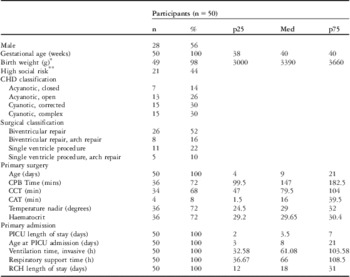
Study participant characteristics are shown in Table 1. Study participants had similar characteristics to non-participants, with the following exceptions: ineligible cases and deceased patients spent longer in the paediatric intensive care unit; ventilation and respiratory support time were much longer in patients who subsequently died; and ineligible cases and deceased cases spent more time in hospital. In all, 36 study participants (72%) underwent their first episode of cardiac surgery with mild to moderate hypothermic low-flow cardiopulmonary bypass. Low-flow selective cerebral perfusion was utilised in cases of circulatory arrest. Gas management was performed with an alpha-stat strategy. There was one study participant who required extra-corporeal membranous oxygenation for 48 hours in the post-operative period following a cardiac arrest, secondary to spontaneous blockage of a cardiac shunt; this was the same participant who died at 213 days of age. There were 21 study participants who underwent a second surgical procedure during the study period, 16 of which occurred before 8 months of age; six study participants underwent a third surgical procedure, and one study participant a fourth surgical procedure during the study period.
Study participant characteristics.

CAT = circulatory arrest time; CCT = cross clamp time; CPB = cardiopulmonary bypass; Med = median; PICU = Paediatric Intensive Care Unit, RCH = Royal Children's Hospital
n = sample size; p25 = 25th percentile; p75 = 75th percentile
*Missing data (n = 1)
**High social risk = social risk index ⩾2, missing data (n = 2)
Gross motor assessment: Alberta Infant Motor Scale
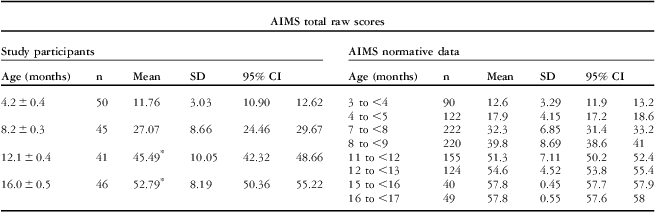
As a group, study participants had delayed gross motor development with reference to Alberta Infant Motor Scale normative total raw scores at all study time points (Table 2). The greatest inter-individual variation in Alberta Infant Motor Scale total raw scores occurred at 12 months of age (Table 2).
Descriptive statistics – AIMS total raw scores for study participants at 4, 8, 12, and 16 months of age.

AIMS = Alberta Infant Motor Scale; CI = confidence interval; SD = standard deviation
n = sample size
*Data not normally distributed. At 12 months of age, median AIMS total raw score = 49, inter-quartile range 40–51. At 16 months of age, median AIMS total raw score = 56, and inter-quartile range = 51–58
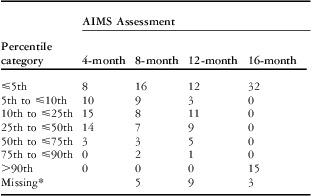
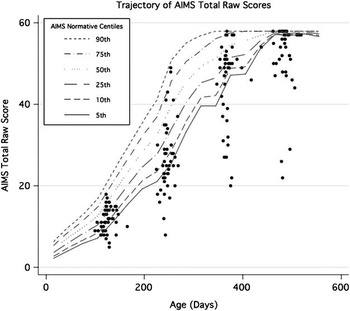
Alberta Infant Motor Scale percentile rank categorisations are shown in Table 3 and Figure 2. Ceiling scores were achieved on the prone (66%), supine (62%), sitting (91%), and standing subscales (40%) at 16 months of age. Approximately 32% of study participants achieved the maximum Alberta Infant Motor Scale total raw score of 58 at 16 months of age. An additional 17% of study participants achieved a score of 57, that is, 51% of study participants were walking independently at 16 months of age (versus 100% of the normative sample being able to walk independently).
AIMS percentile rank classification for study participants at 4, 8,12, and 16 months of age.

AIMS = Alberta Infant Motor Scale
*Missing due to permanent or temporary attrition of study subjects
Trajectory of Alberta Infant Motor Scale total raw scores versus Alberta Infant Motor Scale percentile ranks.4
Notes: Each black dot represents a single study participant's Alberta Infant Motor Scale total raw score at their corrected age at assessment across the four study time points.

Alberta Infant Motor Scale percentile ranks were not sensitive in distinguishing the motor abilities of study participants at 16 months of age (Table 3). These data were not considered suitable for additional discriminative analyses. In all, 39 infants were assessed at all three remaining study time points. Linear interpolation data revealed that 38% (15 of 39) of study participants had atypical motor development and a further 23% (9 of 39) had suspicious motor development, as measured by the Alberta Infant Motor Scale over three assessments.
Inter-rater reliability for Alberta Infant Motor Scale total raw scores was high at 4 months of age (Intra-class correlation coefficient = 0.84) and very high at 8, 12, and 16 months of age (Intra-class correlation coefficient = 0.95, 0.97, 0.97, respectively). Intra-rater reliability for 20% of Alberta Infant Motor Scale assessments at 8 months of age was very high (Intra-class correlation coefficient = 0.98).
Gross motor outcome and peri-operative variables
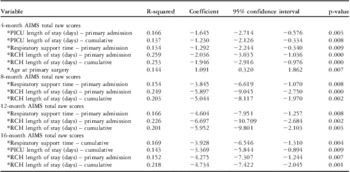
Length of stay in hospital for the initial surgical procedure, as well as cumulative length of stay in hospital, was predictive of Alberta Infant Motor Scale total raw scores at 4, 8, 12, and 16 months of age (Table 4). Other independent variables predictive of Alberta Infant Motor Scale total raw scores included: at 4 months of age, length of stay in the paediatric intensive care unit following primary surgery, cumulative length of stay in paediatric intensive care, post-operative respiratory support time, and age at surgery; at 8 months of age, post-operative respiratory support time; and at 16 months of age, cumulative length of stay in paediatric intensive care, and cumulative respiratory support time (Table 4). No other categorical or continuous variables were predictive of Alberta Infant Motor Scale total raw scores at 4, 8, 12, or 16 months of age.
Variables associated with AIMS total raw scores.

PICU = Paediatric Intensive Care Unit, RCH = Royal Children's Hospital
At 4 months of age, a statistically significant difference was found between Alberta Infant Motor Scale total raw scores for infants who had undergone palliative surgery and those who had had corrective surgery (p = 0.004); this difference was not significant at other study time points. No difference was found for other binary independent variables at 4, 8, 12, or 16 months of age.
Discussion
This is the first study to describe longitudinal Alberta Infant Motor Scale assessment data for infants with congenital heart disease. Our data suggest that more than half (62%) of study participants did not have typical gross motor development during the first year of life. The validity of study findings was strengthened by high participation rates and serial data collection. Inter- and intra-rater reliability were high across the time points of this study.
The Alberta Infant Motor Scale is an excellent test for discriminating between typical and atypical gross motor development for infants with congenital heart disease who are at risk for motor dysfunction in the first 12 months of life. However, the Alberta Infant Motor Scale did not appear to discriminate between typical and atypical gross motor development in older infants, as seen by the classification of percentile ranks of 16-month-old infants in this study, and as supported by previous studies.Reference Bartlett12, Reference Van Haastert, de Vries, Helders and Jongmans13 Although not the only tool for assessing gross motor function in infancy, the Alberta Infant Motor Scale is the only single-domain, gross motor assessment tool available for use with infants between birth and independent walking. Owing to the fact that the test is observational in nature, infants who are medically fragile or irritable need not be excluded from assessment. This was important in choosing the Alberta Infant Motor Scale for use in the congenital heart disease population. Similarly, because the Alberta Infant Motor Scale can be performed in as few as 15 minutes, it is ideal for infants with endurance limitations related to cardiac dysfunction.
The majority of outcome studies of infants with congenital heart disease have used multi-dimensional developmental assessments such as the Bayley Scales of Infant Development. Peri-operative variables significantly associated with these outcomes have included specific congenital heart disease diagnoses/surgical procedures, that is, hypoplastic left heart syndrome,Reference Sarajuuri, Lonnqvist and Mildh14 Norwood,Reference Robertson, Joffe and Sauve15 complex congenital heart disease,Reference Schultz, Jarvik and Wernovsky16 acyanotic heart disease (compared with cyanotic heart disease),Reference Limperopoulos, Majnemer, Shevell, Rosenblatt, Rohlicek and Tchervenkov17 and transposition of the great arteries with ventricular septal defect (compared with the great arteries with intact ventricular septum);Reference Bellinger, Jonas and Rappaport18 electroencephalogram abnormalities;Reference Sarajuuri, Lonnqvist and Mildh14, Reference Bellinger, Jonas and Rappaport18, Reference Gaynor, Jarvik and Bernbaum19 microcephaly;Reference Sarajuuri, Lonnqvist and Mildh14 low birth weight or weight at surgery;Reference Gaynor, Wernovsky and Jarvik20, Reference Alton, Robertson and Sauve21 markers of peri-operative illness severity;Reference Sarajuuri, Lonnqvist and Mildh14, Reference Robertson, Joffe and Sauve15 deep hypothermic circulatory arrest temperatureReference Visconti, Rimmer and Gauvreau22 or duration;Reference Robertson, Joffe and Sauve15, Reference Limperopoulos, Majnemer, Shevell, Rosenblatt, Rohlicek and Tchervenkov17, Reference Bellinger, Jonas and Rappaport18 length of hospital stay;Reference Gaynor, Wernovsky and Jarvik20, Reference Atallah, Dinu and Joffe23 apolipoprotein E polymorphisms;Reference Gaynor, Gerdes and Zackai24 and the need for cardiopulmonary resuscitation.Reference Atallah, Dinu and Joffe23 However, the association of these variables with developmental outcomes has been observed to alter over time. For example, peri-operative factors that have been associated with infant motor ability, such as illness severity, pre-operative ventilation, and weight at surgery, have no longer been relevant at preschool age.Reference Robertson, Joffe and Sauve15, Reference Creighton, Robertson and Sauve25 In the present study, those who had palliative (versus corrective) surgery had lower Alberta Infant Motor Scale total raw scores at 4 months of age; however, there was no association between type of surgery and Alberta Infant Motor Scale total raw scores at the other study time points. In a similar vein, age at surgery was associated with Alberta Infant Motor Scale total raw scores at 4 months of age, yet there was no association between age at surgery and Alberta Infant Motor Scale total raw scores at later study time points. The dilution of significance of certain variables over time is likely because other factors have greater influence on gross motor development at later times. Importantly, which risk factors are important in relation to short- and long-term gross motor outcomes is unclear.
There are some known entities. The risks of impaired delivery of oxygen and glucose to the brain during cardiopulmonary bypass – secondary to embolic events, systemic inflammatory response, or induced cerebral ischaemia – in addition to the risks associated with intra-operative management, that is, pH management, haemodilution strategies, and surgical technique, leading to brain injury and long-lasting developmental dysfunction are very real. The landmark Boston Circulatory Arrest Trial was the first to systematically study the effects of deep hypothermic circulatory arrest on a subgroup of patients with congenital heart disease, concluding that a deep hypothermic circulatory arrest time of more than 41 minutes is associated with lower psychomotor developmental index scores at 1 year of age.Reference Bellinger, Jonas and Rappaport18 Other studies have also shown that the risk of brain injury or developmental dysfunction in the first 2 years of life increases with duration of circulatory arrest.Reference Robertson, Joffe and Sauve15, Reference Limperopoulos, Majnemer, Shevell, Rosenblatt, Rohlicek and Tchervenkov17, Reference Wells, Coghill, Caplan and Lincoln26–Reference Bellinger, Wypij and Kuban28 In our exploratory analysis, intra-operative variables were not related to Alberta Infant Motor Scale scores. This is not unexpected – only four study participants underwent circulatory arrest during their first surgical procedure, and none underwent deep hypothermic circulatory arrest; this reaffirms that generalisation or comparison of findings of different studies, or this study, with other samples must take into consideration the characteristics of the target group.
Research examining specific congenital heart disease diagnoses as risk factors for developmental dysfunction has been inconclusive. Studies that have considered brain injury as a surrogate measure for developmental outcome have shown that the overall risk has not differed by anatomical classification.Reference McQuillen, Barkovich and Hamrick29, Reference Beca, Gunn and Coleman30 The exception has been infants with hypoplastic left heart syndrome, who are thought to be at a higher risk of acquired brain injury in the peri-operative period when compared with infants with diagnoses requiring other types of surgery.Reference McQuillen, Barkovich and Hamrick29 Those with hypoplastic left heart syndrome have been shown to have global developmental delay at 12 months of age, whereas infants diagnosed with other forms of single-ventricle congenital heart disease have more specific gross motor delay at this age.Reference Sarajuuri, Lonnqvist and Mildh14 We could not explore the relationship between specific congenital heart disease diagnoses and gross motor outcome in this study. Even with relatively strict inclusion criteria, the categorised subgroups of congenital heart disease each represented a spectrum of conditions, and the characteristics of participants varied accordingly.
Post-operative respiratory support time was predictive of Alberta Infant Motor Scale total raw scores at 4, 8, and 12 months of age, and cumulative respiratory support time at 16 months of age was associated with 16-month Alberta Infant Motor Scale total raw scores. Interpretation of these data is difficult because of the association between respiratory support time and length of stay in both the intensive care unit and the hospital. Study participants spent a median of 18 days as inpatients for their first surgical procedure, and length of stay was predictive of Alberta Infant Motor Scale total raw scores at all study time points. Previous studies have linked hospital length of stay to cognitive ability in infancyReference Limperopoulos, Majnemer and Shevell31 and at school age.Reference Newburger, Wypij and Bellinger32 In addition, more recent studies have linked the Psychomotor Developmental Index, the Bayley Scales of Infant Development, Second Edition, and hospital length of stay. Gaynor et alReference Gaynor, Wernovsky and Jarvik20 reported lower psychomotor development scores in 1-year-old infants who had undergone biventricular repair and had longer hospital stays. Atallah et alReference Atallah, Dinu and Joffe23 reported lower psychomotor development scores in 2-year-old infants who had undergone a Norwood procedure and had longer hospital stays. What is thought provoking about these two studies is that longer length of stay is indicative of unfavourable outcome following both corrective and palliative surgery. This makes obvious the fact that a multitude of factors coexist to determine length of stay, and may render both groups’ subsequent gross motor trajectory either low or very high risk.Reference Long, Galea, Eldridge and Harris33 Factors such as the need for pre-operative intubation, lower birth weight, low cardiac output, sepsis, arrhythmia, pulmonary hypertension, seizures, chylothoracies, and neuromuscular weakness are implicated in the requirement for prolonged ventilation and admission. It was not possible, nor valid, to collect such a large number of variables in this study. Both prolonged ventilation and hospital admission are thus taken as markers of a more complex medical course, and likely identify the most compromised infants.Reference Robertson, Joffe and Sauve15
Typical motor development is characterised by intra- and inter-individual variability, which is reflected as peaks and plateaus in the acquisition of new motor skills. Results of our study showed that inter-individual variability was greatest at 12 months of age. In a longitudinal study of pre-term infants, Van Haastert et alReference Van Haastert, de Vries, Helders and Jongmans13 also reported a gradual increase in the width of the standard deviation of Alberta Infant Motor Scale total raw scores up to 11 and 12 months of age, followed by a subsequent decrease to the end of the scale (18 months). This contrasts with the standard deviation peak seen between 8 and 9 months of age in the Alberta Infant Motor Scale normative sample,Reference Piper and Darrah4 but is in line with results by Sarajuuri et alReference Sarajuuri, Lonnqvist and Mildh14 who found that a sample of 12-month-old infants with congenital heart disease had a wider standard deviation compared with a sample of healthy 12-month-old term infants. These results suggest that, as a group, infants with congenital heart disease acquire certain gross motor skills several months later than typically developing infants. Furthermore, it suggests that these infants lack the readiness required for the same level of environmental exploration as their typically developing peers.
Conclusions
This study has shown that the Alberta Infant Motor Scale is valid for identifying infants with gross motor delay following early cardiac surgery. The ability to objectively identify infants progressing on an atypical gross motor trajectory is essential to ensure that infants with congenital heart disease are offered timely intervention services. A plethora of risk factors for gross motor delay exist and interact in the pre-, peri-, and post-operative periods; therefore, identifying associative and causal relationships is challenging. Given that more than half of the study participants showed delayed gross motor development, which persisted across infancy, active developmental surveillance of all infants undergoing early cardiac surgery is recommended. Further studies of larger congenital heart disease samples, as well as longitudinal studies that determine the significance of these findings at school age and beyond, are needed. Studies evaluating early intervention services designed specifically for infants with congenital heart disease and their families are also warranted.
Limitations
Approximately 42% of infants who underwent cardiac surgery during the recruitment period were ineligible for participation in this study because of residency outside Victoria. This limited the sample size available for this study; however, given that only sicker, more vulnerable infants are transferred interstate for surgery, inclusion of these infants without the inclusion of all interstate infants undergoing early cardiac surgery would have biased the sample, and made generalisation of findings more difficult.
Although the importance of serial developmental assessment is appreciated,Reference Darrah, Redfern, Maguire, Beaulne and Watt3 there is no existing consensus on how to interpret or report serial Alberta Infant Motor Scale scores. We defined atypical and suspicious gross motor development categories by incorporating previously suggested cut-off scoresReference Van Haastert, de Vries, Helders and Jongmans13, Reference Darrah, Piper and Watt34 with our individual experiences with interpreting serial Alberta Infant Motor Scale data.
The analysis of risk factors was exploratory in nature; the sample was not adequate to perform multivariate analysis and more definitively investigate the contribution of risk factors on gross motor outcome. Finally, variables were predominantly collected in the pre- and peri-operative periods. Consideration of later risk factors for gross motor dysfunction, such as additional measures of environmental conditions, would greatly benefit the interpretation of data.
Acknowledgements
The authors wish to thank A/Prof Susan Donath for statistical consultancy, Katy DeValle for her assessment of digital versatile disc footage, and the families and infants that willingly participated in this study.
Financial Support
Dr Long received a Trust Fund Scholarship from the Faculty of Medicine, Dentistry and Health Sciences, University of Melbourne for the duration of her PhD studies in 2009. Philanthropic financial support was received to perform this study, including the Janina & Bill Amiet Foundation (2006) and the Marion & EH Flack Nominees (2007). The MCRI is supported through a Federal Government infrastructure grant.
Supplementary materials
For supplementary material referred to in this article, please visit http://dx.doi.org/doi:10.1017/S1047951112000121.