Earthquakes have been established as the most dangerous and destructive type of natural disaster. More than 1 million earthquakes occur worldwide each year. Major earthquakes occur on average once every 3 years.Reference Ashkenazi, Isakovich and Kluger 1 On a global scale, a total of 400,000 people were killed and 46 million were affected by earthquakes and tsunamis between 1991 and 2005.Reference Djalali, Khankeh and Öhlén 2 Consequently, an effective earthquake response is of paramount importance in saving lives and limiting long-term effects.
More than 90% of all deaths caused by natural disasters occur in developing and underdeveloped countries.Reference Green, Modi and Lunney 3 Iran, a developing country in Asia, is prone to earthquakes 4 and is ranked as one of the most vulnerable countries in the world with respect to earthquakes. More than 180,000 people have died in earthquakes over the last 90 years. 4 - Reference Schipper and Pelling 6 For example, an earthquake with a magnitude of 6.7 on the Richter scale hit the city of Bam in Iran in 2003. 7 The Bam earthquake is considered to be one of the 21st century’s major earthquakes.Reference Djalali, Khankeh and Öhlén 2 , Reference Gautschi, Cadosch and Rajan 8 , Reference Mirhashemi, Ghanjal and Mohebbi 9 Approximately 40,000 people perished and nearly 30,000 were injured.Reference Naghi, Kambiz and Shahriar 10 , Reference Saghafinia, Araghizade and Nafissi 11 Health services were rendered nonfunctional.Reference Abolghasemi, Radfar and Khatami 12 More than 12,000 injured people were evacuated, which put enormous demands on the disaster response systems and admission sites.Reference Djalali, Khankeh and Öhlén 2 , Reference Gautschi, Cadosch and Rajan 8 - Reference Motamedi, Saghafinia and Bafarani 13
The medical response in disasters is normally accompanied by managerial, logistic, technical, and medical challenges,Reference Sengezer and Koç 14 - Reference Sklar, Richards, Shah and Roth 18 which was also the case in the Bam earthquake.Reference Saghafinia, Araghizade and Nafissi 11 , Reference Djalali, Hosseinijenab and Hasani 19 , Reference Emami, Tavakoli and Alemzadeh 20 Older people are recognized as being the most vulnerable people in disasters. This is particularly true in earthquakes, as elderly people tend to be less mobile and more easily trapped, confined, and injured than younger adults. Elderly populations also have significant comorbidities that affect their resilience to acute trauma and their ability to cope with its long-term consequences, including displacement, poor housing, crowded conditions, and diminished access to health care.Reference Ardalan, Mazaheri and Naieni 21 - Reference Tanida 27 In the aftermath of major disasters, it is crucial to institute efforts that will maintain a high quality of life (QoL) among older citizens. The concept of QoL has been defined by the World Health Organization (WHO) as “an individual’s perceptions of their position in life in the context of the culture and value systems in which they live and in relation to their goals, expectations, standards and concerns.” 28 It has 4 domains: physical health, psychological state, social relationships, and environment. Earthquakes are particularly devastating disasters and have huge physical and psychosocial impacts on human life. The greater the severity or prevalence of the psychiatric impairment caused by the earthquake, the lower the survivors’ expected QoL.Reference Chou, Chou and Lin 29 - Reference Wang, Gao and Zhang 31 While post-disaster QoL assessment can be used as an indicator in monitoring and for the evaluation of recovery plans,Reference Chou, Chou and Lin 29 , Reference Wang, Gao and Zhang 31 few researchers have studied the multidimensional impacts of earthquakes on QoL. In an analysis of survivors of the Chi-Chi earthquake in Taiwan, Lin et alReference Lin, Huang and Huang 26 reported that older people experienced lower QoL in terms of physical capacity, psychological well-being, and environmental quality 12 months after the earthquake compared to the period before the earthquake. However, the extent of damage to the survivors’ residences was related to only one of the QoL dimensions: social relationships. In another study of the same earthquake conducted 21 months after the event, Chou et alReference Chou, Chou and Lin 29 demonstrated that QoL was worse among females, older people, and those who had experienced a major financial loss, social network change, or mental impairment. In a longer-term follow-up study of the Chi-Chi earthquake, Wu et alReference Wu, Chou and Huang-Chih Chou 32 found age, female gender, economic problems, and physical illness to be determinants of poor QoL. Finally, Ceyhan and Ceyhan’sReference Ceyhan and Ceyhan 33 research on the QoL of university students 6 years after the earthquakes in Marmara, Turkey, showed that gender, age at the time of earthquake, and continuing financial difficulties were linked to decreased QoL. Among the above-mentioned studies on post-disaster QoL, only those by Lin et alReference Lin, Huang and Huang 26 and Chou et alReference Ceyhan and Ceyhan 33 focused on older people or included them in the analysis.
Iran is a disaster-prone country, and it is experiencing rapid population aging. The percentage of the population aged 60 years and older is projected to increase from 5.2% in 2000 to 21.7% in 2050.Reference McNicoll 34 As this proportion grows, so too does the population’s risk of being affected by disaster. The Bam earthquake on 26 December 2003, measuring 6.6 on the Richter scale, resulted in the deaths of approximately 40,000 people and left 30,000 injured and more than 45,000 homeless.Reference Ardalan, Holakouie Naieni and Aflatounian 35 Such events are not rare in Iran; the country sits astride active earthquake fault zones and lines.
Post-disaster QoL assessment can be considered appropriate for monitoring and evaluation of recovery plans and interventions, with particular reference to both understanding various aspects of the disaster’s impacts and establishing people’s perceptions of their living circumstances and life chances after the event.Reference Chou, Chou and Lin 29 , Reference Wang, Gao and Zhang 31 In addition, studying the determinants of QoL in a disaster-affected community provides aid donors and managers of recovery programs with the evidence required for cost-effective planning. This study was conducted in conjunction with the development of an appropriate service package for addressing the health and health care needs of older people in disaster events. To this end, the purpose of this study was to identify indexes of caring for elderly people in an earthquake according to the experience of Iranians. We believe that the results can be used in designing an appropriate disaster management plan for both prehospital and hospital services.
METHODS
The study was performed in 2016 as an interview-based qualitative study using content analysis.Reference Malterud 36 , Reference Elo and Kyngäs 37 Content analysis was used as a research method for subjective interpretation of interview data through a systematic classification process of coding and identifying concepts or patterns. This study was conducted to understand what happened to elderly people after disasters and how they experienced it. Therefore, a qualitative study design incorporating content analysis, which is suitable for investigating new areas in an explorative manner or from a new perspective,Reference Peleg, Michaelson and Shapira 38 - Reference Polit and Beck 42 was selected.
We conducted 23 interviews with experts and managers of Iran’s emergency and disaster medicine system, elderly people, and people with experience providing services to the elderly in the Bam, Zarand, and other earthquakes in Iran. Of these 23 individuals, 12 were elderly and 11 were experts. The participants were involved in the medical response to the Bam, Zarand, and other earthquakes, including prehospital emergency medical services, the Red Crescent, and universities of medical sciences. They had at least one earthquake experience or had participated in an earthquake.
Context of the Study
Iran, officially the Islamic Republic of Iran, is located in Southwest Asia.Reference Iranmanesh, Banazadeh and Forozy 43 According to the last census in 2011, Kerman province with a population of 2,938,988 persons is one of the most populated provinces.Reference Center 44 On Friday, December 26, 2003, at 5:26 AM local time, a devastating earthquake with a magnitude of 6.6 on the Richter scale struck the ancient city of Bam, and approximately 14 months later, on February 22, 2005, an earthquake of Mw6.4 struck Zarand. In both earthquakes, most of the houses were old and made of mud bricks and were completely destroyed by the shock. In the Bam earthquake, 25,514 people were killed,Reference Hatamizadeh, Najafi and Vanholder 45 and in the Zarand approximately 500Reference Talebian, Biggs and Bolourchi 46 were killed. The elderly population in Iran is projected to reach 23% by 2050.Reference Nabavi, Aslani and Ghorbani 47
Study Participants
Study participants were 23 individuals who had experienced disastrous events in Iran (Bam, Zarand, etc). The elderly participants ranged in age from 65 to 90 years, and participating experts ranged in age from 28 to 66 years, with 3 types of disaster experience. A rich picture of the topic and saturated concepts was constructed on the basis of the contributions of the range of participants. For example, data were collected from participants to develop concepts (subconcepts) related to indexes of caring for elderly people in an earthquake.
Recruitment
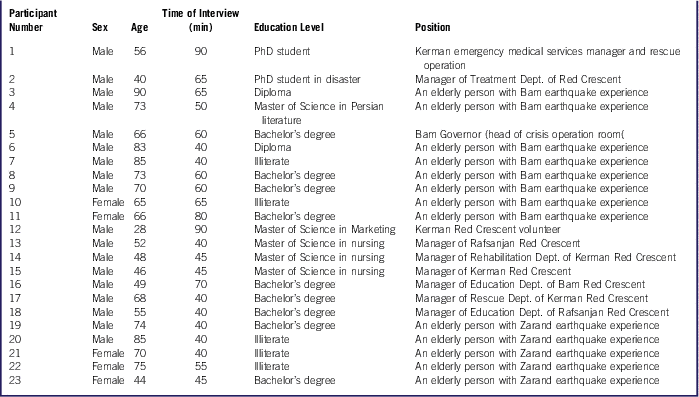
In qualitative studies, research is designed on key informants based on their experience; accordingly, in this study, participants were selected from among those who were able to communicate with the interviewer, had been affected by disasters, and had experience of receiving or providing health services in disasters.Reference Motamedi, Saghafinia and Bafarani 13 In the elderly group, the ability to communicate with the interviewer, the ability to remember the content, and how much the respondent was affected by the disaster were the top priorities. In the group of experts, the importance of the role of the individual in rescue operations, the level of operation of individual actions, and the degree of proximity to the operations were priorities for individual selection (Table 1). The selection of participants was determined by using a purposeful sampling method. The participants were included until saturation of each concept was reached and further data collection failed to contribute additional information. As a first step, elderly people who had experience with receiving health services in disasters were selected. To continue, other participants were chosen according to the needs of the study. Each interview lasted between 40 and 90 minutes depending on the condition of each participant. All of the interviews were recorded and immediately transcribed word by word. The interviews were conducted in Persian (the native language of the participants and the interviewer) by the same interviewer, transcribed verbatim, and then translated to English. Content analysis was performed on the data written in Persian, before translation.
Demographic Characteristics of the Participants (n=23)

Data Collection
The interview guide included a list of general questions used as a tool for initiating the interviews. Complementary probe questions were added when needed, and data collection and content analysis identified ideas. In-depth, semi-structured interviews were used for data collection.Reference Polit and Beck 42 ,48 Each interview was individually organized but usually began with an open question, eg, “Tell me about what happened to you after the incident? How did you feel? What did it mean to you?” or “Could you explain your experiences with respect to the health care after the incident? What did you need? How were your needs met?” Complementary probing questions were added when necessary and could be related to prior experiences of disaster, perceptions of health care, and individual needs. Interviews were guided by the main researcher, but each was checked and evaluated for interview trends and for subjects that needed to be probed by the research team. As comparisons were made between the interviews and the evolving categories, the further interview questions focused on particular categories that required additional information. The researcher thanked the participants for sharing their experiences at the end of the interviews. The sample size was determined by saturationReference Motamedi, Saghafinia and Bafarani 13 , Reference Polit and Beck 42 when the researchers concluded that collected data were repeated, new codes were not developed, or existing codes were not extended.
Data Analysis
This qualitative study was conducted by using the content analysis method.Reference Graneheim and Lundman 49 After transcribing the data, we started taking notes and marking ideas for coding. In the next phase we produced the initial codes from the data by identifying the interesting aspects in the data items that might form the basis of repeated patterns (themes) across the data set. Various codes were compared and discussed by the research team on the basis of differences and similarities and then sorted into subcategories and categories. The categories were carefully revised and debated. Finally, we defined and further refined the themes.
Data Trustworthiness
Credibility was established through field notes and memos, prolonged engagement with the participants, and revisions by the participants using member check and peer check. The use of a wide range of informants (male and female and in different health positions) is one way of triangulating via data sources that can help trustworthiness.Reference Strauss and Corbin 40 ,41 Triangulation of researchers in the research team helped to take into account different perspectives when analyzing the data. The findings and interpretations of the study were reviewed by the research team as an expert revision. Maximum variation of sampling established the credibility of the data.Reference Streubert Speziale and Carpenter 48 As an additional control for validity, a peer check on a sample of transcripts was made by 2 faculty members who were not part of the research team. In addition, to confirm the fitness of the results, they were checked by a panel of experts in the field of health and rehabilitation who did not participate in the research.
During the open coding phase, all the interviews were read several times, and key words and phrases, incidents, and facts in the text were noted. Primary codes were extracted. The codes and data were compared for similarities and differences. Categories and subcategories were developed. From the first interview, a preliminary set of codes, categories, and subcategories was created. These codes were described as the results.Reference Malterud 36 , Reference Graneheim and Lundman 49 In accordance with the methodology of content analysis,Reference Elo and Kyngäs 37 , Reference Graneheim and Lundman 49 this was performed by the same investigator for all interviews. Data validation was performed through in-depth prolonged engagement with the data.Reference Malterud 36 , Reference Elo and Kyngäs 37 , Reference Graneheim and Lundman 49 This procedure, combined with the available transcribed data and notes from the analysis process are considered to ensure trustworthiness. Also, the transcriptions and a summary of the primary results (codes and categories) were checked by the participants in order to improve validity (member check).
Ethical Considerations
Ethical consideration of the study was obtained from the Natural Disaster Research Institute in Iran. Informed consent was obtained and all participants were informed that they could refuse to participate or withdraw from the study at any time. The aim and process of the study were explained verbally and in writing to the participants, after which they gave a written or verbal statement of informed consent for participation in the study. Data collection, interview recordings, and presenting were given confidentially and made anonymous by using code numbers.
RESULTS
A total of 23 interviews were held between 2014 and 2016. Of these 23 individuals, 12 were elderly and 11 were experts. The demographic characteristics of the participants are shown in Table 1. Seven main themes were identified: the vulnerability of elderly people, physiological indexes, psychological indexes, economical indexes, religious and spiritual indexes, health indexes, and security indexes.
We obtained these categories on the basis of the content of the materials collected from the interviews and by collating similar content. Each theme is introduced, described, and supported by findings from the content analysis of the transcribed interviews. There were 3 uncategorized issues: “There is no specific protocol for the elderly,” “The need to design plans based on age care,” and “Aid organizations.”
Specific Protocol for the Elderly
The most important factor that affected the performance and workload of the medical services was the absence of a specific protocol for elderly people. The Red Crescent Society has no program for the elderly. The Red Crescent relief effort is based on environmental conditions and therefore does not consider age. For instance, one participant said “When we start to rescue, one priority is that who had the better position on Debris, young, old and child is no different. We only operate according to the conditions of the area and the debris” (participant no. 4).
The Need to Design Plans Based on Age Care
The absence of a structured procedure and organized teams was the most important issue in the health care of elderly people. We must identify the needs of older people and the equipment they need to be put in a package. Moreover, we must have a precise definition of the elderly, and it is better to identify the incident vulnerable groups.
For instance, one participant said, “Design of an intelligent system is required for relief efforts, and for the groups such as the elderly we have to organize a special plan to save them and prepare post-salvation measures” (participant no. 1).
Aid Organizations
One of the potential benefits is the arrival of various organizations such as the police and the Red Cross to help people. For instance, one participant said, “One of the potential benefits is the arrival of various organizations such as the police and the Red Cross to help people. But sometimes, due to maladministration, despite all the possibilities, unfortunately we see a lot of problems in the earthquake zone, especially for the elderly” (participant no. 6).
The Vulnerability of Elderly People
In this category we had 2 subgroups: “physical fragility” and “mental fragility.” One of the problems in elderly care in disasters is the vulnerability of the elderly due to the decline in ability to move. In fact, these people have a loss of physical strength and mental ability. Living in poor households increases the vulnerability of the elderly.
As an elderly man said, “The elderly have more sensitive spirits and less desire to live and are thus more vulnerable” (participant no. 20). A manager stated, “Elderly people are at risk in both their physical and psychological sense” (participant no. 2).
Physiological Indexes
This category had 2 subgroups: “Elderly nutrition according to their specific age requirements” and “Attention to the body of elderly people.” The elderly have special dietary needs. Earthquakes cause harm to elderly people in terms of their nutritional status. Delivering milk and yogurt to the elderly is very important. The elderly sooner than others fall under the effect of infectious agents. First the body and second the spirit are important in the elderly.
An old man stated, “[An] earthquake causes great harm to the elderly in terms of their nutrition. For example, an elderly person cannot eat each food, they generally have artificial teeth and they aren’t able to chew foods. So we have to consider special foods for this group” (participant no. 3).
Psychological Indexes
This category had 9 subgroups: “Psychological support to maintain hope and morale of elderly,” “Physical and psychological reactions,” “Services of leisure,” “Sports,” “Welfare,” “The need for psychological counseling,” “Regarding the issue of suicide,” “Aid and the elderly age and culture,” “Preserving the dignity of the elderly,” “Interaction with family members,” and “Relying on the strength and experience of elderly person.” Psychological support is very important for the elderly after an earthquake. In the first moments of an earthquake, psychological needs are very important. More attention is given to psychopathology in children because of obvious symptoms such as nocturia. However, the role of the psychologist in the care of the elderly is very important. A recreational area should be created to increase mobility in the elderly.
One participant said, “Respecting elderly people and protecting their self-esteem is very important” (participant no. 18). A Red Crescent volunteer said, “You should not throw anything to the elder. You have to give something to them with respect. You must respect them everywhere and at all times” (participant no. 13).
Economical Indexes
This category had 3 subgroups: “Prostheses requirements,” “Housing and accommodation for the elderly,” and “Attention to the occupation of the elderly.” Prosthetic appliances and assistive devices for the elderly should be considered after an earthquake. Lost aids such as glasses and walkers increase the vulnerability of old people. If accommodation is available in the camp, it should to be given to the elderly who are the most vulnerable. The elderly if financially and physically harmed are quickly disappointed. For example, an elderly farmer said, “For a farmer, perhaps agriculture is equal in value to his children” (participant no. 20). Another elderly person stated, “I lost my whole life when my sheep died after the earthquake. I went bankrupt” (participant no. 21).
Religious and Spiritual Indexes
This category had was one subgroup: “religious ceremonies.” Religious issues are important to elderly people. Adherence to religious practices is very helpful. Holding religious practices is considered even better than celebrations. Religious beliefs are the biggest deterrent from discomfort in the elderly.
For example, one participant said, “I read the Quran more than before and it is calming” (participant no. 9). Another elderly person stated, “We were very worried about the sacrifice for our family dead. The Governor said that we would sacrifice on behalf of the whole city, and this would be a great pleasure for the people” (participant no. 11).
Health Indexes
This category had 2 subgroups: “Therapeutic medicine” and “Addiction.” Medical needs are very important. Elderly adults are more vulnerable due to underlying disease such as diabetes and hypertension. Disruption in medications and treatment of conditions after the earthquake made the elderly more vulnerable. Lack of drugs or even smoking causes mental injury in the elderly.
One participant said, “In the beginning of the earthquake there were no drugs to give to patients. The elderly have more disease and need a lot of medicine after an earthquake, where all the drugs are left under the debris” (participant no. 10).
Security Indexes
After a disaster such as an earthquake, it is vital that security be established. In the first weeks after the earthquake there was chaos. First, police surrounded the town and would not allow anyone to enter with intent to steal. For instance, a participant said, “While we were burying our children, some had come to steal from us” (participant no. 19). An emergency medical services and rescue operations manager stated, “Unfortunately, we do not have a plan for the security of the first days after the earthquake” (participant no. 1).
DISCUSSION
By understanding the nuances of social vulnerability and how these vulnerabilities compound one another, we can take steps to reduce the danger to at-risk populations and strengthen community resilience overall.Reference Thomas, Phillips and Lovekamp 50 For many elderly victims, receiving nutritional support, opportunities for exercise, and the ability to continue their usual life activities were important for maintaining physical and mental health. Comprehensive care by specialized medical staff, including pharmacists, nurses, and psychotherapists, was also effectively provided. To the best of our knowledge, this study is the first attempt to assess multidimensional health care among elderly earthquake survivors some years after the event. We are aware of only one study with a focus on QoL among older people following major disasters, which was conducted by Lin et al,Reference Lin, Huang and Huang 26 although Chou et alReference Chou, Chou and Lin 29 included elderly adults in their analysis. Other studies have addressed post-earthquake QoL among the general population of survivors, but none more than 3 years after the event.Reference Lin, Huang and Huang 26 , Reference Chou, Chou and Lin 29 , Reference Wang, Gao and Zhang 31 Ceyhan and Ceyhan,Reference Ceyhan and Ceyhan 33 however, studied post-earthquake QoL in a sample of university students 6 years after the Marmara earthquake in Turkey, but did not include analysis of older people. All these studies have shown poor QoL as a consequence of earthquakes. Earthquakes decrease the physical health status of survivors by causing injury, by exacerbating chronic illnesses, and by reducing access to health services. Many studies have shown an adverse effect of disasters on psychological state.Reference Lin, Huang and Huang 26 , Reference Armenian, Morikawa and Melkonian 51 Montazeri et alReference Montazeri, Baradaran and Omidvari 52 reported that 58% of the Bam earthquake survivors suffered from severe mental health problems, 3 times higher than reported psychological distress among the general population. In fact, the elderly are among those most vulnerable to psychological distress following a disasterReference Suar, Mishra and Khuntia 53 and in great need of social support to mitigate the effects of stress.Reference Fernandez, Byard and Lin 23 Peachey et alReference Peachey 54 showed that although older people are increasingly acknowledged as a vulnerable group in emergencies, the responses of nongovernmental organizations often fail to meet their needs. There are real difficulties in service adaptation or determining whether ageism is one of the greatest barriers to the provision of appropriate services for older people. Bolin et alReference Bolin and Klenow 55 examined differential vulnerability to environmental stressors among white and black elderly and nonelderly disaster victims. The research identified the determinants of psychosocial recovery for those 4 demographic groups. A total of 431 families who were victims of a tornado were interviewed for the study. A path model of the determinants of psychosocial recovery was presented, and observations were made regarding intervention strategies for older disaster victims.Reference Bolin and Klenow 55 Our study showed that mental health was a real concern among older people in the earthquake-affected area, even many years later. The finding of higher than expected rates of self-reported poor psychological health is supported by comparison with data from the general population and the results of qualitative research on elderly Bam survivors.Reference Ardalan, Mazaheri and Naieni 21 Although a comprehensive mental health intervention was carried out within 1 year of the Bam earthquake,Reference Ardalan, Masoomi and Goya 56 no active interventional program was running in the affected area at the time of this study. This fact highlights the importance of including long-term monitoring for mental health in recovery plans after earthquakes and other disasters. Providing relief and financial support would protect against the adverse psychological impacts of extensive earthquakes.Reference Wang, Gao and Zhang 31 , Reference Ceyhan and Ceyhan 33 , Reference Altindag, Ozen and Sir 57 Environmental health has complex associations with sociodemographic characteristics and health-related factors. Some like Schroeder-Butterfill and MariantiReference Schröder-Butterfill and Marianti 58 have suggested that environmental factors have little relevance to individual well-being, while other studies emphasize the complexity of environmental influences.Reference Sirgy and Cornwell 59 In a study by Bolin et al,Reference Bolin and Klenow 60 findings regarding disaster losses, physical impacts, aid utilization patterns, kinship relations, relative deprivation, social-psychological impacts, neglect of elderly disaster victims, and differential recovery rates by age were retested on new data. Findings of previous research were, in many instances supported, although certain divergences between the current findings and previous findings were noted, particularly in rates of recovery.Reference Bolin and Klenow 60 This study found that a detailed plan to overcome existing limitations of disaster management is very necessary. The complete and correct information collected from different groups of people is needed for appropriate management in earthquake situations, because different groups of people have unique needs.
CONCLUSION
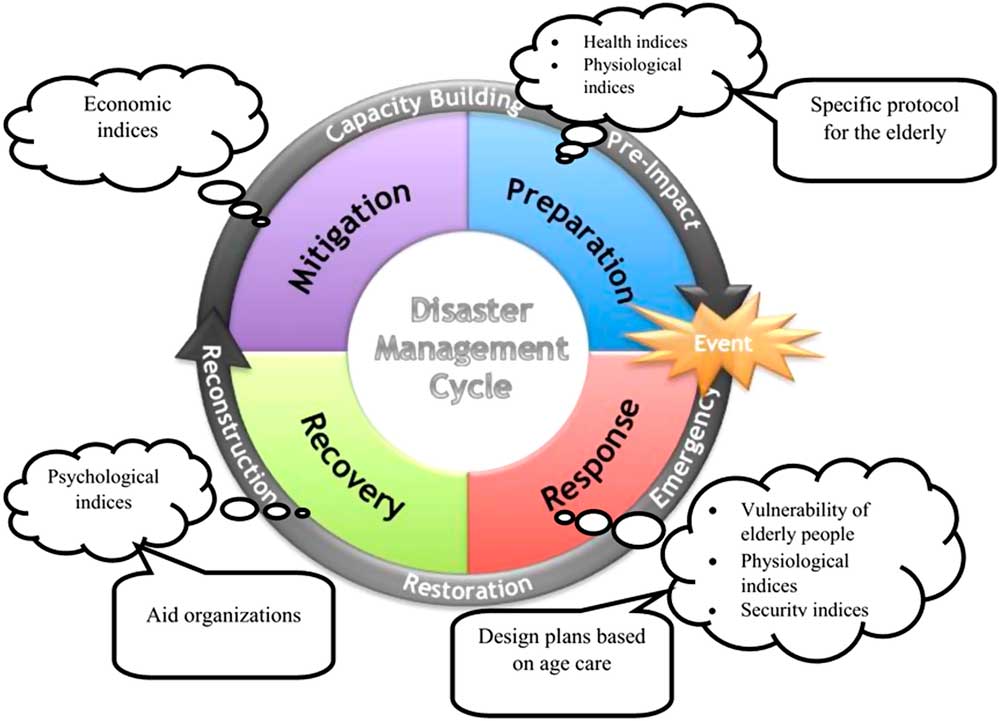
Earthquakes exact a rapid and severe toll on communities in terms of physical destruction and compromise the physical and mental health of the affected populations. The combination of destruction of the physical environment, sudden reductions in physical and mental health, and disrupted livelihoods and social relationships result in poor disaster management. This study is one of the first to document the indicators of elderly care in an earthquake. The elderly survivors of the earthquake reported better social functioning but lower psychological well-being, even many years after the event. According to the information presented here, we propose the following suggestions for the disaster cycle for elderly people in Iranian society. In the mitigation phase, the economic condition of the elderly is considerably important. In the preparation phase, we can reduce the severity of effects by considering the health status and physical condition of the elderly. Designing a special protocol for the elderly population can be helpful. In the response phase, educating the rescue team on the physical conditions and vulnerability of this group is helpful. The presence of a geriatrician on this team is necessary. The importance of elderly security at this phase is very valuable. Although security is important in all phases and groups, in this study we found that this issue is most important for the elderly. By designing plans based on age-related care, these aims are reachable. Finally, in the recovery phase, the mental and religious conditions of the elderly can be a challenge and should be considered (Figure 1). Supporting aid organizations could be of considerable help in this situation. While this study has advanced the study of the long-term outcomes for elderly people who survive earthquakes, more research is needed to compare the experiences of such survivors with those in different settings. Additionally, longitudinal studies of future events might capture important data on the effects of migration and about those who survived the earthquake but died in the years immediately following. The present findings, however, stress the importance of assessing determinants of QoL when planning for post-emergency recovery as well as for reconstruction and development programs.
The Disaster Management Cycle and the Elderly. The figure illustrates that in the mitigation phase, the economic condition of the elderly is important. In the preparation phase, the severity of effects can be reduced by considering the health status and physical condition of the elderly. In the response phase, it is helpful to educate the rescue team on the physical condition and vulnerability of this group. The importance of elderly security at this phase is very valuable. Finally, in the recovery phase, attention should be paid to the mental and religious conditions of the elderly.

Acknowledgments
Previous Publication: This article was derived from a PhD thesis (ID: 33/1394) from the Iran University of Medical Sciences.