Introduction
Bipolar disorder (BD) is a mental illness characterized by distinct periods of alterations in mood and related behaviors. Cognitive deficits and functional impairments are seen in BD, even in the euthymic phase (Bora et al., Reference Bora, Vahip, Gonul, Akdeniz, Alkan, Ogut and Eryavuz2005; Pan, Hsieh, & Liu, Reference Pan, Hsieh and Liu2011; Quraishi & Frangou, Reference Quraishi and Frangou2002). These impairments present in almost all neurocognitive domains and social cognitive function (Gillissie et al., Reference Gillissie, Lui, Ceban, Miskowiak, Gok, Cao and McIntyre2022; Lee et al., Reference Lee, Huang, Chang, Kuo, Lu, Hsieh and Tseng2022; Tsitsipa & Fountoulakis, Reference Tsitsipa and Fountoulakis2015). The default mode network (DMN) is critical for self-referential mental processes, and its dysfunction is implicated in many neuropsychiatric disorders. Abnormal function of the Default Mode Network (DMN) in Bipolar Disorder (BD) has been identified in various studies (Ishida et al., Reference Ishida, Nakamura, Tanaka, Mitsuyama, Yokoyama, Shinzato and Koike2023; Ongur et al., Reference Ongur, Lundy, Greenhouse, Shinn, Menon, Cohen and Renshaw2010). These dysfunctions can lead to deficits in attention, an increased tendency for rumination, and impaired autobiographical memory (Bora, Fornito, Pantelis, & Yucel, Reference Bora, Fornito, Pantelis and Yucel2012; Nejad, Fossati, & Lemogne, Reference Nejad, Fossati and Lemogne2013). Furthermore, disruptions in DMN activity and connectivity patterns have been observed during both resting state and cognitive tasks. Altered DMN activation, particularly in the medial prefrontal cortex and posterior cingulate cortex, has been reported during emotional and self-referential processing tasks (Martino et al., Reference Martino, Magioncalda, Huang, Conio, Piaggio, Duncan and Northoff2016; Zovetti et al., Reference Zovetti, Rossetti, Perlini, Maggioni, Bontempi, Bellani and Brambilla2020). Deviations in the connectivity between the DMN and task-positive networks may contribute to the difficulty in sustaining attention and staying on task (Whitfield-Gabrieli & Ford, Reference Whitfield-Gabrieli and Ford2012). These connectivity patterns, assessable via neuroimaging techniques, have been correlated with the cognitive and affective symptoms characteristic of BD, including mood instability and executive dysfunction (Ongur et al., Reference Ongur, Lundy, Greenhouse, Shinn, Menon, Cohen and Renshaw2010; Vargas, Lopez-Jaramillo, & Vieta, Reference Vargas, Lopez-Jaramillo and Vieta2013), and these symptoms can persist even during periods of euthymia. There is evidence that deactivation of DMN is associated with neurometabolite levels at rest, which suggests a critical role for excitatory and inhibitory neurotransmitters in exogenous task-related processes (Hu, Chen, Gu, & Yang, Reference Hu, Chen, Gu and Yang2013). However, the neurophysiological properties and task-based functional organization of the DMN are not yet fully described or understood.
Glutamate and γ-aminobutyric acid (GABA) are the major excitatory and inhibitory neurotransmitters in the brain, respectively. Glutamate is the most abundant excitatory neurotransmitter (Ramadan, Lin, & Stanwell, Reference Ramadan, Lin and Stanwell2013), and balanced cycling between glutamate and glutamine is crucial for normal brain function. GABA, the most abundant inhibitory neurotransmitter, is produced from glutamate by glutamic acid decarboxylase (GAD) within GABAergic neurons. In BD, the stability of cognitive functioning even during the euthymic phase may be influenced by the delicate balance of neural excitation and inhibition. This concept is underlined by evidence suggesting that disruptions in the excitation-inhibition equilibrium, particularly within the DMN, could underpin some cognitive symptoms of BD. Utilizing Magnetic Resonance Spectroscopy (MRS), studies have shown that the functional connectivity within the DMN, exemplified by the glutamate/GABA ratio in critical areas such as the posteromedial cortex (PMC), may be indicative of these disruptions, pointing to a neurobiological basis for the persistent cognitive challenges faced by individuals with BD (Kapogiannis, Reiter, Willette, & Mattson, Reference Kapogiannis, Reiter, Willette and Mattson2013).
Proton MRS (1H-MRS) is an empirical technique that can be used for non-invasive, in vivo measurements of endogenous metabolites. Furthermore, this approach has been sufficiently developed to enable direct evaluation of neurochemical profiles in patients with psychiatric illnesses (Maddock & Buonocore, Reference Maddock and Buonocore2012; Sosa-Moscoso et al., Reference Sosa-Moscoso, Ullauri, Chiriboga, Silva, Haro and Leon-Rojas2022). To date, MRS is the only technique that can detect endogenous GABA directly and non-invasively in the brain (Puts & Edden, Reference Puts and Edden2012). Studies have shown that regardless of medication status, patients with BD exhibit higher levels of glutamate (Glu) and glutamate + glutamine (Glx) than healthy subjects, particularly in frontal brain areas (Gigante et al., Reference Gigante, Bond, Lafer, Lam, Young and Yatham2012). However, some evidence shows that glutamate/glutamine ratio are lower in the anterior cingulate cortex (ACC) of euthymic patients with BD (euBD) than in controls (Soeiro-de-Souza et al., Reference Soeiro-de-Souza, Henning, Machado-Vieira, Moreno, Pastorello, da Costa Leite and Otaduy2015). In contrast, MRS studies on brain GABA levels in BD have yielded inconsistent results. Some evidence suggests that GABA system functionality is altered in BD (Brambilla, Perez, Barale, Schettini, & Soares, Reference Brambilla, Perez, Barale, Schettini and Soares2003), but a meta-analysis did not confirm that significant differences exist between brain GABA levels of patients with BD and those of controls (Schur et al., Reference Schur, Draisma, Wijnen, Boks, Koevoets, Joels and Vinkers2016). Given this inconsistency in the literature, new insights may be gained by measuring both glutamate and GABA within hubs of the functionally related DMN network, as this approach could clarify the role of balancing between excitatory and inhibitory neurotransmitters in BD psychopathology.
The co-occurrence of changes in glutamate and GABA levels has not been evaluated in individuals with BD, particularly during the euthymic phase. Only six studies have simultaneously measured levels glutamate and GABA, with Scotti-Muzzi et al. (Reference Scotti-Muzzi, Chile, Moreno, Pastorello, da Costa Leite, Henning and Soeiro-de-Souza2021) being the only one to report the glutamate/GABA ratio. After finding a lower glutamate/GABA ratio in the dorsal ACC of patients with BD compared to controls, the authors argued that the neurotransmitter levels are likely to be influenced by anticonvulsant and antipsychotic medications but not lithium. Nevertheless, this finding is difficult to reconcile with the majority of studies on the topic that have shown increased Glx or Glu in the ACC (Ino et al., Reference Ino, Honda, Yamada, Horita, Tsugawa, Yoshida and Moriguchi2023).
Along with the medial prefrontal cortex (mPFC)/ACC, the posterior cingulate gyrus/precuneus (PCC/PCu) is another crucial node of the DMN. The PCC/PCu is crucially involved in self-referential and reflective processes, such as episodic memory retrieval, imagery, and emotion (Sajonz et al., Reference Sajonz, Kahnt, Margulies, Park, Wittmann, Stoy and Bermpohl2010). Moreover, high regional GABA concentrations in the PCC/PCu area are associated with working memory-induced deactivation, while high glutamate concentrations in the PCC/PCu area are related to reduced deactivation (Hu et al., Reference Hu, Chen, Gu and Yang2013). Compared to controls, BD I patients exhibit decreased dynamic functional connectivity between the PCC and mPFC (Liang et al., Reference Liang, Jiang, Zhu, Shen, Xue, Li and Chen2020). Taken together, these observations suggest that an increase in the excitatory/inhibitory neurotransmitter (E/I) ratio in PCC/PCu might contribute directly to the decrease of PCC-mPFC connectivity and may be a neuropathological feature of executive-function deficits in BD (Liang et al., Reference Liang, Jiang, Zhu, Shen, Xue, Li and Chen2020). Nevertheless, the neurometabolite levels in PCC have not yet been measured using MRS.
Studies have highlighted the importance of E/I balance for prefrontal brain maturation and cognitive function. Both the glutamatergic and GABAergic systems have been shown to be dysregulated in major psychiatric disorders, such as ASD and schizophrenia (de Jonge, Vinkers, Hulshoff Pol, & Marsman, Reference de Jonge, Vinkers, Hulshoff Pol and Marsman2017), which is associated with their cognitive symptoms (Page & Coutellier, Reference Page and Coutellier2018). Therefore, our aim is to use 1H-MRS to measure the levels of excitatory glutamatergic and inhibitory GABAergic neurotransmitters in the mPFC/ACC and PCC/PCu of euBD and to explore whether the E/I balance is associated with prefrontal executive functions. We postulated that the E/I ratio in the DMN system of euBD may be higher than that in controls, and this difference may be associated with frontal cognitive dysfunction.
Methods
Subjects
Thirty-four euBD were recruited from the psychiatric outpatient department at National Cheng Kung University Hospital, while 55 individuals were recruited from the community to the healthy control (HC) group through advertisements. All participants were between 18 and 65 years of age and were recruited and evaluated by an attending psychiatrist using the Chinese version of the Mini International Neuropsychiatry Interview (Sheehan et al., Reference Sheehan, Lecrubier, Sheehan, Amorim, Janavs, Weiller and Dunbar1998). Symptom severity was evaluated by the 17-item Hamilton Depression Rating Scale (HDRS) and the 11-item Young Mania Rating Scale (YMRS); euthymic state was defined as both YMRS and HDRS equal to or lower than 7.
To determine eligibility, all patients were diagnosed by a psychiatrist according to the Diagnostic and Statistical Manual of Mental Disorders, Five Edition (DSM-V). The exclusion criteria for all participants were as follows: (1) major mental illnesses except BD for the patient group; (2) a history of head trauma, organic mental disease, or other neurological disorders; (3) inflammatory diseases, serious surgical conditions, or severe physical illnesses, such as acute coronary syndrome, kidney dialysis, or transplant; and (4) plans for pregnancy, breastfeeding, or a positive pregnancy test.
The study was conducted in accordance with the Declaration of Helsinki and was approved by the Institutional Review Board of National Cheng Kung University Hospital. All participants provided written informed consent prior to their inclusion in the study. After enrollment in the study, administration of medications, such as valproic acid or lithium mood stabilizers, was tracked.
The sample size was calculated based on an effect size reported from a previous study by Scotti-Muzzi et al. (Reference Scotti-Muzzi, Chile, Moreno, Pastorello, da Costa Leite, Henning and Soeiro-de-Souza2021), the Glx/GABA group difference was reported with a partial eta squared (η 2p) of 0.064 (alpha = 0.05, 1-beta = 0.6, as analyzed using G*Power 3.1), which resulted in the estimated number of 81 subjects in total. Aiming for a comparable effect size, we set a recruitment goal of 41 participants per group.
Image acquisition and processing
All participants were scanned using a 3.0 Tesla MRI scanner (GE Discovery MR750, GE Medical Systems, Milwaukee, WI, USA) with an 8-channel head coil in the Mind Research and Imaging Center of National Cheng Kung University. MRS was performed to assess the excitatory glutamate-glutamine (Glx) concentration. A 3-dimensional T1-weighted inversion recovery magnetic resonance imaging (MRI) scan was performed on all subjects (axial MRI 3D brain volume, echo time [TE] = 2.9 ms, repetition time [TR] = 7.7, inversion time = 450 ms, flip angle = 12°, field of view = 230 mm, matrix size = 256 × 256, and slice thickness = 1.0 mm).
1H-MRS was acquired using point-resolved spectroscopy (PRESS) (TE = 35 ms, TR = 2000 ms, spectral width = 2500 Hz, 2048 data points, 128 water-suppressed, 16 water-unsuppressed averages, and eight excitation numbers) for Glx analysis. A MeshcherGarwood point-resolved spectroscopy (MEGA-PRESS) pulse sequence (TR = 2000 ms, TE = 68 ms, NEX = 8, NS = 128, no water suppression) was performed for GABA analysis. The voxels were placed in the bilateral PCC/PCu (voxel size = 36 × 24 × 32) and mPFC/ACC (voxel size = 25 × 25 × 30), scanned for 9:20. The coordinates of mPFC/ACC voxels (Kegeles et al., Reference Kegeles, Mao, Stanford, Girgis, Ojeil, Xu and Shungu2012) and PCC/PCu voxels (Hu et al., Reference Hu, Chen, Gu and Yang2013) were used. The detailed voxel placement procedures, locations of 1H-MRS voxels, and representative spectra are shown in Fig. 1. Water-suppressed spectra of mPFC/ACC and PCC/PCu were analyzed using LCModel version 6.3-1K. In the current work, neurometabolites of interest included Glx (glutamate + glutamine) and GABA. As supplemental neurometabolites, myoinositol, glycerophosphocholine + phosphocholine, N-acetylaspartate + N-acetylaspartylglutamate (NAAx), and creatine + phosphocreatine were also collected. All the LCModel spectrum outputs were visually checked. The current study set Cramér-Rao lower bound (CRLB) threshold as <20% to ensure relatively reliable fitting results for further analysis of metabolites.
Voxel locations and placement procedures for 1H-MRS. (a) Voxel placement in the medial prefrontal cortex/anterior cingulate cortex (mPFC/ACC). (b) Voxel placement in the posterior cingulate cortex/precuneus (PCC/PCu). (c) and (d) Magnetic resonance spectroscopy (MRS) spectra indicating glutamate/glutamine complex (Glx), gamma-aminobutyric acid (GABA), N-acetyl-aspartate (NAA), and N-acetyl-aspartyl-glutamate (NAAG) peaks. 1H-MRS, proton magnetic resonance spectroscopy.

A partial volume correction was applied to account for tissue concentration in individual voxels. T1-weighted images were segmented into grey matter, white matter, and cerebrospinal fluid using Gannet (version 3.3.2) (https://github.com/markmikkelsen/Gannet), so tissue content within the MRS voxels could be assessed. This study utilized Gannet to create a mask of the voxel size and location on the segmented T1-weighted image, incorporating the spatial coordinates from the scanner. Correction of neurometabolite levels for fraction of cerebrospinal fluid in the region of interest (ROI) was performed using a MATLAB-based package, MRSParVolCorr toolbox (https://github.com/DrMichaelLindner/MRSParVolCo) (Lindner, Bell, Iqbal, Mullins, & Christakou, Reference Lindner, Bell, Iqbal, Mullins and Christakou2017).
The excitatory neurometabolite was defined as Glx (glutamate + glutamine), and the inhibitory neurometabolite was GABA. In this study, the E/I ratios in mPFC/ACC and PCC/PCu were calculated as Glx/GABA.
Wisconsin card-sorting test (WCST)
The computerized version of the WCST (consisting of 64 cards) was administered by an experienced clinical neuropsychologist to evaluate executive function. Participants were instructed to match response cards to four stimulus cards based on color, form, or number along one of the three dimensions at a time. Feedback was provided as either correct or incorrect. The subjects received no information about the dimensions beforehand. After successfully sorting ten cards in one category the rule automatically changed. Participants had to learn to sort cards according to the new category by feedback. Performance was assessed by examining indexes of completed categories and preservative errors (Stratta et al., Reference Stratta, Daneluzzo, Prosperini, Bustini, Mattei and Rossi1997; Volkow et al., Reference Volkow, Gur, Wang, Fowler, Moberg, Ding and Logan1998).
Continuous performance test (CPT)
The CPT is a psychological test to measure attention (Chen, Hsiao, Hsiao, & Hwu, Reference Chen, Hsiao, Hsiao and Hwu1998; Hsieh et al., Reference Hsieh, Chu, Yang, Yang, Yeh, Lee and Chen2005). The target stimulus may be defined either as one particular stimulus out of the available set (X task: participants were asked to respond to number ‘9’) or a particular sequence of two stimuli out of the available set (AX task: participants were asked to respond whenever the number ‘9’ was preceded by the number ‘1’). Only the AX task was used in the present study. The test session began with a 2-min practice period (repeated if participants required it) to ensure that participants knew how to perform the task correctly. During the test, numbers from 0 to 9 were randomly presented for 50 ms each, at a rate of one per second. A total of 331 trials, 34 (10%) of which were target stimuli, were presented over 5 min. Participant responses were recorded automatically on a diskette using the CPT machine (Sunrise Systems, version 2.20, Pembroke, MA, USA) (Smid, de Witte, Homminga, & van den Bosch, Reference Smid, de Witte, Homminga and van den Bosch2006). The rater monitored the performance of each participant through the computer monitor. The index of detectability (d′), which measures the respondent's ability to differentiate non-targets from targets, was used as a measure of attentional function.
Statistical analyses
The demographic and clinical characteristics of the groups of participants were compared using One-way analysis of co-variance (ANCOVA) and chi-squared test. Considering the group difference in age, sex, and years of education, one-way ANCOVA was used to evaluate group differences in neurometabolite levels in the mPFC/ACC and PCC/PCu, behavioral measures and questionnaires controlling for age, sex, and years of education. Supplementary analysis was used to test the robustness of the main finding in selected participants matched for age and sex. Shapiro–Wilk tests were conducted to examine the data distribution of metabolites. Pearson's correlation was used exploratorily to assess the association between E/I ratios in the mPFC/ACC and PCC/PCu and executive function and attention. Regression analyses were performed to explore the potential contributions of different neurometabolites and E/I ratio to cognitive functions. The threshold for statistical significance in group comparisons was adjusted using the Bonferroni correction for two brain regions (threshold p = 0.05/2 = 0.025). The threshold for exploratory association analyses was set at p < 0.05. All statistical analyses were conducted using IBM SPSS Statistics, version 22 (IBM Corporation, Armonk, NY, USA).
Results
Group demographic data
The demographic and clinical characteristics of the euBD and HC groups are summarized in Table 1. Pharmacological treatments for euBD are summarized in online Supplementary Table S1. The euBD had a higher percentage of female participants (p = 0.027), higher age (independent t test, p = 0.034), and lower number of educational years (independent t test, p = 0.004) compared to the HC group.
Demographic and clinical data

HC, healthy controls; euBD, euthymic patients with bipolar disorder.
a Without controlling for age, sex, and years of education.
Although the euBD, the subjects exhibited both subthreshold manic and depressive symptoms. Nevertheless, the association between symptom severity and metabolites in mPFC/ACC or PCC/PCu were both non-significant (p values both > 0.17).
Executive and attentional function
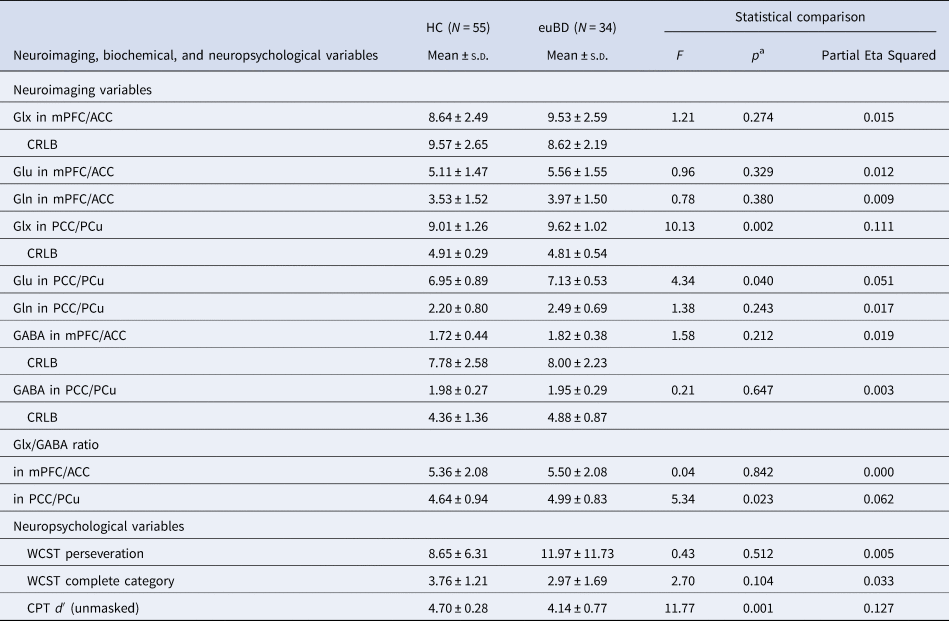
After controlling for age, sex, and years of education, the euBD group had worse attentional function (CPT unmasked d′, F = 11.77, p = 0.001) than the HC group (Table 2).
Neuroimaging and neuropsychological measurements

HC, healthy controls; euBD, euthymic patients with bipolar disorder; MRS, magnetic resonance spectroscopy; Glx, glutamate/glutamine complex; Glu, glutamate; Gln, glutamine; GABA, gamma-aminobutyric acid; mPFC/ACC, medial prefrontal cortex/anterior cingulate cortex; PCC/PCu, posterior cingulate gyrus/precuneus; CRLB, Cramér-Rao lower bound; WCST, Wisconsin card-sorting test; CPT, continuous performance test.
a Controlling for age, sex, and years of education.
Metabolite levels and E/I ratios
The Shapiro–Wilk tests indicated no significant deviations from normality across all metabolites except Glx in the PCC, where the result was marginally significant (corrected p = 0.07). Significantly higher levels of Glx were observed in the PCC/PCu of euBD than HC group (p = 0.002). Furthermore, the E/I ratio (i.e. Glx/GABA) in PCC/PCu was significantly higher in the euBD than in controls (p = 0.023) (Table 2). These findings remain statistically significant even when applying a correction for multiple comparisons across two brain regions, with the adjusted significance threshold set at p = 0.025 (0.05/2). Of note, there was no detectable association between E/I ratios in mPFC/ACC and PCC/PCu for either the BD or HC groups (both p values > 0.57). A significant sex effect on PCC/PCu E/I ratio (p = 0.009) was observed across groups, while male subjects had a significantly higher ratio. The sex effect was also observed in PCC/PCu Glx (p = 0.002). The sex difference on mPFC/ACC E/I ratio was not significant (p = 0.62) and Glx (p = 0.47) (online Supplementary Fig. S1).
Associations of Glx, GABA, and E/I ratio with cognitive function
A marginally significant negative association was observed between mPFC/ACC E/I ratio and executive function, as measured by WCST categories completed (r = −0.33, p = 0.068) in the euBD but not in the HC group (p = 0.440) (Fig. 2). Neither the levels of excitatory (Glx) nor inhibitory (GABA) metabolites were associated with executive functions in both groups (p > 0.107).
Summary figure for the study design and results. E/I, excitatory/inhibitory; euBD, euthymic patients with bipolar disorderl; HC, healthy controls; 1H-MRS, proton magnetic resonance spectroscopy; Glx, glutamate/glutamine complex; GABA, gamma-aminobutyric acid; mPFC/ACC, medial prefrontal cortex/anterior cingulate cortex; PCC/PCu, posterior cingulate gyrus/precuneus; WCST, Wisconsin card-sorting test.

We did not find a significant association between mPFC/ACC or PCC/PCu E/I ratio and attentional function, as measured by CPT d′ (unmasked), in both groups (p > 0.179). However, a marginally significant correlation was identified between the mPFC/ACC level of excitatory (Glx) metabolites and attentional function in the euBD (r = −0.34, p = 0.057) but not in the HC group (p = 0.111). A significant correlation was identified between the PCC/PCu level of excitatory (Glx) metabolites and attentional function in the HC group (r = 0.29, p = 0.031) but not in the euBD (p = 0.641). The levels of inhibitory metabolites were not associated with attentional function (p values all > 0.325).
Prediction of cognitive function from Glx, GABA, and E/I ratio
Partial volume corrected metabolite level (Glx in mPFC, Glx in PCC, GABA in mPFC, and GABA in PCC/PCu) were entered the model predicting executive function (WCST categories completed), but none of the metabolite measurements was a significant predictor of function in either the HC or BD groups. In contrast, analysis of E/I ratios in mPFC and PCC showed that E/I ratio in mPFC was a marginally significant predictor of executive function (beta = −0.33, p = 0.078) in euBD. The E/I ratios did not predict attentional function performance (CPT d′).
Sensitivity analysis
After matching BD and HC individuals by age and sex, 23 euBD and 23 HC individuals were compared. This analysis revealed similar results that higher manic and depressive symptoms (p values < 0.037), marginally worse attentional function (CPT unmasked d′, p = 0.080), higher Glx in the PCC (p = 0.024), and marginally higher E/I ratio in PCC (p = 0.060) in the BD group compared to HC group.
Discussion
In this study, we compared the levels and ratios of excitatory glutamate (Glx) and inhibitory GABA in the DMN hub regions (mPFC/ACC and PCC/PCu) of euBD and controls. Previous MRS-based research have shown differences in neurometabolite levels of patients with BD (Dager, Corrigan, Richards, & Posse, Reference Dager, Corrigan, Richards and Posse2008; Yildiz-Yesiloglu & Ankerst, Reference Yildiz-Yesiloglu and Ankerst2006). Our data showed that patients with BD had a higher E/I ratio in the PCC/PCu but not in mPFC/ACC. Also, we observed a significantly higher levels of Glx in the mPFC/ACC in patients with BD, consistent with previous literature (Dager et al., Reference Dager, Corrigan, Richards and Posse2008). Regarding the relationship between neurometabolite levels and cognitive function in euBD, we found that a higher E/I ratio in mPFC/ACC had a trend of negatively associated with executive function. Yet only the E/I ratio in mPFC/ACC could potentially predict executive function. Individual Glx nor GABA levels in either brain region were not predictive of cognitive performance. These findings are in line with the overall conclusion of a previous review that optimal excitatory and inhibitory neurometabolite balances are essential for normal functioning of most complex brain processes, with imbalances contributing to the pathobiology of neurodevelopmental disorders, neurodegenerative/neurological disease, as well as acute neurological disorders (Sears & Hewett, Reference Sears and Hewett2021).
The Glx/GABA ratio, as measured by MRS, is considered to be directly reflective of the brain E/I balance. Improper balance between excitatory and inhibitory function has been linked to the dysregulation of information through opposing mechanisms that underlie symptoms in psychiatric disorders, such as ASD and schizophrenia (Sohal & Rubenstein, Reference Sohal and Rubenstein2019). While alterations in glutaminergic or GABAergic neurotransmission have consistently been identified in both schizophrenia (Duarte & Xin, Reference Duarte and Xin2019; Marsman et al., Reference Marsman, Mandl, Klomp, Bohlken, Boer, Andreychenko and Hulshoff Pol2014) and mood disorders (Brady et al., Reference Brady, McCarthy, Prescot, Jensen, Cooper, Cohen and Ongür2013; Dager et al., Reference Dager, Corrigan, Richards and Posse2008), our study is among the first to probe the E/I ratio in BD. Furthermore, this is the first study to investigate the E/I ratio in key regions of a brain functional network (i.e. the anterior and posterior hubs of DMN) in euBD.
Imbalances in excitatory and inhibitory neurotransmitters in pyramidal neurons of the PFC have been linked to various PFC-dependent psychiatric symptoms, such as impaired cognition, difficulties in social interaction, and anxiety (Ferguson & Gao, Reference Ferguson and Gao2018). However, due to the heterogeneity of study designs and results, the findings of relationships between neurotransmitters and cognitive dysfunction in mental illness remain inconsistent (Reddy-Thootkur, Kraguljac, & Lahti, Reference Reddy-Thootkur, Kraguljac and Lahti2022). Nevertheless, it appears that the E/I balance may play a crucial role in cognition-related functional networks. As such, our study suggests that the E/I balance in mPFC/ACC is specifically related to executive function. The neurocognitive function is crucial for behavioral outcomes not only in BD but also in other major psychiatric illnesses, such as schizophrenia. Thus, our study suggests that E/I imbalances may lead to poor social functioning in patients with BD due to neurocognitive impairments, even during the euthymic phase.
While we observed a significantly higher E/I ratio in the PCC/PCu of euBD compared to controls, we did not observe a significant difference between the groups in terms of E/I ratio in the mPFC/ACC. Therefore, the E/I balance in the PCC/PCu may be a direct predictor of intrinsic functional connectivity of DMN, while the E/I balance in the mPFC/ACC is not. A possible explanation for this difference is that PCC/PCu E/I balance may contribute to cognitive function via intrinsic PCC-mPFC connectivity within the DMN. Compared with controls, a study suggests that patients with BD showed less dynamic functional connectivity (dFC) between the PCC and mPFC, which has been positively associated with executive function as measured by verbal fluency (Liang et al., Reference Liang, Jiang, Zhu, Shen, Xue, Li and Chen2020). A diminished temporal variability of functional connectivity in PCC-mPFC in BD may therefore be a neuropathological feature of the executive function deficit in BD. This may partly explain why an altered E/I ratio was observed in PCC/PCu and why there was a unique association of higher mPFC E/I ratio with poor executive function. Nevertheless, we did not observe a direct association of E/I ratios in the mPFC/ACC and PCC/PCu. Further functional connectivity studies focused on the DMN will be needed to examine this hypothesis in detail.
We may have inadvertently uncovered a significant sex effect in our data when we controlled for potential confounding factors. As such, the significantly higher PCC/PCu E/I ratio in euBD was mainly driven by male subjects, particularly those with higher Glx levels. A similar trend was also observed in the HC group. However, this phenomenon was not observed in the mPFC/ACC region. In line with these findings, the glutamate system is known to display brain region-specific sex-differences, with males exhibiting significantly higher Glx, Glu, and GABA concentrations in the PFC (O'Gorman, Michels, Edden, Murdoch, & Martin, Reference O'Gorman, Michels, Edden, Murdoch and Martin2011). In addition, blood glutamate levels of females vary across the menstrual cycle and are negatively associated with the levels of female sex hormones. It is therefore possible that males and females have different states of E/I balance. Our results imply that the imbalance of E/I ratio in the posterior DMN network may be more prominent in male euBD. However, our dataset contained relatively few male subjects, so further studies with larger sample sizes with more male subjects are needed to confirm the findings.
The current study is the first to employ both glutamate (Glx) and GABA levels in euthymic patients with bipolar disorder, targeting on the hub of DMN. The strength of this novel approach lies in its potential to unravel the complex interactions between excitatory–inhibitory neurotransmitter systems in the context of the DMN, a network known to be involved in key pathologies in BD, including cognition, self-referential thinking, and emotion regulation. Concerning limitations, the cross-sectional nature of our study restricts our capacity to infer causation. Also, the current small sample size in euBD group with marginally skewed distribution in PCC Glx limited the statistical power concerning the relationship between neurometabolites and cognitive function. Additionally, our research is limited by imbalances of sex and age in our study groups. Previous work has suggested that sex and age may be associated with region-specific differences in glutamate (Chang, Jiang, & Ernst, Reference Chang, Jiang and Ernst2009) and GABA levels (Gao et al., Reference Gao, Edden, Li, Puts, Wang, Liu and Barker2013). Thus, we controlled for these factors in all of our analyses and conducted sensitivity analyses using a subsample to confirm our results. Finally, studies on animal models have shown that mood stabilizers can exert behavioral effects by altering synaptic E/I balance, so the use of medications by patients with BD in our study may confound our results. A future study to compare between medicated and medication-free patients with BD may be necessary to delineate the potential influence of mood stabilizers on E/I balance.
Overall, our study suggests that the Glx/GABA ratio in mPFC and PCC could serve as potential biomarkers for euBD. This ratio is also associated with cognitive functions, and it appears to be a better indicator than single neurometabolites. In future studies, we plan to further investigate the relationship between E/I balance, brain function, and BD neuropathology by examining the functional connectivity within the DMN and with other functional networks. Continued work on this topic is expected to provide a deeper understanding of the relationship among neurotransmitters, brain networks, and BD symptoms.
Supplementary material
The supplementary material for this article can be found at https://doi.org/10.1017/S0033291724001326.
Acknowledgements
We thank the Mind Research and Imaging Center (MRIC) at National Cheng Kung University for consultation and instrument availability. The MRIC is supported by the National Science and Technology Council.
Funding statement
This work was supported by the National Science and Technology Council, Taiwan (MOST 106-2320-B-006-040, MOST 107-2320-B-006-071, MOST 107-2628-B-006-005-, MOST 108-2320-B-006-047-MY3, MOST 108-2314-B-006-045, MOST 108-2320-B-006-004-, MOST 108-2321-B-006-026-MY2, MOST 108-2628-B-006-004-, MOST 109-2628-B-006-004-, MOST 110-2314-B-006-061-MY3, and NSTC 111-2628-B-006-010-MY3) and National Cheng Kung University Hospital (NCKUH-10902014).
Competing interests
The funding institutions had no further role in the study design, the collection, analysis and interpretation of data, the writing of this paper, or the decision to submit it for publication. The authors report no financial relationships with commercial interests. The authors are indebted to the research participants.