INTRODUCTION
The sei whale, Balaenoptera borealis, (Lesson, 1828) is found in all oceans but tends to remain in more temperate waters than other rorquals. This species is believed to migrate considerable distances between higher latitude summer grounds and lower latitude winter grounds (Rice, Reference Rice1998). Two subspecies, one in the northern hemisphere and the other in the southern hemisphere, were identified by Tomilin (1946, in Rice, Reference Rice1998). The southern hemisphere subspecies known as Balaenoptera b. schlegellii (Flower, 1865) is found between the subtropical convergence and the Antarctic convergence during the austral summer (Rice, Reference Rice1998). Only large individuals (presumably adults) have been found south of the Antarctic convergence (Lockyer, Reference Lockyer1977).
Sei whales have a reputation for their unpredictable occurrence, appearing in an area followed by their disappearance and subsequent absence for many years (Tonnesen & Johnsen, Reference Tonnesen and Johnsen1982). Best & Lockyer (Reference Best and Lockyer2002) attribute this reputation to observations made on or close to feeding grounds. These authors suggest that migrations between feeding and breeding grounds are pronounced and consistent (Best & Lockyer, Reference Best and Lockyer2002).
Whaling operations on this species started in the southern hemisphere at the end of the nineteenth century and continued until 1979 when the species was given full protection (Horwood, Reference Horwood, Perrin, Würsig and Thewissen2002).
In the southern hemisphere sei whales were caught in waters off Brazil, Chile, Peru, South Africa and Isla Georgias del Sur/South Georgia. Between 1960 and 1970, over 110,000 sei whales were killed by the pelagic fleets in Antarctic waters (Horwood, Reference Horwood, Perrin, Würsig and Thewissen2002).
It has been estimated that the exploited population size in Area II of the Antarctic (south-east of the American continent, between longitudes 60°W and 0°) in 1974 had declined to 58% of their 1961/1962 levels of abundance (Chapman, 1974 in Tillman & Breiwick, Reference Tillman and Breiwick1977). The extent to which stocks have recovered since they gained full protection is uncertain (Reeves et al., Reference Reeves, Smith, Crespo and Notarbartolo di Sciara2003). Little has been published on sei whales from the south-western Atlantic (Matthews, Reference Matthews1938; Paiva & Grangeiro, Reference Paiva and Grangeiro1970; Budylenko, Reference Budylenko1977; Lichter & Hooper, Reference Lichter and Hooper1983; Barros, Reference Barros1991; Zerbini et al., Reference Zerbini, Secchi, Sicilliano and Simoes-Lopes1997; Secchi et al., Reference Secchi, Dalla, Kinas, Santos, Zerbini, Bassoi and Moreno2003; McDonald et al., Reference McDonald, Hildebrand, Wiggins, Thiele, Glasgow and Moore2005). The present status of this species in the south-western Atlantic is unknown. The purpose of this paper is to report new information on the occurrence of sei whales in this region.
MATERIALS AND METHODS
Sightings of sei whales were opportunistically collected during studies on southern right whale (Eubalaena australis) at Golfo San Jorge (46°06′S 67°38′W), Patagonia, Argentina, where all cetaceans encountered were recorded and during a seabird study on the Islas Malvinas/Falkland Islands in 2004–2007.
In this study, sei whales were positively identified from the external morphology described in the literature using the head ridge and the swimming pattern (Leatherwood & Reeves, Reference Leatherwood and Reeves1983; Horwood, Reference Horwood1987, Reference Horwood, Perrin, Würsig and Thewissen2002; Reeves et al., Reference Reeves, Stewart, Clapham and Powell2002), and using available pictures of the animals' sightings and confirmed later on by whale experts. Only confirmed records are included in this paper for a total of 23.
Land-based observations were made from a fixed point located at 46°14′S 67°36′W at a height of 20 m above sea level. Scan sampling of 5-minute intervals were conducted with binoculars to assess the presence of the whales in the study area. Behavioural data were collected using the ad libitum method (Altmann, Reference Altmann1974).
Two sightings from Islas Malvinas/Falkland Islands were made from an aircraft flying at an altitude of 100 m, with a constant relative speed of approximately 240 km h−1, and from land (Settlement, Isla Goycoechea/New Island). In order to re-sight the groups, the aircraft returned to the first sighting position. The sea state was Beaufort scale 1, the visibility was good for both sightings, and the water was clear.
For the purpose of this paper, a ‘group’ is defined as an aggregation of whales in close association and generally coordinating their surfacing and diving behaviour and direction of movements.
For this paper, behaviour was classified into two categories: travelling and feeding. Travelling was defined as whales swimming consistently in one direction at a moderate to fast speed. In this paper, the term ‘feeding’ follows Heithaus & Dill's (Reference Heithaus, Dill, Perrin, Würsig and Thewissen2002) definition of ‘batch’ feeding. This is a tactic employed to consume a large number of prey items in a single feeding event. There are two basic types of batch feeding: skimming and engulfing.
RESULTS AND DISCUSSION
Group size
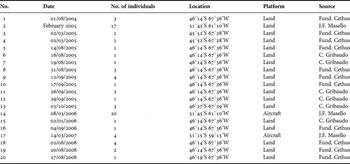
A total of 20 sightings of 72 whales was recorded between August 2004 and August 2008 (Table 1). Sei whales were sighted in February, March and May (austral summer and autumn months), and from August to October (austral winter and spring months).
Sightings of sei whales in the south-western Atlantic during the present study.

Note: land location refers to the observation site, not the sighting itself and whales were located less than 3 nautical miles from observers. Fund., Fundación.
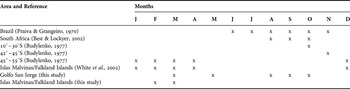
Summarized previous records of South Atlantic sei whales by area and peak time of occurrence.

More than half (65%; N = 13) of the reported sightings in southern Patagonia occurred from August to September. However, this result could be biased due to the fact that our efforts were directed to collecting information on southern right whales during the time they occur in the area.
Sei whale group size ranged from 1 to 4 individuals (X¯ = 1.94, SD = 1.21), with 55.6% (N = 10) of the sightings containing just a single whale.
The largest aggregation were observed close to Isla Goycoechea/New Island (51°45′S 061°10′W) (Islas Malvinas/Falkland Islands) in February 2005 and on 8 March 2006. For the same area, White et al. (Reference White, Gillon, Black and Reid2002) reported that group size ranged from one to three animals.
Based on historic data, the most common group size for sei whales south of 60° was one to four individuals, with a maximum of ten (Lockyer, Reference Lockyer1977). It is also reported that during migration, individuals from this species either travel alone or in small groups (Reeves et al., Reference Reeves, Stewart, Clapham and Powell2002).
Feeding behaviour
As noted above, there are two basic types of batch feeding: skimming and engulfing. Skimmers swim through concentrations of zooplankton, either at the surface or in the water column, with their mouth open, filtering water through their fine baleen plates, which trap prey. ‘Engulfers’ (also known as ‘gulpers’) engulf large amounts of water and prey and then filter the water back through their baleen plates. ‘Lunge feeding’ is one of the most common tactics of rorquals feeding near the surface and may take several forms. During a typical lunge, a whale surfaces with its mouth open to capture prey near the surface. Lunge feeding may be conducted singly or in groups, and in combination with various prey concentration tactics (Heithaus & Dill, Reference Heithaus, Dill, Perrin, Würsig and Thewissen2002).
We observed feeding behaviours on three separate occasions. In February 2005, at 51°45′S 61°10′W, 17 adult sei whales (but no calves) were observed in waters with a bottom depth of 100 m, associated with approximately 1000 seabirds (black-browed albatross, Thalassarche melanophris; imperial shag, Phalacracorax atriceps albiventer; thin-billed prion, Pachyptila belcheri and sooty shearwater, Puffinus griseus). The prey on which the whales were feeding could not be identified. Synchronicity in lunge-feeding behaviour was observed. On 8 March 2006, 20 adult sei whales (but no calves) were observed from the air at 51°45′S 61°10′W. Whales were lunge-feeding and swimming in circles, associated with hundreds of seabirds (black-browed albatross, and thin-billed prions). No apparent reaction to the aeroplane was observed. The prey could not be identified. On 2 August 2008, four individuals, including a juvenile were observed at 46°14′S 67°36′W from land. The individuals swam in circles, at a slow speed, and bubbles were observed on the surface (J. Belgrano, personal observation). Three whales emerged in the middle of these bubbles side by side with mouths open. Kelp gulls, Larus dominicanus, were associated with the whales but the prey could not be identified.
Feeding behaviour of this species was also summarized by Nemoto (Reference Nemoto1959) and Horwood (Reference Horwood1987). The sei whale is described as both a skimmer and gulp-feeder. Whales feed at any time that there is a sufficiency of suitable prey. Feeding mainly takes place in polar regions during summer. However, when food is available on the wintering grounds it is also taken (Best, Reference Best1967). They feed mainly on copepods, but sei whales appear to be very selective based on the broad feeding strategies employed by whales. The prey needs to occur in aggregations and in surface waters. Our observations show that Islas Malvinas/Falkland Islands region is a feeding ground for this species. This is consistent with Horwood's (Reference Horwood, Perrin, Würsig and Thewissen2002) contention that sei whales spend the summer months feeding in the sub-polar higher latitudes, and from December to April at 45°S–55°S (Budylenko, Reference Budylenko1977). Our observations are also consistent with reports of aggregations of individuals on feeding grounds (Reeves et al., Reference Reeves, Stewart, Clapham and Powell2002). In the Islas Malvinas/Falkland Islands, baleen whales feed on small shoaling fish and swarms of planktonic crustaceans, which could include lobster krill (Bonner, Reference Bonner1986). The sei whale catches from Brazilian stations showed that they were not feeding (Paiva & Grangeiro, Reference Paiva and Grangeiro1970), although Best (Reference Best1967) reported that some feeding occurs in the winter months in South African waters.
Travelling
During all sightings in Golfo San Jorge, sei whales were travelling, except during one observation on 2 August 2008. Six sightings were of individuals travelling north, while eight were of individuals/groups, heading south. For the Golfo San Jorge area, the largest group consisted of four individuals (Table 1).
Migration frequently involves trade-offs between feeding and another factor such as reproduction. Baleen whales sometimes feed for a relatively short period of time in highly productive, high-latitude waters and then fast during the rest of the year while moving to, and spending time in, low-latitude breeding grounds (Heithaus & Dill, Reference Heithaus, Dill, Perrin, Würsig and Thewissen2002).
In the South Atlantic Ocean there is evidence from ‘Discovery’ tagging linking sei whales off the coast of Brazil with the western half of the Area II Antarctic whaling ground (Brown, Reference Brown1977). Brown (Reference Brown1977) also reported that the movements of sei whales in the Southern Ocean are similar to those of fin and blue whales in the same waters, with some individuals returning to the same region of the feeding grounds year after year, and others showing more dispersed movements.
The individuals observed in Golfo San Jorge in this study from August to October could be on migration to the south as reported by Best & Lockyer (Reference Best and Lockyer2002) for sei whales off the western coast of South Africa. They reported a marked structure to the migration, with pregnant females and immature whales of both sexes migrating first, followed by mature males, and finally lactating females and calves. In October and November (the austral spring months), sightings were reported between 10° and 30°S and between 42° and 45°S, respectively, by whalers sailing to the Antarctic (Budylenko, Reference Budylenko1977). Sei whales off Brazil were taken from June to November, with most taken from July to September (the austral winter months). However, the captures of sei/Bryde's whales were not distinguished in the catch records of Costinha until 1967 (Da Rocha, Reference Da Rocha1983). In October, they would start migrating towards the south (Paiva & Grangeiro, Reference Paiva and Grangeiro1970).
An observation from Golfo San Jorge in May (Table 1) could be that of an individual that was migrating north. Data presented below suggest that Golfo San Jorge may be an important area in the migration of this species. Schwarz (Reference Schwarz1934), on board the whaling vessel ‘Lancing’, reported that Balaenoptera borealis were frequently observed around Islas Malvinas/Falkland Islands at the end of December through February/April during their migration to the north. Schwarz (Reference Schwarz1934) contended that sei whales swam to the west until they reached Río Gallegos, Santa Cruz Province, Argentina and then followed the Patagonian Sea coast, swimming 10–20 nautical miles offshore until Golfo San Jorge, where they could be seen swimming in every direction. Schwarz (Reference Schwarz1934) stated that sei whales were very frequently observed in Golfo San Jorge, on some days in their ‘thousands’, and between Comodoro Rivadavia (41°51′S 67°22′W) and Cabo Blanco (47°12′S 65°44′W). He also reported that this was the most frequently hunted species along the Patagonian coast (Schwarz, Reference Schwarz1934). Our data on distribution and movements are consistent with these observations.
For the Antarctic, Gambell (Reference Gambell1968), based on the catch per unit effort (CPUE) of whaling from the 1963/1964 to 1964/1965 seasons, showed few sei whales from October to December, with a peak CPUE from January to March. However, the presence of this species is reported at 45°S–55°S from December to April (the austral summer and autumn months) (Budylenko, Reference Budylenko1977). Harmer (Reference Harmer1931) and Matthews (Reference Matthews1938) reported that catches from Georgias del Sur/South Georgia over the period 1913 to 1931 were taken mainly in March with a few in February and April. Gambell (Reference Gambell1968) reported that the catches during 1963–1965 showed peaks during January and lower numbers in February and March.
For Islas Malvinas/Falkland Islands, White et al. (Reference White, Gillon, Black and Reid2002) reported that the numbers of sei whales recorded in the area increased in November and remained high until April, with only three records outside this period, and no records between August and October. Most of the records were made around Isla Soledad/East Falkland, in particular between Cabo Corrientes /MacBride Head and the Isla de los Leones Marinos/Sea Lion Island.
Whaling
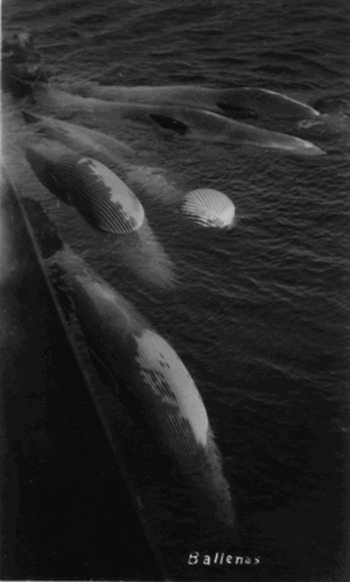
The sei whale was not exploited until the era of modern whaling at the end of the 19th Century. Before pelagic whaling began in the 1923/1924 season, processing vessels operated near land stations at Islas Malvinas/Falkland Islands, Shetland del Sur/South Shetland and Orcadas/South Orkney. The same approach was used during the capture of sei whales by Weigel, Bohnen and Cia in Golfo San Jorge (46°07′S 67°38′W), Patagonia, Argentina, between 1929 and 1930 (Hart, Reference Hart2002) (Figure 2).
Map showing the sightings of Balaenoptera borealis during the present study.

Five sei whales caught by a whaling vessel in Golfo San Jorge around 1930. Photograph courtesy of W. Roil.

Budylenko (Reference Budylenko1977) reported that mature animals of both sexes constitute the basis of schools. While males predominate, females in early stages of pregnancy occur in warm water zones on the breeding grounds. Immature animals with females accompanied by suckling calves and males are reported at latitudes 30°–50°S, and in high latitudes of the Antarctic on the primary feeding grounds (Budylenko, Reference Budylenko1977). In these observations, mature animals predominated, including pregnant or non-breeding females (Budylenko, Reference Budylenko1977). The USSR whaling fleet reported that catches of sei whales were mainly of females (up to 75%) and that the numbers of non-breeding animals and immatures were insignificant near Islas Malvinas/Falkland Islands (Ivashin, 1972 in Budylenko Reference Budylenko1977). Around Islas Malvinas/Falkland Islands, the whaling vessel ‘Yuri Dolgorukiy’ killed 125 sei whales in three seasons (1962, 1966 and 1971), of which 79% were females. For the South Atlantic, the same vessel reported 6684 sei whales captured from 1961 to 1975 (Allison, Reference Allison2009). The International Whaling Statistics for 1937 to 1966 reported that near Isla Georgias/South Georgia Island, the catches consisted mainly of large females. However, Matthews (Reference Matthews1938) reported for this area that the catches consisted mainly of large males. The ‘Admiralen’, a factory ship accompanied by two whale catchers, arrived to Isla Goycoechea/New Island on 24 December 1905 for the first time (Strange et al., Reference Strange, Catry, Strange and Quillfeldt2007). These authors also noted that the ‘Admiralen’ remained at anchor for a month, during which 40 whales were caught. The whalers then moved to Georgias del Sur/South Georgia. On 27 February 1906 they were back at Isla Goycoechea/New Island, where whaling brought in sei whales only (Strange et al., Reference Strange, Catry, Strange and Quillfeldt2007). Early in April 1906 the ‘Admiralen’ left Isla Goycoechea/New Island bound for Norway (Strange et al., Reference Strange, Catry, Strange and Quillfeldt2007). Although a new licence was negotiated for the following season, the expedition did not return to Isla Goycoechea/New Island, but directed their operations around Georgias del Sur/South Georgia (Strange et al., Reference Strange, Catry, Strange and Quillfeldt2007).
The International Whaling Statistics reported from the 1909/1910 to 1913/1914 seasons catches of 103 and 255 sei whales respectively for the Islas Malvinas/Falkland Islands area.
In 1908, Isla Goycoechea/New Island became the site for a further attempt at whaling in the Islas Malvinas/Falkland Islands, when a lease was obtained by Messrs Salvensen & Co. of Leith, Scotland, for the operation of the first and last land-based whaling station here (Strange et al., Reference Strange, Catry, Strange and Quillfeldt2007). The Isla Goycoechea/New Island whaling station was a fairly large operation, with a factory employing some eighty men. In 1916, the station was closed and moved to Georgias del Sur/South Georgia.
Our study confirms previous historic records, from whaling activities, of the regular occurrence of sei whales off the Argentinean coast. It is also possible to consider that potential climate shifts might be affecting the distribution of cetaceans as proposed by Whitehead et al. (Reference Whitehead, McGill and Worm2008), however, our data does not allow testing this hypothesis. Although further studies are necessary in order to better assess the status of sei whales in the south-western Atlantic, our data might indicate a slow recovery in the region from its reduction by whaling. However, given the notably erratic unpredictability in the occurrence of this species, we cannot rule out the possibility that our sightings represent a temporary distributional shift from elsewhere. Either way, this information, and continued research in the area, should prove useful for the conservation of the species in this area and more generally in the southern hemisphere.
ACKNOWLEDGEMENTS
The authors would like to thank the following people and institutions for their support during fieldwork: F. Barrionuevo and family, Caleta Olivia Town Council, C. Calió, Coop. T. Trabajo Trans. La Unión Ltda, Dirección de Fauna y Recursos Naturales, Consejo Agrario—Prov. de Santa Cruz, M. Failla, A. Freile, Grand Hotel Caleta Olivia, P. Moy, Prefectura Naval Argentina (Caleta Olivia), Subsecretaría de Medio Ambiente—Prov. de Santa Cruz, V. Reyes Reyes. We would also like thank to P. Best, P. Clapham, D. Fertl and N. Hodgins who kindly reviewed the earliest version of the manuscript and two anonymous referees. Thanks also to Cherry Allison (IWC Secretariat) for helping us with the information on the capture of sei whales in the South Atlantic and D. Tormosov who provided the data from the IWC and B. Roil who provided the historical picture (www.instantospatogonicos.com). J. Belgrano received financial support from the International Fund for Animal Welfare; J.F. Masello was logistically supported by the New Island Conservation Trust.