Introduction
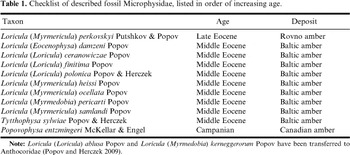
Microphysidae (Hemiptera: Heteroptera) is a small family of diminutive, predatory plant bugs found predominantly on tree bark but also in decaying wood or wet plant litter. Microphysids are poorly known because of their small size (1.5–3 mm), cryptic habitats, and limited distribution (Schuh and Slater Reference Schuh and Slater1995). Recent species appear to have a Holarctic distribution with some putative South African exceptions (Schuh and Štys Reference Schuh and Štys1991; Schuh and Slater Reference Schuh and Slater1995). The Recent fauna is composed of approximately 30 species in either five (e.g., Schuh and Slater Reference Schuh and Slater1995) or four genera (Popov et al. Reference Popov, Herczek and Kanja2008, followed here). Until now, the fossil record for the family consisted of 10 species described from Eocene Baltic and Rovno ambers, all documented between 2003 and 2009 (Table 1).

Note:Loricula (Loricula) ablusa Popov and Loricula (Myrmedobia) kerneggerorum Popov have been transferred to Anthocoridae (Popov and Herczek Reference Popov and Herczek2009).
We provide documentation of the first Mesozoic Microphysidae based on two males preserved in Late Cretaceous amber from the uppermost Foremost Formation near Grassy Lake, southern Alberta (49°50′N, 111°42′W). Pike (Reference Pike1995), McKellar et al. (Reference McKellar, Wolfe, Tappert and Muehlenbachs2008), and McKellar and Wolfe (Reference McKellar, Wolfe and Penney2010) reviewed the biodiversity of this amber deposit and its geological setting, drawing together data from regional geology, palaeoentomological and palaeobotanical records, Fourier-transform infrared spectroscopy of amber, and stable isotope composition of H and C in amber. The resulting interpretation is that Grassy Lake amber was formed approximately 78–79 million years ago by conifer resin (likely from Parataxodium Arnold and Lowther (Cupressaceae)) and deposited within a lagoon or salt marsh setting with little preburial transport.
Materials and methods
Amber specimens were embedded in epoxy, slide-mounted, and polished into thin sections for optimal viewing and long-term preservation. This technique largely follows Nascimbene and Silverstein (Reference Nascimbene, Silverstein and Grimaldi2000) for preparing fragile amber. The thickness of the specimens limited the use of compound microscopy in this study.
Descriptive terminology generally follows Schuh and Slater (Reference Schuh and Slater1995) and Štys (Reference Štys1962). Anatomical abbreviations include “tr.” for transverse, and “long.” for longitudinal. Measurements in the description are of the holotype and, in parentheses, the paratype. All measurements were made using an ocular micrometer on an Olympus SZ60 stereomicroscope; supplemental observations were made with an Olympus BX51 compound microscope. Photomicrographs were prepared using Microptics fiber optic flashes and a Nikon D1X camera attached to an Infinity K-2 long-distance microscope. A Zeiss Axio Imager.A1 compound microscope was used for higher magnification photomicrographs (“b.f.” and “d.f.” denote bright field and dark field photographs, respectively).
- Oval body outline; hemelytra with convex anterior margin and no clear distinction between corium and membrane; cuneus indistinct, exocorium broad and reaching apex of cuneus
Tytthophysa Popov and Herczek
- Oblong body outline; hemelytra with nearly straight anterior margin and distinct corium, cuneus, and membrane; exocorium narrow and reaching costal fracture
2
- Hemelytra with single, large, closed cell in membrane, bordered by thick veins and with short, clavate processus corial; endocorium with single subhyaline cell; metacoxae widely separated; labial segment IV shortest
Popovophysa gen. nov.
- Hemelytra with variable closed cells in membrane, typically with elongate processus corial, and often with additional longitudinal veins; endocorium without subhyaline cells; metacoxae close to each other; labial segment I typically shortest (Loricula Curtis)
3
- Labium thin and reaching middle of mesosternum; apex of labial segment II near or reaching base of head
Loricula (Loricula) Curtis
- Labium thickness variable and only reaching procoxa; apex of labial segment II not reaching base of head
4
- Labium thick and reaching base of procoxa; apex of labial segment II positioned at midlength of compound eye
Loricula (Myrmedobia) Bärensprung
- Labium thin and reaching midlength or apex of procoxa; apex of labial segment II not reaching base of head
Loricula (Myrmericula) Popov
Key to the fossil genera and subgenera of Microphysidae (modified from Popov and Herczek (Reference Popov and Herczek2009), which provides keys to all known fossil species)
Results
Cimicomorpha: Microphysidae
Popovophysa McKellar and Engel gen. nov.
Type speciesPopovophysa entzmingeri McKellar and Engel sp. nov.
Etymology
The new genus name is a combination of Popov, in honour of Yuri Popov (Paleontological Institute, Russian Academy of Sciences), and physa (Greek, “bellows or bubble”), a component of the family name. The name is feminine.
Diagnosis
Male
Compound eyes prominent, hemispherical, positioned posterolaterally on head; ocelli present, dorsally protuberant; antennae slender, 4-segmented, antennomere I shortest, antennomere IV longer than antennomere II. Labium inserted anteriorly on head, 4-segmented, reaching apices of procoxae, gently arched; segment I greatly reduced, segment IV (apicalmost) shortest, II and III subequal in length. Pronotum trapezoidal, with distinct anterior collar, collar longer than postocular length of head and approximately 6× wider than long; callosities not prominent; transverse groove distinct, well impressed. Metacoxae separated; tarsi dimerous; pretarsal claws simple, arolium absent. Endocorium apically with single posterior cell bordered by thick veins; membrane with one thick-veined cell present, with strong processus corial (pronounced veinal stub). Hind wing with simple distal abscissa of R+M. In most aspects, similar to Ciorulla Péricart (Ciorullinae), but differentiated by presence of short labial segment IV and single subhyaline cell in endocorium. Differentiated from all Microphysinae by widely separated metacoxae, and hind wing with unbranched distal abscissa of R+M.
Description
Macropterous; body form not rounded or oval as in coleopteriform species. Head prognathous, elongate; clypeus horizontal. Hemelytra long, entirely covering abdomen, subtransparent except clavus somewhat more heavily sclerotized, membrane transparent and faintly infumate, corium, clavus, and cuneus weakly coriaceous; corium not densely covered with microtrichia, such microtrichia sparsely scattered on corium and absent from membrane; costal margin in corium narrow (= narrow exocorium); costal fracture well developed, demarcating distinct cuneus. Hind wing lightly infumate; R, M, and Cu distinct; R+M and Cu forming distal abscissae extending to, but not reaching, wing apex. Abdomen elongate ovoid, lateral borders convex, segments transverse; pygophore (sternum IX) elongate, bluntly rounded at apex; parameres not visible.
Discussion
Popovophysa shares many characteristics with Ciorulla including a similar hemelytral form and widely separated metacoxae. Popovophysa is readily distinguished from Ciorulla by the single vein-bound cell within its endocorium (two such cells, or spots, are present in Ciorulla). The distal abscissa of R+M is simple in Popovophysa, not forked as in most modern Microphysinae (this feature is unknown for Ciorullinae although the only known ciorullinine specimen has not been dissected or otherwise examined in detail (Péricart Reference Péricart1974; Popov Reference Popov2004)). As in all New World Microphysinae, labial segment I in Popovophysa is greatly reduced.
Popovophysa entzmingeri McKellar and Engel sp. nov.
Material examined
Holotype: Male, UASM 22323; deposited in the University of Alberta Strickland Entomology Museum, Edmonton, Alberta, Canada; Grassy Lake amber, Campanian, Late Cretaceous, collected 1.vii.2004 by Vicki Leuck. Small segment of spider web present as syninclusion.
Paratype: Male, TMP 96.9.334; deposited in the Royal Tyrrell Museum of Palaeontology, Drumheller, Alberta, Canada; Grassy Lake amber, Campanian, Late Cretaceous, collector unknown. Syninclusions are fragments of two feathers attributable to aquatic birds.
Etymology
The specific epithet is a patronym honouring Arthur (Art) Entzminger, the late father of Vicki Leuck, collector of the holotype.
Diagnosis
As for the genus by monotypy.
Description
Male
Measurements
Total body length (from apices of hemelytra to apex of clypeus) 1.63 mm (1.70 mm), maximum width approximately 0.45 mm; head length 0.25 mm, width across compound eyes (approximately 0.24 mm); labial segment lengths I 0.09 mm, II 0.13 mm, III 0.19 mm, IV 0.08 mm; compound eye length approximately 0.13 mm; preocular head length approximately 0.14 mm; interocular distance approximately 0.06 mm; antennomere segment lengths I 0.10 mm, II 0.20 mm, III 0.18 mm, antennomere IV (0.23 mm); pronotal length (medial) (approximately 0.16 mm), anterior width (approximately 0.18 mm), posterior width (approximately 0.38 mm); mesoscutum width (approximately 0.28 mm), medial length (approximately 0.10 mm); scutellum anterior width (approximately 0.14 mm), medial length (0.18 mm); hemelytra length 1.13 mm (1.2 mm), maximum width 0.44 mm; exocorium length 0.56 mm; cuneus length 0.24 mm; abdomen length approximately 0.60 mm, maximum width (approximately 0.40 mm); pygophore length 0.18 mm.
Head
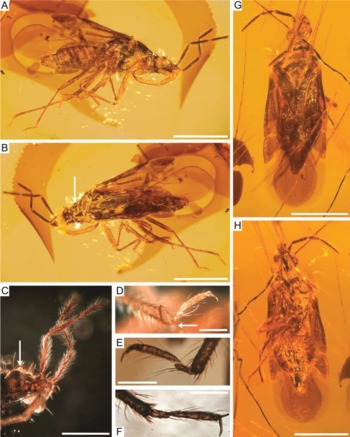
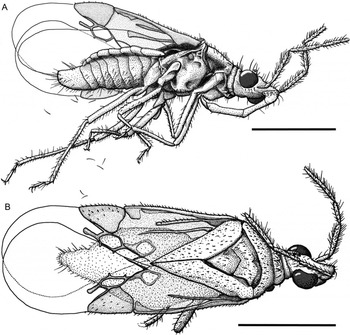
Length greater than width, preocular portion of head elongate, nearly equal to combined ocular and postocular lengths (Figs. 1A, 1H, 2A); head rapidly narrows anterior to antennal insertion; antennal insertion almost contacting compound eye; ocellocular distance nearly two ocellar diameters due to dorsal prominence of ocelli, weak carinae posterior to ocelli converge posteriorly; compound eyes separated from pronotum by less than one-half compound eye length; vertex, frons, clypeus, and labial segment I all with few, coarse, erect, elongate setae (Fig. 1C); setae very sparse, erect, and much finer on labial segments II–IV; labium robust and extending to apex of procoxa; antennomeres II–IV with dense cover of inclined, elongate setae, with lengths comparable to that of antennomere widths, antennomere I apparently glabrous.


Thorax
Pronotum markedly narrowed anteriorly (Figs. 1G, 2B), posterior border approximately 2× longer than anterior border; lateral margins of posterior lobe strongly carinate (Fig. 1B) (= plate-like edging of Popov (Reference Popov2004)); posterior border gently concave; carinae on posterior lobe continue around lateral margins of anterior lobe, with lateral borders sinuate; anterior lobe with calli low and broadly-domed, yet distinct in oblique view; surface texture of callosities unclear in type specimen; sulcus posterior to collar interrupted on ventral surface by at least four fine longitudinal carinae (Figs. 1A, 2A). Mesoscutum comparatively long, subequal to length of scutellum, with pronounced dorsal convexity (Figs. 1G, 2B). Scutellum somewhat kite-shaped in dorsal view, with anterior corner sunken and deeply incised into posterior margin of mesoscutum, posterior corner and central body of scutellum with strong dorsal convexity, forming longitudinal ridge. Pronotum, mesoscutum, scutellum and clavus all bearing fine, inclined setae in moderate density and lengths – with no glabrous patches apparent, but with anterodorsal surface of mesoscutum bearing reduced pilosity. Hemelytra with anterior (outer) margins of corium nearly straight, roughly parallel (Figs. 1G, 2A, 2B); cuneus apex subacute. Legs predominantly thin, with femora approximately twice as thick as tibiae and subequal in length, except metatibiae, with length 1.2× metafemoral length; setae relatively dense on most leg surfaces and elongate (with lengths similar to or greater than widths of their respective leg subcomponents); setae suberect on ventral surfaces of most leg components, and inclined on dorsal surfaces; apex of protibia with increased density and length of setae; protibial apex expanded with distinct tibial comb terminating dorsally in spine as long as basal tarsomere, and apparently with ventral fossula spongiosa (Fig. 1D) composed of fine, elongate tenent setae; mesotibial apex with at least three diminutive, erect spines (Fig. 1E); metatibial apex with circlet of approximately 10 diminutive, suberect spines (Fig. 1F); basal tarsomere on all tarsi with two subapical setae, each at least twice as long as tarsomere.
Abdomen
Anterior to pygophore, abdomen with ovoid outline (Figs. 1H, 2A); pygophore significantly narrower than rest of abdomen; sternites with high ventral convexity medially (following contours of pygophore) and recurved laterally, forming flattened “wings” in lateral one-quarter of sternite width. Thick and moderately elongate setae dense and inclined on sternites, setae longer in posterior and lateral positions; pygophore with increased density and lengths of setae, especially on posterior and lateral surfaces, longest setae similar in length to tarsi.
Colouration
Specimen cuticle pulled away from amber surface during diagenesis (Figs. 1A, 1B, 1G, 1H), producing many surfaces on both specimens with mottled or metallic colouration – these are artifacts of preservation. Original colouration likely consisting of dark brown or chestnut-coloured head (Fig. 1C), antennae, thorax, and lateral extensions of abdomen, with paler brown labium, legs, tarsi, and perhaps ventromedial abdomen.
Discussion
Phylogenetic relationships within Microphysidae have not been cladistically analysed and such an analysis is beyond the scope of the present work. Popovophysa displays a suite of characters that clearly indicates it belongs within Microphysidae, but it cannot be accommodated within any existing genus. In a large-scale morphological analysis of Cimicomorpha, Schuh and Štys (Reference Schuh and Štys1991) suggested the following characters as autapomorphies of Microphysidae: presence of a single processus corial, distal branching in the hind wing R+M, fused dorsal laterotergites and mediotergites, and fused ventral laterotergite 8 and gonocoxite I and the absence of spermathecae and visible metathoracic scent gland grooves. All visible characters in Popovophysa match these states, with the exception of an unbranched R+M apex in the hind wing.
Schuh and Štys (Reference Schuh and Štys1991) placed Microphysidae as the basal sister group to the remainder of Miriformes (Joppeicidae + ((Thaumastocorinae + Xylastodorinae) + (Miridae + (Vianaidinae + Tingidae s. s.)))), and Miriformes as the sister group to Cimiciformes ((Medocostidae + (Nabinae + Prostemmatinae)) + (Lasiochilidae + (Plokiophilidae + (Lytocoridae + (Anthocoridae + (Cimicidae + Polyctenidae)))))). Subsequent molecular analyses generally supported the monophyly of Cimiciformes, but did not agree on the position of Microphysidae, placing Joppeicidae and Microphysidae as basal sister groups to Cimiciformes (Tian et al. Reference Tian, Zhu, Li, Xie and Bu2008). A subsequent treatment, largely focused on the aberrant family Curaliidae, recovered a joppeicoid clade (Joppeicidae + (Velocipedidae + Curaliidae)) as basal, with Microphysidae as sister to the remaining families in Cimiciformes (Schuh et al. Reference Schuh, Weirauch, Henry and Halbert2008). A larger combined molecular and morphological approach (Schuh et al. Reference Schuh, Weirauch and Wheeler2009) confirmed the position of Microphysidae as basalmost within Cimiciformes. Using Loricula elegantula (Bärensprung) as a microphysid exemplar, Schuh et al. (Reference Schuh, Weirauch and Wheeler2009) also recovered a reduced number of morphological unambiguous autapomorphies for Microphysidae including the presence of distal branching in the hind wing R+M and fusion of the dorsal laterotergites and mediotergites. Additional characters, including the presence of sensory structures on the membrane across the entire length of the cell-forming veins and the fusion of ventral laterotergite 8 with the first gonocoxite in females, were not recovered when combined with molecular data (Schuh et al. Reference Schuh, Weirauch and Wheeler2009).
Within Microphysidae, Popovophysa entzmingeri shares many features with the extant monotypic Central Asian genus Ciorulla. Both genera have proportionally large and strongly convex compound eyes, widely separated metacoxae on either side of a posteriorly truncated metasternum, dorsally prominent ocelli, antennal insertion adjacent to the compound eye, and subhyaline cells within the endocorium. The inclusion of P. entzmingeri within Ciorulla is not possible because the Cretaceous species lacks numerous diagnostic characters for Ciorulla and Ciorullinae (sensu Popov Reference Popov2004). In particular, P. entzmingeri lacks the short opisthognathous head, elongate labial segment IV, short labial segment II, and second subhyaline cell within the endocorium that are diagnostic for Ciorulla.
Although P. entzmingeri is most similar to Ciorulla, it shares numerous characteristics with members of Microphysinae, particularly Loricula (Myrmericula). Diagnostic microphysine characteristics possessed by P. entzmingeri include the shape and size of the pronotum and labium, proportions of the labial segments (with segments II and III longest), and the presence of a medial longitudinal groove on the mesosternum. Within Microphysinae, P. entzmingeri meets all of the additional diagnostic criteria for Loricula (sensu Popov Reference Popov2004) including a head with an elongate preocular area, obvious ocelli, and slender antennae with an elongate antennomere II; a pronotum that is broad (tr.) and short (long.), narrowing anteriorly to one-half of its posterior width, with a collar situated distinctly ahead of the anterior pronotal lobe, an anterior lobe with distinct calli and a well-impressed transverse groove, and a posterior lobe with a convex posterior margin. Popovophysa entzmingeri also displays a fossula spongiosa composed of fine, elongate tenent setae similar to structures documented by Weirauch (Reference Weirauch2007, Fig. 6c) in Loricula. Within Loricula, P. entzmingeri is most similar to Loricula (Myrmericula) perkovskyi Putshkov and Popov, a fossil specimen described from Late Eocene Ukrainian (Rovno) amber. Both species have similar labial lengths and proportions (segments II and III of comparable length), similar antennomere proportions and setation, and nearly identical pronotal and mesothoracic configurations (see Popov Reference Popov2004, Fig. 4), but differ notably in the presence of tibial setae and a short labial segment IV in P. entzmingeri.
Despite the numerous similarities outlined above, P. entzmingeri differs from all Microphysinae in wing venation and metacoxal characteristics that closely match Ciorullinae. The intermingling of microphysine and ciorulline traits within P. entzmingeri suggests that these subfamilies may not be distinct, but this remains untested by phylogenetic analysis. Characteristics observed in combination within P. entzmingeri support Popov's (Reference Popov2004) treatment of Myrmericula Popov and Myrmedobia Bärensprung as subgenera of Loricula. Popov (Reference Popov2004) noted that Eocene specimens of L. (Myrmericula) perkovskyi from Ukrainian amber and L. (Myrmedobia) pericarti Popov from Baltic amber display a distinct collar anterior to the pronotum (characteristic of many modern species of Loricula) in combination with carinate lateral borders on the pronotum (characteristic of many modern species of Myrmedobia). The presence of both characters in fossil species reduces the number of diagnostic characters supporting these taxa at the genus level. Popovophysa entzmingeri predates other fossils by approximately 30 million years and also has a distinct collar and prominent lateral carinae.
In terms of palaeobiogeography and palaeoecology, P. entzmingeri is only moderately informative. Aside from being the first Mesozoic record of the family, the two specimens described here are the first New World microphysid fossils. These specimens display a proportionally short labial segment I, a characteristic of modern Nearctic microphysids. This is not necessarily indicative of any broad pattern; the microphysid fossil record is sparse and the monotypic genera Mallochiola Bergoth and Chinaola Blatchley are the only other microphysid taxa recognized in the Nearctic (Schwartz Reference Schwartz1989; Wheeler Reference Wheeler1992; Popov Reference Popov2004). Ecological relationships of P. entzmingeri may have been similar to those of modern microphysids. Modern members of the family prey upon small arthropods such as mites (Acarina), aphids (Hemiptera: Aphididae), and psocids (Psocoptera) (Popov et al. Reference Popov, Herczek and Kanja2008), all of which are common inclusions in Grassy Lake amber.
Acknowledgments
We are grateful to Robb Bennett, Brian Chatterton, Michael Schwartz, Bradley Sinclair, and an anonymous referee for their comments on the manuscript; to Brandon Strilisky and Jim Gardner for assistance with the TMP collections; and to Danny Shpeley for assistance with the University of Alberta Strickland Entomology Museum collections. The Leuck family generously donated the holotype specimen and provided field assistance. Support was provided by the Natural Sciences and Engineering Research Council of Canada and the Alberta Ingenuity Fund (to R.C.M.) and United States National Science Foundation grant DEB-0542909 (to M.S.E.), as well as Natural Sciences and Engineering Research Council of Canada Discovery grants issued to B.D.E. Chatterton and A.P. Wolfe, University of Alberta. This is a contribution of the Division of Entomology, University of Kansas Natural History Museum.