Introduction
The South Pacific hake (Merluccius gayi) is a demersal species found off the Ecuadorian, Peruvian and Chilean coasts (from 01°N to 47°S) in depths between 50 and 800 m (Aguayo, Reference Aguayo, Alheit and Pitcher1995; Guevara-Carrasco & Lleonart, Reference Guevara-Carrasco and Lleonart2008; García-Domínguez et al., Reference García-Domínguez, Gilces, Lavayen-Zapata, Daza-Bermeo, Bermúdez, Ávila-Zambrano and Cevallos-García2014). In Ecuador, this species represents an important fishery resource for bottom trawls, with a total landing of 13,000 tons in 2013 (García-Domínguez et al., Reference García-Domínguez, Gilces, Lavayen-Zapata, Daza-Bermeo, Bermúdez, Ávila-Zambrano and Cevallos-García2014). However, despite its economic importance, information on the feeding habits of the South Pacific hake in Ecuador is lacking. Feeding ecology investigations based on stomach content analysis (SCA) are an ideal tool to investigate such habits and to implement ecosystem analysis based on food web models (i.e. Ecopath-Ecosim) (Pauly et al., Reference Pauly, Christensen and Walters2000).
The South Pacific hake is a voracious predator with a large mouth and prominent rows of sharp teeth well suited to seizing prey. Previous studies carried out in Peruvian and Chilean waters suggested that this species is a non-selective predator that feeds on a wide variety of fish and invertebrate species (Fuentes, Reference Fuentes1983; Alamo & Espinoza, Reference Alamo and Espinoza1996, Reference Alamo and Espinoza1997; Castillo et al., Reference Castillo, Juárez and Aldana1997; Vidal et al., Reference Vidal, Acuña and Rey-Méndez1997; Orrego & Mendo, Reference Orrego and Mendo2012). At the same time, M. gayi represents an important prey source for large pelagic fishes in Ecuadorian waters, such as billfishes, dolphinfishes and sharks (Polo-Silva et al., Reference Polo-Silva, Baigorrí-Santacruz, Galván-Magaña, Grijalba-Bendeck and Sanjuan-Muñoz2007, Reference Polo-Silva, Rendón and Galván-Magaña2009, Reference Polo-Silva, Newsome, Galván-Magaña, Grijalba-Bendeck and Sanjuan-Muñoz2013; Rosas-Luis et al., Reference Rosas-Luis, Loor-Andrade, Carrera-Fernández, Pincay-Espinoza, Vinces-Ortega and Chompoy-Salazar2016; Loor-Andrade et al., Reference Loor-Andrade, Pincay-Espinoza and Rosas-Luis2017a, Reference Loor-Andrade, Pincay-Espinoza, Carrera-Fernández and Rosas-Luis2017b; Varela et al., Reference Varela, Lucas-Pilozo and González-Duarte2017; Zambrano-Zambrano et al., Reference Zambrano-Zambrano, Mendoza-Moreira, Gómez-Zamora and Varela2019). Therefore, this species may play a crucial ecological role in demersal food webs both as predator and prey.
The Ecuadorian coast, located at the confluence of the Pacific Central American Coastal and the Humboldt ecosystems, is characterized by a marked spatial variability of the physical-oceanographic conditions (Sonnenholzner et al., Reference Sonnenholzner, Brandt, Francisco, Hearn, Luzuriaga, Guarderas, Navarro, Alvarado and Solís-Marín2013). Thus, the northernmost regions (Esmeraldas and Manabí provinces) are influenced by the Panama current (warm and nutrient-poor water), whereas the southernmost region (Guayas province) is affected by the Peruvian coastal current (cold and nutrient-rich water) (Sonnenholzner et al., Reference Sonnenholzner, Brandt, Francisco, Hearn, Luzuriaga, Guarderas, Navarro, Alvarado and Solís-Marín2013; Martínez-Ortiz et al., Reference Martínez-Ortiz, Aires-Da-Silva, Lennert-Cody and Maunder2015). These singular oceanographic features may cause geographic variation in the abundance and distribution of prey.
New information regarding the trophic biology of the South Pacific hake in Ecuadorian waters may provide useful data to understand the trophic role of this species in the south-eastern Pacific Ocean. The present study was conducted to describe and quantify the feeding habits of the South Pacific hake in Ecuadorian waters assessing spatial and size-related variation in feeding habits.
Materials and methods
Sampling and stomach-content analysis
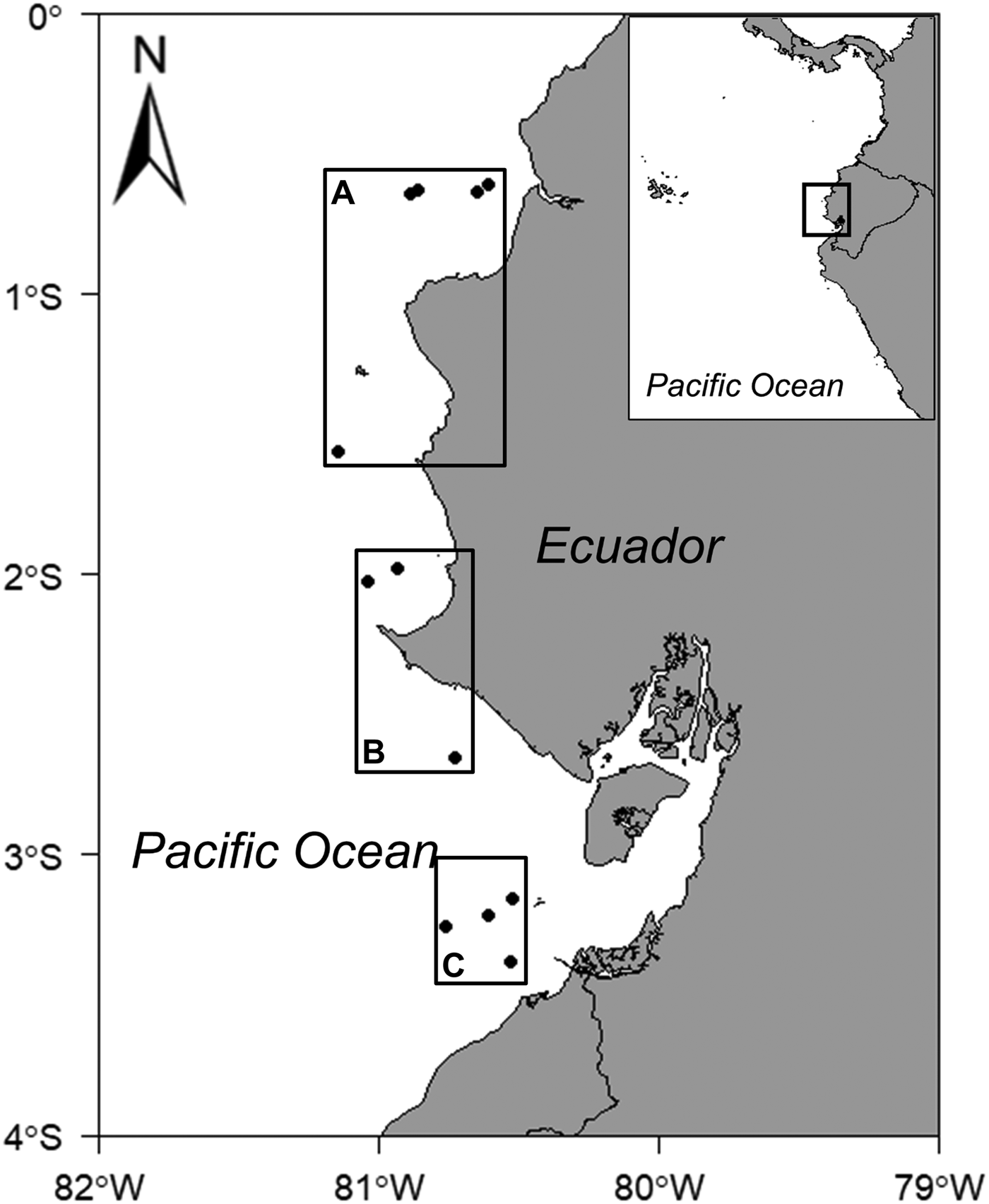
Stomachs of South Pacific hake (N = 232), ranging from 23.4–83 cm in total length (TL) and from 98–1200 g in body mass, were collected aboard bottom trawlers operating off the Ecuador coast (Figure 1) in January–June 2015. Whole stomachs were collected and stored at −20 °C until analysis. In the laboratory, they were cut open for prey identification to the lowest possible taxonomic level, and their wet weight was recorded to the nearest 0.01 g. Partially digested fish items were identified from otoliths (Harvey et al., Reference Harvey, Loughlin, Perez and Oxman2000; García-Godos Naveda, Reference García-Godos Naveda2001), whereas cephalopod species were identified from mandibles using the key of Clarke (Reference Clarke1986). Stomachs containing only hard parts were not taken into consideration for analysis.
Map of the study area. (A) Manabí; (B) Santa Elena, (C) Guayas.

Data analysis
To determine the relative importance of different prey in the diet of the South Pacific hake, three indices were calculated: (1) per cent composition by weight (%W i = weight of prey item i × 100/total weight of all prey items), (2) frequency of occurrence (%O i = number of stomachs containing prey item i × 100/total number of non-empty stomachs), and (3) alimentary index expressed as percentage  $(\% \,AI_i\, = \,[(\% \,O_i\, \times \,\% W_i)\,/\,(\sum \,\% \,W_i\, \times \,\% \,O_i)]\; \, \times \,100)$ (Kawakami & Vazzoler, Reference Kawakami and Vazzoler1980).
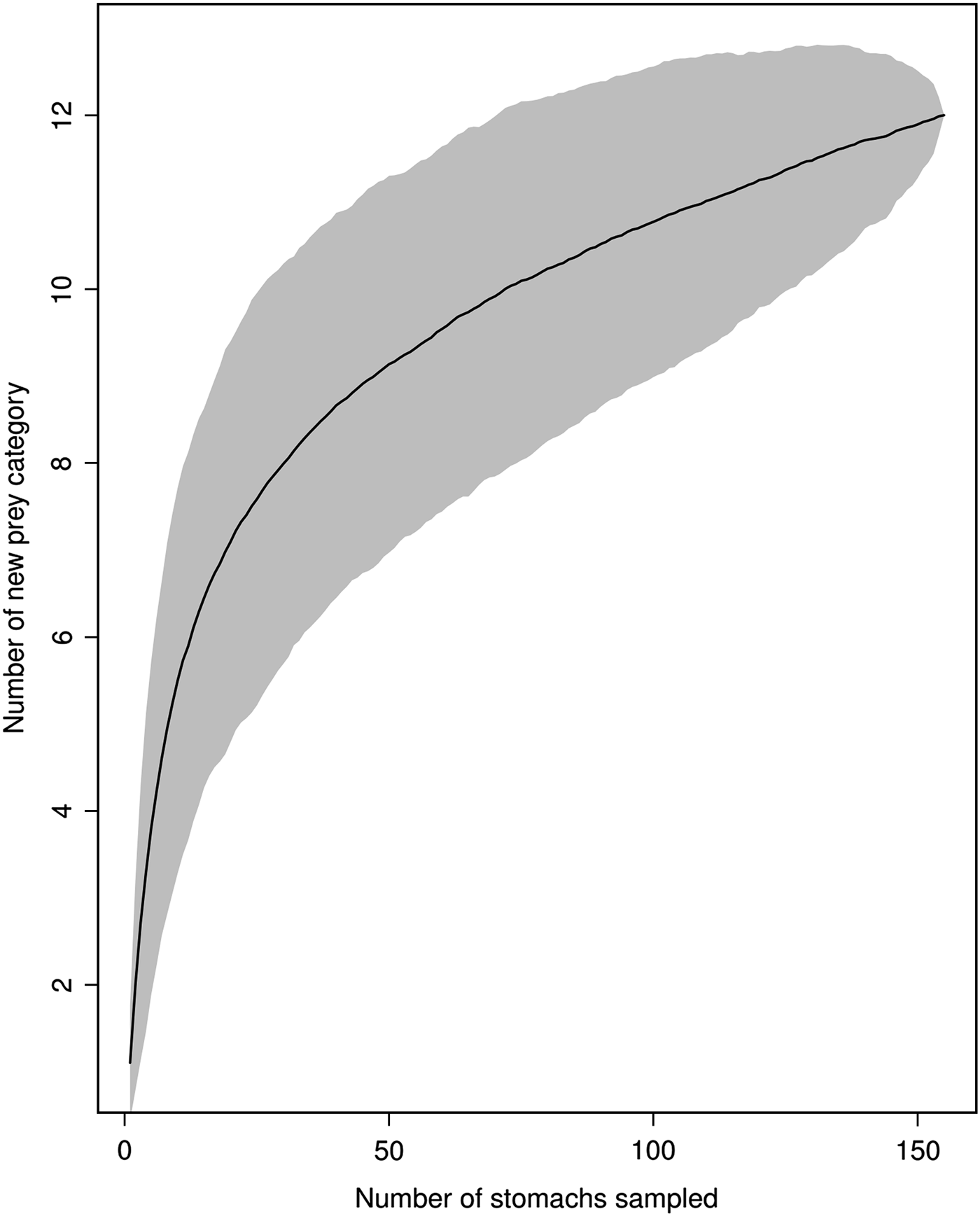
To determine sampling thoroughness, a cumulative prey curve was generated by the vegan package (Oksanen et al., Reference Oksanen, Blanchet, Kindt, Legendre, O'Hara, Simpson, Solymos, Stevens, Szoecs and Wagner2010) in R (R Development Core Team, 2019). To determine whether the curve reached an asymptote, the slope of the linear regression estimated from the last four stomachs was compared with a line of zero slope (horizontal asymptote) by a t-test (Preti et al., Reference Preti, Soykan, Dewar, David-Wells, Spear and Kohin2012).
A Pearson's chi-square test (χ2) was applied to test for significant differences in the frequency of empty stomachs among areas and size classes. A level of α = 0.05 was considered significant. Statistical analyses were performed using Statgraphics Centurion v16.2.04.
Permutational multivariate analysis of variance (PERMANOVA) was used to detect size-related and spatial variations in diet composition (Anderson, Reference Anderson2001; McArdle & Anderson, Reference McArdle and Anderson2001). The experimental design included two factors: ‘Size class' (with six levels, class I (<30 cm in TL), class II (30–35 cm in TL), class III (35–40 cm in TL), class IV (40–45 cm in TL) and class V (≥45 cm in TL)), and ‘Regions’ (with three levels, Manabí Province, Santa Elena Province and Guayas Province). The analysis was based on the Bray–Curtis dissimilarity matrix calculated on the prey weight values after performing a fourth-root transformation (Bray & Curtis, Reference Bray and Curtis1957). Significant terms were investigated using a posteriori pairwise comparisons with the PERMANOVA test. The homogeneity of multivariate dispersion was tested by PERMDISP (Anderson, Reference Anderson2006). Multivariate analyses were performed using the software PRIMER v6.1.13 & PERMANOVA+ v1.0.3 statistical package (PRIMER-E Ltd, Plymouth, UK).
Prey importance and feeding strategy were analysed with a modification of the Costello graphical method (Costello, Reference Costello1990; Amundsen et al., Reference Amundsen, Gabler and Staldvik1996). In this method, prey-specific abundance (%P i) is plotted against %O i, with %P i = ( $\sum $ prey i weight/
 $\sum $ weight of all prey in the stomach containing prey i) × 100. As in Varela et al. (Reference Varela, Lucas-Pilozo and González-Duarte2017), prey categories that only appear in one stomach were not considered in the analysis.
Results
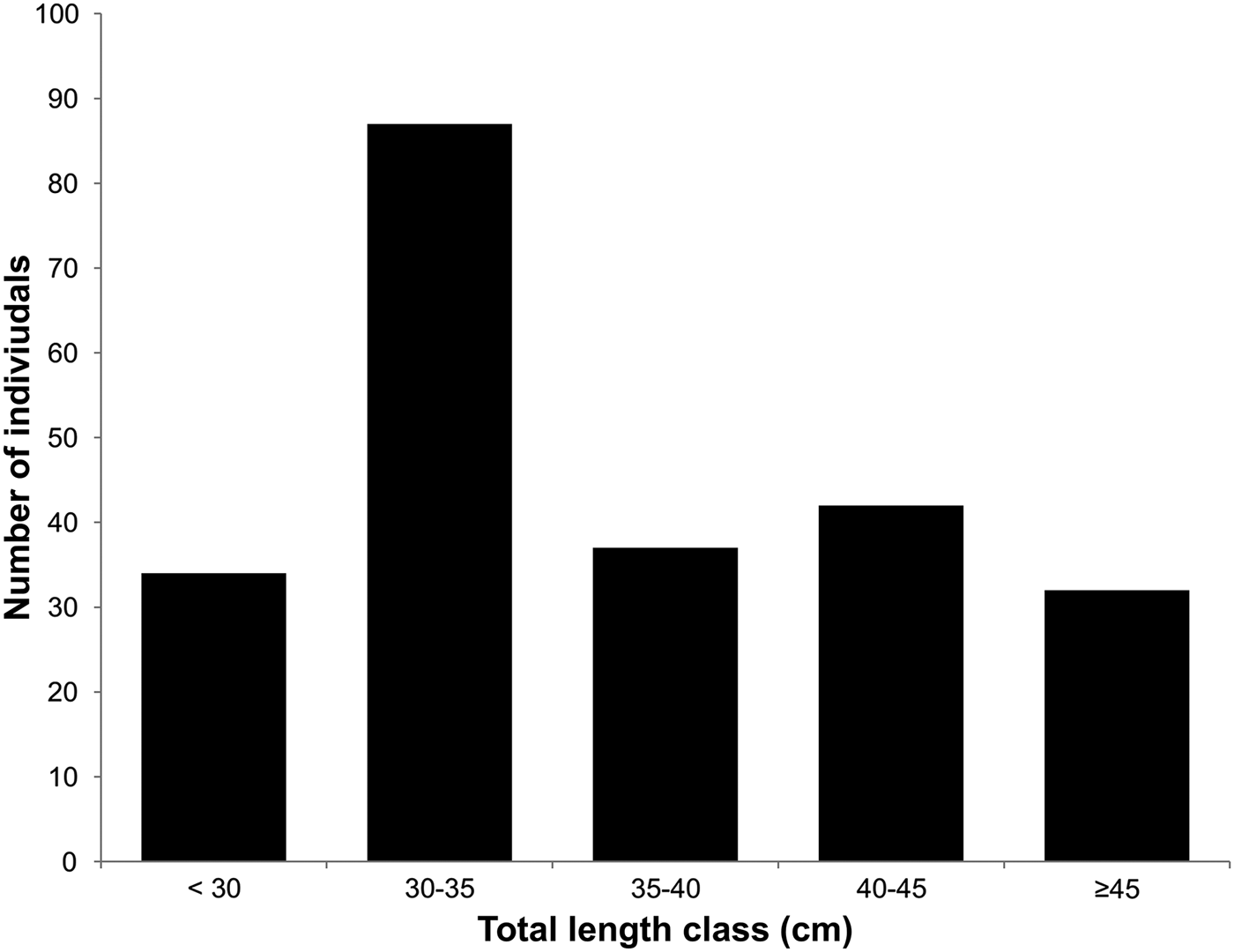
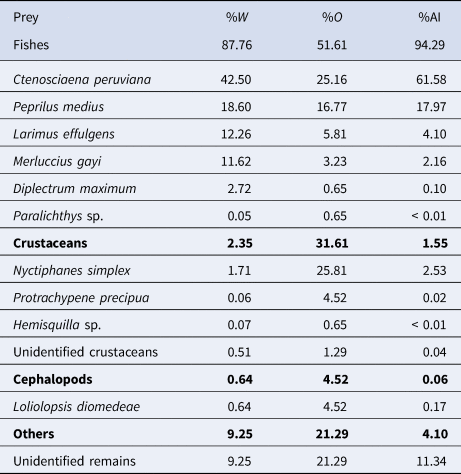
Figure 2 shows the size frequency distribution of the sampled fish. The cumulative prey curve did not reach the asymptote (t-test, P = 0.01) (Figure 3); therefore, the number of samples may not be enough to describe the diet. While regional differences were not found in the frequency of empty stomachs (χ2, P = 0.43), differences were detected among size classes (χ2, P = 0.02). Of the 232 stomachs analysed, 155 (66.81%) contained prey and 77 (33.10%) were empty. The diet was made up of 12 prey categories, including 6 fishes, 4 crustaceans, 1 cephalopod and unidentified remains. Fish was the most important prey group in terms of W, O and AI (87.76, 51.61 and 94.29%, respectively), followed by crustaceans (%W = 2 .35, %O = 31.61 and %AI = 4.13) and cephalopods (%W = 0.64, %O = 4.52 and %AI = 0.06). The teleost Peruvian barbel drum (Ctenosciaena peruviana) was the most important taxon in terms of W and AI (42.50% and 61.58%, respectively), while krill (Nyctiphanes simplex) was the most frequent prey species (%O = 25.81) (Table 1).
Length frequency distribution of the sampled South Pacific hake.

Cumulative prey curve.

Dietary composition of South Pacific hake caught off Ecuador. Percentage of weight (%W), occurrence (%O) and alimentary index (%AI)

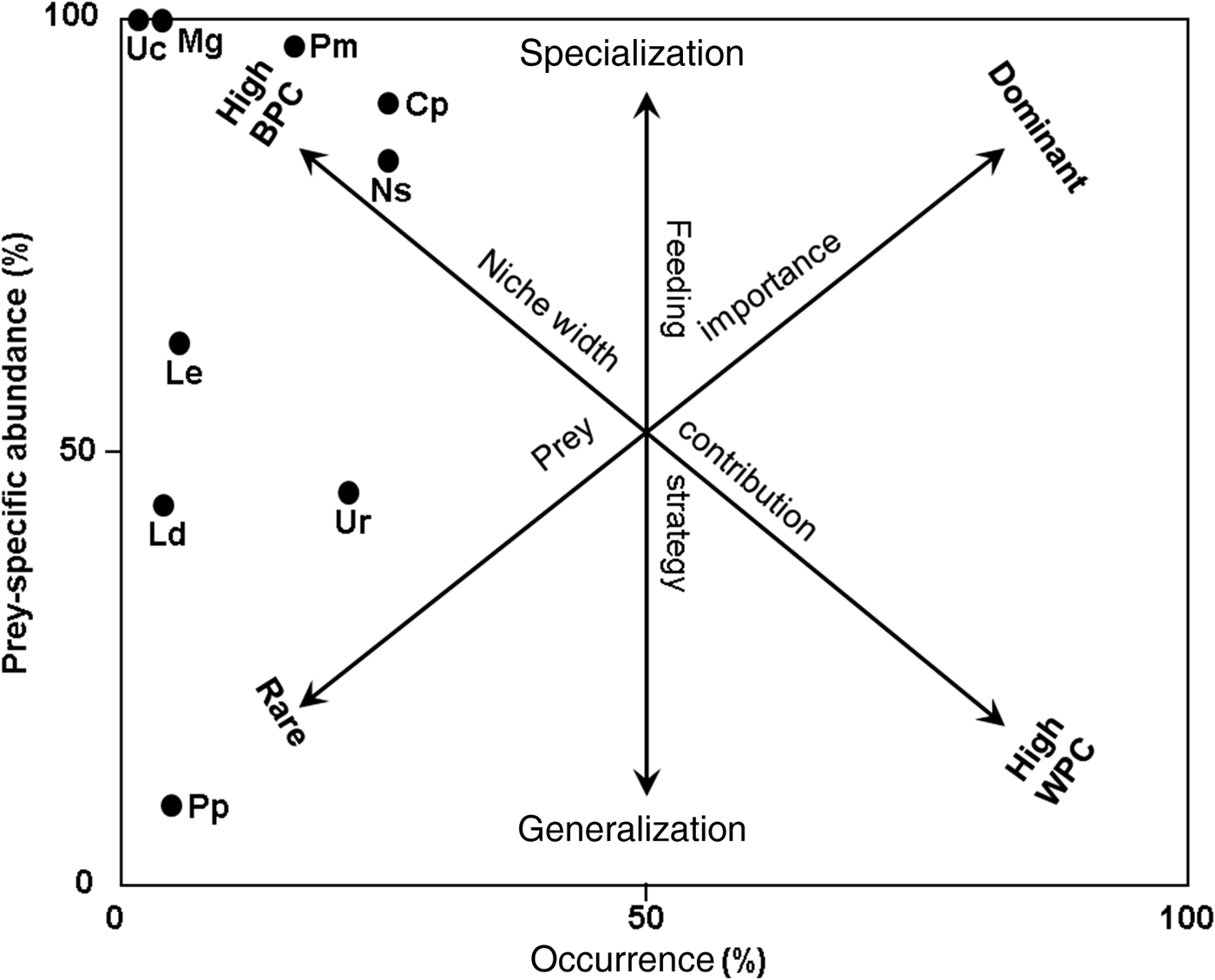
Feeding strategy, based on the Amundsen graphical method, is shown in Figure 4. Most prey species were located close to the y-axis, indicating that the prey consumed by M. gayi were rarely seen in the stomachs (low occurrence). However, krill and Peruvian barbel drum, which were located in the upper central area of the graph, can be considered as the most important prey species in the diet of the South Pacific hake.
Plot of the feeding strategy. The two diagonal axes represent the importance of prey (dominant vs rare) and the contribution to the niche width (high between-phenotype vs high within-phenotype contribution); the vertical axis defines the predator feeding strategy (specialist vs generalist). Cp, Ctenosciaena peruviana; Ld, Loliolopsis diomedeae; Le, Larimus effulgens; Mg, Merluccius gayi; Ns, Nyctiphanes simplex; Pm, Peprilus medius, Pp, Protrachypene precipua, Uc; Unidentified crustacean, Ur, Unidentified remains.

The PERMANOVA analysis detected significant differences in dietary composition among regions (PERMANOVA, P = 0.001) and size classes (PERMANOVA, P = 0.003). There was, furthermore, a significant interaction between both factors, indicating that differences in size classes were not homogeneous across regions (PERMANOVA, P = 0.0047).
The PERMDISP analysis did not show significant differences (PERMDISP, P > 0.05), suggesting that the differences obtained with PERMANOVA were not due to multivariate dispersion. The pair-wise PERMANOVA test revealed significant differences in the dietary composition between classes I and IV (P = 0.001), and I and V (P = 0.001). Significant dietary differences were also found between Manabí and Santa Elena (PERMANOVA, P = 0.013), Manabí and Guayas (PERMANOVA, P = 0.001), and between Santa Elena and Guayas (PERMANOVA, P = 0.001).
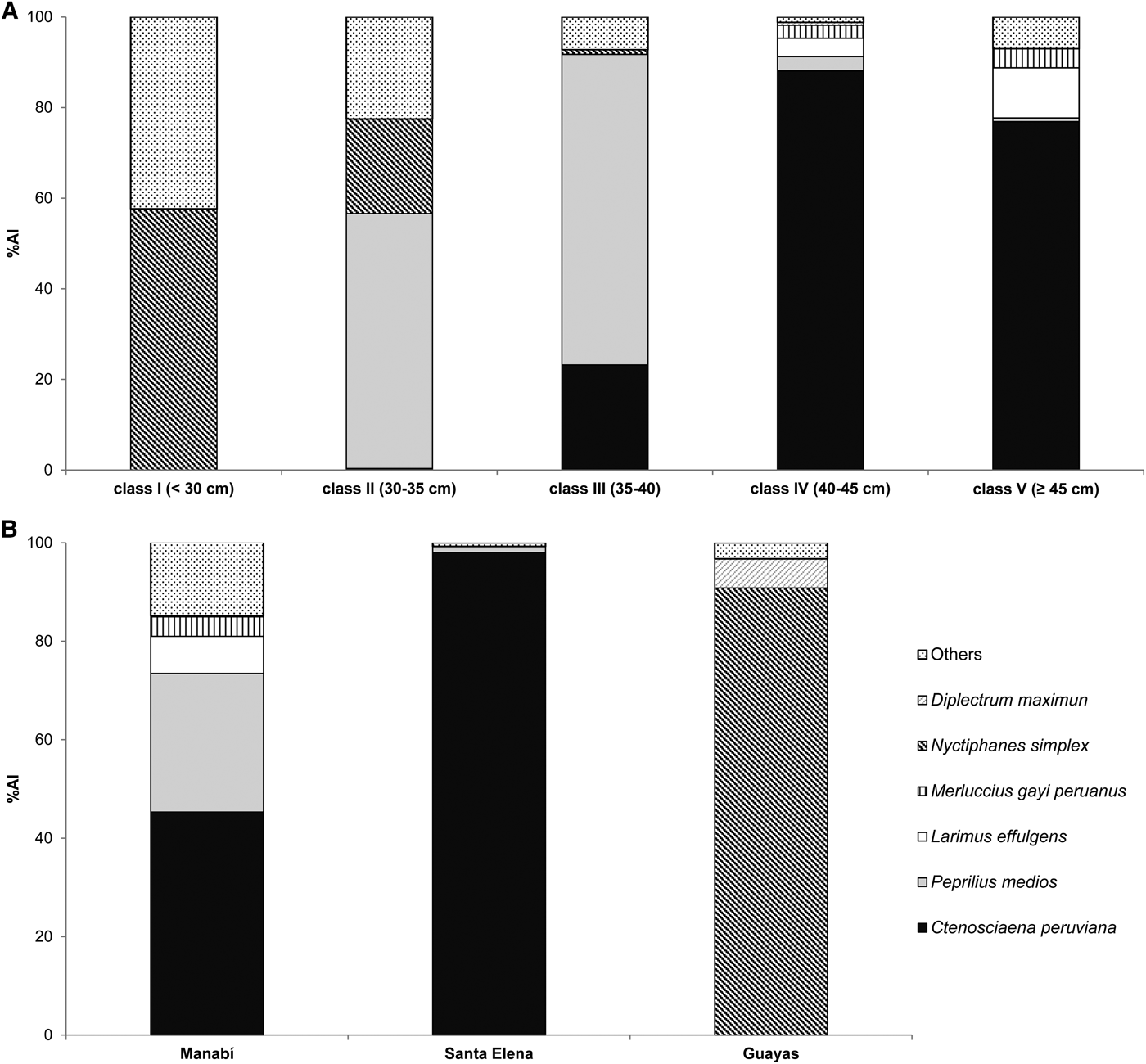
Figure 5 shows the contribution of each prey (%AI) to the diet of the South Pacific hake by size class and region. While class I fed mainly on krill (%AI = 57.64), the principal dietary component in the remaining size classes were fish species. That is, class II and class III consumed primarily Pacific harvestfish (Peprilus medius) (%AI = 56.26 and 68.53, respectively); while class IV and class V fed almost exclusively on Peruvian barbel drum (%AI = 88.12 and 76.92, respectively). In Manabí and Santa Elena, Peruvian barbel drum was the most important prey (%AI = 45.33 and 98.02, respectively), whereas krill was the major food item in Guayas (%AI = 90.84).
Dietary composition by (A) size class and (B) region. Data are presented in %AI.

Discussion
The feeding behaviour of the South Pacific hake has been widely examined along the coasts of Peru and Chile (Stobberup, Reference Stobberup1992; Castillo et al., Reference Castillo, Juárez and Aldana1995, Reference Castillo, Juárez and Aldana1997; Alamo & Espinoza, Reference Alamo and Espinoza1997; Vidal et al., Reference Vidal, Acuña and Rey-Méndez1997; Orrego & Mendo, Reference Orrego and Mendo2012); thus far, however, no information is available on the food habits of this species in Ecuadorian waters. The present study, therefore, provides the first information about the trophic biology of the South Pacific hake in the area.
The results of this study show that the diet of South Pacific hake in Ecuadorian waters is mainly composed by fish. This finding is consistent with previous studies carried out in the northern coast of Chile (Alamo & Espinoza, Reference Alamo and Espinoza1997; Orrego & Mendo, Reference Orrego and Mendo2012). For instance, Alamo & Espinoza (Reference Alamo and Espinoza1997) found that myctophids and sardine were the most important food prey, whereas Orrego & Mendo (2012) reported that hakes and engraulids were the groups that most contributed to the diet (%W = 60). Stobberup (Reference Stobberup1992), however, observed that the South Pacific hake fed mainly on euphausiids off the central coast of Chile. These marked geographic differences in the dietary composition of the South Pacific hake indicate that this species exhibits an extensive plasticity in its food habits.
Multivariate analysis showed size-related shifts in the feeding habits. The smallest South Pacific hake fed mainly on euphausiids, which have been reported to be an important prey species not only for small South Pacific hake (Alamo & Espinoza, Reference Alamo and Espinoza1997; Vidal et al., Reference Vidal, Acuña and Rey-Méndez1997), but also for small individuals of the co-generic hake Merluccius merluccius from the Mediterranean and Celtic seas, and from the Bay of Biscay (Carpentieri et al., Reference Carpentieri, Colloca, Cardinale, Belluscio and Ardizzone2005; Mahe et al., Reference Mahe, Amara, Bryckaert, Kacher and Brylinski2007; Sinopoli et al., Reference Sinopoli, Fanelli, D'Anna, Badalamenti and Pipitone2012). For instance, Alamo & Espinoza (Reference Alamo and Espinoza1997) observed that Euphausiacea was the most important food source for South Pacific hake <30 cm (TL, total length) from northern Peru, whereas Vidal et al. (Reference Vidal, Acuña and Rey-Méndez1997) reported that South Pacific hake >42 cm TL fed primarily on Euphausia mucronata off the northern coast of Chile. Carpentieri et al. (Reference Carpentieri, Colloca, Cardinale, Belluscio and Ardizzone2005), on the other hand, found that the diet of 5.0–11.9 cm TL M. merluccius was dominated by the euphausiid Nyctiphanes couchi in the Mediterranean Sea. Sinopoli et al. (Reference Sinopoli, Fanelli, D'Anna, Badalamenti and Pipitone2012) also reported euphasiids to be the most important prey for M. merluccius collected in the central Mediterranean Sea. It is worth noting that the ingestion of crustaceans decreased with size in our analyses. The largest specimens (≥45 cm), in fact, showed a fully piscivorous feeding behaviour. A similar pattern was reported for M. capensis and M. merluccius from the Celtic Sea and western coast of South Africa, respectively (Payne et al., Reference Payne, Rose and Leslie1987; Mahe et al., Reference Mahe, Amara, Bryckaert, Kacher and Brylinski2007). Mahe et al. (Reference Mahe, Amara, Bryckaert, Kacher and Brylinski2007) stated that this size-dietary shift is caused by an increasing energy demand. This hypothesis, however, does not explain our observations in South Pacific hake, as euphausiids show a high caloric content in comparison to fish (Cartes et al., Reference Cartes, Papiol and Guijarro2008), representing an important energetic resource for predators (Sorell et al., Reference Sorell, Varela, Goñi, Macías, Arrizabalaga and Medina2017). PERMANOVA analysis also detected regional differences in dietary composition, which probably are related to geographic variations in the abundance and distribution of prey.
The presence of conspecifics in the stomachs was not unexpected, since cannibalism has been widely reported in many hake species such as South Pacific hake (Orrego & Mendo, Reference Orrego and Mendo2012), Cape hake (M. capensis and M. paradoxus) (Payne et al., Reference Payne, Rose and Leslie1987; Punt et al., Reference Punt, Leslie and Du Plessis1992), European hake (M. merluccius) (Velasco & Olaso, Reference Velasco and Olaso1998; Cabral & Murta, Reference Cabral and Murta2002; Mahe et al., Reference Mahe, Amara, Bryckaert, Kacher and Brylinski2007), and silver hake (M. bilinearis) (Link et al., Reference Link, Lucey and Melgey2012). In agreement with most of these studies, we found that cannibalism increases with increasing body size. This may be explained by the fact that hakes live in large aggregations, generally composed of different size classes, which make small specimens readily accessible and/or available to conspecific predation (Juanes, Reference Juanes2003).
The results of this study suggest that the South Pacific hake is a generalist feeder as it preys on a wide variety of invertebrates and vertebrates. Future investigations of a higher number of stomachs are however needed to confirm the robustness of our results. To complement the information provided by gut analysis, stable isotope analyses, which give information at longer timescales, should be carried out to improve the understanding of the trophic biology of this species.
Acknowledgements
The authors gratefully thank Dr Maria Paniw for her comments and suggestions.
Financial support
The present work has been funded by CEI·MAR Foundation (project #CEIJ-C03.1) and Spanish Ministry of Economy and Competitiveness (VORATUN project #CTM2017-82808-R).