INTRODUCTION
Contentious battles over Religious Freedom Restoration Acts (RFRA) at the federal and state levels, campaign finance reform, and abortion protests, among others, suggest a fundamental refashioning of the “culture war” in American politics. Conservatives — particularly religious conservatives — have come to champion a politics of rights, using “liberal weapons” (rights) to win battles or at least stave off losses. For example, a number of cases, including the Hobby Lobby decision of 2014, have been litigated in the United States Supreme Court over the issue of whether employers can seek exemption from legal requirements to provide contraception insurance coverage, if such exemptions are based on the employer's religious motivations. In 2015, attempts to enact or strengthen state-level RFRAs in Arkansas, Indiana, and Louisiana were, at least in part, reactions to the advance of Lesbian, Gay, Bisexual, and Transgender (LGBT) rights. Religious conservatives fought back against those advances, by wielding the sword and shield of First Amendment rights. For example, the Indiana Family Institute, which was an early supporter of a state-level RFRA in Indiana, argued that “religious liberty and free speech will come under attack” following the legalization of same-sex marriage (Wang Reference Wang2015). Similarly, in the push for a RFRA, the President of Indiana Right to Life argued that “religious liberty is under attack by the government” (Cook Reference Cook2015). Governor Mike Pence, who signed the bill into law, echoed these concerns and emphasized the need to protect the religious freedom rights of religious objectors to government regulations regarding LGBT rights, healthcare, and abortion (Cook Reference Cook2015). Thus, the use of arguments involving religious liberty has become increasingly frequent in United States political discourse.
Following the push for state RFRAs in 2015, a society-wide debate developed over the extent and limits of rights. The constitution of public space raises important questions about the long-run effects of making rights claims.Footnote 1 It is entirely possible that rights claims contribute to balkanization — reinforcing the resolve and identity of a group exerting their rights. For example, the subtitle of Mary Ann Glendon's book, Rights Talk: The Impoverishment of Political Discourse, suggests that the assertion of rights makes democratic discourse problematic. From this vantage point, because rights claims are absolutes that allow no compromise, they serve as conversation stoppers, undermining the deliberative potential of public discourse (see Rorty Reference Rorty1999). Beyond disabling discourse, rights claims are powerful statements of group grievances, which may reify group boundaries and undermine support for the extension of equal rights of others (i.e., political tolerance — Gibson and Gouws Reference Gibson and Gouws2000).
To the contrary, it is also possible that rights claiming is an education in the democratic process that contributes to an extension of the rights culture. Rights claims are important because they admit the minority position of the claimant and represent a petition to the governing majority for recognition and inclusion. For many conservative Christians, for example, this may serve as one of the first times when personal rights are at stake, though the perspective of being embattled by the larger culture is widespread within evangelicalism (Smith Reference Smith1998). Thus, the assertion of such fundamental rights as religious liberty or free expression may provide a shared set of premises around which limited agreement on divisive political issues may be attainable. At the very least, exercising rights claims may lead to a more inclusive public space where we are all recognized as potential minorities who may not agree but at least can talk.
In what follows, we leverage a survey experiment using an issue taken from contemporary headlines about (religious) small business objections to participating in same-sex marriage ceremonies to answer the following question: if people are primed with rights-based approaches to conservative policies, are they more likely to support the extension of rights to ideological enemies (i.e., political tolerance)? In other words, does rights claiming promote rights extending?
THEORETICAL APPROACH
Individual rights are central to both American culture and American politics, profoundly affecting American politics and law (Hartz Reference Hartz1955). The American rights culture has long been the domain of liberals, who inaugurated the “rights revolution” and won significant legal, political, and cultural victories on the backs of rights claims (Epp Reference Epp1998). The liberal successes in advancing individual rights were largely responsible for activating the culture wars in American politics (Hunter Reference Hunter1991), pitting rights-oriented progressives against communitarians who argued that individual differences should bend to the weight of tradition.
After seeking to rebuff liberal gains with a limited government and law-and-order perspective (Teles Reference Teles2008), conservatives too have turned to the discourse of rights (Miller Reference Miller2014). This conservative shift is particularly noteworthy for the Christian Right, who had for generations used communitarianism and traditionalism in defense of the status quo. Now that the social and political terrain has shifted, observers have identified a growing conservative commitment to rights in the realms of religious freedom (Lewis Reference Lewis2014), free speech (Brown Reference Brown2002), campaign finance (Coats Reference Coats2015), and abortion politics (Jelen Reference Jelen2005). Recent scholarship has also shown the functional utility of employing rights-based arguments — conservatives appear more moderate when using rights claims (Djupe et al. Reference Djupe, Lewis, Jelen and Dahan2014). Notably, this does not work for every issue and therefore there are limits to rights claiming. Abortion is a canonical issue hosting competing legitimate rights claims, but gay rights is not — there is arguably no legitimate conservative anti-LGBT rights claim to advance (see Djupe et al. Reference Djupe, Lewis, Jelen and Dahan2014).
While rights have become regular weapons for conservatives, there has been little analysis of the broader implications of rights discourse for American democracy. Early analyses of the conservative-liberal clashes over rights versus responsibility surmised that an over-emphasis on rights would produce a breakdown in political discourse, a disincentive to compromise, and increased polarization (Glendon Reference Glendon1991). However, rights talk may enhance, rather than inhibit, public reason and democratic civility. In Political Liberalism, John Rawls (Reference Rawls1993) poses the problem of conducting democratic discourse and democratic governance in societies in which there is no consensus on substantive conceptions of the good. That is, absent shared religious beliefs or moral principles, “public reason” becomes rather difficult. One solution is to value a consensus on democratic procedures and on the prerogatives of democratic citizens — Rawls' “priority of liberties.” To use a clichéd, but apt, example, Voltaire's assertion that “I may disagree with what you say, but I will defend to the death your right to say it” may enhance the possibilities of civil democratic discourse (see also, e.g., Tyler Reference Tyler1990).
RELIGION AND TOLERANCE
Support for the prerogatives of citizens is more conventionally known as political tolerance — acknowledging the equal rights of political opponents. From the point of view of much of this literature, the tolerance levels of (especially) religious conservatives appears to be fixed by psychology, reinforced by an insular community. That is, by and large, more religion by almost any measure has been found to be an inhibitor of tolerance (with a few exceptions; for a review see Djupe Reference Djupe2015). There is overwhelming evidence to suggest that religious traditionalism, which includes elements of dogmatism (Jelen and Wilcox Reference Jelen and Wilcox1990), authoritarianism (Mockabee Reference Mockabee2007), and value threat and insular religious practice (Reimer and Park Reference Reimer and Park2001) promote intolerance (but see Eisenstein Reference Eisenstein2008 for counterevidence).
While most analyses of tolerance and religion have focused on the psychological antecedents of tolerance, those analyzing tolerance in the broader population have suggested that contemporary information provides an important contribution (Marcus et al. Reference Marcus, Sullivan, Theiss-Morse and Wood1995). Tolerance can be nurtured through exposure to diverse social networks (Mutz Reference Mutz2002) and elite communication of religious values and other messages (Djupe and Calfano Reference Djupe and Calfano2013; Green et al. Reference Green, Aronow, Bergan, Greene, Paris and Weinberger2011). This informational approach has called for increased attention to communication about political and religious outgroups among the religious over and above psychological factors (see Djupe and Calfano Reference Djupe and Calfano2013). In particular, the informational approach suggests that the tolerance judgments of religious people are mutable.
FRAMING RIGHTS AND RELIGION
Informational connections between religion and tolerance beg the question about how the information is presented and used. The most obvious, perhaps, is that particular situations (frames) are defined to achieve a particular outcome. In this way, framing provides an important connection between issue leaders and the public (Chong and Druckman Reference Chong and Druckman2007). And, specifically, prior studies have shown that application of a rights frame to the public activities of even the Ku Klux Klan can boost a tolerant evaluation (Nelson, Clawson, and Oxley Reference Nelson, Clawson and Oxley1997), which comes naturally to Americans (Gross and Kinder Reference Gross and Kinder1998). This effect is in keeping with widespread evidence that framing can alter public opinion across a range of issues (e.g., Haider-Markel and Joslyn Reference Haider-Markel and Joslyn2001), though not with impunity as we will discuss below.
There are other mechanisms that can connect information like rights claims to tolerance. Stories can have influence beyond a specific situation. This is the point of the sermon, for instance — to inform or remind congregants of a particular principle that should be followed. In other words, the frame of a particular incident or issue can become a prime, elevating a consideration for future decision making (Krosnick and Kinder Reference Krosnick and Kinder1990).Footnote 2 The focus of this article is to investigate whether citizens understand the lessons of rights claims narrowly, reinforcing solidarity against a hostile culture, or whether they understand the parable broadly as building solidarity with other minorities with unpopular views. If the latter, framing of a clash of interests in rights-based language may promote the extension of tolerance to out-groups in future scenarios.
As noted above, framing cannot be done with impunity. Existing work highlights those limits, clearly identifying the strength of the message and the source. Weak frames are less potent, as are those opposed by a counter frame (Chong and Druckman Reference Chong and Druckman2008). But attributes of the source are also important, which primarily turn on the source's credibility (Druckman Reference Druckman2001). There are a number of ways to establish credibility, including making expected and agreeable arguments (Lupia and McCubbins Reference Lupia and McCubbins1998) and by flashing in-group identity through labels, behavior, or other cues (e.g., Djupe and Calfano Reference Djupe and Calfano2013).
There are many elite actors involved in the debate over religious freedom and LGBT rights, but two especially prominent ones are candidates for office and religious elites. Candidates clearly engage the dynamics of polarization, where party identification structures media choices and limits engagement with the messages from the other side, whether because of out-group hostility (Iyengar, Sood, and Lelkes Reference Iyengar, Sood and Lelkes2012) or affective sorting to align issue stances and party affiliation (e.g., Levendusky Reference Levendusky2009). Moreover, candidates are understood, especially by contra-partisans, as engaging arguments for short term gain, less for the principles than the political advantage (e.g., Evans, Peterson, and Hadley Reference Evans, Peterson and Hadley2012). Clergy, on the other hand, gain credibility in this scenario given that their own rights of expression are at stake. Beyond salience, however, clergy are in the business of providing principle-driven stories, or parables, to followers. Thus, their expected mode of communication is priming, raising considerations for future application (see Djupe and Calfano Reference Djupe and Calfano2013). As such, we expect that clergy messages to religious conservatives arguing that their rights are at stake would be more credible and more likely taken to heart than the same message from a candidate.
DESIGN AND DATA
To assess the effects of rights claiming on downstream political tolerance, we designed a 2 × 4 experiment, varying the advocate (2: candidate vs. clergyperson) and frame around a conservative stance (4: control, morality, free speech, religious liberty). Keeping pace with the news, we had participants read about an advocate making a claim on behalf of a photography business that denied service for a same-sex wedding on religious grounds (following Elane Photography v. Willock 2014). In each condition, either a candidate running for Congress is making a statement at a town hall meeting in response to a question from the audience or a local pastor is giving a press conference. In either case, he offers the conservative position in support of the photographer with a different justification frame across conditions (the full wording of treatments is available in the online appendix).
It is important to note two things about the design. First, it does not have a true control group that was not presented with any mention of the photographer case. News about cases like these was available to participants, which means that the treatment effects we may find reflect some combination of framing novel and already accessible arguments. Put differently, the design does not allow us to tell whether any difference in effect from religious liberty and free speech claims comes because one is more persuasive, credible, or accessible. Second, the experiment set in a cross-sectional design does not allow us to make claims about the persistence of the effects, which may be quite short term.
After exposure to the treatments, participants were then asked several questions about their position in the controversy, their support for the advocate, and their perceptions of the politics and religiosity of the advocate. They were posed with a set of feeling thermometers, followed by a request for a summary judgment about the group (out of 6) that they either “like the least” or “disagree with the most.” We selected these unpopular groups to present balance across the ideological spectrum: Immigrants, Tea Party members, Muslims, Homosexuals, Christian fundamentalists, and Atheists.Footnote 3 We will begin our results discussion by looking to see if the selection of the least-liked group shifted across treatments.
The focus of our investigation is the political tolerance level of participants. The tolerance battery we used was patterned on the “content-controlled” approach pioneered by Sullivan, Piereson, and Marcus (Reference Sullivan, Piereson and Marcus1979). Once respondents selected their least-liked group, they were asked a series of questions using a 1–5 likert scale about whether they were willing to extend rights to this group, including their ability to rally, run for office, make a speech, teach, keep a book in the library, and be free from a phone tap. The mean once condensed to a 0–1 scale is 0.68 with a standard deviation of 0.23.Footnote 4
To gather a large sample with dispatch, we turned to Amazon's Mechanical Turk.
Mechanical Turk (MT) is a crowdsource platform for work tasks, allowing “requesters” (in our case, the researchers) to propose a task (taking a short survey) for workers who fit our qualifications. Across a week's span, 2,211 workers completed this task.Footnote 5
As previous researchers have found, MT samples do not look like national random samples of American citizens.Footnote 6 This means that univariate distributions of the sample are not representative of the United States population, but that does not mean that relationships among variables of interest are necessarily unrepresentative. That has been tested in several ways. For instance, Krupnikov and Levine (Reference Krupnikov and Levine2014) found that results using MT workers sometimes diverge from theoretical expectations. Other work has found that relationships from MT worker data compare favorably to those found with data gathered with more traditional sampling methods, such as the General Social Survey (GSS) (Lewis et al. Reference Lewis, Djupe, Mockabee and Su-Ya Wu2015). Notably, Lewis et al. found this similarity in the context of the relationships of religion variables and political outcomes. Thus, even highly skewed religious variables with highly skewed political opinions and identities may not pose a serious threat to finding comparable relationships to what is found using more traditional and representative data sources.
In these data, we have a sizable representation of important groups in the sample and they were effectively randomized into the treatments. We tested whether the age, gender, and education distributions varied across treatments and the amount of variance across them was insignificant (in ANOVA tests). That does not mean they were equal, so we employ controls in order to balance the cells and ensure the comparability of experimental groups.
RESULTS: LEAST-LIKED GROUPS
We expect that the frames we employ would raise somewhat different considerations that may show up in variant selection distributions of least-liked groups. Our theoretical expectation is that the argument and elite treatments affect tolerance levels, but it is possible that the treatments affected the least-liked group selections, which in turn may have effects on political tolerance. Initial explorations suggest that there are no sample-level treatment effects on the distribution of least-liked group selection (reported in the online Appendix Table A1). Using a chi-square test, the treatments do not significantly alter the selection of the least-liked group and the variation is quite uniform. Further, this null finding is confirmed in a hierarchical logit model, in which the least-liked group selection in level 1 is nested within least-liked groups and the treatment frames predict variation in the level 2 group means.Footnote 7 There is no significant variation at level 1 or between treatment groups at level 2.
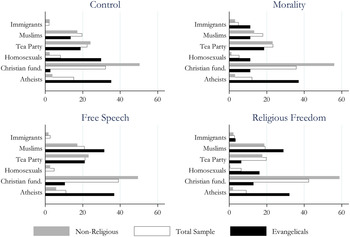
While there are no sample-level effects, Figure 1 shows how the selection of least-liked groups varies across the argument frames for the non-religious (gray bars) and for evangelicals (black bars). The selections by the non-religious did not shift much across the frames. The most common group selected was Christian Fundamentalists at a rate slightly higher when they receive the morality and religious liberty conditions — near 60% compared to 50% in the other two. This is not surprising since those treatments raise religion as a consideration the most clearly. The second most commonly selected, at just over 20%, was the Tea Party, followed by Muslims at just under 20%.
Selection of least liked groups for evangelicals, the total sample, and the non-religious by treatment.

Evangelicals were more plural in their selection of a least-liked group. They were most likely to choose atheists (32–−37% across the four treatment frames), with Muslims in second (11–32%). The Tea Party, interestingly enough, is the third most disliked group (6–21%), followed by homosexuals (0–29%). Their selections vary somewhat more than the selections of the non-religious. If the largest gap among non-religious is about seven points, it is 30 points among evangelicals in their selection of homosexuals (30% in the control compared to 0% in the free speech condition).Footnote 8 The variation is quite high for the selection of Muslims as well, varying from 11% that selected them in the morality condition to 30% in the rights conditions (free speech and religious liberty). We suspect that part of the reason for the dramatic increase in picking Muslims in the rights treatment cells is the suspicion that they are not Americans and therefore outside the bounds of rights for citizens (see, e.g., Kalkan, Layman, and Uslaner Reference Kalkan, Layman and Uslaner2009).
These findings suggest that the treatments did drive the least-liked group selection among several important groups in the sample, at least to an extent, which may affect their tolerance judgments rather than the treatments themselves. We investigate and discuss this possibility below.
RESULTS: TOLERANCE LEVELS
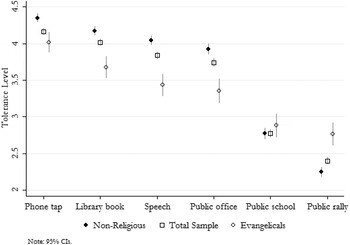
From these least-liked groups, we obtain our tolerance battery, which is our dependent variable in our model of political tolerance. The tolerance scale uses six substantive questions regarding support for the public activities of members of unpopular groups.Footnote 9 Figure 2 displays the variation by the component questions for the total sample, the non-religious, and evangelicals. The results generally jibe with existing research — that different groups organize tolerance in somewhat different ways (Jelen and Wilcox Reference Jelen and Wilcox1990) and that the non-religious are more tolerant than evangelicals (e.g., Burdette, Ellison, and Hill Reference Burdette, Ellison and Hill2005). Most of the tolerance components are clustered in the tolerant range (above 3), with the exception of the least-liked group teaching in a public school and rallying in the community, which gather little support. Notably, evangelicals are more supportive of their least-liked group rallying in the community than the others.
Average tolerance levels of the component questions in the tolerance battery for the non-religious, evangelicals and the total sample.

The full results of our model of tolerance appear in online Appendix Table A2 for the total sample, the non-religious, and evangelicals (Protestants and Other Christians who identify as “born again or evangelical” – the online appendix has full variable coding).Footnote 10 We included a set of controls to help rectify small, insignificant imbalances in the cells. This also serves to provide a most robust model since political tolerance is not native to the experiment (the variance is not simply a function of differences in treatment conditions). Most notably, we include education, ideology, political interest, gender, age, and democratic norms, all of which are standard in tolerance models.Footnote 11
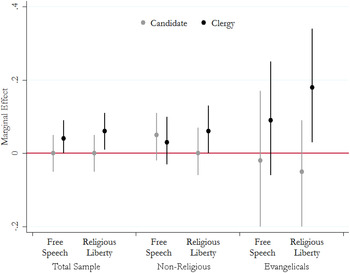
We focus on the treatment effects, which are shown in Figure 3. Since none of the tolerance scores differed from the control when receiving the morality frames, they are not displayed. Moreover, none of the frames had direct effects on the respondents' tolerance levels. Instead, we find significant effects of the rights treatments conditional on the clergy person advancing them.
marginal effects of the free speech and religious liberty treatments on political tolerance given the advocate (Clergy vs. Candidate) for the total sample, for the non-religious, and for evangelicals (90% confidence intervals — estimates from online appendix Table A2).

Clearly, the candidate did nothing for tolerance scores across these frames — the various arguments presented by the candidate did not shift opinion relative to the candidate control. The clergy, on the other hand, had consistently positive effects when they used the rights frames of free speech and religious liberty (these comparisons are relative to the clergy control). In the total sample, the average boost in tolerance when exposed to the rights frames from a clergyperson advocate is 0.05–0.06. The non-religious also reacted in a positive way, with effects parallel to the total sample. Notably, the effects of the clergy person advancing a religious liberty argument hold steady among the non-religious, boosting the rights they are willing to extend to their least liked group. While surprising, this finding is in line with other results that, for instance, find liberal donors to candidates more tolerant of Christian fundamentalists than even evangelical donors are (Wilcox and Kim Reference Wilcox, Kim and Djupe2015). That clergy's rights claims promote the non-religious to be more tolerant suggests that outgroup tolerance may be enhanced when rights are proffered by a stakeholder outside of a political campaign. But it is unclear if this would be reciprocated if the in-group and outgroup were reversed.
When evangelicals are exposed to a rights frame from the clergyperson (relative to the clergy control), they shift considerably, becoming more tolerant of their least liked group. The free speech generated shift of 0.09 is large, but outside of significance (p = 0.31) given the small sample size. The religious liberty shift is double that — 0.18 — and significant (p = 0.05). It is worth reflecting that these are evangelicals receiving a pro-in-group cue from an in-group elite when the issue is politically charged. Instead of triggering a defensive posture (and lower tolerance), the effect is to broaden democratic inclusion for even ideological enemies. The exercise of rights is clearly a potent symbol in American politics, one that can reach across deep divides between groups.
The least-liked group chosen by evangelicals by and large is not “homosexuals” (see Figure 1), but this raises the possibility that the treatments may interact with the least-liked group selection to influence tolerance judgments. Controlling for the least-liked group in the tolerance models does not substantially change the estimates — it does at the hundredth of a point level. Moreover, the group indicators showed an insignificant difference from the reference group (in this case, the group granted the lowest tolerance level — immigrants). But we also checked triple interactions to assess whether the key clergy-treatment interaction shifted when particular least-liked groups were picked. The results, shown in online Appendix Table A3(see also Figure A2), suggest that choosing a group engaged by the treatment story (“homosexuals” for evangelicals and “Christian fundamentalists” for the non-religious) does not significantly alter the estimates seen in Figure 3. The democratic lesson posed by the rights frame is not applied unevenly at a significant rate.
DISCUSSION
These results offer comment on a major work in the tolerance literature, which convincingly demonstrates that tolerance judgments, particularly in South Africa, are linked to social identity conflicts (Gibson and Gouws Reference Gibson and Gouws2000). In accord with social identity theory, positive in-group sentiments are related to negative out-group evaluations and prejudice is the primary driver of intolerance. There are other links provided, but that result in itself suggests a degree of intractability of group conflict in South Africa that transcends the particularities of each incident (Gibson and Gouws Reference Gibson and Gouws2000). That is, the history of group conflict appears to weigh more heavily on tolerance judgments than whether a particular incident is truly threatening.
The situation motivating our article clearly pits one group's asserted rights against another's and the degree of prejudice (whether dislike or disagreement) toward Christian fundamentalists runs high in this sample.Footnote 12 Moreover, the history of American politics is replete with tensions between evangelicals and the broader culture and with the non-religious specifically (e.g., Edgell, Gertais, and Hartmann Reference Edgell, Gertais and Hartmann2006). Thus, it is surprising that a scenario so well constructed to emphasize social identity conflicts instead demonstrates transcendence.
Though clearly only suggestive, the sharp break with the South African case may highlight the importance of this controversy being situated in an established rights culture (Hartz Reference Hartz1955). This, arguably, enables participants to draw on a set of (constitutional) symbols with considerable power to understand the path of the controversy and to rest assured that there will be a fair set of procedures to adjudicate disputes. Of course, the difference in findings does nothing to resolve the question of whether institutions are sufficient to overcome group divisions (see, e.g., Transue Reference Transue2007), but the results are suggestive of the power of institutions in keeping them at bay.
CONCLUSION
Commentators have been rightly absorbed with the politics of the current battles at the state and federal levels, as religious conservatives look to reinforce religious liberties in the face of dramatic gains for same-sex marriage in 2015. This followed on the heels of a number of issue areas in which religious conservatives have deployed rights claims in attempts to stave off a weakening position on abortion, public education content, and providing contraception, among others. From this vantage point, rights claiming is a particularly potent weapon to have and thus may simply prolong conflict and reinforce claims, undermining the peaceful resolution of disputes.
However, it is also possible that the assertion of rights is a powerful object lesson. The framing of political grievances or demands as rights claims invokes a highly legitimate cultural symbol of United States politics. Claiming Constitutional rights is an acknowledgement of minority status and a legal plea (or demand) for recognition, equal status, and protection from some societal or political force. So while claiming rights could be seen as a strategy to strengthen a weakened position, this is not the only effect rights claiming might have. In the parlance of public opinion research, the frame may become a prime. Use of a frame in a particular battle may serve to make it accessible in the next, leading recipients of the frame to be primed to more positively evaluate the status of outgroups, even of ideological enemies. Our results indicate that exposure to an in-group elite making rights claims, especially claims narrowly tailored to the group (religious freedom), has noticeable effects on the political tolerance extended to others beyond the current controversy.
As political leaders and activist citizens attempt to balance competing rights claims during the firestorm over state religious freedom measures, the potential long run positive implications for American democracy have been overlooked. The long game is focused not on a particular controversy but on the foundations upon which equal rights for all can be granted and sustained. Though this is just one look, it suggests a long-term dynamic that all can celebrate. As evangelicals become a political minority, they are in the process of learning about the value of rights for themselves and others. The old saying, sometimes attributed to Martin Luther, was not wrong that “Most human affairs come down to depending upon whose ox is gored.” But we might alter the phrase to say that a democratic politics that respects rights advances when everyone's ox has an equal chance of being gored.
Supplementary materials and methods
To view supplementary material for this article, please visit http://dx.doi.org/10.1017/S1755048316000547.