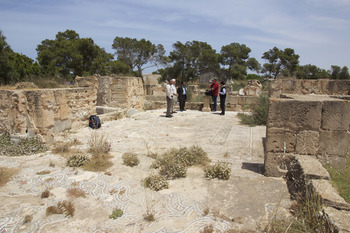
Introduction
The conservation of mosaics and the good management of archaeological sites are Mediterranean-wide problems. Libya's mosaics are no exception. They are of international significance and have great value to the country, but are under significant threat and need long-term protection. The international isolation created by Muammar Gaddafi has had a devastating impact on Libya's archaeological remains and those tasked with looking after them, in particular by limiting educational opportunities within the country and access to training courses beyond. As a result, knowledge of current best practice in the conservation and management of cultural heritage is lacking, as are foreign language skills and confidence.
CaMMiL (Conserving and Managing Mosaics in Libya) was developed in 2010 as a response to this problem and a reconnaissance trip was planned for early 2011.Footnote 1 Following the uprising against Gaddafi's regime and the freeing of Libya from his rule, the project was restructured to fit the radically altered social and political circumstances. In April 2012, we visited Libya to evaluate the conditions within the country, raise awareness of our project and start planning subsequent activities.Footnote 2 Two workshops followed in October 2012 and April 2013, which focused on the transfer of basic knowledge on conservation practice and management planning. This piece reviews the project and reflects on its outcomes and future.
The misfortunes of Libya's mosaics: Benghazi and the project's origins
The project has its origins in the early 2000s when Andrew Wilson and Paul Bennett invited Will Wootton to join their excavation of the Hellenistic site of Euesperides in Benghazi (see, for example, Bennett et al. Reference Bennett, Wilson, Buzaian and Higham2001; Wilson et al. Reference Wilson, Bennett, Buzaian, Fell, Found, Göransson, Guinness, Hardy, Harris, Helm, Kattenberg, Tébar Megias, Morley, Murphy, Swift, Twyman, Wootton and Zimi2004; Wilson et al. Reference Wilson, Bennett, Buzaian, Found, Göransson, Guinness, Hardy, Holman, Kattenberg, Morley, al-Mugasbi, Swift, Vaughan-Williams, Wootton and Zimi2005). At this time Wootton became aware of the disastrous deterioration of the Roman mosaics of Berenice, testament to the devastating combination of now defunct conservation techniques, the desire to display the mosaics outside and no systematic monitoring. The mosaics had been exposed during the 1970s when rescue and more systematic excavations took place at the Turkish cemetery of Sidi Khrebish in response to an attempt to develop the area (Lloyd Reference Lloyd1985, 11–14). Part of the Roman site was uncovered including 34 tessellated pavements, one emblema and at least one opus sectile floor. Some of these were lifted, re-laid onto iron-reinforced concrete and moved together to form a new suite of pavements.Footnote 3 In one case, a rudimentary cover was built to protect the mosaic (Michaelides Reference Michaelides1998, cat. no. 3).
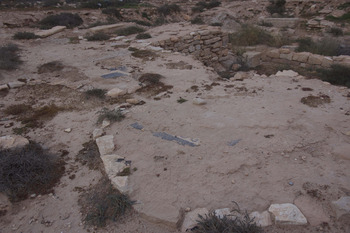
Leaving mosaics, re-laid on iron-reinforced concrete, exposed to hostile environmental factors can have disastrous results. The combination of a coastal location with saline marine aerosols and extreme temperature variations is particularly destructive. With no intervention, a mosaic can be lost in a matter of decades. This is the case at Sidi Khrebish (see Figure 1). Comparison between the original excavation photographs and the mosaics in 2005 shows the significant amount of loss over 30 years.Footnote 4 The surface tesserae have become detached from the backing due to the corrosion of the iron bars, which have expanded and caused cracking of the concrete support. Vegetation has also been allowed to grow without restriction. The state of the mosaics in 2012 shows the accelerated deterioration during the intervening seven years (see Figure 2).
Overview of the ancient site of Berenice (Sidi Khrebish, Benghazi) with mosaics re-laid on iron-reinforced concrete in the foreground. Photograph: W.T. Wootton.

Mosaic 16, below in 2005 and above in 2012, Sidi Khrebish, Benghazi. Photograph: W.T. Wootton.

Modest and inexpensive interventions might have saved these mosaics from reaching their current perilous state. Regular monitoring might have assessed their condition and identified incipient problems. Simple solutions based on the available expertise and funds might then have been put in place; placing them under cover would have reduced the environmental effects, even if storage has its own different set of risks. The complexity of the situation is not, however, to be underestimated and nor is the severity and number of different dangers to Libya's heritage. In such a situation, without the requisite knowledge and confidence to act appropriately, anyone might easily become paralysed.
Benghazi's other Classical site, Euesperides, has also been threatened by development, including an electricity substation, illegal bus station and shopping centre (Bennett et al. Reference Bennett, Wilson, Buzaian and Higham2001, 221; Wilson et al. Reference Wilson, Bennett, Buzaian, Fell, Found, Göransson, Guinness, Hardy, Harris, Helm, Kattenberg, Tébar Megias, Morley, Murphy, Swift, Twyman, Wootton and Zimi2004, 186–87). Focusing on mosaics, the site boasts some very important pebble and tessera pavements, which contribute to our knowledge of the development of tessellation in the early third century BC (Wilson et al. Reference Wilson, Bennett, Buzaian, Fell, Found, Göransson, Guinness, Hardy, Harris, Helm, Kattenberg, Tébar Megias, Morley, Murphy, Swift, Twyman, Wootton and Zimi2004, 155–58). Some conservation work has already taken place. Following heavy rainfall, the mixed-technique floor in Room 2 was consolidated with a temporary and fully reversible wall (Wilson et. al. Reference Wilson, Bennett, Buzaian, Found, Göransson, Guinness, Hardy, Holman, Kattenberg, Morley, al-Mugasbi, Swift, Vaughan-Williams, Wootton and Zimi2005, 143). The surface of the mosaic was then buried (see Figure 3).Footnote 5 There have been significant efforts to raise awareness of the site's importance through public engagement (Marzano Reference Marzano2006, 91). Plans exist to turn the area into an archaeological park, which would involve the proper demarcation of the site and the creation of a museum (Marzano Reference Marzano2006). The current perimeter wall has, however, collapsed leaving the Upper City open to intruders and the Lower City, where there are also valuable Hellenistic mosaics, continues to be used as a rubbish dump which affects the archaeology and the rare sebkha vegetation (Marzano Reference Marzano2006, fig. 1; Wilson et al. Reference Wilson, Bennett, Buzaian, Fell, Found, Göransson, Guinness, Hardy, Harris, Helm, Kattenberg, Tébar Megias, Morley, Murphy, Swift, Twyman, Wootton and Zimi2004, fig. 17).
Reburial of mixed-technique mosaic from the Upper City of Euesperides (Sidi Abeid, Benghazi). In the foreground, the subsequent exposure of the mosaic can be seen. Photograph: W.T. Wootton.

Benghazi is just one example of the severe level of threat to Libya's mosaics. At Cyrene, the Seasons mosaic in the House of Jason Magnus was vandalised when Spring and Winter were removed (see Figure 4).Footnote 6 Since the revolution, uncontrolled construction activity has increased, becoming a particular threat to Cyrene and other sites across Libya (Marzano Reference Marzano2006, 93; Abdulkariem and Bennett Reference Abdulkariem and Bennett2014). Alarming cases of rapid deterioration can be found in Tripolitania too. The Villa of the Nereids at Tajourah is particularly critical (see Figure 5) (Di Vita Reference Di Vita1966; Kenrick Reference Kenrick2009, 142). In the early 2000s, Enrica Foschi (Reference Foschi and Blanc2003) drew attention to the continued use of out-dated conservation techniques and inappropriate materials at Sabratha. She is not the only one to have voiced concerns about the state of Libya's mosaics (for example, Witts Reference Witts1993, 27; Bennett and Barker Reference Bennett and Barker2011, 16–17). The severity of the situation demands swift and decisive action. There is no doubt that the assessment of Paul Bennett and Graeme Barker (Reference Bennett and Barker2011, 20) of the situation as a ‘perfect storm’ continues to be very relevant.
Details of the removed spandrels, Spring to the left and Winter to the right, the Seasons mosaic, House of Jason Magnus, Cyrene. Photograph: W.T. Wootton.

View of the covered mosaics at the Villa of the Nereids at Tajourah. Photograph: W.T. Wootton.

Assessing the situation: training and documentation
The challenges facing Libya can be paralleled around the Mediterranean: the large quantity of cultural heritage and its perceived low value by some people, the lack of educational programmes and public awareness, inadequate legislation and funding, and the pressures of rapidly deteriorating and numerous mosaics all with their own special set of circumstances (Hamdan, Shaaban and Benelli Reference Hamdan, Shaaban, Benelli, Ben Abed, Demas and Roby2008). There is also an absence of money, time and trained personnel, which result in unsatisfactory documentation and condition assessments as well as the continued lifting of mosaics without an appropriate infrastructure for storage and maintenance.Footnote 7 Professionals continue to call for an international set of standards, whether guidelines for preventive conservation aimed at non-specialist conservators or codes for site management tied to legislation, and, above all, for specialist programmes for the long-term training of maintenance technicians and conservators.
Such training programmes have never existed in Libya and there has been no system for the monitoring and maintenance of archaeological sites. The critical situations found at Benghazi and elsewhere are witnesses to this. As the problems become increasingly serious, so the appropriate response becomes harder to formulate and requires more time, effort and money. Training is needed at all levels, from site controllers to technicians, and should be used to build consensus of approach to ensure that outdated methods are removed from the decision-making process. Such a call for capacity building in Libya has already been made (Bennett and Barker Reference Bennett and Barker2011, 16). The importance of training has also been recognised amongst the mosaic community since the first meeting of the International Committee for the Conservation of Mosaics (ICCM) in 1977, becoming a regular feature of the conferences (de Guichen and Nardi Reference de Guichen, Nardi, Ben Abed, Demas and Roby2008, 10–12). There is, however, still no major synthetic work bringing together the dramatic changes in conservation practice over the last 35 years, much of this knowledge remaining diffuse and inaccessible (Reference de Guichen, Nardi, Ben Abed, Demas and Robyibid., 13). Such a publication is crucial to support training initiatives (Wootton forthcoming).
It is important that such efforts reach the right people. In Libya, as Bennett and Barker point out (Reference Bennett and Barker2011, 16), it is desirable to identify and train the next generation of site controllers, archaeologists, conservators and technicians. There are some indicators that this process is beginning to happen.Footnote 8 Specific to mosaics, Libyans have been involved in MOSAIKON training courses for technicians and site managers, organised by the Getty Conservation Institute.Footnote 9 CaMMiL formed part of this work, belonging to a group of distinct and complementary efforts designed to help the Department of Archaeology during this challenging post-conflict period and beyond (Wootton forthcoming). In particular CaMMiL was funded as part of MOSAIKON, which is an initiative of the Getty Conservation Institute, the Getty Foundation, the International Centre for the Study of the Preservation and Restoration of Cultural Property (ICCROM) in Rome, and the ICCM. It is ‘a collaborative, regional initiative dedicated to improving the conservation, presentation and management of mosaics in the southern and eastern Mediterranean region … Through a series of interrelated activities, MOSAIKON aims to build capacity, develop replicable models of best practice, and promote the dissemination and exchange of information regarding the conservation and management of archaeological mosaics, both those in situ and those in museums and storage’.Footnote 10
In addition to training, Libya needs an inventory of its mosaics so that the Department of Archaeology knows what there is and its condition. This is central to the formulation of a conservation strategy. MOSAIKON has supported the documentation of lifted mosaics in Libya. This presents an important step forward in the Department's ability to manage such mosaics and monitor their condition. Extensive documentation already exists in publications as well as in unpublished archives belonging to the Department.Footnote 11 All such documentation, including any new condition assessments, needs to be consolidated, integrated and centralised while remaining available to, and able to be updated by, those involved in their management and conservation. Such a resource should be undertaken in conjunction with a national sites and monuments record so that Libya's heritage can be properly assessed, monitored and safeguarded against the growing pressures of development in both urban and rural contexts (Bennett and Barker Reference Bennett and Barker2011, 14–20).
The development of CaMMiL: evaluating specific need
CaMMiL was established by Will Wootton, Hafed Walda and John Stewart in 2010, when Gaddafi was still in power. It was intended as a practical response to the problems that the Department faced, in particular a lack of trained personnel to effectively protect and manage their heritage in general and their mosaics more specifically. Although a small project, CaMMiL hoped to contribute to international efforts to build capacity among the Department's staff. Following the revolution, our original aims were updated to take account of the new socio-political situation:
-
• evaluate the current state of Libya's mosaic heritage and assess, with the Department, the needs of its staff;
-
• deliver workshops that raise awareness about contemporary approaches to mosaic conservation and site management;
-
• reach Department staff with different levels of responsibility and knowledge;
-
• encourage Libyans to join international training projects, such as those organised by ICCROM and MOSAIKON;
-
• investigate the viability of longer term training projects in Libya, building on the foundation-level workshops delivered by CaMMiL.
The first step was the evaluation trip, which took place on 19–29 April 2012, during which we intended to:
-
• meet with members of the Department and visit sites with mosaics;
-
• give presentations at the most important of these sites;
-
• distribute key texts in Arabic on the conservation of mosaics;
-
• give a general background to mosaics and some of the problems associated with their conservation and management;
-
• engage as many people as possible from across the country;
-
• make a rapid survey of the present condition of the mosaics;
-
• assess the context for providing the subsequent workshops.
We planned the ten-day visit with members of the Department, in particular Mustafa Turjman and Adel El-Turki, who were key members of the project team. Five sites were chosen on the basis of their size, the presence of mosaics and the facilities available. In each case, we met with the site controller and their management team to introduce them to the project and to discuss the content of the presentations and any particular issues pertinent to their sites or to the region. We also distributed useful publications.Footnote 12 The presentations followed, translated and delivered in Arabic (see Figure 6). They defined the fundamental nature of mosaics, examined some of the problems associated with their conservation and management, and proposed some effective and simple solutions. The slides were printed and distributed as handouts.
Setting up for the presentation in Shahat as part of the evaluation trip. Photograph: W.T. Wootton.

There was considerable engagement from the audience in the form of enthusiastic questions and comments. There was much discussion of reburial as a positive solution to some of the current problems and concern about the legacy of reinforced concrete backings. This second issue was sometimes raised alongside the historic lack of provision for training. Everyone who attended completed the expression of interest form, which named a total of 121 people from many different backgrounds including current and previous employees of the Department, staff and students of universities, and those with an interest in the local archaeology, including journalists.Footnote 13
Archaeological sites were visited with members of the Department so that we could discuss particular issues or recommendations for the conservation of problematical pavements (see Figure 7). The mosaics were also quickly surveyed with regard to their future didactic potential.Footnote 14 The problems raised then guided the format and design of the workshops. It became evident that a lack of planning controls and construction activity was having a significant impact on Libya's archaeological heritage. Rescue excavation had become a core part of the Department's work, along the coast around Lepcis Magna, for example, and therefore documentation and inventory in relation to a sites and monuments record were identified as necessary inclusions in the workshops. The required legal framework was discussed, but this is a national planning issue and thus beyond this project's scope.
Discussing the so-called ‘Office Baths' at Sabratha as part of the evaluation trip. Photograph: W.T. Wootton.

Two main conservation techniques were raised with regularity: reburial and the treatment of mosaics with iron-reinforced cement backing. Both issues are important but complicated. It would only be possible to describe the materials involved and the appropriate treatment methodology. A distinctive training initiative is still needed to address practical intervention. There was scope to provide some demonstrations with lime mortars, which was deemed a necessary inclusion as excessively strong cement mortars were in common use on mosaics. There was a definite need for advice on storage, as well as the maintenance and renovation of existing cover buildings, and on mitigating the impact of vegetation and animals on archaeological sites.
The general observations from the visit can be summed up as follows. Libya is part of a wider Mediterranean context. The problems they are experiencing are not specific to the country. But, the sheer numbers of mosaics that have been exposed in the twentieth century and the improper methods applied could lead to catastrophic loss of our mosaic heritage without intervention. There is a lack of training, and therefore there is low capacity, a lack of management and appropriate decision-making, of systems for monitoring or maintenance and of infrastructure and resources, whether financial or material, especially alternatives to modern cement mortars.
Collaborating with the Department: CaMMiL's workshops
The aims of the next phase of the project were to:
-
• create a short workshop that responded to the needs of the Department as identified during the evaluation trip and that could be easily repeated in different areas of the country;
-
• deliver the workshops to members of staff with the greatest responsibility for the country's mosaic heritage and from two separate regions of Libya: Tripolitania and Cyrenaica;
-
• reach Department staff at different levels of the organisation, in particular those responsible for the management of sites with mosaics and those tasked with the practical activities associated with their maintenance;
-
• maximise the quality and range of instruction within the allocated time and budget;
-
• integrate different teaching types, including time in the classroom and on-site;
-
• keep the project team small and flexible but retain recognised international experts in the subject, a range of nationalities and as many Arabic speakers as possible.
The workshops were ultimately intended to serve as a foundation for more formal training courses run by major international organisations and to empower Libyans in the conservation and management of their own heritage by giving them the confidence to make simple and sound decisions.
Sabratha was chosen for the first workshop for participants from Tripolitania. It had the greatest didactic potential, owing to the large number of mosaics in a range of conditions, and the best facilities for teaching and accommodation. The workshop for Cyrenaica also took place there because the British Government's Foreign and Commonwealth Office advised against all travel to Benghazi in early 2013. This alteration was approved by the Department and the Chairman agreed to fund the travel of the Cyrenaican participants to ensure their attendance. There were unforeseen advantages for the participants in repeating the workshops in the same place, not least the opportunity to visit new sites and to build new professional networks across the country. To the project team was added Alaa El-Habashi, whose expertise as a conservation architect complemented and extended our capabilities.
Participant selection was handled by the Department, specifically El-Turki, who was then Head of Training. All were current Department employees with either a management role or tasked with more practical activities. In total, nearly 50 people attended the two workshops (see Figures 8 and 9). At the first, there were 26 participants, 10 for the management part and 16 for the technical one. This was closely matched during the second workshop with a total of 23 individuals, 8 attending the management section and 15 the practical part. This worked well both logistically and practically and meant that we could reach the widest audience without compromising on the teaching methods. The gender balance, however, was very unequal with only one woman attending either workshop. Although disappointing, there were cultural reasons that we could not overcome, in particular the inability of women to attend without a companion. This may explain why no women from Cyrenaica were present. This is an issue that should be targeted in the future, as there was interest expressed by women who came to presentations during the evaluation trip.
Group photograph of the site controllers and their management teams during their workshop. Photograph: W.T. Wootton.

Group photograph of the technicians during their workshop. Photograph: W.T. Wootton.

Although the teaching programme was divided in order to separate two broad categories of people (managers and technicians), there was still a wide range of knowledge and skill levels. At one extreme, some managers had responsibility for large numbers of mosaics from huge and important archaeological sites while, at the other, there were individuals who had no mosaics at all and, because of the nature of their sites, would probably never encounter one professionally. Most of the participants had received little or no prior formal training in the topics covered in the workshops; some managers had studied archaeology at university. Language was particularly problematic. Only one had fluent English, while the rest had only a few words. There were others who could speak some Italian. In general, there was a real lack of foreign language ability, a factor that will limit opportunities for study abroad.
All our teaching was done in Arabic or with simultaneous translation. The primary teaching resources were PowerPoint presentations with bound handouts forming a workshop handbook. Everyone was given the Arabic version of the Getty Conservation Institute's technician training manual for mosaic conservation and a connection was made between the instruction and the publication, especially during discussion of documentation, condition survey, stabilisation and reburial (Alberti et al. Reference Alberti, Bourguignon, Carbonara and Roby2013). The teaching environment was purposefully relaxed and informal, and the activities designed to be as engaging as possible with interaction encouraged. Participants stayed in the building where they were being taught. This was located next door to the so-called ‘Office Baths', which contain a number of mosaics with challenging conservation problems (Brecciaroli-Taborelli Reference Brecciaroli-Taborelli1974–Reference Brecciaroli-Taborelli75; Foschi Reference Foschi and Blanc2003; Bonacasa Reference Bonacasa2010). This ease of access was excellent for the on-site exercises.
The curriculum for the site controllers and technicians contained complementary content with common slides in their respective presentations. This ensured that the same messages were delivered to the two groups. The emphases were different, however, and so were their experiences. For the site controllers, the seminars focused on strategic decision making across a site with less emphasis on the specifics of materials. Time was spent considering the significance, condition and location of specific monuments as a basis for the good management, conservation, and presentation of a site. The process of decision making was also seen as a critical subject and was assessed in the classroom and via on-site surveys in order to create prioritised programmes of intervention across an archaeological site. Participants were expected to present their ideas in a coherent fashion, proposing logical steps for the management of mosaics with supporting evidence (see Figure 10). Instruction, therefore, was divided between conventional lectures, with discussion encouraged, seminar teaching and group exercises.
Presentation in the classroom as part of the workshop for the site controllers and their management teams. Photograph: W.T. Wootton.

All their lectures were underpinned by a standard methodology for the conservation planning process, illustrated graphically in a table shown throughout:
-
1. Recording of resources: inventory;
-
2. Assessment of resources: significance and condition;
-
3. Strategic planning: appraisal;
-
4. Design of intervention: specification;
-
5. Implementation: conservation;
-
6. Maintenance, monitoring, reassessment.
For the site exercises monuments and mosaics were chosen for their comparative didactic potential with respect to their significance, condition and location, in particular to highlight the available opportunities and constraints of each. This task was based on the inspection of a unique monument by one group, followed by a presentation with recommendations to the other group. Instructors were present for critical discussion and appraisal (see Figure 11). As a follow-up, their assessments were later considered within the context of the whole site.
Presentation on-site as part of the workshop for the site controllers and their management teams. Photograph: W.T. Wootton.

The instruction for technicians was largely lecture based (see Figure 12). These were distilled versions of the site controllers' lectures, but with additional emphasis on deterioration processes and conservation methods. This focused their attention on those aspects that they would encounter in their working days. The content of the technicians' programme also highlighted appropriate materials and levels of intervention, managing vegetation and animals, and the recognition of issues with storage or cover buildings. There was also detailed consideration of reburial as a means of conservation and how to design a burial environment. A lecture was dedicated to lime mortars for conservation, which promoted an understanding of their properties and use, and was followed by a practical demonstration of different lime binders and aggregates (see Figure 13).
Lecture as part of the workshop for the technicians. Photograph: W.T. Wootton.

Practical class on lime mortars as part of the workshop for the technicians. Photograph: W.T. Wootton

Their lectures were complemented by practical on-site exercises where participants were required to articulate what they had learnt in the classroom (see Figure 14). The exercises concentrated on a specific monument, the so-called ‘Office Baths', and participants were tasked with examining processes of deterioration, relative condition and methods of repair or conservation. Areas of the monument were chosen to elicit a comparative response within a small area. As a result, participants applied their new knowledge and instructors could discuss problems in a different context and more practical manner.
On-site group work as part of the workshop for the technicians. Photograph: W.T. Wootton.

All participants were actively engaged and enthusiastic. Comments and questions demonstrated a high level of comprehension, also evidenced by the feedback and the recommendations of the site controllers. Everyone enjoyed the experience and spoke very highly of the workshops. They were frustrated, however, by the brevity of the teaching, which meant that it was both dense and intense. Technicians in particular wanted even more practical activities and showed a great desire for further training, whether longer and more detailed courses on mosaics or on other types of heritage materials. They also realised the value of learning other languages so that they could join courses abroad. Of significant benefit was the creation of different types of professional networks between the participants themselves and also with the instructors. These personal and professional relationships were developed during the teaching and strengthened at the end of each course through group dinners, the exchange of contact details and subsequent communication.
The final review: CaMMiL's outcomes and the future of the project
Over the course of a single year the project team succeeded in completing an evaluation trip and delivering two workshops. In the process, we gave general presentations on mosaic conservation and management to nearly 150 people and then tailored workshops to nearly 50 members of the Department's staff. These numbers exceeded the original expectations but, in the case of the workshops, did not affect the quality of the teaching. This represents an enormous achievement requiring the development of a curriculum – related to previous Getty Conservation Institute initiatives but with significant adjustment, refinement and elaboration to suit the Libyan context – its translation and presentation in Arabic and all the other logistical challenges of working in a country which has had such a recent and radical change in its socio-political landscape.
Reaching so many Libyans at different levels in the Department and at different stages in their careers will, we hope, have an impact on their future activities in the heritage sphere. It is clear from the feedback that both site controllers and technicians felt more confident about assessing the problems associated with mosaics and implementing an appropriate plan for mitigating those issues. It is important, however, that this is not overstated as there remain significant challenges to overcome, voiced by the participants' desire for further training. Usefully, even those site controllers with no responsibility for mosaics acknowledged the value of the methodology espoused and declared their intention to use it as a framework for the management of the particular heritage in their region.
Changes in practice are already taking place. When we visited Tocra during the evaluation trip, Ahmed Buzaian of the University of Benghazi was in the process of designing a mosaic reburial. We discussed the steps with him and the reburial has now been completed (Buzaian and Hashem Reference Buzaian and Hashem2014; Buzaian Reference Buzaian2015). Since then Mohamed Abougela, Sabratha's site controller, has asked us to collaborate on the design for the reburial of mosaics in the ‘Office Baths’. While in Libya, we also engaged with local communities by giving talks about the nature of the project. These took place during both of the workshops and were accompanied by appearances on local radio, an article in the print media, as well as an interview intended for television. In addition, we met with members of Sabratha's Municipal Council and the Acting Governor to discuss heritage matters, during which they showed strong support for the adoption of conservation approaches for various aspects of the city and the need for a local planning system that could control development in and around local and regional archaeological sites. These engagements formed an important collaborative activity with the Department by reaching out to a wider public and showing the sort of capacity-building work that was taking place and the new relationships that were being constructed to ensure the long-term future of Libya's heritage.
The feedback we received suggests that the workshops succeeded in transferring foundation-level knowledge of the principles of heritage conservation. All those attending left with the understanding that conservation is not about formulaic recipes to be implemented across any site, but that each case has its own parameters and conditions that dictate an appropriate intervention. This basic lesson made the participants much more attentive and critical towards what they had learnt and practised in the past. In addition, they were aware of the importance of correct material selection when dealing with historic structures. People also understood the need for a major initiative to help language acquisition and the value this would have on an individual level.
Following the completion of the project, the team has considered a new initiative focusing on the practical application of conservation planning and intervention. Our idea was to undertake two collaborative activities with Department staff to design and implement a reburial at Sabratha and to protect the mosaics under a collapsing cover building at Tajourah. This would allow a small team of experts to work closely with Libyans and have a positive impact on their heritage. Including staff members from across the country would help develop national networks of expertise, which would have a broader impact on mosaic conservation and management. It would also have an immediate effect by conserving mosaics and, in the process, training members of the Department. Although our fundraising attempts have received positive responses, as the situation in Libya has worsened so have our chances of raising the necessary money, along with our ability to travel safely to Libya. We sincerely hope to renew our collaboration with the Department and its staff in the very near future.