





Non-technical Summary
A new species of brachiopod, Altaethyrella xuejiaoi, was collected from the Katian (Upper Ordovician) of the Yingan Formation in Northwest China. It is distinguished by its small size, averaging only 8.60 mm in shell length, ~ 60% smaller than any other species of this genus. The presence of a central myophragm and well-developed teeth confirms that these small-sized specimens represent sexually mature adults, not juveniles. The discovery of this species within a shallow-water reef-stromatoporoid bioherm environment provides critical new evidence for understanding the origination and early evolution of the Altaethyrella fauna, which was widely distributed in the tropical ocean of the Proto-Tethys prior to the Late Ordovician Mass Extinction (LOME).
Introduction
Altaethyrella Severgina, Reference Severgina1978 is a rhynchonellide brachiopod first reported from Katian rocks (Upper Ordovician) in northwestern Altai, the southern part of West Siberia, Russia (Severgina, Reference Severgina1978). Mature shells of this genus feature a transverse triangular or pentagonal outline, dorsibiconvex lateral profile, and uniplicate anterior commissure, usually with four ribs in the fold and three ribs on the sulcus. This genus was thought to lack a median septum and septalium in the notothyrial cavity of the dorsal valve (Kulkov and Severgina, Reference Kulkov and Severgina1989; Zhan and Li, Reference Zhan and Li1998). Recent studies indicate that adult specimens of some species, e.g., Altaethyrella seletensis Nikitin et al., Reference Nikitin, Popov and Bassett2003 (see also Zhang et al., Reference Zhang, Sproat, Zhan, Harper and Rong2026) and Altaethyrella inflata (Xu, Reference Xu1996) (see also Zhang et al., Reference Zhang, Sproat, Zhan, Harper and Rong2026) have a small, short central myophragm in the dorsal cavity.
The last acme of the Great Ordovician Biodiversification Event (GOBE) before the Late Ordovician Mass Extinction (LOME) occurred in the Katian (e.g., Harper et al., Reference Harper, Rasmussen, Liljeroth, Blodgett and Candela2013; Servais and Harper, Reference Servais and Harper2018), although this event was recently considered part of a single long-term radiation in the early Paleozoic (Servais et al., Reference Servais, Cascales-Miñana, Harper, Lefebvre, Van Bocxlaer and Wang2023a, Reference Servais, Cascales-Miñana, Harper, Lefebvre, Munnecke, Wang and Zhangb). Several terranes and plates now located in central Asia and northwestern China (e.g., Kalmykkol-Kokchetav, Selety, Boshchekul, Chingiz-Tarbagatai, Atasu-Zhamshi, Tarim, and Chu-Ili) were then located in the tropical or subtropical region of the Proto-Tethys, west of Gondwana, in the Katian (e.g., Kröner, Reference Kröner2015; Torsvik and Cocks, Reference Torsvik and Cocks2017). The Altaethyrella brachiopod fauna is a typical shallow-water brachiopod fauna commonly found in carbonate build-ups or siliciclastic deposits on the shelf or upper slope, distributed among these terranes and plates during the Katian before the Hirnantian glaciation (e.g., Zhan and Cocks, Reference Zhan and Cocks1998; Zhan et al., Reference Zhan, Rong, Jin and Cocks2002; Sproat and Zhan, Reference Sproat and Zhan2018; Zhang et al., Reference Zhang, Sproat, Zhan, Harper and Rong2026). Quantitative analysis of global Katian brachiopod faunas also indicates close affinities among the brachiopod faunas of these regions (Harper et al., Reference Harper, Rasmussen, Liljeroth, Blodgett and Candela2013; Popov and Cocks, Reference Popov and Cocks2017; Zhang et al., Reference Zhang, Sproat, Zhan, Harper and Rong2026), forming part of the Low-Latitude Province (Harper et al., Reference Harper, Rasmussen, Liljeroth, Blodgett and Candela2013).
Mature Altaethyrella shells are typically medium to large in size, varying from approximately 15 mm (Nikitin et al., Reference Nikitin, Popov and Bassett2006) to 20 mm in width (e.g., Zhan and Cocks, Reference Zhan and Cocks1998; Sproat and Zhan, Reference Sproat and Zhan2018; Zhang et al., Reference Zhang, Sproat, Zhan, Harper and Rong2026), but the new species of Altaethyrella (i.e., Altaethyrella xuejiaoi new species) described here is only 40% of this size, i.e., on average only 8.60 mm long, 9.73 mm wide, and 5.69 mm deep. This smaller size might normally indicate that these specimens represent juveniles, but the presence of the central myophragm and the strength of the teeth indicate these small shells are mature individuals. This species is a dominant component of an unusual Altaethyrella fauna that was a key constituent of diverse reef-stromatoporoid bioherms in the warm shallow sea that covered Tarim at this time.
This study systematically describes the brachiopod Altaethyrella xuejiaoi n. sp., documenting new occurrence data that will provide insight into the origin and early evolution of the rhynchonellides. The descriptions and data from this study will also contribute to ongoing work on the paleogeography and macroevolution of the Altaethyrella fauna in the tropical Proto-Tethys before LOME.
Geological setting
The Tarim paleoplate was located in the tropical region of the Proto-Tethys west of Gondwana in the Late Ordovician (Popov and Cocks, Reference Popov and Cocks2017; Torsvik and Cocks, Reference Torsvik and Cocks2017) but is now located in southern Xinjiang, Northwest China. The Tarim Basin covers much of the Tarim paleoplate and contains a variety of sedimentary sequences (e.g., carbonate mud mounds, siliciclastic deposits, and deep-water turbidites) in different regions during the Katian (Late Ordovician).
In the northwestern part of the basin, the lower Katian Yingan Formation consists of a 141-m-thick sequence of dark-colored mudstone, thin-layered nodular limestone, and reef-stromatoporoid bioherms at the top. The formation extends across northwestern Tarim, but the thick-bedded reef-stromatoporoid bioherms are only known in the eastern part of the Kalpintag Range. The Yingan Formation is unconformably overlain by the Arisu Formation, a succession of upper Katian reddish siltstone.
In the Arisu West Section of the Kalpintag Range, a succession of light-gray, thick-bedded, reef-stromatoporoid bioherms are present at the top of the Yingan Formation. This succession is dominated by corals and stromatoporoids, but cyanobacteria and calcareous algae are also common in thin sections. The rocks host a rich fossil assemblage, including bryozoans, brachiopods, gastropods, mollusks, trilobites, ostracodes, cephalopods, and echinoderms. Conodonts from this section indicate that the reef-stromatoporoid bioherms can be correlated to the Belodina confluens conodont Biozone, indicating an early Katian (Ka-1) age (Tang et al., Reference Tang, Zhang, Wang, Huang and Yang2023). Three species of stromatoporoids—Camptodictyon amzassensis (Khalfina, Reference Khalfina1960), Simplexodictyon yavorskyi (Nestor, Reference Nestor1966), and Rosenella sp. indet.—have been reported from the same bed in this section, representing a short-lived, low-diversity reef-forming association (Liang et al., Reference Liang, Zhang, Zhang, Wei and Tang2023). Calcareous algae and cyanobacteria are mostly represented by Vermiporella Stolley, Reference Stolley1893; Solenopora Dybowski, Reference Dybowski1877; Rothpletzella Wood, Reference Wood1948; and Hedstromia Rothpletz, Reference Rothpletz1913, implying a warm shallow-water subtidal environment during this time interval. Brachiopods mainly inhabit pockets in the bioherm and do not attach to other fossils. Altaethyrella xuejiaoi n. sp. is the most abundant species of the brachiopod fauna, whereas other genera—like Eospirigerina Boucot and Johnson, Reference Boucot and Johnson1967; Liostrophia Cooper and Kindle, Reference Cooper and Kindle1936; Parastrophina Schuchert and LeVene, Reference Schuchert and LeVene1929; Strophomena Rafinesque in de Blainville, Reference de Blainville and Cuvier1824; and Sulcatospira Xu in Jin et al., Reference Jin, Ye, Xu and Sun1979—are also present (these genera will be studied in the future).
Materials and methods
A total of 94 conjoined valves of Altaethyrella xuejiaoi n. sp. were collected from the uppermost part of the Yingan Formation at the Arisu West section (40°14′14.84″N, 78°47′26.06″E; Fig. 1), Kalpin County, Xinjiang, Northwest China. Fossil specimens were prepared and measured with digital calipers to a precision of 0.1 mm. Reduced major axis regression plots of shell length vs. width and shell width vs. depth were produced to show the ontogenetic variation of the species. Seven fossils were coated with ammonium chloride by sublimation and photographed under an optical stereoscope. Three shells were serially ground to produce a series of sections parallel to each other at the grinding precision of 0.05 mm (Zhang et al., Reference Zhang, Sproat, Zhan, Zhang, Luan and Huang2019). The internal structure on each ground surface was etched with acid and replicated on cellulose acetate peels for microphotography, which were later manually traced to interpret fossil internal morphology.
Map of the fossil site and its neighboring region in northwestern Tarim, western Xinjiang, Northwest China.
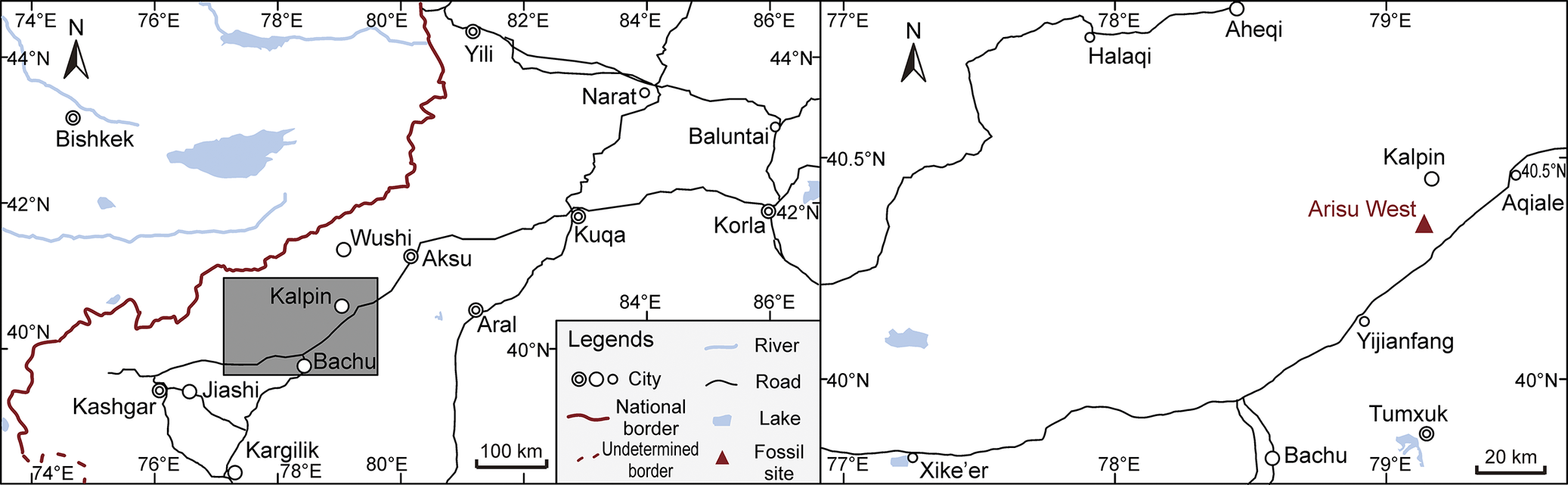
Figure 1. Long description
The image consists of two side-by-side geographical maps with a shared legend.
Left Panel: A regional map of northwestern China and neighboring regions. A North arrow is in the top left. The X-axis shows longitude from 74 degrees East to 86 degrees East, and the Y-axis shows latitude from 40 degrees North to 44 degrees North. A dark red line indicates the national border to the West and North. Major cities include Bishkek in the Northwest, Yili and Narat in the North, and Korla in the East. A grey rectangular inset box in the Southwest covers the area between Kalpin and Bachu, indicating the area shown in the right panel. A scale bar represents 100 k m.
Right Panel: A localized map of the area within the grey inset. The X-axis ranges from 77 degrees East to 79 degrees East, and the Y-axis from 40 degrees North to 40.5 degrees North. The fossil site, labeled Arisu West, is marked with a dark red triangle located Southeast of Kalpin and Northeast of Bachu. Other nearby locations include Halaqi and Aheqi to the North, Xike'er to the Southwest, and Yijianfang and Tumxuk to the Southeast. A scale bar represents 20 k m.
Legend: Located at the bottom center of the left panel. It identifies symbols for City (circles), National border (solid red line), Undetermined border (dashed red line), River (light blue line), Road (black line), Lake (light blue shape), and Fossil site (dark red triangle).
Repository and institutional abbreviation
Brachiopod fossils and acetate peels presented in this study are stored at the Nanjing Institute of Geology and Palaeontology (NIGP), Chinese Academy of Sciences, Nanjing, China. Catalog numbers are NIGP 209457–209465.
Systematic paleontology
Phylum Brachiopoda Duméril, Reference Duméril1806
Subphylum Rhynchonelliformea Williams et al., Reference Williams, Carlson, Brunton, Holmer and Popov1996
Class Rhynchonellata Williams et al., Reference Williams, Carlson, Brunton, Holmer and Popov1996
Order Rhynchonellida Kuhn, Reference Kuhn1949
Superfamily Ancistrorhynchoidea Cooper, Reference Cooper1956
Family Ancistrorhynchidae Cooper, Reference Cooper1956
Genus Altaethyrella Severgina, Reference Severgina1978
Type species
Altaethyrella megala Severgina, Reference Severgina1978, p. 38; from the Katian, northwestern Altai, Siberia, Russia.
Genera synonymized
Zanclorhyncha Xu in Jin et al., Reference Jin, Ye, Xu and Sun1979; Otarorhyncha Nikiforova and Popov, Reference Nikiforova and Popov1981; Latirhynchia Fu, Reference Fu1982; Lydirhyncha Popov and Cocks, Reference Popov and Cocks2021.
Diagnosis
See Zhang et al. (Reference Zhang, Sproat, Zhan, Harper and Rong2026).
Remarks
This genus has been reviewed based on fossil material recently discovered and studied in China (Zhang et al., Reference Zhang, Sproat, Zhan, Harper and Rong2026). The internal morphology of the type species, Altaethyrella megala, is still poorly understood due to the inaccessibility of the original type material and the difficult access to the topotypic fossil locality in the northwestern Altai Mountains of Russia.
The number of ribs on the dorsal fold and ventral sulcus is consistent among species of Altaethyrella from different regions, as is often common in rhynchonellide lineages, but the number of ribs on the lateral flank of adult shells is a key diagnostic characteristic at the species level (Zhang et al., Reference Zhang, Sproat, Zhan, Harper and Rong2026). A septum or septalium is not developed in the dorsal cavity of the type species Altaethyrella megala (see Kulkov and Severgina, Reference Kulkov and Severgina1989) but a few specimens of Altaethyrella (e.g., Altaethyrella seletensis by Nikitin et al., Reference Nikitin, Popov and Bassett2003; Zhang et al., Reference Zhang, Sproat, Zhan, Harper and Rong2026; Altaethyrella inflata by Zhang et al., Reference Zhang, Sproat, Zhan, Harper and Rong2026; and Altaethyrella xuejiaoi n. sp., this study) possess a central myophragm in the posterior of the notothyrial cavity that extends toward the anterior, resembling a median septum and septalium.
Lydirhyncha, based on the type species Rhynchotrema zhejiangensis Wang in Wang et al., Reference Wang, Jin and Fang1964, first discovered in South China, is very similar in external morphology and could be a junior synonym of Altaethyrella (Zhang et al., Reference Zhang, Sproat, Zhan, Harper and Rong2026). The type species of Lydirhyncha has four ribs on the dorsal fold and three ribs on ventral sulcus, a character common to most Altaethyrella species found in Northwest China and central Asia.
The externally similar rhynchonellide Rhynchotrema Hall, 1960, contemporaneous with Altaethyrella, possesses a median septum and well-developed septalium, so the interpretation of these features has considerable taxonomic significance. Rhynchotrema is known from tropical Laurentia and Gondwana (Percival, Reference Percival1991; Zhan and Li, Reference Zhan and Li1998; Sproat et al., Reference Sproat, Sohrabi and Jin2014; Sproat and Zhan, Reference Sproat and Zhan2018), unlike Altaethyrella that is only known from the Kazakh terranes, Tarim, and North China. These two genera are excellent examples of convergent evolution of shell form in similar paleoenvironmental settings in two different rhynchonellide lineages.
Altaethyrella xuejiaoi new species
Altaethyrella xuejiaoi n. sp., dorsal, ventral, anterior, posterior, and lateral views of five conjoined valves collected from the uppermost part of the Yingan Formation at Kalpin, western Xinjiang, Northwest China: (1–5) NIGP 209457; (6–10) paratype, NIGP 209458; (11–15) paratype, NIGP 209459; (16–20) paratype, NIGP 209460; (21–25) NIGP 209461.
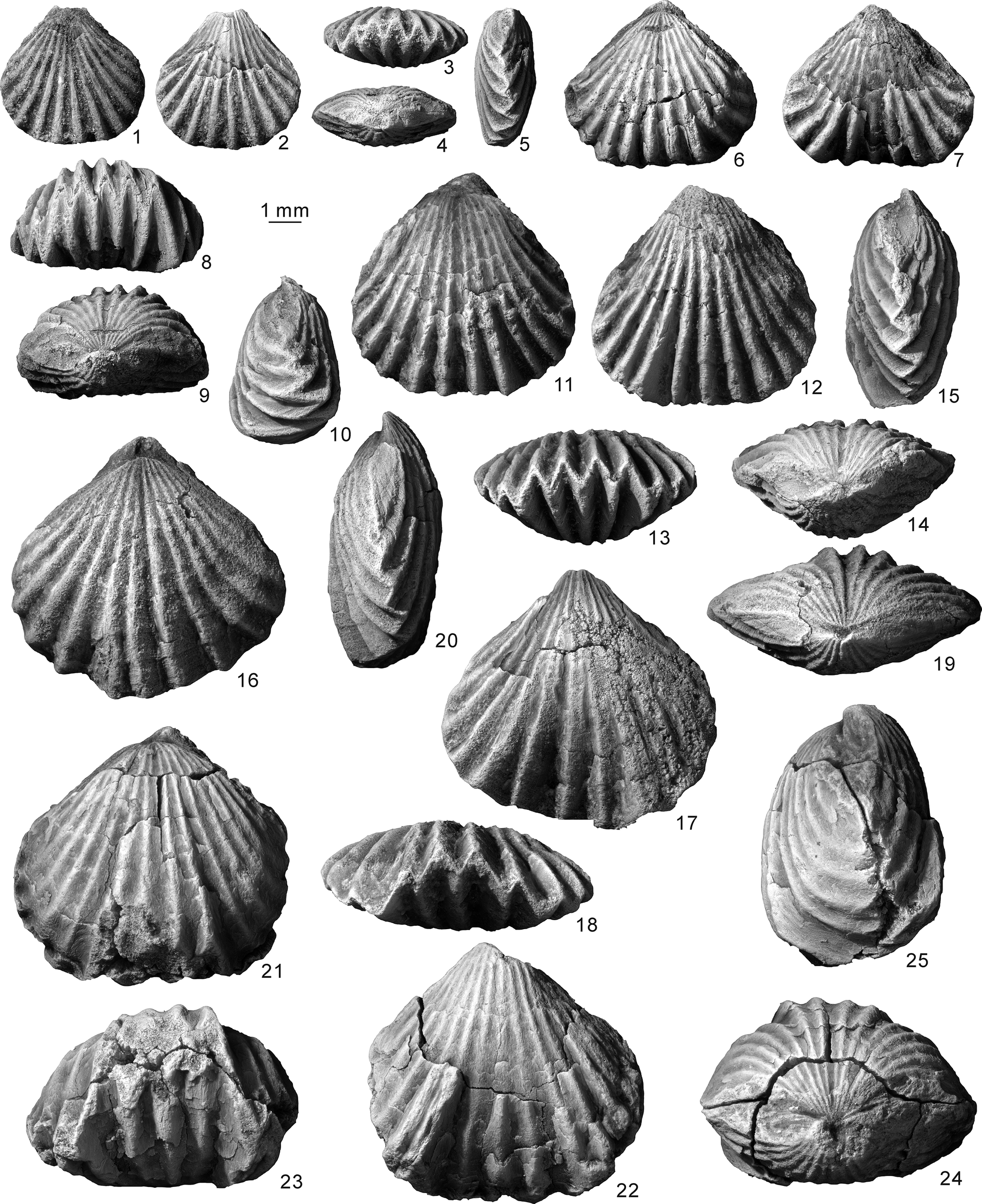
Figure 2. Long description
A collection of black and white photographs of five conjoined brachiopod valves, numbered 1 through 25. A 1 m m scale bar is located near the top center.
* Specimen N I G P 209457 (1 to 5): Smallest specimen. 1 is dorsal view, 2 is ventral view showing radial ribs, 3 is anterior view showing a zigzag commissure, 4 is posterior view, and 5 is lateral view showing the profile.
* Specimen N I G P 209458 (6 to 10): 6 is dorsal view, 7 is ventral view, 8 is anterior view with deep plications, 9 is posterior view, and 10 is lateral view.
* Specimen N I G P 209459 (11 to 15): 11 is dorsal view, 12 is ventral view, 13 is anterior view, 14 is posterior view, and 15 is lateral view.
* Specimen N I G P 209460 (16 to 20): 16 is dorsal view, 17 is ventral view, 18 is anterior view, 19 is posterior view, and 20 is lateral view.
* Specimen N I G P 209461 (21 to 25): Largest specimen. 21 is dorsal view, 22 is ventral view, 23 is anterior view, 24 is posterior view, and 25 is lateral view.
All specimens exhibit a triangular to sub-pentagonal outline with strong, coarse radial ribs that create a distinct zigzag pattern where the two valves meet at the anterior margin.
Altaethyrella xuejiaoi n. sp., dorsal, ventral, anterior, posterior, and lateral views of two conjoined valves collected from the uppermost part of the Yingan Formation at Kalpin, western Xinjiang, Northwest China: (1–5) holotype, NIGP 209462; (6–10) paratype, NIGP 209463.
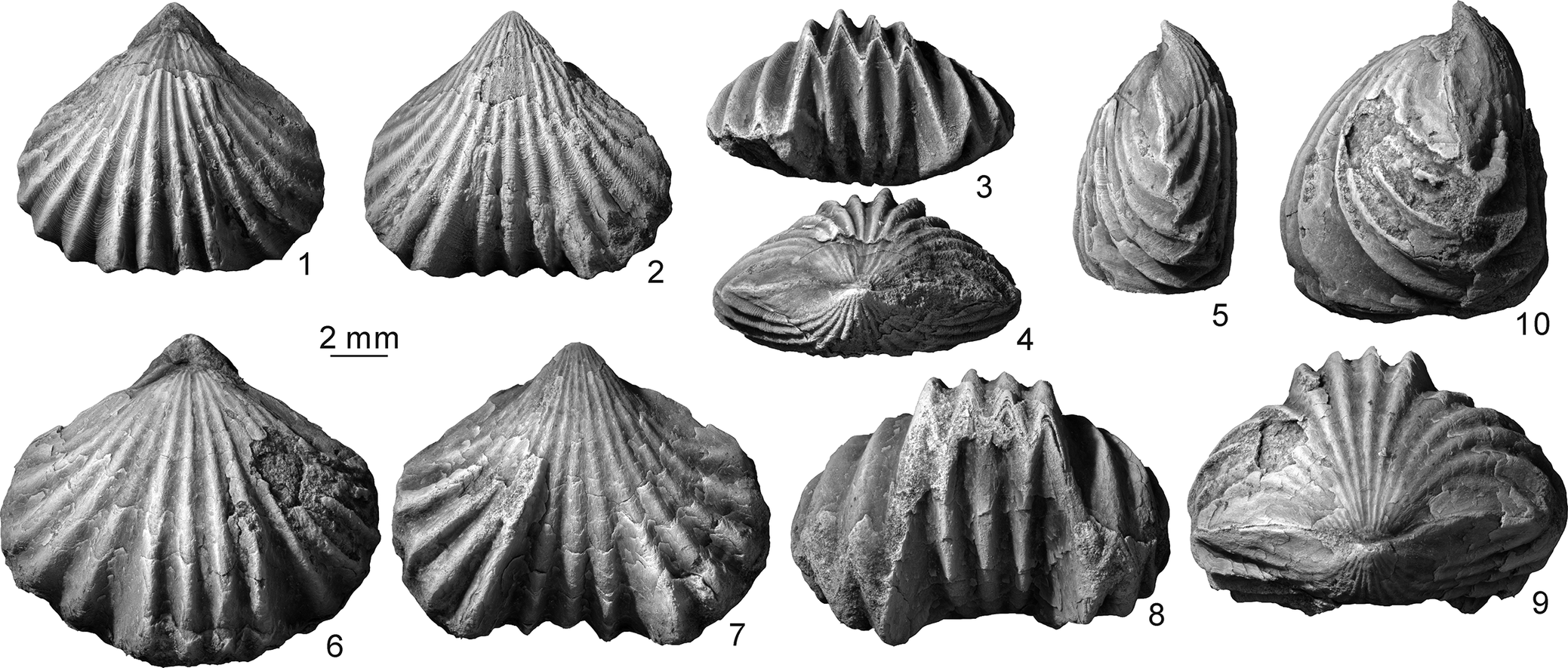
Figure 3. Long description
The photo displays two fossilized specimens of Altaethyrella xuejiaoi n. sp. against a white background, with a 2 mm scale bar located between the rows.
Top row (Holotype N I G P 209462):
* Panel 1: Dorsal view showing a triangular shell with deep vertical ridges radiating from the hinge.
* Panel 2: Ventral view showing a similar ribbed texture and convex shape.
* Panel 3: Anterior view highlighting the zig-zag commissure where the two valves meet.
* Panel 4: Posterior view showing the hinge line and the thickness of the conjoined valves.
* Panel 5: Lateral view showing the profile and curvature of the shell.
Bottom row (Paratype N I G P 209463):
* Panel 6: Dorsal view of the second specimen, showing slightly more wear on the right side of the ribs.
* Panel 7: Ventral view showing the prominent radial costae.
* Panel 8: Anterior view showing a high, sharp zig-zag pattern at the front margin.
* Panel 9: Posterior view showing the umbo and hinge area.
* Panel 10: Lateral view showing the side profile and the depth of the ribs.
Serial grinding sketches of a conjoined shell of Altaethyrella xuejiaoi n. sp. (NIGP 209464) collected from the uppermost part of the Yingan Formation at Kalpin, western Xinjiang, Northwest China.
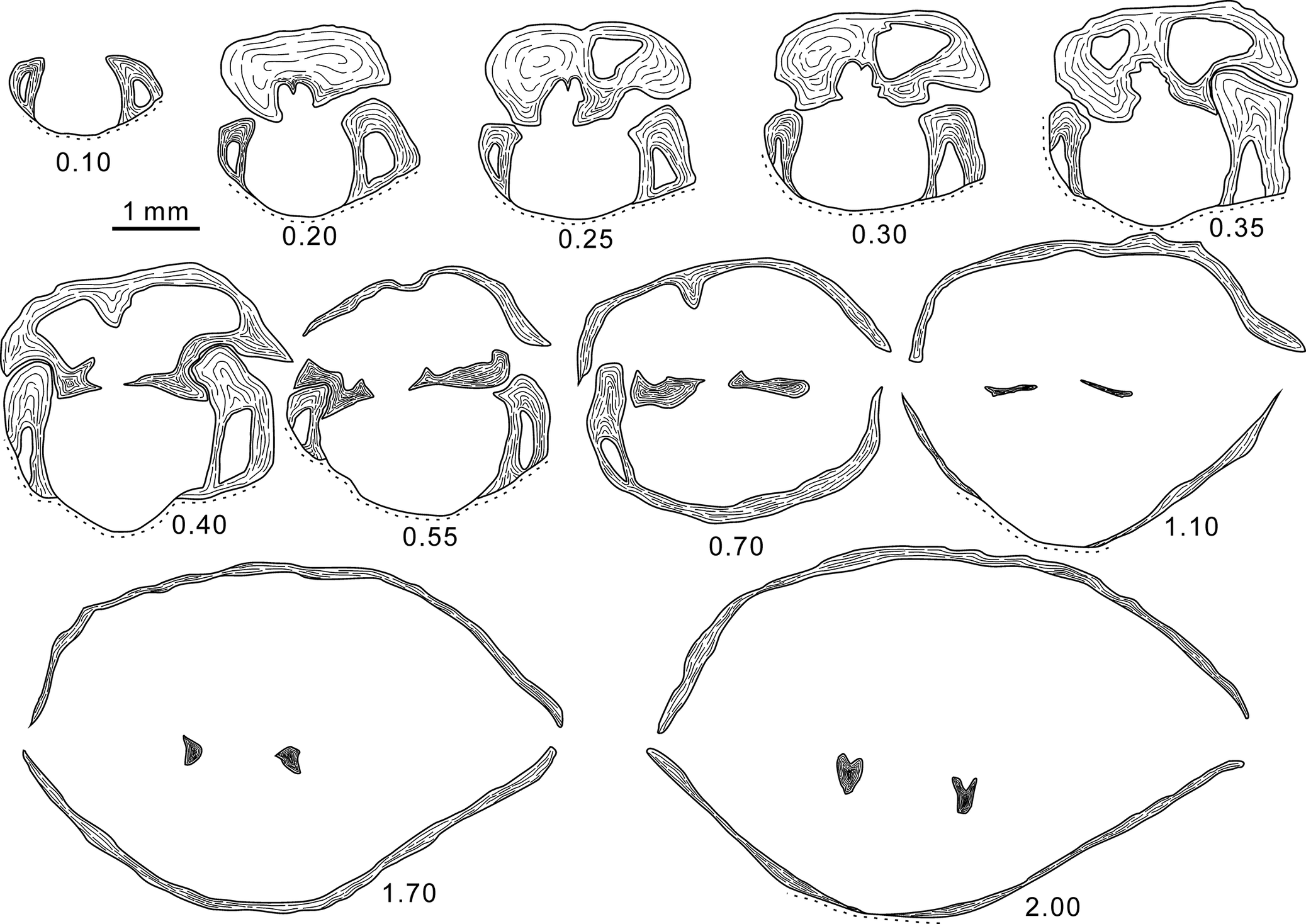
Figure 4. Long description
A multi-panel set of eleven line sketches arranged in three rows. A 1 mm scale bar is located at the top left. Each sketch represents a transverse section of the shell with a numerical value below it indicating the depth in millimeters.
* Top row: Five small sections labeled 0.10, 0.20, 0.25, 0.30, and 0.35. These show the initial development of the hinge and internal structures, with complex layered patterns in the upper and lower valves.
* Middle row: Four larger sections labeled 0.40, 0.55, 0.70, and 1.10. The shell cavity expands, and the internal processes (crura) appear as distinct horizontal or slightly angled projections within the open space.
* Bottom row: Two large, wide sections labeled 1.70 and 2.00. These show the maximum width of the shell valves. The internal structures are reduced to small, dark, V-shaped or triangular points near the center of the cavity.
The sketches use fine lines to indicate the thickness and internal layering of the shell walls, with dotted lines occasionally used to represent the outer boundary of the lower valve.
Serial grinding sketches of a conjoined shell of Altaethyrella xuejiaoi n. sp. (NIGP 209465) collected from the uppermost part of the Yingan Formation at Kalpin, western Xinjiang, Northwest China.
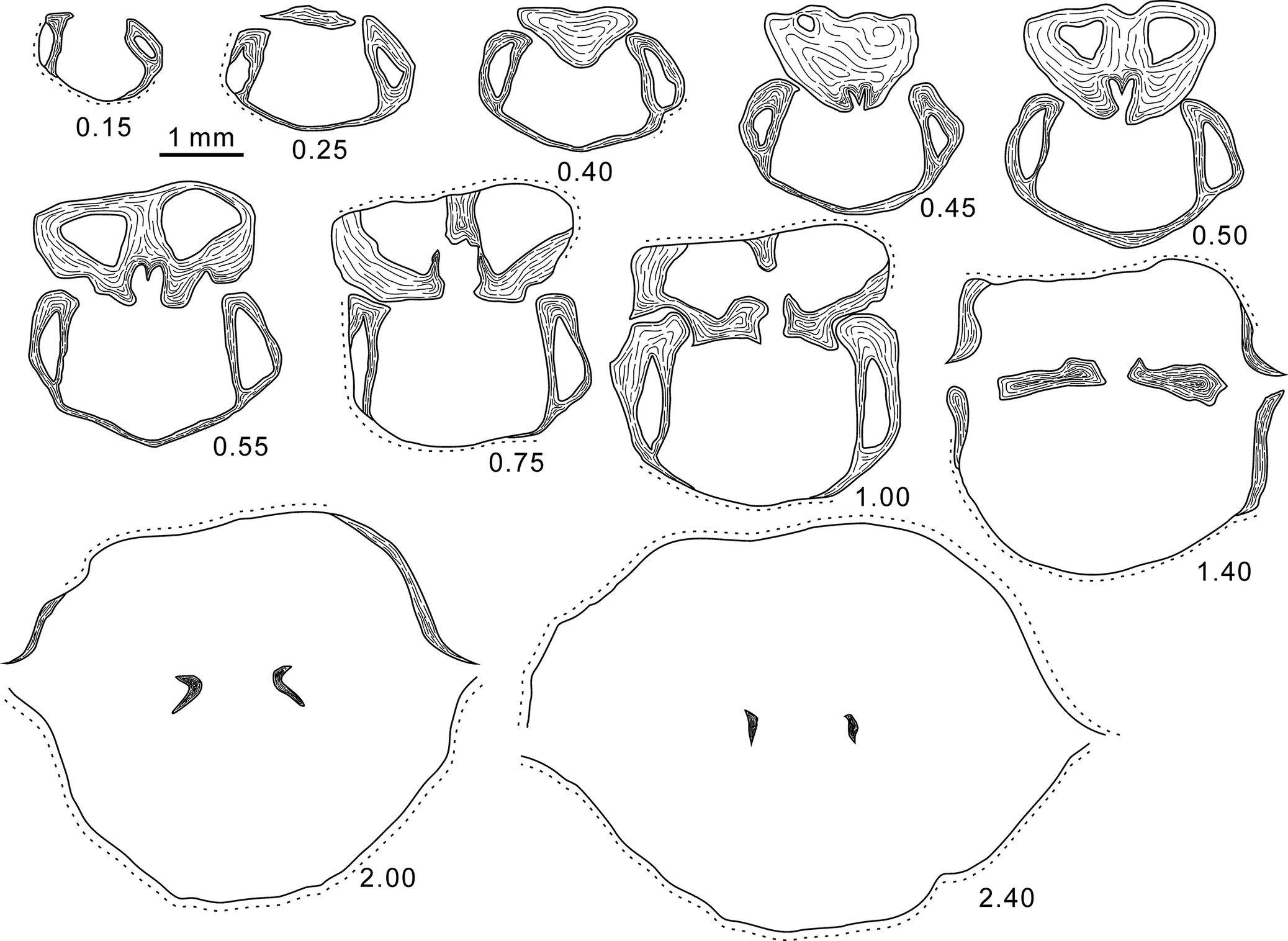
Figure 5. Long description
The sketches represent serial grinding sections of a conjoined shell, with a 1 mm scale bar located at the top left. Each section is labeled with a numerical value indicating depth in millimeters.
* Top row: Five sections labeled 0.15, 0.25, 0.40, 0.45, and 0.50. These show the initial development of the shell hinge and internal structures, with the 0.15 section appearing as a simple open curve and subsequent sections showing the emergence of complex, layered internal plates.
* Middle row: Four sections labeled 0.55, 0.75, 1.00, and 1.40. The shell cavity expands significantly. In sections 0.55 through 1.00, the internal structures are connected to the dorsal wall. By section 1.40, the internal structures appear as two isolated horizontal bands within the large open cavity.
* Bottom row: Two large sections labeled 2.00 and 2.40. These represent the widest part of the shell. The internal structures have reduced to two small, dark, pointed tooth-like features near the center of the large, rounded shell outline.
Throughout the series, solid lines represent the shell wall and internal structures, while dotted lines indicate reconstructed or missing portions of the shell margin.
Length/width and width/depth reduced major axis regression plots of Altaethyrella xuejiaoi n. sp. collected from the uppermost part of the Yingan Formation at Kalpin, western Xinjiang, Northwest China. All measurements in mm.
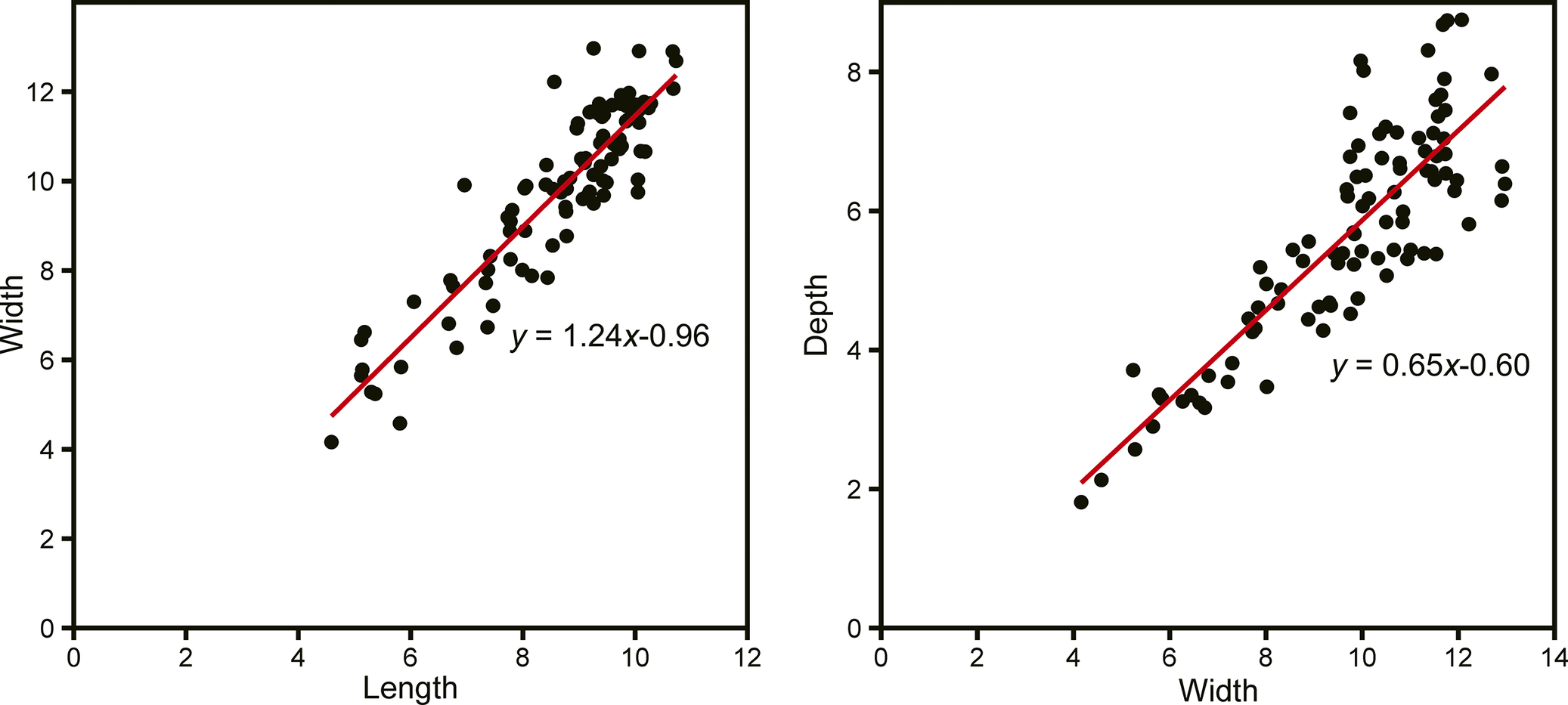
Figure 6. Long description
Two side-by-side scatter plots display morphological data.
The left plot maps Length on the x-axis from 0 to 12 and Width on the y-axis from 0 to 14. Black circular data points are clustered in a tight linear formation starting at approximately length 4.5, width 4 and extending to length 11, width 13. A red regression line passes through the center of the cluster with the equation y equals 1.24 x minus 0.96.
The right plot maps Width on the x-axis from 0 to 14 and Depth on the y-axis from 0 to 9. The data points show a positive linear correlation starting at width 4, depth 2 and extending to width 13, depth 8. The cluster is slightly more dispersed at higher width values. A red regression line follows the trend with the equation y equals 0.65 x minus 0.60.
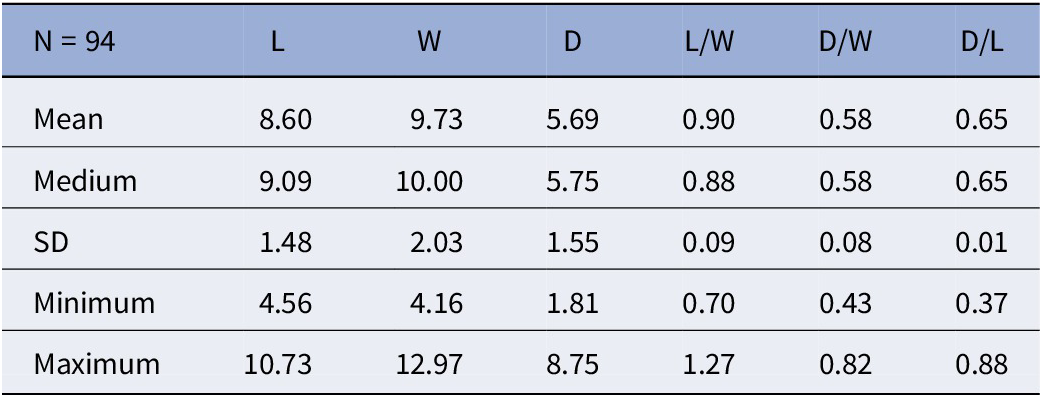
Statistics for the measurements of 94 conjoined Altaethyrella xuejiaoi n. sp. valves collected from the uppermost part of the Yingan Formation (lower Katian) at the Arisu West Section, Kalpin, western Xinjiang, Northwest China. D = shell depth; L = shell length; SD = standard deviation; W = shell width. All measurements in mm
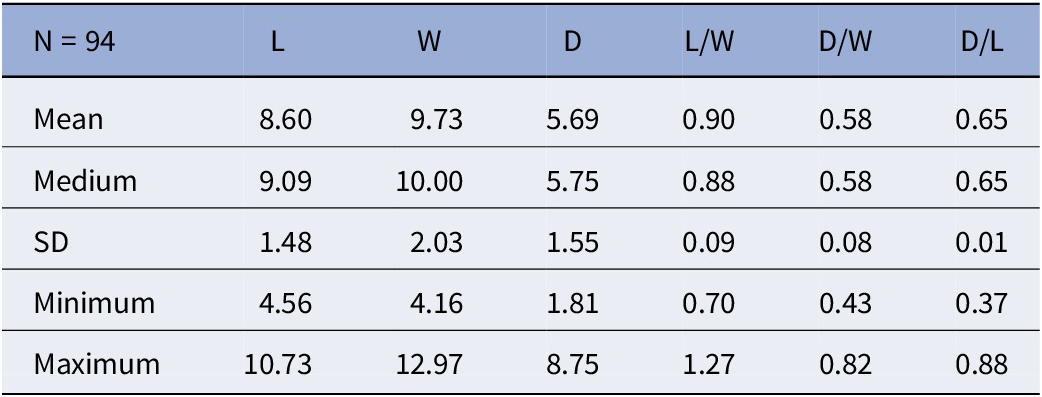
Table 1. Long description
The table presents statistics for 94 conjoined valves. The columns are labeled N equals 94, L (shell length), W (shell width), D (shell depth), L forward slash W, D forward slash W, and D forward slash L. All measurements are in millimeters.
* Mean: L 8.60, W 9.73, D 5.69, L forward slash W 0.90, D forward slash W 0.58, D forward slash L 0.65.
* Medium: L 9.09, W 10.00, D 5.75, L forward slash W 0.88, D forward slash W 0.58, D forward slash L 0.65.
* S D (Standard Deviation): L 1.48, W 2.03, D 1.55, L forward slash W 0.09, D forward slash W 0.08, D forward slash L 0.01.
* Minimum: L 4.56, W 4.16, D 1.81, L forward slash W 0.70, D forward slash W 0.43, D forward slash L 0.37.
* Maximum: L 10.73, W 12.97, D 8.75, L forward slash W 1.27, D forward slash W 0.82, D forward slash L 0.88.
Type specimens
Holotype, one conjoined shell (NIGP 209462) from the uppermost part of the Yingan Formation (lower Katian) at the Arisu West Section, Kalpin County, western Xinjiang, Northwest China. Four paratypes, conjoined shells (NIGP 209458–209460, 209463) from the same bed and locality. The collection locality is located on a mountain slope dipping northward (40°14’14.84"N, 78°47’26.06"E).
Diagnosis
Shell small. Anterior commissure developing from rectimarginate to uniplicate with trapezoidal transverse section during ontogeny. Five ribs on lateral flank. Central myophragm at posterior of notothyrial cavity in mature shells, extending a short length toward anterior.
Occurrence
Reef-stromatoporoid biostromes in the uppermost bed of the Yingan Formation (lower Katian), Kalpin County, western Xinjiang, northwestern China.
Description
Size and morphology of species vary at different growth stages. Smallest shells measuring 4.56 mm long, 4.16 mm wide, and 1.81 mm deep, equally biconvex in lateral profile, subtriangular in outline with no dorsal fold and ventral sulcus developed; anterior commissure rectimarginate. Medium-sized shells equally biconvex or slightly dorsibiconvex in lateral profile, diamond-shaped or subcircular in outline; dorsal fold and ventral sulcus originating at one-quarter to one-half of length from posterior margin, becoming increasingly prominent to form uniplicate commissure trapezoidal in transverse profile, one-third to two-thirds of shell width. Largest shell 10.68 mm long, 12.07 mm wide, and 8.75 mm deep, dorsibiconvex in lateral profile and subpentagonal in outline. Prominent dorsal fold and ventral sulcus originating near umbonal region, becoming wider and more prominent toward anterior margin to form trapezoidal uniplicate commissure with deflection of up to one-third or half of anterior width. Normally four (occasionally three to five) costae on dorsal fold corresponding to three (occasionally two to four) on ventral sulcus with five costae on lateral flanks; simple and rounded, originating from beak, becoming coarser toward anterior or lateral flanks.
Ventral beak small and pointed, orthocline with open delthyrium. Teeth strong and supported by pair of tall, thin dental plates, extending to one-tenth of shell length. Delthyrial cavity deep.
Cardinal process simple, ridge-like. Central myophragm absent in juvenile shells, present in medium-sized and large shells, extending from posterior of notothyrial cavity for < 0.2 mm. Median ridge weakly developed, extending to one-tenth of shell length. Hinge plates distinct, thinning anteriorly, extending parallel to commissural plane. Crura rod-like, delicate, extending to less than one-quarter of shell length in adult shells.
Etymology
Named after Xuejiao Li in appreciation of her support for the first author.
Materials
A total of 94 conjoined valves, including five shells (NIGP 209457–209461) figured in Figure 2 and two shells (NIGP 209462, 209463) shown in Figure 3. Two shells (NIGP 209464, 209465) were serially ground and illustrated in Figures 4 and 5, respectively.
Remarks
Altaethyrella xuejiaoi n. sp. differs from all other known species of the genus in its particularly small size. The five costae on the lateral flank of this species differs from Altaethyrella crata (Fu, Reference Fu1982) with four ribs on the dorsal lateral flank and three ribs on the ventral side; Altaethyrella gentilis (Xu in Jin et al., Reference Jin, Ye, Xu and Sun1979) and Altaethyrella megala (see Kulkov and Severgina, Reference Kulkov and Severgina1989) with five or six lateral ribs; Altaethyrella akchokense (Popov et al., Reference Popov, Cocks and Nikitin2002) with at most six lateral ribs; Altaethyrella otarica (Rukavishnikova, Reference Rukavishnikova1956), Altaethyrella seletensis (see Nikitin et al., Reference Nikitin, Popov and Bassett2003), and Altaethyrella tarimensis Sproat and Zhan, Reference Sproat and Zhan2018 with an average of seven lateral ribs; Altaethyrella yaoxianensis (Fu, Reference Fu1982) and Altaethyrella transversa (Fu, Reference Fu1982) with seven or eight lateral ribs; Altaethyrella zhejiangensis (Wang in Wang et al., Reference Wang, Jin and Fang1964) with at most 11 lateral ribs, and Altaethyrella yaxianensis (Xu and Su, Reference Xu and Su1977) with 12–15 lateral ribs.
Although all species of Altaethyrella are known from shallow marine settings, Altaethyrella xuejiaoi n. sp. was collected from a low diversity assemblage of stromatoporoids that likely reflects a stressed, and perhaps very shallow-water, assemblage with the co-occurrence of abundant corals and stromatoporoids. This stressed environment could have benefited a smaller shell size with individuals reaching maturity very quickly and therefore able to reproduce to survive in a challenging environment. Other species of Altaethyrella have been described from a more stable, level-bottom, shallow marine community that could have favored larger shell sizes.
Evolution and paleobiogeographic significance of Altaethyrella fauna
Inferring the ancestor of Altaethyrella remains challenging due to the lack of direct evidence. Ancistrorhyncha Ulrich and Cooper, Reference Ulrich and Cooper1942, however, appears to be a plausible contender in this regard. The species Ancistrorhyncha modesta Popov in Nikiforova and Popov, Reference Nikiforova and Popov1981 is the earliest known rhynchonellide in the Sandbian of Central Asia that lacks the dorsal median septum, and belongs to the Ancistrorhynchidae (Nikiforova and Popov, Reference Nikiforova and Popov1981).
Altaethyrella xuejiaoi n. sp. is thus far only known from the top of the Yingan Formation in the Tarim Basin. The early Katian (Ka-1) age (Tang et al., Reference Tang, Zhang, Wang, Huang and Yang2023) of this formation indicates that Altaethyrella xuejiaoi n. sp. is also one of the oldest known Altaethyrella species. Other early species in this genus have been reported from the Sowerbyella-Sulcatospira association (Popov et al., Reference Popov, Holmer and Gorjansky1997, Reference Popov, Nikitin and Sokiran1999) and the Altaethyrella-Rongatrypa association (Popov et al., Reference Popov, Nikitin and Cocks2000; Popov and Cocks, Reference Popov and Cocks2006) in Chu-Ili, Kazakhstan; the ‘Mimella’ beds (Misius, Reference Misius1986b) and ‘Kuzgunia’ beds (Misius, Reference Misius1986b) in North Tien-Shan and Karatau-Naryn, Kyrgyzstan; and the Parastrophina association (Nikitin et al., Reference Nikitin, Popov and Bassett2006) in Boshchekul, Kazakhstan. This new species extends the early range of this lineage outside the Kazakh terranes, although Tarim was likely closer to most of these terranes than to North and South China (Popov and Cocks, Reference Popov and Cocks2017). Early Katian (Ka-1) Altaethyrella faunas from Kazakhstan and Kyrgyzstan can be easily distinguished from the Sandbian faunas in the same region by the occurrence of Altaethyrella and abundant endemic atrypides (e.g., Nikolaispira Nikitin, Leonid, and Holmer, Reference Nikitin, Leonid and Holmer1996; Nuria Misius, Reference Misius1986a; Rongatrypa Popov and Cocks, Reference Popov and Cocks2014; Schachriomonia Nikiforova, Reference Nikiforova1978; and Sulcatospira). No early Altaethyrella species have been reported from South China, however, this might have been due to the deeper paleoenvironmental setting there, where the Foliomena fauna, in contrast, was widely distributed at this time (Zhan et al., Reference Zhan, Jin, Liu, Corcoran, Luan and Wei2016).
By the middle Katian (Ka-2–4), the Altaethyrella fauna had expanded from the Kazakh terranes eastward into the plates and terranes that make up China. Species have been reported from Chu-Ili (Popov and Cocks, Reference Popov and Cocks2006), Boshchekul (Nikitin et al., Reference Nikitin, Popov and Bassett2006), and Chingiz-Tarbagatai (Pushkin and Popov, Reference Pushkin and Popov1990) in Central Asia. Three endemic Altaethyrella faunas were reported from northern South China, northwestern Tarim, and western North China. The brachiopod fauna from the Shiyanhe Formation of Xichuan, northern South China, yields abundant Altaethyrella inflata and atrypide brachiopods, e.g., Xichuanatrypa Zhang, Reference Zhang2021 and Rongatrypa, with the co-occurrence of the endemic orthide Zhejiangorthis Liang in Liu, Xu, and Liang, Reference Liu, Xu and Liang1983 (Zhang et al., Reference Zhang, Sproat, Zhan, Harper and Rong2026). The fauna from the carbonate mud mound of the Lianglitag Formation of Bachu, northwestern Tarim, is dominated by triplesiides, camerelloids, and atrypides, with a few orthides and strophomenides (e.g., Camerella Billings, Reference Billings1859; Didymelasma Cooper, Reference Cooper1956; Dinorthis? Hall and Clarke, Reference Hall and Clarke1892; Glyptomena Cooper, Reference Cooper1956; Grammoplecia Wright and Jaanusson, Reference Wright and Jaanusson1993; Parastrophina; Pectenospira Popov, Nikitin, and Sokiran, Reference Popov, Nikitin and Sokiran1999; Placotriplesia Amsden, Reference Amsden1968; Plectosyntrophia Fu, Reference Fu1982), comprising a unique assemblage although still showing affinities with contemporaneous faunas from Kazakhstan (Rong et al., Reference Rong, Jin, Shen and Zhan2017). The fauna from the carbonate mud mound of the Beiguoshan Formation in Longxian, western North China, includes a variety of brachiopods with high endemism and diversity (Fu, Reference Fu1982; Fu et al., Reference Fu, Hu, Zhang and Wang1993; Jin et al., Reference Jin, Rong and Zhan2011). This fauna, however, is poorly known and needs to be re-studied. This shows that when the appropriate shallow-water paleoenvironments were available on these plates and terranes, Altaethyrella was able to quickly expand its geographic range, perhaps indicating an ability to proliferate quickly and dominate shallow-water ecosystems at this time.
Late Katian (Ka-4) Altaethyrella faunas are only known in Chu-Ili and Chingiz-Tarbagatai in Kazakhstan (Sapelnikov and Rukavishnikova, Reference Sapelnikov and Rukavishnikova1975; Apollonov et al., Reference Apollonov, Bandaletov and Nikitin1980; Popov and Cocks, Reference Popov and Cocks2014), but are widely known from South China (e.g., Xu and Su, Reference Xu and Su1977; Zhan and Cocks, Reference Zhan and Cocks1998; Zhang et al., Reference Zhang, Sproat, Zhan, Harper and Rong2026), Tarim (Sproat and Zhan, Reference Sproat and Zhan2018, Reference Sproat and Zhan2019; Zhang et al., Reference Zhang, Sproat, Zhan, Harper and Rong2026), and Qaidam (Jin et al., Reference Jin, Ye, Xu and Sun1979). These faunas have close affinity and can be easily distinguished from faunas in Russia and Mongolia (Zhang et al., Reference Zhang, Sproat, Zhan, Harper and Rong2026). The Altaethyrella fauna from the northeastern margin of the Zhe-Gan Platform, eastern South China, is the most diverse and representative, yielding a total of 41 genera that can be classified into eight brachiopod communities (Zhan and Cocks, Reference Zhan and Cocks1998). The complexity of sedimentary backgrounds in the Jiangshan, Changshan, and Yushan areas (e.g., water depth, sedimentary substratum, and redox conditions) supports a variety of habitats, which significantly enhances the regional brachiopod biodiversity and promotes the faunal endemism before LOME.
Altaethyrella megala, the type species of this genus, was reported from the Katian dark gray massive limestones in northwestern Altai, Russia (Severgina, Reference Severgina1978; Kulkov and Severgina, Reference Kulkov and Severgina1989), with the co-occurrence of other brachiopods: Ptychopleurella mica Severgina, Reference Severgina1978; Austinella sp. indet.; Plaesiomys sp. indet.; Giraldibella bella (Bergström, Reference Bergström1968); Giraldibella sp. cf. G. subsilurica Marek and Havlíček, Reference Marek and Havlíček1967; Cyclocoelia? prima Severgina, Reference Severgina1978; Cliftonia oxoplecioides Wright, Reference Wright1963; Streptis incompta Ulrich and Cooper, Reference Ulrich and Cooper1936; Ptychoglyptus parvus Severgina, Reference Severgina1978; Diambonia septate (Cooper, Reference Cooper1930); Parastrophinella salairica Severgina, Reference Severgina1978; Parastrophina orloviensis Severgina, Reference Severgina1978; Eoanastrophia transversa Severgina, Reference Severgina1978; Thebesia thebesensis Amsden, Reference Amsden1974; Catazyga carteri Cooper and Kindle, Reference Cooper and Kindle1936; Spirigerina (Eospirigerina) minima Severgina, Reference Severgina1972; and Spirigerina (Eospirigerina) gaspeensis Cooper, Reference Cooper1930). A systematic revision of this fauna and a precise biostratigraphic correlation of the related formations, however, need to be carried out to reveal the regional brachiopod evolution and biogeography prior to LOME.
Although some paleogeographic reconstructions have already provided results, reliable identification of shallow-water benthic faunas will be key to understanding not only the location of these paleoplates over time, but also the migration of fauna across these plates.
Acknowledgments
We thank R. Zhan, Y. Wang, Z. Huang, K. Liang, and J. Fu, for their support during fieldwork. We are also grateful to D.A.T. Harper, I.G. Percival, Y. Candela, and the editorial board for supportive comments that greatly improved this work. Financial support was provided by the National Natural Science Foundation of China (grant no. 42202021), the Key Laboratory of Palaeobiology and Petroleum Stratigraphy (grant no. 20232102), and the Key Laboratory of Deep-time Geography and Environment Reconstruction and Applications of the Ministry of Natural Resources, Chengdu University of Technology (DGERA 20251007). Shcherbanenko was supported by the Russian Academy of Sciences (FW ZZ-2026-0033). Sproat was supported by a Natural Sciences and Engineering Research Council of Canada Discovery Grant. This work is a contribution to IGCP Project 735: Rocks and the Rise of Ordovician Life.
Competing interests
Sproat is an associate editor for the Journal of Paleontology but played no role in handling this manuscript.



 Open access

