

Introduction
This study seeks to gauge views on criminalization of HIV non-disclosure among people living with HIV or AIDS (PHAs) in Ontario, Canada, where the issue has attracted considerable press attention and been the subject of extensive, ongoing community discussion over many years. In particular, it explores: the sources of legal information available to HIV-positive people, including how they have been informed of legal developments by AIDS service organizations (ASOs), health providers, and other relevant organizations; PHAs’ perceptions of how criminal prosecutions for HIV non-disclosure, and media coverage of these legal proceedings, affect understanding of rights and responsibilities of self and others concerning transmission and vulnerability to prosecution; where PHAs themselves stand on the role the criminal justice system should play in regulating HIV transmission or exposure; and how these views vary according to respondent characteristics, including how long they have been living with HIV and whether disclosure to partners arises in their own lives. This study, then, is interested in the informational environment and social characteristics that shape views of criminalization in order to better understand how criminalization is affecting the lives of PHAs and to contribute to ways of better navigating the relationship of PHAs with the criminal justice system. Drawing on survey questions posed to two large cohorts of PHAs plus 122 qualitative interviews, this study casts light on the ways in which PHAs’ attitudes toward criminalization are shaped by their social locations in relation to a broader public HIV-related discourse generated by the courts, media, and health sectors.
Over the last decade, criminal prosecutions of HIV-positive people for not disclosing their serostatus to sexual partners have attracted extensive media attention, placing HIV in the public eye as a criminal justice matter (Mykhalovskiy and Betteridge Reference Mykhalovskiy and Betteridge2012). The media attention may, in turn, be contributing to the volume of charges, as criminal prosecution as a response to HIV non-disclosure is given greater visibility in the public sphere, and recourse to police and to the laying of criminal charges is constructed and reaffirmed as an expected and appropriate response. The result, not surprisingly, has been heightened anxiety and uncertainty among people living with HIV about how to act in everyday encounters to avoid prosecution (Adam et al. Reference Adam, Corriveau, Elliott, Globerman, English and Rourke2014). Canadian media coverage of HIV transmission, responsibility, and culpability has increased a sense of vulnerability, especially among women, immigrants, and black men, as well as in anyone experiencing or anticipating the possibility of a disgruntled ex-partner using, or threatening to use, allegations of non-disclosure and possible criminal prosecution as an instrument in disputes (Adam et al. Reference Adam, Corriveau, Elliott, Globerman, English and Rourke2014). As observed in Australia (Persson and Newman Reference Persson and Newman2008), the United Kingdom (Weait Reference Weait2007), and the United States (Clarke Reference Clarke2006), the pattern of criminal prosecutions, and the media coverage of those prosecutions, have tended to reinforce a moral hierarchy of deserving and undeserving “victims” defined in particular by race and gender. Criminal law and media attention have fallen most heavily on (usually heterosexual) men of African descent (Miller Reference Miller2005), while women often find themselves divided between “the ‘good’ woman [who] is a woman who had kept herself chaste, and unfortunately trusted the wrong man [and] the ‘bad’ woman, [who] by contrast, is one who deliberately neglected all warnings and succumbed to her base desires” (Jiwani Reference Jiwani2014). Gay men and accused persons who use(d) drugs, on the other hand, tend to be relegated to the abject category of the always, already guilty. Examining the issue of media representation generally (i.e., more broadly than just the context of criminal prosecutions), Juanne Clark’s (Reference Clarke2006, 326) study of the coverage of AIDS in Canadian popular magazines found that “innocent victims of HIV/AIDS were described in warmly sympathetic and even heroic terms. Guilty victims, such as homosexuals, were almost never featured in personal profiles.”
HIV-positive people find themselves socially positioned by competing discourses generated by a set of actors ranging from the medical system and ASOs to the criminal justice system and mass media. These latter, dominant actors tend to generate punitive discourses in the public sphere that frame the sexual interactions of HIV-positive people in terms of criminal regulation. As a result, many people among the populations most at risk of HIV, and HIV-positive people in particular, find themselves at a nexus of discourses which prescribe appropriate practice for citizens of neoliberal societies, most notably a demand for responsible management by individuals in a marketplace of risk (Rangel and Adam Reference Rangel and Adam2014). The prominence of criminal narratives, including their widespread dissemination via mass media, publicizes constructions of PHAs as failed subjects deemed to be inadequate or irresponsible in the self-government of risk.
People living with HIV have their own experiences of negotiating sexual and romantic relationships where disclosure of serostatus may arise and of articulating a personal ethic of responsible action. This study raises questions of how PHAs respond to this social environment, how their own social and sexual histories interact with disciplinary discourses circulating in that environment, how they reconcile punitive language with their own sense of social and sexual citizenship, and how they seek to position themselves among these forces of state regulation and expected self-governance. This study seeks to delineate the ways in which these personal, interactional, and social factors influence PHA positioning vis-à-vis the criminalization of HIV exposure and non-disclosure under Canadian law and explores policy implications of the dilemmas that PHAs currently face.
Legal Content: HIV Non-Disclosure and Canadian Criminal Law
The Supreme Court of Canada first addressed the question of criminal liability for not disclosing HIV-positive status in the case of R. v Cuerrier. The key question was whether non-disclosure could lead to a conviction for aggravated assault, because under Canada’s Criminal Code (s. 265), consent to physical contact is vitiated if obtained by “fraud.” Adapting the legal definition of fraud developed in the context of commercial transactions, the Court concluded that, to secure a conviction for sexual assault against an HIV-positive person for non-disclosure, the prosecution must prove three things beyond a reasonable doubt: (1) that the accused person committed an act that a reasonable person would see as dishonest; (2) that there was a harm, or a risk of harm, to the complainant as a result of that dishonesty; and (3) that the complainant would not have consented to the contact (i.e. sex) but for the accused person’s dishonesty. In applying this framework and having expressed its concern about not over-extending the criminal law, the majority of the Court concluded that the duty to disclose HIV would arise in the case of activity posing a “significant risk of serious bodily harm” and also explicitly stated that in the absence of such a risk, the duty to disclose would not arise. Writing for the majority of the Court (four of the seven judges who sat on the case) and partly in response to submissions of intervening HIV organizations, Justice Cory also suggested that “careful use of a condom might be found to so reduce the risk of harm that it could no longer be considered significant,” so there might be no duty to disclose in the event of condom use for penetrative sex. Two of the judges generally concurring with this majority opinion, including the subsequent Chief Justice of the Court, went further in a separate judgment, explicitly affirming that the HIV-positive person who does not disclose but engages in “protected sex” (i.e., penetrative sex with the use of condom) should not be captured by the criminal law of sexual assault.
Following the Cuerrier decision, the charge most frequently laid in subsequent years in cases of alleged HIV non-disclosure to a sexual partner was “aggravated sexual assault,” which is defined as including any assault that “wounds, maims, disfigures or endangers the life of the complainant” (Criminal Code, s. 268). This is the most serious of the three categories of sexual assault defined in the Criminal Code, and conviction for this offence carries a maximum penalty of life imprisonment and mandatory designation, presumptively for life, as a sex offender. In most of the prosecutions that followed Cuerrier, a majority of trial and appellate judges implicitly or explicitly adopted the suggestion in the majority judgment of the Supreme Court that condom use precluded criminal liability for not disclosing HIV-positive status. However, this was not universally the approach, and eventually the question of criminal liability for non-disclosure to a sexual partner returned to the Supreme Court of Canada, in a pair of cases that not only engaged the question of the legal significance of condom use, but also, in light of scientific developments following Cuerrier, the legal significance of the viral load of an HIV-positive person accused of non-disclosure.
In February 2012, the Supreme Court of Canada heard the cases of R. v Mabior from Winnipeg and R. v D.C. from Montreal, in which the Attorneys General of Manitoba and Quebec, with the vocal support of the Attorney General of Alberta as an intervener, argued for obligatory disclosure of HIV status in any sexual encounter, upon pain of criminal prosecution for aggravated sexual assault, regardless of the degree of risk of transmission (Canadian HIV/AIDS Legal Network 2012c). In its paired rulings released in October 2012, the Court refrained from imposing under the criminal law of assault this blanket obligation of HIV disclosure urged by the Attorneys General, and instead asserted that it would maintain the “significant risk of serious bodily harm” test from the earlier Cuerrier ruling. However, the Court went on to state that, in the context of HIV, this test is met if there is a “realistic possibility” of HIV transmission. As outlined by advocates for the human rights of people living with HIV, the Court has seemingly set the bar very low in defining when there is a “realistic possibility” of transmission, despite its statements of concern about not “extending the criminal law beyond its appropriate reach in this complex and emerging area of law.” The Court stated that “as a general matter, a realistic possibility of transmission of HIV is negated if (i) the accused’s viral load at the time of sexual relations was low, and (ii) condom protection was used.” Given this statement and the facts of the cases on which the Court was pronouncing, the only sex that the Court has clearly recognized as not posing a realistic possibility of HIV transmission is penile-vaginal sex that takes place when both a condom is used and the person living with HIV has a “low” viral load, under 1,500 copies/mL. If both of these conditions are met, then there is no obligation under the criminal law to disclose HIV-positive status (Canadian HIV/AIDS Legal Network, 2012c). This approach deviates from the suggestion by the majority of the Court in Cuerrier, largely followed by lower courts, that condom use alone should or might suffice to avoid criminal conviction. This departure from the Cuerrier suggestion, which raises the bar higher and substantially extends the potential application of the law of sexual assault to PHAs in a wider range of circumstances, was one of several criticisms of the decision advanced by HIV advocates. The Supreme Court did not clarify how the requirement to disclose in the case of a “realistic possibility” of transmission applies to any sexual activity other than penile-vaginal sex (Canadian HIV/AIDS Legal Network, 2012c).
The Court’s decisions were widely criticized by HIV advocates (e.g., Canadian HIV/AIDS Legal Network et al., 2012b) and have raised concerns in other quarters as well. It should also be noted that the Court’s pronouncements in Mabior and D.C. are likely not the last word on the matter. Arguments about the parameters of the law, including the interpretation and application of the Court’s “realistic possibility” threshold articulated in these cases, continue in the courts, between community advocates and prosecutors, and in the legal and other academic literature. For one thing, the Supreme Court itself explicitly stated that the law should be open to “adapting to future advances in treatment,” which could further affect both the risks of HIV transmission and the harm associated with HIV. In a couple of subsequent reported proceedings, trial court judges have taken the unusual step of outlining in detail their concerns with, and objections to, the Supreme Court’s approach in Mabior/D.C. In refusing to convict an HIV-positive accused who had an undetectable viral load but did not use a condom, they have adopted a slightly less expansive approach to criminalization by underscoring that the Supreme Court referred to the requirement of both condom use and low viral load with the caveat that this was “as a general matter.” Furthermore, they have insisted that the prosecution retains the burden of proving beyond a reasonable doubt that there was a “realistic possibility” of transmission and have found on the medical evidence before them that there was no such realistic possibility in the case of an undetectable viral load. (See the decisions in R. v J.T.C and R. v J.T.C.) There has also been ongoing debate among legal academics concerned with human rights, including among feminist scholars and advocates, about the tensions raised between protecting a robust conception of consent in the law of sexual assault necessary to reflect women’s equal right to sexual autonomy and over-extending the law of sexual assault in ways that unjustly prosecute people, including women, living with HIV (Mathen and Plaxton Reference Mathen and Plaxton2011; Grant Reference Grant2011; Grant Reference Grant2013; Shaffer Reference Shaffer2013; Symington Reference Symington2013; Buchanan, 2015; Canadian HIV/AIDS Legal Network, 2015).
Studies of Views on HIV Criminalization
Studies on views of criminalization of HIV have typically surveyed the opinions of either gay and bisexual men (both HIV-positive and HIV-negative) or people living with HIV from different risk groups. The largest study, done in the United Kingdom by Dodds and Keogh (2009, 6,9), focuses on the criminalization of the transmission of HIV, rather than the criminalization of non-disclosure of HIV-positive status; this reflects the state of the criminal law in England and Wales, under which criminal liability arises only for actual transmission, not for exposure. They asked 8,252 men who have sex with men, “Do you think it is a good idea to imprison people who know they have HIV if they pass it to sexual partners who do not know they have it?” and found that more than half of respondents overall agreed with the statement, but only a fifth of HIV-positive men agreed. Overall, Dodds and colleagues found some variation in attitudes toward criminalization: those who were younger, untested, less educated, less urban, and more behaviourally bisexual were more likely to agree with the more punitive position.
A study by Horvath, Weinmeyer and Rosser (Reference Horvath, Weinmeyer and Rosser2010, 1224) of 1,725 men in the United States who have sex with men shifts attention from actual transmission to (non)-disclosure, in line with the law in much of North America. Horvath and colleagues found that “sixty-five percent of respondents believed that it should it be illegal for an HIV-positive person who knows his or her status to have unprotected sex without telling the other person of their HIV-status.” They also found some variation in opinion, with support for criminalization of unprotected sex without disclosure associated with being younger, HIV-negative or unknown sero-status, less educated, and not gay identified. Unless otherwise specified, these studies refer to “unprotected” sex as penetrative sex, generally anal or vaginal, without a condom. More recently, there has emerged a substantial body of evidence establishing that the use of antiretroviral medications, whether as treatment by persons living with HIV that succeeds in suppressing viral load or by HIV-negative persons as pre-exposure prophylaxis, can and does have a substantial protective effect that dramatically reduces the risk of transmitting or acquiring HIV (Loutfy et al. Reference Loutfy, Tyndall, Baril, Montaner, Kaul and Hankins2014). As a result, there is a current move toward referring to “condomless” sex rather than “unprotected sex” in recognition of risk reduction alternatives to condoms.
Three studies, one in the United Kingdom and two in the United States, have investigated in particular the views of people living with HIV on criminalization. Dodds and Keogh (Reference Dodds and Keogh2006, 316–17) conducted twenty focus groups with 125 HIV-positive people in England and found they expressed considerable “concern that criminalization had weakened the message that sexual health should be the responsibility of both consenting partners during sex” but “a minority of respondents did hold that criminalization may be justified” in some instances. Klitzman et al. (Reference Klitzman, Kirshenbaum, Kittel, Morin, Daya, Mastrogiacomo and Rotheram-Borus2004, 49) interviewed seventy-six HIV-positive people in four US cities and reported that “most participants supported the criminalization of non-disclosure of one’s HIV-positive status to sexual partners” in some circumstances. Galletly et al. (Reference Galletly, Glasman, Pinkerton and DiFrancisco2012, 2137), in a survey of 493 HIV-positive in New Jersey, found even more punitive views, with 87 percent believing that unprotected vaginal or anal intercourse with an uninformed partner should be a crime.
A national public opinion poll conducted in Canada in 2011 found that 82 percent of Canadians agreed with the statement, “People living with HIV/AIDS have the same right to be sexually active as long as they inform their sexual partners about their HIV/AIDS status,” and at the same time, 71 percent agreed that “People living with HIV/AIDS have the right to be sexually active as long as they practice safe sex” (Calzavara et al. Reference Calzavara, Allman, Worthington, Tyndall and Adrien2012, 16). Furthermore, 74 percent agreed it is “appropriate to imprison someone who knowingly did not divulge their status to a sexual partner,” even though “fewer than half agree that criminal prosecution is an effective way to stop or deter people from transmitting HIV to their sexual partners.” A national survey of gay, bisexual, and other men who have sex with men that had a particularly strong representation of rural and heterosexually-married men, found that 61 percent agreed that “there should be a law that requires people who are HIV-positive to disclose their HIV status to their sexual partners,” but at the same time, only 30 percent thought criminalization could be justified if a condom were used, and only 30 percent believed that “criminal prosecution is an effective way to stop or deter people from transmitting” HIV (Myers et al. Reference Myers, Allman, Adam, Alexander, Blais, Calzavara, Remis, Marchand and Maxwell2013, 62–63). The study reported here represents the first Canadian study, to our knowledge, exclusively reporting on the views of people living with HIV, as well as being the largest survey to date of people living with HIV on the issue of criminalization.
Not surprisingly, the existing published research finds that people are far from unanimous in their views on the role of criminalization in instances of HIV (non)-disclosure or transmission, but in several places, non-disclosure coupled with condomless sex attracts high levels of disapproval, including agreement that criminal prosecution may be justifiable, while the use of condoms significantly reduces support for prosecution.
Methodology
The findings reported here draw on in-depth qualitative interviews conducted with 122 PHAs plus questions added to the two major cohort studies of PHAs in Ontario, the Ontario HIV Treatment Network Cohort Study (OCS) (http://www.ohtncohortstudy.ca/) (N=959) and the Positive Spaces, Healthy Places cohort study (PSHP) (http://www.pshp.ca/) (N=442).
An objective of drawing from all three of these data sources was to attain broad representation of people living with HIV in accordance with the epidemiology of HIV prevalence in Ontario as measured by risk group, age, gender, sexual orientation, and ethno-cultural origin. In general, this objective was met. Of the 122 interviews, eight were conducted in French in Ottawa, the rest being in English in Toronto and Ottawa, where 83 percent of HIV-positive people in Ontario live. Ten interviews were with people who had some kind of direct experience with the criminal justice system, whether as complainants, defendants (including some who were convicted of charges related to non-disclosure or exposure to HIV), or former sex partners contacted by police for testimony in HIV-related trials.
A proposal for this study arose from a series of meetings of people from academic, community, government, and ASO settings concerned with the impact of criminalization on the lives of PHAs. A research team and community advisory committee emerged from these meetings, based primarily on interest, skill, and degree of time commitment that members were able to devote to the project. The study proposal was reviewed in accord with the Tri-Council Policy Statement: Ethical Conduct for Research Involving Humans by research ethics boards at the University of Windsor and the University of Ottawa. A community advisory committee, with representatives from HIV-positive people, ASOs, legal organizations and the provincial ministry of health, assisted in the development of the project. An honorarium of $30 was provided to all participants from whom data were collected. Funding for the study was provided by a grant from the Ontario HIV Treatment Network.
Semi-structured interviews explored such topics as: awareness of court cases and media coverage of criminal proceedings concerning HIV, information sources and awareness of the law, perceptions of media coverage, and views on when criminalization may be justified. Interviews were transcribed and coded to capture all narratives relevant to each topic. Narratives were then examined to identify the range of views associated with each topic using constant comparative analysis with NVivo8 software. The narrative themes that emerged with each topic are reported here, with more frequently occurring themes reported first as a whole and under each subheading, followed by variations and less frequent themes.
Demographic Characteristics
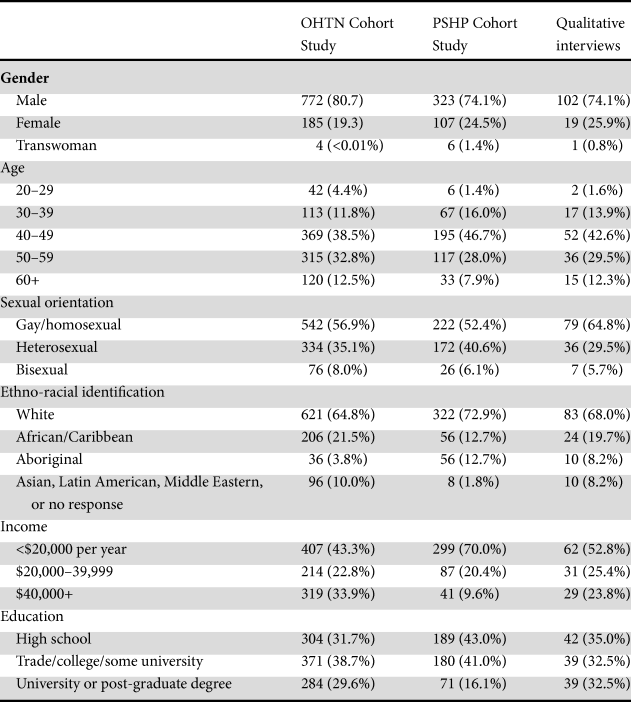
Table 1 shows the demographic characteristics of study participants from the three data sources.
Participant demographics

OHTN = Ontario HIV Treatment Network; PSHP = Positive Spaces, Healthy Places.
Between 74 and 81 percent were male, depending on data source; 19 to 26 percent were female. The majority were between 40 and 59 years of age. Fifty-seven to 65 percent were gay, and 65 to 73 percent white, with significant representation of people identifying as of African, Caribbean, or Black origin (13–22%). Modal income was low, with sizeable numbers (43–70%) reporting less than $20,000 in income per year despite 57 to 68 percent reporting postsecondary education.
Information Sources and Awareness of the Law
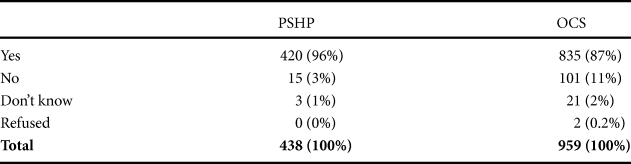
Participants in the two cohort studies were asked a basic question about their awareness of the law concerning HIV: Have you heard that Canadian law requires you to tell your sexual partners that you are HIV-positive, at least in some circumstances? The distribution of answers is provided in Table 2.
Distribution of answers to the question: Have you heard that Canadian law requires you to tell your sexual partners that you are HIV-positive, at least in some circumstances?
PHSP = Positive Spaces, Healthy Places; OCS = Ontario HIV Treatment Network Cohort Study.
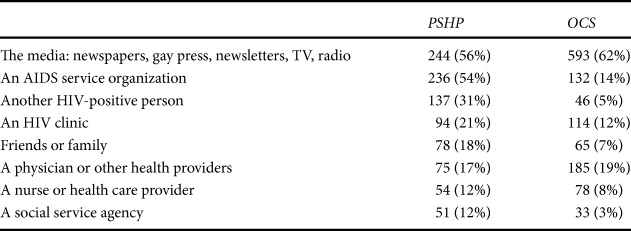
Overall, awareness of the current law was high. This was followed by a question on sources of information on HIV and the law: Have you received any information about disclosure, responsibility, or other legal issues from any of the following sources, whether through websites, public events, printed information, or counselling? The distribution of responses is given in Table 3.
Distribution of responses to the question: Have you received any information about disclosure, responsibility, or other legal issues from any of the following sources, whether through websites, public events, printed information, or counselling?
PHSP = Positive Spaces, Healthy Places; OCS = Ontario HIV Treatment Network Cohort Study.
Study participants could check off more than one source so percentages add to more than 100 percent.
The most frequently named source of information about HIV and the law is the media. The gay press figures prominently among the sources named. OCS respondents name health-care sources second (physician, clinic, nurse) and then AIDS service organizations (ASOs). PSHP respondents name ASOs second, followed by other PHAs and HIV clinics. These differences may reflect different recruitment strategies of the two cohort studies, as the OCS is a clinic-based cohort while the PSHP relies on ASO networks to identify potential study participants. These findings might be compared with Galletly and colleagues (Reference Galletly, Glasman, Pinkerton and DiFrancisco2012), who surveyed 384 PHAs whose awareness of the law was less (76%) than this Ontario sample, and who cited ASOs more often than the general media as the source of information in the area. Overall the sizeable portion of PHAs in this study who report little or no formal instruction in the area may also reflect the fact that most were diagnosed before criminalization became a prominent public issue, in the decade preceding the study.
Statistical analysis (Pearson Χ 2) of the PSHP responses shows that those who are employed (p=0.015), on disability (p=0.011), or volunteering (p=0.003) are more likely to name an ASO as a source of information about disclosure, responsibility, or other legal issues than those who are unemployed (p=0.017). Websites are named more often as information sources by those who are employed (p=0.005) and better educated (p=0.001). Hearing from another HIV-positive person is mentioned more often by those on disability (p=0.003) and Aboriginal people but less often by people of African or Caribbean descent (p=0.039).
The interviews confirm this overall pattern. (Throughout this report more common remarks from interviews are presented first, followed by less common remarks.)
[I have] never been to anything, published or nothing. Just what I read in Xtra [gay press], occasional articles, that’s it. (015, gay, male, 40s)
I read Xtra….I read everything from the Globe to the Toronto Sun to the Post to the Star and also stuff online if I get a lot of news online. I watch the daily news on TV. (020, gay, male, 40s)
Anything that I learn today I get off the news. Nobody has sent any information, none of the doctors or anything, has given me any information whatsoever on the criminalization or the standings on how they’re going to deal with this. (040, gay, male, 50s)
Those who are better connected with ASOs do mention them as sources of information on HIV and the law.
There’s quite a number of people I know that work at ASOs. Over the years, there’s been quite a number of discussions about it. (056, gay, male, 40s)
I seem to want to think that it came through ACT [AIDS Committee of Toronto] or PWA [Toronto People With AIDS Foundation]. They both put out rather extensive and high calibre e-bulletins and newsletters and I think I may have picked up a reference in one of those to either a study done by someone or some activity going on in the legal community that I went further and googled on and found out that, hey, there are some organizations. (002, gay, male, 60s)
And a few mention their physician:
My doctor told me….I must tell. If I don’t tell it’s a crime. That’s what she told me. (009, heterosexual, male, 50s)
My doctor down at St. Michael’s hospital, he kind of filled me in on a few of the things….That I have it, to let other people know. Yeah, he let me know that if I infect other people, they could come back on me. (012, bisexual, male, 40s)
Well I went to my doctor. He told me. I think he said to disclose if I’m engaging in significant risk sex and he gave me some pamphlets, one being from ACT. (063, gay, male, 30s)
The interviews reveal some divergence in the nature of the coverage of criminalization issues by language. Anglophones frequently mention the Aziga case from Hamilton, Ontario, and some, the earlier prosecution of professional football player Trevis Smith in Regina, Saskatchewan. In 2009, in a high-profile case, Johnson Aziga, a Ugandan immigrant to Canada (whose national origin and immigrant status repeatedly formed part of the media reporting of the case), was found guilty of two counts of murder in the first degree, ten counts of aggravated sexual assault, and one count of attempted aggravated sexual assault for transmitting HIV to two women and for not disclosing his sero-status to several others. Previously, in 2007, Smith was convicted of two counts of aggravated sexual assault; he was deported to the United States in 2009.
Other high-profile cases have also attracted considerable, often sensational, media coverage, portraying the HIV-positive accused in graphic terms as sexually irresponsible, at best, or even as reckless or malicious predators, but these were not explicitly referenced by interviewees. These include the Ssenyonga case in the early 1990s, discussed at length by Miller (Reference Miller2005), in which a Black man of African descent, whose race and immigrant status featured prominently in the media coverage, was charged in relation to HIV non-disclosure to several (white) female partners. More recent cases have included the prosecution of an HIV-positive woman, in relation to sexual encounters with willing soldiers at an Ontario army base, who was subsequently prosecuted in Barrie, Ontario, notwithstanding her undetectable viral load, including for briefly receiving oral sex, a proceeding that attracted condemnation and courthouse protests by HIV activists (Canadian HIV/AIDS Legal Network et al., 2013). Ontario, which, in comparison with other provinces and the distribution of PHAs across Canada, has witnessed a disproportionate number of criminal prosecutions for HIV non-disclosure, also was the site of a series of prosecutions in Ottawa and in the Kitchener-Waterloo region against an HIV-positive man that gave rise to ongoing, sensational media coverage, including regular repetition in stories of his self-description as a “poz (HIV-positive) vampire” (Caldwell Reference Caldwell2013).
Francophones more frequently cited the case of “Diane” (not her real name) from Longueuil, the accused in the Quebec case of R. v D.C. that was ultimately decided by the Supreme Court of Canada in October 2012 (in tandem with the Manitoba case of R. v Mabior, as noted above), and whose story was featured in the documentary film Positive Women: Exposing Injustice, released the same year (Canadian HIV/AIDS Legal Network, 2012a). These cases often created quite different visions of the workings of the criminal justice system. While Aziga had few defenders, Diane provoked a good deal of sympathy.
There is the case of Diane from Longueuil, someone who has been abused [by her] spouse, who at the last minute pulled out of his back pocket the fact that she had not said she was HIV-positive, and that she could have put his life at stake .... who had broken her arm and bullied her son.... He is the one who ends up winning and it’s her who gets a sentence when she is very sick etc. I find it totally unacceptable (translated from the French). (F6, gay, male, 40s)
The interview was completed before her conviction was overturned by the Supreme Court of Canada, not on the substance of the law, but because of errors by the trial judge in interpreting the evidence.
Perceptions of Media Coverage
Despite the reliance on media as an information source, views on mainstream media coverage are ambivalent. The primary theme emerging from interviews is a sense of media coverage as sensationalized and one-sided, often portraying HIV-positive people as criminals looking to cause harm. In an environment where police and press have at times published the names and pictures of HIV-positive people accused of non-disclosure or other charges related to their HIV status well before going to trial (Kirkup Reference Kirkup2015), many individuals feel the media are not supportive of people living with HIV and that their main goal is to sell papers. A secondary characterization of media coverage is that the media do a good job of bringing attention to this issue, but often “miss the point” or present incomplete or misleading information. A number of these individuals feel the gay press does a better job of supporting PHAs in the current public climate. Less common is the view that media coverage is objective, fair, neutral, or adequate. These respondents state that the media are simply stating the facts but also note how they could do a better job of explaining the details and complexities of HIV cases.
For example, study participants remarked in interviews that:
I think the media coverage is very discriminatory, and the people who are HIV-positive, they are not seen as people. The media is always talking negative things about people who are HIV-positive. They don’t talk about anything positive about them. I’m so scared because of the way they portray us. It scares me. It looks like we are not human. (091, heterosexual, female, 40s)
I think there’s a very, like, racial bias with it, as well, with people of colour who get it. I mean I do have to wonder, if this was a white man, would this be happening as well, or, because he’s a man of colour, is it something worse? (020, gay, male, 40s)
They tend to vilify people even before they appear in the court. I think that there’s still a lot of ignorance around HIV, and people look for clues in the media as to how HIV individuals should be treated and so on and so forth. When there are a few individuals that perhaps are careless or perhaps don’t have proof of disclosure, it sensationalizes the whole issue again. (077, gay, male, 50s)
Participants thought the media could do a better job explaining the details and complexities of the cases and play a role in educating the public about HIV:
If they were real journalists, they would be doing their job and getting the full story, the real version of what’s happening out there, and innocent people are being accused and charged, and lives are being destroyed because of whatever reason that someone is falsely accused. I think a lot more needs to be done. (004, gay, male, 40s)
Others observe that the majority of the cases in the media involve heterosexual conduct and that the gay press does a better job of supporting PHAs. Finally, some remember media coverage this way:
They just stated the facts, which was a good thing. They didn’t get into their opinion. They just said this is the fact, this person was caught, admitted it or didn’t admit it but through testing and then gave a list of all of the, if you call them, victims. So it went chronologically, and it was well described without too much comment from the reporters, so that was good I thought. (003, bisexual, male, 60s)
PHA Views on Criminalization: Survey of Cohort Study Participants
In this study, a series of questions explored several different scenarios with participants in the OCS and PSHP cohort studies. The results show that the largest proportion of PHAs participating in these cohort studies believe that criminal law should not be applied in cases where there is no disclosure, but protected sex (i.e., penetrative sex with a condom) occurs. Respondents do believe that “someone with HIV should be charged with a crime and perhaps sent to prison” in cases where there is no disclosure before unprotected (i.e., condomless) sex, and for not disclosing if “it’s clear that the person wanted to pass HIV to their partner” that is, there was actual intent to cause harm. The question “Do you think someone with HIV should be charged with a crime, and perhaps sent to prison, for having unprotected vaginal or anal sex without telling sexual partners he or she has HIV before having sex?” proves to be the critical breaking point for PHAs in drawing the line in the criminalization debate. In the OCS cohort, 48 percent disagree with the proposition that people should be prosecuted for non-disclosure in cases of protected sex (i.e., penetrative sex with the use of condom), as opposed to 40 percent who agree with prosecution in such circumstances. In the PSHP cohort, the majority of respondents (54%) disagree with prosecution in cases of protected sex (i.e., with condom use), and only 28 percent agree with criminalization in cases where a condom is used.
The results are shown in Table 4.
Views of people living with HIV on criminalization
Statistical analyses of the PSHP cohort show no significant differences by gender, sexual orientation, or ethno-cultural background on these questions, except for Aboriginal PHAs who are somewhat more punitive in their views regarding non-disclosure. Though the order of magnitude for the most part is not great, the larger OHTN cohort [OCS] does show a statistical difference along these dimensions. Among HIV-positive people in Ontario, gender and sexual orientation are highly collinear variables with almost all of the women being heterosexual and the majority of men gay or bisexual. As well, most African, Caribbean, and Aboriginal PHAs are heterosexual while a minority of the gay and bisexual men have a racialized identity. For the key question, “Do you think someone with HIV should be charged with a crime, and perhaps sent to prison, for having unprotected vaginal or anal sex without telling sexual partners he or she has HIV before having sex?”, agreement is significantly higher (Pearson Χ 2, p<0.01) among heterosexual men (83%) and women (79%), than among bisexual men (72%) or gay men (60%). Women are similarly somewhat more likely to agree that HIV status should be disclosed to a sexual partner even if viral load is undetectable (and hence risk of transmission approximating zero) (79% versus 72% of men) (p=0.02), that a sexual partner should be charged if he lied about his status (85% versus 60% of men) (p<0.01), and that charges could be justified for not disclosing even if a condom was used (51% versus 37% of men) (p<0.01).
The ethno-cultural breakdown from the OCS on the key question of whether “someone with HIV should be charged with a crime, and perhaps sent to prison, for having unprotected vaginal or anal sex without telling sexual partners he or she has HIV before having sex,” shows that 76 percent of respondents identifying as Black, African, or Caribbean, and 74 percent of Asian, Latin American, or Middle Eastern respondents, agree, while 65 percent of white people and 67 percent of Aboriginal people agree (p<0.01).
There are also significant differences according to the educational attainment of respondents. More educated respondents show less punitive views. In the OCS cohort, 79% of respondents with less than a high school education support criminalization for non-disclosure in the case of unprotected sex (i.e., without a condom), but this support declines to less than half (49%) among those with post-graduate education (p<0.01).
In the OCS cohort, punitive views decline with time being sero-positive: 83% of those diagnosed less than six years ago agree with the criminalization of non-disclosure in cases of unprotected sex, but this falls to 69% of those diagnosed more than six years ago. While majorities agree with criminalization in this instance regardless of time living with HIV, this finding suggests that with time, PHA views may moderate, perhaps because, in the early period, their relationship to the question of criminal prosecutions is more influenced by a focus on the circumstances of becoming infected, whereas in the latter period, the possibility of being vulnerable to criminal prosecution is accorded greater weight. There may also be a historical factor at play in the results given the timing of data collection for this study: those who were infected within the last six years were infected during a time when the intensity of criminalization for HIV non-disclosure, and consequent media coverage, were higher than in the earlier period (Mykhalovskiy and Betteridge Reference Mykhalovskiy and Betteridge2012).
In addition, having had a casual partner in the last six months makes a difference to PHAs; those who have recently had a casual partner are less punitive in their views. Not disclosing HIV-positive sero-status before having condomless sex should be criminalized according to 73% of those who have not had a casual partner; in contrast, only 54% of those who have had a casual partner in the last six months agree (p<0.01). As well, actively lying about one’s HIV-positive status, as opposed to simply remaining silent, is viewed more punitively by those who have not had a casual partner (76%) than by those who have (65%) (p=0.02).
The greatest variation in opinion occurs in relation to the question of non-disclosure in the case of being the recipient of oral sex, with support for criminalization in the PSHP cohort ranging from:
• 51% among heterosexual men, 50% among heterosexual women, 31% among bisexual men, and 21% among gay men (p<0.0001);
• 50% among Aboriginal people, 44% among African and Caribbean people, and 30% among white people (p=0.019); and
• 50% among respondents with less than high school education to only 20% with a four-year post-secondary degree or more education (p=0.014).
The strong gradient by sexual orientation may be related to the thirty-year history of safer sex training provided by ASOs that has instructed gay and bisexual men that oral sex is “low risk” for HIV transmission compared with the higher risk associated with anal sex. Heterosexual respondents appear to assimilate oral sex to attitudes about sex in general, not making a distinction about relative risk. Turning to the OCS data and calculating odds ratios for statistically significant variables for the same question shows that men were only 0.36 (95% confidence interval [CI] = 0.26–0.50) times as likely as women to agree that criminalization would be appropriate, African and Caribbean people were 2.72 (95% CI = 1.99–3.71) times as likely as white people, people with less than high school education 2.12 (95% CI = 1.41–3.20) times as likely as people with post-secondary education, and people with casual partners 3.32 (CI = 2.31–4.78) times as likely as those with regular partners.
Views on Criminalization: Qualitative Interviews
The interviews show that HIV-positive people may respond to questions on criminalization either in terms of the actions of another person that resulted in their infection, or in terms of potentially infecting someone else. For example,
I know someone that should be [charged] because the person who gave me HIV knew he had it and didn’t tell me he had it and when I asked him, he turned around and goes, “No, I don’t have it,” and gave it to me. (018, gay, male, 40s)
There is a contingent of opinion that criminalization is justifiable in some cases. In several instances, the Aziga or Smith case appears to be the touchstone for the opinion expressed, suggesting that much of the framing of questions of HIV and the law for people living with HIV, not to mention the larger public, shows the influence of media attention to a few high-profile cases. In a number of these examples, interviewees clearly wish to distance themselves from behaviour deemed to be extreme or egregious and reaffirm a commitment to HIV prevention.
If they knowingly are putting the other person at risk, then they should have the full weight of the law hit them because they are ruining lives. That’s how I feel. I have no sympathy for them because they are knowingly doing it. (003, bisexual, male, 60s)
That man, how many people did he infect and now he’s in jail? I don’t like the thought of jail for anybody but if that’s the only discipline that people will listen to, I guess it has to be. (034, gay, male, 60s)
Would I want there to be some sort of a legal recourse available for victims? I think I would and I have to allow that. I have to admit that I do think that. (042, gay, male, 30s)
Well I don’t think it’s right. I find it disgusting. And he [Smith] deserves everything he gets. (O7, heterosexual, male, 30s)
Some argue for a potential deterrent effect of prosecution.
If they’re HIV-positive and they’re going around having sex unprotected, when they see these sort of court cases coming up, it should ring a bell in their head. (025, gay, male, 60s)
The fear of possible repercussions of not disclosing or not using protection should hopefully encourage the people that were doing that, not to. (014, heterosexual, female, 40s)
Here in this country, I can say I like the law because it’s very nice to tell your partner, because where I come from they keep it to themselves…Maybe this is why HIV is all over because they don’t tell anyone and some just go doing unprotected sex and infecting anyone….I like that law because that law can reduce HIV/AIDS. (064, heterosexual, female, 40s)
I think it [criminal law] makes people to be disciplined, yeah. This is how I feel. (081, heterosexual, female, 40s)
The greater representation of female voices in this section is consistent with the OCS findings of somewhat more punitive views held by women and it is consistent with the overall pattern of prosecutions, where complainants are disproportionately women in heterosexual relationships, though they account for only about a quarter of HIV-positive people in Ontario according to epidemiological data. These findings suggest that PHAs are not exempt from the dominant discourses circulating in the larger society at the intersection of gender and responsibility. Women appear to be more readily accepted as victims when aligned with traditional narratives of the sexual purity or virtue of “good” women, while at the same time they remain vulnerable to historic constructions of “bad” women as vectors of disease and as dangerous to men.
Most of these cases have not involved actual transmission of HIV; as noted above, Canadian criminal law extends beyond that of some other jurisdictions (and the limits recommended by UNAIDS and others such as the Global Commission on HIV and the Law), applying also to non-disclosure of HIV. Legal proceedings rest on a deeper politics of blame and innocence that index a longstanding social distinction assigning some HIV-positive people to the status of “innocent victim” and others, often tacitly, to the status of the always, already guilty. In the early days of the epidemic, these distinctions were often overt in public depictions, with women, children, and haemophiliacs assigned to the “innocent” category while gay men, people who use drugs, sex workers, men of colour, and foreigners or immigrants were relegated to the latter category and seen as “deserving” of, or vectors of, infection (Weait Reference Weait2007; Adam et al. Reference Adam, Elliott, Husbands, Murray and Maxwell2008; Persson and Newman Reference Persson and Newman2008; Hoppe Reference Hoppe2014). Though less overt today in Canada, these distinctions have not entirely disappeared. In interviews, gay men and people who use drugs often typify HIV as a silent tragedy that has befallen their communities; “both groups are offered ready-made moral recipes assigning them personal responsibility for their illness” (Adam and Sears Reference Adam and Sears1996, 71). Members of groups that are not accorded the “benefit of the doubt” by the public politics of blame are perhaps more hesitant to appeal to the courts to judge them “innocent” in the face a historical legacy that has closely identified them as morally suspect and a blameworthy source, rather than a “victim,” of HIV.
Diversion Not Punishment
A significant set of study participants believe that imprisonment is simply not the solution to problematic behaviour.
I don’t think that the legal system is the proper place for handling the containment of communicable diseases. (002, gay, male, 60s)
I don’t think prison is. I don’t think that even locking them up is really addressing any sort of problem or the effects of it. You’re putting someone away. Does it make us any safer in the long run? I’m not entirely convinced that that’s the best way. (032, gay, male, 40s)
If people are again being reckless, well then they have the consequences unfortunately…. I don’t think incarceration for that is going to solve anything. (061, gay, male, 50s)
In some instances, this view is grounded in a suspicion of the state based on its historically repressive regulation of gay sexuality.
I think there’s always been kind of an unspoken code within the gay community that we don’t take these kinds of issues to the larger community because of the Pandora’s box it would open…. Any stories like these with a kind of a narrative mark of victim and the bogey man are always going to be portrayed in this manner. It’s the same kind of thing as collapsing child molestation with homosexuality.… I don’t think that HIV should be criminalized in any manner whatsoever. (062, gay, male, 40s)
Among those not granted the status of “innocents,” the HIV epidemic is often conceptualized as a shared tragedy that has befallen the community as a whole.
I was given this when I was in a relationship with someone. I never felt animosity toward my partner for giving it to me. He was ignorant of the situation. It was the eighties, it was early on. So you know, there’s no blame attached. I don’t understand this prosecution thing at all. (016, gay, male, 50s)
Others envision the possibility of diversion programming that moves the legal system’s response away from punitive to educational and preventive strategies.
I think there should always be some kind of educational or remedial type of program for that, but I don’t believe in any imprisonment for that kind of thing. (018, bisexual, male, 50s)
I think there should be some kind of course like a john course. (I: “John school”?) There should be a school. (translated from French interview) (F15, heterosexual, male, 50s), (with reference to court-ordered attendance at “john school” for men found guilty of communicating to purchase sexual services or of similar offences related to sex work)
This survey of PHAs regarding HIV and the law shows considerable diversity of opinion. Variability in opinion is most closely associated with gender, sexual orientation, level of education, and with “grey area” issues such as the risk associated with oral sex or with penetrative vaginal or anal sex protected by the use of a condom.
Conclusion
PHAs’ views on criminalization appear to be affected by mainstream media constructions of criminal iconography, but these images are interpreted differently according to their social location. While PHAs often view mainstream media portrayals with considerable ambivalence, and other information sources, such as health care providers and ASOs, are cited from time to time, pervasive discourses of responsibility and criminality circulating in the larger society clearly have an effect in framing the discussion. Views of the appropriate application of criminal law vary in several ways: those with higher levels of formal education tend to have less punitive views on criminal responsibility in HIV transmission. Those who report having had a casual sex partner are also less punitive in their views than those who have not, and those who have been living longer with HIV hold less punitive views than those who have more recently sero-converted. This latter shift in attitude suggests a transition from seeing oneself as a potential complainant soon after seroconverting to seeing oneself as potentially vulnerable to prosecution after living with HIV for some time. While the overall pattern of agreement on where to draw the line in criminal prosecution holds, regardless of numerous demographic characteristics, there is some statistically significant variation in degree of punitiveness according to sexual orientation and gender with gay men holding less punitive views than women and heterosexuals.
For the most part, PHAs in Ontario believe that HIV-positive people should not face prosecution if they do not disclose their serostatus when they use a condom for vaginal or anal sex. This position can be characterized as broadly consistent with the suggestion of the majority of the Supreme Court of Canada in the 1998 Cuerrier decision, subsequently largely followed by lower courts, that condom use might be considered to reduce the risk of HIV transmission sufficiently that there would no longer be a “significant risk” of transmission and therefore no crime for not disclosing HIV-positive serostatus to a sexual partner. However, as noted above, the subsequent Supreme Court of Canada rulings in October 2012 in the Mabior and D.C. cases further tightened the definition of what they termed the “realistic possibility” of HIV transmission: the Court suggested that disclosure of serostatus to partners (at least in the case of vaginal sex, given the facts of those cases) is legally required unless both a condom is used and the HIV-positive partner has a low viral load, while leaving open the possibility that the approach might be revisited in light of further advances in treatment. It remains to be seen to what extent these rulings will further fuel criminalization dynamics by bringing even more PHAs into court and making PHA lives even more difficult when pursuing romantic and sexual relationships in everyday life.
In recent years, media coverage of criminal prosecutions has been setting the tone for portrayals of HIV in the public sphere in Canada. This treatment of HIV in a criminal justice framework may be operating as a feedback loop whereby media coverage of prosecutions in turn stimulates newly diagnosed people to consider prosecution as an appropriate response to infection. It may also embolden people in situations of relationship breakdown to consider prosecution, or at least threats of alleging non-disclosure to police, as a tool to be used in their personal conflicts. The impact of media coverage is clear in this survey of people living with HIV who cite the media as a primary source of information about disclosure, responsibility, and other legal issues related to HIV. While media coverage is greeted with some consternation and trepidation among PHAs, it may still play a significant role in shaping discourses on responsibility and legal obligation. PHAs’ own views about where to draw the line in criminalizing HIV must be read against this larger socio-historical context, where public discourse has become pervasively influenced by the courts and by media coverage of egregious or scandalous instances of HIV transmission. A wish to distance oneself from these kinds of cases and a desire to show a commitment to HIV prevention as the “responsible” citizen of neoliberal society may reinforce the degree of support for criminalization evident in this survey of PHAs.
In the current, uneasy relationship of the criminal justice system with HIV disclosure and transmission, PHAs find themselves coping with legally imposed requirements and public images of criminal infectors while they seek practical methods of finding intimacy in everyday life. This study provides a sense of the variable social locations at the nexus of these demands that result in PHAs’ assessments of the role and limits of criminal justice. It also raises larger questions of how the cycle of prosecution and media coverage might be disrupted to deflate public discourses linking HIV with criminal irresponsibility and to limit the number of PHAs who become caught up in criminalizing processes.