INTRODUCTION
Most studies of maternal care in peracarid crustaceans have been conducted on benthic species (reviewed in Thiel, Reference Thiel2003a), such as caprellids (e.g. Thiel, Reference Thiel1997; Aoki, Reference Aoki1999), gammarids (e.g. Thiel, Reference Thiel1999; Dick et al., Reference Dick, Balley and Elwood2002; Kobayashi et al., Reference Kobayashi, Wada and Mukai2002) and isopods (e.g. Murata & Wada, Reference Murata and Wada2002; Thiel, Reference Thiel2003b). The only case of maternal care in a pelagic species to date is in the hyperiid amphipod Phronima sedentaria (Forskål, 1775) of the family Phronimidae (see Laval, Reference Laval1980). The Phronimidae consist of ten species in the genus Phronima and one species in the genus Phronimella (Shih, Reference Shih1969, Reference Shih1991). Phronimids are parasitoids, known to utilize gelatinous zooplankton such as salps, pyrosomas and cnidarians as host animals (Laval, Reference Laval1978; Nishikawa et al., Reference Nishikawa, Suzuki and Nishida2005). They live in the inner hollow of the host after modifying those gelatinous animals into barrel-shaped objects (hereafter called the ‘barrel' in this study) (Diebel, Reference Diebel1988). Phronima sedentaria is the largest species in the Phronimidae, and its reproductive behaviour has been detailed by Richter (Reference Richter1978) and Laval (Reference Laval1980). However, maternal care in other phronimid species has not been reported. One possible reason for the scarcity of behavioural studies in these species lies in the difficulty of obtaining intact specimens from ship-based net collections. When phronimids are caught by plankton nets, the barrels occasionally become flattened, resulting in the discharge of the resident phronimid from the barrel. Laval (Reference Laval1980) suggested that hand collections and in situ observations by diving are useful methods for the study of these species with fragile barrels. In this study, we obtained intact specimens of Phronimella elongata and eight Phronima species by snorkelling and quantitatively examined the number of young that cohabited with their mother in the barrel, as well as the growth stage compositions of the young and other information. This is the first quantitative report of mother–young cohabitations in these species, especially in the little-known species Phronimella elongata.
MATERIALS AND METHODS
Samplings were conducted by snorkelling off the coast of Cape Maeda, Okinawa Island (26°26′38″N 127°46′22″E), from January to May 1999 (Supplementary Material). The water depth was shallower than 5 m. Drifting phronimids with or without ‘barrels' were hand-collected gently and individually in 300-ml plastic containers by a diver in situ. The samples were immediately brought back to the laboratory and fixed with 2.5% glutaraldehyde–seawater and later transferred to 70% ethanol for long-term preservation. Animals were identified to species following Shih (Reference Shih1991), checked for the presence or absence of their host barrels, and the numbers of cohabiting young or brooded eggs with the adults were counted. Body lengths of both adult and young individuals were examined under a binocular microscope. Body length was measured along the body axis from the frontal margin of the head to the posterior edge of the telson. According to Shih (Reference Shih1969), the number and shape of podomeres generally reflect the moulting growth stage, and the number of podomeres on the exopod of pleopod 3 is zero in the stage I, one in the stage II, two in the stage III, and so on in Phronima sedentaria. To estimate the growth stage of young, we examined the podomeres on the exopod of pleopod 3 under a light microscope. In Phoronimella elongata, the size and shape of terminal podomere discriminated the two distinct stages in the young with two podomeres; the terminal podomere was small, hemisphere at stage III and oblong at stage IV. The number of podomeres was three at stage V.
RESULTS
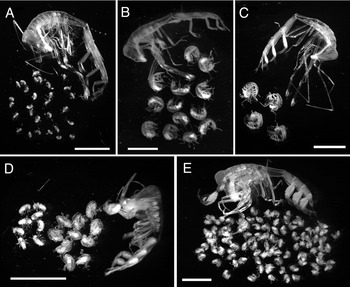
Of the 30 samples obtained, 12 were Phronimella elongata and others consisted of eight species of Phronima (Supplementary Material). Ovigerous females or adult females with young were found in four species: Phronimella elongata, Phronima dunbari, P. sedentaria and P. solitaria (Figure 1). Of the 10 females of Phronimella elongata collected in barrels, seven were cohabiting with young and the other three were not associated with young. Of the four animals that did not have barrels in situ, three were ovigerous females of Phronimella elongata, Phronima sedentaria and P. solitaria, and the other was a female of Phronimella elongata to which four young were attached (Figure 1C). During the investigation, most of the original animals from which the barrels were constructed could not be identified; however, the salp Traustedtia multitentaculata was recognized as one of the ‘barrel animals’ for two phronimid species, Phronima atlantica and P. bucephala, due to the presence of many tunic tentacles unique to this salp. Pyrosoma sp. was also used by a female Phronima sedentaria with no young, because zooids of Pyrosoma remained in the barrel made by this phronimid.
Adult female and cohabiting young of Phronimella elongata (A–C), Phronima dunbari (D), and Phronima sedentaria (E). (A) The adult female with the smallest young (29 individuals) collected on 23 February, 1999; (B) the adult female with the second largest young (13 individuals) collected on 9 April, 1999; (C) the adult female with the largest young (four individuals) collected on 9 April, 1999; (D) the adult female collected on 31 January, 1999. There are two size-groups in the cohabiting young; eight small young (left) and ten large young (right); (E) the adult female with 129 young collected on 23 February 1999. A, B, D, and E were found in host barrels; C was found with no host. Scale bar: 3 mm.

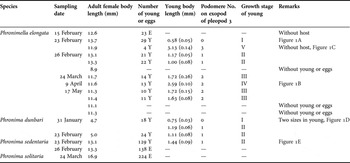
Five distinct stages, I–V, were recognized in the young of Phronimella elongata. Sexual dimorphism was not remarkable even at stage V. While all young belonging to stages I–IV were found with the females in the barrels, the largest size-group, i.e. stage V, consisted of the young clung to the female without the barrel. The cohabiting young in Phronimella elongata and Phronima sedentaria always consisted of a single growth stage. In a single specimen of Phronima dunbari, however, two different stages (I and II) of young coexisted in a barrel (Table 1 and Figure 1E).
Size of females (mm) and the number or size of cohabiting young or carried eggs in Phronimella elongata, Phronima dunbari, Phronima sedentaria and Phronima solitaria collected from Cape Maeda, Okinawa Island in 1999. E, eggs carried; Y, cohabiting young. The figure before E or Y is the number of eggs or young. Body length (mm) of young is the mean for each clutch and the figure in parentheses is the standard deviation. Refer to the text for growth stages I–V of the young.

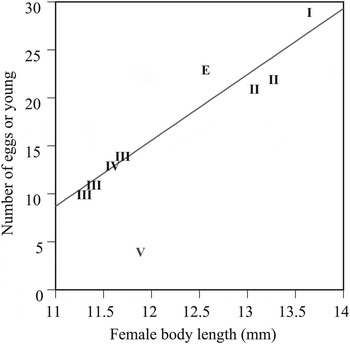
In Phronimella elongata, nine females carried 4–29 eggs or young (Table 1). Among these, the young in stage V clung to the mother without a host barrel, as mentioned above. The number of stage V young cohabiting with their mother may have been underestimated because some had left the mother to become independent. Correlation between the body length of the mothers and the number of brooded eggs or cohabiting young was extremely significant (Pearson's correlation, df = 6, r = 0.96, P < 0.001), when the female with the stage V young was excluded (Figure 2).
Correlation between adult female body length and the number of cohabiting young or brooded eggs in Phronimella elongata. Plots with roman numerals indicate the growth stages of the young in the host barrel, except for ‘V' of which the young clung to the adult female without a host barrel. ‘E' indicates eggs carried by a female without a barrel. The plot of the young of stage V was omitted from the linear regression analysis because the number of young without barrels was potentially underestimated.

In Phronima spp., the number of eggs or young per mother apparently increased with the size of the mother in each species: while the smallest, P. dunbari, carried the smallest numbers of young (18 and 24 individuals female−1), the largest, P. solitaria, had the largest number of eggs (224 eggs female−1). In Phronimella elongata, the number of young/eggs was 4–29 per female, i.e. much lower than those in Phronima species. For example, two females of Phronimella elongata (13.1 and 13.3 mm in body length, respectively) carried 21 and 22 young of stage II (1.17 and 1.00 mm in mean body length, respectively), whereas a Phronima sedentaria female (13.1 mm in body length) carried about 129 young of stage II (1.44 mm in mean body length) and a Phronima dunbari female of 5.0 mm in body length carried 24 stage II young (1.11 mm in mean body length) (Table 1).
DISCUSSION
In this study, nine species of phronimids were successfully collected by snorkel diving with their hosts derived from gelatinous zooplankton, and the mother–young cohabitations were firstly recorded in Phronimella elongata and P. dunbari. The quantitative data, such as number of eggs or young, growth stage compositions of young etc., partly disclosed the intact condition of mother–young cohabitation in these pelagic amphipods, especially in the poorly-known species, Phronimella elongata.
In Phronimella elongata, five distinct stages, I–V, were recognized in the young. All young belonging to stages I–IV were found with females in barrels. Therefore, young cohabiting with adult females may moult three times in the host barrel in this species. The four largest-sized young attached to an adult female that drifted without a barrel were in growth stage V and were probably in the process of leaving the adult female to find their own barrel (Figure 1C). In Phronima sedentaria, three growth stages before the premature stages are recognized, and third-stage young are supposed to start feeding and be ready to leave maternal care (Richter, Reference Richter1978; Laval, Reference Laval1980). The development of sexual dimorphism starts at the fourth stage in Phronima sedentaria (Shih, Reference Shih1969). In Phronimella elongata in this study, specific morphological characters close to those of adults seemed to be completed at the stage V. The timing of independence may be between stages IV and V in Phronimella elongata. In one sample of Phronima dunbari, two distinct size-groups of young were found (Figure 1D), and the two groups respectively corresponded to stage I and stage II based on the podomere numbers (Table 1). These individuals may have been in two different cohorts or the size differences could have been due to asynchronism of growth in one cohort. In either case, this indicates that the cohabitation of the female and young for a sufficient period of time for one moult to occur. The young in the other sample of Phronima dunbari and those in Phronima sedentaria consisted of single stage young, respectively (Table 1).
Considerable variation was observed in the number of eggs or young per female among phronimid species: Phronimella elongata carries a smaller number of eggs or young than the Phronima species. This might be due to differences in the volumes of the brood pouches, as these are stout and wider in the Phronima species than in Phronimella elongata, which has a slender body shape. In Phronimella elongata, the number of eggs or young significantly correlated with the mother size, regardless of the growth stages (Figure 2). If the young are lost during development, the number of young at late growth stages will be smaller than the estimate from the mother size. The present results imply that young cared for in barrels are rarely lost during development, although the number of observed samples are rather limited in our study.
In addition to the parental care behaviour, the hand collection of intact barrel harbouring phrominids provided new findings. It was uncertain whether males of Phronima live in barrels or not, except for the males of P. curvipes and P. sedentaria that are known to form barrels (Laval, Reference Laval1968, Reference Laval1978). The present study clarified that males of P. dunbai, P. pacifica and P. stebbingii also utilize barrels. Barrels made from gelatinous zooplankton seem to be convenient shelter not only for females cohabiting young but also for males. Recently, it was clarified that the wall of the host barrel that the phronimids utilize is still active immunologically, even after becoming a barrel for phronimids (Hirose et al., Reference Hirose, Aoki and Nishikawa2005). The long-term persistence of the barrel wall without collapse may be one of the important factors enabling its long and stable inhabitation by the phronimids.
ACKNOWLEDGEMENTS
This study was partly supported by Japanese Association for Marine Biology (no. 22-57) the ‘International Research Hub Project for Climate Change and Coral Reef/Island Dynamics’ from the University of the Ryukyus and the JSPS KAKENHI Grant Number 11740426. This report includes the contribution no. 761 from Shimoda Marine Research Centre, University of Tsukuba.
SUPPLEMENTARY MATERIALS
The supplementary material referred to in this paper can be found online at journals.cambridge.org/mbi.