


Introduction
Iran is the biologically most diverse country in west Asia. Approximately 8000 plant species have been recorded in the Flora Iranica (Rechinger Reference Rechinger1963–2010). This extraordinary diversity is due to Iran being located at the border of three major phytogeographical regions, the Irano-Turanian, the Saharo-Sindian and the Euro-Siberian regions (White & Léonard Reference White and Léonard1991), overlapping two global biodiversity hotspots, the Irano-Anatolian and the Caucasus hotspot, and harbouring five regions of endemism (Noroozi et al. Reference Noroozi, Talebi, Doostmohammadi, Rumpf, Linder and Schneeweiss2018).
Boxwood (Buxus sempervirens) forests in the eastern Hyrcanian region are a unique ecosystem in this region (Khabazi & Esmailzadeh Reference Khabazi and Esmailzadeh2020). The boxwood forest in the Cheshmeh Bolbol Reserve is the easternmost occurrence of such forests in Iran. It is less affected by common diseases of this tree, boxwood leaf blight and boxwood moth pest, than other forests of this type in the region (Pour Moqaddam Reference Moqaddam K2019). Outbreaks of fungal disease causing boxwood leaf blight, due to the improper exploitation of boxwood over previous decades and, more importantly, the outbreak of boxwood moth pest, have caused 80–90% of these forests to be destroyed (Khabazi & Esmailzadeh Reference Khabazi and Esmailzadeh2020). Over an area of 40 000 hectares of boxwood forests in northern Iran, almost all forests have been affected. Only 450 hectares of boxwood forests in Golestan Province are not severely damaged, offering the opportunity to study their foliicolous lichen biota in more detail. The most important plant species in this forest are Buxus sempervirens, Danae racemosa, Parrotia persica, Quercus castaneifolia, Acer cappadocicum, Cornus australis, Ficus carica and Zelkova carpinifolia (Khabazi & Esmailzadeh Reference Khabazi and Esmailzadeh2020).
No detailed reports on foliicolous lichens in Iran have been published so far and no record was included in the first world monograph by Santesson (Reference Santesson1952). Only Gyalectidium caucasicum (Elenkin & Woron.) Vězda was later reported from Sisangan Forest Park in Mazandaran (east of Nowshahr, 1976, Lambinon 76/273, LG; Ferraro et al. Reference Ferraro, Lücking and Sérusiaux2001). This species is reported here for the first time from Golestan Province. In addition, we discovered Strigula buxi Chodat and a new species of Phylloblastia.
Material and Methods
The study area is situated in the boxwood forest reserve, part of the Cheshmeh Bolbol Protective Forest of the Liwan-Banafsheh Hill Forestry Project in the Natural Resources Department of Bandar-e-Gaz, Golestan Province. The coordinates are 36°42ʹ12ʺ–36°42ʹ30ʺN, 53°48ʹ40ʺ–53°52ʹ40ʺE, and the altitudinal range is 55–260 m a.s.l. The closest meteorological station is in the city of Bandargaz, which has an average annual rainfall of 516 mm and an average temperature of 19 °C, with a minimum of 3 °C and a maximum of 40 °C.
All specimens were deposited in the herbarium of the Research Institute of Forests and Rangelands, Tehran, Iran (TARI). For their identification, they were compared with herbarium samples in the Botanischer Garten und Botanisches Museum Berlin-Dahlem, Berlin, Germany (B). Macroscopical characters were studied using a Luxeo 4D stereomicroscope and microscopical characters were examined under a Zeiss Axiostar plus compound microscope. Hand-cut sections were mounted in water (Orange et al. Reference Orange, James and White2010). Images of anatomical and morphological characters were captured with a digital camera mounted on a Luxeo 4D stereomicroscope and an Olympus BX53 compound microscope. For identification, the keys and guides of Lücking (Reference Lücking1992), Lücking & Kalb (Reference Lücking and Kalb2000), Sipman (Reference Sipman2005) and Ferraro et al. (Reference Ferraro, Lücking and Sérusiaux2001) were used.
Results and Discussion
We found three obligately foliicolous species on leaves of evergreen Buxus sempervirens and Danae racemosa namely Gyalectidium caucasicum, Phylloblastia iranica S. Kazemi, Lücking & Sipman sp. nov. (see below), and Strigula buxi. In addition, we found three opportunistically foliicolous lichens that normally grow on bark and other substrata: Physciella chloantha (Ach.) Essl. (8978, 8814, 9001; TARI) (Fig. 1A), Physcia adscendens H. Olivier (9049; TARI) (Fig. 1B), and Xanthoria parietina (L.) Th. Fr. (9029; TARI). These three are widespread, mainly corticolous species found across extratropical Eurasia and partly also North America.
A, Physciella chloantha (Kazemi 8978, TARI); arrows indicate two specimens. B, Physcia adscendens (Kazemi 9049, TARI). Scales: A = 5 mm; B = 1 mm. In colour online.

Taxonomy
Phylloblastia iranica S. Kazemi, Lücking & Sipman sp. nov.
MycoBank No.: MB 846142
Separated from all other Phylloblastia species by the colourless 1-septate ascospores, 9–19 × 4–6 μm, absence of isidia and orange-brown to dark brown perithecia.
Type: Iran, Golestan Province, Bandargaz, Bolbol mineral spring, 36.700595°N, 53.887304°E, 156 m, Kazemi 8999 (TARI—holotype).
(Fig. 2)
Phylloblastia iranica. A & B, thallus (Kazemi 9009, TARI); arrows indicate barely discernible thalli. C, perithecia. D, asci. E, ascospores (arrow) (C–E, Kazemi 8999, TARI). Scales: A & B = 20 mm; C = 1 mm; D & E = 20 μm. In colour online.
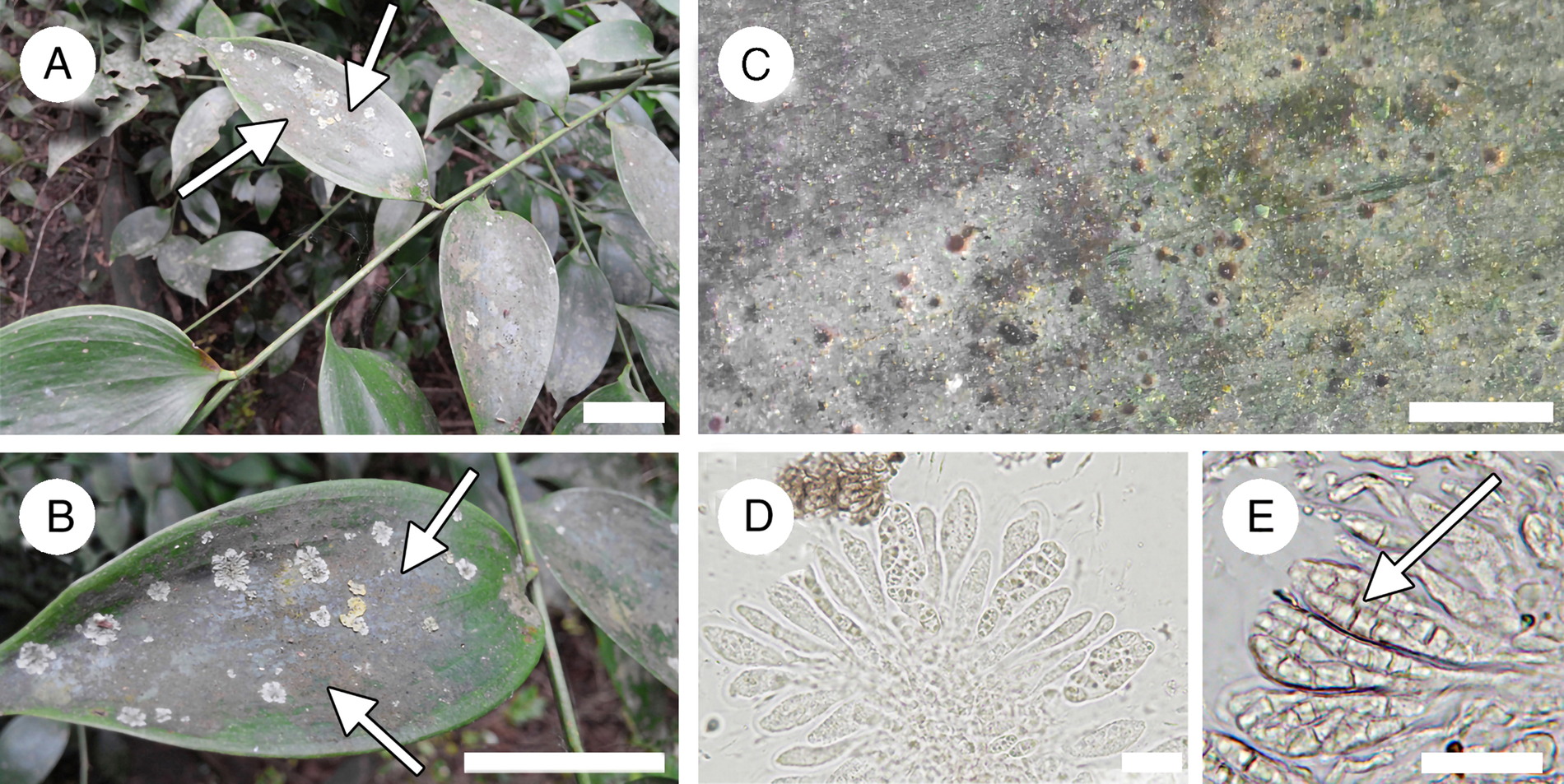
Thallus crustose, foliicolous, supracuticular, very thin, dark grey or dusty grey to grey-brown, often with a purplish tinge, matt, ±smooth to minutely uneven, c. 0.2–1 mm wide, often forming minute patches around single perithecia, c. 8–12 μm thick, ecorticate.
Perithecia prominent, orange-brown to dark brown, solitary, 0.2–0.6 mm diam. Perithecial wall prosoplectenchymatous, brown; involucrellum absent. Paraphyses absent but ostiolar channel with scattered periphysoids. Hamathecium and ascoplasm I+ orange to orange-red. Asci 8-spored, fusiform-cylindrical, apex with or without a broad and rather flat ocular chamber, 28–46 × 11–16 μm. Ascospores oblong, fusiform or cylindrical, slightly curved, 1-septate, hyaline, 9–19 × 4–6 μm.
Pycnidia not observed.
Habitat
This species occurs in temperate, deciduous, broad-leaved forest, on Danae racemosa, an erect, evergreen shrub which grows in shaded forest understorey in deep valleys of the surrounding steep rocks and in high moisture areas along the rivers in the Hyrcanian forests of Iran; it is an endangered species (Akhani et al. Reference Akhani, Djamali, Ghorbanalizadeh and Ramezani2010; Masoudi et al. Reference Masoudi, Zare Maivan and Mehrabian2022).
Geographical distribution
Known only from the type, from the Hyrcanian forest in northern Iran.
Comments
Phylloblastia is a mid-sized, foliicolous genus so far containing 20 species (Vězda Reference Vězda1975; McCarthy Reference McCarthy1999; Sipman Reference Sipman2005; Sérusiaux et al. Reference Sérusiaux, Coppins and Lücking2007; Lücking Reference Lücking2008; McCarthy & Stajsic Reference McCarthy and Stajsic2013; see global species key below). As a typical Verrucariaceae, it lacks persistent paraphyses and the ascospores are oblong to cylindrical and transversely septate to muriform. The new species is characterized by the combination of 1-septate ascospores and brownish perithecia. The only other species in the genus with 1-septate ascospores, P. pocsii (Farkas & Vězda) Lücking, has much smaller and narrower ascospores and often bears disc-shaped isidia. Phylloblastia iranica superficially resembles several other species of the genus, but all have larger, at least 3-septate ascospores. The new species should not be confused with Porina aenea (Wallr.) Zahlbr. which agrees somewhat in the colour of the perithecia (although usually more blackish) and thallus, and the shady habitat. However, Porina aenea differs by the dense, persistent paraphyses, the thin-walled asci, and the 3-septate ascospores.
Key to worldwide known species of Phylloblastia
1 Ascospores transversely septate ……… 2
Ascospores (sub-) muriform ………18
2(1) Ascospores regularly 1- or 3-septate ………3
Ascospores irregularly (3–)5–15-septate ………9
3(2) Ascospores regularly 1-septate ………4
Ascospores regularly 3-septate ………5
4(3) Thallus with disc-shaped isidia; ascospores 8–10 × 2–2.5 μm, c. 4 times as long as wide; perithecia light to dark brown; Afrotropical ………Phylloblastia pocsii (Farkas & Vězda) Lücking
Thallus lacking isidia, ascospores 9–19 × 4–6 μm, c. 2–3 times as long as wide; perithecia orange-brown to dark brown; Iran ………Phylloblastia iranica S. Kazemi, Lücking & Sipman
5(3) Thallus with disc-shaped isidia ………6
Thallus lacking isidia ………7
6(5) Ascospores 18–23 × 4.5–5 μm; perithecia orange-yellow; Afrotropical ……… ………Phylloblastia borhidii (Farkas & Vězda) Lücking
Ascospores 10–13 × 2.5–3.5 μm; perithecia pale yellow; neotropical Phylloblastia aff. borhidii (Farkas & Vězda) Lücking
7(5) Ascospores 24–26 × 3.5–4 μm, 6–7 times as long as wide; perithecia cream-coloured to pale brownish; Australia Phylloblastia triseptata (Kalb & Vězda) Lücking
Ascospores 10–17 × 3–5 μm, 3–4 times as long as wide 8
8(7) Perithecia orange-yellow; ascospores 13–17 × 3–4.5 μm; Afrotropical Phylloblastia verheyeniana Van den Broeck et al.
Perithecia pinkish brown to black; ascospores (10–)14–16 × 4–5 μm; Europe Phylloblastia inexpectata Sérus. et al.
9(2) Ascospores irregularly (3–)5–7-septate 10
Ascospores irregularly (3–)7–15-septate, at least some ascospores with more than 7 septa 14
10(9) Ascospores up to 5-septate, 22–26 × 6–8 μm, 3–4 times as long as wide; perithecia yellowish with dark base; Korea Phylloblastia gyeongsangbukensis J. P. Halda et al.
Ascospores up to 7-septate, (18–)25–26 × 3–6 μm, 4–11 times as long as wide 11
11(10) Perithecia greenish to greyish brown, with depressed top 12
Perithecia orange(-yellow), subglobose 13
12(11) Ascospores (3–)5(–6)-septate, 18–34 × 4–6 μm, 4–6 times as long as wide; perithecia greenish brown; Australia Phylloblastia blechnicola P. M. McCarthy & Stajsic
Ascospores 3–7-septate, 30–40 × 3–4 μm; 9–11 times as long as wide; perithecia greyish brown; Neotropics (Mexico) Phylloblastia alvaroi (Herrera-Camp. & Lücking) Lücking
13(11) Thallus inconspicuous so perithecia appearing dispersed over the leaf surface; ascospores (5–)7-septate, 25–32 × 4–4.5 μm, 6–8 times as long as wide; Afrotropics Phylloblastia dispersa (Vězda) Lücking
Thallus conspicuous, pale greenish; ascospores 7-septate, 30–40 × 5–6 μm, 5–7 times as long as wide; Neotropics and Afrotropics Phylloblastia septemseptata (Vězda) Lücking
14(9) Ascospores occasionally submuriform, 3.5–5 times as long as wide, 3–9(–11)-septate and sometimes with some longitudinal septa, 30–55 × 7–13 μm; perithecia blackish grey; Neotropics (Bolivia) Phylloblastia bielczykiae Flakus & Lücking
Ascospores only transversely septate, 6–11 times as long as wide 15
15(14) Ascospores 4–7 μm wide, 9–11 times as long as wide, with gelatinous appendages 16
Ascospores 6–11 μm wide, 6–8 times as long as wide, without appendages 17
16(15) Ascospores (7–)11–15-septate, 40–70 × 4–7 μm, 9–11 times as long as wide, with mucronate projections; perithecia orange-brown to dark greyish brown; sub-cosmopolitan Phylloblastia mucronata (P. M. McCarthy) Lücking
Ascospores (9–)11–15-septate, 40–65 × 4–6 μm, 9–11 times as long as wide; with gelatinous appendages; perithecia dark orange-brown to greyish brown (involucrellate); North America Phylloblastia aff. mucronata (P. M. McCarthy) Lücking
17(15) Ascospores (7–)9–11(–13)-septate, (40–)50–70(–85) × 6–11 μm, 6–8 times as long as wide; perithecia olive-brown; Australia Phylloblastia excavata P. M. McCarthy
Ascospores 15-septate, 40–55 × 6–8 μm, 6–7 times as long as wide; perithecia brownish, with depressed top; Afrotropics Phylloblastia marattiae (Vězda) Lücking
18(1) Ascospores 16–55 μm long, c. 3.5–5 times as long as wide, submuriform to small muriform; perithecia blackish grey 19
Ascospores 80–110 μm long, c. 10–15 times as long as wide, richly muriform; perithecia variously coloured 20
19(18) Ascospores 3–9(–11)-septate to submuriform, 30–55 × 7–13 μm; perithecia blackish grey; Neotropics (Bolivia) Phylloblastia bielczykiae Flakus & Lücking
Ascospores muriform, (16–)20–35(–40) × 4.5–9(–10) μm; perithecia blackish grey; Europe Phylloblastia fortuita Llop & Gómez-Bolea
20(18) Thallus inconspicuous; ascospores 80–120 × 8–12 μm, 9–11 times as long as wide; perithecia greyish brown, with depressed top; Neotropics Phylloblastia inconspicua Lücking
Thallus well developed, often with disc-shaped isidia; ascospores 80–110 × 6–8 μm, 12–14 times as long as wide 21
21(20) Perithecia orange; Neotropics Phylloblastia amazonica Kalb & Vězda
Perithecia black; Asiotropics Phylloblastia dolichospora Vain.
Gyalectidium caucasicum (Elenkin & Woron.) Vězda
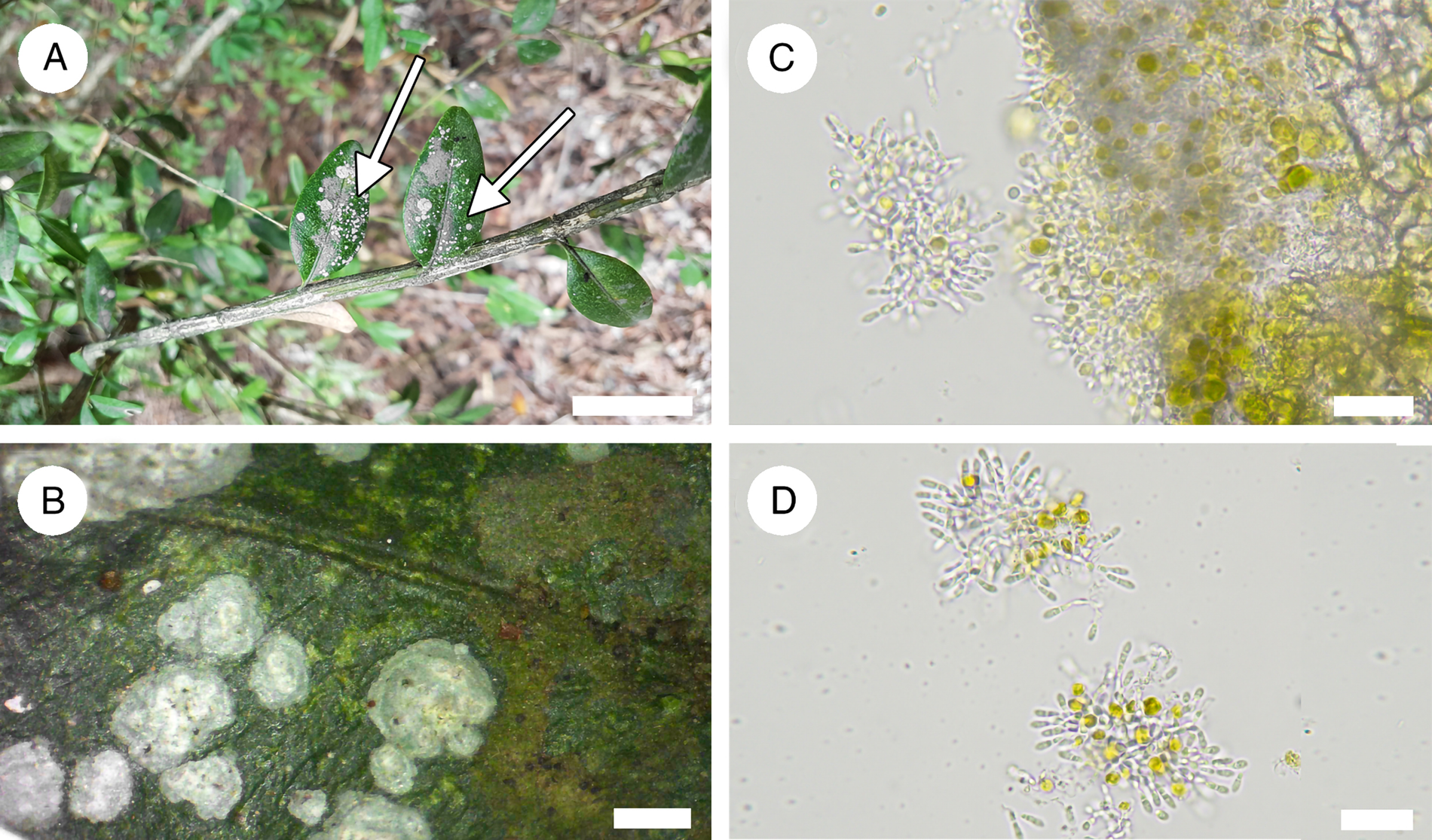
Thallus areolate-bullate, bright grey to white or silvery grey, with an icy and continuous layer of calcium oxalate crystals below the surface, with irregular margins, often irregularly divided into narrow, sometimes acute lobes (Fig. 3). Hyphophores squamiform, laminal to submarginal on the thallus patches; diahyphae moniliform, in radiating cell rows, intermingled with algal cells. Apothecia round to slightly angular, 0.2–0.4 mm diam., immersed in the thallus, with a pale green to greyish, thinly pruinose disc and prominent, whitish margin. Ascospores single, ellipsoid, 35–50 × 10–17 μm. Pycnidia not observed.
Gyalectidium caucasicum (Kazemi 9011, TARI). A & B, thallus; arrows indicate clusters of small thalli on the leaves. C & D, diahyphae associated with photobiont cells. Scales: A = 15 mm; B = 1 mm; C & D = 20 μm. In colour online.
Comments
Gyalectidium caucasicum is similar to the western-Mediterranean G. minus Sérus. The latter is smaller in size and the hyphophores are marginal (Ferraro et al. Reference Ferraro, Lücking and Sérusiaux2001).
Habitat
On leaves of Buxus sempervirens in open and dry situations.
Geographical distribution
Neotropics (Guatemala, Costa Rica, Brazil), Eurasia (Russia, Georgia), South Africa, Asia (Iran, Turkey, Japan, Papua New Guinea), and Australia (Ferraro et al. Reference Ferraro, Lücking and Sérusiaux2001).
Specimens examined
Iran: Golestan Province: Bandar Gaz, Bolbol mineral spring, near Amirkhanloo farm, 36.710114°N, 53.848376°E, 175 m, Kazemi 9011, 9017, 9025 (TARI).
Strigula buxi Chodat
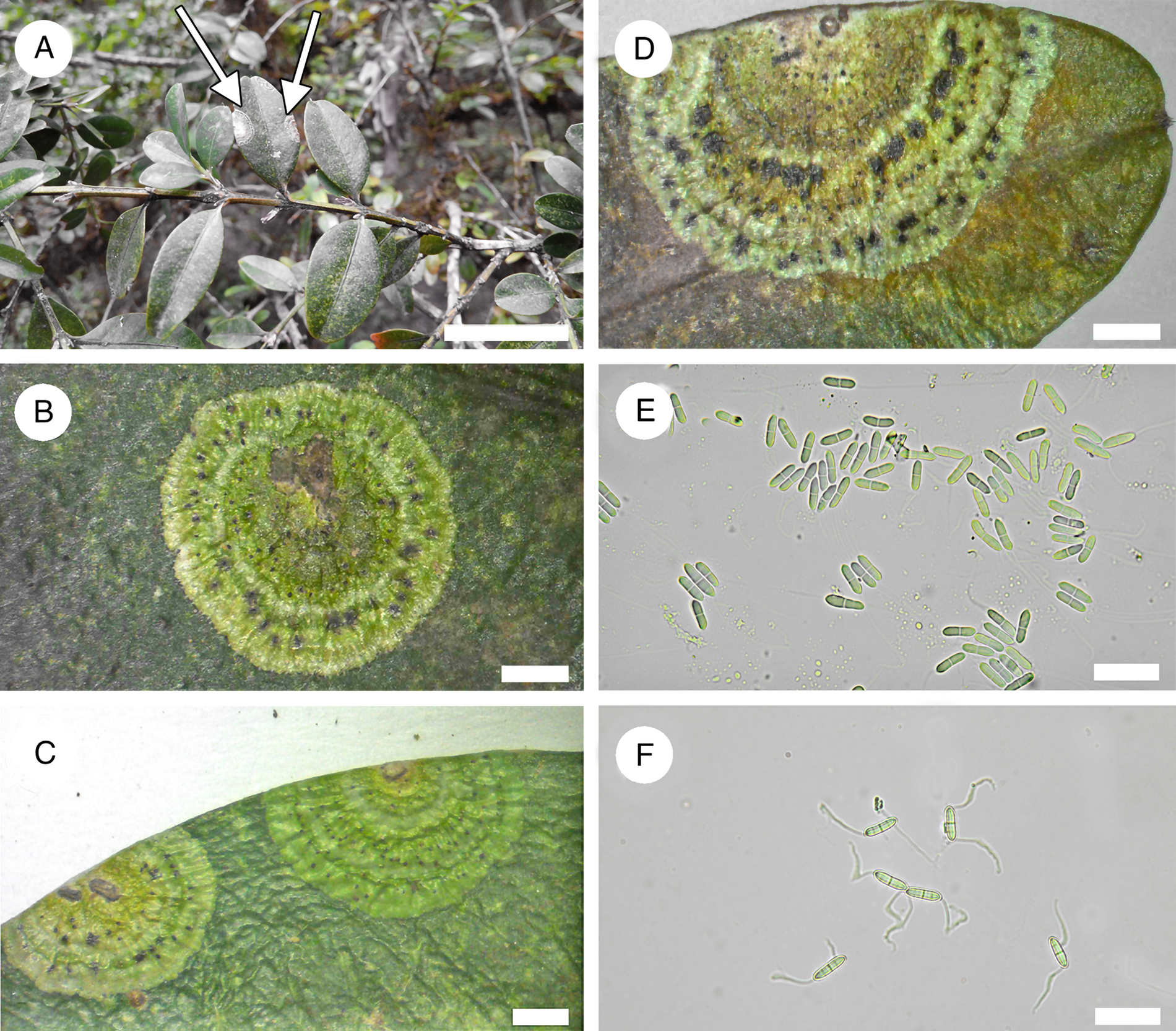
Thallus bright green to dark green when young, becoming whitish when old or cream-yellowish to bright brown in patches with age, thin, often semicircular to circular forming a crust on the surface of the leaf near the edge (Fig. 4). Lobes 3–6 mm across and 30–60 μm thick. Perithecia black, immersed in the thallus, with clear ostiole. Ascospores elliptical, 1-septate, with distinct constriction at the septum, 10–12 × 2–3 μm, hyaline. Pycnidia usually abundant, with macroconidia and microconidia; macroconidia ellipsoid, 1-septate, with gelatinous appendages at both ends, in the form of a whip. Photobiont Cephaleuros (Roux & Sérusiaux Reference Roux and Sérusiaux2004).
Strigula buxi (Kazemi 9050, TARI). A–D, thallus; arrows indicate two thalli on a single leaf. E & F, macroconidia with gelatinous appendages. Scales: A = 25 mm; B–D = 1 mm; E = 200 μm; F = 50 μm. In colour online.
Comments
Strigula buxi is superficially similar to Strigula smaragdula Fr. and was long considered a synonym of the latter. Molecular data, however, show that S. smaragdula is a complex consisting of several different species. Typical S. smaragdula, as exemplified by the lectotype material from Nepal (König s. n., UPS), has larger perithecia at least partly covered by the thallus, larger asci and ascospores (15–25 μm vs 11–17 μm long), and larger macroconidia (12–21 μm vs 9–13 μm long). Strigula buxi is characterized by the concentric arrangement of the perithecia and pycnidia, and the finely and contiguously lobulate thallus (Roux & Sérusiaux Reference Roux and Sérusiaux2004).
Habitat
On leaves of Buxus sempervirens in humid and shady places.
Geographical distribution
South America, North America (USA), Asia (Armenia, Japan, India), and Oceania (Micronesia) (Roux & Sérusiaux Reference Roux and Sérusiaux2004).
Specimen examined
Iran: Golestan Province: Bandargaz, Nokandeh, Kohne Kolbad, Forest Heights, 36.705843°N, 53.865330°E, 121 m, Kazemi 9050 (TARI).
Acknowledgements
The first author appreciates the cooperation of the Research Institute of Forests and Rangelands, Tehran (Iran) and the herbarium of the Botanischer Garten und Botanisches Museum, Berlin for the facilities provided, and is also grateful to Seyed Naghi Khaleghi Trujeni and Ali Jafari for pointing out the unspoiled areas and providing company into the depths of the Cheshmeh Bolbol forest (Range and Watersheds management organization, Natural Resource of Cheshmeh Bolbol, Bandar Gaz, Golestan, Iran).
Author ORCIDs
Sareh Sadat Kazemi, 0009-0009-4758-6129; Harrie J. M. Sipman, 0000-0002-6224-3513; Robert Lücking, 0000-0002-3431-4636.
Competing Interests
The authors declare none.



