Introduction
Nasolacrimal duct obstruction is more common in females than males.Reference Nemet and Vinker1, Reference Woog2 In females, the anteroposterior and transverse diameters of the nasolacrimal canal are smaller, and the angle between the canal and the nasal floor is more acute than in males.Reference Shigeta, Takegoshi and Kikuchi3 Osteoporotic changes, and smaller dimensions in the lower nasolacrimal fossa and the middle nasolacrimal duct, have been proposed as factors contributing to the higher prevalence of benign stenotic nasolacrimal duct obstruction in middle-aged women.Reference Groessl, Sires and Lemke4 Additionally, early menopause, hormonal fluctuations and low oestrogen causing drying of lacrimal mucosa have been proposed as theories for the formation of nasolacrimal duct obstruction.Reference Nemet and Vinker1, Reference Zolli and Shannon5
Although neoplasia near or around the lacrimal system may produce epiphora, the incidence of neoplasia from within the lacrimal system as a cause of nasolacrimal duct obstruction is not well documented. In a previous report, neoplasms resulting in chronic nasolacrimal duct obstruction affected 4.6 per cent of patients, and were unsuspected before surgery in 2.1 per cent of patients.Reference Anderson, Wojno and Grossniklaus6 The current study aimed to document the incidence of neoplasia encountered during endoscopic dacryocystorhinostomy (DCR) surgery.
Materials and methods
A retrospective study was performed on all patients with symptoms of nasolacrimal duct obstruction who underwent endoscopic DCR between January 1998 and July 2013, using data collected from three surgeons (RS, GW and RJH). We sought to determine the incidence of patients with operative findings of non-stenotic causes of symptoms. Histopathologically confirmed cases were included.
Gender, age, previous surgery and symptom resolution were compared between these patients and those with common nasolacrimal duct obstruction. Statistical assessment was performed, via a chi-square analysis of proportions, using Prism 6 software (GraphPad, La Jolla, California, USA).
Results
The study comprised 537 patients (aged 62.66 ± 18.01 years; 68.62 per cent were female), who underwent a total of 631 endoscopic DCRs. Multiple cases of tumours arising within the nasolacrimal system together with nasal tumours obstructing the nasolacrimal system were encountered. Many of these were unsuspected prior to surgery.
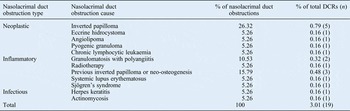
From a total of 631 DCRs, non-stenotic causes of nasolacrimal duct obstruction were found in 3.01 per cent of cases (n = 19), and included neoplastic (1.43 per cent), inflammatory (1.27 per cent) and infectious (0.32 per cent) pathologies (Table I). Neoplasia accounted for 47.37 per cent of non-stenotic nasolacrimal duct obstructions, inflammatory causes accounted for 42.11 per cent and infection accounted for 10.53 per cent.
Rates of unsuspected non-stenotic causes of nasolacrimal duct obstruction

DCR = dacryocystorhinostomy
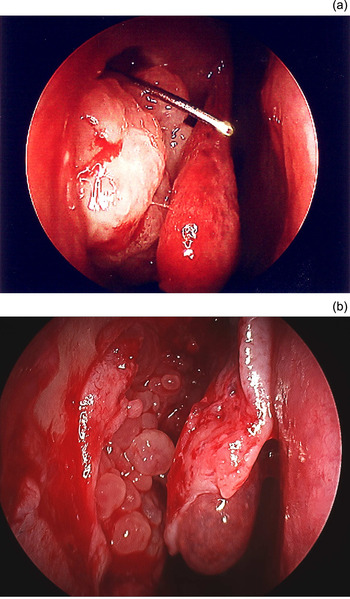
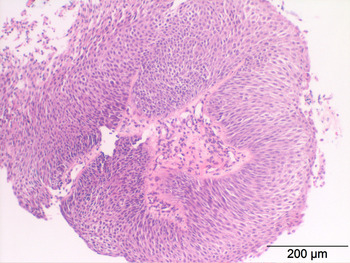
Inverted papilloma was the most common cause, encountered in 0.79 per cent of DCRs (n = 5) and confirmed histopathologically. Whilst inverted papillomas were suspected in two of these cases, they were unsuspected prior to surgery in the remaining three cases. Moreover, neo-osteogenesis secondary to previous inverted papilloma excision was the cause of nasolacrimal duct obstruction in three cases. Figure 1 demonstrates the macroscopic appearance of inverted papilloma at DCR, with Figure 2 demonstrating the histopathological features of inverted papilloma.
(a) & (b) Endoscopic images demonstrating the macroscopic appearance of inverted papilloma at dacryocystorhinostomy.

Histopathological features of inverted papilloma. (H&E; ×100)

Gender
Of the 631 DCRs performed, 31.38 per cent were conducted on male patients. However, 52.65 per cent of non-stenotic cases of nasolacrimal duct obstruction visualised during DCR were in male patients (non-stenotic causes were found in 5.05 per cent of males vs 2.08 per cent of females; p = 0.04). Male gender was significant as a predictor for inverted papilloma at DCR when compared to non-inverted papilloma related nasolacrimal duct obstruction (2.02 per cent vs 0.23 per cent; odds ratio = 8.91, p = 0.02) (Table II).
Relationship of gender to incidence of inverted papilloma in lacrimal system*

*p = 0.04
Age
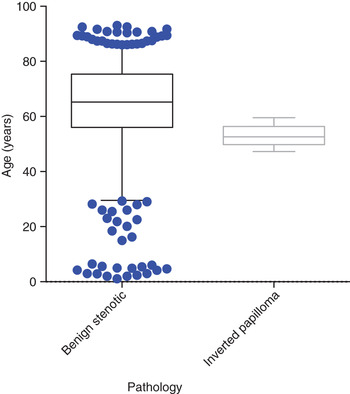
The mean age for DCR was 62.84 ± 17.62 years for females and 62.61 ± 18.80 years for males (p = 0.88). For patients with nasolacrimal duct obstruction due to non-stenotic causes, this was 60.05 ± 13.97 years (vs 62.85 ± 18.12 years for patients with stenotic causes; p = 0.51). There was no statistical difference in age between inverted papilloma and benign stenotic nasolacrimal duct obstruction cases (52.99 ± 4.37 years vs 62.85 ± 18.12 years; p = 0.22). Ages for these groups are shown in Figure 3. Similarly, there was no statistical difference in age between neoplastic versus benign stenotic nasolacrimal duct obstruction cases (60.78 ± 12.23 years vs 62.85 ± 18.12 years; p = 0.73), nor between cases with an infectious or inflammatory cause versus a benign stenotic common cause of nasolacrimal duct obstruction (59.40 ± 16.00 years vs 62.85 ± −18.12 years; p = 0.55).
Age of nasolacrimal duct obstruction patients with benign stenotic causes versus those presenting with inverted papilloma in the lacrimal system (p = 0.22).

Previous surgery
Previous nasolacrimal, eyelid, nasal or sinus surgery was documented in 26.94 per cent of DCR patients (stenotic patients 26.14 per cent vs non-stenotic patients 52.63 per cent; p = 0.01). Nasolacrimal surgery was the most common surgery, recorded prior to DCR in 15.37 per cent of all patients (stenotic patients 15.85 per cent vs non-stenotic patients 15.79 per cent; p = 0.99). Eyelid surgery had been performed prior to DCR in 4.91 per cent of patients (stenotic patients 5.07 per cent vs non-stenotic patients 0.00 per cent; p = 0.31), and 6.66 per cent had undergone prior nasal or sinus surgery (stenotic patients 6.86 per cent vs non-stenotic 36.84 per cent; p < 0.0001).
Resolution status
Symptom resolution (defined as complete resolution) was not associated with the underlying pathology. Symptom resolution was recorded in 88.07 per cent of stenotic cases and in 100 per cent of non-stenotic cases. In the recorded data, complete resolution was seen in 84.21 per cent of stenotic cases and in 81.08 per cent of non-stenotic cases (p = 0.73).
Discussion
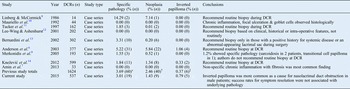
The cumulative reported incidence of non-stricture related pathology at DCR, including neoplasia, inflammatory or infectious pathology, was 3.69 per cent, based on 1624 biopsies (Table III). The reported incidence of non-stricture related pathology in this study was 3.01 per cent, which is consistent with global literature (Table III).Reference Anderson, Wojno and Grossniklaus6–Reference Knežević, Stojković, Jovanović, Stanković and Rašić14 Whilst previous studies have demonstrated a range in the incidence of inverted papilloma at DCR from 0 to 1.06 per cent, inverted papillomas in this population have been found during 0.79 per cent of DCRs.Reference Anderson, Wojno and Grossniklaus6–Reference Knežević, Stojković, Jovanović, Stanković and Rašić14
Summary of relevant study findings

*Range = 0.00–14.29 per cent; †range = 0.00–7.14 per cent; ‡range = 0.00–1.06 per cent. DCR = dacryocystorhinostomy
• Neoplasia was found to be a cause of nasolacrimal duct obstruction in 1.43 per cent of cases
• Despite a female predominance in nasolacrimal duct obstruction patients, inverted papilloma was a more common cause in male patients
• Success rates for symptom resolution were not associated with underlying pathology
Non-stenotic causes of nasolacrimal duct obstruction were unsuspected prior to DCR in all patients, except for two patients with known inverted papillomas diagnosed pre-operatively. The tendency of local bony remodelling after resection was demonstrated in three cases where neo-osteogenesis secondary to previous inverted papilloma excision was the cause of nasolacrimal duct obstruction.Reference Sandison15
There was a female predominance of 68.62 per cent in this study, consistent with evidence that nasolacrimal duct obstruction is more common in female patients.Reference Anderson, Wojno and Grossniklaus6 Male gender was associated with both a higher chance of having a neoplastic-related nasolacrimal duct obstruction and inverted papilloma, a result that correlates well with the reported gender distribution of sinonasal inverted papillomas.Reference Linberg and McCormick9, Reference Sandison15
Conclusion
Neoplasia is an uncommon (1.43 per cent) but not a rare cause of nasolacrimal duct obstruction. Male patients presenting with unilateral epiphora were most commonly associated with inverted papilloma. Success was achieved at similar rates for non-stenotic causes of nasolacrimal duct obstruction. These results can be used to inform the DCR surgeon and patients regarding the causes of nasolacrimal duct obstruction.