1 Introduction
What distinguishes collocations of modal auxiliaries and an adverb (mod + adv) such as would rather, may well or could possibly from would well, can likely or may rather? After all, the bigrams are structurally identical and all are possible and attested in language use. Yet there is a notable asymmetry in how we judge them intuitively: modal idioms such as would rather or might as well are more idiosyncratic than could possibly, and all of them sound more natural than can well. These examples give a first impression of the complexity of post-modal adverbial modification which goes beyond a binary distinction into idioms (would rather) and non-idioms (could possibly or would well). Rather, mod + adv bigrams seem to lie on a continuum from strong association to strong dissociation (see Wulff Reference Wulff2008). In other words, some modal auxiliaries and adverbs share a closer bond than others, which may explain our intuition about the examples above. From a corpus-linguistic perspective, this raises the question of how we can approach shades of mod + adv idiomaticity in a bottom-up fashion and whether patterns of (dis)preference in usage data tell us something about the scope of adverbial modification.
A collocational study of mod + adv bigrams offers a quantitative perspective on the interaction of modality and adverbial modification, which are two highly polyfunctional and context-dependent areas of grammar that are notoriously difficult to describe. We will focus on adverbs in post-modal position, as in example (1), which is more specific than general adverb placement, illustrated in example (2):

For the purpose of this article, we distinguish three broad types of mod + adv bigrams that we will refine below. They can take the form of highly idiosyncratic modal idioms (1a); they can be modally harmonic, that is, the modal auxiliary and the adverb agree in their modal value (1b); or they can combine with general-purpose adverbs (1c). These types form a reasonably coherent class; the differences, as we will see below, are gradual rather than categorical. Crucially, they are sufficiently distinct from general forms of (sentential) adverb placement in (2).
The heterogeneity of adverbial modification has been widely studied (Greenbaum Reference Greenbaum1970, Reference Greenbaum1974; Jacobson Reference Jacobson1975; Simon-Vandenbergen & Aijmer Reference Simon-Vandenbergen and Aijmer2007; Simon-Vandenbergen Reference Simon-Vandenbergen2008; Celle Reference Celle, Salkie, Busuttil and van der Auwera2009; Aijmer Reference Aijmer, Degand, Cornillie and Pietrandrea2013; to mention only a few). But while adverb placement appears unsystematic and free, it is not random (see the overview in Nuyts Reference Nuyts2001: chapter 2). Hence, we assume that post-modal adverbial modification is also non-random.
Mod + adv collocations are understudied in the modality literature, although they are occasionally mentioned in passing (e.g. Coates Reference Coates1983; Perkins Reference Perkins1983; an exception is Hoye Reference Hoye1997). Some types receive considerably more attention than others, especially in cases of high idiosyncracy. For instance, the modal idioms ’d/would rather, ’d/had better or may (as) well are comparatively well studied (e.g. Jacobsson Reference Jacobsson1980; Mitchell Reference Mitchell, Facchinetti, Palmer and Krug2003; van der Auwera & De Wit Reference Auwera, De Wit, Cappelle and Wada2010; Denison & Cort Reference Denison, Cort, Davidse, Vandelanotte and Cuyckens2010; van der Auwera, Noël & Van linden Reference Auwera, Noël, Van linden, Marin-Arrese, Carretero, Hita and van der Auwera2013; Traugott Reference Traugott2016). In addition, collocations with epistemic adverbs have been discussed in a number of theoretical or applied-descriptive contexts (e.g. Coates Reference Coates1983; Hoye Reference Hoye1997; Xiao Reference Xiao2009 on ‘modal harmony’; for ‘modal concord’ in formal frameworks, see Geurts & Huitink Reference Geurts, Huitink, Dekker and Zeijlstra2006; Zeijlstra Reference Zeijlstra, Friedman and Gibson2007; Grosz Reference Grosz, Prinzhorn and Zobel2010). By contrast, collocations with general-purpose adverbs (e.g. still, also or just) only attract occasional comments (see Hoye Reference Hoye1997).
The divergence in the amount of attention can be explained with reference to qualitative properties, particularly to the higher degree of idiosyncracy of modal idioms. At the same time, however, 8.5 percent of modal auxiliaries in COCA are directly followed by an adverb, even if we exclude the negation particles not/n't (see section 3). Hence, mod + adv is a frequent phenomenon that deserves a closer look.
As we assume no a priori distinction between the types in (1), a number of questions can be addressed. For instance, can we distinguish modal idioms and other forms of post-modal adverbial modification on the basis of a quantitative corpus analysis? How can corpus data be used to measure cohesion between modal auxiliaries and adverbs? Does a probabilistic approach reflect our intuition that may well and could only are more idiomatic or ‘natural’ than would well and can rather? And do distributional patterns inform hypotheses on the scope of adverbial modification?
These questions touch upon idiomaticity in a way that goes beyond the notions idiom, idiosyncracy or harmony. First, they force us to critically examine the implicit assumption that the difference between idioms and non-idioms is categorical. From a usage-based perspective, which is well suited to capture gradual differences in the idiomaticity of semi-fixed multi-word expressions (Wulff Reference Wulff2008), the argument is that mod + adv bigrams are situated along a linguistically meaningful continuum. Second, the questions address the probabilistic nature of the cohesion between a modal auxiliary and an adverb: stronger semantic cohesion should correlate with stronger statistical association at one end of the continuum. Third, they permit a discussion of the implications of an absence of cohesion at the other end of the continuum. That is, statistical dissociation provides cues as to which unit of meaning an adverb ‘refers to’. This information taps into general questions about the scope of adverbial modification.
This article presents quantitative evidence for an idiomaticity continuum by means of a collostructional analysis of all mod + adv observations in the Corpus of Contemporary American English (COCA; Davies Reference Davies2008; see section 3). Although Construction Grammar (CxG) is not a necessary framework for this type of analysis, it is well suited conceptually and methodologically. On the one hand, constructionist approaches have long abandoned the idea of categorical distinctions in lexis and syntax; rather, they assume gradience on many levels of linguistic representation (Langacker Reference Langacker1987, Reference Langacker, Barlow and Kemmer2000; Goldberg Reference Goldberg1995, Reference Goldberg2006; Wulff Reference Wulff2008; Hilpert Reference Hilpert2014; for a methodological perspective, see Stefanowitsch & Gries Reference Stefanowitsch and Gries2003). On the other hand, while modal idioms are clearly form–meaning pairings in the CxG sense, the constructional status of modal auxiliaries is less clear, since they resist a straightforward integration into a framework that puts greater emphasis on slot–filler constructions (Hilpert Reference Hilpert2016; see the overview in Cappelle & Depraetere Reference Cappelle and Depraetere2016a). Thus, the aim of this study is to complement recent usage-based approaches to modality from a distributional perspective, which highlight the modal auxiliaries’ associative connections to other items in the network. This article argues that probabilistic information about combinatorial patterns is part of speakers’ knowledge in general and of modal constructions in particular (see Hilpert Reference Hilpert2014, Reference Hilpert2016).
The article is organized as follows. Section 2 discusses the phenomenon in more detail; it pays particular attention to the strengths and limits of categorical distinctions. Section 3 describes data and method. Section 4 presents the results; the implications of association and dissociation are discussed in section 5. Section 6 concludes with some general remarks and argues (i) that idiomaticity in mod + adv is gradient across qualitatively different types and (ii) that speakers make use of this distributional information as part of their constructional knowledge.
2 Post-modal adverbial modification
Extending the overview in (1), we can distinguish four types of mod + adv collocation that range from highly idiosyncratic, traditional idioms to seemingly free, predictable combinations. While the types appear to be conceptually discrete, many of their exemplars defy a categorical classification.
The ‘modal idioms’ in (1a) can be further subdivided into two types, depending on their internal structure. They include had/’d better or had/’d sooner on the one hand, as in (3), and would rather, may well or might as well on the other, as in (4):Footnote 2
(3)
(a) “Then maybe you’d better come out . . . and attend to the job yourself.” (fic, 1994)
(b) I said, ‘Let them shoot. I’d sooner die by a bullet as die by an explosion.’ (news, 1990)
(4)
(a) In a city where people would rather get wet than admit that it is raining outside, we permitted ourselves the luxury of beginning from truth, not politics. (news, 2004)
(b) . . . we may well be past the point where hearts and minds are winnable. (spok, 2004)
(c) If you are going to be a Mennonite you might as well join with me and be a Cub fan. (acad, 1992)
The so-called ‘comparative modals’ had/’d better, had/’d best, had/’d sooner, had/’d rather, as in (3), are most idiom-like (Jacobsson Reference Jacobsson1980; van der Auwera, Noël & Van linden Reference Auwera, Noël, Van linden, Marin-Arrese, Carretero, Hita and van der Auwera2013). Unless ’d is analyzed as would, they are the only type without a modal auxiliary. Their classification as modal follows from their functional-semantic properties (e.g. ‘peripheral modals’, van der Auwera, Noël & Van linden Reference Auwera, Noël, Van linden, Marin-Arrese, Carretero, Hita and van der Auwera2013; ‘marginal modals’, Traugott Reference Traugott2016; see also ‘modal indicative’, Declerck Reference Declerck, Salkie, Busuttil and van der Auwera2009). They satisfy the textbook definition of idioms, since the deontic or optative import is a property of the combination rather than the additive sum of the parts (Denison & Cort Reference Denison, Cort, Davidse, Vandelanotte and Cuyckens2010; van der Auwera, Noël & Van linden Reference Auwera, Noël, Van linden, Marin-Arrese, Carretero, Hita and van der Auwera2013; Traugott Reference Traugott2016). They share non-compositionality with the examples in (4), which do contain a modal auxiliary. Yet the examples in (4) are clearly idiosyncratic and therefore idiom-like: the meaning of may well or might as well is non-predictable from the parts: omitting the adverb leads to a considerable change in meaning (you might as well join me vs you might join me).
The idiosyncracy of would rather, may/might (as) well or should sooner motivates the treatment as modal idioms (Mitchell Reference Mitchell, Facchinetti, Palmer and Krug2003). Their classification is sometimes based on the adverb (as better, sooner or rather idioms; see van der Auwera & De Wit Reference Auwera, De Wit, Cappelle and Wada2010; Traugott Reference Traugott2016) and reflects functional-semantic overlaps between the two groups (see overview in van der Auwera, Noël & Van linden Reference Auwera, Noël, Van linden, Marin-Arrese, Carretero, Hita and van der Auwera2013). Depending on the aim of an analysis, it makes sense to single out or collapse certain types. That is, it is a matter of focus whether would rather is on par with had/’d rather in a class of rather idioms. Yet this can be taken as a symptom of gradience, since it illustrates the difficulty in delimiting idioms, which in turn provides evidence for degrees of idiomhood along an idiomaticity cline (see Wulff Reference Wulff2008: chapter 1 for discussion).
The two other groups appear compositional by comparison. The first are ‘modal harmony’ bigrams (could possibly, will probably or might conceivably). A defining property of modal harmony is the agreement in the modal value between modal auxiliary and adverb, such as possibility in could possibly or prediction for will inevitably:
(5)
(a) One wonders how they could possibly proceed in such an ambivalent manner. (acad, 1990)
(b) When officials have absolute power, they will inevitably become corrupt. (acad, 1990)
Modal harmony illustrates that idiomaticity and (relative) compositionality are not mutually exclusive. For instance, could and possibly share a strong bond with unit-like status. Yet the modal and the adverb are in a reinforcing relationship, so that the meaning of could possibly is closer to the sum of its parts than the meaning of the traditional idioms. In other words, could possibly is idiomatic (or conventional), but less ‘idiom-like’ (or idiosyncratic) compared to would rather or ’d better.
Harmony effects are sometimes referred to as ‘synergism’ or ‘concord’ (Halliday Reference Halliday1970: 331; Lyons Reference Lyons1977: 807; Coates Reference Coates1983: 45–6; Hoye Reference Hoye1997; for formal analyses of ‘concord’, see Geurts & Huitink Reference Geurts, Huitink, Dekker and Zeijlstra2006; Zeijlstra Reference Zeijlstra, Friedman and Gibson2007; Grosz Reference Grosz, Prinzhorn and Zobel2010). The adverbs are described as ‘modal adjuncts’ (Halliday Reference Halliday1970: 330), ‘epistemic adjuncts’ (Huddleston & Pullum et al. Reference Huddleston and Pullum2002: 173, 767) or ‘modal satellites’ (Hoye Reference Hoye1997; Xiao Reference Xiao2009). The metaphor of a satellite reflects the special relationship between adverbs and modals; note that many studies in the context of modal–adverb collocation include adverbs in slots other than the post-modal position (Coates Reference Coates1983; Hoye Reference Hoye1997; Xiao Reference Xiao2009). Since epistemic adverbs form a reasonably closed class (Nuyts Reference Nuyts2001: 55), it appears straightforward to delimit this group. In actual practice, however, it is difficult to devise a comprehensive list of adverbs that fall under the concept of harmony.
The classificational problems are also evident in the final group, where modal auxiliaries are followed by general adverbs. In isolation, only, also or always have less or no modal import. But they attain considerable epistemic flavor, since, in combination with a modal, they evaluate the extent of prediction (will) or hypothetical prediction (would):
(6)
(a) I can only get more by denying an equal amount to others. (acad, 1990)
(b) Still, people will always generalize from specific encounters. (mag, 2009)
(c) Petrov would never have described her as beautiful … (fic, 1997)
In contrast to the types we discussed above, these collocations are more compositional. They add a temporal or interval qualification (also, only, always, never) and are clearly not modally harmonic.
This type is rarely discussed (but see comments in Hoye Reference Hoye1997). One reason may be that general adverbs are perceived as non-modal in isolation. They are implicitly assumed to form compositional sequences, which may not be immediately relevant for a discussion of modality. On the other hand, they occur in idiom-like fixed expressions, where the adverb is an essential element, such as I can hardly wait, I would never dream of it or we’ll just have to wait and see. This cohesion, as well as their high frequency, warrants the inclusion of general adverbs in a study of mod + adv bigrams alongside idioms and modally harmonic collocations.
In sum, the four groups appear sufficiently distinct on conceptual grounds, yet their boundaries overlap considerably. In the sense that we refrain from drawing a sharp distinction between ‘idioms’ and ‘collocation’ (as in, e.g., Hoye Reference Hoye1997), the discussion is empirically more inclusive. At the same time, the restriction to the post-modal position is more exclusive compared to studies with a much wider definition of a satellite (see Hoye Reference Hoye1997; Xiao Reference Xiao2009). However, the results from the more restrictive analysis permit informed inferences about the scope of adverbial modification beyond the post-modal position (see section 5).
The restriction has a methodological and a linguistic motivation. Methodologically, adjacent items are much easier to extract from usage data and require minimal manual intervention. This means that we can comprehensively exploit large corpora like COCA, where the number of mod + adv tokens runs into the hundreds of thousands. The linguistic motivation follows from the assumption that idiomaticity is gradient, covering a continuum from highly idiosyncratic idioms to idiom-like expressions to more freely combining sequences. Hence, a greater inclusiveness pays heed to the observation that neither idiom, nor harmony, nor compositionality or predictability capture the full extent of mod + adv collocation on their own.
From a distributional perspective, which assumes that statistical patterns are linguistically meaningful, we can formulate the following expectations. First, greater cohesion, or association, between a modal and an adverb coincides with higher degrees of idiomaticity and/or unit-status. While this is the case for modal idioms almost by definition, it is probabilistic and gradual for the remaining types. Second, conversely, the greater the dissociation, the less likely a combination has unit-status. In other words, in addition to (statistically significant) patterns of mutual preference, the method described below identifies (statistically significant) patterns of dispreference. Greater dissociation, i.e. the absence of a statistical relationship between the modal auxiliary and the adverb, has implications for the scope of adverbial modification.
Analyses of mod + adv in a collocational context are not new, but the phenomenon remains understudied. Hoye's (Reference Hoye1997) study is the most relevant in this respect; it is concerned with descriptive frequency profiles of individual modal auxiliaries. The current study extends on Hoye's concept of ‘collocability’, but takes a paradigmatic and contingent perspective: it measures (dis)preferences relative to all other (potential) combinations in the same pattern. This can be seen as an operationalization of the ‘collocational range’ of a modal auxiliary (see Greenbaum Reference Greenbaum1974; Hoye Reference Hoye1997). The insights on combinatorial properties help to address questions of speaker knowledge of modal constructions (see Hilpert Reference Hilpert2016).
3 Data and method
This section describes the data set and the method used to investigate it, i.e. Collostructional Analysis (Stefanowitsch & Gries Reference Stefanowitsch and Gries2003; Stefanowitsch & Gries Reference Stefanowitsch and Gries2005). CA is a well-established method for the investigation of lexis–construction interaction, but has not featured prominently in the modality literature (but see Hilpert Reference Hilpert2011, Reference Hilpert2016; Cappelle & Depraetere Reference Cappelle and Depraetere2016b; for deontic modality more generally, see, e.g., Van linden Reference Van linden2010a, Reference Van linden, Lenker, Huber and Mailhammer2010b, Reference Van linden2012; for German, see Stefanowitsch Reference Stefanowitsch2009). The logic of CA is identical to collocational analyses in lexical semantics (Evert Reference Evert2004), except that it focuses on the co-occurrence of two items within a pattern. Like other contingency-based methods, CA goes beyond raw frequencies and identifies positive and negative association, which cannot be inferred from raw frequency profiles.
3.1 Data: source and retrieval
Three queries were run on the mid-2015 offline version of the Corpus of Contemporary American English (COCA; Davies Reference Davies2008).Footnote 3 The first query extracted the core modals as strings (unambiguously tagged ‘vm’, i.e. can, could, may, might, must, should, shall, will, would, ’d, ’ll). The adverb slot contained any number of adverbs (retrieving, e.g. could also, might as well, will almost certainly); negation in not/n't was excluded. The second query retrieved had/’d better/best and their modifications. In order to avoid duplicate matches with ’d from the first query as well as ambiguity with a contracted ’d in perfect auxiliaries, the second search excluded the modal tag (vm) and required an infinitive after better/best. The third query retrieved the string had rather with zero or more intervening adverbs; these results were manually cleaned. In the displays below, ’d is represented as ’d(wd) if retrieved from the first query (likely would) and as ’d(hd) if retrieved from the second (likely had). The data and the query documentation are available at https://osf.io/f6azk/
The final data set contains 441,608 mod + adv observations (436,436 for query 1; 5,147 for query 2; 25 for query 3). This amounts to about 8.5 percent of all modal auxiliaries in COCA (5,173,007). Since contractions are treated as distinct from their full forms, there are 13 types in slot A (can, could, may, might, must, should, shall, will, would, ’d(wd), ’ll, had, ’d(hd)). A total of 5,012 types occur in slot B: multi-token adverbs account for 65 percent of types, but only for 7.5 percent of tokens (the bulk of these are no longer, as well, at least, very well, most likely and almost certainly).
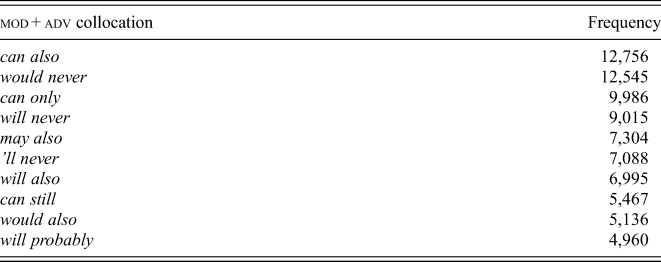
Table 1 provides an overview by frequency, from which it is clear that raw occurrence is not the most comprehensive indicator of cohesion, let alone of idiomhood. The top ten do not include a single modal idiom and only one modally harmonic bigram (will probably). Frequency lists mask strong association between low-frequency items. For instance, it is implausible to assume that the frequency of can also (12,756) reflects a higher degree of cohesion than ’d(hd) better (3,561). Since both can and also are very frequent on their own, their co-occurrence is expected to be high by chance alone. Thus, in order to measure cohesion, the frequency of co-occurrence must be controlled for the frequency of its parts.
Top ten mod + adv sequences by raw frequency; COCA

3.2 Method: Collostructional Analysis
Collostructional Analysis (CA) normalizes raw co-occurrence by taking into account overall frequencies of the units involves. For the current purpose, I used Co-Varying Collexeme Analysis (CCA). CCA is a variant of CA, which quantifies attraction or repulsion between the items in two slots of a pattern (Gries & Stefanowitsch Reference Gries, Stefanowitsch, Achard and Kemmer2004; Stefanowitsch & Gries Reference Stefanowitsch and Gries2005). In the context of mod + adv, we assume that each type in slot A (the modal) can in principle co-occur with each type in slot B (the adverb). If the combination of A and B were free, each combination would occur roughly as often as expected given the individual frequencies of A and B in the pattern. (C)CA calculates whether an observed value deviates from expectation; the corresponding test statistic is interpreted as a measure of attraction or repulsion between A and B.
To illustrate, we assess the level of attraction between the parts of the most frequent combination can also in the 441,608 mod + adv observations. We need four frequencies (see table 2): in COCA, can and also co-occur 12,756 times, can occurs 73,594 times without also, also occurs 34,788 times without can, and 320,470 mod + adv observations involve neither can nor also. Note that CCA ignores the corpus frequencies of can (1,054,081) and also (508,808), as well as the corpus total (this version of COCA: 444,797,856). In contrast to collocational methods (see Evert Reference Evert2004), where measures are calculated across total corpus frequencies, CCA is based on the frequencies within a pre-defined pattern, such as mod + adv.
2 × 2 contingency table for can also

Based on the four conditions, the expected frequency of can also is 9,297.Footnote 4 Since this is lower than the observed value, can and also are positively associated. The log likelihood value (G 2)Footnote 5 for this table is 1,670, which is statistically significant at p < .001. This means that can and also are significantly positively associated. In other words, their co-occurrence is not merely a function of their individual frequencies, but suggests a linguistically relevant level of mutual cohesion.
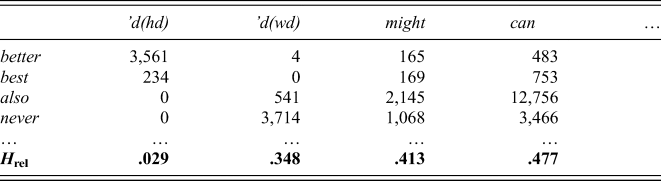
To take the example of a traditional modal idiom, the association for ’d(hd) better is influenced by two types of skew (see table 3): slot B is largely restricted to better and better is skewed toward ’d(hd). The expected frequency of 52 is not only much lower than the observed frequency of 3,561, the association score (G 2 = 31,412) vastly exceeds the value for can also (G 2 = 1,670). This is mathematical confirmation for the intuition that ’d(hd) better is a more cohesive unit than can also despite its lower raw frequency.
2 × 2 contingency table for ’d(hd) better

Two remarks illustrate the additional advantage of association over raw frequency. CCA can be used to identify negative association and the absence of an association. As an example for the former, would well occurs only 14 times out of an expected 1,463 and is thus significantly dissociated (G 2 = 3,113, neg). For the latter, must really occurs 157 times out of an expected 172; since this difference is not statistically significant, there is no association in either direction (G 2 = 1; p = .25). Non-associated items are usually not discussed in the CA literature, but we will return to potential implications of this phenomenon in the context of mod + adv in section 5.
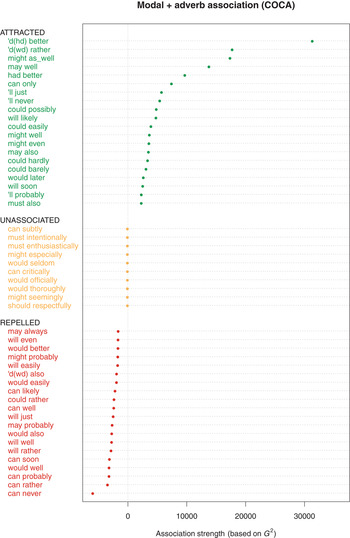
The procedure is repeated for each (potential) mod + adv type using appropriate software. All calculations reported below were performed using the collex.covar() function in the R package {collostructions} (Flach Reference Flach2017). The output of CCA is a ranked list of mod + adv bigrams in descending order of attraction, which represents a continuum of (waning) idiomaticity. Note that dissociation is represented in a graph below as a negative value; since it is incorrect to represent a squared value (G 2) as a negative, this should be read as ‘directed association strength’ (see figure 1).
Modal idiomaticity continuum (CCA); COCA

3.3 Relative entropy
A related point for idiomaticity concerns the propensity of modals to combine with adverbs. To use an extreme comparison, would and will combine with vastly more adverb types than ’d(hd) or had (by definition). This skew is a rough operationalization of Hoye's (Reference Hoye1997) notion of the ‘collocational range’ of a modal auxiliary.
Relative Entropy (H rel) measures the level of skew in a distribution. Imagine that modal A combines with six adverbs in a set A = {5, 4, 3, 2, 1, 0} and modal B with the same set of adverbs as B = {7, 6, 1, 0, 0, 0}. Modal A is more evenly distributed, indicated by a higher Relative Entropy (H rel = .83) than B (H rel = .50). A maximally skewed modal C = {10, 0, 0, 0, 0, 0} has a H rel of 0. Thus, the higher a modal's H rel, the more varied its collocational range. Overall frequency is not relevant for H rel, although H rel and frequency are correlated in the present context (see below).
Table 4 shows a snippet of the table for the calculation of H rel (Gries Reference Gries, Sánchez and Almela2010: 273). The rows represent all adverbs that have at least one significant positive relationship with one of the modal auxiliaries (G 2 > 3.84, p < .05).
Sample input for Relative Entropy (Hrel)

4 Modal idiomaticity from a collostructional perspective
This section presents the results from two angles. First, it describes patterns in mod + adv and the continuum of idiomaticity, as determined by CCA. It is followed by a brief discussion of the modal auxiliaries’ collocational ranges.
4.1 mod + adv idiomaticity
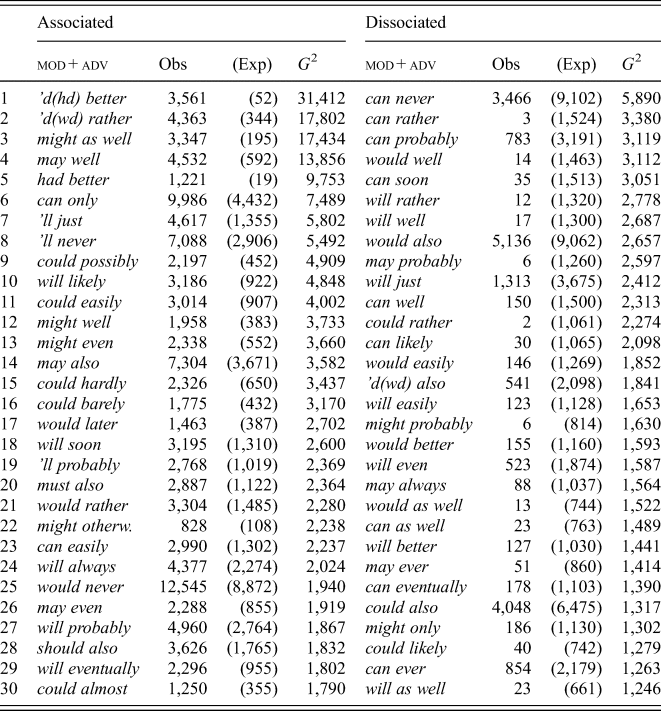
Of 65,156 possible mod + adv combinations, 11,374 are attested and 1,546 of these are significantly associated or dissociated at p < .001 (G 2 > 10.83).Footnote 6 Table 5 lists the top thirty attracted (left) and repelled (right) mod + adv bigrams, which we can interpret linguistically as the two ends of the idiomaticity continuum. Figure 1 visualizes the continuum and includes a random selection for non-associated types.
Top thirty most strongly associated (left) and dissociated (right) mod + adv combinations

CCA identifies the traditional modal idioms ’d(hd) better, ’d(wd) rather, might as well, may well and had better as the top five. The most frequent combination can also is ranked only thirty-second by association. Conversely, the clearest idiom by intuition and statistical cohesion, ’d(hd) better, is ranked only thirty-second by frequency. This is a plausible result, since we would expect idioms with higher degrees of idiosyncracy to have the strongest levels of statistical cohesion.
There are at least four additional patterns. First, while the modal idioms dominate the top of the list, one – would rather – is ranked rather low (rank 21) and much lower than the contracted variant ’d(wd) rather. Generally, contractions rank higher than their full forms, which is indicative of a stronger bias toward idiosyncracy (see below).
Second, general adverbs not only outnumber epistemic adverbs, they are also relatively evenly spread across only, just, never, easily, even, also, later, soon, otherwise, always and almost. There is a tendency for historically and/or semantically related modal auxiliaries (can/could, may/might, ’ll/will, etc.) to attract similar adverbs, but each auxiliary has at least one very salient ‘satellite’ in the top list that it doesn't share with its ‘relative’. Examples of similar patterning of pairs include the positive association between even and may/might or can/could (all other modals disprefer even) or easily with can/could (dispreferred by all others others). An example for dissimilar patterning of pairs is never, which is positively associated with ’ll, but not with will, while also is strongly attracted to may, must, should and could and much less strongly attracted to might, shall or can. These tendencies indicate that many bigrams are conventionalized chunks: if co-occurrence were random, we would expect general adverbs to be evenly distributed across (pairs of) modal auxiliaries. That said, it is a matter of definition in how far easily, only, even or always are actually non-modal – they do have epistemic, speaker-based import in combination with modals (e.g. in this could easily be done or one might even argue).
Third, epistemic adverbs are underrepresented among the top thirty (could possibly, will likely or ’ll/will probably). Their relative absence from the top of the list is partly due to the lower frequencies of epistemic adverbs (CA favors frequent items). However, their systematic absence is also noteworthy with regard to modal harmony (see below).
Finally, as alluded to above, there is a conspicuous pattern with contractions: ’ll and ’d(wd) appear to have ‘a life of their own’. Specifically, will and ’ll combine with very different adverbs at the top or even have ‘contradictory’ associations. For example, ’ll just is associated, but will just is dissociated. While this reflects oral discourse to some extent, it points to a broader pattern (which is also evident in the COCA-spoken data). The adverbs attracted to ’ll cluster around expressions of intention and proximity (just, never, both, ever, even), while will attracts adverbs which signal the prediction of results (likely, probably, eventually, undoubtedly, inevitably, ultimately). For would and ’d(wd), the picture is less clear, but it is interesting to note that variations of mod rather (much rather, just rather, still rather or really rather) are associated predominantly with ’d(wd). On the one hand, it points toward greater flexibility within the ’d(wd) rather idiom; on the other, it parallels the contractions’ stronger propensity to form idiom-like combinations.
There are three types of negative association at the other end of the continuum, which we will return to in detail in section 5. Some bigrams are dissociated for mathematical reasons. The obvious cases involve the adverbs well, rather and better, which are largely restricted to may/might, ’d/would and ’d/had, respectively. By the logic of CA, all other modals show a strong dispreference; they also sound decidedly odd (can rather, will well or would better). The second type concerns high-frequency combinations with general adverbs that are similarly affected by skews and also repelled for mathematical reasons (also, still, yet, easily). However, these are not unidiomatic (would easily). The final type includes those we expect to be repelled by conflicting (modal) values: adverbs of prediction (e.g. probably and likely) are unlikely to combine systematically with modal auxiliaries of ability, permission or inference (can, may, might). Despite these differences, the three types of repulsion share a linguistic interpretation, which we will also discuss in section 5.
4.2 Propensity toward adverbial modification
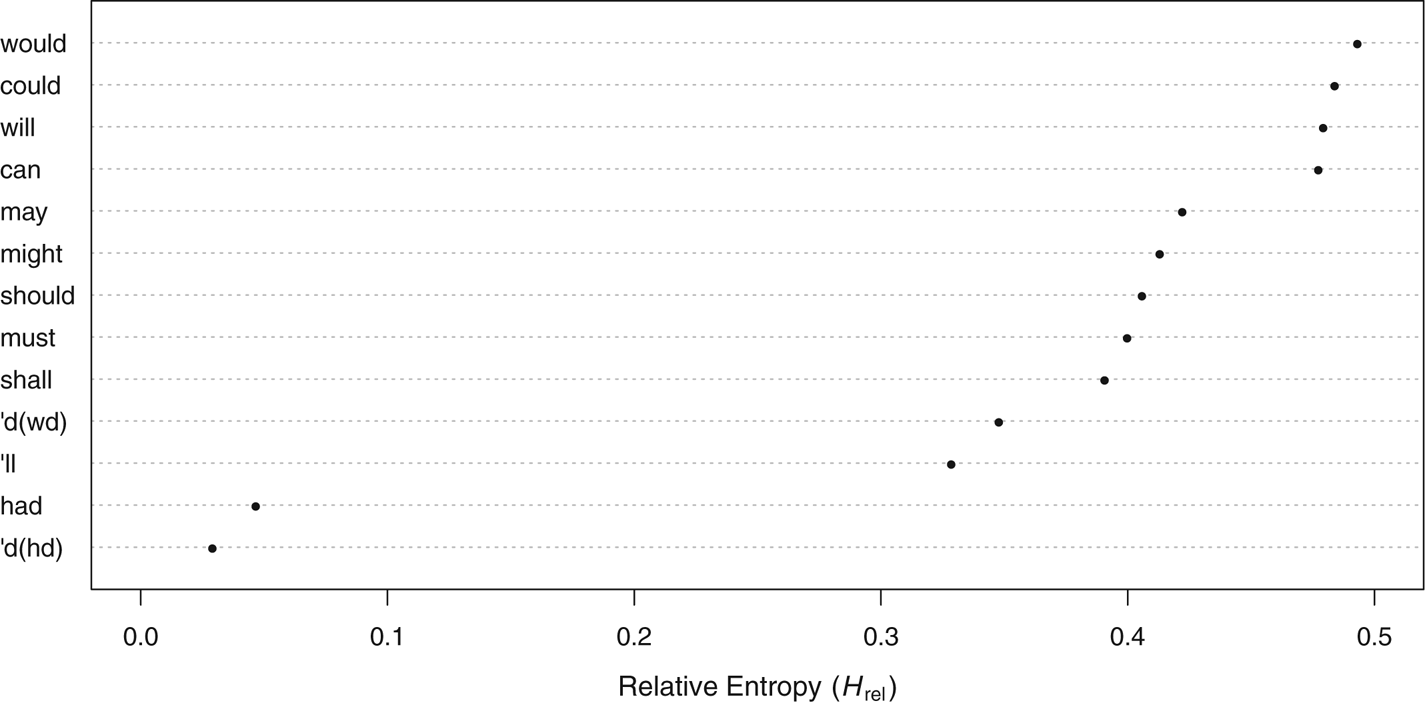
Recall from section 3.3 that we can use Relative Entropy (H rel) to measure the ‘collocational range’ of a modal auxiliary (Hoye Reference Hoye1997). A more varied modal auxiliary will have a higher H rel, as it indicates greater distributional spread. Conversely, a lower H rel indicates less variability and thus a higher propensity toward idiomhood. The dotplot in figure 2 shows the H rel for each of the thirteen slot A types (see table 4).
Diversity of post-modal adverbial modification (H rel)

Four clusters emerge: ’d(hd) and had have by far the lowest entropies (almost by definition): ’d(hd) is restricted to better and best, while had is slightly more productive and combines with rather and better/best and their modifications (just better, far better, damn well better). Contracted ’ll and ’d(wd) form a second cluster. The remaining two clusters are the mid-frequency (may, might, should, must, shall) and the high-frequency modal auxiliaries (would, will, could, can), respectively.
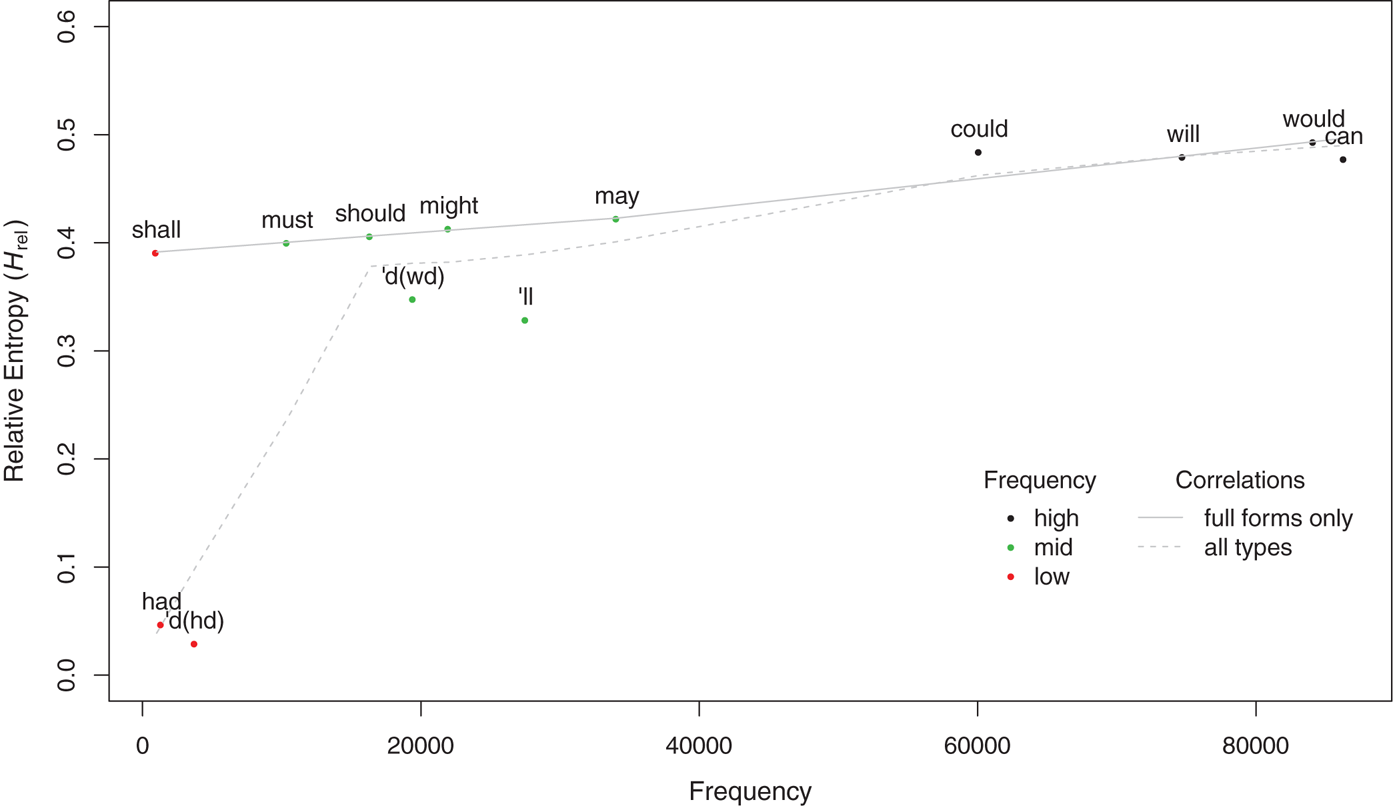
One contributing factor is frequency, which is correlated with Relative Entropy (r = .66, p < .05). At the same time, a modal's variability is indicative of semantic generality, and semantically general items tend to be more frequent. The stronger skew of ’ll and ’d(wd) indicates that limited generality accounts for lower Relative Entropy more than frequency. Figure 3 illustrates this effect. The relationship between variability and frequency for the full forms is linear and near-perfectly correlated (r = .97, p < .001). However, while ’ll and ’d(wd) are in the same frequency band as must, should, might and may, they are much less variable. Thus, frequency alone does not account for fluctuation in the collocational range.Footnote 7, Footnote 8
Relative Entropy (H rel) by frequency (full COCA)

In summary, two distributional patterns illustrate how mod + adv bigrams go beyond modal idioms or modal harmony. First, the four groups of post-modal adverbial modification that were distinguished on qualitative grounds in section 2 are quantitatively different only as a matter of degree. While idioms tend to cluster at the top end of the continuum, there is considerable overlap between and across groups along the cline of association. Second, modal auxiliaries differ in variability, with a higher tendency toward idiom-like behavior for those that are also functionally restricted. The question is how to interpret presence and absence of association in mod + adv, to which we now turn.
5 Discussion
The numerical results confirm an idiomaticity continuum for mod + adv (see figure 1). Higher-ranked bigrams correlate with greater idiomaticity, regardless of the qualitative type. On the other hand, there are several types of relevant non-associations. There is true repulsion, mostly with bigrams that have conflicting modal values; for others, the repulsion is only apparent (e.g. would easily). This section discusses the implications of association and dissociation and argues that distributional information of mod + adv potentially provides cues to the scope of adverbial modification.
Since the results at the top end of the continuum can straightforwardly be interpreted as higher degrees of idiomhood and idiomaticity, more emphasis will be on the absence of an association and on repulsion. That is, we focus on the mid- and end-sections of the continuum, respectively. Despite some key differences, all types of dispreference are based on a simple assumption that follows from the logic of statistical association. Trivially, the stronger the attraction between two items, the more likely they are to form a cohesive, indivisible unit. This is most intuitive for modal idioms (You'd better be sorry vs *Better, you'd be sorry). Conversely, the stronger the repulsion, the more likely the adverb has wider scope and modifies a unit of meaning beyond the modal auxiliary.
In the case of a strong positive association, the adverb modifies ‘backward’, qualifying modality. To illustrate, consider barely and hardly, which are positively associated only with can (G 2 = 511 and G 2 = 695) and could (G 2 = 3,170 and G 2 = 3,437):
(7)
(a) He could barely keep his thoughts straight, but he knew things had gone wrong. (fic, 2007)
(b) We can't see her and we can barely hear what they're talking about . . . (fic, 2006)
(c) My husband has such bad road rage that we can barely stay in the car together for an hour. (mag, 2010)
(d) We can hardly wait for it to come in and take Ryan home with us. (spok, 2006)
Here, barely and hardly qualify the agents’ ability of keeping, hearing, staying or waiting, rather than the actions themselves. The adverbs have scope over the modal auxiliary, although both may be part of a larger chunk (can hardly wait). A similar connection between cohesion and modification of modality is assumed to be at work for all strongly associated mod + adv bigrams.
By contrast, if the relationship between a modal and an adverb is a strong dissociation, modification tends to work forward, that is, the adverb modifies the infinitival group. Consider the examples in (8) for would barely (G 2 = 731, neg), will barely (G 2 = 831, neg) or may hardly (G 2 = 670, neg):
(8)
(a) Furthermore, NASA sought a substance that would barely expand or contract as it passed through extremes of temperature . . . (acad, 1990)
(b) He would barely talk to any of them, except Mat . . . (fic, 1991)
(c) Now it looks as though the company will barely earn $1.48 this year. (mag, 1993)
(d) That may hardly seem likely in the current political environment. (mag, 2005)
Here, barely qualifies expansion, the intention to talk or one's earning of money, not (past) prediction. If the adverbs are part of a conventional collocation with the rightward infinitival group, they pertain to the situation (barely talk, hardly likely), not to modality (cf. could hardly wait above).Footnote 9
The same argument applies to adverbs that are not associated with any of the modal auxiliaries. A few random examples with at most mild (dis)preferences include will seriously (G 2 = 5, neg), would utterly (G 2 = 13, neg) or can forcefully (G 2 = 9, neg):
(9)
(a) If continued, they will seriously threaten the quality of research and education UC can provide, to the detriment of California and the nation. (news, 1993)
(b) Told that an order to advance would utterly crush the retreating Rebels, Meade hesitated. (mag, 1993)
(c) The church can forcefully stand up in the public arena and say, ‘Look, we've got to think about these people as human beings.’ (news, 2006)
In brief, the absence of statistical cohesion increases the likelihood that the adverb is part of the infinitival group. This holds irrespective of whether the adverbs are otherwise distinctive for other modal auxiliaries (e.g. barely, hardly) or infrequent with few or no statistically significant relationships (e.g. utterly, seriously).
Another case of wider scope is sentential modification, where the adverb qualifies the proposition, not the modal or the infinitival group. To illustrate, consider understandably, which is mildly associated only with might (G 2 = 31, pos):
(10)
(a) Nations will understandably resist imposing taxes on their own industries to provide a global benefit if this simply causes production or future investment to move to other nations without such taxes. (acad, 1997)
(b) Understandably, nations will resist imposing taxes on their own industries.
(11)
(a) However, parents may understandably feel that decisions about inheritances are theirs alone to make. (news, 2005)
(b) Understandably, however, parents may feel that decisions about inheritances . . .
Similarly, evidently is only (very weakly) associated with will (G 2 = 8, pos):
(12)
(a) But gold was still gold, money was still money, money could evidently buy anything, and he was going to be rich enough to start over. (fic, 1998)
(b) evidently, money could buy anything . . .
(c) money could buy anything, evidently . . .
The absence of an association indicates a weaker connection, which in turn reflects greater positional variability. In other words, a lower unit-like status increases the likelihood that the adverb has scope over the proposition. In these cases, the adverb often has no particular relationship in either direction: neither could evidently nor evidently buy are intuitively very strong collocates.
The phenomenon of modal harmony likely falls into this area. On the one hand, we could expect harmony to correlate with strong cohesion between an auxiliary and an adverb of the same modal value. This connection appears trivial: two items are more likely to co-occur to form a unit when they are also semantically compatible. Indeed, many mod + adv combinations discussed as harmonic or synergetic (Hoye Reference Hoye1997: 80f. 216; Geurts & Huitink Reference Geurts, Huitink, Dekker and Zeijlstra2006) have positive associations. However, the association strength is often rather low, for instance in must inevitably (G 2 = 68) or might possibly (G 2 = 7). Two exceptions with strong unit-status include will probably (G 2 = 1,867) and could possibly (G 2 = 2,197). On the other hand, there are numerous counterexamples with no or even a negative association, including must certainly (G 2 = 15, neg), must really (G 2 = 1, ns) or may possibly (G 2 = 117, neg).
Hence, the evidence on modal harmony is inconclusive from a distributional view. This adds weight to the (implicit) idea that harmony is a wider phenomenon (Lyons Reference Lyons1977: 807; Hoye Reference Hoye1997: 81f.). With the exception of a few highly frequent collocations (could possibly, will likely, will probably), modal harmony seems to be, on the whole, a phenomenon of sentential modification, based on the logic of the absence of cohesion and given only mild association in either direction for the majority of obvious candidates.
Finally, two types of dissociation deserve a brief discussion. We may call the first ‘true repulsion’, illustrated by well and better, which are only associated with may/might and ’d(hd)/had, respectively. For reasons that follow from the non-prototypicality of well and better as mod + adv adverbs, they are strongly repelled by all other modal auxiliaries. Where they do co-occur, they are found in contexts that are reminiscent of split infinitives (to deal better with X > to better deal with X) and thus signal forward modification:
(13)
(a) I will well and faithfully discharge the duties of the office on which I am about to enter. So help me God. (acad, 2002)
(b) so she could better deal with performance problems. (acad, 2010)
The other repulsion type is only apparent and mainly affects modals in their non-central sense(s). An example is easily, which is positively associated only with could (G 2 = 4,002) and can (G 2 = 2,236). When easily co-occurs, for instance, with would (G 2 = 1,853, neg) or will (G 2 = 1,653, neg), they match the ability sense of easily with would and will's meanings of hypotheticality or prediction, respectively:
(14)
(a) Truly, this sandwich would easily handle the needs of two people. (news, 2006)
(b) Whatever you lift will easily slide off the blade and onto the plate. (mag, 2010)
That said, these examples are ambiguous with respect to the scope of modification: easily could also qualify handle or slide off. Yet ability meanings are compatible with the main senses of will (prediction) and would (hypotheticality), which is why neither would easily nor will easily are particularly odd. Contrary to would well, their statistical repulsion is only apparent: it is due to the inability of CCA to distinguish between subsenses if, like here, subsenses are not explicitly coded (see below). Note that apparent repulsion largley concerns bigrams of high token frequency (would also: 5,136); true repulsion is rare here (will well: 17; see table 5). In a sense, high raw frequency ‘overrides’ mathematical dissociation such that ‘apparent repulsion’ bigrams are also perceived as unit-like.
The phenomenon of apparent repulsion leads us to a shortcoming of the collostructional method in the current context, because CA glosses over polyfunctionality. This is particularly obvious with modal auxiliaries, which enter the analysis as one type for each. Put simply, polysemy is poorly represented in CA (but see Gilquin Reference Gilquin2013 for using CA in the context of constructional polysemy). If a modal auxiliary has an infrequent subsense, then any collocation that is restricted to that subsense is mathematically disadvantaged. A hypothetical workaround would involve the manual annotation of each mod + adv observation for subsenses. This is clearly unfeasible for a data-hungry method such as CA. Given the logic of CA, an analysis of manually annotated data would increase both the individual association scores and the number of mod + adv types at the idiom-like end of the continuum. From this angle, the current approach underestimates the extent of unit-like mod + adv. Yet CA fares better than raw frequency and potentially better than collocation-based analyses (Evert Reference Evert2004). A collocation-style analysis based on transitional probabilities did not bring out sensible pattern in the context of modal idiomaticity.
A limitation of a different kind is the exclusion of negated uses (can't possibly), which were not queried to begin with (rather than subsuming them under their positive forms). Following from the behavior of contracted forms, if negated modal auxiliaries were included, they should probably be treated as separate types: {will} would enter the analysis as five types (will, ’ll, will not, won't, ’ll not). This would reshuffle the ranks, since, for instance, even is particularly frequent in negation (won't even, can't even). However, separating them could lead to the identification of further interesting sub-patterns.
The methodological limitations are reminders that collostructional analyses uncover tendencies and/or latent patterns, not fixed or deterministic results. Yet the results are robust in the sense that the general idea – i.e. assigning a crucial role to probabilistic information – remains unaffected. Idiomaticity clines can, therefore, be seen as part of speaker knowledge, both for modal constructions and beyond (Stefanowitsch & Gries Reference Stefanowitsch and Gries2003; Wulff Reference Wulff2008; Hilpert Reference Hilpert2016).
6 Concluding remarks
Previous research on mod + adv collocation made an implicit categorical distinction between idioms and non-idioms. The current analysis illustrated the added value in going beyond this distinction. While the notions idioms and harmony are useful for individual aspects of modality, they cover neither the full range nor the complexity of (post-)modal adverbial modification. Hence, they are less suitable to address the question why ’d rather or could possibly sounds more natural than can rather or should possibly. This motivated the collective analysis of the relevant collocational phenomena from a distributional angle as a function of (quantitative) cohesion.
Cohesion was operationalized in terms of statistical association as a systematic measure of idiomaticity. The stronger the cohesion, the higher the unit-status and the higher the degree of idiomaticity. Greater cohesion, not necessarily higher frequency, is more conducive to idiosyncracy, which is why modal idioms are at the extreme end of the continuum. The same argument holds for contraction compared to their full forms, that is, higher statistical cohesion leads to greater idiom-like behavior (rather than frequency). At the other end, many forms of dissociation signal modification beyond mod + adv. In other words, cohesion is predictive in both directions: greater association correlates with unit-status and idiomaticity, while greater dissociation correlates with forward or sentential modification. The collostructional method is better suited to distinguish between idiomatic and less idiomatic or unidiomatic sequences than raw frequency.
Note at this juncture that statistical repulsion was interpreted in a different way than in most CA applications for traditional ‘closed’ slot–filler constructions. In the latter, a repelled lemma is usually an ‘odd’ use of that lemma in a pattern (or construction) under investigation. In the case of mod + adv, repulsion identifies an increased probability that the lemma has relevance for something outside the pattern. This follows from an application of CA that does not take a pre-defined construction or ‘node’ (in the CxG sense) as its starting point, but rather a linear sequence.
Two points deserve a brief comment. First, the results are in line with work in constructionist frameworks, which handle scalar categories and gradience rather well (Langacker Reference Langacker1987, Reference Langacker, Barlow and Kemmer2000; Goldberg Reference Goldberg1995, Reference Goldberg2006; Wulff Reference Wulff2008). Usage-based approaches assume that speakers make use of statistical information: strongly associated or highly frequent items are stored, or entrenched, and therefore more quickly activated (Langacker Reference Langacker1987). In a usage-based perspective, idiomaticity is a function of distributional properties (which may take a number of forms) that speakers derive from their linguistic environment. There is a growing body of research which suggests that approaching this knowledge by corpus-based means is psychologically plausible (Gries, Hampe & Schönefeld Reference Gries, Hampe and Schönefeld2005; Wulff Reference Wulff2008, Reference Wulff2009; Ellis & Simpson-Vlach Reference Ellis and Simpson-Vlach2009; see overview in Stefanowitsch & Flach Reference Stefanowitsch, Flach and Schmid2016).
Second, the study adds to recent work on the integration of modal auxiliaries into a Construction Grammar model (see the papers in a special issue of Constructions and Frames; see Cappelle & Depraetere Reference Cappelle and Depraetere2016a). This is not a trivial task since modal auxiliaries fail to meet many classic criteria for constructionhood (Hilpert Reference Hilpert2016). To be sure, there is little disagreement that modal idioms are constructions, i.e. learnt form–meaning parings with unpredictable formal and/or semantic properties (Goldberg Reference Goldberg1995). Yet the constructional status is less clear for modal auxiliaries, and the ubiquity of gradience in idiosyncracy and compositionality of mod + adv bigrams adds to this problem. As a way out, Hilpert (Reference Hilpert2016) suggests a combinatorial perspective, which views collocational relationships between modals and infinitives as part of constructional meaning. Such an approach shifts the focus away from constructions as static schemas, and highlights more dynamic, connective links between constructions in the network. The idiomaticity perspective on mod + adv can be seen as a prime empirical case study of the underlying idea that constructional knowledge is knowledge of connections: links will be stronger for more attracted items and will be most extreme for modal idioms. Conversely, the greater the repulsion, especially for true repulsion, the weaker the links between them (or the stronger the link of an adverb with another unit of meaning). In other words, looking at modal collocation in this way works around the problem that we would otherwise have of assuming arbitrary categorical thresholds between (modal) idioms and non-idioms.