Introduction
Depression in later life is a major public health concern (Hamer, Bates and Mishra Reference Hamer, Bates and Mishra2011; Moussavi et al. Reference Moussavi, Chatterji, Verdes, Tandon, Patel and Ustun2007; Serby and Yu Reference Serby and Yu2003). It is associated with suicide, disability and dementia (Chen et al. Reference Chen, Hu, Wei, Qin, McCracken and Copeland2008; Lee et al. Reference Lee, Tsang, Huang, He, Liu, Zhang, Shen and Kessler2009; Phillips et al. Reference Phillips, Yang, Zhang, Wang, Ji and Zhou2002). From the lifecourse perspective, past literature has shown that depression is often related to earlier life events (e.g. Chen et al. Reference Chen, Wei, Hu, Qin, Copeland and Hemingway2005; Green et al. Reference Green, McLaughlin, Berglund, Gruber, Sampson, Zaslavsky and Kessler2010; Marshall Reference Marshall, Bengtson, Silverstein, Putney and Gans2009). However, there is still a lack of evidence as to how the significant events that happened in earlier life stages, both on the individual level and social level, jointly contribute to depressive symptoms in later life.
In particular, some studies have reported a significant correlation between depressive symptoms in later life and adversities in childhood, such as family violence, death of a close family member and financial strain (e.g. Gilman et al. Reference Gilman, Kawachi, Fitzmaurice and Buka2003; Gonzalez et al. Reference Gonzalez, Boyle, Kyu, Georgiades, Duncan and MacMillan2012). However, the existing literature mainly treats childhood adversities (CAs) as independent life events. As such, little is known about the combined effects of correlated CAs, let alone their typology. Moreover, few studies have been found that examine how the relationship is moderated by the life events that happen between the childhood and later-life stages, such as those in relation to socio-economic status (SES) transformation.
In the coming decades, urbanisation on a global scale may have a profound influence on depressive symptoms in later life and their association with CAs. By 2050, the world urbanisation rate is expected to rise to 66 per cent from 54 per cent today, adding 2.5 billion people to the urban population. The major contributors to the increase will include both emerging economies, such as China and India, and developed economies such as the United States of America (USA) (United Nations 2014). Urbanisation represents an expansion of urban space, of the market and of the workforce. Some people may take advantage of the opportunity to improve their SES, while others, due to individual and/or societal reasons, may fail to seize the opportunity and remain where they are or even descend the social ladder. Such changes in status and their psychological consequences deserve more academic attention. Moreover, urbanisation will bring changes in lifestyle, living arrangement, work pressure and neighbourhood environment, which can be significant risk factors for depressive symptoms (Gong et al. Reference Gong, Liang, Carlton, Jiang, Wu, Wang and Remais2012).
China offers an appropriate context for exploring later-life depressive symptoms from a lifecourse perspective. Current Chinese middle-aged and older people were born in an economically and politically unstable era, which means that adverse experiences may not have been uncommon in their childhood. At the same time, China has seen an acceleration of urbanisation since the early 1990s. This timing coincides with the working age of the current Chinese middle-aged and older population. As such, this portion of the Chinese population is very relevant to the current research. The primary purposes of this study are to investigate: first, whether or not CAs, in a clustered way, significantly affect the depressive symptoms of Chinese middle-aged and older adults; and second, how status change caused by China's urbanisation imposes a moderating effect, if any, on the correlation between these two factors.
Childhood adversities and depressive symptoms in adulthood
Childhood adversities may take various forms: with regard to family relationships, they may include parent divorce/separation, physical and sexual abuse by family members or witnessing family violence, and the death of close family members; with regard to SES, they may include family financial strain, parent unemployment and parents' lack of or non-existent education; they may also include disadvantaged health and functional status such as poor physical health and disability; and they may include traumatic experiences such as hunger resulting from natural disasters or wars. Many studies based on the lifecourse perspective have demonstrated that CAs have powerful associations with the onset of mental disorders throughout the lifecourse (e.g. Green et al. Reference Green, McLaughlin, Berglund, Gruber, Sampson, Zaslavsky and Kessler2010; Wainwright and Surtees Reference Wainwright and Surtees2002). These studies usually explain the connection from two pathways. First, CAs may shape one's depressive personality and this personality can persist all through one's lifetime (Kasen et al. Reference Kasen, Cohen, Skodol, Johnson, Smailes and Brook2001). The other pathway can be examined through the cumulative disadvantage theory, which recognises that early life disadvantages may transform into a low SES and low social supports in adulthood, thus forming risk factors for depression (Chen et al. Reference Chen, Wei, Hu, Qin, Copeland and Hemingway2005).
On the other hand, however, some scholars have reported resilience and adaptation towards CAs in the form of a similar or even better psychological state for people with CAs compared with individuals without or with fewer CAs. Examples include the successful later-life adaptation of Cambodian youths who survived the massive trauma of war in the country in the 1970s (Fergusson and Horwood Reference Fergusson, Horwood and Suniya2003), teenage mothers (Black and Ford-Gilboe Reference Black and Ford-Gilboe2004), and troubled teenagers and delinquent youths (Werner and Smith Reference Werner and Smith2001). These research results were usually explained through the frameworks of the protective process and compensatory process. The two frameworks propose that resilience factors such as intelligence, problem-solving skills, gender, personality, parental attachment, parenting skills and peer affiliation may offset or even reverse the negative effects of CAs (Fergusson and Horwood Reference Fergusson, Horwood and Suniya2003; Werner and Smith Reference Werner and Smith2001). Moreover, some studies found that the influence of CAs on depressive symptoms may attenuate in magnitude with the lifecourse stage (Collishaw et al. Reference Collishaw, Pickles, Messer, Rutter, Shearer and Maughan2007; Green et al. Reference Green, McLaughlin, Berglund, Gruber, Sampson, Zaslavsky and Kessler2010).
The method used to analyse CAs could be an important reason for the controversies over the effects of CAs on adult depressive symptoms. Many studies focused on just one or one type of CA, even though CAs can be highly correlated with each other. For example, children with a poor family socio-economic background were more likely to suffer from poor health and leave school early (Bradley and Corwyn Reference Bradley and Corwyn2002); and those who experienced parent divorce or family violence were more likely to be involved in youth crime and thus be punished by the legal system (Demuth and Brown Reference Demuth and Brown2004). As such, CAs may come about hand in hand or be cumulative along the lifecourse. This feature means that a clustered examination of CAs is required in order to avoid information negligence or over-estimating associations involving a particular CA (Kessler, Davis and Kendler Reference Kessler, Davis and Kendler1997).
It is also worth noting that although some CAs, such as family-related ones, show a particular significance for adult depressive symptoms (Green et al. Reference Green, McLaughlin, Berglund, Gruber, Sampson, Zaslavsky and Kessler2010), they can be culturally or socially specific. For example, China had quite a conservative marriage culture before the 1980s, which made family dissolution a rare occurrence (Liao and Heaton Reference Liao and Heaton1992). Therefore, parents' divorce might be a CA experienced by very few current Chinese middle-aged and older people. Moreover, different from many Western countries, modern Chinese history is notable for constant and turbulent wars and political upheaval that in some cases have exacerbated the hazardous consequences of natural disasters and led to great famines. This is best represented by the Great Chinese Famine that happened between 1959 and 1961, which is estimated to have caused some 30 million deaths and about the same number of birth losses or postponements (Smil Reference Smil1999). So famine should be taken into consideration when examining the CAs of Chinese middle-aged and older people.
Urbanisation and psychological wellbeing in China
Urbanisation represents a convergence of specific population, environmental, economic, cultural and political forces with their psychological consequences. According to Marsella (Reference Marsella1998), these consequences are four-fold and they are hierarchical, namely the macro-environmental impacts of population size and density, and urban decay; the macro-social impacts of population diversity and social change; the micro-social impacts of family and neighbourhood disintegration; and the psycho-social impacts of values conflict and insecurity. As a social process intertwining closely with land reform, marketisation and rural-to-urban migration, China's urbanisation involves all four levels of psychological impacts, and the macro-social impacts can be especially significant. This is because of the economic orientation of the social process and the government's leading role in it (Chan and Hu Reference Chan and Hu2003). These impacts can vary for different people as a result of differentiated individual capabilities and social policy arrangements.
China's urbanisation has been conceptualised as a mechanism of upward social mobility, with increased access to education, career choices and income, consumption and status attainment (Zhang and Song Reference Zhang and Song2003). However, these opportunities and benefits are not distributed equally among Chinese people. In fact, the gap between rural and urban China, and within China's urban sector, has widened alongside increased urbanisation in recent decades, which has posed great challenges for social stability (Lu and Chen Reference Lu and Chen2006). At the individual level, the reasons mainly lie in the prescribed and acquired disadvantages, such as low family SES, poor health, disabilities and illiteracy. According to Sen (Reference Sen1993), these disadvantages mean individuals have a limited capability in transforming resources and opportunities into wellbeing. While some people may realise upward social mobility through taking advantage of the opportunities offered by the macro-environment, others remain unchanged, or are even downwardly mobile due to a limited capability. At the same time, these disadvantages, mostly taking place in the childhood stage, can be cumulative over the lifecourse (Angela Reference Angela, Crystal and Shea2003).
At the societal level, social discrimination and institutional exclusion have been found to play an important role in denying many Chinese people the same access to the fruits of urbanisation. For example, social stigma has resulted in migrant workers receiving lower wages in the labour market and exclusion in the neighbourhood (Li Reference Li2006; Wong et al. Reference Wong, Fu, Li and Song2007). More importantly, the persistence of the Hukou (household registration) system poses a major challenge for realising an equal and inclusive process of urbanisation in China. A human division mechanism established in the 1950s, the Hukou system shapes rural–urban segregation in Chinese society and divides people into ‘numerous family-based or clan-based, regionally defined, and mutually exclusive groups' (Wang Reference Wang2005: 11). Even now, China's major social welfare benefits are still embedded in the system, with substantial priority given to the urban Hukou holders. Moreover, although with massive rural labour pouring into the urban region each year, the threshold for the rural Hukou holders being allowed into the urban Hukou system is set very high, especially in mega-cities where migrants concentrate. The few channels for getting an urban Hukou include obtaining a higher education, joining the People's Liberation Army and/or the Chinese Communist Party, and purchasing residential property in an urban region (Wu and Treiman Reference Wu and Treiman2004). By the end of 2012, 52.6 per cent of the Chinese population resided in an urban region, while only 35.3 per cent of the total population held an urban Hukou (State Council of China 2014). In other words, about 235 million urban residents in China are excluded from the local urban pension, medical insurance, free education, social assistance and other welfare schemes.
Therefore, the opportunities and benefits brought by urbanisation are not enjoyed equally by Chinese people, mainly as a result of cumulative disadvantages originating in their early life, social discrimination and institutional exclusion. In terms of social mobility, this can generate status inconsistency. It has long been recognised that status inconsistency produces conflicting expectations and experiences that lead to symptoms of stress (Jackson Reference Jackson1962). It is believed that this causation can be best explained by the theory of cognitive dissonance (Nicklett and Burgard Reference Nicklett and Burgard2009). According to this theory, status inconsistency affects psychological wellbeing through two pathways (Cooper Reference Cooper2007: 1–27). First, one may be uncertain about what he or she can rightfully expect of others and what they can expect of him or her. These uncertainties will not only add unpleasantness to social relationships, but also lead to instability of self-image. Second, one may be frustrated by the contradictory expectations of others or conflicting expectations between him or her and others. That is, one may be discouraged by not being able to fulfil others' expectations or by the failures of social interactions. In this sense, the status inconsistency resulting from China's urbanisation process can affect people's psychological wellbeing significantly. Furthermore, since one's expectations for self and others are closely related to early life experiences (Crawford and Wright Reference Crawford and Wright2007), urbanisation may also moderate the correlation between CAs and current psychological state.
Methods
This is a secondary data analysis based on a sub-sample of the baseline of the China Health and Retirement Longitudinal Study (CHARLS) conducted in 2011. As a counterpart of the USA's Health and Retirement Study, CHARLS aims to be representative of the residents of China aged 45 and older, with no upper age limit. The data-set covers 150 counties randomly chosen across China, which were grouped into eight geographic regions and stratified by rural/urban status and by per capita county gross domestic product. Counties were then sampled and stratified, with probability proportional to population. The total sample size is 17,705 individuals. A detailed description of the study and sampling method can be found in the users' guide for CHARLS (Zhao et al. Reference Zhao, Strauss, Yang, Giles, Hu, Hu, Lei, Park, Smith and Wang2013).
Sample
For this study, three inclusion criteria were applied for the selection of the needed sub-sample. They are: (1) aged 45 or above; (2) with the first Hukou being rural; and (3) having mainly lived in a rural region before the age of 16. A total of 14,681 samples were left for study after applying the criteria. As middle-aged or older people, these respondents had the same starting line in life. That is, they were born and spent their childhood in rural China which featured a uniform living and working style under a typical communist regime before the 1980s. However, their psychological state can be differentiated due to the fast urbanisation process in the past three decades.
China's urbanisation was initiated in the late 1970s, following the Reform and Opening Up policy, and has accelerated since the 1990s. This timing coincides with the working age of the current Chinese middle-aged and older population, during which urbanisation may have brought them a new lifestyle, career, living environment, and so on, and thus may have affected them psychologically. As such, this group of the Chinese population is very relevant for research on urbanisation's moderating effects on the correlation between CAs and depressive symptoms.
Measures
CAs
Based on the past literature and in consideration of China's social and cultural context, this study includes seven variables as the indicators of respondents' CAs. Each of them was coded into a dummy (i.e. ‘0’ represents with the adversity while ‘1’ represents without) and defined as life events that happened before the age of 16. The first indicator is ‘famine’. Its coding was based on Li's (Reference Li1994) summarisation of the ten most disastrous famines that happened in China between 1840 and 1949, as well as the Great Chinese Famine of 1959–1961. Those born in a famine year or the next year after a famine year (i.e. spent the uterus period in the famine year) were coded as with this CA. This coding method is supported by the ‘fetal origin hypothesis' (Barker Reference Barker1997). The second and the third indicators are ‘mother death’ and ‘father death’, respectively, which means that the respondent experienced the death of a parent before the age of 16. The fourth one is ‘parental illiteracy’, which means that the respondent was raised in a family with both parents illiterate. The fifth one is ‘no schooling’, which describes that the respondent had no school experience in childhood. The sixth one is ‘poor health’, meaning that the respondent's childhood health condition was poor, which is retrospective information reported by the respondents themselves. The final one is ‘disability’, which indicates that the respondent suffered from physical disability, brain damage, vision problems, hearing problems or speech impediment in childhood. The seven variables are of different categories: ‘famine’ is a disaster while ‘father death’ and ‘mother death’ are categorised as family relationship, and these three variables are all about life trauma; ‘parental illiteracy’ and ‘no schooling’ fall into the category of SES; and ‘childhood health’ and ‘childhood disability’ belong to the category of physical and functional health.
Urbanisation type
A number of urbanisation categorisation and measurement methods have been proposed in the literature. They mainly focus on aspects such as location of residence, neighbourhood features, and the modernisation of family and economic life (e.g. Brown, Cromartie and Kulcsar Reference Brown, Cromartie and Kulcsar2004; Ou et al. Reference Ou, Li, Liu and Chen2004). Recognising the dominating influence of institutional force in China's urbanisation, this study applied a measure that combines information on respondents' Hukou status and neighbourhood type. Accordingly, three urbanisation statuses were identified: the first one is non-urbanised, which means that respondents stayed in the rural area and held the rural Hukou across their lifetime; the second one is semi-urbanised, which means that respondents moved into the urban region while still holding the rural Hukou; and the third one is fully urbanised, which means that the respondents had obtained the urban Hukou. This categorisation is not new: increased attention has been paid to migrants who live in urban China while not having the urban Hukou, thus lacking the same civil rights as local urban residents. This phenomenon has compelled some researchers to describe China's urbanisation as ‘semi-urbanisation’ or ‘pseudo-urbanisation’ (Wang Reference Wang2006).
Depressive symptoms
The ten-item Center for Epidemiological Studies Depression Short Form (CES-D-10) is used to measure depressive symptoms in this study. As a widely used measure, the ten-item version of CES-D has demonstrated strong psychometric properties, including predictive accuracy and high correlations with the original 20-item version, in community populations (Björgvinsson et al. Reference Björgvinsson, Kertz, Bigda-Peyton, McCoy and Aderka2013).
Analyses
The analysis process of this study was divided into two stages. First, the method of latent class analysis was applied to determine the number and nature of the sub-types of the respondents' CAs based on the absence or presence of each of the seven CAs. The fit of four models, namely a two-class latent class model through to a five-class model, was tested. Based on the work of Nylund, Asparouhov and Muthén (Reference Nylund, Asparouhov and Muthén2007), five statistical fit indices for the latent class model were used in selecting the optimal number of latent classes, namely likelihood ratio chi-squared (LRχ2), Akaike information criterion (AIC), Bayesian information criterion (BIC), the Lo–Mendell–Rubin's adjusted likelihood ratio test (LRT) and entropy measures. A non-significant LRχ2 indicates an acceptable model fit. Lower observed values of AIC and BIC indicate a better fit when comparing competing models. The Lo–Mendell–Rubin's LRT statistic is also an indicator for comparing models: a non-significant value (p > 0.05) suggests that the model with one less class should be accepted. Finally, entropy is a standardised measure of how accurately participants are classified. Entropy values can range from 0 to 1, with higher values indicating a better classification.
In the second stage, the CA class membership and the urbanisation status for each respondent were put into a factorial analysis of covariance. The selected covariates were gender and age. Covariates were included to reduce within-group error variance and to eliminate confounds (Field Reference Field2009: 479). Moreover, although the literature has demonstrated that the effects of CAs on adult depressive symptoms can vary for different genders (Wainwright and Surtees Reference Wainwright and Surtees2002), we have found scarce evidence in China's context. Given the wide age range of the respondents (i.e. aged 45 or above), it is also necessary to take age into consideration. In this study, the factorial analysis of covariance served two aims. First, it investigated whether the CA latent classes differed significantly in depressive symptoms. Second, it examined whether the urbanisation status moderated the correlation between CA class membership and depressive symptoms.
Results
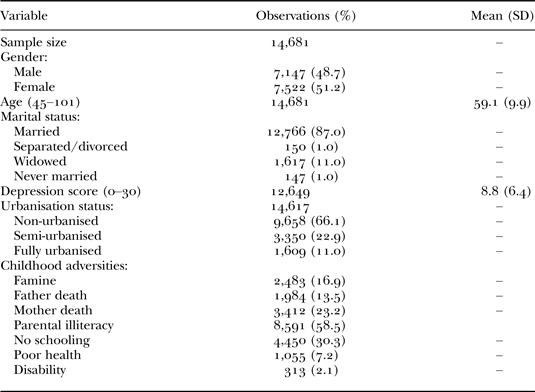
Table 1 presents the descriptive statistics of the respondents. Regarding the demographics statistics, it is reported that 51.2 per cent of respondents were females, the average age was 59.1 years old and the majority (87.0 per cent) were married with spouse alive. About two-thirds of the respondents were found to be non-urbanised. That is, they lived in rural areas and held rural Hukou. Of the remaining one-third, most were just living in urban regions while not holding the urban Hukou, with only about 11 per cent of the respondents being fully urbanised. In terms of the CAs, the respondents had quite a differentiated endorsement rate, with ‘parental illiteracy’ experienced by as many as 58.5 per cent of respondents and ‘disability’ experienced by only 2.1 per cent of them.
Descriptive statistics of the respondents

Note: SD: standard deviation.
Latent classes of CAs
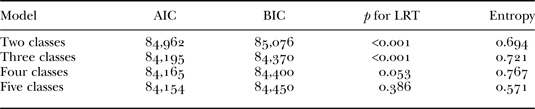
The latent class analysis demonstrated the clustered nature of CAs. The fit indices from the four latent class analyses are reported in Table 2. Based on the standards stated in the methods section, it is found that the three-class model has the best model fit: the AIC and BIC are lower than the two-class model, the LRT indicates that the four-class model is not significantly better than the three-class (and so the three-class solution should be preferred on the basis of parsimony) and the entropy value is acceptable.
Fit indices for the latent class analysis of childhood adversities

Notes: AIC: Akaike information criterion. BIC: Bayesian information criterion. LRT: likelihood ratio test.
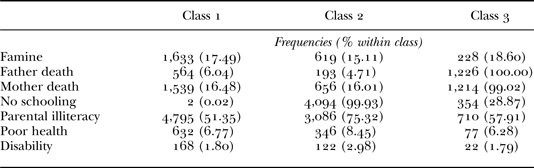
The latent class analysis outcome showed that the latent class 1 was the largest class, with 9,337 members and accounting for 63.6 per cent of the respondents. It was characterised by moderate to low probability of having the seven CAs compared with the other two classes. Moreover, 27.9 and 8.4 per cent of the respondents fell into classes 2 and 3, respectively. Although it is hard to distinguish which class, class 2 or class 3, had a better childhood, it was found that class 2 respondents had the highest probability of having ‘parental illiteracy’, ‘no schooling’, ‘poor health’ and ‘disability’, which are indicators for childhood socio-economic and health status; while class 3 were most likely to have ‘father death’, ‘mother death’ and ‘famine’, which are life disasters. Based on these findings, the three classes are labelled as ‘normal childhood class', ‘low childhood SES and health class' and ‘traumatic childhood class', respectively. The distribution of the seven CAs in the three latent classes can be seen in Table 3.
Distribution of the childhood adversities in the three latent classes

Notes: N = 9,337 for class 1. N = 4,097 for class 2. N = 1,226 for class 3.
Variances of CA classes in depressive symptoms
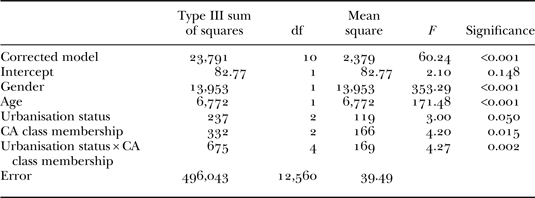
The latent class analysis generated CA class membership for each respondent, which became an independent variable in the factorial analysis of covariance. The CA class membership was found to be a significant predictor for the depressive symptoms of respondents, F(2, 12,561) = 4.20, p = 0.015; Bonferroni comparisons of the three classes indicated that the estimated marginal means for the depression score of the ‘traumatic childhood class' (mean = 8.09, 95% confidence interval (CI) = 7.60–8.57) was significantly lower than that of the ‘low childhood SES and health class' (mean = 8.95, 95% CI = 8.58–9.32) (p = 0.016), while it is not significantly lower than that of the ‘normal childhood class' (mean = 8.49, 95% CI = 8.32–8.65) (p = 0.076) at the 0.05 level; moreover, the difference in the estimated marginal means for the depression score between the ‘normal childhood class' and the ‘low childhood SES and health class' was found to be non-significant (p = 0.365).
Effects of covariates and urbanisation status
Hypothesising urbanisation as a moderator of the relationship between CAs and current depressive symptoms, this study put the variable of urbanisation status together with CA class membership into the factorial analysis of covariance as fixed factors, with gender and age as covariates. As with the covariates, both gender (B = 2.11; F = 353.29; p < 0.001) and age (B = 0.08; F = 171.48; p < 0.001) were found to be significantly associated with the depressive symptoms of the respondents; moreover, the B coefficients showed that the depression score was higher for females than for males and tended to increase with age. The urbanisation status was found to be a significant predictor for depressive symptoms (F = 3.00; p = 0.05), with higher urbanisation leading to a lower depression score; and the interaction between urbanisation status and the CAs had a significant effect on depressive symptoms (F = 4.27; p = 0.002), which demonstrated the significant moderating effect of the urbanisation status on the relationship between CAs and current depressive symptoms (Table 4).
Tests of between-subjects effects

Notes: N = 12,571. CA: childhood adversity. df: degrees of freedom. Unstandardised coefficient (B) for gender is 2.11 and for age is 0.08. R 2 = 0.046.
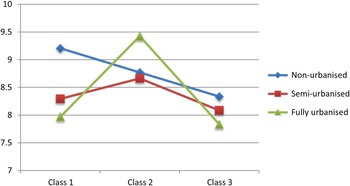
Based on the results of estimated marginal means for the depression score (see Figure 1), it is first found that within the non-urbanised group, class 1 (i.e. the normal childhood class) had the highest depression score, class 2 (i.e. low childhood SES and health class) ranked second, while class 3 (i.e. traumatic childhood class) had the lowest depression score. However, the semi-urbanised group and fully urbanised group had a different trajectory, in which class 2 had the highest depression score while class 1 ranked second. Moreover, although the semi-urbanised group and fully urbanised group shared a similar trajectory, they had quite a different fluctuation.
Estimated marginal means for the depression score.

Discussion
The main findings of this study point out that CA, measured in three clusters, is a significant predictor for the depressive symptoms of Chinese middle-aged and older adults. Moreover, the association is significantly moderated by the status change led by China's urbanisation. This study also reveals the importance of urbanisation status, gender and age on psychological wellbeing in middle and older age.
Echoing previous research, this study demonstrated that CAs could significantly affect depressive symptoms. A more detailed picture of the correlation was unveiled by applying the latent class analysis. First, though CAs may fall into different categories, they were clustered with each other. The latent class analysis outcome showed that: ‘famine’ from the category of disaster clustered with ‘father death’ and ‘mother death’ from the category of family relationship; and that ‘no schooling’ and ‘parental illiteracy’ from the category of SES clustered with ‘poor health’ in the category of health and ‘disability’ in the category of physical function. This latent structure formed the foundation of the labelling of the three classes. Among the literature on Chinese famines, especially the Great Chinese Famine of 1959–1961, a higher mortality of middle-aged adults was reported, which was interpreted as a result of giving away limited food to the older generation and their children according to traditional Chinese family values (Chen and Zhou 2007). This may explain the cluster of famine and early death of parents in this study. Moreover, the significant correlation between the SES and health and functional status has been well documented all over the world (Bradley and Corwyn Reference Bradley and Corwyn2002), which can explain their cluster here.
Based on the typology, it is further revealed that CA classes may differentiate in depression scores. It is worth noting that the people of the traumatic childhood class (i.e. class 3) reported the lowest depression score among the three CA classes. The estimated marginal mean of the depression score for class 3 remains significantly lower than that for the low childhood SES and health class (i.e. class 2), after controlling for gender and age. This can be explained from several perspectives. First, according to the selection effect hypothesis, people who have survived traumatic events, such as famine, are actually healthier and stronger and thus can cope with later-life stressors better (Gørgens, Meng and Vaithianathan Reference Gørgens, Meng and Vaithianathan2012). The health advantage of people who survived a traumatic childhood has also been evidenced by this study: class 3 respondents reported the lowest rate of poor health in childhood; they also reported the highest rate of ranking current health as good or better. Second, traumatic childhood life events like parent death and famine may not necessarily lead to limited resources and capabilities. Family supports could be a safety net. In China before the 1980s, joint family was an important family type, especially in the rural areas; and married siblings tended to live close by even if they formed separate family units (Zeng Reference Zeng1986). In this context, Chen (Reference Chen1985) evidenced that China's extended kinship system could be strengthened in dire living circumstances. That is, other family members might take on the role of parents when children are orphaned and resources from various family members might be pooled together for joint economic survival in famine time. Furthermore, class 3 reported a much higher schooling rate than that for class 2, and education may also be an effective preventive factor. More education is associated with better intelligence, problem-solving skills, occupations and social networks, which may offset or reverse the negative psychological effects of CAs in adult life (Fergusson and Horwood Reference Fergusson, Horwood and Suniya2003; Werner and Smith Reference Werner and Smith2001).
This study demonstrated the significant moderating effects of urbanisation on the correlation between Chinese middle-aged and older people's CAs and their current depressive symptoms. Other proof for the significant role of macro socio-economic environment in affecting and moderating individual's psychological wellbeing and lifecourse can be found from studies on the children of the Great Depression and the baby-boomer cohort (e.g. Elder Reference Elder1999; Wilson Reference Wilson2006). Though urbanisation generally decreased the level of depression for middle-aged and older adults, its moderating effects on the relationship between CAs and depressive symptoms deserve more detailed analysis and policy attention.
People of three different CA latent classes had varied trajectories in depression level based on their different urbanisation statuses. Regarding the non-urbanised group, those falling into the normal childhood class reported the highest level of depression. Status inconsistencies may explain the result: in terms of social stratification, these people might be in an advantaged position during childhood compared with people from the other two classes; however, their current social status was lower than people who had become semi-urbanised or fully urbanised. For a long time, the identity of urban resident has not only meant more economic resources and opportunities for Chinese people, but also encompassed a higher education and taste, and thus, a sense of cultural and psychological superiority (Wang Reference Wang2001). For this reason, it is necessary to further break the structure of the urban–rural segregation that was established under the former conservative communist regime and give equal development opportunities to the rural sector. Moreover, considering the still large potential for urbanisation in China, it is proposed that the restrictions for rural-to-urban migration shall be further loosened.
As with the semi-urbanised group and fully urbanised group, people who reported the highest level of depression were those from the low childhood SES and health class. This was especially so for the fully urbanised group. This could be a result of the inequalities within China's urban sector. For the rural-born Chinese, becoming an urban resident means participating in a fierce competition for resources and opportunities, where socio-economic statuses such as education, family background, health and functional status are all important qualities. Thus, due to the deep-rooted social stereotype attached to the rural identity and the institutional exclusion mechanism represented by the Hukou system, semi-urbanised and fully urbanised people with a low education and family background could face more obstacles when climbing the social ladder. Also, with priority given to economic efficiency and productivity in the urbanisation process, China is found to still have a long way to go regarding the social protection and inclusion of disadvantaged groups such as the disabled and the low-skilled (Leung Reference Leung2006).
Existing research findings leave little debate over the gender difference in older-age depression. That is, women are more at risk of depression than men (Luppa et al. Reference Luppa, Sikorski, Luck, Ehreke, Konnopka, Wiese, Weyerer, Konig and Riedel-Heller2012). The female preponderance has also been reported by our study. On the one hand, it may be due to artefactual factors, such as threshold for caseness, measurement procedures, course of illness and symptom reporting (Piccinelli and Wilkinson Reference Piccinelli and Wilkinson2000). For instance, women are more likely to report their bad feelings, while men are more likely to deny and instead act them out through suicide or alcoholism (Sonnenberg et al. Reference Sonnenberg, Beekman, Deeg and van Tilburg2000). On the other hand, some genuine determinants are found to be more likely to be involved. Social factors (e.g. socio-cultural roles and support) and psychological factors (e.g. coping skills and vulnerability to life events) are well recognised as playing a role. It is also reported that genetic or biological factors have few or no effect on the emergence of gender difference (Luppa et al. Reference Luppa, Sikorski, Luck, Ehreke, Konnopka, Wiese, Weyerer, Konig and Riedel-Heller2012).
At the same time, our study reported that depression score increased with rising age. Explanatory factors may include a higher proportion of women, higher incidence of physical disability and chronic diseases, lower cognitive function and lower SES (Blazer Reference Blazer2003). However, this finding is not indisputable. A review by Djernes (Reference Djernes2006) did not find a significant correlation between depression and age from the late-life depression literature included, even if adjustments were made for the above-mentioned explanatory factors. Also, though depressive symptoms were reported to be more frequent among the oldest old, no more frequency or even less frequency was found in general late life than in mid-life (Charles, Reynolds and Gatz Reference Charles, Reynolds and Gatz2001). These contentions necessitate further investigations on whether there is a real increase of depressive symptoms in the older population.
There are several limitations in this analysis that relate to data availability and data reporting style. First, this study was only able to focus on a small range of CA variables. Although the seven variables cover the aspects of childhood life trauma, health and function, and family SES, they can hardly give a full picture of the respondents' childhood adverse experience. It is also worth noting that there is an inevitable imposition of the variable of famine to individuals, considering it was coded based on province-level data. Second, it is noted that the use of the latent class analysis may obscure the effect of a particular CA on depressive symptoms, although it can reveal the clustering structure of the CAs. Third, our study was not able to illustrate the life adaptation and resilience process of the respondents sufficiently due to the lack of information on possible protective factors, such as personality traits, peer affiliation and problem-solving skills. Life adaptation and resilience may be an important reason for the differentiation of the depressive symptoms in later life, especially for the people who experienced a traumatic childhood but reported a lower depression score. Finally, as cross-sectional data-sets, the CHARLS only provides a retrospective recall of the past life events. This reporting style may add to the inaccuracy of the information.
Despite the above limitations, we contend that this study makes a contribution to extending the understanding of the relationship between childhood life experience and psychological wellbeing in later life. Controversies over the relationship in the existing literature may largely be a result of ignoring social environment transformation during the lifecourse. Applying the lifecourse perspective, this research examined the ageing of people as a process consisting of successive and interconnected life stages in order to link the childhood life with middle- and older-age life through social status transformation happening in between. By doing this, our study provides a useful method to streamline the correlation between childhood life experience and human development outcome in later life. Moreover, our study bases individuals in an ecological context when examining their lifecourse in order to outline how the dynamics between individual, family and society shape depressive symptoms. That is to say, we are not only concerned about individual characteristics, but also about family backgrounds (namely whether parents were alive and parental education) and societal backgrounds (namely famine and the urbanisation process). This approach may generate a more integrated picture regarding contributors to psychological wellbeing in later life.
This study may also have important implications for other countries. With the ongoing of trends of population ageing and urbanisation worldwide, especially in low- and middle-income countries, increasing attention has been paid to the intertwining of these two major demographic transitions (Beard and Petitot Reference Beard and Petitot2010). This has evolved into a public concern of how to shape a process of urbanisation that facilitates better human development outcomes in later life. Our study shows that although urbanisation generally contributes to better psychological wellbeing, it can worsen the psychological wellbeing of people with certain life backgrounds. In particular, it was revealed that the higher the extent of urbanisation, the higher the level of psychological disadvantage for people with a low childhood SES and poor health compared with their peers. To avoid cumulative disadvantage, social inclusive policies should be introduced within the urbanisation context, with special attention being paid to those who are disadvantaged in family and individual SES, health or physical function.
Acknowledgements
This research is part of the Seed Funding Programme for Basic Research at the University of Hong Kong. Both of the authors contributed to the paper. Thanks also go to Dr Hao Luo from the Sau Po Center on Ageing of the University of Hong Kong, for her kind comments on the statistical methods used. There is no conflict of interest in submitting this work for publication.