


Introduction
In this study celestial Marduk is understood as Marduk in relation to his celestial ancestors, the sky gods Anšar and Anu, his associations with ancient planets and fixed stars, and his creation and organization of the heavens and heavenly bodies. Rochberg (Reference Rochberg2007; Reference Rochberg and Porter2009: 58–62; Reference Rochberg, Haubold, Helle, Jiménez and Wisnom2024) published a paper on astral Marduk and, subsequently, a broader study of the relationship between celestial bodies and gods, as well as a recent overview of knowledge of the heavens in Enūma Eliš in relation to world order. The publication of Neo- and Late Babylonian tablets from northern Babylonia has added new evidence for celestial Marduk in Enūma Eliš and in works attesting to the poem’s reception (Fadhil and Jiménez Reference Fadhil and Jiménez2022; Frahm and Jiménez Reference Frahm and Jiménez2015; Heinrich Reference Heinrich2021; Jiménez Reference Jiménez2016a; Jiménez Reference Jiménez2016b; Reynolds Reference Reynolds2019). Late Babylonian scholarly and cultic contexts are also now better understood (Debourse Reference Debourse2022; Debourse and Jursa Reference Debourse and Jursa2025; Krul Reference Krul2018; Reynolds Reference Reynolds2019). This paper presents the first integrated study of celestial Marduk in the poem and a corpus of texts with pastiche or quotation.Footnote 1 Analysis of the poem demonstrates that Marduk’s portrayal as a celestial deity is more cohesive than previously appreciated. The works attesting to its reception are introduced and assessed thematically: Marduk’s celestial ancestry and his creation and organization of heaven; Marduk and the Sun without the Moon; Marduk and the paired Sun and Moon; and Marduk, planets and specific fixed stars. Aspects of celestial Marduk in the poem show a remarkable longevity and were combined with other material in a variety of perspectives.
1. Celestial Marduk: Enūma Eliš
Intertextual and syncretic, Enūma Eliš draws on earlier ideas about heaven and heavenly bodies, including heaven’s creation and organization, astral Marduk, Šulpae, the Bow, and the Arrow (Gabriel Reference Gabriel2025: 27–35, 58–60; Horowitz Reference Horowitz2014: 1–7, 20–24; Lambert Reference Lambert2013: 169-92; Reynolds Reference Reynolds2019: 299, 378 n. 659; Rochberg Reference Rochberg, Haubold, Helle, Jiménez and Wisnom2024: 237–50). The poem selectively portrays heaven and heavenly bodies to glorify Marduk’s supremacy. Marduk’s celestial ancestors Anšar and Anu are woven into the narrative before the list of Marduk’s fifty names. Four passages specifically concern his celestial nature: his name Māriutu and, through wordplay, the Sun (Enūma Eliš I 89–108); his destruction and recreation of an unspecified lumāšu-constellation (Enūma Eliš IV 19–28); his creation and organization of heaven, including unspecified lumāšu-constellations as the gods’ stations and calendrical markers, his star Nēberu, the Sun, and the Moon (Enūma Eliš IV 135 – V 46); and Anu’s astralization of his bow as the Bow constellation (Enūma Eliš VI 90–91).
The list of Marduk’s fifty names draws on the preceding narrative and adds rich theological exegesis to demonstrate Marduk’s supremacy and syncretic absorption of other gods (Enūma Eliš VI 121 – VII 144; Gabriel Reference Gabriel2014: 170–76; Van De Mieroop Reference Van De Mieroop, Haubold, Helle, Jiménez and Wisnom2024).Footnote 2 These name entries are most relevant: Marduk; Asalluḫi with Namru and Asaralimnuna; Tutu as Ziukkena; Aranuna; Lugal-Šuana; Nēberu; and Lord of the Lands. Using wordplay, these entries associate Marduk with Anu, Anšar, the Sun, Nēberu, light, and purity/luminosity, and they expound on his creation and regulation of heaven and the gods’ astral stations and motion. The only named heavenly bodies in the poem are Nēberu, the Sun, the Moon, and the Bow. Only the Moon is linked to Marduk solely in the creation episode. In this paper the quotations from the poem in composite transliteration and translations are based on Heinrich (Reference Heinrich2021) and Lambert (Reference Lambert2013: 45–134), with minor adjustments of my own. This analysis enables a fuller understanding of celestial Marduk in the poem.
1.1 Anšar and Anu
In Enūma Eliš Anšar and Anu are prominent celestial ancestors and promoters of Marduk, including as name-givers, but their own names are not ceded to him. Anu in particular has appropriate celestial associations, including the Sun, winds, upper heaven, Bow constellation, light, and, in one variant, the Moon.Footnote 3
In the poem’s introductory theogony, Anšar (an-šár), “All Heaven”, is paired with Kišar (d ki-šár), “All Earth”, the latter mentioned only once (Enūma Eliš I 12). Their son, Marduk’s grandfather, Anu (d a-num), “Heaven”, stands out as Marduk’s only unpaired ancestor (Enūma Eliš I 1–20).Footnote 4 It was Anu who elevated the young Marduk to the acme of divine power, calling him Māriutu with solar interpretation and arming him with the winds (Enūma Eliš I 89–108, IV 44, VI 123). The hermeneutics of the name Māriutu are discussed below. From Tablet II onwards Anšar recurs as the junior gods’ first king who yielded his kingship to Marduk (Enūma Eliš II–III passim, IV 83, 125, V 79). Anu and Anšar held these key roles independently of Marduk’s creation of heaven. However, in Marduk’s first phase of populating heaven, he installed Anu in the upper zone (Enūma Eliš IV 145–46, VI 41–42, see below section 1.4).
As specified name-givers, Anu and Anšar predominate in Tablets VI–VII. Anu celebrated and named Marduk’s bow, including astralizing it as the Bow constellation (Enūma Eliš VI 86–94, see below section 1.5). Anšar called Marduk Asalluḫi to express Marduk’s supremacy as a prelude to the list of fifty names, so this act of naming and the name Asalluḫi had a special status in the poem (Enūma Eliš VI 101). Anu gave Marduk two key names associated with light: his earliest and first name, Marduk, and his seventh name, Asalluḫi (Enūma Eliš VI 123, 127–28, 147–50).Footnote 5 Anšar, Laḫmu, and Laḫamu are each said to have awarded three of Marduk’s first nine names, implying that Anšar awarded the name Marduk, and Laḫamu awarded the name Asalluḫi, each with two sub-names (Enūma Eliš VI 157–60). Lambert (Reference Lambert2013: 480–81) attributed multiple name-givers to the poem’s composite nature but this could have been a strategy for enhancing a name’s prestige.
Marduk’s Sumerian name Lugal-Šuana (d lugal-˹šu˺-an-na, “King of Šuana”) is rendered as both “lord, strength of Anu” (be-lu 4; e-muq d a-nim) and “naming by Anšar” (ni-bu-ut an-šár) (Enūma Eliš VII 101–02). The sign “an” in Lugal-Šuana was interpreted as Sumerian an, “heaven”, the base element of the names of the celestial gods Anu and Anšar (George Reference George1992: 38–39, 239–45, I 4–7; Lambert Reference Lambert2013: 490).
1.2 Māriutu and the Sun
In the poem the first name awarded to Marduk is written with the traditional Sumerian logogram damar.utu (e.g. Enūma Eliš I 81–82, VI 123). This writing can be understood as damar.utu.ak, “Bull-calf of Utu (Sun)”, and corresponded to marūtuk (later marūduk), Marduk’s name in Akkadian (Lambert Reference Lambert2013: 161–163). Interpretation of d marūtuk(amar.utu) associates Marduk with the Sun and light very early in the poem and in the first entry in the list of fifty names. Perfected by Anu in his youth, Marduk was saluted with homophonic wordplay on his name:
101 ˹ma˺-ri-iu-ú-tu ma-ri-iu-ú-tu
102 ma-ri d šamšu(utu) šú d šamšu(utu) šú šá ilī(dingir)˹meš˺
Enūma Eliš I 101–02101 “Māriutu, Māriutu,
102 my son, the Sun, the Sun of the gods”Footnote 6
As an introduced variant in three Babylonian sources, the Sun’s name in the final title has the exegetical spelling d šà-máš.Footnote 7 The Sun does not recur in the poem until Marduk creates heavenly bodies (Enūma Eliš V 19). In the first entry in the name list, Anu is said to have awarded the name written damar.utu from the time of Marduk’s birth and more elaborate interpretation includes the same wordplay:
125 šá ina giš kakki(tukul)-šú a-bu-bi ik-mu-ú šá-pu-ti
126 ilī(dingir.dingir) abbī(ad)meš-šú i-ṭi-ru ina šap-šá-qí
127 lu-u ma-ru d šamši(utu) ši šá ilī(dingir.dingir) né-bu-ú šu-ma
128 ina nu-ri-šú nam-ri lit-tal-la-ku šú-nu ka-a-a-na
Enūma Eliš VI 125–28125 “who with his weapon the flood subdued the loud
126 (and) saved the gods, his fathers, in a time of suffering.
127 May he be the son, the Sun of the gods, the radiant one,
128 in his bright light may they constantly move with regularity”
Marduk saved the gods from the suffering of war by defeating Tiāmtu and VI 127–28 are best understood as referring to the gods’ astral motion regulated by Marduk’s star Nēberu after he had created heaven and the constellations as their astral stations.Footnote 8 The name entries on Asalluḫi, where he is described as “light of the gods” (nu-ru šá ilī(dingir.dingir)), Asaralimnuna, Tutu, and Nēberu contain related material (see below section 1.4). The description of Marduk as “Sun of the gods” (I 102, VI 127) and the role of Nēberu, probably signifying Jupiter, as Marduk’s star elsewhere in the poem suggest a correspondence between these two bright heavenly bodies: “Sun of the gods”, deriving from wordplay, may well be an epithet of Nēberu.Footnote 9 In any case, “Sun of the gods” and “radiant one” are appropriate epithets of Marduk as the gods’ saviour, who oversaw their astral motion bathed in his light.
1.3 First lumāšu-constellation
In the poem two episodes attest to the prestige of unspecified heavenly bodies termed lumāšū and these episodes frame Marduk’s battle with Tiāmtu and her army. In line with Fincke (Reference Fincke2023: 201–09), the term lumāšū in Enūma Eliš is understood as signifying constellations that represent gods and function as their homes. The ability to destroy and create (a-ba-tu 4; ù ba-nu-ú) was intrinsic to Marduk’s newly acquired supremacy and, to demonstrate his elevation, he destroyed and recreated one such constellation (lu-ma-šu) specially created by the gods for this purpose (Enūma Eliš IV 19–28; Gabriel Reference Gabriel2025: 43–51; Rochberg Reference Rochberg, Haubold, Helle, Jiménez and Wisnom2024: 241). Gabriel (Reference Gabriel2025: 43–51) highlights the significance of this lumāšu as the representation of a deity but the proposed identification as the planet Venus in an allusion to Ištar’s death and resurrection can only be speculative.Footnote 10 Marduk’s small-scale demonstration with one pre-created lumāšu-constellation affirmed his kingship. This prefigured his large-scale, original creation and population of heaven with lumāšu-constellations (˹lu˺-ma-ši) as the first type of heavenly body (Enūma Eliš V 1–36).
1.4 Creation and organization of heaven
Marduk’s creation of heaven and heavenly bodies in Enūma Eliš IV–V has been extensively studied (e.g. Horowitz Reference Horowitz2014: 1–8; Lambert Reference Lambert2013: 169–92; Rochberg Reference Rochberg, Haubold, Helle, Jiménez and Wisnom2024). This topic features in the narrative before the name list and in the name list itself.Footnote 11 The poem’s opening couplet specifies the primeval setting when heaven (šá-ma-mu) and solid ground (am-ma-tu 4;) were unnamed, signifying their non-existence (Enūma Eliš I 1–2). Choosing the non-existence of heaven as the subject of the opening line shows its crucial importance for the poem and this couplet works with Enūma Eliš VII 135–36 as a framing device (see below in this section).
Heaven does not recur after I 1 until Marduk creates it from half of Tiāmtu’s corpse, the poet using apt imagery about butterflying a fish to aid drying:
137 iḫ-pi-ši-ma ki-ma nu-un maš-ṭe-e a-na ši-ni-šu
138 mi-iš-lu-uš-ša iš-ku-nam-ma šá-ma-mi uṣ-ṣal-lil
Enūma Eliš IV 137–38137 He split her into two like a dried fish,
138 half of her he positioned and made into a roof as heaven.
Marduk contained this half of Tiāmtu’s watery corpse with her taut skin (maš-ka) (Enūma Eliš IV 139–40). The final couplet before the population of heaven reads:
141 šamê(an) e i-bi-ir aš-ra-tu 4 i-ḫi-ṭam-ma
142 uš-tam-ḫi-ir mé-eḫ-rat apsî(abzu) šu-bat d nu-dím-mud
Enūma Eliš IV 141–42141 He crossed heaven and inspected the firmament,
142 he made it match the Apsû, the dwelling of Nudimmud (Ea)Footnote 12
Marduk installed Anu in his unnamed shrine in upper heaven, Enlil in his shrine Ešarra in lower heaven, and Ea in his shrine Ešgalla, corresponding to Ešarra, in the Apsû (Enūma Eliš IV 143–46). These allocations are later linked with the building of Marduk’s temple Esagil in Babylon and the division of the gods between heaven and netherworld, which was also called the Apsû (Enūma Eliš V 119–30, VI 39–46, 61–69). Thus, Marduk assigned the traditional triad of great gods to their appropriate cosmic domains, using the Apsû as a pattern, and split the other gods between heaven and netherworld (Lambert Reference Lambert2013: 193–99; Rochberg Reference Rochberg, Haubold, Helle, Jiménez and Wisnom2024: 248–49). Elsewhere in the poem, heaven created by Marduk as the gods’ residence has a prominent role but the netherworld as their other residence occurs only briefly in the stock pair heaven and netherworld.Footnote 13
Tablet V opens with Marduk’s astral population and regulation of heaven:
1 ú-ba-áš-šim ma-an-za-za an ilī(dingir.dingir) rabûti(gal)meš
2 kakkabī(mul)meš tam-šil-šu-˹nu lu˺-ma-ši uš-zi-iz
3 ú-ad-di šatta(mu.an.na) ˹mi˺-iṣ-ra-ta ú-aṣ-ṣir
4 12 arḫī(iti)meš kakkabī(mul)meš ˹šulušā(3.ta.àm)˺ uš-zi-iz
5 iš-tu u4;-mi ša šatti(mu.an.na) uṣ-ṣ[i-r]u ú-ṣu-ra-ti
6 ú-šar-šid man-za-az d né-bé-ri ana ud-du-u rik-si-šú-un
7 a-na la e-peš an-ni la e-gu-ú ma-na-ma
8 man-za-az d +en-líl u d é-a ú-kin it-ti-šú
Enūma Eliš V 1–81 He fashioned the stations for the great gods,
2 he set up the lumāšu-constellations, the stars, corresponding to them (the gods).Footnote 14
3 He defined the year, he drew the boundaries,
4 he set up three stars each for the twelve months.
5 After he had drawn the plans of the year,
6 he founded the station of Nēberu to define their linkages.
7 So that nobody did wrong or acted negligently,
8 he established the stations of Enlil and Ea with it.
The tablet’s opening line makes the fundamental but under-appreciated point that Marduk created stations (manzāzū) for the astralized gods in the aftermath of the war with Tiāmtu. In this celestial sense, the term manzāzu, “station, standing place”, signifies the correct position in the sky occupied by a heavenly body as the dwelling of an astral deity. Fixed stars, including the lumāšu-constellations, were perceived by the ancient observer as maintaining their relative positions (“stations”) in a pattern that moved overall in the course of each year. The positions (“stations”) of ancient planets were perceived as moving more freely in relation to this pattern. The lumāšu-constellations were the first type of heavenly body created by Marduk and their heliacal risings marked the ideal calendar through the so-called astrolabe system that allocated three stars to each of the twelve months.Footnote 15 As part of this system, Marduk founded the station (manzāzu) of his star Nēberu, “Crossing”, to define the correct positions of these constellations and also established Enlil and Ea’s stations to prevent any deviation. This alludes to the three heavenly paths along which the stars were believed to move: Enlil’s in the north; Anu’s, including Nēberu, in the centre; and Ea’s in the south (Horowitz Reference Horowitz2014: 1, 6–7, 11–15, 196). As most recently argued by Rochberg (Reference Rochberg, Haubold, Helle, Jiménez and Wisnom2024: 239–40), Marduk’s star Nēberu in Enūma Eliš is probably Jupiter, later Marduk’s principal planet in the first millennium B.C.E.Footnote 16 Nēberu in the list of Marduk’s names (Enūma Eliš VII 124–34) is discussed below. Marduk enabled and controlled the heavenly bodies’ motion by opening lockable gates (abullātu(abul)meš) in both sides of Tiāmtu’s ribcage (ṣe-li [k]i-lal-la-an) and positioning heights (e-la-a-ti) in her innards (ka-bat-ti-šá-ma) (Enūma Eliš V 9–11; Hätinen Reference Hätinen2021: 83–84).
Marduk created the Moon (d nanna-ru, “Luminary”) and instructed him in his monthly cycle.Footnote 17 After rising glowing in the heights (na-pa-ḫi e-˹la-a˺-ti) at the start of the month, a waxing crescent radiant with horns (qar-ni na-ba-a-ta) was to become a half-crown (a-ga-a [maš]-la) on day seven before opposition with Šamaš on day fifteen and corresponding waning (Enūma Eliš V 12–20).Footnote 18 Conjunction at the month’s end was particularly important:
21 [bu-ub-bu-l]u 4; (var. u4;.n[á.àm]) a-na ḫar-ra-an d šamaš(utu) šu-taq-rib-ma
22 ˹i˺-[na u4; 3]0.˹kám˺ lu šu-tam-ḫu-rat d šamaš(utu) lu šá-na-˹at˺
23 ˹ú˺-[x x x (x)] x itta(giskim) ba-ʾi-i ú-ru-uḫ-˹šá˺
24 ṣa-x [x x x x š]u-˹taq-ri-ba˺-ma di-na di-n[a]
Enūma Eliš V 21–2421 “On the day [of (lunar) disappearance] draw near to the path of Šamaš,
22 on [day] thirty may you be matched (in conjunction), may you rival Šamaš.
23 I [ … ] … the sign, go along its way,
24 … [ … ] draw near to each other and decide judgement.”
The invisible Moon and the Sun jointly issued judgements and V 23 may describe conjunction as an ominous sign (ittu) created by Marduk.Footnote 19 Fragmentary lines relate Šamaš to human wrongdoing, conjunction, day and night, and New Year (zag-˹muk˺-ku) (Enūma Eliš V 25–46).
In the list of Marduk’s names in Enūma Eliš VI–VII, the following entries contain closely related material about his celestial aspects and could encapsulate the preceding narrative.Footnote 20 Through Marduk’s seventh name Asalluḫi and its sub-names Namtila and Namru, Marduk was linked with light, the gods’ salvation, and purity/luminosity (Enūma Eliš VI 147–56).Footnote 21 The main entry reads:
147 d asar-lú-ḫi šùm-šú šá im-bu-ú a-bu-šú d a-num
148 šu-ú lu-ú nu-ru šá ilī(dingir.dingir) geš-ṭu-ú dan-nu
149 šá ki-ma šu-mi-šu-ma la-mas-si ili(dingir) u ma-a-ti
150 ina šá-áš-mì dan-ni i-ṭe-ru šu-bat-ni ina pu-uš-qí
Enūma Eliš VI 147–50147 “Asalluḫi, his name that his father Anu called,
148 may he be the light of the gods, outstanding one, mighty one,
149 who, in accord with his name, is the protective spirit of god and land,
150 and who through mighty combat saved our dwellings from distress.”
The name is rendered as “light of the gods”, understanding the element “asal/asar” as “light” (see below in this section). With increasing specification, the entry links Marduk’s light with his rescue of the gods’ dwellings through his victory over Tiāmtu. This alludes to the gods’ new astral homes, created by Marduk and controlled by his star Nēberu (see above and below in this section).
Marduk’s related tenth name Asare prominently opens Tablet VII and in the entry on its second sub-name Asaralimnuna, a by-name of Asalluḫi that probably means “Asar, Bison of the Prince”, Marduk is linked with light and regulation:
5 d asar-alim-nun-na ka-ru-bu nu-úr a-bi a-li-di-˹šu˺
6 muš-te-šir te-ret d a-nim d +en-líl u d é-a d nin-ši-kù
Enūma Eliš VII 5–65 “Asaralimnuna, honoured one, light of the father, his begetter,
6 who keeps in order the decrees of Anu, Enlil, and Ea, (called) Ninšiku.”
In the interpretation in VII 5 “asal/asar” corresponds to “light” and “nun” to Ea as Asalluḫi–Marduk’s father (Fadhil and Jiménez Reference Fadhil and Jiménez2022: 25). Keeping the decrees in order probably refers to Nēberu’s regulation of the astral deities’ motion in the sky on the paths of Anu, Enlil, and Ea (Rochberg Reference Rochberg, Haubold, Helle, Jiménez and Wisnom2024: 242). In Ea’s title Ninšiku the sign kù alludes to purity/luminosity.
The fourteenth name entry concerns Tutu’s sub-name Ziukkena, “Life of the Host”:
15 d tu-tu d zi-ukken-na na-piš-ti um-ma-ni ša-niš iz-zak-ru
16 šá ú-kin-nu ana ilī(dingir.dingir) šamê(an) e el-lu-ti
17 al-kát-su-un iṣ-ba-tu-ma ú-ad-du-ú man-za-as-su-un
18 a-a im-ma-ši i-na a-pa-a-ti ep-še-ta-šu li-ik-til-la
Enūma Eliš VII 15–1815 Tutu as Ziukkena, life of the host, they secondly pronounced,
16 who established pure heaven for the gods;
17 who governed their motion and defined their stations,
18 may his deed not be not forgotten by teeming mortals, may it be kept in mind.
Building on this sub-name’s meaning, Marduk’s saving of the gods’ lives is linked to his creation of pure/luminous heaven for them and his organization of their astral motion and stations.
The thirty-ninth name entry on Aranuna, “Advisor of the Prince”, reads:
97 d a-rá-nun-na ma-lik d é-a ba-an ilī(dingir)meš abbī(ad)meš -šú
98 šá a-na a-lak-ti ru-bu-ti-šú la ú-maš-šá-lu ilu(dingir) a-a-um-ma
Enūma Eliš VII 97–9897 Aranuna, advisor of Ea, creator of the gods, his fathers,
98 whom no other god equals for the motion of his nobility.
In my view VII 98 alludes to Marduk’s motion (alaktu) as his star Nēberu that regulated the positions of the other astral gods.Footnote 22
The list culminates with Marduk’s names Nēberu, “Crossing”, the longest entry in Tablet VII, and Lord of the Lands:
124 d né-bé-ru né-bé-re-et šamê(an) e u erṣeti(ki) tì lu-ú ta-mi-iḫ-ma
125 e-liš ù šap-liš la ib-bé-ru li-qé-ʾu-šú ša-a-šu
126 d né-bé-ru kakkab(mul)-šú šá ina šamê(an) e ú-šá-pu-u
127 lu-ú ṣa-bit kun-sag-ge-šu-nu šá-a-šú lu-ú pal-su-šú
128 ma-a šá qer-biš ti-amti i-te-eb-bi-ru la na-ḫi-iš
129 šum-šu lu-ú d né-bé-ru a-ḫi-zu qer-bi-šu
130 šá kakkabī(mul)meš šá-ma-mì al-kàt-su-nu li-kin-ma
131 ki-ma ṣe-e-ni li-ir-ta-a ilī(dingir.dingir) gim-ra-šu-un
132 li-ik-mi ti-amta na-piš-ta-šu li-si-iq u lik-ri
133 aḫ-ra-taš nišī(ùg)meš la-ba-ri-iš u 4;-mì
134 li-is-se-ma la uk-ta-li [l]i-re-eq ana ṣa-a-ti
135 áš-šum aš-ru ib-na-a ip-ti-qu dan-ni-na
136 d bēl(en) mātāti(kur.kur) šum-šu it-ta-bi a-bu d+ en-líl
Enūma Eliš VII 124–36124 “May Nēberu control the crossing place(s) of heaven and netherworld,
125 above and below they must not cross, may they wait for him.
126 May Nēberu, his star, which he made visible in heaven,
127 govern their turning point, may they look to him,
128 saying: ‘He who constantly crossed inside Tiāmtu without resting
129 may his name be Nēberu, the one who seizes her insides’.
130 May he establish the motion of the stars of heaven,
131 like flocks may he constantly shepherd all the gods.
132 May he subdue Tiāmtu, may her life become limited and short.
133 For posterity, for the duration of days,
134 may he become far away, he may not be held back; may he become distant for the
remote future.Footnote 23
135 Because he created the firmament and fashioned the underworld,
136 father Enlil called his name Lord of the Lands.”
The position and length of the Nēberu entry indicate this name’s prestige. In an eternal cycle, Nēberu not only looks after the gods by controlling the motion of their stars but also enacts Marduk’s conquest of Tiāmtu in the night sky. The astral content has attracted particular attention (Horowitz Reference Horowitz2014: 6–7, 22–23; Rochberg Reference Rochberg, Haubold, Helle, Jiménez and Wisnom2024: 244–45). Nēberu, from the root ’ b r, is translated by the more general term “Crossing” but meanings of the common noun nēberu also include “ferry, ford” in relation to crossing a body of water (e.g. CAD N/2: 145–47). Building on this root, Nēberu holds the “crossing place(s) of heaven and netherworld” (nēberet šamê u erṣeti) and the astral gods “must not cross” (lā ibberū) above and below but should wait for him. Nēberu should control their turning point (kunsaggêšunu) and they should call him Nēberu because “he constantly crossed” (ītebbiru) inside Tiāmtu.Footnote 24 Although the significance of the terms nēberet and kunsaggêšunu in relation to the sky is unclear, Nēberu should govern the stars’ motion (alkassunu), herding all the gods like sheep (Rochberg Reference Rochberg, Haubold, Helle, Jiménez and Wisnom2024: 244–45). By herding the fixed stars as the astral gods’ dwellings, Marduk ensures that they are always in the correct positions in the sky. The image of a shepherd and his flocks conveys Marduk’s control of and care for the gods. He gives them eternal security and stability in stark contrast to the preceding turmoil of his war with Tiāmtu when the gods were split into the two opposing factions (e.g. Enūma Eliš I 127–32, II 11–18, III 15–22, 73–80, VII 25–32). Marduk had fashioned heaven from half of Tiāmtu’s corpse, using her skin, ribcage, and innards (Enūma Eliš IV 137–40, V 9–11, see above in this section). As well as continually crossing inside Tiāmtu, Nēberu should seize Tiāmtu’s insides and subdue her.Footnote 25 By its eternal motion in and regulation of heaven, Nēberu not only gave the displaced gods security in a post-war world but also viscerally reenacted Marduk’s victory over Tiāmtu.
Marduk’s creation of firmament (ašru) and underworld (dannina) introduce his fiftieth name, Enlil’s title Lord of the Lands (Enūma Eliš VII 135–36; Rochberg Reference Rochberg, Haubold, Helle, Jiménez and Wisnom2024: 241).Footnote 26 This narrative culmination constitutes ring composition with Enūma Eliš I 1–2, when heaven and solid ground were unnamed and did not exist.
Thus, in the narrative before the name list, Marduk’s creation of heaven from Tiāmtu’s corpse has a high degree of materiality. His astral population of heaven begins with the gods’ stations but focuses on heavenly bodies as calendrical markers, especially the Moon and Sun.Footnote 27 Marduk, astralized as Nēberu, controls heaven and the motion of the other heavenly bodies. In the name list, Marduk is a god of light and purity/luminosity, and the gods’ saviour who created their astral stations as havens and controlled their motion (atalluku Gtn; alaktu) for eternity. Heaven’s initial non-existence and Tiāmtu’s disruptive agency endangering the gods form a counterpoint to Marduk’s butchery of her passive corpse to create heaven and the gods’ astral stations. Pure/luminous heaven created by Marduk from Tiāmtu’s corpse, regulated by Nēberu, and populated with stars, including his astralized bow, represented Marduk’s victory and gave the gods permanent security. Marduk as a deity of light saved the gods from their wartime suffering, with Tiāmtu as his principal antagonist.Footnote 28 At nighttime the bright stars, overseen by Nēberu, would have contrasted with the dark sky formed from Tiāmtu’s body. The poem does not specify a light–dark antithesis but, by implication, Tiāmtu can be seen as a deity of darkness.
1.5 Astralized bow
Marduk’s bow launched the arrow fatal to Tiāmtu (Enūma Eliš IV 101–02). Prefiguring the list of Marduk’s fifty names, Anu glorified the bow as “my daughter” and awarded it three names, culminating in its astralization:Footnote 29
90 šal-šú šum-šá mul qaštu(pan) ina šamê(an) e ú-šá-pi
91 ú-kin-ma gi-is-gal-la-šá it-ti ilī(dingir)meš at-ḫe-e-šá
Enūma Eliš VI 90–9190 He made its third name, Bow constellation, appear in heaven,
91 he established its position with the gods, its brothers.
In the poem gisgallu as an astral position occurs only once but manzāzu, “station”, is intermittent (Enūma Eliš V 1, 6, 8, VI 79, 145, VII 17). The Bow’s brothers are the gods whom Marduk had rehomed in heaven by creating stations for them (see above section 1.4). In Enūma Eliš the Bow constellation is the only fixed-star name and Anu’s only astral creation (see above section 1.1). Thus, Anu’s astralization of Marduk’s pre-existing weapon is distinct from Marduk’s earlier creation and organization of heaven. However, both episodes project Marduk’s slaughter of Tiāmtu onto the night sky (Gabriel Reference Gabriel2014: 303–06). In the context of Ištar’s disempowerment, Gabriel (Reference Gabriel2025: 27–35) convincingly argues that the bow created and used by Marduk represents Ištar of Elam and that Anu adopted this bow before he astralized it to serve as an omen of Marduk’s martial supremacy. The repurposing of Ištar theology to glorify Marduk would, therefore, be fundamental to this passage.
2. Celestial Marduk: Reception in other works
During the first millennium B.C.E. the emphasis shifted from heaven and heavenly bodies as the gods’ stable, post-victory world, created and controlled by Marduk, within the overarching narrative of Enūma Eliš. However, the poem’s astral motifs retained their potency and scholars gave them new relevance. The poem links Marduk with the Sun, Nēberu (probably Jupiter), the Bow, and light, and these associations were elaborated throughout the poem’s cuneiform reception. By the Late Babylonian period, less attention was paid to Marduk’s celestial ancestry, his links with purity (which could entail luminosity), and his creation and regulation of heaven and unspecified lumāšu-constellations for unspecified gods. Instead, specific astralizations of specific deities gained new importance. In relation to Late Babylonian Esagil ritual, planetary and fixed-star astralizations were syncretically extended and schematized for Marduk and his female counterparts. The monthly lunar cycle and particularly the annual fixed-star and solar cycles remained key elements throughout the poem’s reception. Both the ideal solstice and equinox system and the scheme of (ašar) niṣirtu, “(place of) secrecy/protection”, achieved new prominence in the Late Babylonian period when Marduk and Tiāmtu antithetically represented light and darkness in elaborate schematizations.Footnote 30 The Moon, Sun, propitious Jupiter, and the Bow were all ominous, and complex Late Babylonian interpretations incorporated unpropitious Mars and other ominous fixed stars. The integration of celestial Marduk into omen and ritual contexts indicates a focus on human–divine communication. In the earlier first millennium B.C.E. scholars quoted the poem in contexts where its narrative could be less relevant and it was used to promote other gods. However, Late Babylonian scholars with an Esagil perspective foregrounded Marduk’s victory over Tiāmtu as a myth of Babylon’s invincibility, and combined it with innovative ritual and astrological interpretation. These later interpretations can be understood as self-justification for Esagil’s cult in a period of reduced importance under imperial rulers.Footnote 31
2.1 Source overview
This analysis examines compositions relevant to celestial Marduk that are hymnic pastiches of Enūma Eliš or contain literal quotations from the poem, including recitation references.Footnote 32 The sources range from Neo-Assyrian tablets from Nineveh and Aššur to Neo- and Late Babylonian tablets from northern Babylonia that can usually be attributed to Sippar and Babylon.Footnote 33 Pastiche and quotation added authority to hymns, prayers, and exegesis. Scholars incorporated elements of the poem’s portrayal of celestial (and non-celestial) Marduk into different celestial contexts, expressing their own contexts and priorities.
As part of a Marduk-focused syllabus that helped form trainee scholars in northern Babylonia, Neo- or Late Babylonian school tablets include dictated Enūma Eliš extracts and the Moon and its conjunction with the Sun were popular topics.Footnote 34 An Enūma Eliš VII commentary on tablets from Nineveh was perhaps composed in Babylon (Lambert Reference Lambert2013: 139–42). A commentary on Enūma Eliš I–VII occurs on tablets from Nineveh and Aššur, as well as Sippar Collection tablets from northern Babylonia, and may have been composed by a Nippur scholar in Assyria (Frahm and Jiménez Reference Frahm and Jiménez2015: 293–333). Only particularly relevant material in these commentaries is discussed here.
Assurbanipal’s acrostic hymn to Marduk and Zarpānītu can be considered a pastiche of the poem (Livingstone Reference Livingstone1989: no. 2; see above in this section with n. 32). Three Assyrian exegetic works quote, or allegedly quote, the poem: Marduk’s Ordeal, an anti-Marduk polemic that reinterprets Babylon’s New Year festival and is linked with Sennacherib (Livingstone Reference Livingstone1989: no. 34, 35); a compendium with cosmogonic and ritual material, some of which is Assyrianizing (Livingstone Reference Livingstone1989: no. 39, copied by Kiṣir-Aššur under Assurbanipal); and a compendium focused on calendars and Nabû (Rawlinson and Pinches Reference Rawlinson and Pinches1909: no. 43, with an ‘Assurbanipal Library’ colophon). These four Assyrian works occur solely on tablets from Nineveh and Aššur, so their Assyrian-oriented content may have been of interest only in the Assyrian heartland.
Three compositions are attested on tablets both from the Assyrian heartland and from later Babylonia. Eriš šummi, a Babylonian hymn to Marduk, occurs on Aššur, Nineveh, Sippar Library, and Babylon Collection tablets (Fadhil and Jiménez Reference Fadhil and Jiménez2022).Footnote 35 Two treatises quote Enūma Eliš. One on Elamite month names is likely to be an Assyrian composition and is found on a Babylonian tablet from Nineveh copied from an Assyrian source and on a Babylon Collection tablet probably copied in Achaemenid Borsippa, although the colophon has a note referring to Babylon (Frahm and Jiménez Reference Frahm and Jiménez2015: 334–43).Footnote 36 The other treatise, called I.NAM.GIŠ.ḪUR.AN.KI.A, was probably composed in Babylonia and occurs on three Nineveh tablets written by Nabû-zuqup-kēna, one dated to Sennacherib’s twenty-second year (683 B.C.E.), and on a Babylon Collection tablet written by Bēl-nādin-apli, linked with an Esagil butcher’s prebend, in the thirty-third year of Darius I (488 B.C.E.) (Livingstone Reference Livingstone1986: 17–52).Footnote 37 These three works do not have a comparable Assyrian focus and remained of interest to later scholars in northern Babylonia.
A commentary on Tablet IV of the diagnostic series Sagig quotes Enūma Eliš and is attested on a Sippar Collection tablet, which dates from the Neo- or Late Babylonian period and may come from Babylon.Footnote 38 Two other exegetic works quoting the poem occur on Babylon Collection tablets that are probably Achaemenid from library holdings associated with Esagil. A copy of a compilation commentary (cento) was written in Babylon by a member of the Atkuppu family; and two duplicate tablets with interpretation of Simānu ritual were probably written by Iprāʾya of the Ēṭiru family, one copy specifying oral transmission (Jiménez Reference Jiménez2015; Reference Jiménez2016b).Footnote 39 Late Babylonian compositions that can be identified as Hellenistic works harking back to Babylonian past sovereignty and Esagil’s centrality are attested on Hellenistic or Parthian tablets attributable to library collections associated with Esagil. Texts describing Babylon’s New Year festival include prayers astralizing Marduk and Zarpānītu in association with the recitation of Enūma Eliš (Debourse Reference Debourse2022: 116–21, 124–31, 138–40, 144–49 (lines 222–333)).Footnote 40 A Babylon calendar treatise attested on three Babylon Collection tablets interprets Esagil rituals as apotropaic against Babylon’s invasion and includes astral exegesis linked to the poem’s battle narrative (Reynolds Reference Reynolds2019: 50–54, 190–195, 206–11 (§§ 2–4, 13)).Footnote 41
2.2 Celestial ancestry and heaven
The Marduk Ordeal associated Anšar with Aššur and subverted Marduk’s role as the creator and organizer of heaven. Eriš šummi syncretized the triad Anšar (Anu) – Dagan (Enlil) – Ninšiku (Ea) with Marduk.Footnote 42 The Anu–Enlil–Ea triad was also identified with Marduk in the cento and, with astralization, in a New Year festival prayer. With varying degrees of closeness to the poem, Marduk as heaven’s creator and organizer featured in other Assyrian works and was astralized in the New Year festival prayers. Compositions on Neo-Assyrian tablets linked unspecified lumāšu-constellations with unspecified gods but did not portray them as the gods’ havens after Marduk and Tiāmtu’s war.
The Assyrian-dialect Marduk’s Ordeal can be associated with Sennacherib’s religious reset and links singing Enūma Eliš before Marduk’s statue to his imprisonment in an Assyrianizing reinterpretation of Babylon’s New Year festival.Footnote 43 Marduk’s denigration in favour of the god Aššur includes an alleged, marked quotation from Enūma Eliš:
54 šu-ú ina libbi(šà) e-nu-ma e-liš iq-˹ṭi-bi˺ ki-i šamê(an)e erṣeti(ki)tì la ib-ba-nu-ni an-šár
it-[tab-ši]
55 ki-i ālu(uru) u bētu(é) ib-šu-u-ni šu-ú it-tab-ši …
Livingstone Reference Livingstone1989: no. 34 (Aššur version), 54–55Footnote 4454 It said in Enūma Eliš – When heaven and netherworld were not created, Anšar [came
into existence].
55 When city and house existed, he (Marduk) came into existence. …
This rescheduling of Marduk’s birth subverts Enūma Eliš. It ousts Marduk from his prestigious roles as saviour of his royal predecessor Anšar, conqueror of primeval Tiāmtu (directly relevant in this ritual context), and creator of heaven and netherworld (Reynolds Reference Reynolds, Haubold, Helle, Jiménez and Wisnom2024: 143–44).
In the Assyrian compendium with cosmogonic material, a ruled-off section on Marduk’s creation of a tri-partite heaven and a tri-partite netherworld begins:
30 šamû(an) ú elûti(an.ta) ti na4 l[u]-lu-da-ni-tú ša d a-nim 300 d í-gì-gì ina lìb-bi ú-š[e-šib]
31 šamû(an) ú qablûti(murub4) ti na4 sag-gil-mud ša d í-gì-gì be-lu 4 ina libbi(šà)
paramaḫḫi(bára.maḫ) ina libbi(šà) x
32 i-na parak(bára) na4 uqnî(za.gìn) ú-šib giš bu-ṣi<-in> na4 el-me-ši ina libbi(šà) ú-nam-mir
33 šamû(an) ú šaplûti(ki.ta)meš na4 aš-pu-u ša kakkabī(mul) lu-ma-ši ša ilī(dingir)meš ina
muḫḫi(ugu) e-ṣir
Livingstone Reference Livingstone1989: no. 39, 30–3330 Upper heaven of banded agate of Anu – he (Marduk) made 300 Igigī dwell in it.
31 Middle heaven of amethyst of the Igigī – the Lord … on a pre-eminent dais in it;
32 he sat down on a dais of lapis lazuli; he lit up a lamp of amber in it.
33 Lower heaven of chalcedony of the stars – he drew the gods’ lumāšu-constellations on it.
In the Marduk interpretation of the three stone heavens, he placed the Igigī highest and had his own heaven.Footnote 45 Marduk enthroned in splendour with a bright lamp, presumably the source of astral light, is distinctive to this text. Contrastingly, in Enūma Eliš IV–V Marduk created heaven from Tiāmtu’s corpse, installed Anu above Enlil, and created heavenly bodies, including lumāšu-constellations as the gods’ stations controlled by his star Nēberu. In both works Marduk populates heaven, including lumāšu-constellations for the gods, and is associated with light. The compendium continues with Marduk’s defeat of Tiāmtu as the source of material for world creation and quotes Enūma Eliš IV 137 (Livingstone Reference Livingstone1989: no. 39, r. 2: iḫ-pi-ši-ma kīma(gin7) nūnī(ku6)meš maš-ṭe-e a-na šini(2)-˹šú˺; see above section 1.4). Thus, it combines traditions that diverge from and accord with the poem. Assurbanipal’s acrostic hymn includes a damaged entry on Marduk as Engišgalana (den-gišgal-an-na, “Lord of the Positions of Heaven”) that mentions “stations of the gods” (43: man-za-zi ilī(dingir)me[š]),Footnote 46 followed by ritual content (Livingstone Reference Livingstone1989: no. 2, 43–44). In a later entry Marduk (damar.utu) created and regulated the lumāšu-constellations:
9 ina ṣītān(giš.nim) u šīlān(giš.šú) lú-maš-ši uš-ziz-ma ḫar-ra-nu ma-la-[ku] iš-ruk-šú-nu-ma
ú-[x x x x x x]
Livingstone Reference Livingstone1989: no. 2, rev. 99 In east and west he set up lumāšu-constellations and bestowed paths, courses, upon them
… [ … ]
The ideas and phraseology accord with Enūma Eliš V 1–8, including V 2: ˹lu˺-ma-ši uš-zi-iz (see above section 1.4).
The hymn Eriš šummi syncretically awards the names and identities of other gods to Marduk. Anšar (Anu), Dagan (Enlil), and Ninšiku (Ea) form an initial triad and Marduk as Anšar (an-šár) is linked with celestial supremacy (Fadhil and Jiménez Reference Fadhil and Jiménez2022: 2, 5–6, 18–21). The cento on an Achaemenid tablet interprets Marduk’s name Asaralimnuna and includes supporting quotation of Enūma Eliš VII 5 (see above section 1.4):
2 [d asar-al]im-nun-na : nu-úr šá d anu(60) d enlil(50) u d˹ea(40) : asar˺ : ˹d˺[a-num : alim : d en-líl :
nun : d é-a … ]
3 [d asar]-˹alim˺-nun-na ka-ru-ba nu-úr a-bi a-li-di-šú [ … ]
Jiménez Reference Jiménez2015: 2–3Footnote 472 [Asaral]imnuna : light of Anu, Enlil, and Ea : asar = [Anu; alim = Enlil; nun = Ea … ]
3 “[Asar]alimnuna, honoured one, light of the father, his begetter” [ … ]
Enūma Eliš VII 6 (see above section 1.4) links Asaralimnuna with this triad and probably their astral paths. In the New Year festival prayers, Marduk created heaven from Tiāmtu’s corpse, and this astralized triad was syncretized with him (see below section 2.5.2 with Table 2).
2.3 Sun without Moon
As in Enūma Eliš, Marduk was linked with the paired Sun and Moon or the Sun alone, but never with the Moon alone. Neo-Assyrian works associating Marduk with the Sun accord closely with the poem, albeit once probably to promote Nabû. Marduk’s non-astral name Šazu was reinterpreted as Šamaš. This instance of increased astralization is attested in the earlier first millennium B.C.E. and was elaborated in Achaemenid ritual exegesis. The cento on an Achaemenid tablet includes Marduk’s representation in the Sun.
A Neo-Assyrian compendium aligns month names in six calendars with Standard Babylonian month names, possibly in relation to ritual practice, and interprets names of Nabû before a final ruled-off section:
54 [damar].utu | ma-ri ma-ri-ú-tu!(LA)
55 [ma-ri ša]m-šu | ma-ri šam-šú šá ilī(dingir)meš
56 [d ma-r]u-duk | ma-ri šam-šú šá ilī(dingir)meš
Rawlinson and Pinches Reference Rawlinson and Pinches1909: no. 43, rev. 54–56; Lambert Reference Lambert2013: 164Footnote 48These lines incorporate quotation of Enūma Eliš I 101–2 and are related to VI 127 (see above section 1.2). In the compendium the wordplay on Marduk’s name has been reconfigured to suit the list format. In my opinion this final celebration of Marduk probably added lustre to his son Nabû, and the Sun’s calendrical role may have been relevant.Footnote 49
Assurbanipal’s acrostic hymn links Marduk with the Sun, light, and cleansing:Footnote 50
34 [ul]-lu-ú gat-tu 4 d marūduk(amar.utu) d šamšu(utu) šú né-bu-u di-pa-ru nam-ru šá ina šu-pi-šú ˹ú˺-[x x x x x x]
35 [šá] ub-ba-bu ar-šu-ti ú-šaḫ-lu-u x [x x x x x x]
Livingstone Reference Livingstone1989: no. 2, 34–3534 Exalted in stature, Marduk, radiant Sun, bright torch, who on his appearance … [ … ],
35 [who] cleanses the dirty, makes gleam … [ … ]
The terms, nebû, namru, and related ellu are linked with Marduk in Enūma Eliš (see above sections 1.2 and 1.4).
The commentary on Enūma Eliš I–VII and exegesis of a Simānu ritual quote Enūma Eliš VII 35 introducing Marduk’s name Šazu (d šà-zu), “One who Knows the Heart”, and link it with Šamaš written d šà-máš and interpreted as “heart” (libbu) plus “diviner/divination” (bārû/bīru), alluding to Šamaš as an extispicy god.Footnote 51 The ritual exegesis links d šà-máš with rare Amgarud ([d]˹am?˺.gar.ud) and Amgara ([dam].gar.a), and I understand this as implicitly exploiting the partial homophony with damar.utu, the relationship between “am”, “wild bull”, and “amar”, “bull calf”, and that between “ud”, “day”, and “utu(UD)”, “sun”.Footnote 52
The cento’s interpretation of Marduk’s name Asaralimnuna generates further light-related exposition:Footnote 53
6 aš-šum! d šamaš(utu) : d šamaš(utu) šá inappaḫa(kur) ḫa ṣalmu(nu) šá d marūduk(amar.utu) ina lìb-bi-šú šu-˹ú?˺ [ … ]
Jiménez Reference Jiménez2015: 66 because of Šamaš : Šamaš who rises glowing, the image of Marduk is inside it [ … ].
The related Māriutu material in Enūma Eliš may have contributed to these associations and, as discussed below, Marduk in the Sun usually had lunar counterparts.Footnote 54
2.4 Paired Sun and Moon
Calendrical exegesis in I.NAM.GIŠ.ḪUR.AN.KI.A and the Elamite month-name treatise quotes Marduk’s regulation of the Moon and Sun in Enūma Eliš. In Eriš šummi and a Hellenistic New Year festival prayer, both Sun and Moon are syncretized with Marduk. His enduring representation in the Sun generated counterparts in the Moon: Nabû in the Neo-Assyrian compendium with cosmogonic material and, as new evidence, the commentary on Enūma Eliš I–VII; and Tiāmtu in the Late Babylonian calendar treatise. The Assyrianizing compendium also subverts summer-solstice theology to Marduk’s detriment.
I.NAM.GIŠ.ḪUR.AN.KI.A focuses on numerical explanations with extensive interpretation of the lunar cycle. In a Nineveh source, after a ruled-off lunar phase summary, quotation of Enūma Eliš V 17 introduces the first interpretative section on the waxing Moon (Livingstone Reference Livingstone1986: 22–23, 11: u4 ˹7˺.[kam agâ(aga) ma-á]š-˹la˺, “Day seven a half [crown]”). In a subsequent section, Sîn and Šamaš in conjunction on day twenty-seven make decisions for the land and give it an ominous signal ([ṣ]a-ad-du) before supporting quotation of Enūma Eliš V 21 as a ruled-off section:
24 [bubbulu(u4.ná.àm) an]a ḫarrān(kaskal) d šamaš(utu) šu-taq-rim-ma gabrû(gaba.ri)
Livingstone Reference Livingstone1986: 24–25, 2424 “[On the day of (lunar) disappearance] draw near to the path of Šamaš”. Equivalent.Footnote 55
Both quotes are from Marduk’s direct-speech instructions to the Moon (Livingstone Reference Livingstone1986: 40–42; see above section 1.4).Footnote 56 In the later copy of the Elamite month-name treatise, a ruled-off section ends with quotation from the same speech, this time Enūma Eliš V 24 (see above section 1.4) addressed to the Moon and Sun:
12 [iti pi-ti-bābi(ká) iti du’ūzu(šu) áš]-šú ina iti du’ūzi(šu) u4; 13.kam
13 [ … ]-ú ù d šamaš(utu)
14 [ … d]šamaš(utu) ippuḫa(kur) ḫa
15 [ … šu-ta]q-ri-ba-ma di-na di-i-na
Frahm and Jiménez Reference Frahm and Jiménez2015: 338, 342, A 12–1512 [The month Pīti-bābi is Du’ūzu]. Because on Du’ūzu day thirteen
13 [ … ] … and Šamaš
14 [ … ] Šamaš rose glowing
15 “[ … ] draw near to each other and judge judgement”.
As discussed by Frahm and Jiménez (Reference Frahm and Jiménez2015: 342–43), Pīti-bābi, “Opening of the Gate”, may have been interpreted in terms of sun-rise through the eastern celestial gate and the quotation, occurring in the poem after Marduk’s creation of this gate, concerns conjunction at the month’s end. Du’ūzu day thirteen, the only specific day in this treatise, and the focus on the Sun and its rising may indicate the ideal summer solstice, Du’ūzu day fifteen in MUL.APIN.Footnote 57
In Eriš šummi the fifth god syncretized with Marduk is the Moon called Nannāru (d nanna-ri, “Luminary”) and the entry focuses on calendrical regulation and the provision of decisions and omens, epithets including “one who lights up gloom” (mu-nam-mir e-ṭu-ti) (Fadhil and Jiménez 2022: 8, 34–37; Reference Fadhil and Jiménez2023: 34–37). The sixth god is Šamaš (d šamaš(utu)) and epithets concern judgement but predominantly light, terms including “light” (nu-úr), “bright one” (na-mar), “one who lights up the people’s darkness” (mu-nam-mer ek-let nišī(ùg)meš), and “his brilliance” (na[m]-˹ri˺-ir-ru-šú) (Fadhil and Jiménez 2022: 8, 38–40; Reference Fadhil and Jiménez2023: 38–40). In a Hellenistic New Year festival prayer to Marduk, his astralizations conclude with Šamaš (d šamaš(utu)) “light of the world regions” and Sîn (d sîn(30)) “the one who lights up darkness” (Debourse Reference Debourse2022: 139, 148–49, 311, lines 314–15; see below section 2.5.2 with Table 2). The Eriš šummi pastiche follows the Moon–Sun order in Enūma Eliš V but the prayer prioritizes Šamaš as Marduk’s primary association.Footnote 58
The Neo-Assyrian compendium with cosmogonic material moves from the Enūma Eliš quotation about splitting Tiāmtu and the related creation of rivers to solar and lunar disk (ḪAB-rat) dimensions (Fincke Reference Fincke2023: 190–93; Livingstone Reference Livingstone1989: no. 39, rev. 3–4; see above section 2.2). Entities inside the Sun and Moon, and the summer solstice follow:
5 šá libbi(šà) d ša[maš](u[tu]) ˹d˺marūduk(˹amar˺.utu) šá libbi(šà) d sîn(30) d nabû(nà) ina libbi(šà) d šamaš(utu) ba-aš-mu ittanablakkat(bal.bal) a [ t ]
6 ina libbi(šà) d sî[n](3[0]) [l]u-ma-šú patru(gír) ina muḫḫi(ugu) nēši(ur.maḫ) šá qāti(šu)-[šú]
7 d mes-lam-ta-è-a d marūduk(amar.utu) šá a-na erṣeti(ki) tì ūridu(e11) ú ūrid(e11)
8 áš-šu aššur(an.šár) a-na ḫurri(ḫabrud) ir-du-du-šú-ma ˹bāb(ká)˺-šú iptehû(úš) ú
Livingstone Reference Livingstone1989: no. 39, rev. 5–8 (edition revised); Fincke Reference Fincke2023: 190–91 (rev. 5–6 collated)
5 The one inside Šamaš is Marduk. The one inside Sîn is Nabû. Inside Šamaš a bašmu-serpent is constantly coiling.
6 Inside Sîn is a lumāšu. The blade above the lion is of [his] hand.
7 Meslamtaea: Marduk, who went down to the netherworld, went down
8 because Aššur chased him into a hole and blocked up its gate.
The solar and lunar disks depict Marduk and his son Nabû respectively: Marduk is with a bašmu-serpent, probably his conquest, while Nabû, as a lumāšu, is the conqueror of a lion.Footnote 59 Marduk’s portrayal can be seen as developing Enūma Eliš elements: the solar interpretation of Marduk’s name (see above section 1.2) and the bašmu-serpent in Tiāmtu’s army (Enūma Eliš I 141, II 27, III 31, 89). The poem does not mention Nabû but his depiction as Marduk’s counterpart and fellow victor accords with Nabû’s promotion in the first millennium B.C.E. (Agnethler et al. Reference Agnethler, Gogokhia, Jiménez, Pilloni and Setälä2022: 216–19; Rubin Reference Rubin2021: 2–4, passim). As with the preceding disks, the order is Sun–Moon and Marduk remains the focus. In my revised reading of rev. 7–8 (see above in this section; cf. Livingstone Reference Livingstone1986: 234–35), an Assyrianizing reinterpretation explains Meslamtaea’s descent to the netherworld at the ideal summer solstice as Marduk’s entrapment there by Aššur/Anšar. Meslamtaea/Nergal was usually linked with Mars and an ascent at the ideal winter solstice, the longest night; a summer-solstice descent was less prominent (Horowitz Reference Horowitz2014: 85–88). Antithetically, Marduk was usually linked with Jupiter, the Sun, and the ideal summer solstice, the longest day (see below sections 2.5.1, 2.5.2, and 2.5.3).
The commentary on Enūma Eliš I–VII probably includes related comment on Enūma Eliš VII 98 on Marduk’s name Aranuna (see above section 1.4).Footnote 60 One version on a Nineveh tablet and probably also a tablet from Sippar has this entry:
4’ [šá a-na] a-lak-ti ˹ru-bu˺-[ti-šú la ú-maš-šá-lu ilu(dingir) a]-a-ú-m[a? (:) d]nabû(nà) šá ṣilli(gissu) amēli(lú) : ˹KA˺ x [šá itti(ki) d bēl(en) x x x ina t]a-lu-ki-šú la un-da-an-ṭù-[ú]
Frahm and Jiménez Reference Frahm and Jiménez2015: 311–12, Z rev. 4’ with z rev. 23’–24’4’ “[Whom no] other [god equals for] the motion of [his] nobility”: Nabû is the one of the shadow of a man : …, [who together with Bēl … and ] is not reduced [in] his course.
A variant entry occurs on an Aššur tablet:
8’ ˹šá a-na a˺-[lak-ti ru-bu-ti-šú la ú-maš-šá-l]u ilu(dingir) a-a-um-ma
9’ ša itti(ki) ˹d bēl(en)˺ [x x x x ina ta-lu-k]i-šú la un-da-an-ṭù-˹u˺
10’ šal-šiš šumma(diš) sîn(30) ultu(t[a]) x [x x x x x x]-ru ḫap-ra-tú ina šur-ru
Frahm and Jiménez Reference Frahm and Jiménez2015: 311–12, V rev. 8’–10’8’ “Whom [no] other god equals] for [the motion of his nobility]”:
9’ Who together with Bēl [ … and] is not reduced [in] his [course].
10’ Thirdly, if Sîn from … [ … ] … the lunar disk in the beginning.
In my opinion this probably concerns Nabû’s visibility as a “man’s shadow” on the Moon’s surface, with Marduk in the Sun as an implicit counterpart, and the second version adds alternative comment about an eclipse shadow entering the lunar disk.Footnote 61 A shadow-like anthropomorphic figure in the Moon, identified as Nabû, would be linked with a lunar-eclipse shadow. On the Uruk micro-zodiac tablet VAT 7851 obv., an anthropomorphic figure fighting a lion inside the Moon has been linked with Nabû and, in various ways, with lunar eclipses (Fincke Reference Fincke2023: 184–90, 206). The commentary recontextualizes a line of the poem in relation to a god and astral concepts unattested there.
The Late Babylonian calendar treatise closely related to Enūma Eliš includes Tiāmtu’s complex and unparalleled astralization in response to the poem (Reynolds Reference Reynolds2019: 42–45, 50–51). Tiāmtu and Marduk are probably depicted in the Moon and Sun respectively in a Simānu omen:
11’ [šumma(diš)? t]i-amtu ina lìb-bi d sîn(30) in-n[a?-mir? x x x x]
12’ [šumma(diš)?] d marūduk(amar.utu) ina lìb-bi d˹šamaš(utu)˺ in-[na?-mir? x x x x]
…
16’ ina u 4 -mu šu-ú agê(aga) taš-ri-iḫ-tu 4 šá nu-uk-ku{-ri}-ru palê(bala) ú-kal-la[m-ma]
17’ ana muḫ-ḫi paraṣ(garza) e-nu-tu 4 šá la si-ma-a-tu 4 i-šak-kan pa-ni-[šú]
Reynolds Reference Reynolds2019: 192–93 § 3 i 11’-12’, 16’-17’11’ [If] Tiāmtu is seen inside Sîn […]
12’ [if] Marduk is seen inside Šamaš […],
…
16’ It is in the day. He (Marduk) reveals a crown of splendour portending reign change [and]
17’ she (Tiāmtu) aspires to the divine power of Anu’s rank, which is improper.
This omen revealed by Marduk and portending the Babylonian king’s downfall, attributed to Elamite invasion, is probably morning opposition, with a secondary interpretation that the Moon and Sun’s surfaces depict Tiāmtu and Marduk as analogues to the Elamite and Babylonian kings (Reynolds Reference Reynolds2019: 245–50). In the Ṭebētu section Tiāmtu probably “stood in a crown of splendour” (ina agê(aga) taš-ri-iḫ-tu 4 iz-ziz-[ma?]), referring to her depiction on the Moon’s surface in the same Simānu omen (Reynolds Reference Reynolds2019: 208–09, 372–73 § 13 iv 16). The exclusive focus is on one battle between two protagonists, Marduk and Tiāmtu, one per heavenly body, probably in appropriate opposition. Marduk’s traditional presence in the Sun is related to Enūma Eliš but Tiāmtu’s secondary presence in the Moon is unparalleled. This interpretation scales up their astral battle, prioritizes the Moon and Tiāmtu, and gives her and Marduk corresponding astral roles. In Enūma Eliš, celestial Tiāmtu is passive: Marduk created heaven from her corpse and she is not astralized. In the treatise against enemy attack, Tiāmtu’s dangerous agency is prominent.
2.5 Planets and specific fixed stars
Nēberu, understood as Jupiter, and the Bow are the only specific planet and constellation in Enūma Eliš and they continued to represent Marduk and his bow into the Hellenistic period. However, astralizations often combined material found in the poem with syncretic reinterpretations and Late Babylonian sources expressed complex networks of association. A range of planets and fixed stars represented Marduk, while fixed stars represented his weapons and his temple Esagil. As counterparts to astral Marduk, planetary and fixed-star astralizations centred on two female figures: Zarpānītu as Marduk’s wife through parallelism and Tiāmtu as his principal opponent through antithesis, with her spouse Qingu in a secondary role. A broken passage of Enūma Eliš mentions New Year in connection with Marduk’s organization of heaven (Enūma Eliš V 41, see above section 1.4). However, the full scheme of ideal solstices and equinoxes and the related concept of (ašar) niṣirtu, “(place of) secrecy/protection”, became recurrent features in Neo-Assyrian and, more prominently, Late Babylonian sources.Footnote 62 The Babylon calendar treatise linked Tiāmtu with the ideal winter solstice and the corresponding Goat-Fish zodiac sign and her related astralizations included Mars, the Goat-Fish, and the She-Goat. Her powerful astral agency contrasts starkly with her passive celestial roles in Enūma Eliš and the New Year festival prayers. These schematic astralizations and the prominence of the winter solstice in relation to Esagil ritual were Late Babylonian innovations.Footnote 63
2.5.1 Hymn, commentaries, and month-name treatise
In Assurbanipal’s acrostic hymn a section on Marduk as Jupiter resembles the one on the Sun (see above section 2.3):
41 [né]-bu-u šum(mu)-ka dsag.me.gar ilu(dingir) reš-tu-u a-šá-re[d! a-š]a!-red-di šá-qu-u ilī(dingir)meš šá l[u?-x x x x x x]
42 [š]á ina ni-ip-ḫi-šú ú-kal-la-mu ṣa-ad-du x [x] x x [(x) u]b-ba-ab x [x x x x x x x x]Footnote 64
Livingstone Reference Livingstone1989: no. 2, 41–4241 Your radiant name is Sag.me.gar, pre-eminent god, foremost of the foremost, lofty one of the gods, who … [ … ],
42 who in his glowing rising shows a signal … [ … ] … [ (…) ] he cleanses … [ … ]
In accordance with Enūma Eliš, Jupiter’s pre-eminence probably concerns Nēberu as the regulator of other heavenly bodies (Enūma Eliš V 6, VII 124–31, see above section 1.4). The hymn also specifies Jupiter’s propitious rising.Footnote 65 In an earlier section witnesses to promulgate Marduk’s deeds, signifying Tiāmtu’s defeat, include Anu, Enlil, and Ea; three cosmic domains with heaven termed “lumāšu-constellations” ([l]ú-maš-ši), showing their importance; and the Crab and Anunītu (mul alluttu(al.lul) d a-nu-ni-tu 4) (Livingstone Reference Livingstone1989: no. 2, 36–38). I understand the latter pair as the ašar niṣirtu of Jupiter as Marduk (associated with the ideal summer solstice) and, secondarily, of Venus as Zarpānītu, as befits a hymn to both deities.Footnote 66
In the Sagig commentary, quotation of Sagig IV 10 is followed by interpretation quoting Enūma Eliš IV 101 about Marduk’s shooting of Tiāmtu with the fatal arrow:
13 libbī(šà) libbī(šà) ištanassi(gù.gù)-s[i qāt(šu) eṭemmi(gidim)]
14 [š]á-né-e d ištar(15) imât(gam) libbu(šà) : d15 : is-suk mul-mul ˹iḫ˺-te-pi ka-r[as-sa]
Jiménez Reference Jiménez2016a: 13–1413 “He keeps crying ‘My belly, my belly!’ – [hand of a ghost],
14 emissary of Ištar. He will die”. Belly is Ištar : “He shot an arrow (and) broke open her belly”.
As discussed by Jiménez (Reference Jiménez and Geller2023: 11–13), the distinctive writing mul-mul signifies that Marduk’s arrow (mulmullu) in Enūma Eliš is understood here as the Pleiades (mul.mul, ”Stars”, in Sumerian; zappu, “Bristle”, in Akkadian).Footnote 67 I would suggest that the Bow constellation is the implicit link between Ištar in Sagig and this tailored quotation. The Bow constellation represented Ištar and was also Marduk’s astralized bow in Enūma Eliš and other works (Gabriel Reference Gabriel2025: 29–32; Reynolds Reference Reynolds2019: 378).Footnote 68 Thus, Ištar would be the source of the affliction affecting the belly in Sagig and, implicitly, the source of the arrow striking the belly in the poem. In the later copy of the Elamite month-name treatise, the month Ayāru has the comment “because of Tiāmtu whom he (Marduk) subdued” (Frahm and Jiménez Reference Frahm and Jiménez2015: 334–35, 338, A 7: áš-šú tam-tì šá ik-mu-ú). The probable link here is also the Pleiades’ name mul.mul. On related material in the Babylon calendar treatise see below section 2.5.3.
The cento’s light-related interpretation of Marduk’s name Asaralimnuna comments on Marduk as Jupiter:
7 dsag.me.gar ina šumi(mu)-šú na-din it-ti ana mātāti(kur.kur) šá-niš na-[áš ṣa-ad-du ana …]
8 šá-niš ṣa-ad-du nu-úr : sag : ma-ta-a-ti : ina AN x [ … ]
Jiménez Reference Jiménez2015: 7–8Footnote 697 Sag.me.gar in his name (is) giver of a sign to the lands; secondly, bearer [of a signal for … ];
8 secondly, signal (is) light : “sag” is lands : in … [ … ]
Jupiter as Marduk gives a light-related propitious omen. Later in this commentary Qingu and the Hired Man (mul.lú agru(ḫun.gá), Aries) are equated to justify linking Qingu and Nisannu in association with Anu and Enlil: the Hired Man as Dumūzi rose heliacally on Nisannu day one in MUL.APIN and Dumūzi could correspond to Qingu (Jiménez Reference Jiménez2015: rev. 8’–9’).Footnote 70 This concerns Babylon’s New Year festival associated with the ideal spring equinox when the Sun rose in the Hired Man, its ašar niṣirtu (Debourse Reference Debourse2022: 233–37; Reynolds Reference Reynolds2019: 288–89).
2.5.2 New Year festival prayers
In Hellenistic texts describing Babylon’s New Year festival, the Esagil priest “Elder Brother” (aḫu rabû) recites two pairs of nocturnal prayers, one to Marduk and one to his wife Zarpānītu in each pair, chiefly to secure their blessings for Babylon’s citizens (Debourse Reference Debourse2022: 116, 118–21, 124–26, 128–131, 138–40, 144–49, 302–28; see Table 1).
Prayers AF 4 – AF 7 in Hellenistic texts describing Babylon’s New Year festivalFootnote 73

Table 1: Long description
The table contains five columns: Line Name, Epithet, Structure, with 16 rows of data. Each row lists a celestial body or divine entity, its epithet, and the structure it is associated with. The Line Name column includes entries such as God of Heaven and Netherworld, Hitched Yoke, Eridu, Asare, Jupiter, Mercury, Saturn, Mars, Arrow, ŠU.PA, NE.NE.GAR, Numušda, Scorpion's Chest, Šamaš, and Sîn. The Epithet column provides descriptive titles like mu-šim šimāti(nam)meš, who carries sceptre and ring, who possesses wisdom, grantor of arable land, carrier of a signal for all, the one who makes it rain, star of truth and justice, fierce Fire, measurer of Tiāmtu's water, lord of Enlils, who was created from himself, who makes the rain last, trampler of Tiāmtu's chest, light of the world regions, and the one who lights up darkness. The Structure column categorizes these entities into groups such as Triad Enlil–Anu–Ea, Solo, Quartet: Planets, Quintet: Fixed-star names, Pair: Sun and Moon.
The prayer to Zarpānītu is secondary within each pair and AF 4–5 implicitly astralize Marduk as Jupiter and, in my view, Zarpānītu as Venus, whereas AF 6–7 have explicit, multiple astralizations (Krul Reference Krul, Proust and Steele2019: 230–31). This accords with the description of Marduk in the earlier prayer AF 1 as “light of mankind” (14: nūr(zálag) amēlūtu(lú) tú ) and “light of the Igigī” (26: nūr(zálag) d í-gì-gì) (Debourse Reference Debourse2022: 95, 100-01).Footnote 71 These prayers align with the New Year festival context: Marduk is supreme and Tiāmtu has a minor, passive role. Comparable to the prospective syncretism of Eriš šummi, they express the localized focus of Late Babylonian temple cult.Footnote 72
AF 4 includes two balanced poetic lines:
240 e-bir šamê(an) e ḫā’iṭi(lal) ṭi erṣeti(ki) tì
241 ma-di-di mê(a)meš tam-tì mu-ur-riš mēreštu(uru4) tú
Debourse Reference Debourse2022: 124, 128–29, 240–41240 the one who crosses heaven, the one who inspects the netherworld,
241 the one who measures Tiāmtu’s water, the one who cultivates arable land
Line 240 and Enūma Eliš IV 141 about Marduk’s creation of the world from Tiāmtu’s corpse share the same terminology, except the prayer uses contrasting erṣetu, “netherworld”, not complementary ašratu, “firmament” (see above section 1.4). In my opinion, the creation context applies in line 240, which generated parallel but less relevant epithets for Zarpānītu in AF 5.Footnote 74 AF 6 awards the first epithet in line 241 to the Arrow and an epithet related to the second one to Asare (see below in this section with Table 2). Measuring Tiāmtu’s water refers to Marduk’s conversion of Tiāmtu’s corpse into heaven (Debourse Reference Debourse2022: 308). I would argue that line 241 develops the heaven/netherworld contrast in line 240.Footnote 75 In AF 4 Marduk is also “bright light” (Akkadian: [nu-u-r]i nam-ri) and can provide light (namirtu(zálag) tú ) for Babylon’s citizens (Debourse Reference Debourse2022: 116–19, 124, 128–29, lines 230–31, 249). AF 5 includes Zarpānītu’s epithet “radiant one of the stars” (na-bat kakkabānī(mul)), also awarded to Venus in AF 7 (see below in this section), and mentions her light (nūru(izi.gar)), station (man-za-zu), and brightness (nam-rat) (Debourse Reference Debourse2022: 125, 128–29, lines 252–56).Footnote 76
Prayer AF 6 in Hellenistic texts describing Babylon’s New Year festival

Table 2: Long description
A table with four rows and three columns. The columns are labeled Lines, Prayer siglum, Recipient statue, and Night. Row 1: Lines 222-49, Prayer siglum AF 4, Recipient statue Marduk, Night starting Nisannu day four. Row 2: Lines 250-72, Prayer siglum AF 5, Recipient statue Zarpānītu, Night not specified. Row 3: Lines 289-316, Prayer siglum AF 6, Recipient statue Marduk, Night starting Nisannu day five. Row 4: Lines 318-33, Prayer siglum AF 7, Recipient statue Zarpānītu, Night not specified.
Immediately after AF 5, the Elder Brother recites a prayer three times to the Field (múl ikû(aš.iku), Pegasus), representing Esagil, outside in Esagil’s Great Court and, later that morning, he recites Enūma Eliš before Marduk’s statue (Debourse Reference Debourse2022: 117, 120-21, 125, 130–31, 138, 144–47, lines 273–75, 279–84).Footnote 77 In my understanding the two pairs of prayers, with intensified astralization in AF 6–7, frame these pivotal events.
AF 6–7 astralized Marduk and Zarpānītu as specific planets and fixed stars (Debourse Reference Debourse2022: 125–26, 130–31, 139–40, 146–49, 302–21, lines 301–15, 324–32). After the initial pair Dimmerankia and Damkiana, both referencing heaven and netherworld, six of the seven ancient planets are allocated to Marduk and only “Venus, radiant one of the stars” to Zarpānītu, as her second name and first astralization (Debourse Reference Debourse2022: 140, 148–49, line 325: múl dele-bat na-bat kakkabānī(mul); see above section 2.5.1(Assurbanipal hymn)). Each deity has seven fixed-star names, giving three groups of seven in total, and Marduk is also called Asare. Table 2 clarifies the structure in AF 6 for the first time.
The most important member opens each group: Dimmerankia (Enlil) leads a triad in Anu’s stead; Asare stands alone; Jupiter is the first planet; the Arrow heads a fixed-star group; and the Sun precedes the Moon.Footnote 78 They all have Enūma Eliš associations: Enlil, the pantheon’s previous head, gave Marduk his own name (VII 136);Footnote 79 “Asare grantor of arable land” is the incipit of Tablet VII and a major Marduk name in a light-related group (VII 1: d asar-re šá-rik mé-reš-ti); Marduk’s star Nēberu was a name for Jupiter (V 5–6, VII 124–34); Marduk’s bow that shot the fatal arrow was astralized as the Bow (IV 101–02, VI 90–91);Footnote 80 and Marduk’s name has solar interpretation (I 101–02, VI 127–28). Two bright stars, the Arrow (Sirius) and Scorpion’s Chest (Antares), frame the fixed-star quintet with epithets about Marduk’s victory. He either butchers Tiāmtu’s corpse to create heaven or tramples her in an interpretation of the Scorpion and its brightest star, both with her subjugation built in.Footnote 81 Šamaš and Sîn’s epithets concern light and Jupiter’s name múl.babbar is intrinsically luminous (Thavapalan Reference Thavapalan2020: 137). As noted by Debourse (Reference Debourse2022: 312–18) and Krul (Reference Krul, Proust and Steele2019: 231), the astralization of Zarpānītu, in a secondary role as Marduk’s partner, is a striking development and gendered associations in AF 7 include Venus (múl dele-bat), the Bow (múlpan), She-Goat (múlùz), Eru (múl e 4 -ru 6), and Ninmaḫ (múlnin.maḫ).
2.5.3 Babylon calendar treatise
As a response to Enūma Eliš, the Late Babylonian calendar treatise interpreting Esagil rituals as preventing invasion developed the astral portrayal of Marduk and, in particular, Tiāmtu accompanied by Qingu as analogues to the kings of Babylonia, Elam, and Subartu respectively (Reynolds Reference Reynolds2019). The treatise and the New Year festival texts include third-person narrative about Esagil ritual performance. However, the treatise is set in the past with an unnamed ritual performer responding to omens before a final “prophecy” of Babylonian victory. It emphasized Marduk’s enemies to express Babylon’s vulnerability and the continued need for ritual protection. The treatise reflects the poem’s linkage of Marduk with the Sun, Nēberu as Jupiter, the Bow, and light but also links him with the Arrow and probably the Stars and King. As secondary developments, Tiāmtu is prominently linked with the Moon, Mars, the Goat-Fish in her twin form, the She-Goat in her Tiāmtu aspect, and, in her Qingu aspect, the Scorpion, Corpse and Hyena. Marduk is schematically associated with the Sun, Jupiter, the ideal summer solstice in Du’ūzu, and light; and antithetically Tiāmtu with the Moon, Mars, the ideal winter solstice in Ṭebētu, the Goat-Fish zodiac sign, and darkness. This accords with the positive and negative associations of brightness and darkness respectively that occur in other Akkadian sources, especially from the first millennium B.C.E. (Thavapalan Reference Thavapalan2020: 37, 96–122, 154–62). The innovative developments in the calendar treatise can be seen as Esagil scholars deploying Late Babylonian astral science to support their self-justifying agenda.Footnote 82
In a section probably on Ayāru, concise poetic narrative about Marduk’s victory over Tiāmtu and Qingu is closely related to Enūma Eliš and quotes Enūma Eliš IV 101: “He shot an arrow and [broke open her belly]” (Reynolds Reference Reynolds2019: 190–91, 236–39 § 2 i 1’: mul-mul is-suk!(tablet SI)-˹ma˺ i[ḫ-te-pi ka-ras-su]). The atypical writing mul-mul probably links Marduk’s arrow (mulmullu) with the Pleiades’ Sumerian name Stars (mul.mul), a constellation associated with Ayāru. This is related to Marduk’s astralized bow in Enūma Eliš and is discussed in relation to the Sagig commentary’s quotation of the same line and the Elamite month-name treatise’s linkage of Ayāru with Tiāmtu’s defeat (see above section 2.5.1).
In a section on Du’ūzu the Babylonian king’s downfall was portended by an omen pairing Mars with the Moon, and then Jupiter with the Sun, in relation to “height” (šūqu) and “depth” (šuplu), probably an impossible ecliptic latitude omen (Ossendrijver Reference Ossendrijver2022: 568–69; Reynolds Reference Reynolds2019: 194–95, 267–301 § 4 i 24’–32’). Mars and Sîn, “lords of niṣirtu of the land of Elam”, contrast with Jupiter and Šamaš, “lords of niṣirtu of the land of Akkad” (§ 4 i 25’: d ṣal-bat-a-nu u d sîn(30) bēlū(en)meš ni-ṣir-tu 4 šá māt(kur) elamti(elam.ma)ki; 26’: dsag.me.gar u d šamaš(utu) bēlū(en)meš ni-ṣir-tu 4 šá māt(kur) akkadî(uri)ki). This is probably an elaborated lunar-opposition omen in Du’ūzu that involved Mars’ first stationary point before retrograding in the west in its ašar niṣirtu the Goat-Fish and, contrastingly, Jupiter in direct motion in the east in its ašar niṣirtu the Crab where the sun rose in Du’ūzu as the ideal summer-solstice month (Reynolds Reference Reynolds2019: 32–33, 37–42).Footnote 83 Correspondingly, in a section on Ṭebētu Mars was in direct motion in the east in its ašar niṣirtu the Goat-Fish constellation in the Goat-Fish zodiac sign (qaq-qa-ri múl suḫurmašî(máš)) where the sun rose in Ṭebētu as the ideal winter-solstice month and, in contrast, Jupiter (mulsag.me.gar) reached its first stationary point, probably west of the King star, before retrograding in the west into its ašar niṣirtu the Crab (Reynolds Reference Reynolds2019: 206–11, 346–48, 374–80, 391 § 13 iv 2–4, 19–20, 34). In this schematization Mars and Jupiter on opposite sides of the sky with perceived contrasting motion would portray the two combatants. Mars’ stationary point and retrogradation would represent Tiāmtu’s readiness to attack as the nights began to lengthen after the summer solstice, and Jupiter’s stationary point and retrogradation Marduk’s readiness to counter-attack as the days began to lengthen after the winter solstice. A balanced annual scheme of darkness and light would give equal agency to both deities. Mythologizing the solstices in response to the battle in Enūma Eliš is unattested elsewhere. Marduk’s associations with Jupiter, the Sun, and light accord with the poem but Tiāmtu’s antithetical associations with Mars, the Moon, and darkness are later developments (see above section 2.4). Through Tiāmtu–Nergal syncretism as epitomes of war and destruction, Mars represented Tiāmtu from at least the Neo-Assyrian period and in the treatise this syncretism extended to the winter-solstice ascent of Mars/Nergal from the dark netherworld as part of increased astral schematization and winter-solstice ritual in Late Babylonian Babylon and Uruk.Footnote 84
In the section on Ṭebētu the astralization of Tiāmtu and Qingu as fixed stars visible in that month is the most elaborate known (Reynolds Reference Reynolds2019: 206–09, 343–72 § 13 iv 1–16). Through wordplay, Ṭebētu spelled iti tap-pat-tu 4 alludes to Tiāmtu as “female twin, female paramour” (tappattu) and Ṭebētu spelled itiab is equated not only with Tiāmtu and Qingu as “fathers” (ab-bi) but also with “sea, Tiāmtu” (ab.ba ti-amtu) (Reynolds Reference Reynolds2019: 57–58, 60). As ominous events triggering ritual, astral Tiāmtu and her army assembled and advanced against Marduk (Reynolds Reference Reynolds2019: 206–07 § 13 iv 1–4). In accord with Mars’ ašar niṣirtu and Tiāmtu’s caprine and marine nature, she is astralized as the Goat-Fish constellation (múl suḫurmašû(máš), Capricorn), encompassing twin Tiāmtu and Qingu aspects in a female–male composite (Reynolds Reference Reynolds2019: 206–07 § 13 iv 2–12). Her Tiāmtu aspect is also the She-Goat (mul/múl enzu(ùz), Lyra), called star of witchcraft (kakkab(mul) kišpī(uš11.zu)) (Reynolds Reference Reynolds2019: 206–09 § 13 iv 6–16). Her Qingu aspect is both the Scorpion ((múl)zuqaqīpu(gír.tab), Scorpius) through Tiāmtu–Išḫara syncretism and the Corpse (múl pagru(adda), Delphinus) through Qingu–Asakku syncretism, and the Corpse is equated with the Hyena (múl būṣu(kir4)) (Reynolds Reference Reynolds2019: 206–09 § 13 iv 6–16).
This section on Ṭebētu probably later links Jupiter’s stationary point before retrogradation, representing Marduk’s counter-attack, with the acronychal rising of the Arrow star and Bow constellation (múl šukūdu(kak.si.sá) u múl qaštu(pan)) as Marduk’s weapons and with a position west of the King star (mul ša[rri](lu[gal])?) (Reynolds Reference Reynolds2019: 208–09 § 13 iv 19). The Arrow represented Marduk’s arrow through Marduk–Ninurta syncretism; the Bow constellation occurred in Enūma Eliš (see above section 1.5); and the King star (Regulus) represented Marduk elsewhere (Reynolds Reference Reynolds2019: 374–80). Subsequently in this Ṭebētu section the Arrow’s acronychal rising represented Ninurta and marked the ideal winter solstice linked with a musical festival (Reynolds Reference Reynolds2019: 208–09, 384–90 § 13 iv 25–29). Further syncretic material relates the Arrow star to Ninurta and Marduk, and the Corpse to Asakku and Qingu (Reynolds Reference Reynolds2019: 208–11, 380–94 § 13 iv 22–40). The treatise redeployed lines of Enūma Eliš about warrior Marduk in non-astral form as exegesis of his astralized battle. Enūma Eliš IV 49/75 about Marduk’s raising of his flood-weapon supports homophonic wordplay between his name (d marūduk(amar.utu)) and Sumerian a.ma.ru or mar.ru10, “flood”, plus gištukul, “weapon” (Reynolds Reference Reynolds2019: 208–09, 382–84 § 13 iv 24–25). Enūma Eliš IV 120 about Marduk’s post-battle counting of Qingu with the Dead Gods supports the Corpse as astralized Qingu (Reynolds Reference Reynolds2019: 208–11, 391–93 § 13 iv 32–33). The setting Bull of Heaven ([múl]˹gu4˺.an.na, Taurus) as the Moon’s ašar niṣirtu probably also represented a conquest of Marduk (Reynolds Reference Reynolds2019: 208–09, 390–91 § 13 iv 30).
Concluding remarks
This article enables a fuller appreciation of Marduk as a celestial deity in and beyond Enūma Eliš. A more cohesive overview of celestial Marduk in the poem integrates the narrative before the list of Marduk’s names with the list itself. This highlights the importance of Anšar and Anu as Marduk’s ancestors and gives due prominence to his roles as an astral god and a god of light, including his links with the Sun and the use of the root ’ l k to signify astral motion. As his star Nēberu, Marduk controlled and protected the other astral deities. The key role of unspecified lumāšu-constellations can now be better understood, especially as the gods’ permanent new homes after the war with Tiāmtu. The references to the non-existence of heaven and earth in the opening couplet and their creation by Marduk in his fiftieth name are identified as ring composition. It is suggested that Tiāmtu can be seen as a deity of darkness in the poem, although this is not explicit.
Works with pastiche or quotation of Enūma Eliš contextualize the development of these ideas in the first millennium B.C.E. This study offers new insights into passages that include the following topics: astral stations, Jupiter, and ašar niṣirtu in Assurbanipal’s acrostic hymn (Livingstone Reference Livingstone1989: no. 2); the summer solstice in one Neo-Assyrian compendium (Livingstone Reference Livingstone1989: no. 39); Marduk and the Sun in another (Rawlinson and Pinches Reference Rawlinson and Pinches1909: no. 43) and in exegesis of Simānu ritual (Jiménez Reference Jiménez2016b); solar and lunar conjunction in I.NAM.GIŠ.ḪUR.AN.KI.A; Nabû as the man in the Moon in the commentary on Enūma Eliš I–VII (Frahm and Jiménez Reference Frahm and Jiménez2015: 293–333); Marduk’s astralized arrow (Jiménez Reference Jiménez2016a); and astralizations of Marduk and Zarpānītu in New Year festival prayers (Debourse Reference Debourse2022: lines 222–333).
My analysis results in a better understanding of the enduring and evolving impact of Enūma Eliš through into the Hellenistic period. Earlier in the first millennium B.C.E. Assyrian and Babylonian works were more broadly related to celestial Marduk in the poem and show greater diversity, including Assyrianizing perspectives and the promotion of Nabû. In the Late Babylonian period sources are limited to northern Babylonia and have a strong local focus on promoting Babylon and Marduk’s Esagil cult. In Late Babylonian ritual contexts specific astralizations are expanded and schematized to portray both Marduk with his wife Zarpānītu, and Marduk versus his enemy Tiāmtu. Incorporating ašar niṣirtu and the ideal solstices, the latter conflict was innovatively mapped onto the night sky as a battle between light and darkness. This textual corpus is relatively small with an extensive chronological range but it demonstrates how mythologems and astral science could be combined to express changing theological and cultic priorities.
Acknowledgements
This article is dedicated to Andrew George, whose expert work has illuminated so many areas of Mesopotamian religion, myth, literature, and scholarship. I am grateful to Iraq editor Mark Weeden for his helpful feedback as this article took shape. My thanks also go to the reviewers whose comments enabled further improvement.

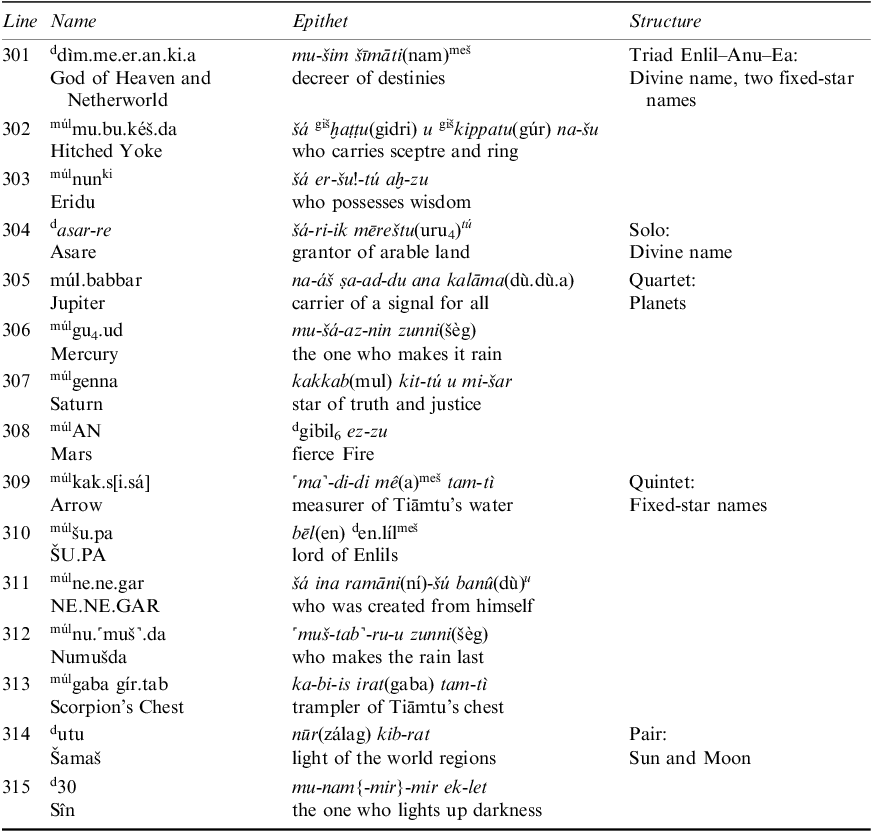

 Open access

