


Increased understanding and awareness of congenital cardiac disease has allowed early identification of these children. Advances in surgical techniques, anesthesia, and medical treatment have rendered the majority of forms of congenital cardiac defects treatable. Therefore, the incidence of pulmonary hypertension related to the Eisenmenger syndrome should decrease. However, some patients need treatment for pulmonary hypertension despite repair of defects. Heart-lungReference Jamieson, Stinson and Oyer1 and lung transplantationReference Fremes, Patterson, Williams, Goldman, Todd and Maurer2 remain the therapeutic options when medical therapy fails.
According to the registry of the International Society for Heart and Lung Transplantation, 25% of heart-lung and less than 1% of lung transplants have been performed for adult patients with congenital cardiac disease.Reference Trulock, Christie and Edwards3 Similarly, more than 40% of heart-lung and 5% of lung transplants have been performed in children with congenital cardiac anomalies.Reference Aurora, Boucek and Christie4 The objective of this session is to address four major points: the cost-benefit and risk-benefit issues for lung or heart-lung transplantation versus currently available medical treatments, the allocation policies for these patients, the risk-benefit issue for lung versus heart-lung transplant, and the use of ventricular assist devices in patients with biventricular failure as to allow successful isolated heart transplantation following improvement of pulmonary hemodynamics.
Lung or heart-lung transplantation versus medical treatment
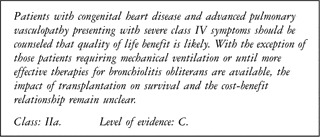
In comparison with idiopathic pulmonary arterial hypertension, the natural history of patients with pulmonary hypertension associated with congenital cardiac disease is considerably better, with a greater than 60% survival rate being reported 20 years following diagnosis. It has been also suggested that adults with the Eisenmenger syndrome have a more favorable hemodynamic profile and prognosis than adults with the idiopathic form,Reference Hopkins, Ochoa, Richardson and Trulock5 with an 80% and 40% survival respectively five and 25 years following diagnosis. Furthermore, the Columbia University group recently reported that long-term infusion of epoprostenol improves hemodynamics and the quality of life in patients with pulmonary hypertension associated with congenital cardiac defects.Reference Rosenzweig, Kerstein and Barst6 In contrast, the survival after lung or heart-lung transplantation is approximately 50% at five years,Reference Trulock, Christie and Edwards3 but it continues to decrease thereafter, as opposed to heart transplant where survival at one year is fairly predictive of rates observed at five and ten years. The Papworth group evaluated the potential survival benefits by reviewing 653 patients accepted for lung transplantation.Reference Charman, Sharples, McNeil and Wallwork7 Among them, 76 subjects had the Eisenmenger syndrome. They reported that lung transplantation confers a significant survival benefit for patients with various lung diseases except for the Eisenmenger syndrome. However, these data primarily reflect outcomes in adolescents and adults. Although post-transplant outcomes are comparable, survival without transplant in pediatric patients is likely to be worse, as in a large single center series, 25% of patients were on mechanical ventilation at transplant.Reference Choong, Sweet and Guthrie8
While survival is the most important measure for the success of transplantation, improving the recipient’s quality of life is another important objective of the procedure. Several studies have shown improved quality of life after lung and heart-lung transplantation.Reference TenVergert, Essink-Bot, Geertsma, van Enckevort, de Boer and van der9, Reference Studer, Levy, McNeil and Orens10 Gains diminish, however, with the onset of complications such as bronchiolitis obliterans syndrome.Reference Gross, Savik, Bolman and Hertz11, Reference van den Berg, Geertsma and van Der12 No studies have investigated the impact of transplantation on the quality of life specifically for patients with congenital cardiac disease and pulmonary hypertension.
The issue of cost-effectiveness must be analyzed taking the quality of life into account, in particular in view of the lifetime cost of care for the lung transplant recipient estimated at about $425,000 in the United StatesReference Ramsey, Patrick, Albert, Larson, Wood and Raghu13 and $180,000 in the United Kingdom.Reference Anyanwu, McGuire, Rogers and Murday14 Investigators have attempted to determine the cost per year adjusted for the quality of life.Reference Groen, van der, Koeter and TenVergert15, Reference Vasiliadis, Collet, Penrod, Ferraro and Poirier16 The emerging picture is that although the lifetime follow-up of lung transplant recipients is associated with high costs, it remains cost-effective in view of the gain in terms of quality of life as compared with standard care without transplantation. The lowest gain, however, has been observed for secondary pulmonary hypertension.Reference Groen, van der, Koeter and TenVergert15 Thus, although no clear survival benefit has been demonstrated for patients with congenital cardiac disease, recipients with advanced symptoms appear to benefit in terms of the quality of life, but at considerable cost. There may be a survival benefit in pediatric patients who require mechanical ventilation. Development of more effective therapies for bronchiolitis obliterans may also lead to a survival benefit.
Indication and allocation for lung and heart-lung transplantation
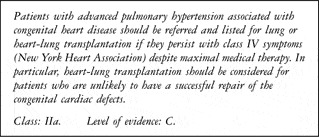
The timing of referral is particularly difficult in patients with congenital cardiac anomalies because they are not a homogeneous group. Regarding the Eisenmenger syndrome, some centers would follow guidelines for idiopathic pulmonary arterial hypertension proposed by the International Society for Heart and Lung Transplantation,Reference Orens, Estenne and Arcasoy17 but it should be emphasized that there is no general agreement on this, as others would refer only patients with advanced class IV symptoms.
Referral
• New York Heart Association functional class III or IV, irrespective of the ongoing therapy
• Rapidly progressive disease.
Transplantation
• Persistent class III or IV symptoms on maximal medical therapy
• Low (less than 350 meters) or declining six-minute walk distance
• Cardiac index of less than 2 liters/min/m2
• Right arterial pressure exceeding 15 mmHg.
Similar recommendations for children with the Eisenmenger syndrome were included in a consensus statement from major pediatric lung transplant centers.Reference Faro, Mallory and Visner18 The same document recommends immediate referral for children with specific anomalies (i.e. pulmonary venous stenosis) because of poor response to medical therapy.
Heart-lung transplantation is indicated for severely symptomatic patients who are unlikely to have a successful repair of congenital cardiac defects, and patients with severely depressed left ventricular function (left ventricular ejection fraction less than 35%).Reference Choong, Sweet and Guthrie8, Reference Bando, Armitage and Paradis19 German groups, however, have performed heart-lung transplantation as the procedure of choice for these patients, resulting in similar outcomes.Reference Reichart, Gulbins, Meiser, Kur, Briegel and Reichenspurner20, Reference Goerler, Simon and Gohrbandt21 Again, it should be emphasized that other groups would not support this approach. In the United States, the United Network for Organ Sharing allocates lungs to adolescents and adults based on a multi-factorial analysis of the waiting list and transplant mortality.Reference Egan, Murray and Bustami22 Children aged less than 12 years old continue to be allocated lungs based on time accrued on the waiting list. There has been increased allocation to recipients with idiopathic pulmonary fibrosis and cystic fibrosis, and decreased allocation to recipients with emphysema and pulmonary hypertension.Reference Gries, Mulligan, Edelman, Raghu, Curtis and Goss23 In the United States, heart-lung candidates receive first priority for lungs when allocated the heart and priority behind Status 1A heart candidates when allocated the lungs. The heart priority is unlikely to increase, as the waiting list mortality for heart-lung transplant candidates is comparable to lung candidates and much lower than Status 1A or 1B heart candidates.Reference Mulligan, Shearon, Weill, Pagani, Moore and Murray24
Lung versus heart-lung transplantation
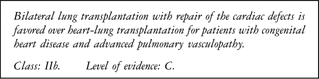
There are three transplant options for end-stage patients; single lung transplantation with repair of the cardiac defect, bilateral lung transplantation with repair of the defect, and heart-lung transplantation. Theoretical advantages with single lung transplantation include shorter bypass time, thoracotomy instead of sternotomy, less bleeding, and organ sparing.Reference Pasque, Trulock, Kaiser and Cooper25 It is well recognized, however, that single lung transplantation for pulmonary hypertension involves a potentially difficult post-operative course and high mortality.Reference Bando, Armitage and Paradis19 Cardiac repair with bilateral lung transplantationReference Choong, Sweet and Guthrie8, Reference Mendeloff and Huddleston26 appears to be associated with a better post-operative course, but carries potential morbidity associated with longer cardiopulmonary bypass. Heart-lung transplantationReference Reichart, Gulbins, Meiser, Kur, Briegel and Reichenspurner20, Reference Goerler, Simon and Gohrbandt21 is a simpler operation as compared to bilateral lung transplantation, but requires allocation of two organs from the scarce donor organ supply, adds risk of cardiac graft coronary vasculopathy and is less tolerant of ischemic time.
Several reports have shown similar survival between bilateral lung transplantation and heart-lung transplantation for pulmonary hypertensive patients.Reference Choong, Sweet and Guthrie8, Reference Bando, Armitage and Paradis19, Reference Mendeloff, Meyers and Sundt27 No single center has, however, transplanted a large enough number of patients with Eisenmenger syndrome. The Toronto group analyzed the International Society for Heart and Lung Transplantation and United Network for Organ Sharing Joint Thoracic Registry database which included 69, 106 and 430 single-lung, bilateral-lung and heart-lung transplantations respectively.Reference Waddell, Bennett, Kennedy, Todd and Keshavjee28 This analysis suggests that heart-lung transplantation appears to offer a survival benefit for pulmonary hypertensive patients with ventricular septal defects and should be considered as the operation of choice. Regarding pediatric patients with congenital cardiac disease and advanced pulmonary vasculopathy, the number of transplants reported by the International Society for Heart and Lung TransplantationReference Aurora, Boucek and Christie4 is quite limited (less than 100) and the major experience has been reported by the St. Louis group. They reported that despite the complexity of combined cardiac repair with bilateral lung transplantation in 35 cases, and the resulting perioperative morbidity, patients had similar outcomes as compared with 16 patients who underwent heart-lung transplantation.Reference Choong, Sweet and Guthrie8
Ventricular assist devices and patients with pulmonary hypertension and congenital cardiac disease
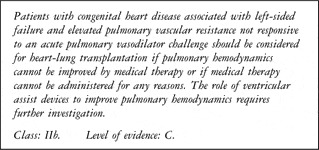
Some patients with congenital cardiac disease have altered pulmonary hemodynamics with increased vascular resistance partly or totally related to left ventricular dysfunction. Outcomes for isolated cardiac transplantation are often poor in this scenario, so that levels of pulmonary vascular resistance above 6 Wood units·m2 or a transpulmonary gradient exceeding 15 mmHg are routinely considered as exclusion criteria for this procedure. In these instances, heart-lung transplantation appears as a therapeutic option.Reference Canter, Shaddy and Bernstein29 Recent reports of normalization of elevated pulmonary vascular resistance in adults treated on a long-term basis with ventricular assist devicesReference Salzberg, Lachat, von, Zund and Turina30 raise the possibility that similar improvement can occur in children. Recently, the use of Berlin pediatric device in two patients initially referred for heart-lung transplant allowed isolated heart transplant with successful outcome.Reference Gandhi, Grady, Huddleston, Balzer and Canter31 Further studies are obviously required before this approach can be recommended.
Alternatively, recipients with preoperatively increased pulmonary vascular resistance might benefit from short-term or long-term treatments with drugs such as continuous intravenous epoprostenol, enteral sildenafil, etc. started peri-operatively and maintained for months. This approach has been successfully attempted more than several times, and appears to be promising in terms of avoiding heart-lung transplantation. This would increase the likelihood of getting a donor, as heart transplant would be carried out alone instead of waiting for a heart-lung block. The potential impact of this approach on outcomes warrants further investigation.
Conclusion
Because of statistical impossibility to demonstrate a clear survival benefit, lung and heart-lung transplantation remain a procedure of last resort for patients with advanced pulmonary vasculopathy associated with congenital cardiac disease. Ongoing development of therapies to improve pulmonary hemodynamics in these patients will likely reduce the numbers of patients requiring transplant in the future. At present, lung and heart-lung transplant should be considered in order to improve the quality of life in selected patients.


