

A listening garden
IMAGINE a garden alive with plants, birds, people and music. Approaching, you first hear sounds singing out from high in the trees. Inside, melodies float in mid-air and noises chatter from the undergrowth. The foliage is tall and lush, mid-summer growth filled with recent rain. The path branches. Now you have a choice: stop or keep moving, turn left or right.
| Left and the sounds seem to respond to your movement: starting, stopping and swirling around. An elderly couple sit in silence as you pass by. You notice a bird box suspended in a low tree – except there’s a camera lens inside, returning your gaze. Cicadas buzz from the flowerbeds; shoes scrape on gravel. | You wait on a bench, listening and watching. Minutes go by as the world moves around you. A noisy family passes; then a festival volunteer, clicking a tally counter. Breathy solo lines emerge from the hum of music and garden, catching your ear. Bird calls – real or recorded? – whirr high above. | Or perhaps you don’t think about where to go, only soon you’re elsewhere. New sounds call out from the trees and fence line, drawing you onto an open lawn above the central garden. Here the sound is more open and expansive; people wander in conversation, currawongs flap and call out, kids cartwheel. |
You move on, turn again, listening, looking, in and out of your thoughts. Someone approaches, asking if you have a few minutes to talk about ‘the installation’ …
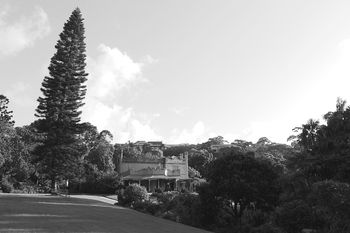
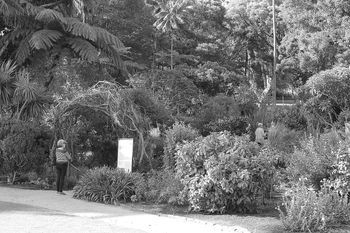
In January 2016, visitors to Vaucluse House, a colonial-era estate in an affluent eastern suburb of Sydney (see Figure 1), found the historic pleasure garden full of sounds. Many paused at the entrance to read an explanatory sign about the artwork, itself called Pleasure Garden (see Figure 2). Some studied the notice carefully, while others only scanned it, catching glimpses:
In Pleasure Garden, music and environmental sounds weave through the landscape […] It is a listening garden – a gently interactive instrument […] Inspired by the story and music of the 17th-century musician […] Jacob van Eyck […] Pleasure Garden sets van Eyck’s exquisite blooms in a new environment […] explore it, or sit a while and listen […] We’re inviting you to complete the composition […] We hope that […] this magical place, wreathed in soft, delicate music, encourages you to be quiet, move slowly, to look deeply, and then to leave with a little glow of contemplative beauty.
Just as audience members came to understand the installation only gradually, this article presents information about Pleasure Garden piecemeal: attempting to summarize the project up front would work against the uncertain play of meaning that I want to evoke and analyse here. Audience members could quickly learn that Pleasure Garden was conceived and co-composed by the recorder-player Genevieve Lacey, and that her collaborators were the Norwegian producer Jan Bang (co-composer), Jim Atkins (recording engineer and sound designer) and Robin Fox (interactive system design), as well as several others.Footnote 1 But experiencing the sounds of the installation, learning how they were diffused into the garden and how the interactive system responded to their movements was a much slower, often incomplete, process.
Lawn (left), pleasure garden (right) and Vaucluse House (rear). Photograph by the author.

Audience member reading an entrance sign. Photograph by the author.

Pleasure Garden switched on automatically for the first time on the morning of 7 January 2016. It would run from 8 a.m. to 8 p.m. for 20 days. This article emerges at the intersection of my extended fieldwork with the creative team behind Pleasure Garden Footnote 2 and a more focused period of research, in which I spent five days talking to and observing audience members in the Vaucluse garden, recording short interviews with 35 people.Footnote 3 Joining other calls for greater empirical attention to audiences and musical experience,Footnote 4 the article develops a relational account of the reception of Pleasure Garden, exploring how multiple parties co-constituted experiences of the artwork. Elsewhere, I describe the creation of Pleasure Garden as a process of co-production involving varied actors.Footnote 5 Here, I describe experiences of Pleasure Garden in terms of what I call ‘co-reception’, a relational process involving its human creators, the installation, the garden, the people who came to listen and myself as researcher. My contention is that, while ‘distributed creativity’ and allied terms have recently gathered conceptual momentum in music studies, the theorization of reception as ‘distributed’ has been largely neglected, despite its potential for investigating musical experience.Footnote 6 My approach builds on recent work on the interactions and relationships between musicians, audiences and others,Footnote 7 but also considers the role of more-than-human entities in experiences of the installation. Together, these entities constituted what I call the installation-in-the-garden, a techno-natural assemblage formed through the co-articulation of the installation (its sound design, infrastructure, interactivity, discursive framing and spatial arrangement) and the Vaucluse garden (its plant, animal and human inhabitants; its acoustics, pathways, physical contours and so on).
In proposing a more-than-human account of the reception of Pleasure Garden, my aim is not to speculate about the experiences of birds, plants or computers, but rather to move beyond treating musical experience as exclusively centred on individual human subjects. Musical experience is cultivated through varied relations between subjects and objects with results that are variously subjectifying, fragmenting, dialogic and collectivizing,Footnote 8 and non-human contributors participate, alongside humans, in the circulation, interruption and modulation of musical affect. Indeed, recent scholarly attention to affect in the environmental humanities and science and technology studies can productively expand our theorization of musical experience. Here, I draw on Carla Hustak and Natasha Myers’s rethinking of plant–insect ecologies in order to analyse the affective significance of Pleasure Garden as an arena for more-than-human encounters. Reading ‘against the grain’ of dominant logics in recent ecological science and neo-Darwinist evolutionary theory, Hustak and Myers ask, ‘What if the topology of insect/orchid encounters were conditioned not just by a calculating economy that aims to maximize fitness but also by an affective ecology shaped by pleasure, play, and experimental propositions?’Footnote 9 Rereading a range of research into these complex, multisensory encounters, they propose ‘involution’ as a supplement to ‘evolution’, in order to account for ‘the creative, improvisational, and fleeting practices through which [… organisms] involve themselves in one another’s lives’.Footnote 10 In this article, I draw out some of the implications of this involutionary perspective for our understanding of musical and artistic experience, including tentatively extending the concept to include human–technology intimacies. The distributions of subjectivity that attend co-reception are not, in my account, about oceanic communion with sound, community or nature, but rather about the often subtle perturbations of subjectivity which texture musical experience. Not all such distributions are welcome (I discuss, for example, the distracting effects of audience members’ efforts to become visible to Pleasure Garden’s interactive system), but they are, following Hustak and Myers, subjectively and intersubjectively involving – they entangle us with multiple others, sonic and social.Footnote 11 Such entanglements can blur conventional divisions of musical labour, so I also consider how Pleasure Garden implicated audiences in a process of simultaneous co-creation and co-reception, in such a way that to experience the installation-in-the-garden was also collectively to remake it.
Another major strand in my argument examines how experiences of Pleasure Garden were conditioned and animated by cultures of ‘audiencing’.Footnote 12 The habits and expectations that audiences and artists brought to the installation were shaped on the one hand by established, broadly contemplative reception practices associated with Western art music, and on the other hand by less well-established, broadly exploratory forms of reception linked to sound art, environmental art and public art. These modes of reception of course overlap, and their differences are relative, but they usefully highlight the distinctive cultures of audiencing that attend different genres and settings. Beyond this, Pleasure Garden participated in wider shifts in contemporary musical experience, including what Georgina Born identifies as the increasing ubiquity of music across diverse settings, allied with a move towards less attentive, more fragmented types of listening.Footnote 13 More broadly still, audience experiences were formed in relation to features of everyday experience associated with late capitalism and neo-liberalism, including the ‘distracted’ character of urban life; the ubiquity of technological mediation, especially interactive systems; notions of culture as expedient; and the widespread aestheticization and somatic appreciation of nature and landscape.Footnote 14 These features variously intensified, re-inflected and undercut each other in shaping the reception of Pleasure Garden, collectively signalling wider trends in contemporary forms of musical experience.Footnote 15 One key trend, I suggest, is towards transient immersion, a form of absorbed yet ephemeral experience often orientated towards participatory or environmental art. Immersion (and allied terms such as participation or interactivity) pervades much current artistic discourse and has been subject to considerable exploration and critique.Footnote 16 Responding in particular to Stefan Helmreich’s call for ‘discernments of material and semiotic relationships often washed out of attention by the all-encompassing idiom of immersion’,Footnote 17 my account credits audience members’ narrations of Pleasure Garden as immersive, while also recognizing the ephemeral, bounded status of their involvement, the construction of ‘immersion’ via specific discourses and techniques, and its predication on non-immersive experiences.
The distinctive reception culture that arose from the superposition of such features refracted both the intentions of Pleasure Garden’s creators and the expectations of its audiences in such a way that experiences of the installation, although strongly conditioned, remained far from assured or predictable. Indeed, together, the situated co-reception of Pleasure Garden and its imbrication in wider cultures of audiencing powerfully shaped such experiences while also – through their tensions and complexity – leaving space for uncertain and generative responses. I suggest that this ambivalence – at once powerfully conditioned and generatively uncertain – might be a valuable focus for the study of musical experience in other settings.
These issues of musical experience are bound up with questions of method and representation. Reflecting below on the methodological challenges of studying Pleasure Garden, I suggest that the affective responses and meaning-making impulses not only of artists and listeners, but also of researchers, both academic and corporate, partake in and constitute musical experiences and wider cultures of audiencing. This is not just because my interview questions shaped audience responses, but because of a more far-reaching dialogism at stake in the relationship between audiences, artists and researchers.Footnote 18 Pleasure Garden’s creators had particular hopes and expectations as to what the installation would offer audiences.Footnote 19 Audience members brought assumptions about what kinds of musical experience it afforded or were worth investigating. And I discussed, in turn, both my own and audience members’ responses to the installation with Pleasure Garden’s creators. Artists’ and audiences’ informal theories of musical experience variously re-inscribed and resisted a widespread culture of interpretation and evaluation associated with both scholarly and market research which, rather than simply reporting the effects of artistic projects, now powerfully shapes their commissioning, production, promotion and reception.Footnote 20 In these ways, this article – far from being a straightforward report of audience experiences – emerges from the interaction between multiple engagements with Pleasure Garden. Crucial here is the tension between divergent impulses (politicizing, instrumentalizing and autonomizing) in the interpretation of Pleasure Garden. Also central is the challenge of studying particular types of audiencing characteristic of many public art forms – from sound installations to street performance – that combine (often in tension) different modes of experience, variously transient and immersive, solitary and sociable, contemplative and distracted. Such audiences have been neglected within ethnomusicology,Footnote 21 partly because they permit little in the way of long-term fieldwork, and the literature on audiences within sound art studies remains largely speculative, abstracted or implicitly auto-ethnographic:Footnote 22 scholars have rarely talked to such audiences about their experiences or observed what they do.Footnote 23 This article both advocates this kind of empirical work and considers some of the many challenging questions it raises regarding the types of knowledge – variously ethnographic and demographic, scholarly and market-orientated, critical and evaluative, reflexive and positivist – it is possible to generate about (and with) audiences.
Where experiences and audiences are so various and elusive, representation also becomes fraught. Throughout the article, I present excerpts from my anonymous interviews with Pleasure Garden audience members, like fragments of conversations overheard by the reader. Through this and other textual devices (including occasional columns allowing the reader multiple routes through the text), I want to suggest the approximate relationship between two figures of reception – the reader and the audience member – and so foreground the mimetic relationship between this text and the installation it describes. A text, like a garden or an artwork, can direct attention, accommodate varied experiences and encourage participation. It can provoke, enchant and annoy. If the trick of an ethnographic sketch is to transport the reader elsewhere, then playing with the relationship between text and place might resensitize us to both. Rather than presenting a closed, linear argument, a text might tread several paths simultaneously, remaining spacious to alternative readings.Footnote 24 The setting evoked might be understood as a place where meaning is made, lost and debated long before its representation in writing.
One subtle, yet particularly thorny, methodological and representational issue is worth highlighting at the outset: the tension between demographic and ethnographic impulses in the presentation of fragments of my conversations with audience members. To say that Pleasure Garden audiences looked largely (although far from exclusively) white and middle class, and mixed in age and gender, may seem a fairly straightforward observation – and such information is important in recognizing the relative privilege of the installation’s audiences. But it also risks various assumptions, especially about the visual legibility of gender, race and ethnicity, which are untenable in light of the complexities of gender identity and indigenous status in contemporary Australia.Footnote 25 This risk could not have been neutralized by simply collecting demographic data. Direct questioning about demographic information would have sat extremely awkwardly in my attempts at relatively naturalistic, open-ended conversations with audience members. More than this, it would have reproduced both the demographic modelling of instrumentalized market research and long-standing colonial strategies of surveillance directed at indigenous populations.Footnote 26 Accordingly, I did not ask about, and do not offer here, demographic information regarding audience members’ ethnicity, race, age, gender, occupation, class and so on, unless it was directly raised by an audience member in our conversation. In the vast majority of cases, this means that such information is entirely absent, except for the occasional mention of a person’s occupation and the important case of a woman who self-identified as Aboriginal (discussed towards the end of the article). Undoubtedly, this lack of contextual information is a limitation, but it can at least highlight a troublesome and under-recognized methodological dilemma. In omitting such information, my aim is not to posit an idealized or somehow neutral audience member, but rather to suggest that both the collection of demographic information and audience members’ practices of self-identification (or lack thereof) are part of the culture of audiencing surrounding Pleasure Garden, one in which the subject position of the white audience member is perhaps especially important for its unmarked, yet dominant, status. Further, as a textual device, I hope that these disembodied fragments of conversation might draw attention to the kinds of audience member imagined by readers and so to the wider challenges of knowing and representing who participates in different kinds of audiencing.
Aesthetic ‘alternatives’ and making ‘space’
Pleasure Garden grew out of a richly biographical, collaborative process drawing on features of Genevieve’s personal and professional life, as well as other team members’ skills and interests,Footnote 27 making it impossible to distil Genevieve’s hopes about what audiences would get from the installation. Nonetheless, the words that gathered around the installation – the explanatory signs, information online and in the Sydney Festival brochure – shape our sense of her intentions, just as they guided listeners in Vaucluse: ‘My aim was to create a contemporary Pleasure Garden, allowing an alternative experience to a manically busy, noisy, contemporary life, affording instead an opportunity for repose and delight, for wonder and the contemplation of beauty.’Footnote 28 With its implicit critique of modernity and its advocacy of an ‘alternative’, Genevieve’s aim treads a delicate line between direction and accommodation, making an almost political point by moving into the autonomous realm of the aesthetic, ‘a modality of perception in which objects and forms are withdrawn from normal hierarchies and causality’.Footnote 29 Pleasure Garden’s contemplative bent places emphasis on historical pleasure gardens as places of leisure, meditative retreat and respectable sociability, rather than spectacle and hedonism.Footnote 30 It also participates in a wider cultural preoccupation with qualities that elide the ethical and the aesthetic, such as slowness, stillness, attentiveness and naturalness, which are often seen as antithetical to those that dominate contemporary life: speed, mobility, distraction, technology.Footnote 31 For Genevieve, music and nature can rehabilitate our experiences of contemporary life. As Nigel Thrift argues, ‘Nature has become a, perhaps even the, key site of contemplation and mysticism in the modern world.’Footnote 32
Many audience members described their experiences in ways that resonated strongly with Genevieve’s intentions. Words such as ‘relaxing’, ‘pleasant’, ‘peaceful’, ‘soothing’, ‘calm’, ‘natural’ and ‘meditative’ came up repeatedly in our conversations, and most people seemed to value their experience, making positive, sometimes effusive, comments about the installation.Footnote 33 Yet each response was distinctive: Pleasure Garden made listeners variously attentive, evaluative, introspective and more.
It makes you more aware of all the different noises around, doesn’t it? You know, the car and the bird and the coffee shop and the people. It does kind of suddenly awaken … that inner aural sense.
It’s really beautifully balanced … with the birds, like it doesn’t overpower it, … it’s present enough to be heard, but really in beautiful harmony … with the surrounding organic sound.
You can sit and listen and kind of still drift off into your own thoughts without it being a distraction.
It will take this whole article to credit the diversity of audience reactions, whether resonant with Genevieve’s aims or not. From early on, though, we should note Genevieve’s emphasis on accommodating such diversity. She describes ‘trying to do things that have enough space in them that I’m not telling someone what to think or how to feel, I’m just hopefully trying to induce a state of mind or being that then allows them to experience, feel, think whatever it is that they need to’.Footnote 34
Making ‘space’ was, I suggest, a powerful yet informal idea through which Pleasure Garden’s creators conceptualized the relationship between the installation and its audiences. As I describe elsewhere, the musical textures and frequencies of Pleasure Garden were designed with a view to creating something that, as Jan put it, ‘leaves space for the garden’.Footnote 35 Such ideas offer an instructive parallel between ‘space’ as the actual site of the installation and ‘space’ as a metaphor for the work’s openness to diverse contributions and experiences. Whereas the site gathered a public who followed winding paths and wandered on open lawns, the space of the work was intended to accommodate multiple individual experiences and hold open the possibility of diverse experiences in general. Genevieve’s explanation figures this openness as reparative (‘whatever […] they need to’), chiming with the idea of aesthetic experience as an ‘alternative’ to the rush of modernity. Her attitude is, like my wider argument here, double-edged: the artwork at once conditions musical experience (by affording contemplation) and leaves it generatively uncertain (by making ‘space’).
‘A meaning above what it actually is’: interpretation and quasi-autonomy
The installation of Pleasure Garden took place over five extremely rainy days in early January 2016. During the mixing phase, Jim, the project sound engineer, would start some music playing and we would all walk from the tech workspace, housed in a small marquee, into and around the garden. We would listen, talk, return to the marquee, make changes, then listen again. One such walk took us onto the lawn above the central pleasure garden, our attention focused on a percussive passage in a track called ‘Granite’, made from the processed, layered sounds of struck stones and low-pitched key-hits on a contrabass recorder. A previous mix spatialized this texture more diffusely, but Jan suggested locating it on one side of the garden, where it thrummed from a row of tall trees. As we listened, Jan commented: ‘It’s the migrants knocking at the door.’ I have an image of Jan holding his palms vertically as if feeling the wall of sound, and I think he subsequently worked with Jim to make the texture louder and more unsettled. But I’m not sure: my ethnographic notes are sketchy since I only half took in this seemingly offhand comment. The flow of conversation moved on, but talking with Jan later, it became clear that this issue was important to him. He was critical of current attitudes towards migration and of the low numbers of Syrian refugees taken in by Australia and his home country, Norway. But, significantly, his focus lay elsewhere:
For me … it’s not important to emphasize the political aspect of it, but there definitely could have been [that emphasis], which if you … are a presenter or a curator you would be very interested in presenting it like that, because it would … put it into a [bigger] context … Then again for me that comes from … [the] commercial aspect of it […] And I think that, in general, is quite boring actually … and I find it also limiting … because it projects certain images to the listener and I want the listener to have … as wide and different possibilities … as possible.Footnote 36
Jan and Genevieve were similarly hesitant about my interest in any environmentalist sentiment behind Pleasure Garden – hesitant despite the fact that both valued nature as an important dimension of the installation and, indeed, their lives. Some audience members shared my interpretation: one person with a conservation background, visiting with their child, wondered whether hearing ‘recorded’ rather than ‘actual natural sounds’ would be increasingly common for ‘future generations when there aren’t such natural places any more. Perhaps that is the nature they will know as opposed to actual nature, which is a worry.’ Asked about such environmentalist readings, Genevieve did acknowledge the affective potential of the installation: ‘It’s harder to hurt something if you love it, [… so] trying to open the channels for that encounter [with nature] to happen for someone, then might make them think – in practical ways – differently about a whole lot of things.’ Nonetheless, prompting such experiences was not her focus, and Jan took a firmer stance:
For me … I don’t really have any, what do you [call it]? In Norwegian we call it ‘overbygning’ [literally ‘superstructure’], which is like a meaning above what it actually is. For me … it’s purely sound, structures, pitches, rhythmical events […] but I know that if I am precise […] I can create something else for an audience, or even for myself you know … That’s what I do. I create … these kind of possible worlds … to live in, but I don’t really have any of those [overbygning], and I find them also a bit sort of limiting.
Another ambivalence, then: Jan and Genevieve want Pleasure Garden to be experientially open, but downplay strongly ‘political’ interpretations; they have hopes for what the installation can offer to listeners, yet figure both music and nature as domains of more or less autonomous experience. Their stance highlights the scholarly impulse to ‘uncover’ interpretations, as demonstrated by my interest in subtexts of migration and environmentalism. I’m struck especially by Jan’s comment about the ‘commercial’ appeal of ‘the political aspect’ for ‘curators’. By avoiding ‘political’ readings, artists do not simply affirm art’s transcendence or autonomy, they also sidestep reductive interpretations and their close relationship with marketing strategies. Nonetheless, understanding Pleasure Garden means engaging with discourses of autonomy that – in separating music from the social and cultural – seem antithetical to the ethnomusicological project. David Clarke’s work offers a valuable guide here. He re-evaluates musical autonomy, recognizing its considerable ideological problems, tracing its history within Western art music, attending to its sociocultural mediation and its dispersal across other genres, and arguing for its continuing potential to do ‘valuable cultural work’, which he glosses most succinctly as ‘an inwardly oriented resistance to outer political circumstances’.Footnote 37 Following Clarke, rather than simply dismissing autonomy a priori, we might instead study what could be called ‘cultures of autonomy’ – a ‘helpfully jarring oxymoron’Footnote 38 – and their continuing significance as a topic for ethnographic enquiry.Footnote 39 Genevieve’s desire for a contemplative ‘alternative’ to chaotic contemporary life, her idea of ‘leaving space’ and Jan’s description, again using a spatial metaphor, of creating ‘possible worlds … to live in’ add up to a distinctive version of musical autonomy.Footnote 40 Combining this with the installation’s participatory dimension (the entrance signs inviting audiences to ‘complete the composition’, its interactive elements), as well as a concern for audiences’ situated, multisensory experiences of the installation, they make Pleasure Garden at most quasi-autonomist, invested at once in the openness, irreducibility and reparative potential of aesthetic experience and in its social and embodied mediation.
‘Not pinpointable’: an undecidable aesthetic
Talking with Pleasure Garden’s creators and audiences sometimes turned into a strange game of collaborative musical analysis as my questions about how the installation was conceived and experienced prompted discussions of how it sounded.Footnote 41 Audience comments ranged across issues of texture, tempo, volume, structure, spatialization and timbre, but circled around a few central ideas: Pleasure Garden was spacious, slow, varied, ‘balanced’ or ‘integrated’ with the sounds of the garden, and ‘encompassing’, surrounding the listener with ‘soothing’ and ‘natural’ sounds.
I guess it’s made us feel very relaxed and calm for the most part. It feels a very natural sound, very spontaneous, lots of silence.
It’s slow, it’s soothing sorts of noises, but it’s [got] enough variation that you can be interested in listening to what noises are coming next.
Other features, not commented on by audiences, probably contributed to an appreciation of Pleasure Garden as relaxing and ‘fitting’ with the garden: the predominance of free rhythm – especially in slow, single-breath recorder lines – matched its spacious, organic textures; and the installation’s melodic and harmonic characteristics, influenced by van Eyck, were broadly in keeping with the tonal conventions probably familiar to most audience members. But, as some listeners acknowledged, the music also took unexpected turns.
| Imagine virtuosic Baroque-like melodies layered and juxtaposed, creating ambiguous, dissonant, sometimes polytonal textures, neither clearly pulsed nor rhythmically free. Imagine static harmonies unsettled by internal variations in voicing and intensity. Recorder trills at different pitches and speeds, offset and layered to make tall, undulating chords. Long-held notes pulsing with varied kinds of vibrato. | Imagine a single bass recorder voice – low, husky, unpulsed – singing from one spot, with harmonies drifting in and out. A disembodied melody, the human performer clearly audible, yet absent. Or a dense mass of voices, tumbling and spinning around the space, harsh and strident. Or a diffuse wash of sound with no clear source. | Imagine textures where instrumental, natural and electronic sounds blur together; where live and pre-recorded sounds are hard to tell apart. A whistling recorder that mimics a bird. A sliding bird call that seems computer-generated. A low electronic drone that sounds like a bass recorder. Or moments of surreal juxtaposition: a mechanical, ratcheting noise that releases a flock of birdsong, the sudden appearance of a manual carillon, chiming in mid-air. |
Out of a limited palette focused on Genevieve’s recorder playing, electronic sounds and field recordings of birds and bells, Pleasure Garden’s creators crafted diverse musical textures, which undercut any simple characterization of the installation as ‘relaxing’ or reliant on ‘natural’ sounds, and matched their insistence on openness and varied listening possibilities. This was reflected in audience members’ divergent ad hoc descriptions of the installation, which ranged across genres, time periods and what counted as ‘music’.
… period music, early, Middle Ages English I suppose.
… it’s fairly radical music, … you could even call it atonal in part.
… to me it’s not music, to me it’s more life, it’s just comfort, life, rather than just ‘music’ music.
… just noises, rather than musical tunes.
… it’s not classical music, … obviously it’s not any kind of, you know, like, popular music or anything, so it’s music that’s not music.
Ambiguity pervaded audience members’ comments. They just as often talked of ‘sounds’ and ‘noises’ as ‘music’. The refrain that Pleasure Garden was ‘relaxing’ was sometimes qualified by comments that invoked more ambivalent affects: it was also ‘eerie’, ‘haunting’, ‘lonely’, ‘spooky’ and ‘mysterious’. And although audience members largely celebrated the combination of installation and garden sounds, they were also preoccupied by the boundary between the two, especially regarding birds.
I’m not sure whether that bird sound is part of the system or not.
[I’m] trying to work out if all the bird sounds were actually part of the performance or whether they’re also the birds that are here.
I like the idea […] that you’re hearing birds here or different sounds here and you’re not quite sure which is … natural […] and which is part of this experience.
Rather than describing bird sounds as ‘live’ or ‘recorded’, they turned to stranger syntax and terminology, as if ‘natural’ or present (‘here’) birds were somehow excluded from the ‘performance’ of the installation or their ‘experience’ of it. In this way, they registered an uncertainty about the experiential limits of Pleasure Garden, about where birds stood in relation to the creation–reception boundary and, perhaps, about the limits of musical experience in general. Although engagements with birdsong are a long-standing feature of Western art music, the installation reinvigorated audience members’ attentiveness to this familiar topic, perhaps owing to the relatively unfamiliar convergence of two broad cultures of listening, which we might gloss as ‘musical’ and ‘environmental’. Adapting Eve Kosofsky Sedgwick’s notion of ‘periperformativity’, we might see birds’ sounding practices as happening alongside the creation and reception of Pleasure Garden, neither fully inside nor outside, at once evading and dramatizing the normative conditions of music as (what John Blacking calls) ‘humanly organized sound’.Footnote 42
Writing about South African kwaito, Gavin Steingo develops the idea of ‘aesthetic undecidability’ as a means for understanding this popular form of electronic music, including its extremely eclectic sonic reference points, which ‘agitate […] the traditional criteria for establishing distinctions between music, sound, and noise’, and its incorporation into the soundtrack of the controversial TV show Yizo Yizo, which blurred the boundaries between township life and its representation in ways that made it ‘impossible to determine the precise relationship between an aesthetic product and social reality’.Footnote 43 Although far removed from the social and political world of kwaito, Pleasure Garden cultivated its own version of ‘aesthetic undecidability’, centred on ambiguities surrounding liveness and mediation, the relationship between instrumental, natural and technological sounds, and that between rhythmic, harmonic, spatial and structural conventions.
Discussing his compositional approach, Jan described how combining several different musical textures can create ‘something that is not pinpointable’, encouraging the listener’s attention to ‘turn inwards’. Acknowledging the difficulty of describing this effect, he commented that ‘unusual combinations [of sounds] can create a feeling that I can sense more than I can explain’. Echoing Jan’s sentiment, one listener reflected:
It’s good, it works, I’m not sure … what I mean by that, but it works … having the sounds and being in the spot, it just sits right so … there’s a lot of thought that’s gone into it and, although we try to analyse what that is … from a technical point [of view], other than from a technical point [of view] … it just works.
In linking aesthetic ambiguity or analytical indeterminacy on the one hand and expressivity or effectivity (‘it works’) on the other, such comments flesh out our sense of Pleasure Garden’s quasi-autonomy. Familiar tropes of musical experience as mysterious and beyond words are reframed in terms of the deliberate subversion of conventions in order to provoke valued yet elusive affective responses. Talking with listeners provided only partial insight into these responses, however, inevitably foregrounding the reflective and discursive. Some people said very little in interviews, but stayed for long periods, listening intently. My evening conversation with one elderly couple dried up particularly quickly, but afterwards they sat together in companionable silence for many minutes while the shadows lengthened. Paying attention to hesitations and ambiguities in audience comments,Footnote 44 and placing them in dialogue with observations of the embodied and performative dimensions of audiencing, helps to expand our sense of the experiences afforded by Pleasure Garden.
Garden sociality and ‘interspecies intimacies’
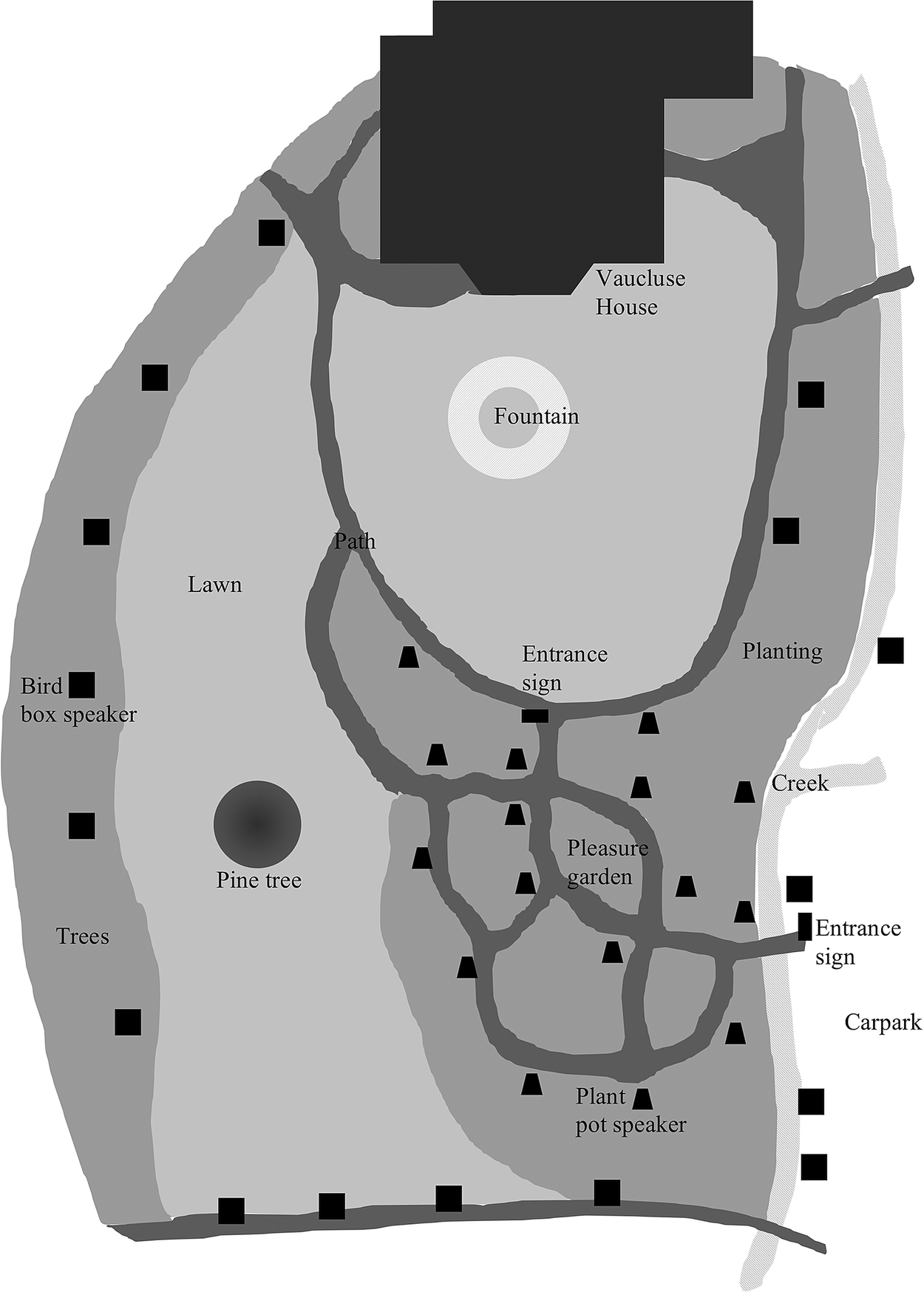
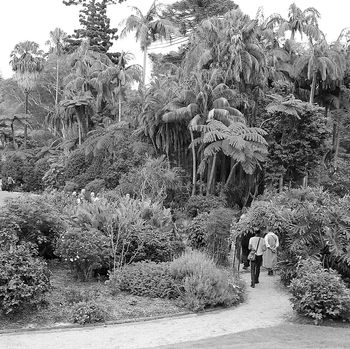
Most people approached the installation from the car park or the bus stop, crossing a bridge over a narrow creek into the central pleasure garden (see Figure 3). Some hurried directly to Vaucluse House, passing through the garden as if nothing unusual was happening. Others wandered, taking photos, touching foliage, chatting, pausing to listen (see Figure 4). In places, the installation simply shifted the tempo of engagement: visitors had to follow the central paths of the pleasure garden, but now might walk more slowly or pause to listen. Elsewhere, the installation changed audience behaviour more substantially, tempting them into areas they might not normally reach. The most intent listeners made several passes through the central garden, sat on the benches for extended periods of silent and solitary listening, then walked up onto the lawn, drawn by the sounds coming from the perimeter fence.
It sort of … carries you almost … around the paths and … makes you ready to sort of move on and walk and it keeps you going […] And then every now and again you might stop and listen to a particular one or you might hear something from further away and go, ‘Oh I’ll go and find that one.’ Yeah. So it’s a lovely concept.
Plan of Vaucluse garden showing speakers, paths and other features. After map prepared by Mick Jessop, with hand annotations for Pleasure Garden by Jim Atkins. © Mick Jessop and Jim Atkins. Reproduced by permission of Mick Jessop and Jim Atkins.

Audience members entering the central pleasure garden. Photograph by the author.

The installation-in-the-garden had its own distinctive sociality, formed through the articulation between cultures of audiencing associated with different musical genres and settings. On the one hand, audiences responded to the installation as an artwork through the disciplined, still, silent and solitary listening associated with Western art music and concert performances.Footnote 45 On the other hand, they responded to it as a setting or experience affording exploration, experimentation, participation and conversation, as with various forms of sound art, installation art and environmental art.Footnote 46 When the central pleasure garden became more crowded, usually in the middle of the day, the etiquette and atmosphere leant towards that of an art gallery: people moved slowly, avoided or overtook each other, formed brief informal queues, conversed quietly. Outside these times, especially in the early evening, people could move more freely – though often this meant more slowly and deliberately – or settle on a bench and listen undisturbed while the light faded. The spacious lawns outside the central garden afforded space for more animated conversation, playful behaviour and a chance to sit, picnic, lie down or observe others. Despite numerous individual differences, these shifts in the tempo and style of audience behaviours, and the patterns of their movement through the space, were remarkably consistent, hinting at emergent, collective practices of audiencing. The installation could divide family or friendship groups, temporarily pulling them in different directions, yet it also provoked conversations between strangers. These shifting socialities produced different kinds of musical experience, registering the layering of, and tensions between and within, different cultures of audiencing:Footnote 47 some people welcomed the presence of other audience members, others described how their contemplation was disturbed by their fellow listeners. Various modes of experience – solitary, sociable, introspective, conversational, disturbed and so on – shifted in and out of focus, signalling different distributions of subjectivity across self, other and crowd, as well as ‘fluid and nested zones of publicness and privacy’.Footnote 48 As a collective, the Pleasure Garden audience was, to paraphrase Martin Stokes, neither unitary nor atomized, but civilly, temporarily and unevenly knotted together.Footnote 49
The varied socialities of Pleasure Garden extended beyond humans to the garden at large, resulting in ‘partial affinities’, ‘interspecies intimacies and subtle propositions’ between organisms.Footnote 50 By changing the pace and scope of movement, the music altered audience engagements with the plants in the garden. People peered into neglected corners of the planting or stood for long periods facing the tall trees on the upper lawn. Some described ‘almost […] stopping at every plant’ or touching and smelling them. One person mentioned hearing ‘the bells, they chime and then it drops away and then you’re just left watching the stillness of the plant, listening to the tail of the bell’. Others, by contrast, found the music shifted their attention to distant parts of the garden. As one put it, ‘you’re more lifted up’ because ‘the sounds are coming more from through the trees’. The installation likewise subtly shifted audiences’ physical, visual and sonic relations with the Vaucluse birdlife, especially larger, vocal birds with distinctive calls, such as laughing kookaburra, Australian magpies and pied currawongs. People not only listened more carefully, they also looked at and ventured into less frequented parts of the garden, encountering birds in different ways. Currawongs, large crow-like birds, were particularly conspicuous, not only for their loud calls, but also because – as tree-dwelling birds, relatively accustomed to humans – they occupied the higher reaches of the garden, flying between trees and navigating branches to look for food, as we looked on from below. Where the plant life of Vaucluse has been actively cultivated, currawongs thrive as an indirect result of human action: birds that were, historically, visitors to the Sydney region have taken advantage of urban habitats and food supplies to become permanent residents, causing declines in smaller bird species.Footnote 51 Vaucluse visitors encountered certain birds and plants (but not others) because of these histories of human–garden–animal interaction.
Within these longer, mutually significant environmental histories, experiences of Pleasure Garden were textured from moment to moment by species’ co-presence, attention and mutual apprehension, through distinct sensoria,Footnote 52 of one another and of a shared environment. Co-listening was, however, far from assured. Despite the potential double meaning in the project’s occasional subtitle, ‘A Listening Garden’, Pleasure Garden was reckoned by artists and audience as a space for human listening, not a garden which itself listened. Accordingly, there was very little speculation about the experiences of other organisms – with one exception: a person who described appreciating the ‘non-humanness’ of animals, insects and birds and the privilege of witnessing ‘a different way of being in the world, I guess; they experience the world differently’. Rather than listening with the garden, Pleasure Garden’s audience members listened in the garden, attentive to other species, their experiences shaped by practices that highlighted ‘the affinities, ruptures, enmeshments, and repulsions among organisms constantly inventing new ways to live with and alongside one another’.Footnote 53 Birds and humans watched and listened to each other, and got in and out of one another’s way; plants afforded multisensory experiences for visitors, with often hidden reciprocal effects for the plants themselves. These encounters were at once relatively conventionalized (sharing much with gardens elsewhere), and necessarily improvisational – with responses to specific details which are hard to capture (and easy to romanticize) in writing: a swerve of a flightline; a moment of surprise; a shared glance; foliage crushed underfoot, carefully avoided or caressed. In such settings, signals usually understood as functional – territorial bird calls, plant scents that attract pollinators – can also go awry. Many of the natural sounds, smells, textures and sights of Vaucluse offered potent opportunities for such (mis)communication between non-humans and humans. (And human practices of, for example, breeding scented plants muddy the water of intentionality, confusing who communicates what to whom.) Nor should we discount the possibility that the installation – in terms of its sounds and infrastructure, and the audience behaviours it engendered – was not also experienced by non-humans as shifts in the material and affective contours of their environment (even if these were of little interest to audience members). Discussing plant–insect signalling in chemical ecology, Hustak and Myers argue, ‘An involutionary reading would require us to begin with the assertion that we don’t yet know what a signal is or what it can do, let alone what constitutes cross-species communication.’Footnote 54 Such uncertainty profoundly unsettles our anthropocentric understanding of cultural experience, even as it generatively enriched audience responses to Pleasure Garden.
Immersion and transience
Walking among and with Pleasure Garden’s audiences heightened my appreciation of the ways in which they were guided by the sonic-spatial features of the installation, by their pre-existing and emergent social relations and by the multispecies, multisensory ecology of the garden itself. When I wanted to interview people, my preferred spot was on a bench underneath a lone pine tree in the middle of the open lawn that overlooked the central garden. I could watch unobtrusively as people moved around, observing how they used the space and weighing up when to go over and ask for a short interview. I was keen to talk to careful listeners, but also tried to catch more fleeting visitors. It was a hard balance to strike: before interviewing someone, I wanted to make sure they had been there long enough to have experienced the installation, but if I were to wait too long, they might leave. Nor did I want to disturb people by following them through the narrow paths of the central garden, presenting them with consent forms and questions, intruding on what was intended to be a contemplative and relaxing experience. Although reassured by Timothy J. Cooley and Gregory F. Barz’s description of fieldwork as ‘chasing the shadows’ of ephemeral musical and social phenomena, and by their assertion that ‘no musical genre, tradition, or related activity is off limits for contemporary ethnomusicologists’,Footnote 55 I knew that my interactions with Pleasure Garden audiences would push these characterizations quite far.
Most visitors would have a one-off encounter, both with me and with the installation. The brevity of these interactions put a host of limitations on the tenets of long-term immersion, trust-building and gradual enculturation so valued in much fieldwork. And although more time and resources might have bought me more days or weeks in the garden, this would have meant more interviewees, but no deeper relationship with any individual. Talking with audience members made it clear, however, that their experiences often had a depth or intensity that belied their brevity. One described being ‘totally immersed in it’, many expressed delight with the installation, some found it ‘magical’ or alluded to rich and distinctive experiences, and others simply stayed and listened intently for some time. So my concerns gave way to the idea that what I will call transient immersion was a key feature of Pleasure Garden, both for listeners and for me as ethnographer. Audience members clearly valued the chance to be absorbed briefly in this unusual artwork. And, given that relatively ephemeral social formations and transient listening practices are characteristic of the audiences for much public art, accepting both the limitations and the possibilities of doing fieldwork in such settings is a necessity in opening up this form of contemporary musical experience to scholarly enquiry. Finally, drawing attention to the limits of ‘immersion’ as ethnography’s guiding methodological principle reveals, as the following sections show, complexities in the production of ethnographic knowledge and in the relationships between researcher and researched.Footnote 56
The city and the garden
On my first day, I decided to introduce myself to the Sydney Festival volunteers patrolling the garden, so that they would understand what I was doing. One turned out to be a market researcher, there – like me – to talk to visitors to the installation. We chatted for a while and I decided to avoid speaking to the same people as her and so avoid imposing too much on their time. We were asking different questions and had different interview styles, but her presence, and my conversations with listeners, added to my methodological anxieties. Although I introduced myself as an academic (and had an identity badge), several audience members assumed or implied that I too was conducting market research, asking if their comments would affect whether the installation happened again next year or offering suggestions as if I would feed these back to the creative team in order to ‘improve’ the installation. This blurring between academic and market research raises important questions,Footnote 57 not only about how to do ethnography among audiences ‘sociologized’ in qualitative methods,Footnote 58 but also about what happens when people expect their experiences to be incorporated within economies of attention and consumption. In prohibiting ‘immersive’ ethnography, such methodological difficulties reveal the cultural logics shaping field interactions. Unsure how to respond, I clarified my agenda and made my interviews even more open and conversational, and I hope more attentive to the diversity of listeners’ experiences – unintentionally echoing Jan and Genevieve’s anti-reductionist stance.
It matters that Pleasure Garden was launched in Sydney, installed not only in a garden, but in an affluent part of a large, global city. Because Pleasure Garden was free to attend, its location in the exclusive Vaucluse suburb arguably shaped experiences of the installation – often bringing a sense of a touristic excursion to an unusual place – rather than strongly limiting who was able to attend (again, in the absence of demographic information, this is hard to assess, but attendance clearly extended well beyond local, affluent Vaucluse residents). Because cities are key sites for public sound art owing to their greater density of potential visitors, high-profile arts scenes, institutional support, infrastructure and so on, the Sydney location also situated Pleasure Garden within a particular cultural economy. In addition, the use of market research to evaluate Pleasure Garden points to its participation in what Morgan James Luker, writing about Argentinian tango, calls ‘the age of expediency – where music and the arts are called upon and often compelled to address social, political and economic problems that were previously located, by theorists and practitioners alike, outside the cultural domain’.Footnote 59 As one of many events in the Sydney Festival, Pleasure Garden played a small part in the leveraging of the city’s art scene for economic ends.Footnote 60 Because Pleasure Garden was free (unlike other events in the festival), the attendant economic benefits were of second order, most obviously through some audience members’ paid entry to Vaucluse House and cafe, and their use of public transport. Nonetheless, cultural expediency and the marketization of musical experience stand in tension with the quasi-autonomy of Pleasure Garden, a topic to which I return below. George Yúdice’s assertion that ‘culture is no longer experienced, valued, or understood as transcendent’ pushes the point too far.Footnote 61 Rather, multiple – sometimes competing, sometimes synergistic – frameworks condition our experiences. Pleasure Garden audiences recognized the potential expediency of their comments (via implications for improvement or recommissioning), while also evaluating the installation in aesthetic or subjective terms.
The location of Pleasure Garden in Sydney also registered more directly in audience members’ reflections. Many contrasted their experiences in the garden with the hectic buzz of the city experienced minutes or hours earlier.
You get on a bus in traffic, you get off here and walk in, you’re hyper […] I’m a real tree-hugger basically, a nature lover […] It’s the effect it has on me, … seeing nature, being away from the built environment […] I feel better and that’s all it is […] just [a] feeling of relief, because the city stress […] there’s an intensity to it. That intensity is gone here, and the contrast is welcome.
Sometimes I think the peacefulness of a garden isn’t quite enough or it can be a hard thing to settle into if you’ve come out of something very busy, and so having the music or the different noises to listen to, it just … gives you one extra thing to do to sort of settle you down.
I think [it’s] yeah just peaceful and I’m just trying to let it wash through me […] It’s been a very stressful time at work … so this’d be great, if you could just transport here, teleport here, this would be nice … But yeah it’s nice and it’s not too busy.
Tourism is killing a lot of contemplation and reflection [… in] public space […] You can still reflect and contemplate here without being inundated with hordes.
Such contemplative framings of Pleasure Garden offer a provocation to understand contemplation through its relationship with distracted capitalist perception.Footnote 62 Audiences welcomed the peacefulness of Pleasure Garden in part because it offered respite from a particular imagined version of the city, typical for Michael Taussig of ‘the shock-rhythm of modernity’, provoking a ‘flitting and barely conscious peripheral-vision perception’.Footnote 63 Thus, their experiences of immersion were predicated on the apparently ‘non-immersive’ nature of much everyday experience. Although this particular dimension of audience experiences was not anticipated by the Pleasure Garden team, the city–garden juxtaposition does fit with Genevieve’s broader idea of the installation as an aesthetic ‘alternative’ to modernity. The choice of Vaucluse House, a once-rural historic estate surrounded by scenic grounds and situated in an exclusive suburb, was important in staging this relationship. And as audience comments show, visiting Pleasure Garden was not just about escaping from the city into the garden, but also about other related movements: from work to leisure, from everyday to heightened experience, and from the tourist horde to solitary or sociable introspection. No doubt my methodological anxieties, and the confusion over whether I was conducting market research, speak to these shifts: I felt and looked like an intruder, a market researcher from the city who had infiltrated the garden. The contrast between the city and the garden also relied on a sense of their divergent claims on human agency. The city is often imagined as an unpredictable and out-of-control place, continually redirecting our perceptions through advertising, channelling our movements with crowd and traffic control. Audience members chose the tranquillity of the garden in part because they had no choice but to experience the fragmentary intensity of the city.
The work of art in the age of interactivityFootnote 64
Pleasure Garden’s interactivity represents a particularly ambivalent element in the interplay between contemplation and distraction. Conceived by Genevieve in terms of ‘agency’ and ‘discovery’, the interactivity was intended to crystallize or augment audience members’ contemplative engagements with the installation by responding to their presence (cameras linked to motion-sensor software triggered pre-recorded tracks in response to their movement).Footnote 65 Yet, by adapting urban surveillance technology to the garden setting, the interactive system borrowed from the city and redeployed its techno-social resources with surprising results. Although no audience members expressed any concern to me about these ‘surveillance cameras’ (as I overheard one Sydney Festival volunteer describe them to some interested audience members), their presence nonetheless helped to reinstall a culture of distraction in Pleasure Garden (see Figure 5).
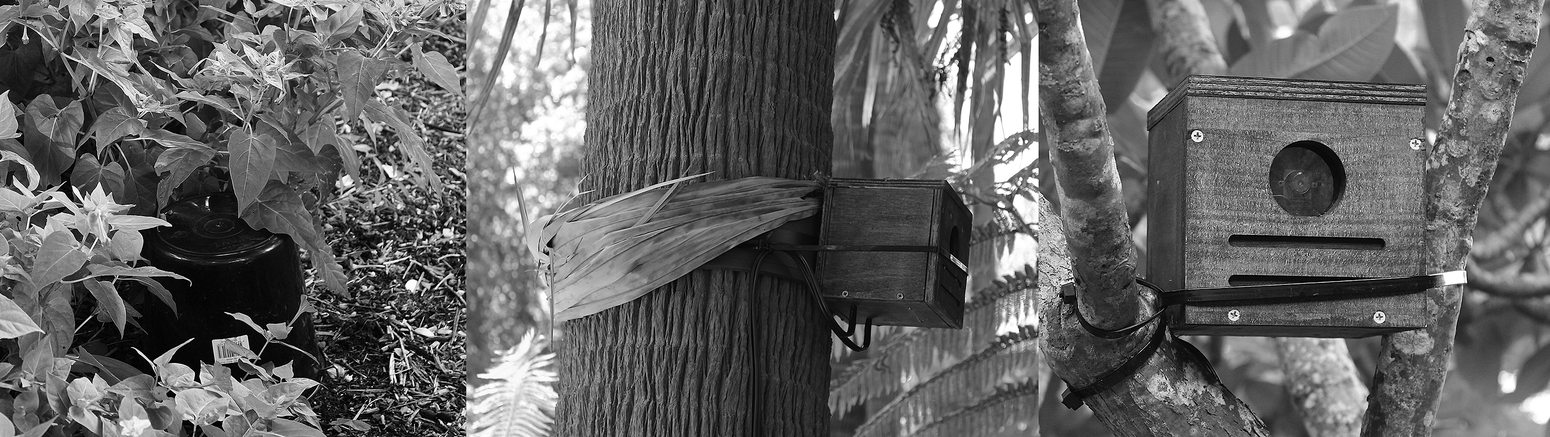
Plant-pot speaker, bird-box speaker and bird-box camera. Photographs by the author.

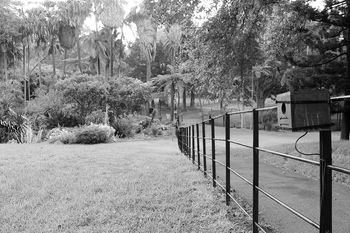
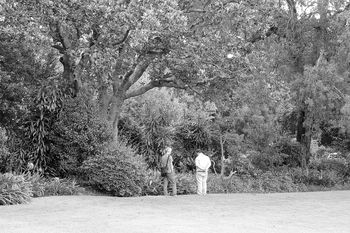
During interviews, many people asked me how the installation, especially the interactive system, worked. I was happy to explain, yet aware that too much detail would undo the sense of discovery that Genevieve intended. So I tried to direct people’s attention in ways that invited exploration, rather than making it redundant. My ethnographer/tour-guide role signalled another strange methodological position: not only did I know quite a lot about the installation where the audience often knew little, but also my familiarity with Pleasure Garden’s creators and with the experiences of previous audience members made me a relative insider to wider cultural practices surrounding this artwork’s creation and reception. This reversal of the standard ‘immersive’ ethnographic model (researcher learns about a cultural setting from insiders) nonetheless meant that audience members were, implicitly, conveying a great deal about the culture of audiencing surrounding the installation: widespread lack of expertise; the pleasures of transient immersion and learning about an unusual artwork; and fascination with interactivity. I had already seen people searching for and looking at cameras and speakers (hidden in bird boxes and upturned plant pots; see again Figure 5)Footnote 66 and soon noticed how the speakers on the perimeter fence and the larger trees (among the most visible and acoustically distinct) attracted the most attentive listeners, pulling them in to stand and listen close up (see Figures 6 and 7).
It makes me want to follow the sound, you know, like, ‘Where is it coming from?’ OK, it’s being triggered by something, not necessarily to get to the actual speaker, but just to follow it through the garden.
Actually, one thing that’s really interesting is it’s made me walk very slowly through the gardens, very slowly … Because I’ve known that there are things there I might be interacting with, I’ve almost been stopping at every plant.
Bird-box speakers along the perimeter fence. Photograph by the author.

Audience members listening at the treeline. Photograph by the author.

Others were unsure how the interactivity worked. Some people waved their hands in front of cameras and speakers, trying to test the interactivity. One person searched for pressure sensors by pressing down with their feet on the lawn directly in front of a speaker. This despite the fact that the Pleasure Garden team had gone to considerable lengths to limit the visual impact of the installation by burying cables, choosing naturalistic bird boxes and upturned plant pots as housing for speakers and cameras, and covering plastic and foam fixings with palm fronds.Footnote 67 This attempted naturalization of the infrastructure in fact had multiple effects: some audience members were largely unaware of the hidden technology, others found its ambiguity distracting or intriguing. Some described a tension or progression between an intellectual or ‘left-brain’ impulse to ‘figure out’ the technological system versus an emotional or experiential mode that was more immersive. Such comments suggest moments of fragmentary subjectivity, patterns of attention that oscillated between contemplation and distraction, or between artwork and technological system.
Audience members’ widespread interest in, uncertainty over and occasional apparent physical compulsion to test the interactivity was all the more striking because much of what they experienced and reported was imagined, not part of the interactive system at all. This strange, productively miscommunicative capacity of Pleasure Garden gathered impetus from its sonic features and discursive mediation, wider expectations about interactivity in contemporary culture and local conceptions of the relationship between this artwork and its audiences. Because the sound design of the installation included many mobile and varied elements, listeners could easily feel that sounds were moving and changing in response to their presence: again Pleasure Garden’s ‘not pinpointable’ aesthetic provoked uncertain and imaginative engagements. In the less active pieces, the substantial silences allowed listeners to imagine that a sound had started or stopped because of them. Of the 14 discrete pieces in Pleasure Garden’s hour-long cycle, only the four tracks comprising recordings of Genevieve’s performances of van Eyck recorder solos (roughly a quarter of the whole cycle) incorporated any interactivity, although visitors were unaware of any such structure. Of the sounds triggered by the interactive system as accompaniment to the van Eyck solos, some – such as the buzzing of cicadas or the flapping of birds’ wings – were relatively subtle and could easily be taken to be part of the garden soundscape (although others – such as bell sounds – were relatively loud and clearly pre-recorded). The interactivity was triggered by movement only in the central area of the garden, not on the lawns, so if the garden was less busy, interactive sounds were relatively intermittent. This relative subtlety and scarcity of interactive sounds combined with the suggestive aesthetic of the wider sound design to encourage experiences of imagined interactivity.
Interactivity also featured prominently in the discourse surrounding the installation, including in reviews and newspaper coverage, on the signs at the entrance to the garden and in the Sydney Festival brochure.Footnote 68 This no doubt primed audience members’ expectations:
Probably just knowing at some level that [it was interactive], and … maybe previous experience of sound installation pieces […] made me attend very specifically to the relationship between movement and sound.
But listeners and the installation alike also channelled what Darin Barney and others call the ‘participatory condition’, in which the ‘promise and expectation’ of being involved in the co-constitution of social, political and cultural life – including art – has become ‘both environmental […] and normative’ in the contemporary West.Footnote 69 As one mode of participatory culture, digitally mediated interactivity characterizes not only much sound art and public art, but also everyday technologies often associated with urban life, such as automated doors and hands-free devices, the user interfaces associated with smartphones and computers, as well as retail, public information and transport systems, to name only a few. Arguably, this wider participatory culture, combined with the local discourse of interactivity, the semi-naturalized visible physical infrastructure of the installation and the non-interactive elements in its sound design, had a more powerful role in rendering audience experiences ‘interactive’ than the interactivity technically at work in the Pleasure Garden system.
Scholarship on participation and participatory art is powerfully ambivalent, as a few examples show. Barney and his colleagues describe the ‘deep political ambiguity’ of participation, noting that it can be allied with democracy and neo-liberalism alike, and deployed in divergent ways, from surveillance systems and social media to open-source software development and politicized art practices.Footnote 70 Adam Alston considers the sense of risk, agency and responsibility afforded to audiences for immersive theatre as demanding a form of ‘entrepreneurial participation’ indebted to neo-liberalism.Footnote 71 Susie Scott et al. describe audience shyness and resistance around interactive exhibitions that ‘presume a level of technological and performative competence’.Footnote 72 Similarly, Kirsty Sedgman discusses how some audience members can feel excluded from immersive theatre if they lack certain kinds of knowledge, cultural capital or motility.Footnote 73 Born recognizes the preoccupation with ‘participation, interactivity, collaboration or community’ among sound artists and others, and highlights the attendant potential for forging novel experiences and social relations, while also arguing that entrenched social differences and individuated listening practices (most obviously via headphones) can nonetheless produce participation without affiliation.Footnote 74 Where the debate is so fraught, singular interpretations become untenable.
| Imagine a listener entranced by music that seems to come from nowhere, magically alive to their presence or animated by unknown forces. | Imagine a listener distracted and confused by a technological system, which they’re aware of, yet can’t figure out. | Imagine a listener as a citizen-in-training, experiencing motion capture cameras aesthetically, learning to be tracked. |
As soon as I sat down the less melodic kind of loop that was playing kind of stopped and this much more melodic thing started, so that was really beautiful and mesmerizing.
And what is that interactivity? I know that there is supposedly some interaction and I tried to make it do something, but I couldn’t.
I’d rather ignore [the interactivity] and sort of see it as […] a sound that’s … kind of created from out of nowhere […] Sort of makes it a bit more fun to imagine that there’s just little creatures playing in the trees, you know, playing a panpipe or something.
| Imagine a listener empowered by the possibilities of playing an intangible instrument with their body. Everyone can join in. Agency is assured, the experience unique for every visitor. | Imagine a listener who must take the initiative in order to get the most out of an interactive artwork centred, narcissistically, on their individual experience. | Imagine a listener fatigued with interactivity, desiring escape and spectatorship rather than the obligation to join in. |
I’m the type of person that likes to figure things out […] When you have to figure it out you actually engage with it more because you have to work a little bit to get it, versus its just passively being given to you.
I thought if there weren’t other people around then I’d have to walk around and make it do its thing, but if there are other people walking then I can just listen.
The analogue ambivalence over participation within both academic thought and audience responses is surely suggestive. First, it highlights the necessity of crediting interpretative and experiential multiplicity, rather than singularity. From talking to Pleasure Garden’s audiences, it is clear that the interactivity had multiple effects: it engaged, distracted, afforded agency and interpellated listeners as entrepreneurial and under surveillance. These effects were extremely uneven and the ephemeral nature of my fieldwork made it hard to explore their relationship with individual biographies and dispositions. While there is a substantial literature on audience experiences of participatory art, especially theatre,Footnote 75 further empirical work is needed to ground scholarly theorizations of technologically mediated interactivity on the complexities of lived experience. Secondly, this joint ambivalence points to uncertainty about the nature and limits of participation. Just as audience members imagined much of the interactivity, so, for Genevieve, it was important that
somehow people feel like they’re walking into something that’s live and that’s breathing around them […] The fact that in pure technical terms that element [the interactivity] is small doesn’t at all to me matter. What matters is the permission that that gives people and the sense that I think it really elicits … a different experience and a different way of listening.
By framing interactivity as imaginative, rather than technological, Genevieve considers all listening, regardless of its technological mediation, as participatory, unsettling conventional hierarchies between artist, artwork and audience: ‘I always have a really strong sense as a player that listeners have much more power and agency than they ever realize.’ Jan, by contrast, had reservations about the interactivity, and was concerned that it might distract audience members from the carefully crafted textures of the compositions (an attitude in keeping with his quasi-autonomist stance) and seem tokenistic – as he put it, a way of saying, ‘Look, we are modern.’Footnote 76 The relatively limited interactivity in the finished installation partially assuaged these worries, but nonetheless they find some resonance in audience members’ distracted responses to the interactivity. Finally, whereas Genevieve regarded the interactivity in terms of agency, audience members’ comments and practical tests of the interactivity point also to a concern with their own intelligibility: they wanted not simply to act upon the installation, but also to be recognized by it. To experience Pleasure Garden was to be (at least imaginatively) detected by the interactive system, thus changing how it sounded, and so entering into an ongoing chain of registration by and re-experiencing of the installation. Whether such sensing constitutes a kind of machinic ‘experience’ is an open question, but the co-receptivity between human audience and technological infrastructure was a powerful factor in experiences of Pleasure Garden. Participation became a more-than-human undertaking, unsettling expectations of who or what could join in or be recognized. Where audience engagements with plants and animals were ambiguously positioned at the boundary of their experience of the installation, their co-receptive relationship with the technological system (at least for those aware of the interactivity) was more decisive, involving both in ‘a reciprocal capture from which neither […] can be disentangled’.Footnote 77 Paradoxically, then, although the installation’s technical interactivity was – for Pleasure Garden’s creators and listeners alike – oddly redundant and at worst distracting, a wider sense of reception as both participatory and more-than-human prompted forms of audiencing that could not help but be inventive.
Discrepant listenings
Through these inventive engagements, the meanings and experiences associated with Pleasure Garden proliferated beyond those imagined by its creators. Two types of reaction deserve further discussion here: negative responses to the installation and responses that made reference to Aboriginal music and Vaucluse’s colonial history. We might see these as discrepant listenings, at variance with the creators’ hopes and intentions. Negative experiences were not, of course, desired by the creative team, and readings in terms of Aboriginality were not actively cultivated (although neither were they discouraged). As such, they raise further important questions of method and meaning that reach beyond this particular case.
Negative reactions to Pleasure Garden were a sharp, if rare, contrast with the prevailing positive view. I interviewed only three people, and spoke to three others off the record, who did not enjoy the installation.
I find the music irritating and it works against … the peaceful atmosphere […] Now I know you’ll say that there are plenty of – in nature – irritating sounds, like […] cicadas and magpies […] but I can cope with them. But then to have an added unnatural noise I find quite irritating and I find it disturbs that […] tranquil feeling I had [from the garden].
We’ve come here for a tranquil experience and the garden gives us that [… but] I find the noises disturbing, they interfere with that feeling, they’re a bit too piercing for me and the pitch is too high for my hearing. I prefer a more mellow sound, and I also think there’s a lack of tune to it. At first I thought it was an attempt to mimic birds or Aboriginal, um, noises and then I found that it didn’t do any of those. It just – to me they’re just noises, rather than musical tunes. I would have preferred closer to bird sounds, in a garden where there’s a lot of natural beauty here.
Typically, these people had come only for the garden (not the installation) and were repeat visitors, often elderly. Although uncommon, these negative views highlight several further methodological issues. Audience members who did not like the installation were less willing to participate in the research,Footnote 78 a few commenting that they would not be suitable because they did not especially enjoy the experience. Some measured themselves against an imagined normative or expert listener:Footnote 79 one person commented that they should not participate owing to a hearing problem; several others said they felt unable to comment because they had no musical training. It was only by encouraging people to express their feelings freely, partly by explaining this problem of self-selection, that I persuaded a few people to register negative opinions. Methodology aside, it is striking to note that the same music was experienced in such divergent ways by different listeners: it enhanced the tranquillity for some and disturbed it for others; some heard many real and imitated bird sounds in the installation, while others lamented the lack of them.
The disturbed listener quoted above, who thought ‘at first’ that Pleasure Garden might ‘mimic […] Aboriginal, um, noises’ was one of several with this view. Another person commented, ‘To me, at first I got the idea it was like an Aboriginal “Aaah”,’ shifting from speech into a high-pitched sung note. These crude characterizations – one turning to the category of ‘noise’, the other attempting to imitate Aboriginal song – give voice to racialized understandings of musical alterity. But their shared hesitancy and use of the qualification ‘at first’ also suggest an uncertainty or second-guessing of their own interpretation, as if half-aware of their lack of cultural understanding. Others were more articulate. One enjoyed the installation, but was prompted to reflect on the lack of mention of Aboriginal history in Vaucluse House itself.Footnote 80 Another listener thought, ‘At one point it almost sounded like gamelan […] Indonesian music, and I know that there’s a kind of colonial tie to … the Netherlands, […] maybe I was, um, projecting, but it sounded that way.’ This hesitancy over ‘projecting’ suggests that Genevieve’s desire to give audiences ‘permission’ to experience the installation in varied ways matches a genuine uncertainty among some listeners about the kinds of meaning that could be drawn from Pleasure Garden. Footnote 81 Much more self-assured in their interpretation, another listener enthusiastically described the installation as a scathing critique of colonialism: they saw the use of van Eyck as a reference to colonial history, seeing ‘Vaucluse House as a sort of centre of imperialism’ and the installation as ‘mapping the history’ of ‘Western aggression’. They contrasted this violence with the luxury of the garden setting, commenting that ‘at the … richest moment in humanity’s history and in one of the richest cities, with the gluttonous appetite of the Sydney Festival audience’ it was right that Pleasure Garden was a free event; and they praised the subtlety of the installation in contrast to the more bombastic character of some Sydney events. Such responses were all the more striking because of their scarcity. Aboriginal culture has an ambiguous status in Pleasure Garden: it was not a prominent concern for the creative team, although Genevieve cares strongly about issues of Aboriginal rights and they have an important place in some of her other musical collaborations.Footnote 82 Nonetheless, these audience responses demonstrate music’s ‘hyper-connotative […] propensities’Footnote 83 and the importance of distinctive national concerns about land and culture that pervade much Australian sound art,Footnote 84 regardless of artists’ intentions.
Issues of Aboriginal representation came to the fore in my conversation with one woman visiting Pleasure Garden with her family, the only audience member I interviewed who identified herself as Australian Aboriginal.Footnote 85 Asked about her experience of the installation, she replied,
You know what I would say? To me it would be appropriate if you had something about … the didgeridoo, and people talking in language, Aboriginal people talking in language […] Not to go political about the traditional owners and all the rest of it, but it’s conducive to country to do this.
She also found the installation ‘beautiful’, commenting: ‘I suppose you could play this in … any place in the bush and it would be conducive … to make you think and listen.’ On one level, these comments reaffirm that, unsurprisingly, even a quasi-autonomist project can provoke sociopolitical interpretation. But I’m intrigued by that phrase ‘Not to go political’. It can be taken many ways: as a softening qualifier when the speaker intends precisely to speak of politics; as a suggestion that political language is tainted or ineffective when it comes to talking about ‘traditional ownership’ in contemporary Australia; as an acknowledgement of the ways in which indigenous viewpoints (especially criticism and protest) have historically been stigmatized and silenced by colonial institutions, including the academy; or as an affirmation that this issue transcends mere politics.Footnote 86 However we take it, the gesture of simultaneously invoking politics and forestalling its operation shares something with Jan’s comments (discussed above) about politics as ‘limiting’. The two mirror each other, not only in their shared concern for the rights of marginalized groups (Aboriginal people and migrants), but also in their nesting of the political inside the autonomous, or vice versa. Jan’s political comment (about migrants) was subsumed by his statement about taking the music on its own terms. This woman’s comment about autonomy (‘Not to go political’) was contained in a statement about Aboriginal representation. By highlighting this ambiguity, my intention is not to blunt the critical edge of her comment, but to note how it situates itself alongside rather than within politics, perhaps resisting the terms of, or at least dramatizing its own imbrication in, wider debate.Footnote 87 Certainly, Pleasure Garden is caught up in a culture of expediency (concerning for example the use of culture in Aboriginal representation or the role of the Sydney Festival in bolstering the city’s economy), but like the quasi-autonomist stance of Pleasure Garden’s creators, this woman’s response perhaps registers a reluctance regarding the instrumentalization of culture for political or other ends.
Drawing on Lauren Berlant’s notion of the ‘juxtapolitical’ (used to describe forms of sentimentality, proximate to the political, that aspire towards justice, yet refuse or seek relief from politics as usual), Byron Dueck considers whether such reluctance might also resist the ongoing colonial ‘determination to draw Aboriginal people into deeper and deeper engagement with the nation-state’.Footnote 88 It perhaps also enacts a form of self-policing, which internalizes the actual policing of marginalized people for whom (to paraphrase Sara Ahmed) to describe a problem is to become a problem.Footnote 89 However it is viewed, the desire ‘not to go political’ certainly makes sense given the troubled, complex relationship between Aboriginal culture and Australian national politics. As well as gesturing to a more-than-political debate, the woman’s suggestion that the inclusion of Aboriginal music and language might be ‘conducive to country’ also invokes a more-than-human frame of reference: at stake here is not simply the representation of Aboriginal people, but also the cosmological implications of the word ‘country’ within Australian Aboriginal English, which Deborah Bird Rose glosses as ‘the matrix of all the living beings and all the life-systems that interactively share that time and place’.Footnote 90 The gesture is thoroughly ambivalent, however: as well as praising the beauty of the installation, she mentioned the didgeridoo – a non-local musical instrument that has become an iconic, if contested, symbol of Aboriginal identity – and generalized ‘Aboriginal language’ as ‘appropriate’ additions to the installation, recruiting them as expedient symbols in a broad project of Aboriginal representation. Although caught up in the interaction at the time, in retrospect I’m struck by the way this woman wove land and politics through our entire conversation and by her gentle insistence on turning the interview back onto me, asking about my ‘background’ and what I made of her comments. We touched on her involvement in Aboriginal affairs, the palm trees and magpies in the Vaucluse garden, and the ironies, given the colonial setting, of my English background (shared, she laughingly pointed out, with the former prime minister Tony Abbott). Pleasure Garden became, by implication as much as argument, part of a much larger cultural and political canvas. So, in highlighting the strange status of politics within such moments of reception and creation, my intention is not to advocate autonomist thinking or depoliticized analysis. Rather, I want to highlight the ongoing cultural constitution of, and ambivalence over, what counts as politics and whether politics is desirable. Instead of following the truism that ‘everything is political’,Footnote 91 we might trace varied and specific patterns of the political – wrapped inside and around the apolitical and autonomous, differentially valued and styled – within musical experience.
Involving experiences: conditions and uncertainties
The paths I have traced through the reception of Pleasure Garden have been diverse, sometimes winding, sometimes straightforward. They attest, I have suggested, to a deep ambivalence within musical experience: that it is both powerfully conditioned and generatively uncertain. Pleasure Garden’s creators responded to this ambivalence, even as the reception of the installation was patterned by it. They combined a recuperation of contemplative, quasi-autonomous musical experience with an ethos of ‘leaving space’, which aimed to cultivate diversity and accommodate responses that rubbed against the grain. As such, it was a fraught project: the idea of offering a contemplative refuge at once separated it off from and responded to distracted modernity, its constitutive outside, and – despite the attempted separation – distraction reasserted itself. In many ways, artists and audience shared a sense of the installation as promoting contemplation, attentiveness and relaxation. In this they offer a subtle provocation, perhaps even a gentle politics: where cultural forms value stillness rather than mobilization, quietism rather than protest, we might see them not simply as disengaged, but as reparative ethical projects. They will still demand critique, not least around the issue of who is able to participate, contemplate and take pleasure, but at a time when politicization feels increasingly urgent, they cultivate alternative sensibilities that do something other than reproduce late capitalism’s logic of intensification with a similarly intensified resistance.
Amid this contemplative project, the installation also took on meanings and prompted experiences that were at odds with each other, unexpected, fleeting, and that fell out of circulation. The reception of Pleasure Garden was strongly conditioned by specific cultures of audiencing, especially those associated with Western art music and sound art, as well as by wider forces shaping everyday experience within late capitalism. Yet the complexity of these cultures, their intra-actions and interactions, generated uncertainty and plurality. Just as it provoked both contemplation and distraction, so the reception of Pleasure Garden was animated by combinations, tensions or oscillations between immersion and transience; individual subjectivity and collective sociability; meaning and autonomy; creation and reception; agency and intelligibility. These tensions were felt across the trajectory of the installation’s reception, from its creators’ anticipations of audience responses, through the work’s undecidable aesthetic, to the ambivalent transformations of subjectivity it engendered. It afforded powerful somatic escape from hectic modernity. It brought uncertainties, especially regarding bird sounds and the interactivity, which were both fascinating and unsettling. It dispersed subjectivity across wider ecologies – with other audience members, sounds, plants and animals, the technological system – in ways that were differentially valued or unwelcome, chosen or compulsive. All these effects, and more, resulted from collaborative acts of co-reception involving audiences, artists, researchers and the installation-in-the-garden.
Coda: times of co-reception
| Early morning, nobody’s around: imagine a garden, alive with plants, birds, and music, singing to itself, doing its own thing. | Weeks later: imagine the artist returning to the garden to experience the experience they made for others, with those others. | Months later: imagine an audience member returning, remembering the installation, hearing only the garden. | Years later: imagine the ethnographer writing, others reading, all imagining a garden, alive with plants, birds, people and music. |
Around ten days after the launch of Pleasure Garden, Genevieve returned to Vaucluse, as she put it, ‘as a visitor’. She went at different times of day, lay on the grass, listened and watched others experiencing the installation. She enjoyed, she said, going back without a sense of responsibility, because the installation was ‘doing its own thing’. Around two years later, as I exchanged drafts of my writing with Jan and Genevieve, Pleasure Garden lived on in various ways. There is a project CD and website, Genevieve has performed a live concert version, and the installation has travelled to other locations. Yet the creative team has also moved on and my writing is a strange reminder of a now old project. Many of Pleasure Garden’s Vaucluse audience members would, it seems likely, remember their visit; few would remember their conversation with me. The technological infrastructure is periodically dismantled and remade for new locations; the Vaucluse garden moves through the seasons, regrown and remade. This contrast between the project’s interpretative afterlife in my writing and its uncertain long-term significance for others present at its reception revives questions about the limits and character of musical experience that have pervaded this article.
Hustak and Myers argue that neo-Darwinian accounts of evolution ‘overdetermine the temporalities that are deemed relevant to the study of life’, overlooking ‘particular bodies and […] local and ephemeral differences’.Footnote 92 They aim, instead, to ‘track […] the very momentum through which organisms reach toward one another and involve themselves in one another’s lives’.Footnote 93 Transposing these ideas to the theorization of the temporality of musical cultures, we might ask how to develop accounts of musical experience that recognize broad historical forms of audiencing and co-reception, while simultaneously crediting the distinctive characteristics of particular scenes of musical experience. More than this, we might ask how the two relate, tracing how ephemeral yet involving musical experiences feed into and out of the emergence of new, historically significant forms of musical reception. Does the experience of Pleasure Garden live on, for example, in fractionally shifted or consolidated patterns of attention, tiny material changes to sites and bodies, small attenuations or extensions of agency? Might such small differences cumulatively matter across longer historical spans or do they vanish under the weight of more powerful forces? As Pleasure Garden shows, artists and audiences are already navigating such historical questions on their own terms: using and making music to seek ‘time out’ from modernity and recuperate older forms of musical experience; improvising new reception practices as music enters new spaces (or returns to old spaces, as with the Vaucluse garden) and takes on new forms of technological mediation. To engage these issues within music studies would be to recognize how conditioned, uncertain and fertile musical experience is, for all of us.